Screening Room: Wakanda Forever, Spirited, My Father’s Dragon & More
by Hope Madden
Nyla Innuksuk’s sci-fi horror Slash/Back opens with a likable, snow-suited scientist gathering permafrost samples in a breathtaking Northern Canadian snowscape.
Researchers on the Arctic Circle don’t have a great track record for surviving horror movies. Don’t you love the way blood pops on snow? The tentacled menace that cuts the scientist’s research short is soon to terrorize a remote fishing village called Pangnitung, or as Maika (Tasiana Shirley) and her buddies call it, Pang.
Innuksuk has a lot of fun reconsidering John Carpenter’s The Thing – the tale of an invasive species and the terrifying havoc it can wreak – from the perspective of four indigenous teens. And in case the point is lost on you, Maika has a badass jacket to wear when killing invasive species that may help to clarify things.
None of the performances suggest a superstar in the making, although Nalajoss Ellsworth impresses as instigator, malcontent and comic relief Uki. Still, the buddies – who include Chelsea Prusky as Lee Lee and Alexis Wolfe as Jesse – share a rapport that feels honest and relatable. Innuksuk mines this to enrich the fantasy elements with realism.
The filmmaker’s greatest collaborator is cinematographer Guy Godfree (Maudie, Let Him Go). The two contrast the ramshackle buildings of Pang with the glorious natural landscape around it. The effect not only conveys what could be lost to these bloodthirsty outsiders, but what was lost the last time.
Creature design is sometimes inspired, sometimes a little weak, but Innuksuk embraces these limitations. Production value is high, even when the images and performances on the screen seem a bit amateurish. Somehow the two fit together in this world at the edge of the world, where that adolescent urge to pretend to be someone you’re not feels like a real betrayal and those seal hunting trips you took with your dad finally pay off.

by Hope Madden
Filmmaker Nina Menkes tries to distill the effect of a century of cinema’s male gaze in her documentary Brainwashed: Sex-Camera-Power. Her focus is the way the language of film – particularly shot design, lighting and sound – subconsciously, insidiously inform how we see not just the film we’re watching, but everything we see everywhere.
Menkes’s doc is essentially a Ted Talk, padded here and there with talking head footage from academics, filmmakers and actors. Their conclusion? Filmmakers can’t fall back on any of the existing language of cinema because this language was developed by men for men, with men as the subject (one who acts) and women as the object (one who is acted upon) of their interest. It’s a language of power, and is used to disempower not only women, but any person or population meant to be seen as subject to the white, heterosexual patriarchy.
Intriguingly, Menkes chooses as examples mainly films universally considered masterpieces – Raging Bull, The Phantom Thread, The Hurt Locker, Do the Right Thing. Her aim is not to diminish each film on its own, but to point out that cinematic techniques that objectify women are so ingrained in filmmaking that even female filmmakers invoke them without thinking.
Menkes’s expert commentary includes Laura Mulvey, who coined the term “male gaze” in her 1973 essay “Visual Pleasure and Narrative Cinema.” The incomparable Julie Dash (Daughters of the Dust) quotes Audre Lourde to explain why even Patty Jenkins and Kathryn Bigelow fall prey to the same disempowering cinematic tendencies in their films. “The master’s tools will never dismantle the master’s house.”
And when women do make films, in all likelihood, we do not see them. Director Eliza Hittman (Never Rarely Sometimes Always, It Felt Like Love) points to one of the many reasons we are so inundated by films awash in objectifying visuals. Men also choose which films are distributed.
The film clips she chooses are often spot on, sometimes head-scratchers. (I would argue that one Phantom Thread sequence is, in fact, an example of Paul Thomas Anderson intentionally subverting a common shot sequence to give the female power.) But more troubling is an over-reliance on her own footage.
Menkes’s brief venture into the lawsuits facing Hollywood studios is too brief. So, too, are sections about the connection between cinema’s treatment of women and Hollywood’s hiring practices, as well as global rape culture.
The arguments she raises are necessary, though. It’s important for women to see how the films we love betray us in large ways and small, and perhaps even more important for all of us to see that this is a structured, intentional device that we should notice and change.
by Hope Madden
Film right now is littered with “geezer teasers” – lowish budget action flicks with inflated cameos from aging actors who were once the world’s biggest box office draws. Bruce Willis and John Travolta have one right now. Mel Gibson has one every other week.
Wouldn’t it be lovely to see a film that casts veteran actors in challenging roles that respect the actor, their age, and the audience? Yes, it would. The proof is called Kate & Sam.
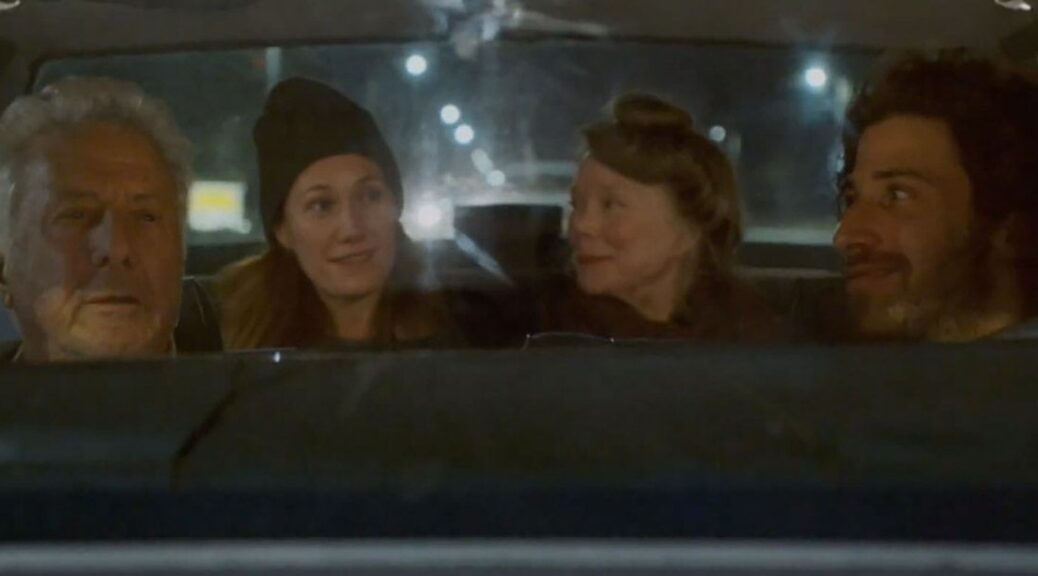
Dustin Hoffman and Sissy Spacek co-star in the indie dramedy about resilience, grief and family. Hoffman’s Bill, a boisterous widowed veteran, lives modestly with his good-natured son, Sam (Jake Hoffman, coincidentally Dustin Hoffman’s actual son).
Father and son fall, almost simultaneously, for Spacek’s Tina and her daughter, Kate (Schuyler Fisk, coincidentally Spacek’s daughter – not that you could miss it with that pointed little nose).
As much as the family ties may seem like a gimmick, the truth is that they bring unmistakable depth and rapport to the pairings. Writer/director Darren Le Gallo mines this repeatedly in large and small ways to create a believable, rich environment for pathos and love. Even small details breathe with authenticity touched lightly by nostalgia. You can imagine Bill’s recliner and afghan perhaps belonging to Le Gallo’s own father, while the stash of family photos clearly, sweetly come from the Hoffmans.
Le Gallo never condescends, mercifully. His small town is possibly hipper than most, but the way the film expresses a healthy respect for vintage materials is impressive.
Spacek is the adorable, natural presence she’s always been in a film that looks without mockery but with humor at the toll life takes on us all. She and Hoffman are, as expected, excellent. But they never outshine their kids.
Fisk’s elegant, frustrated Kate is a solid anchor for the film’s drama, but Jake Hoffman is its heartbeat. With him in the lead, Le Gallo is able to make a lot of subtle points about fathers and sons, masculinity and acceptance. Most of all, the film balances loss and resilience beautifully.
Le Gallo’s first feature delivers grace and goodwill in ways that are genuinely uncommon. It doesn’t tell a big story, but the story it tells resonates. Yes, he lucked into a dream cast, but they may have been luckier still to have him.

by Rachel Willis
Based on the book by Lizzy Goodman, Meet Me in the Bathroom finds documentarians Dylan Southern and Will Lovelace exploring the New York City rock scene of the early 2000s.
Opening in 1999, the film treats us to a little history of the popular music scene of the time. Artists like The Offspring, Blink 182 and Fred Durst of Limp Bizkit dominated the radio and airwaves (mostly courtesy of MTV).
Our introduction to a new wave of rock in New York begins with the duo that made up The Moldy Peaches. We’re treated to several home movie moments of the two getting acquainted, not only with their new city (many of these bands are transplants to NYC) but also with the young men who would make up the band The Strokes.
The biggest benefit of adapting a book about a music scene is the access to footage from some of the early concerts. Watching bands like The Strokes, Interpol and the Yeah Yeah Yeahs play to small crowds is one of those things that cannot be replicated in book form.
The film also adapts the book’s narrative style – overlaying the footage and images with soundbites from several of the people who were part of the scene. You’ll find no talking heads here – the best part of the documentary is getting to watch the timeline unfold.
The trick of adapting such an expansive book is knowing where to concentrate your focus. The majority of the film focuses on three bands – The Strokes, Interpol and James Murphy (LCD Soundsystem). And though the filmmakers reduce the number of bands covered compared to the book, there are still too many others brought into play.
The Moldy Peaches are our introduction, but they drop out as the film passes through 2001. TV on the Radio comes into play briefly, and one of the scene’s most interesting bands, The Liars, gets even less attention. Several other mentions are made, but each is so quick as to be forgettable.
Because of this shifting focus as we weave from The Strokes to Interpol to the Yeah Yeah Yeahs and beyond, things get messy. It’s impossible to keep track of every band and person introduced.
If the filmmakers had whittled down the book’s focus just a bit more, they could have delivered a more interesting documentary.

by Hope Madden
Like most animation fans, I eagerly await each new Cartoon Saloon adventure. Their output is simply stunning: Wolfwalkers, The Breadwinner, Song of the Sea, The Secret of the Kells. Even Pixar doesn’t have a stronger batting average.
Nora Twomey directed two of those beauties, The Breadwinner and The Secret of the Kells (which she co-helmed with Tomm Moore). She returns to the screen with the lovely romp about a dragon with a problem and a boy who solves problems, My Father’s Dragon.
Animator Masami Hata first adapted Ruth Stiles Gannett’s beloved 1948 novel for the screen in 1997. Twomey’s update takes advantage of intricate, hand-drawn animation and an impressive voice cast to bring Elmer Elevator’s imaginative journey to life.
Elmer and his mom have left behind their small town and the little store they ran. They’re living on the leaking top floor of an apartment building in a crowded city. Neither is happy about it, even if both pretend well. Then a talking cat points Elmer toward a chance to fix everything. He just needs to save this one dragon.
Charming and endlessly good-natured, My Father’s Dragon succeeds despite its comparatively predictable nature. Go into any of the other Cartoon Saloon films and you’ll find yourself surprised with each narrative turn. My Father’s Dragon, on the other hand, feels more familiar.
If the studio’s defining uniqueness is missing from its latest ‘toon, its heart is not. Voiced by Jacob Tremblay, Elmer’s the kind of kid who’s wound too tight. He tries so hard, he breaks your heart, even when his anxiety shortens his temper. Elmer’s own personality mirrors his mother’s when the chips are down, which feels of bittersweet authenticity thanks in part to Golshifteh Farahani’s tender vocal performance as Mom.
As Boris the dragon, Gaten Matarazzo is silly and sweet with moments of raw emotion. Whoopi Goldberg, Judy Greer, Mary Kay Place, Rita Moreno, Chris O’Dowd, Alan Cumming, Diane Wiest and Ian McShane round out a uniformly excellent vocal ensemble, O’Dowd is especially impressing as McShane’s harsh second-in-command, Kwan.
My Father’s Dragon represents a new direction for the animation studio. While it’s not the unassailable success of their previous films, it’s a joyous, beautiful film.
by Hope Madden
When you were 11, what did you think you would be doing now?
For a lot of parents encountering this query from their own 11-year-old, a joke might ward off any painful introspection. For Aftersun’s Calum (a riveting and tender Paul Mescal), the long silence seems to echo with more than just unreached potential.
Calum and his preteen daughter Sophie (Frankie Corio, remarkable) spend a holiday together in Turkey sometime in the mid-1990s, judging from the tech, which includes Sophie’s digital8 camcorder.
While the blurry, fragmented, buzzing presence of camcorder images is a long-tired filmmaking crutch, writer/director Charlotte Wells gives it deeper purpose. The fractured, off-center but intimate footage mirrors Sophie’s fuzzy memory. The gaps in reality, and the distance between what something looks like and what’s really going express adult Sophie’s (Celia Rowlson-Hall) struggle as she looks back on the fraught relationship between her younger self and her distant father.
The film moves at a languid pace, but Wells repays your patience with a rich and melancholy experience. Like Sophia Coppola with her similar Somewhere, Wells and cinematographer Gregory Oke capture palpable longing, nostalgia and heartbreak.
Neither film structures a tidy narrative, instead trusting viewers to pay attention and piece together fragments to form a whole image. Wells also benefits from two bruised but buoyant central performances that help you see what’s not being told and feel what characters are trying to keep hidden.
Mescal’s charming, innocent, awkward father is as much the memory of a lost daughter as he is a flesh and blood man. His performance aches with authenticity, and Mescal’s chemistry with young Corio only furthers that poignant realism.
Though the loose narrative may frustrate some, as a work of remembrance, Wells’ first feature film delivers something powerful and powerfully impressive.
by George Wolf
Turns out, the afterlife is a musical!
And Spirited knows that’s not everyone’s idea of heaven, which just becomes another part of its holiday charm.
Director and co-writer Sean Anders (Instant Family) takes a cue from Wicked by spotlighting the little-known good side of a classic villain. What happened to Ebenezer Scrooge after his change of heart? Well, he re-teamed with Jacob Marley in the Great Beyond, leading a firm that haunts more Earthly souls into redemption.
And the Ghost of Christmas Present (Will Ferrell) has a tough assignment in Clint Briggs (Ryan Reynolds). Clint’s a smug mix of “Mussolini and Seacrest,” a media chaos and disinformation specialist that Marley (Patrick Page) calls unredeemable.
But Present, Past (Sunita Mani) and Yet-to-Be (voiced by Tracy Morgan) get the assignment, which only gets more complicated when Present’s attraction to Clint’s assistant Kimberly (Octavia Spencer) has him contemplating a return to human form.
It’s high concept, but the ensemble cast is all in, the production design sparkles and the original songs from The Greatest Showman‘s Benj Pasek and Justin Paul feature at least a couple of future holiday classics. Okay, “Good Afternoon” might not technically be a Christmas song, but it’s Pasek and Paul’s hilarious answer to Scrooge‘s “Thank You Very Much” and is going on my playlist right now.
And while there are no great singers here, that’s a detail rendered more and more minor as the surprise cameos, meta asides and winks thrown at musical tropes create a “let’s all sing and dance” vibe that’s hard to resist.
Ferrell and Reynolds share a likable chemistry only old Scrooge himself would dismiss. But underneath all the jokes and pizzazz, you will still find some character arcs here, and one surprisingly dark turn on Clint’s toe-tapping road to redemption.
It’s been nearly 20 years since Ferrell’s done Christmas (some of us have been counting), and it’s easy to see why he thought Spirited was the big ticket item he couldn’t pass up. Yes, the two-hour run time would benefit from a slight tree trimming, but this is a film some households will make required viewing for plenty of seasons to come.
And for the others…
Good afternoon!
by Hope Madden and George Wolf
The shocking news of Chadwick Boseman’s death brought plenty of feelings. One of them was curiosity about the future. How would the Black Panther franchise – newly launched via Marvel’s most impressive feature – move forward?
Wakanda Forever does it with respect, love and reverence, in a worthy second effort that’s anchored by loss, grief and perseverance.
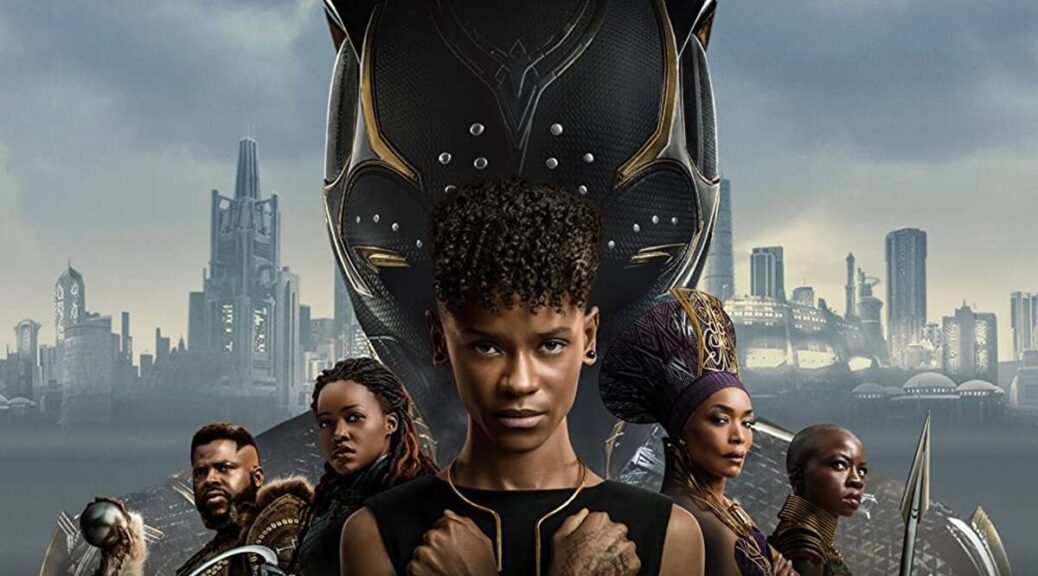
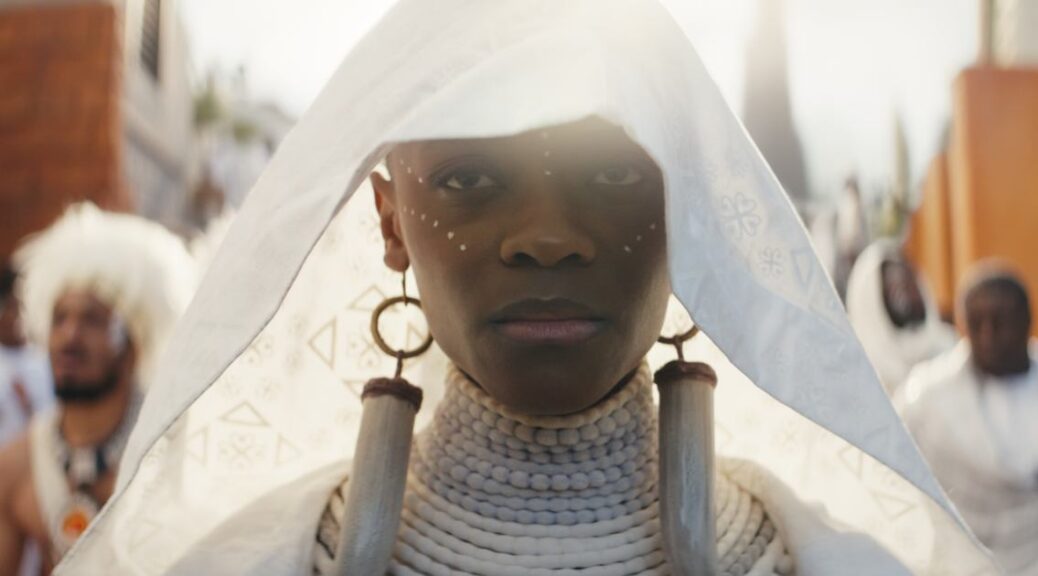
One year after King T’Challa’s death, Princess Shuri (Letitia Wright) is wondering if the idea of a “Black Panther” is outdated and Queen Ramonda (Angela Bassett) is facing increased pressure to share vibranium with other world powers.
The world powers, of course, aren’t just asking. And their efforts to take are aided by a new device that can detect vibranium in the environment, which brings the powerful “Feathered Serpent God” Namor (Tenoch Huerta from The Forever Purge and Sin Nombre) out of hiding.
Vibranium is also the resource vital to his undersea world of Talukan. Namor views the detection device as a threat to his nation and demands that Ramonda and Shuri turn over the scientist responsible. If they do not, Wakanda will have a formidable new enemy.
Hannah Beachler’s production design rivals that of her Oscar-winning work in Ryan Coogler’s 2018 original. Wakanda itself is as stunning and fully realized as ever, while Namor’s undersea realm becomes a lush waterworld that puts Aquaman to shame.
But after the defiant, often furious adventure of Black Panther, the most striking aspect of Wakanda Forever is the way it embraces the void left by the loss of both T’Challa and Boseman.
Coogler, writing again with Joe Robert Cole, delivers a more contemplative film this time around. Characters wrestle with loss and power, tradition and progress, rage and mercy. The depth of the script allows Basset and Lupita Nyong’o to really shine, while Winston Duke steals many scenes with a meatier, more layered take on M’Baku.
There is room for action aplenty, equally impressive whether massive seafaring attacks or intimate one-on-one battles (much thanks to the forever badass Danai Gurira).
The introduction of young M.I.T. phenom Riri (Dominique Thorne) is a well-intentioned mirror to Shuri’s technical genius, but the thread ultimately lands as a bit light and superfluous next to the complexities being pondered here. Still, Coogler’s skill with both emotion and spectacle never allows the two-and-a-half hour plus running time to feel bloated, and the film soars highest when the rush to war plays out against a backdrop of immense, intimate grief.
Have the tissues handy for the mid-credits coda. It’s a touching toast to an absent friend, and it cements Wakanda Forever‘s beautiful commitment to looking forward with cherished memories intact.
by Hope Madden
I have about six different cousins named Cathy Madden, but Lynne Davison’s Mandrake is not about any of them. I hope.
Davison’s tale follows probation officer Cathy Madden (Dierdre Mullins), whose recently assigned client, Mary Laidlaw (Derbhle Crotty), has the county in a tizzy. Old “Bloody” Mary is thought to be a witch, you see, and no one’s too keen on her being let out after what she did to her husband in those woods. Twenty years wasn’t long enough.
It’s tough to do something surprising within the witch genre. These films generally fall into two categories: she’s evil and in league with Satan, or she’s misunderstood and being wronged by hateful townfolk. Davison blurs that line. Her handling of Matt Harvey’s script treads a provocative path of moral ambiguity that requires constant guesswork and generates real dread.
Connor Rotherham’s cinematography draws out the best in Vanessa O’Connor’s production design to give Bloody Mary’s environment a primal, organic and dizzying feel. Everything is draped in moss and knotted with roots. You can almost smell the rotting leaves. It’s gorgeous and dense, simultaneously lovely and terrifying.
Crotty, all wild hair and knowing eyes, blends effortlessly into this primordial world. Mullins perfectly complements that performance with her own complex take on Madden. Straightforward with no time for nonsense, the parole officer still weakens, and Mullins finds depth here. The two performers play on their opposing look and vibe not to illustrate differences but to unveil sympathies.
Mandrake never falls back on one-dimensionality. Characters are messy. They do the wrong thing, then the right thing, behave monstrously and also with kindness. The film is also mercifully light on religion, instead pitting the scientific world against something older. Whether that world and its options are more sinister is in the eye of the beholder.