Tag Archives: Screen Wolf

Best Films, First Half of 2026

It’s already been a banner year in film and we’re only halfway through 2026! We’ve seen a blessed rise in true independent and original filmmaking, although there is one pretty big sequel we enjoyed. But there were so many choices for our mid-year Top 10, we need to give a little love to the honorable mentions.  Crime 101, Pizza Movie, Hamlet, The Sheep Detectives, Earth Wind & Fire (To Be Celestial vs. That’s the Weight of the World), and Strange Journey: The Story of Rocky Horror were all excellent movies that you should check out if you have not.

But not before you catch these gems:

10. The Bride!

On Disney+, Hulu, HBOMax

One part Metropolis, one part Bonnie & Clyde, just a touch of Bride of Frankenstein and yet somehow entirely writer/director Maggie Gyllenhaal’s own, The Bride! deserves that exclamation point. Jessie Buckley is a force of nature in a dual role—sort of a triple role, really: an unhappy Chicago gangster’s moll; Mary Shelley, silenced far too soon; and a monster, chaotic, unruly, unburdened by memory and guided by peculiar fury.

The Bride! delights with an anarchic energy, but its underlying plot is tight, its characters clearly drawn and beautifully performed, and its aesthetic wondrous. In just her second feature, after 2021’s sublime The Lost Daughter, Gyllenhaal’s cemented her spot as one of the most exciting filmmakers working.

9. The Drama

On Prime

Writer/director Kristofer Borgli continues his social provocateur-ing with look inside a couple thrown waaay off course by a shocking confession. The aftermath – affecting not only the couple involved but other couples in their orbit – becomes a darkly funny and intentionally cringe-worthy dissection of intimacy.

The thought experiment here isn’t just about Emma (Zendaya) and Charlie (Robert Pattinson). Borgli, even more-so than he did with 2023’s Dream Scenario, invites you to imagine yourself in several roles (and, of course, to judge the choices of those around you). The script is crisp, the humor is coal black, and the pacing (aided by some nifty editing and visual cues) keeps you invested at every turn.

8. Tuner

In theaters

His first narrative feature may focus on busting into safes, but Oscar-winning documentation Daniel Roher shows some fine natural instincts for cracking the code that makes “romantic thriller” a crowd-pleasing genre ride.

The slightly contrived, crowd-serviced turns that come in Act Three would elicit a few eyes rolls in lesser films. But by then, Tuner has carved out its own safe space, as a pitch-perfect example of how to make an audience want exactly what you’re going to deliver.

7. Hokum

On Prime

Damian Mc Carthy is doing something right. The Irish filmmaker writes original stories, invests time and attention to visual storytelling, and produces eerie, memorable horror. There’s an elegance to his movies, but his tales are not meant simply to provoke thought or to elevate the genre. Caveat, Oddity, and now Hokum draw from a long tradition of Irish horror storytelling and love a jump scare as much as anybody.

In HokumI, scene after scene balances a funhouse vibe with Irish folktale spookiness, and the vintage horror beauty of every frame beguiles you. Caviat offered quietly claustrophobic terror. Oddity delivered clever, melancholy horror. Hokum feels more polished yet more old school. It is perhaps less terrifying than Mc Carthy’s previous features, but it’s a haunting good time.

6. Backrooms

In theaters

Twenty-year-old filmmaker Kane Parsons adapts a series of shorts that made him a YouTube force, all of it based on online Twenty-teens creepypasta dread of being trapped eternally in an endless, yellow, moistly carpeted maze of empty rooms with no hope of escape. The fact that Parsons turned this concept into a compelling feature essentially about our own labyrinthine minds and psychiatry’s impotence is pretty impressive for a teenager!

The endlessly talented Chiwetel Ejiofor and Renate Reinsve play two disillusioned adults lost in the maze. Here are two actors who’ve built careers on understated, natural performances that ground every moment onscreen in something honest. Which makes them a magnificent choice for a film where nothing makes sense, and that’s the whole point.

5. 28 Years Later: The Bone Temple

On Netflix

There is more visceral horror in the first three scenes of Nia DaCosta’s film than in the entire hour and fifty-five minutes of 2025’s 28 Years Later. She delivered the first great horror film of the year with 28 Years Later: The Bone Temple, also written by Alex Garland. It picks up the most intriguing threads left untied last time: those of the band of Clockwork Orange-esque marauders who saved young Spike (Alfie Williams) from the infected, and the beautiful soul covered in iodine and living amongst the bones, Dr. Ian Kelson (Ralph Fiennes).

The filmmaker (Little Woods, Candyman, The Marvels, Hedda) returns to horror with aplomb, expertly weaving from the grimmest horrors the sadistic, bewigged Jimmys can muster to the tender bromance blossoming over at the bone temple. And the climactic musical number she stages there is a thing for the ages.

4. Toy Story 5

In theaters

Do we need another Toy Story? Actually, it appears we do. The miraculous thing about this franchise is that it’s never just about the toys or about the kids they love. It’s about a recognizable phase in a life. Which episode is your favorite depends entirely on how old you were when you started watching.

Episode 5 delivers an honest assessment of the way screens have invaded childhood and looks with clear eyes at the impact on children. Simultaneously, as Jessie (the genius Joan Cusack) chases down destiny, the film recognizes that, eventually, we all need to let go. Plus Woody has a poncho!

3. I Love Boosters!

In theaters

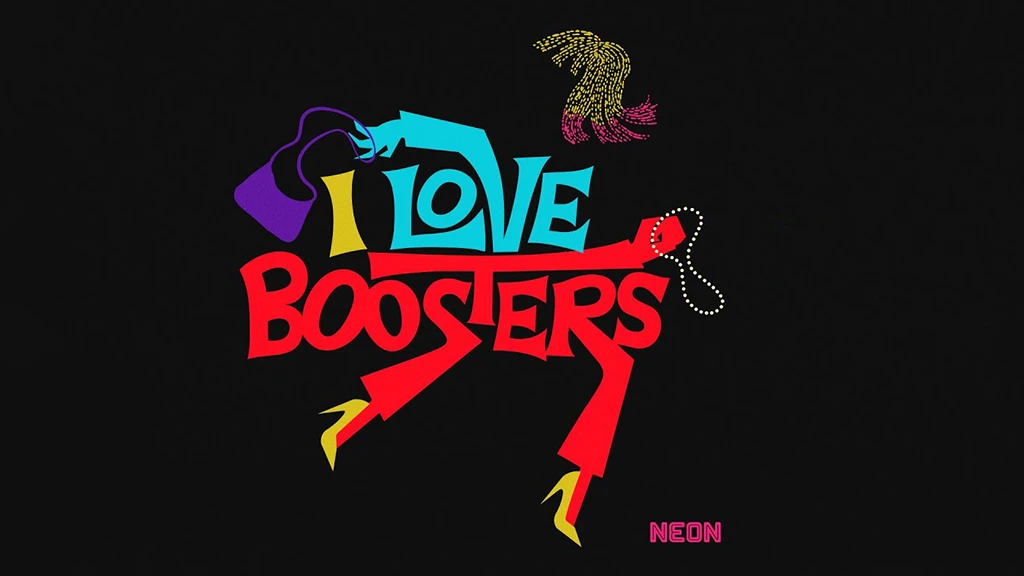
Boots Riley and a remarkable cast tell a wild, boldly colorful, sometimes Claymation, often surreal, occasionally demonic, fantastical, consistently smart, regularly hilarious, and shockingly personal tale about the individual’s need for community. And, of course, the inescapable evils of capitalism.

Underneath the metaphysical science fiction banter, beneath the scathingly comical evisceration of fast fashion, at the heart of the wacky heist flick, is a lonesome story that resonates. It’s all one struggle.

2. Is God Is

On Prime

Writer/director Aleshea Harris may be pulling from folklore and road movies, revenge flicks and historical dramas, noir and arthouse, exploitation and even horror. But the result of those inspirations is one of the most boldly original films of 2025. The filmmaker shows great affection for so many types of movies, and the way she bends these tropes and styles to the will of this narrative is fresh, unpredictable, and fascinating.

Violence and destiny, family trauma, classism and misogyny, and rage—Is God Is finds poetry and honesty and blood in all of it. Her cast, including Kara Young, Mallorie Johnson, Vivica A. Fox, and Sterling K. Brown, impress in every frame. But the star of Is God Is has to be the storyteller herself. Harris’s command of the audience and of cinema deliver the summer’s most daring and satisfying adventure.

1. Obsession

In theaters

Obsession is a film about consent. Sad boy Bear (Michael Johnston) can’t bring himself to confess his feelings for coworker Nikki (Inde Navarrette). He’s so desperate after one cringy missed chance that he breaks open a One Wish Willow he’d purchased as a joke and—without reading any of the warnings printed all over the box—wishes that she would love him more than anyone else on earth. And she does.

The themes writer/director Curry Barker mines are incredibly of-the-moment. Bear wants what he wants, but he wants it to be true. It isn’t, but that’s not good enough. Make it be true. But you can’t make something be true if it isn’t true, no matter how sad the boy is who wants it. Male entitlement masquerading as loneliness leads to violently self-centered behavior. Barker’s story, however jump-scary or genre friendly it becomes, never forgets this central, relevant concept.


Shotgun Wedding

Enola Holmes 3

by George Wolf

The air of Enola Holmes has only gotten fresher since the franchise debut in 2020. While more and more star-studded streamers carry the obvious stench of algorithm engineering, the formula at work in these Netflix installments seems perfectly suited to keeping the attention of home viewers.

First off, EH3 presents a headline-grabbing mystery: Enola’s legendary brother Sherlock (Henry Cavill) has been kidnapped! And the timing couldn’t be worse, as Enola (Millie Bobby Brown) is trying to fight off serious doubts about her upcoming marriage to Lord Earnest Tewkesbury (Louis Partridge).

“Yes, he has a first name,” Enola tells us. “I was surprised, too!”

Brown’s ease with the fourth wall is just one part of her irresistible embodiment of this role. The personal invitation into Enola’s life and adventures is welcome, and Brown gives us a heroine that is endlessly fun to root for as we follow along.

Sherlock’s kidnapping means the dashing-as-always Cavill is more out of sight than last time, allowing Brown the focus she more than deserves. Her Enola wants to get married, yes, but she also wants to keep the name and standing she’s worked hard to attain. Enola is smart, heroic, flirty and romantic, a pretty super girl in her own right.

Director Phillip Baratini and writer Jack Thorne (both from Netflix’s Adolescence) make sure Brown gets the chance to show all those sides of Enola. And while the mystery may play out a tad too conveniently, the visual aesthetic bursts with interactive sleuthing and multimedia pop-ups that are consistently engaging.

The returning support cast (including Helena Bonham Carter, Himesh Patel, and Hattie Morahan) adds to the wonderfully frisky chemistry of the entire ensemble. Part three also allows some nostalgia for how these characters (especially our engaged couple) have grown, giving the film some sweet moments of emotion.

Forget about Sherlock’s kidnapping, Enola Holmes may be solving the mystery of holding a streaming audience without condescension or spoon-feeding. And once again, that’s a formula worth repeating.

Fight the Pain Away

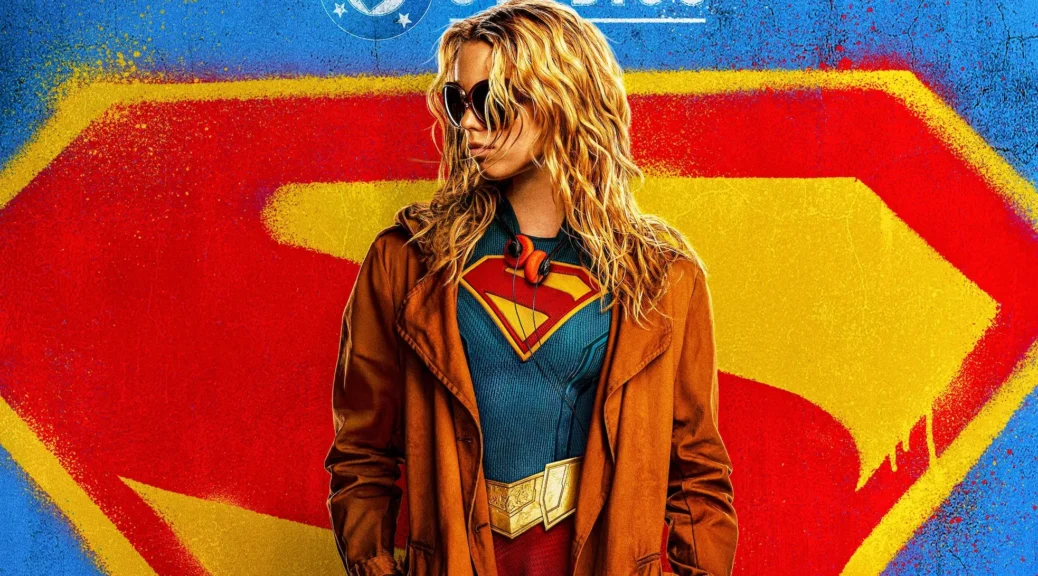
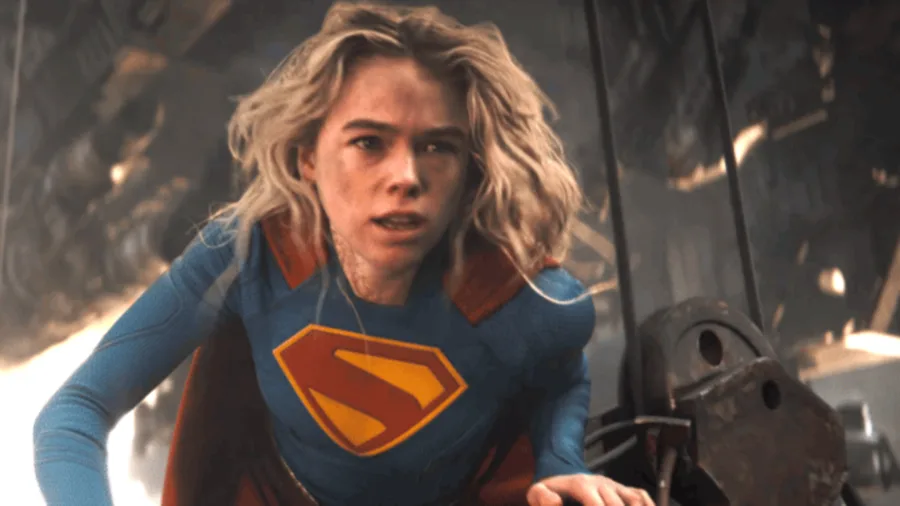
Supergirl

by George Wolf

Look, Kara Zor-El (Milly Alcock) isn’t some goody-goody like her cousin Superman, okay? She’s a hard partying rock chick rockin’ a Blondie t-shirt and a wiseass attitude on her 23rd birthday, so F-you! She’s not about go and join young Ruthye’s (Eve Ridley) quest to avenge her parents’ death at the cold-blooded hands of space villain Krem (Matthias Schoenaerts).

But then Krem shoots Krypto full of a slow-acting poison, and suddenly Kara’s got 72 hours to find Krem, get the antidote, and save her beloved dog from back home.

There’s also a sex trafficking ring to bust up, so add Fury Road to John Wick, Star Wars, Alien, multiple Westerns and various other inspirations you may spot. And while at this point, finding an entirely original stylistic angle for your superhero film may be damn near impossible, this familiarity is one of the things keeping a pretty satisfying adventure from reaching the stratosphere.

Director Craig Gillespie (I, Tonya, Lars and the Real Girl, The Finest Hours) overcomes some occasionally wonky CGI to craft several winning sequences of action, backstory and world building, but often undercuts the growing momentum by bailing out too soon. The surprising dive into the demise of Krypton adds narrative heft, but dropping it between the grimness of The Dark Knight and the giddy excess of Birds of Prey keeps any distinct tone elusive.

Through all of it, Alcock (House of the Dragon) keeps our titular hero wonderfully grounded. Writer Ana Nogueira’s debut screenplay may be filled with familiar themes of grief, destiny, revenge and female rage, but Kara has specific reasons to be wounded. Alcock makes sure we appreciate the character arc that turns Kara’s defense mechanisms into Supergirl’s defense of truth, justice, and…you know.

Alcock finds a way to make us care about the girl, whether hunting down Krem (Schoenaerts is a wonderful, facially-studded psycho), fighting alongside Lobo (Jason Mamoa, gleefully hamming it up) or feeling sweetly big sisterly to the resourceful Ruthye.

And more importantly, Alcock’s scenes with David Corenswet’s Superman cement the film’s biggest win: giving Kara the agency for her hero to stand as more than just a sidekick. This girl’s truth is separate from her famous cousin. Supergirl makes no apologies for making that clear, with an uneven but ultimately effective introduction.

I Can’t Live Without My Radio

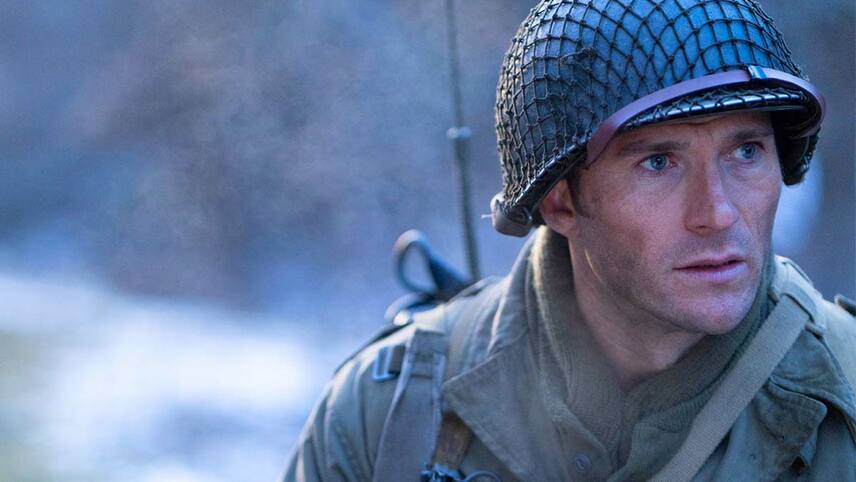
Lucky Strike

by George Wolf

The song that plays over the closing credits of Lucky Strike couldn’t be a more appropriate choice. Co-written by Rod Lurie, who also co-wrote and co-directed the movie, the theme is passionate and well meaning. It is also overwrought and heavy handed.

So again, perfect for this film.

By all accounts, Lurie (The Outpost), co-director Todor Kotzev, co-writer Marc Frydman and their fellow producers have gone to great lengths to ensure this film gets the thumbs up from WWII historians. From the jeeps to the artillery, the terrain and beyond, the clear aim of the production was to create an authentic bridge between recorded history and battlefield reality.

And on the note, Lucky Strike hits the mark. An authentic feel for the characters being developed proves a much harder target.

Scott Eastwood takes the lead as Capt. John Castle, who in December 1944 is ordered by his superior (Colin Hanks in a brief cameo) to oversee the blockade of a road in the Ardennes forest often used by German soldiers.

Castle and his team come under heavy fire, eventually leaving John and his invaluable radio “Lassie” – which will become even more valued later on – alone behind enemy lines.

Based on true events from the legendary Battle of the Bulge, the film becomes one man’s journey of commitment and survival, as Castle sets out on the 30km trek to safety in Elsenborn, Belgium.

As correct as all the details may be, the writing and direction never miss the opportunity to overplay a hand. Despite some tense and well orchestrated one-shot action sequences, much of the dialog lacks nuance, the editing and reaction shots continually aim for the back row, a third act twist isn’t hard to see coming, and there’s even the inclusion of an actual pale horse (apparently ridden by subtlety).

Eastwood shoulders a big load but doesn’t show the family gift of understatement, and cannot elevate any of this material. Only the great Aunjanue Ellis-Taylor, as a grieving mother in some touching bookend scenes with Eastwood, can give the film a fleeting layer of humanity.

Lucky Strike needed more of that. There’s plenty to respect here on a technical and historical level, but any true emotional connection is lost in the wilderness.

Fright Club: Parenting Disasters in Horror

There are loads of bad parents in horror. Jack Torrence is no doll. Margaret White’s a bit much. In bad parent horror, we empathize with the offspring. But there’s something perhaps more unsettling when you empathize with the parents who are genuinely trying but something—sometimes just one bad decision—ends in unspeakable disaster. It’s those dumbasses that we salute today!

And thanks again to FeedSpot for including us on their latest list of Best Horror Podcasts! FeedSpot is an RSS Reader that lets you follow your favorite podcasts alongside blogs and news in one place. https://podcast.feedspot.com/midwest_horror_podcasts/

5. Splice (2009)

This creature feature Frankenstein mad science mash up goes places you may not expect. Director Vincenzo Natali (Cube) investigates science as commerce, the maternal instinct or lack thereof, sexual politics, nature and nurture and more in this body horror.

The wtf! of it all works because of the undeniable talent of its leads, Sarah Polley and Adrien Brody. What they’re doing in this is hard to know, but they elevate a B-horror script to something weirdly compelling. Polley’s big eyed, emotionless performance offers a fascinating conundrum that makes every wild turn make sense. Sort of.

4. Antichrist (2009)

Lars von Trier’s foray into horror follows a couple down a deep and dark rabbit hole of grief. Von Trier’s films have often fixated on punishing viewers and female protagonists alike, but in this film the nameless woman (played fearlessly by Charlotte Gainsbourg) wields most of the punishment – whether upon her mate (Willem Dafoe) or herself.

Consumed by grief, a mother allows her husband—also grieving—to become her psychotherapist as they retreat to their isolated cabin deep in the woods where they will try to overcome the horror of losing their only child.

They won’t succeed.

3. Speak No Evil (2022)

Christian Tafdrup’s Speak No Evil, a terribly polite tale of Danes and Dutchmen that veers slowly but relentlessly toward something sinister. Speak No Evil quickly becomes a sociological experiment that questions our tendency to act against our own instincts, side with the cool kids, and lose who we are.

Tafdrup’s script, co-written with Mads Tafdrup, is sneaky in the way it treads on social anxiety, etiquette, politeness. You see how easily gaslighting alters the trajectory of a conversation, the course of action. Speak No Evil is a grim trip, but there is no question that it’s well made.

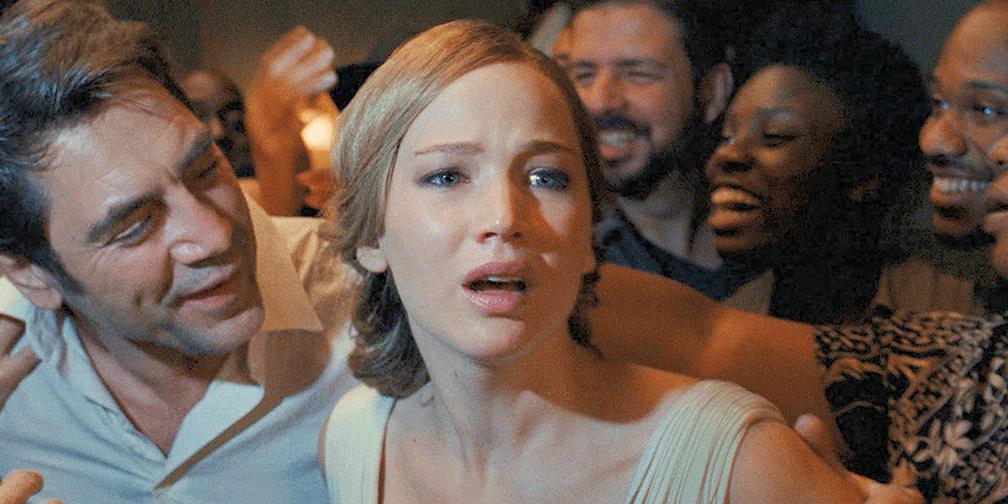
2. Mother! (2017)

Between writer/director Darren Aronofsky’s disorienting camera and his cast’s impeccable performances, he ratchets up tension in a way that is beyond uncomfortable. This is all clearly leading somewhere very wrong and the film develops the atmosphere of a nightmare quickly, descending further and further with each scene.

Jennifer Lawrence, Javier Bardem, Ed Harris and Michelle Pfieffer are indescribably brilliant. Like most of the filmmaker’s work, mother! will not be for everyone. But if you’re up for an allegorical descent into hell, meticulously crafted and deftly told, and if you like your metaphors heavy and your climaxes absurd, this mother! is for you.

1. Coffee Table (2022)

On Shudder, Prime, Tubi, AMC+

A remarkably well written script fleshed out by a stunning ensemble becomes utter torture as you want so badly for some other outcome. Co-writer/director Caye Casas ties threads, builds anxiety, plunges the depths of “what’s the worst that could happen?” and leaves you shaken.

David Pareja and Estefania de los Santos craft indelible, believable, beautifully flawed characters so convincing that their experience becomes painful for you. Casas salts the wounds with dark comedy, but the tenderness and tragedy collaborate toward something far more crushingly human.

Mighty Mighty Joy

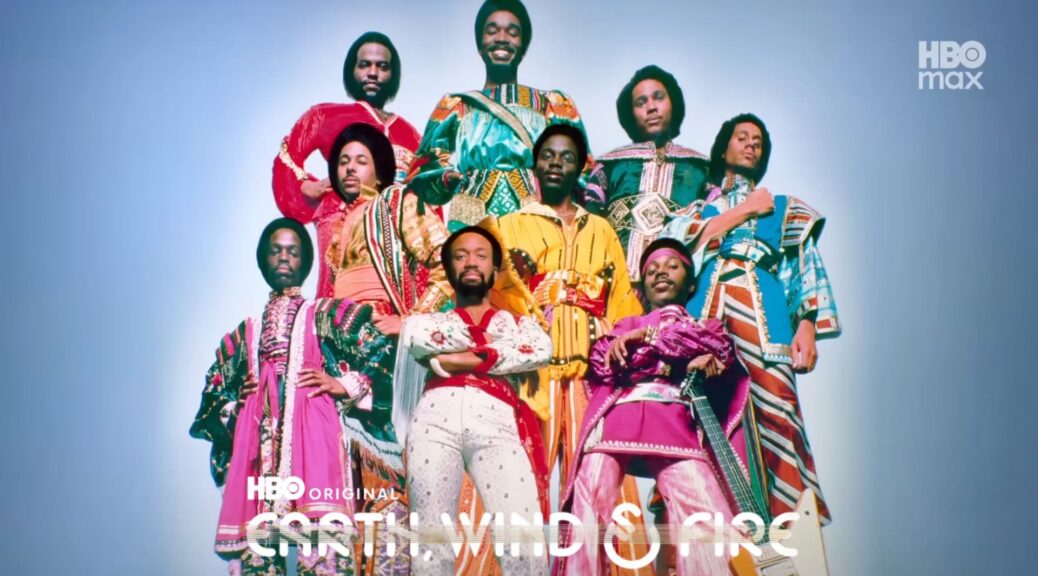
Earth, Wind & Fire: To Be Celestial vs. That’s the Weight of the World

by George Wolf

Don’t worry, Ahmir “Questlove” Thompson doesn’t let the surviving members of Earth, Wind & Fire sidestep the tough questions.

What is the meaning of “ba-dee-ya,” anyway?

But well before Thompson gets to that, his HBO streamer Earth, Wind & Fire: To Be Celestial vs. That’s the Weight of the World becomes an exhilarating celebration of a band making music so joyful it’s described as “Jesus-less gospel.”

Through archival footage, performance clips, family mementos and interviews new and old, we see the band’s visionary founder Maurice White persevere through early struggles to embrace a unique sound that propelled EWF’s journey as 70s superstars, 80s has-beens and eventual worldwide icons.

Director Thompson, already an Oscar winner for the triumphant Summer of Soul, again shows impeccable instincts for presenting a music doc that transcends any Behind the Music formula. Of course, being an accomplished music himself can’t hurt, and Thompson’s effervescent approach lets the stories and songs find a seamless blend of style and meaning.

And somehow, the film manages to smooth over the massive absence of White, who passed away in 2016 from Parkinson’s disease. Heartfelt remembrances from band members, family, partners, friends and admirers (including Stevie Wonder, Lionel Richie, and Barack and Michelle Obama) paint an effective portrait of a gifted but complex artist who rose above childhood trauma for professional success full of singalong affirmations that often masked a personal struggle.

Those who may not know much about White will get schooled plenty, and even longtime fans like myself (hey, my birthday just happens to be the 21st night of September) may find a few surprises here (like why Philip Bailey would apologize for his classic slow jam “Reasons”). What everyone will find with Earth, Wind & Fire is two solid hours of EWF magic, and an inescapable joy both celestial and weighty.

Screening Room: Masters of the Universe, Power Ballad, Office Romance & More

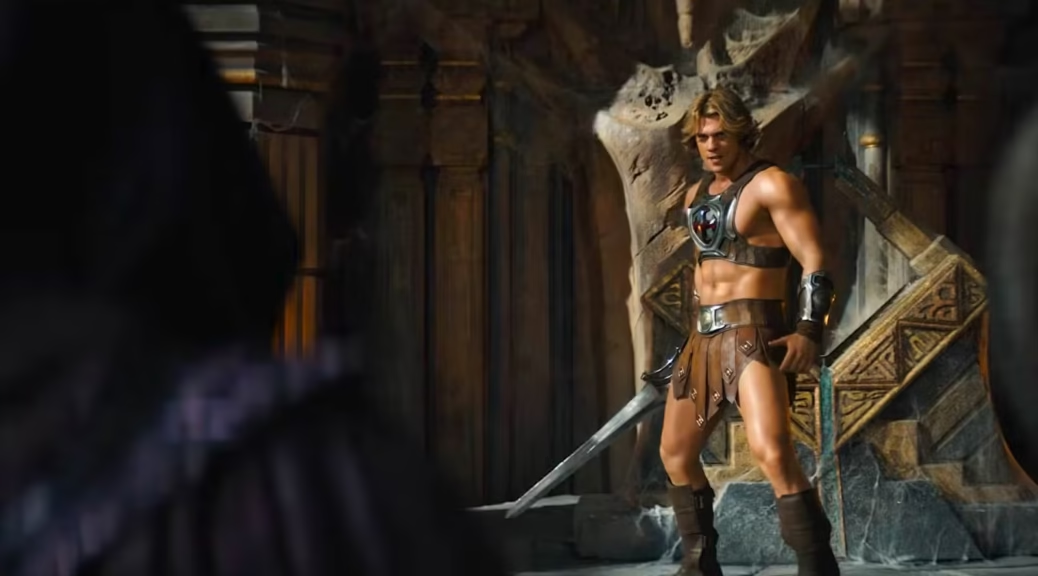
On this week’s Screening Room podcast, Hope & George review Masters of the Universe, Power Ballad, Carolina Caroline, Office Romance, Scary Movie, Strange Journey: The Story of Rocky Horror, Chum, and Seven Snipers!

You Play Lizzy?

Power Ballad

by George Wolf

Give it up for “Ireland’s grooviest wedding band…Bride and Groove!”

Back in the day, Rick Power (Paul Rudd) had an American rock band, a record deal and big dreams that never panned out. But after settling in the Emerald Isle with his Irish wife Rachel (Marcella Plunkett) and daughter Aja (Beth Fallon), Rick scratches his musical itch by playing other people’s classic hits and trying not to be too cliched about his glory days.

Power Ballad is yet another tune-centric winner from writer/director/composer John Carney. And much like Once, Sing Street, Begin Again and Flora and Son, his latest is a crowd-pleasing ode to authentic music, heartfelt inspiration and the twists of fate that change the course of our lives.

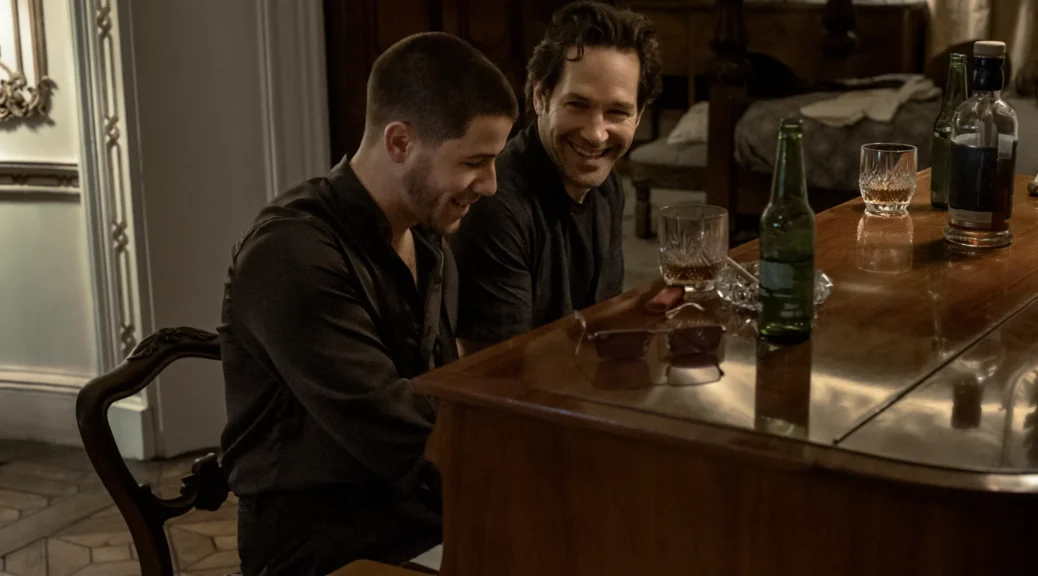
When Rick and his band play a high end wedding at a sprawling Irish castle, he meets friend-of-the-bride Danny Wilson (Nick Jonas), a former boy band star trying to transition into legit solo act. Danny sits in for a song, he and Rick hit it off and they end up drinking and jamming the night away in Danny’s lavish suite.

Fast forward a few months, and Danny’s first big solo hit is just a polished version of a song that Rick wrote years ago and played for Danny that very night.

Surely Rick can just call the number Danny left him with and settle this, right? He seemed like a great guy!

Well, he can only get through to Danny’s label head (Jack Reynor), who tells Rick that unless he has proof of his claim, buzz off or they’ll sue him into oblivion.

The endlessly endearing Rudd (who sings surprisingly well) shares a nice chemistry with Jonas, and Carney pumps the soundtrack full of both classics and some new originals that actually sound like pop hits. Carney also tosses in a couple wink-wink callbacks to Once and some outright hijinx, but the film’s greatest hits come from the warm humanity in the deep tracks.

Rick can feel his family and his band doubting his claim, and as Danny’s song becomes a global anthem requested at weddings (uh-oh!), Carney finds ways to probe the characters that are easily digestible.

Does Rick want the fame and riches that would come from a writing credit, or does he want to feel like he did when he was young and full of confident ambition?

And if that younger Rick had hit it big with his first band, would he really have had a better life?

Since the achingly beautiful Once, Carney has often relied on contrivances that work well in service of the feel good meter. Power Ballad follows that familiar rhyme scheme, but strikes an irresistible medley of joy, sacrifice and reward that feels like a bangin’ summer playlist.