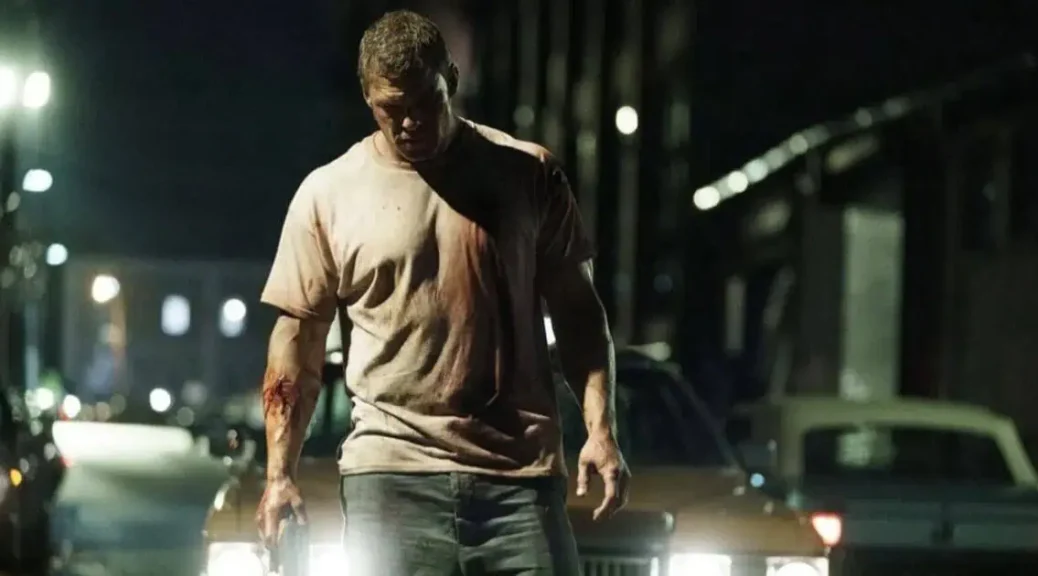
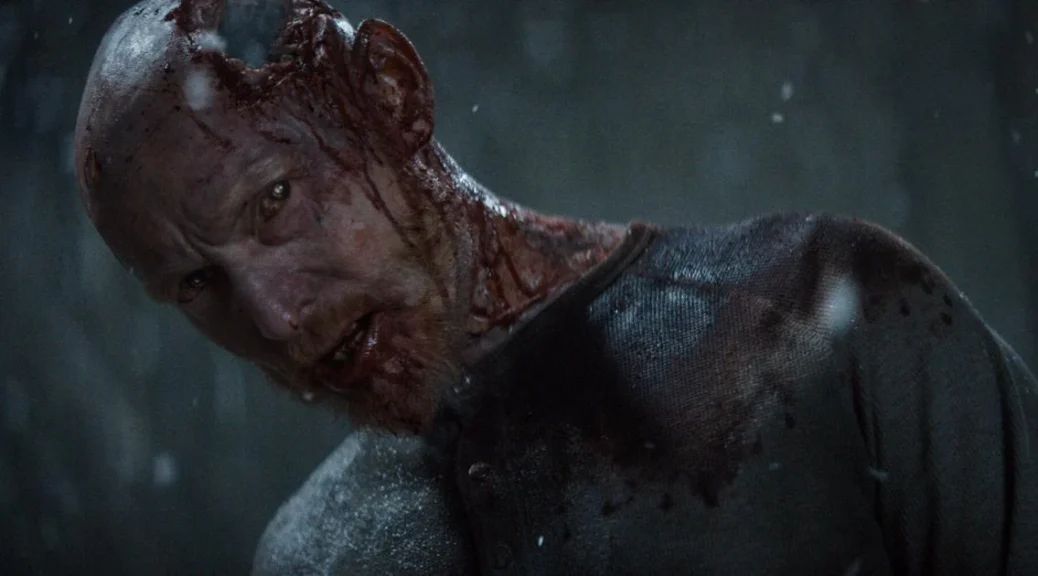
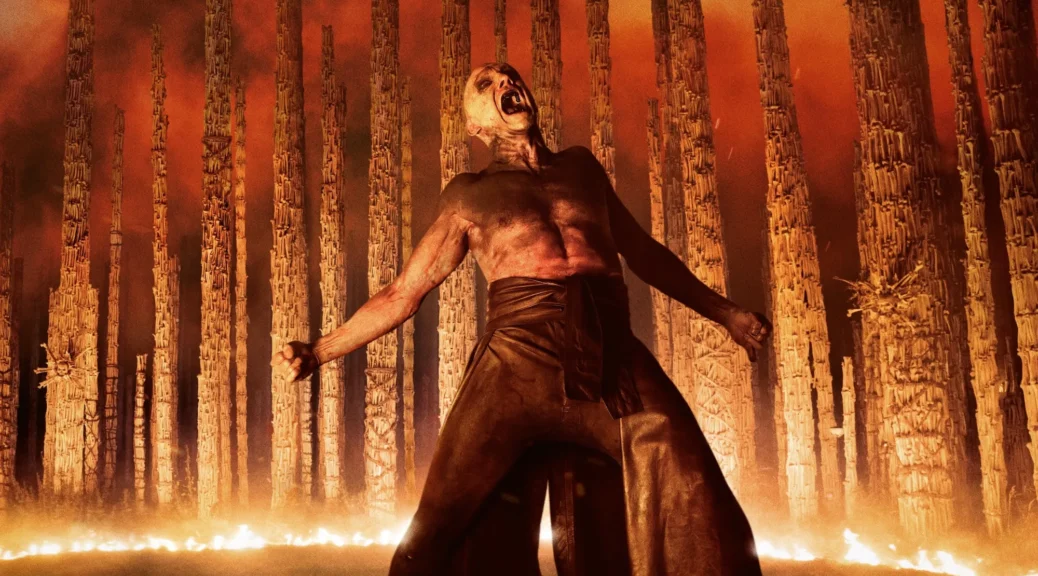
Man, if you can hang with Motor City for about an hour and fifteen minutes, you’ll get one damn fine action sequence. Suddenly violent, increasingly bloody and eventually downright grisly, it’s an impressively choreographed and well shot set piece.
It’s also curious, considering the film surrounding it is a pretty tedious exercise in navigating a needless hurdle of its own making. And needle-dropping some sweet 70s hits.
The theme is simple enough: revenge. Ex-con John Miller (Alan Ritchson) is on probation and trying to toe the line in 1977 Detroit. He pops the question to his honey Sophia (Shailene Woodley) and things are looking up. But then Sophia’s gangster ex-boyfriend Reynolds (Ben Foster) frames John with a staged drug bust, and back to the slammer he goes.
So how does director Potsy Ponciroli (Old Henry) refresh the familiar idea from writer Chad St. John? By crafting Motor City as a nearly dialog-free thriller propelled by mood and music.
That “nearly” is the first curious bump in John’s long road to payback.
The few bits of dialog that are here just end up drawing attention to how hard the film is trying to get credit for telling most of this story without words. And it just isn’t necessary. Scenes that should naturally have organic conversation do not, and the strain of keeping the silent device intact is just too obvious.
I mean, do it or don’t. Since there is some dialog, Ponciroli’s commitment to visual storytelling ends up feeling more gimmicky and forced.
Foster and Woodley are customarily fine, Ritchson continues to show raw talent and real charisma, and Pablo Schreiber makes a perfectly menacing henchman. The soundtrack choices from Jack White (who also has a cameo) are on point, too, which helps keep the boredom at bay when the story just takes too long getting down to business.
And though revealing just what derails the finale would be too much of a spoiler, the result is anticlimactic and just plain silly.
But man, that one elevator scene shows just how much action potential is wasted in Motor City.
For the next week at least, Greece is most definitely the word at your local theatre.
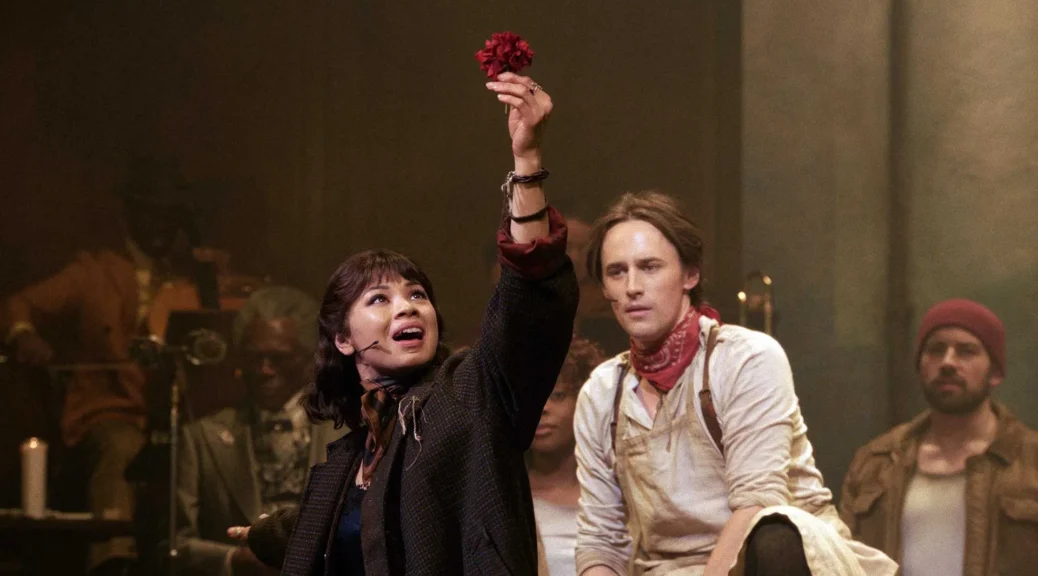
While Christopher Nolan’s take on The Odyssey is wowing critics, audiences and box offices, the movie version of Broadway smash Hadestown combines the Greek tragedies of Orpheus and Eurydice and Hades and Persephone with an irresistible, jazz-infused treatment that dazzles from the opening glimpses backstage.
Screening in theaters for five nights only beginning July 24th, Hadestown unveils the “pro-shot” film capture of a reunion performance from last year in London. The five leads reprised their roles in the multi award-winning production, with veteran filmed stage feature director Brett Sullivan bringing new life to stage director Rachel Chavkin’s original vision.
Tony Award-winner Andre De Shields is a mesmerizing tour guide as Mr. Hermes, our host who explains “the road to hell is a railroad line,” as Anaïs Mitchell’s Tony and Grammy Award-winning score begins working it’s toe-tapping magic.
Young lovers Orpheus (Reeve Carney) and Eurydice (Eva Noblezada) face an uncertain future due to their life of poverty. When King Hades (Patrick Page and his delicious baritone) arrives to bring his wife Persephone (Amber Gray) back to the Underworld and usher in a harsh winter, Eurydice is intrigued by his offer to end her hunger and suffering. Urged on by the Fates, Eurydice signs Hades’s book and leaves Orpheus for a new life down below.
But Orpheus will not give up his quest to bring Eurydice home, and his commitment inspires Persephone to plead his case to her husband, leading to the legendary offer Hades extends to the couple for a final chance at their freedom.
Mitchell updates the classic myths with a timely parallel to our current chasm between the privileged and the struggling, and Sullivan bolsters that theme with a wonderfully active showcase for Rachel Hauck’s Tony Award-winning set design. Anchored by a rotating center stage with one circle descending to the Underworld, the set extends the movement outward to the dancing Fates, the terrific jazz musicians upstage and the frequently pacing Mr. Hermes.
Sullivan mines that sweet balance between framing the totality of the audience view with the more intimate moments a camera allows. Overplaying this hand would betray the innate beauty of a pro shot experience, but here the pushes only accentuate the emotion of the performances, the detail of the production design and the richness of the costuming (bonus points for turning Page’s cane and walking boot from an Achilles injury into a menacingly cool addition to the Hades swagger).
And much like its mythological sister The Odyssey, Hadestown‘s extended length (2h 21m) only gives you more time to relish the experience. The brief screening window (remember, only five nights beginning this Friday) however, does not.
So don’t miss your chance to bask in the joy and pain, tragedy and hope that Hadestown finally brings to the big screen. And get ready to put those jazz hands together, early and often.
A massive cast, incredible set designs, far flung locations, 70mm IMAX cameras, The Odyssey has it all. And why not? Homer’s story is among history’s first ever epics.
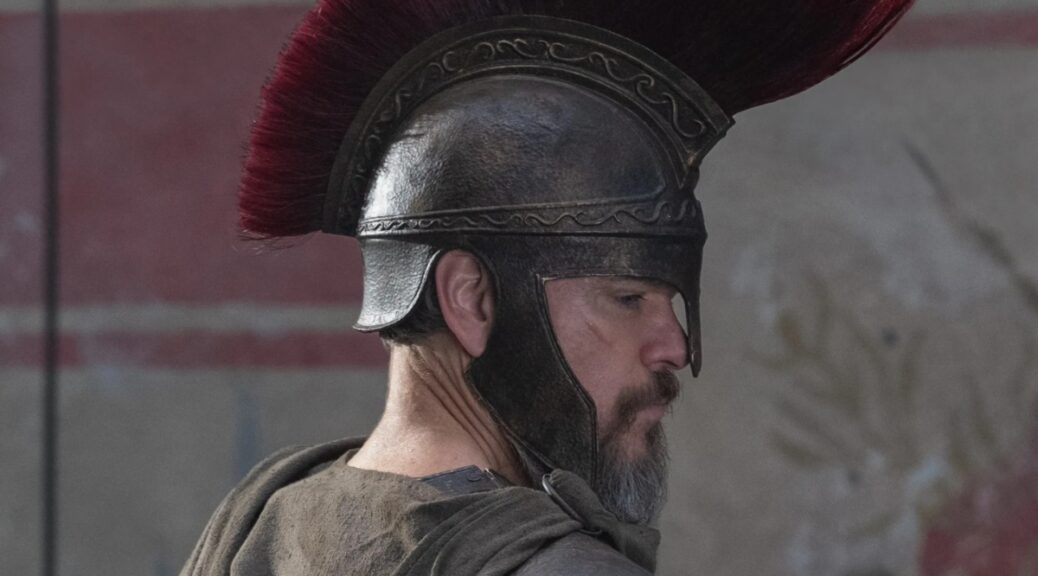
And it’s quite a tale, trailing Odysseus (Matt Damon) as he struggles to return home to Ithaca after his savvy strategy leading to the defeat of Troy. Nolan, who adapts the 2700-year-old tome, finds echoes of Oppenheimer in Odysseus’s struggle. It’s a haunting narrative choice that gives the ancient proceedings a relevance that transcends time.
Damon is magnificent, wily and honorable, humble and arrogant, and Nolan surrounds him with a jaw-dropping ensemble. Anne Hathaway is bracingly wonderful as Penelope, the wife pushing off suitors circling the throne Odysseus left empty nearly two decades ago. Tom Holland, John Leguizamo, Mia Goth, Corey Hawkins, and Robert Pattinson join Penelope in the castle, and while the entire cast is solid, Pattinson again carves out unforgettable screentime.
Out in the wild world, Charlize Theron offers a beautiful dash of melancholy as Calypso, who prods Odysseus to search his memories and tell the tale. Himesh Patel is also exceptional as Eurylochus, Odysseus’s second in command. Elliot Page delivers a heartbreaking turn as Sinon, a youngster who follows Odysseus into battle, Jon Bernthal crafts a perfectly hardened King of Sparta while Samantha Morton finds remarkable depths as the witch Circe, given her limited time on screen. With even less screentime, Lupita Nyong’o and Zendaya leave an emotional mark.
And that’s not even the full cast, each of them bringing vulnerability to scenes of remarkable staging. The Trojan horse, the ship at sea, scenes of war, of mutiny, scenes confined to a banquet hall or strewn across the black embers of hell—this is Nolan at not just his most imaginative, but his most insightful as he finds relatable humanity inside even the grandest of moments.
He also mines new relevance from this ancient text, increasing the narrative weight with each spectacular step on the journey. Set in “a time of apparent magic,” Nolan doesn’t let us forget that the sacred bonds between people are still very fragile indeed, and breaking them can still have haunting, tragic repercussions.
The Odyssey casts such a mesmerizing spell that its three-hour runtime seems inconsequential, and the occasional lapses into more contemporary types of dialog and phrasing are rendered mere curiosities. Even those who may not be quite scholarly in Greek mythology will find a rich, rewarding story to get lost in, one that is anchored in storytelling itself as a reminder of what power the ancient art can hold.
Expect witchcraft and monsters (maybe a horror film next, Mr. Nolan?), war, brutality, political skullduggery, love and longing, revenge and regret, sacrifice, cowardice, honor and visual wonder.
The magic here is more than apparent, so don’t cheat yourself by waiting for the streaming date. The Odyssey is a true cinema experience, and a reason to seek out IMAX, 70mm, the whole fantastic shebang. This trip of a lifetime deserves nothing less.
Temptation is a big, big topic in horror. All sin begins with temptation and all horror begins with sin. But we narrowed down the list of our favorites so we didn’t focus exclusively on one kind of temptation. Which means we had to leave LOADS of movies out, including Nosferatu, The Lure, and Def by Temptation. But hopefully we made up for it with variety!
5. The Untamed (2016)
Sexual frustration leads to a lot of bad choices, but sexual satisfaction may be the real monster in Amat Escalante’s wild scifi/horror flick.
Alejandra (Ruth Ramos) is one of the sexually frustrated. Veronica (Simone Bucio) is not. Angel (Jesus Meza) is making bad choices. But there was this meteor, and it landed out by this isolated farm. What if the answer to all their problems is there?
Taking direct inspiration from Andrzej Zulawski’s Possession, Escalante reframes the taboo-defying frenzy of unbridled sexuality. Where Zulawski’s surreal, antiseptic environment suggested absurdism, Escalante grounds the fantasy in profoundly ordinary and relatable human drama. The result is horrifying.
4. Jennifer’s Body (2009)
The central premise in this succubus horror: Boys are stupid, throw rocks at them. Better still, lure them to an isolated area and eat them, leaving their carcasses for the crows. This is the surprisingly catchy idea behind this coal-black horror comedy.
In for another surprise? Megan Fox’s performance is spot-on as the high school hottie turned demon. Director Karyn Kusama’s film showcases the actress’s most famous assets, but also mines for comic timing and talent other directors apparently overlooked.
Amanda Seyfried’s performance as the best friend, replete with homely girl glasses and Jan Brady hairstyle, balances Fox’s smolder, and both performers animate Diablo Cody’s screenplay with authority. They take the Snaps conceit and expand it – adolescence sucks for all girls, not just the outcasts.
3. The Lair of the White Worm (1988)
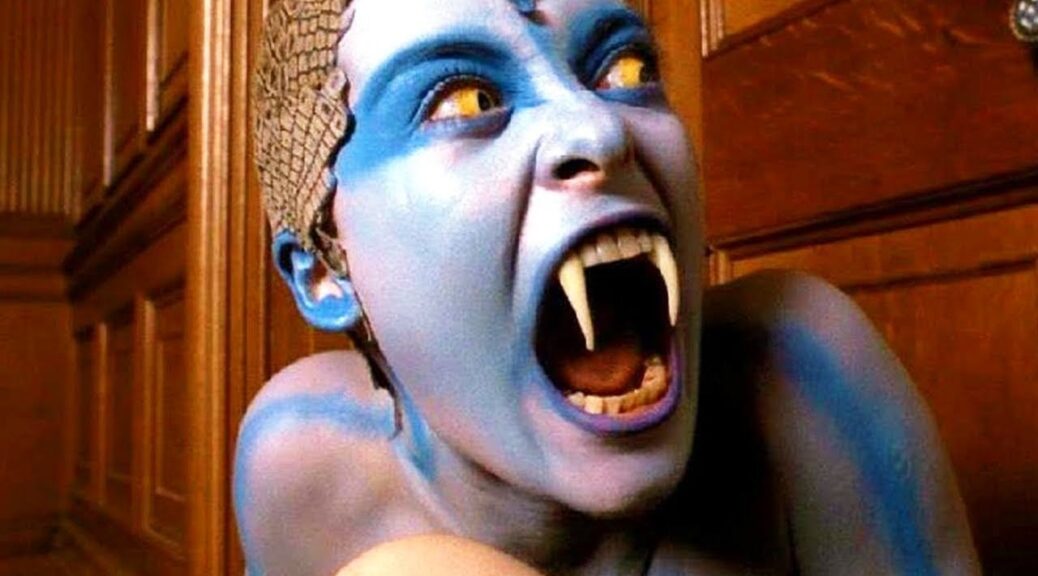
Who tempted us first? It was that clever snake. And who better to turn Bram Stoker’s abysmal novel The Lair of the White Worm into a blasphemous, hedonistic blast than Ken Russell?
Hugh Grant’s unibrow! Amanda Donohoe’s serpentine strap on! Peter Capaldi’s impenetrable accent! It’s all here, with as much subtlety as you might expect from Russell. Campy fun from the opening credits (that font!), this one’s a hoot!
2. The Devil’s Advocate (1997)
Al Pacino is subtle as ever as the devil himself, here to tempt Keanu Reeves with power. Though carnal temptation does make a number of visits, it’s greed and ambition that drive this film.
Is this Taylor Hackford vehicle a campy act of excess? It is! Gloriously, absolutely ridiculously so! The acting is over-the-top, though Reeves is characteristically cardboard. But both Charlize Theron and Connie Nielsen are exceptional and the wretched excess is a kind of joy.
1. Raw (2016)
In a very obvious way, Raw is a metaphor for what can and often does happen to a sheltered girl when she leaves home for college. But as writer/director Julia Ducournau looks at those temptations and the excesses committed on the cusp of adulthood, she creates opportunities to explore and comment on so many upsetting realities, and does so with absolute fidelity to her core metaphor. She immediately joins the ranks of Jennifer Kent (Babadook) and Ana Lily Amirpour (A Girl Walks Home Alone at Night) – all recent, first time horror filmmakers whose premier features predict boundless talent.
This week, Hope & George review Moana, Evil Dead Burn, The Invite, Gail Daughtry and the Celebrity Sex Pass, The Outer Threat, Night Nurse, Mockbuster, and The Isolate Thief. PLUS! Movie News & Notes from The Schlocketeer Daniel Baldwin!
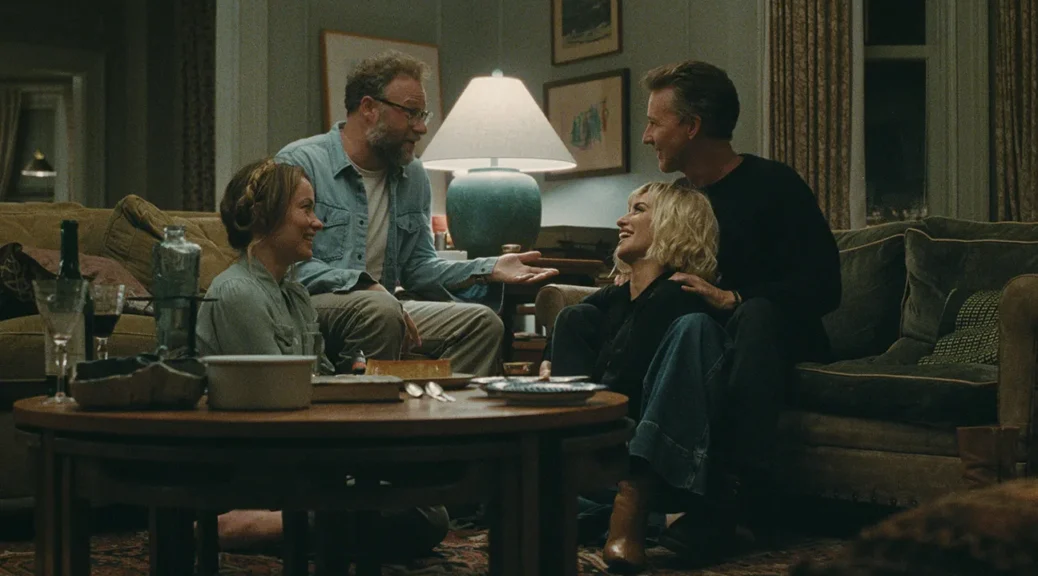
For a film set almost entirely inside one apartment, The Invite covers an awful lot of ground. It’s a trip through performative banter and anxious glances to repressed feelings, emotional honesty and possible new beginnings.
And it’s funny, in ways that are often relatable, revealing, and a good bit awkward.
Adapted from Cesc Gay’s The People Upstairs (stage play, then movie), the film finds Angela (Olivia Wilde, who also directs) and Joe (Seth Rogen) finally ready host their upstairs neighbors Pina (Penélope Cruz) and “Hawk” (Edward Norton) for dinner.
Well, Angela is ready, and schoolgirl nervous. Joe insists she didn’t tell him it was tonight, so he didn’t get any wine, and you know what if they come over he just might ask them to please tone down all those wild sex noises.
No! Joe can’t do that. Pina is so pretty, and Hawk is so cool! Angela just has to impress them and at least pretend that she and Joe are as happy as they are. Or at least as they seem to be.
It’s all polite laughter and rug compliments at first, but slowly the adapted script from Will McCormack and Rashida Jones begins probing old wounds, petty grievances and provocative possibilities. The cast wrings emotion from the dialog with the zest you would expect from a veteran foursome such as this. Cruz and Norton are effortlessly suave and sexy, while Rogen is the grumpy fly buzzing around the cheese tray and Wilde is the frazzled host desperate for the night to play out as she planned it.
It won’t. And everyone is better for it.
Wilde’s direction seems equally intent on bringing movement to this static setting, and for the most part she succeeds without showy desperation. Windows, doorframes and mirrors are carefully utilized in several shots, giving a visual boost to the emotional distance – or growing attraction – between characters.
It all works in wonderful unison for this wonderfully adult comedy/drama…okay I’ll say “dramedy.” Funny, biting, poignant, and surprising, The Invite speaks to how easily longtime couples can drift apart, and the hard fought honesty it takes to stick things out.
You think Gail Daughtry and the Celebrity Sex Pass is just about a small-town Kansas woman in ruby red shoes traveling to Hollywood on a quest to have sex with Jon Hamm?
Get hip to the subtext, man! It’s also a film about a tragic bullfighting fatality, John Slattery pulling out a man’s eyeball while imitating Howard Cosell, a nefarious plot to dismantle the corrupt global financial system, a mailman’s beef with his overcharging roofer and Henry Winkler’s role in the deadly consequences of a briefcase mixup.
But yes, this hilarity is centered around Gail (an irresistible Zoey Deutch), a fresh faced and endlessly upbeat hairdresser excited to soon marry her childhood sweetheart Tom (Michael Cassidy). But when a local book signing leads Tom straight into the legs of his celebrity sex pass, Gail’s best friend Otto (Miles Gutierrez-Riley) knows there’s only one thing to do.
Gail has to come with him to the big hair show in L.A., and settle the score with her own chosen wizard of aaahhs – Mr. Jon Hamm.
Director/co-writer David Wain (Wet Hot American Summer, Role Models) and co-writer/co-star Ken Marino (veteran comedic support standout) have created a relentless assault of silliness that delivers a consistent string of smiles, yuks, laughs and belly laughs.
Beyond the multiple nods to the yellow brick road adventure, Wain and Marino lampoon celebrity culture, paparazzi, the Hollywood bubble and various movie genres with winks, nods and relish, tossing in several surprise cameos to boot. Deutch proves again that she is a versatile talent with serious comedy chops, and the wide-ranging ensemble (led by Marino, Slattery and a delightfully understated Ben Wang) offers fun from every angle.
Gail Daughtry is an unhinged cult leader in waiting, with a vibe that is set from the opening minutes. Ride it all the way through the credits (and one final Wiz bang) to score the funniest film of the year so far.
Even if Spielberg’s latest alien adventure left you a bit frustrated, you might think twice about turning to The Outer Threat to scratch that E.T. itch.
That’s not to say it’s a terrible movie. But while Disclosure Day leaned into the extra-terrestrial question the more it went along, The Outer Threat does the opposite, ultimately becoming more of a family-based race against time and tech.
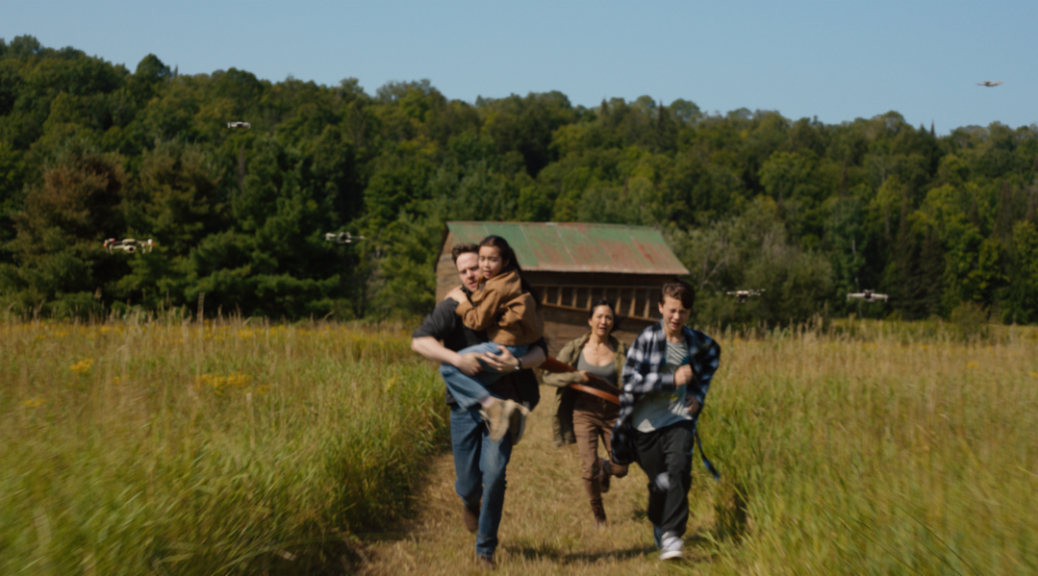
Scientist couple Daniel (Ready or Not‘s Mark O’Brien) and Michelle (Constance Wu, Hustlers and Crazy Rich Asians) live out in the country with their two teen kids (Calista Crowe, Isaac Smelcer-Zhang). They’re not married, and if Daniel keeps abandoning his family to search for signs of alien life in his underground lab, they won’t be any time soon.
This time he swears it’s different, though. Really. He finally has proof we are not alone. Too bad no one at NORAD is listening to him anymore.
And even when Daniel’s newest findings convince Michelle, she implores him not to..ahem…disclose the news to anyone. But in an impulsive moment, he emails the data to a trusted contact and instantly becomes the target of a mysterious threat.
In his debut behind the camera, writer/director William Woods crafts a competent ride full of paranoia, cautionary tales and family bonds. The cast is trusty and believable (William Fichtner’s second half cameo is an added bonus), but the third act moves the film closer to a softened young adult thriller assembled via well-traveled plot points and surface level messaging.
To say what films The Outer Threat will bring to mind is probably saying too much, but this is one where the trailer teases some closer encounters than those actually delivered.
Still, need a mild, 90-minute diversion with the kids? The Outer Threat will be perfectly fine and pretty forgettable.
Hope & George review this week’s new releases: Minions & Monsters, Enola Holmes 3, Winthrop/Lockbox, Touch Me, Gregg Allman: Music of My Soul PLUS count down the best films of the first half of 2026!
No, really! The horror of the first half of this year has been amazing! Bloody, original, meaningful, fun, terrifying—it has it all! So much, actually, that we’re obligated to run through a quick list of honorable mentions.
Writers Nick Kocher and Brian McElhaney, fresh off the hilariously unhinged Pizza Movie, adapt the 2021 Norwegian film The Trip with a healthy scoop of witty cynicism atop one good ol’ American mean streak.
Jason Segel and Samara Weaving make an excellent pair of frassasins (friendly assassins), he of the emasculated man child and she of the exasperated younger wife wondering what she saw in this guy. Neither is blameless in the demise of the marriage, and the two actors make the deadly bobbing and weaving (pun intended) a surprising, squirm-inducing delight. Over Your Dead Body is an entertaining genre blast that’s pretty hard to ignore. And by pretty, I mean pretty funny.
And pretty gross.
9. Ready or Not 2: Here I Come
On Prime Premium
If you enjoyed Ready or Not, I’m hard pressed to believe its sequel won’t also leave you smiling. Weaving is back for the sequel. This time, Grace is paired with her sister and reluctant sidekick Faith (Kathryn Newton), as both are forced to endure Round 2. And what this game teaches us is that the entire world is run by a bunch of billionaires, each of whom is unspeakably, irredeemably evil. Just like real life!
Weaving and Newton share a fun, funny, bickering chemistry. Their backstory becomes the spine of a film that, like the original, delivers series of entertaining, bloody set pieces.
8. They Will Kill You
On Disney+, Hulu, HBOMax, and Prime
Zazie Beetz is Asia. She takes a gig as a maid in old school, elite Manhattan high rise, The Virgil. Asia has ulterior motives. The Virgil has ulterior motives. It’s a home for Satanists and she is to be their sacrifice. But Asia has mad skills and the best hair in action hero history, so The Virgil’s residents don’t have such an easy time of it.
What follows is room after crawlspace after room of absolute carnage. They Will Kill You definitely bears a resemblance toReady or Not 2: Here I Come. But this film is more hard-core, the stakes are higher, and the confined, goretastic action is superior.
7. Crazy Old Lady
On Shudder, Prime
Crazy Old Lady traps us in a home with a dementia sufferer who’s stopped taking medication and has embraced a violent unreality. But Martín Marengui, an Argentinian filmmaker, is less interested in what the future holds as what the past hides. He takes a Death and the Maiden approach to much of the film. The result is a profoundly uncomfortable, breathtakingly performed exhumation of the kind of dark past that refuses to stay buried in the garden.
Mauregui builds tension, delivers unexpected shocks, and lets his exceptional cast compel your attention. Despite its exploitation title, Crazy Old Lady delivers a gripping tale.
6. Leviticus
In theaters
Writer/director Adrian Chiarella’s heartbreaking, aching coming-of-age horror deposits Naim (Joe Bird, wonderful) in an Australian backwater with his widowed mom (Mia Wasikowska). She’d been struggling but has found strength in a small community church. That community is less supportive of Naim and Ryan (Stacy Clausen), the boy he loves.
Leviticus turns into a supernatural horror story, but its themes are as true as they can be. Those who seek to save you are the danger, and that which they would save you from is your only salvation. The film is fearless, tender, aching, frightening, and a must see.
5. The Bride!
On Disney+, Hulu, HBOMax
One part Metropolis, one part Bonnie & Clyde, just a touch of Bride of Frankenstein and yet somehow entirely writer/director Maggie Gyllenhaal’s own, The Bride! deserves that exclamation point. Jessie Buckley is a force of nature in a dual role—sort of a triple role, really: an unhappy Chicago gangster’s moll; Mary Shelley, silenced far too soon; and a monster, chaotic, unruly, unburdened by memory and guided by peculiar fury.
The Bride! delights with an anarchic energy, but its underlying plot is tight, its characters clearly drawn and beautifully performed, and its aesthetic wondrous. In just her second feature, after 2021’s sublime The Lost Daughter, Gyllenhaal’s cemented her spot as one of the most exciting filmmakers working.
4. Hokum
On Prime
Damian Mc Carthy is doing something right. The Irish filmmaker writes original stories, invests time and attention to visual storytelling, and produces eerie, memorable horror. There’s an elegance to his movies, but his tales are not meant simply to provoke thought or to elevate the genre. Caveat, Oddity, and now Hokum draw from a long tradition of Irish horror storytelling and love a jump scare as much as anybody.
Scene after scene balances a funhouse vibe with Irish folktale spookiness, and the vintage horror beauty of every frame beguiles you. Caviat offered quietly claustrophobic terror. Oddity delivered clever, melancholy horror. Hokum feels more polished yet more old school. It is perhaps less terrifying than Mc Carthy’s previous features, but it’s a haunting good time.
3. Backrooms
In theaters
Twenty-year-old filmmaker Kane Parsons adapts a series of shorts that made him a YouTube force, all of it based on online Twenty-teens creepypasta dread of being trapped eternally in an endless, yellow, moistly carpeted maze of empty rooms with no hope of escape. The fact that Parsons turned this concept into a compelling feature essentially about our own labyrinthine minds and psychiatry’s impotence is pretty impressive for a teenager!
The endlessly talented Chiwetel Ejiofor and Renate Reinsve play two disillusioned adults lost in the maze. Here are two actors who’ve built careers on understated, natural performances that ground every moment onscreen in something honest. Which makes them a magnificent choice for a film where nothing makes sense, and that’s the whole point.
2. 28 Years Later: The Bone Temple
On Netflix
There is more visceral horror in the first three scenes of Nia DaCosta’s film than in the entire hour and fifty-five minutes of 2025’s 28 Years Later. She delivered the first great horror film of the year with 28 Years Later: The Bone Temple, also written by Alex Garland. It picks up the most intriguing threads left untied last time: those of the band of Clockwork Orange-esque marauders who saved young Spike (Alfie Williams) from the infected, and the beautiful soul covered in iodine and living amongst the bones, Dr. Ian Kelson (Ralph Fiennes).
The filmmaker (Little Woods, Candyman, The Marvels, Hedda) returns to horror with aplomb, expertly weaving from the grimmest horrors the sadistic, bewigged Jimmys can muster to the tender bromance blossoming over at the bone temple. And the climactic musical number she stages there is a thing for the ages.
1. Obsession
In theaters
Obsession is a film about consent. Sad by Bear (Michael Johnston) can’t bring himself to confess his feelings for coworker Nikki (Inde Navarrette). He’s so desperate after one cringy missed chance that he breaks open a One Wish Willow he’d purchased as a joke and—without reading any of the warnings printed all over the box—wishes that she would love him more than anyone else on earth. And she does.
The themes writer/director Curry Barker mines are incredibly of-the-moment. Bear wants what he wants, but he wants it to be true. It isn’t, but that’s not good enough. Make it be true. But you can’t make something be true if it isn’t true, no matter how sad the boy is who wants it. Male entitlement masquerading as loneliness leads to violently self-centered behavior. Barker’s story, however jump-scary or genre friendly it becomes, never forgets this central, relevant concept.