Tag Archives: movie reviews

Don’t Judge It By the Cover

The Bookshop

by Rachel Willis

The Bookshop is not what you might imagine. Adapted from the novel of the same name by Penelope Fitzgerald, one might expect a sentimental, feel-good film about the power of books to open up closed minds. That’s not what we get in writer/director Isabel Coixet’s latest film.

At the heart of the story is Florence Green (Emily Mortimer). Having recently purchased a building known colloquially as “the Old House”, she decides to open a bookshop in the space. It’s a way for her to find a level of independence, as well as rekindle a connection with her late, much beloved, husband. However, she is unprepared for the level of opposition she faces in the small seaside town of Hardborough.

The opposition is spearheaded by Mrs. Violet Gamart (Patricia Clarkson), a woman who is used to getting what she wants, and what she wants is to turn the Old House into an arts center. On her side are several Hardborough residents who seem to oppose the bookshop only because she does.

The film starts strong. We watch as Florence overcomes the stall tactics of her solicitor, squashes rumors that she plans to buy another property for her bookshop, and successfully launches the shop of her dreams. However, before the first act concludes, the film begins to meander.

As Florence contends with obstacles she didn’t foresee, she becomes friendly with her first customer, the local eccentric, Edmund Brundish (Bill Nighy), and their relationship blossoms with an exchange of letters. In a scene reminiscent of The Age of Innocence, Brundish reads his first letter into the camera. It’s an unusual technique, but it helps to humanize the reclusive man. Unfortunately, not enough time or importance is given to this correspondence.

Florence’s only other ally in this world is her young assistant, Christine (Honor Kneafsey). It’s touching to watch Florence try to instill a love of books into Christine, but the connection between the two is never earned. There is little chemistry between the actors; their interactions are awkward when they should be affectionate.

For a movie with only a few characters, it still ends up feeling like too many. Minor characters are given more importance than they deserve. Major characters aren’t given time to develop meaningful relationships. Most of the characters are one-dimensional.

The lovely cinematography captures the theme of the film better than any other aspect. Hardborough appears both enchanting and foreboding. If this had been better explored through character dynamics, The Bookshop may have made a lasting impression. As it is, it’s a beautiful, but empty film.


I Don’t Want to Go Out—Week of September 3

A bunch of new stuff in home entertainment this week, not one of them a dud. We have two of the year’s absolute best, followed by a slew of really solid flicks you may have missed during their brief stints in theaters. Now is the day to rectify! We’ll help you sequence your week’s viewing.

Click the film title for the full review.

Hereditary

Won’t You Be My Neighbor?

Beast

Ghost Stories

*new on DVD

Adrift

The Screening Room: Hiding in Plain Sight

A lot of little gems out in theaters this week. On the podcast, we talk through Searching, Operation Finale, The Little Stranger, Kin and what’s new in home entertainment.

Listen to the full podcast HERE.

Family Recipe

Kin

by Hope Madden

I’m no cook. If it’s not on Chipotle’s menu, I’m not eating it. And yet, I feel like I understand certain things that don’t go together, say Captain Crunch cereal and goat cheese, meatball subs and tuna, ice cream and hair.

That’s kind of the experience to be had when watching Kin.

Advertised as an adolescent SciFi adventure where a ‘tween finds an intergalactic gun and all his problems are solved (nothing tone deaf about that storyline), the film is much more than that. And also much less.

Eli Solinski (Myles Truitt) is an adolescent outsider, missing his mom and trudging through his dad’s chores and disappointment. His older brother Jimmy (Jack Reynor, or as I like to call him, Handsome Seth Rogan) comes home from a 6-year prison stretch, and things go quickly to hell in a handbasket thanks to his old associate, Taylor (James Franco).

Filmmaking brothers Jonathan and Josh Baker start off with traditional angsty teen drama. They quickly warp it into a gritty, mid-budget crime thriller, with a little charm thanks to Franco’s characteristic weirdness: badly cut mullet, unexplained puffy coat, women’s shoes.

But then it turns into a road picture with antics and a sort of tragic take on the cycle of poverty, crime and bad decisions. By this time, we realize that Truitt doesn’t have much hope of establishing a character, as he may, indeed, have no idea what film he’s in.

Reynor fairs slightly better. He’s likable and vulnerable. To pull the role off, he’d also have to be believably corrupted, which is where Reynor falters.

Zoe Kravitz is Milly, the stripper they befriend. Let’s not even get into it.

The strength and honest conflict in the film is really the relationship between the two brothers and the inevitable, depressing conclusion their lives together will lead to.

But, wait. Don’t settle into that just yet, because there’s an over-the-top, high-octane climax headed inexplicably and irreversibly toward you. And remember the whole SciFi nonsense they threw at us in the trailer? Well, it finally finds its resolution in the last five minutes of the film—a plot twist that is so mismatched with the tone of the film leading up to it, it truly feels like a whole other movie just came knocking on the door because it was lost.

Dude, all we wanted was beans and rice.

An Unfortunate Movie Mixtape

Juliet, Naked

by Brandon Thomas

Movies that mix music and quirk tend to punch me right in the feels (is a 36-year-old allowed to say “feels”?). Once, Begin Again and Sing Street are a few examples of movies that gave my tear ducts a workout. The only feelings Juliet, Naked conjured in me were boredom, apathy and a dash of frustration.

Annie (Rose Bryne) is stuck in a rut. She lives in her sleepy hometown and works the same job her father did. Her boyfriend, Duncan (Chris O’Dowd), is more interested in a long-disappeared musician than starting a family with her. When a CD demo for Duncan’s favorite musician, Tucker Crowe (Ethan Hawke), shows up at their home, Annie is the first to listen. Her negative reaction to the album, mixed with Duncan’s over-the-top positive one, sets off a chain of events that ends with Crowe himself visiting her in England.

I realized halfway through Juliet, Naked that director Jesse Peretz (Our Idiot Brother) was trying to reinvent the classic rom-com. Instead, it’s more of a Frankenstein’s monster hybrid, as one part indie drama mixed with your classic rom-com clichés makes for strange bedfellows. It’s not to say that these tropes couldn’t exist together – they could – but it would need to be in the hands of a stronger filmmaker.

The cast fares a little bit better. Hawke and Byrne do what they can with a messy script, and they have an undeniable chemistry. The problem – again – lies in that it sometimes feels like the characters are moving between two different films. One moment, Hawke’s character is lamenting his shortcomings as a father, and the next he’s in a hospital bed surrounded by all of his ex-wives/lovers. It’s a scene that wouldn’t feel out of place in a network sitcom.

Byrne is the one saving grace. She’s always been able to lift the material she’s given and it’s no different here. There’s a sweetness to Annie that never feels naïve. She’s a competent, driven woman who just hasn’t allowed herself to go after what she wants in life.

There’s a behind-the-camera pedigree to Juliet, Naked that makes its shortcomings all the more disappointing. It’s based on the book by Nick Hornby (About a Boy, High Fidelity), and produced by Judd Apatow (Bridesmaids, Superbad, Pineapple Express). Apatow has especially shown himself to be adept at producing really funny, thoughtful comedies.

Had Juliet, Naked kept both feet firmly in one genre, I think the film would’ve had something nice to say. Instead, it’s a murky mess of what could have been.

Old Money, Old Problems

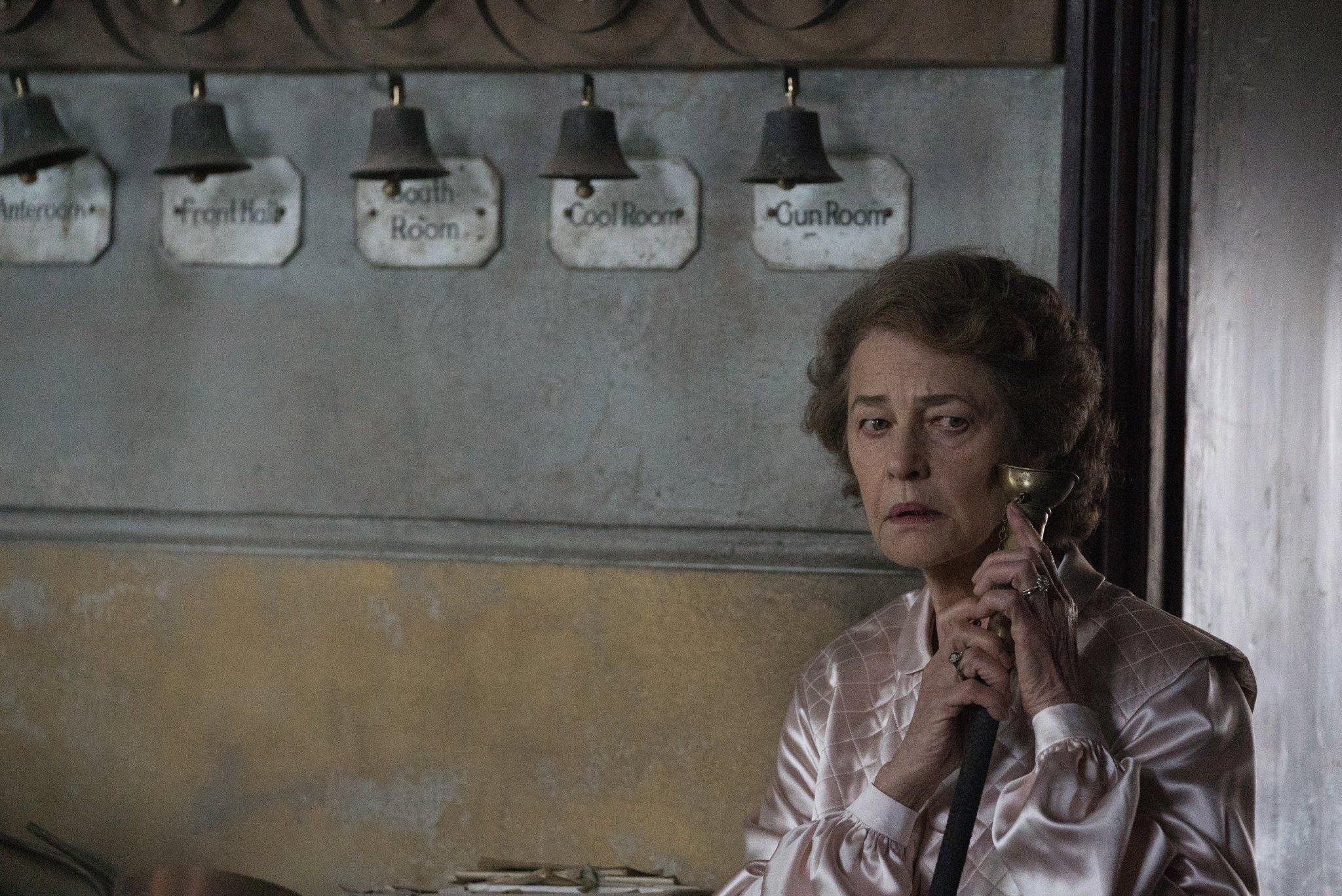
The Little Stranger

by Hope Madden

There were a lot of reasons to be excited about The Little Stranger.

The film is director Lenny Abrahamson’s follow up to his staggeringly wonderful 2015 film Room. It stars three of the most solid character actors you will find (whether you know the names or not): Domhnall Gleeson, Ruth Wilson and Will Poulter.

Who else? Oh, yes, Charlotte Rampling, who’s been a miracle of understated power since the mid-Sixties.

On top of all that, it may (or may not) be a period British ghost story, and who doesn’t dig that?

But something’s gone terribly wrong with The Little Stranger.

It looks stunning. Abrahamson’s camera captures postcard quality images of spooky old mansion quarters, lonesome countrysides, sparse bachelor apartments.

Gleeson’s performance is wonderful: restrained and proper to a degree that suits this particular character. Poulter (who is a marvelous and amazingly versatile actor) is underused, as is Rampling, although she cooly delivers enough decisive lines to make an impression.
Performances, too, are picture-perfect.

Wilson impresses most as Caroline Ayres, the put-upon sister in an old-money family that’s seen its share of heartache. She’s being courted, so to speak, by reserved country doctor Faraday (Gleeson), while she helps to care for her badly injured (inside and out) WWII veteran brother Roddy (Poulter), quietly helping him manage his responsibilities to the estate.

Caroline longs to be free. Longing is maybe the most palpable theme in the film, along with the underlying nod to classism. Unfortunately, by Act 3, you’ll be longing for some action of any kind.

Abrahamson’s film, adapted from Sarah Waters’s novel by screenwriter Lucinda Coxon (The Danish Girl), moves at an iceberg’s pace. Though the bumps, burns and bruises in the night are developed with the proper haunted house atmosphere, the resolution is so underdeveloped and slow in coming that the film cannot help but disappoint.

The reveal makes sense to a degree, and bravo to Abrahamson for expecting audiences to have paid enough attention to earlier dialog that we might fathom the conclusion. At the same time, with too much thought, that reveal can fall apart. So, if you’re not paying attention you will have no idea what just happened. Pay too much attention and the mystery’s resolution will disintegrate on you.

It’s unfortunate because there is an awful lot of talent and aesthetic going to waste here.

I Don’t Want to Go Out—Week of August 27

It’s like an end-of-summer fire sale this week. So many movies! All available to watch from the couch in unwashed yoga pants and Alf tee shirts. I mean, that’s how we imagine you watching these, but really, wear whatever you want. The important thing is to let us help you decide where to spend your valuable time.

Click the movie titles for the full review.

Tag

American Animals

Upgrade

A Kid Like Jake

Book Club

Mary Shelley

Felt Fetish

The Happytime Murders

by Hope Madden

Do you like Melissa McCarthy? Foul language?

How do you feel about puppet ejaculate?

You should probably be comfortable with at least two of the three if you’re considering seeing The Happytime Murders.

In a Who Framed Roger Rabbitt? vein, The Happytime Murders serves up a noir that exists in a town where flesh-and-blood humans co-exist with fantasy – in this case, puppets. Not Kermit, though. Not Big Bird, either.

No, like most noirs, the film lives on the seedier side of town, so we meet puppets with problems—sex addicts, porno freaks, folks with a mean jones for a sugar fix. The type of cat who’d perform a Continental Hot Sock for just fifty cents.

Continental Hot Sock—how great is that name?

Disgraced cop turned private investigator Phil Philips (Bill Barretta, longtime Muppet voice of Pepe the King Prawn, Rowlf the Dog, The Swedish Chef and others) re-teams with his old partner, Det. Edwards (McCarthy), to solve a string of puppet murders.

The case smells like rotten cotton.

McCarthy interacts as believably with puppets as she ever did with Sandra Bullock, and Todd Berger’s script takes excellent advantage of her whip-smart profanity maneuvering.

Not every joke lands. In fact, too many fall entirely flat and far too much time is spent cursing simply to curse. But there are also some spit-take laughs. McCarthy delivers several, and the always glorious Maya Rudolph is responsible for many others.

There is an underlying commentary in Happytime Murders that can be read as a take on systemic racism, or as a note on the underappreciation of puppetry as an art form. Or both? Systemic racism as a metaphor for marginalized puppeteers feels a little tone deaf, but the filmmakers aren’t trying to make the audience comfortable and Happytime Murders is not one for nuance.

The film is raunchy. It amounts to 90 minutes of profane, DNA-spewing nastiness with very little story to redeem it. I’m pretty sure that’s the point.

Director and puppeteer royalty Brian Henson, son of Jim and filmmaker behind The Muppet Christmas Carol and Muppet Treasure Island, spares no one as he spits in the eye of the family film that’s been his family legacy.

Actually, that may not be spit.

Hollywood in the Closet

Scotty and the Secret History of Hollywood

by Brandon Thomas

Hollywood has always been about vanity, secrets and fiction. It’s an industry filled with people who make a living pretending to be someone else. Scotty and the Secret History of Hollywood tells a tale of men and women who led fictional personal lives too.

After his service in World War II, Midwest transplant Scotty Bowers lands a job at a busy gas station on Hollywood Blvd. It’s here where Scotty meets his first secretly gay Hollywood celebrity: Walter Pidgeon (Forbidden Planet). This meeting—and subsequent sexual encounter—opens Bowers’s eyes to a large community of closeted gay actors and actresses. He wants to give them a place to meet one another…and to make a buck in the process. Through his likability and ability to find sexy, young men and women, Bowers cements his place among the Hollywood elite.

During his tenure as “Pimp to the Stars,” Bowers finds himself setting up rendezvous for more than just famous actors and directors, as business tycoons also knew of his reputation. Bowers also attracts the attention of British royalty. Through it all, Scotty Bowers claims to only want one thing: to make people happy.

Scotty and the Secret History of Hollywood could’ve easily turned into one big tell-all (and there are some revelations that I didn’t know), but director Matt Tyrnauer wisely keeps the focus squarely on Bowers himself. Scotty Bowers isn’t the flamboyant center of attention you’d expect. Instead, we’re shown a 95-year-old hoarder who spends most of his free time cruising the streets looking for junk he can load into one of his many homes.

The film wisely doesn’t rely on talking heads to fill in the gaps of the story. There’s the occasional interview with a Hollywood player like Peter Bart (former editor of Variety) or one of Scotty’s “boys,” but the bulk of the movie is composed of Scotty’s interactions with these people. Tyrnauer strives to show how Bowers continues to make connections with people, even though gay culture in Hollywood has become mainstream.

Scotty and the Secret History of Hollywood is a celebration of sexual freedom. The feel-good nature of the film is a byproduct of who Bowers is as a person. He claims he only wanted to make people happy—and he meant it.