Tag Archives: movie reviews

Lost (Girls) in Translation

Lost Girls and Love Hotels

by Brandon Thomas

“I tell myself…there’s no happy ending.”

Cinema revels in emotion. It’s why the artform has lasted well over a century. We love to experience films that make us laugh, make us afraid, and make us examine even the darkest of our decisions. Lost Girls & Love Hotels is an exploration of these painful, disorientated choices.

Margaret (Alexandra Daddario) is an American ex-pat living in Japan. By day, she teaches at a training academy for Japanese stewardesses. By night, Margaret loses herself in booze and random rendezvous in the red light district. Her life of debauchery softens after she meets a brooding Yakuza (Takehiro Hira).

Margaret’s pain and self-loathing are apparent from the opening frames: she drunkenly stumbles through a subway entrance, tears brimming in her wide eyes as she realizes a man is lurking behind her. Fear is less apparent in her distant gaze. What I saw was more akin to someone finally succumbing to their demons. This was rock bottom.

Lost Girls & Love Hotels isn’t looking to break new ground. There’s no way this movie could. What’s interesting – and original – is how this kind of movie is told through the point of view of a female character. We’ve seen self-destructive dudes do this for eons. Let the ladies have a turn at spiraling out of control! 

Daddario turns in an impressive performance as Margaret. She walks a fine line – showing the character’s high-highs and low-lows with ease. Her wide-eyed, all-American look helps her stand out in a mostly Japanese cast. One would expect a person with such outwardly beauty to harbor very little in the way of pain. For a character like this one, believability is key, and Daddario delivers. 

Director William Olsson and writer Catherine Hanrahan (adapting her own novel) haven’t set out to make a salacious sex drama. While Margaret’s BDSM escapades inform who her character is, Lost Girls & Love Hotels is more interested in a person who has latched onto numbing behavior. Isolation, even with a core group of friends and co-workers, is ever-present in Margaret’s condensed world. 

There’s a simmering sense of danger running through the entire film. Olsson never wrings false drama out of it, but that subtle feeling is there nevertheless. When Margaret does find herself in a precarious situation, it feels more like an eventuality, not the tacked-on payoff to a sleazy thriller.

Grounded with an outstanding lead performance, Lost Girls & Love Hotels is a look at how sadness and isolation isn’t something you can run away from – even if you run halfway across the world. 

Make America Great Again

Antebellum

by Hope Madden and George Wolf

The past is not dead. It’s not even past.

That Faulkner quote gets a lot of action in writers/directors Gerard Bush and Christopher Renz’s social nightmare Antebellum.

The titular term describes the period in American history just prior to the Civil War. That’s where this thriller finds its horror, and where a prominent, present day African American sociologist/activist/author wakes up to find herself trapped.

Janelle Monáe crafts an impressive lead as Veronica, a PhD beaten, branded and forced to accept a slave name in a film that plays out like a disturbingly relevant Twilight Zone episode.

Enslaved on a reformer plantation, “Eden” works to stay alive long enough to plan an escape and outsmart two Confederate officers (Eric Lange, Jack Huston) and the mysterious mansion mistress (Jena Malone).

The hideous rise of white nationalism is the true nightmare here – fertile and bloody ground for horror. From Godzilla to Get Out, horror has always brimmed with social commentary and anxiety, so it should come as no surprise that a genre film tackles America’s racist shame this directly.

And while this approach certainly grabs your attention with its boldness, Bush and Renz can get too caught up in obviousness and speech-making. The second act suffers most from these heavy hands. The modern day shenanigans with Veronica and two friends (Gabourey Sidibe, Lily Cowles) push too hard, last too long and say very little.

But as much as Spike Lee has recently connected the past and present of racism with layered nuance, Bush and Renz go right upside our heads. Pulpy exploitation? It goes there. It’s a horror movie.

Horror movies exist so we can look at the nightmare, examine it from a distance, and come out the other side, unscathed ourselves. Antebellum is acknowledgment and catharsis, and not only because all those Black people being terrorized on the screen are fictional, instead of real victims in another cell phone crime scene. The film’s true catharsis – a highly charged and emotional payoff – lies in Act 3: comeuppance.

And it is glorious.

There are stumbles getting to the fireworks, but for sheer heroic tit for tat, Antebellum delivers the goods.

Secret Garden

The Garden Left Behind

by Hope Madden

Newcomer Charlie Guevara charms in Flavio Alves’s drama The Garden Left Behind with a bittersweet performance as Tina, an undocumented Mexican trans woman getting by in NYC. Her performance is simultaneously optimistic, wearied, frightened and strong.

Wisely, filmmaker Alves focuses his tale unblinkingly on Tina—her day to day, her loving if prickly relationship with her grandmother (Miriam Cruz), her warm and supportive community of friends, her struggle with an insecure boyfriend, her tentative steps toward transition. In a real way, every movement in the film is about transition, about claiming something that belongs to Tina, whether it’s her voice or her financial independence, her emotional health or her political power.

The rawness of Guevara’s turn sometimes makes way for self-consciousness that brings certain scenes to an awkward halt. Still, Guevara and Cruz share a lovely, lived-in chemistry. It’s their relationship that both buoys the film and makes the it ache all the more.

The story around the periphery crystallizes the ways in which the lives of trans people—especially trans women of color—differ from your garden variety New Yorkers’. Alves’s hand is not heavy; the fact that so many of Tina’s interactions could be taken as potentially menacing speaks volumes without an overt narrative. It’s actually in this B-story that the filmmaker may make the most salient and heartbreaking points.

If the film feels authentic, that’s unsurprising. Alves not only cast trans actors for each trans role, but he also employed a staff of transgender filmmakers in creative and crew roles. This after several years of research within the NYC transgender community to develop the insightful and poignant storyline.

It’s no surprise The Garden Left Behind became the 2019 SXSW audience award winner. The film breaks through as not only an admirable artistic vision produced with integrity, but a beautiful human tale of perseverance and love.  

A Darkness in the Light

Luz: The Flower of Evil

by Hope Madden

As colorful as a dream, Juan Diego Escobar Alzate’s feature film debut Luz: The Flower of Evil looks like magic and brims with the casual brutality of faith.

Set inside a religious community in the mountains of Colombia, the film drops us into ongoing struggles with the group’s religious leader, El Señor (Conrad Osorio). No one knows the devil as he does, he reminds his daughter Laila (Andrea Esquivel).

She lives contentedly, devoutly, along with her two adopted sisters. El Señor and the villagers consider the trio angels—just as they believe the little boy chained up out back is the Messiah who will deliver the community from its recent calamities.

Though never entirely detailed, the internal logic of the film and the community is clear enough to feel simultaneously familiar and horrifying. The way the filmmaker wrestles with what is and is not real, with forgiveness and the morally ambiguous nature of man, and with our tendency to blame God or the devil for our own shortcomings is frustrating and intoxicating.

Alzate gets maximum impact for minimum budget thanks in large part to Nicolas Caballero Arenas’s cinematography. His breathtaking visuals add spooky richness, turning this Western of sorts into a beautiful, lyrical, macabre Columbian folktale.

Lovely as it is, the film echoes of loss. The title itself conjures what is absent. As time wears on and the “angels” lose confidence in their father figure, remembered stories of the late mother figure Luz (Spanish for light) take the space for them that El Señor’s tales of God take for the rest of the community.

Luz: The Flower of Evil surprises as often as it relies on expectations to deliver its message. The film is more atmospheric than cautionary, its resolution a fitting end for characters’ whose own logic doesn’t likely reflect that of the audience. It is a vision, from its opening musical notes to its closing image, though, that marks a filmmaker worth discovering.

Gone Catfishin’

Summerland

by Rachel Willis

It’s hard to sympathize with a catfish – someone who pretends to be someone else online to develop a misleading relationship.

Yet, in the film, Summerland, directed by Lankyboy (the nickname for directing duo Kurtis David Harder and Noah Kentis), we’re asked to do just that.

Bray (Chris Ball), who is pretending to be Victoria online, has made a connection with Shawn (Dylan Playfair) via a Christian dating site. Bray/Victoria has plans to meet Shawn at the music festival, Summerland.

Along for the road trip to Summerland is Oliver, Bray’s best friend, and Oliver’s girlfriend, Stacey. The problem? Bray has been using Stacey’s pictures to construct Victoria online. Once the trio gets to Summerland, will Bray be able to find Shawn before he finds Stacey?

Miraculously, as the film progresses, we do begin to sympathize with Bray. As a gay teenager, he is not accepted by his parents and struggles with his identity. He wants to meet someone, to have a relationship, and be himself. Despite the fact he has lied about his identity, he’s managed to be as open with Shawn as he has with anyone.

However, the film doesn’t let Bray off the hook entirely. We’re repeatedly reminded that he’s constructed a relationship around a lie. We must ask ourselves if some lies are forgivable when the liar struggles with what it means to be himself.

Most of the film is centered around the road trip to Summerland. Bray is anxious to get there so he can finally meet Shawn in person. Oliver wants to enjoy the journey. Stacey is rebelling against a stepdad she doesn’t like.

Lankyboy wants their movie to be quirky, but it’s a conventional road trip/relationship movie with some weird extras thrown in. Those weird moments are forced, don’t contribute much, and end up making a short movie feel intolerably long.

There are also far too many montages for such a short film.

The actors aren’t terrible in their roles. They’re not the worst trio to spend time with on a road trip movie, and the film does have one or two funny moments. But too much of the movie is focused on what it wants to be rather than effectively embracing what it is.

Unfortunately, what is ends up being is an unmemorable experience.

H is for Hopeful

H is for Happiness

by Cat McAlpine

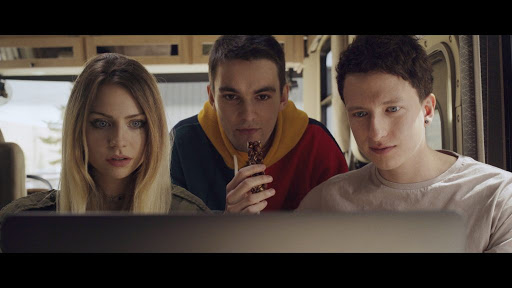
H is for Happiness navigates grownup tensions and trauma from the perspective of an optimistic 12 year-old named Candice (Daisy Axon). Candice’s class is given an assignment to recount their life via a narrative based on the letters of the alphabet. On the same day, a new student arrives.

“Can you keep a secret?” newcomer Douglas asks her.

“No.” Candice chirps back with cheerful honesty.

Douglas (Wesley Patten) claims he’s from another dimension, but it doesn’t faze Candice. Little bits of mystery and magical realism like this make Candice’s world deeper and more fantastical, even when the magic ends up being rooted in reality.

Brightly colored and fun, exaggerated moments make the film’s world seem vibrant and alive in a storybook kind of way. But it has its dark moments too. Candice may be hopelessly optimistic but everyone around her is miserable. Her grieving, depressed mother stays in a room deeply saturated in blue. Her father and uncle, at odds, exist in opposite landscapes. Her father works in a tiny garage office. Her rich uncle sails a picturesque sailboat on a bright blue sea.

While H is for Happiness is told through Candice’s eyes, it’s not just a watered-down children’s story. The way it unfolds is enjoyable to all ages. Instead of going for easy laughs, the film explores the frustration of trying to fix a broken family with silly hijinks that simply don’t work. The heavy dose of realism creates continued tension throughout and motivates Candice to continue exploring what her role in the world might be as she turns 13.

Director John Sheedy frames his shots with whimsy and beauty, showing adults struggling through Candice’s eyes. Bright colors are always caught just off in the corner to show how the world continues beyond the screen. Candice’s broken-spirited father is perfectly framed by pastel balloons at a fateful birthday party. Its images like these that meld nostalgic memories with the realities behind them.

Making her film debut, Axon is fantastic as Candice, showing a precocious can-do attitude will make you fall in love with her immediately. Her partner in crime, Patten, is charming and equally likable as Douglas from Another Dimension.

H is for Happiness is a beautifully crafted coming-of-age movie that teeters on the edge of childhood innocence and the next step beyond it.

Family Matters

Blackbird

by Darren Tilby

Based on his own Danish-language film Silent Heart, writer Christian Torpe partners with director Roger Michell for the Anglo-American remake, Blackbird. You likely know the story already: an ailing matriarch invites her fractured family around to stay for one last weekend of joy and festivities before she plans to end her life through euthanasia. But, as is so often the case in films like this, everyone’s a long way from even pretending to play happy family.

Susan Sarandon stars as Lily, the head of the family unit. Sam Neill puts in a career-high as Paul, Lily’s husband, who proceeds with a stoic, removed air about his wife’s illness and impending self-death.

Kate Winslet’s Jennifer is the first to arrive, early, along with husband Michael (Rainn Wilson) and son Johnathan (Anson Boon). Straight-laced and proud, Jennifer is the polar opposite of her younger sister, Anna (Mia Wasikowska); a flighty young woman who traipses in late, “looking like shit,” with girlfriend Chris (Bex Taylor-Klaus) in tow.

Completing the family unit is Liz (Lindsay Duncan), Lily’s oldest and dearest friend.

As you can probably tell, the film’s main attraction is its star-studded cast. A sea of riveting performances is what awaits us and Torpe’s well-written, character-establishing (and building) dialogue make these people come alive and feel genuine—even if some of their actions don’t. Indeed, Michell relies heavily on the strength of his actors to deliver the emotional clout the movie promises. There’s no denying the cast is up to the task, although other aspects of the film feeling like an afterthought.

The plot mechanics are hackneyed and unoriginal, while Peter Gregson’s score feels generic and uninspired. Mike Ely’s crystalline visuals, though, are an absolute delight, and effortlessly reflect the beauty and tragedy of both life and death.

It’s unoriginal, and it’s certainly not perfect, but this is a beautiful piece of filmmaking about the celebration of life, love and family, rather than the sadness of death and loss. And it brought tears to my eyes on more than one occasion.

Hope Floats

Buoyancy

by Hope Madden

Hey, it’s been a pretty easy going year. Feel like a movie?

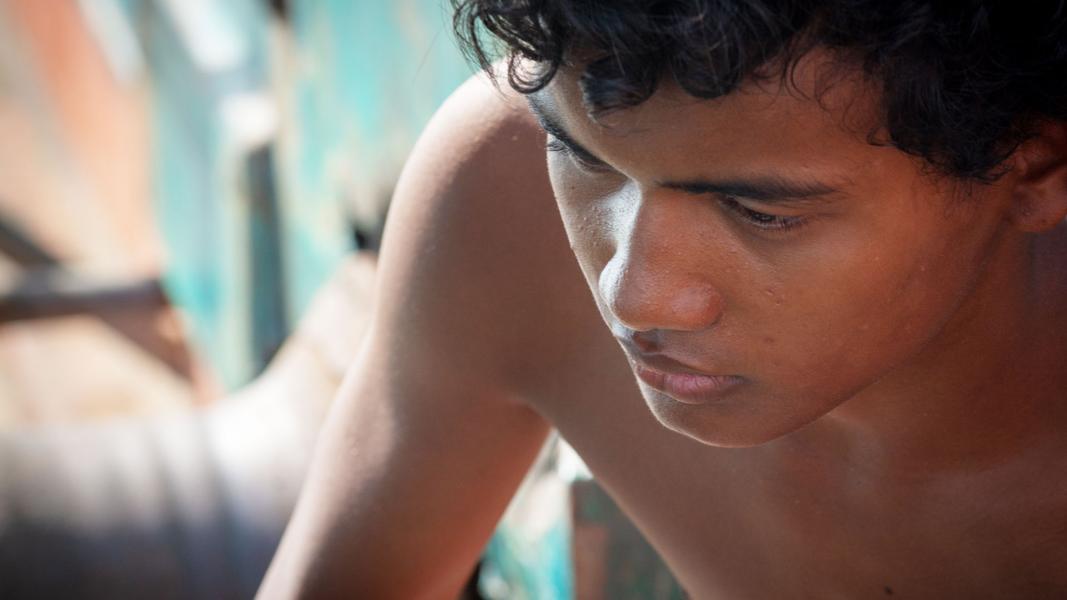
Well, first time feature filmmaker Rodd Rathjen has one for you and you’re not going to like it, but you should watch it anyway. Buoyancy shadows a 14-year-old Cambodian boy sold into slave labor on a Thai fishing trawler.

I know, but stay with me.

In his feature debut behind the camera, Rathjen wisely relies on naturalistic performances from mainly non-professional actors to recreate the circumstances rather than dramatize them.

Sarm Heng is Chakra, a put upon adolescent bristling at the limitations of his life. There’s the universal element of adolescent rebellion, here tied to far more than angst. Chakra does manual labor rather than going to school, and as kids in uniform whiz by him on bicycles, and cars on the nearby highway come and go, his stagnancy and the back breaking monotony awaiting him in adulthood press down on him.

He follows an opportunity to sneak away from home and get a ride out of the country, where he’ll make real money working in a factory. It’s OK if he doesn’t have the $500 fare to leave the country, he can work that off in his first month.

That’s not how it actually works, and we spend the rest of the film watching as Chaka’s realization comes to him in bits and pieces that he will probably never leave this rickety fishing boat.

Rathjen’s film ends with sobering facts concerning the modern slave trade in Southeast Asia, with as many as 200,000 boys and men currently missing and believed to be held in bondage on fishing boats. The filmmaker’s verité style helps us understand how this happens. There’s no boisterous villain detailing the scheme, no, “Ha! You belong to me now!” No one tells you you’re never being paid, never going home. You simply adjust to your circumstances or you die.

There’s little dialog once Chakra leaves the boys in the village behind, but Heng doesn’t need it. The evolution of this character hangs on his face. It’s a remarkable performance, especially from a kid who’s never acted before.

Heng gets an assist from two actors with some experience. An utterly heartbreaking Mony Ros is the middle aged man who falls prey to the scheme in the hopes of providing for his family. The camaraderie between these two characters is powerful, and it’s a theme Rathjen mirrors in Chakra’s relationship with the ship’s captain, played with menacing relish by Thenawut Ketsaro.

What they create together is harrowing, but it’s also a brilliant piece of filmmaking that needs to be seen.

Show Me Your Junk

The Broken Hearts Gallery

by George Wolf

I have no problem at all with scary movies, I love them. But I gotta be honest, I can’t think of many things more frightening than the prospect of dating in today’s social climate.

So kudos to writer/director Natalie Krinsky for squeezing so much feel-goodiness out of the dating tribulations of twenty-something New Yorkers in The Broken Hearts Gallery.

Lucy (Geraldine Viswanathan), a gallery assistant, is smarting from a painful breakup. Her roommate besties Amanda (Molly Gordon from Booksmart, Good Boys, Life of the Party) and Nadine (Hamilton‘s Phillipa Soo) are helping her cope.

First lesson in letting go: get rid of all that junk you’ve saved as souvenirs from past relationships!

But a chance meeting with Nick (Dacre Montgomery from Stranger Things), a budding hotel owner, spawns an idea. If Lucy will help get the hotel ready for opening day, Nick will give her space to open a gallery showcasing trinkets donated by lovers left behind.

Krinsky, a TV vet helming her first feature, leans on plenty of familiar rom-com tropes, but gives them all just the right amount of unabashed enthusiasm to feel more comfortable than cheesy.

The dance montages are numerous, the dialog less like real conversations and more like people waiting for their next turn to quip, and the ladies’ Big Apple cynicism as biting as a sugar-coated fantasy.

But Viswanathan (Blockers, Bad Education) is bursting with bubbly charm, Montgomery brings a welcome, dialed-down authenticity, and Krinsky is able to mine some contemporary laughs from recycled ideas (the actual Museum of Broken Relationships, When Harry Met Sally-styled interviews with the trinket owners).

The Broken Hearts Gallery is often as awkward and messy as it is breezy and spirited. You know where it’s going and it goes there, pushed buttons blazing.

And for 108 minutes, dating in this world seems like it isn’t that scary at all, and could maybe even be fun. Maybe.

Artful Escape

A Step Without Feet

by Hope Madden

“People want to know about the road, if it was hard getting here. That’s not the question.”

A Step Without Feet, the first documentary from Jeremy Glaholt and Lydia Schamschula, spends 90 minutes in snowy Berlin with a handful of refugees from the Syrian war. The filmmakers’ first question: What do you think of the word “refugee”?

They don’t see the word the same way you do.

It’s actually a fascinating way to get into a story that looks sideways at a topic so often portrayed in documentaries. The bloody, lengthy, horrific war in Syria has launched more documentaries than I can count, many of them brilliant, most of them brutal.

Glaholt and Schamschula pull us out of all that brutality, mercifully, and drop us into the newly created lives of those who’ve escaped it: a dancer and a dentist, a musician and a cook, a writer and a student. Their resilience, nostalgia, trauma and optimism are on screen in a film that recognizes salvation—however profound—as just another transition in life.

Though life in Germany has been seemingly peaceful for the group and each has many happy moments to discuss, the anxieties of the past and the longing for what is lost give their peaceful existence a bittersweet flavor.

Many bridge the past and the present, their old home and new, with art. One writes, one dances, one sings, each of them tapping into something that gives creative outlet to their fear and yearning.

The film’s biggest drawback is its lack of context. We’re 15 minutes or more into the film before anyone utters the word Syria. The reasons each one left is never clearly articulated. While those familiar with the conflict would certainly have a sense, the reasons that these individuals needed to flee while their parents or siblings were OK to stay is never addressed.

With the clear and mostly fulfilled goal of casting these human beings in the present tense, the filmmakers likely made the conscious decision not to dig too deeply in this painful terrain. Still, the magnitude of the subjects’ sorrow, longing and trauma is tied to that specific conflict. To do their present justice we need more of their past.

The film—almost exclusively talking head footage of interviews with the seven refugees—remains strangely captivating throughout. Because of the music, the dance, the poetry and the candor, a deeply human and powerfully universal story emerges.