Tag Archives: MaddWolf

RIP David Bowie

We lost the incomparable David Bowie last night, a figure whose impression on this planet is hard to overstate.

We’re all familiar with David Bowie’s contributions to the field of music as a god among men, but how well do you know him as an actor? Unable to play an ordinary man, it’s no surprise Bowie glided enigmatically from one film to the next, routinely representing eternal youth and alienation.

Though not every film choice has been a jewel, here is a handful of recommendations, along with a good Bowie tune to get you in the mood for each movie.


THE HUNGER (1983)
Director Tony Scott’s first major film is a stylish if dated vampire fable.

A beautiful true vampire is in need of a new human lover, because her current mate’s age is finally catching up to him. Atmospheric and sensual, the film is best known for Catherine Deneuve/Susan Sarandon love scenes, but Bowie is hauntingly memorable as Deneuve’s doomed lover John Blaylock.

Quote: Are you making a pass at me, Mrs. Blaylock?
Song: Scary Monsters


THE LAST TEMPTATION OF CHRIST (1988)
Scorsese’s once-controversial crucifixion movie sees Christ as a masochistic everyman, exemplifying moral struggle rather than biblical “accuracy.” Bowie’s small but pivotal role as Pontius Pilate (actually a combination of Pilate and Herod), is understated and effective. The film is more literary than literal, and benefits from a dreamy quality created through Michael Ballhaus’s cinematography and Peter Gabriel’s score.

Quote: It simply doesn’t matter how you want to change things; we don’t want them changed.
Song: The Man Who Sold the World


MERRY CHRISTMAS, MR. LAWRENCE (1983)
This powerful culture clash tale is the underrated story of WWII British prisoners of war in a Japanese camp, perhaps more meaningful now than when it was released in 1983. Haunting cinematography and score, as well as subtle performances and Nagisa Oshima’s fearless direction, combine to create an intensely emotional film. Bowie’s Maj. Celliers, the most layered and provocative character, is the most polished performance of his acting career.

Quote: There are times when victory is very hard to take.
Song: Heroes


BASQUIAT (1996)
This meandering biopic of NY artist Jean Michel Basquiat is buoyed by one of the most reliably brilliants casts ever assembled: Jeffrey Wright, Benicio del Toro, Christopher Walken, Gary Oldman, Dennis Hopper, Parker Posey, and Willem Dafoe. David Bowie more than holds his own amidst this remarkable group, surprisingly insightful as Basquiat’s only true friend, Andy Warhol. An absolutely killer soundtrack gives scenes a little added punch.

Quote: You kids. You drink red wine with fish. You can do anything.
Song: Andy Warhol


MR. RICE’S SECRET (2000)
This rarely seen gem of a children’s film is a low budget Canadian fantasy told without condescension to a pre-pubescent audience. Bowie plays Mr. Rice, wise and mysterious friend to a terminally ill boy. Though the film has its clunky, almost TV movie moments, on the whole it’s a refreshing and interesting coming of age film, made even more poignant with tempered morbidity.

Quote: Every man needs a good blue suit.
Song: My Death


THE MAN WHO FELL TO EARTH (1976)
A very sympathetic, delicate Bowie finds himself on an alien planet (Earth) in this post-modern tale of the trappings of modern life. This eccentric film, co-starring Candy Clark, Rip Torn, and Buck Henry, could be a time capsule of 1976. The film, though sometimes hard to follow, benefits from director Nicolas Roeg’s mastery behind the camera, but it is Bowie’s performance that makes Man memorable.

Quote: Mr. Newton, are you crazy?
Song: Loving the Alien

https://www.youtube.com/watch?v=lfccDapMA14


THE PRESTIGE (2006)
Maybe an unusual casting choice by director Christopher Nolan for the role Nicola Tesla, but in a film built around illusion, Bowie delivers an impressive mix of the legendary and the enigmatic

Quote: You’re familiar with the phrase, ‘Man’s reach exceeds his grasp’?
Song: Life on Mars?


ZOOLANDER (2001)
A cameo, yes, but it made perfect sense! Who else to judge the walkoff?

Quote: I believe I might be of service
Song: Fashion

Mr. Bowie, you are and will continue to be deeply missed.

Fright Club: Best Silent Horror Movies

Horror movies have been around for as long as movies have been around, and we jumped into the way back machine to look at some of the earliest and most influential horror films the genre has to offer. So many fundamental genre elements – tropes the genre adheres to today – were created in these early, eerily beautiful silent gems that they deserve some attention. While there are actually loads of options – nearly everything Lon Chaney ever did, for instance – these are the five films we deem the best.

Listen to the whole podcast HERE.

5) The Unknown (1927)

When Tod Browning makes a movie about side show freaks, color us excited. In this unseemly tale, the great silent monster Lon Chaney is The Amazing Alonzo, an armless knife thrower/sharp shooter/guitar player/smoker in a circus. He has eyes for his show partner Nanon (Joan Crawford, pre-wire hanger), but the circus strongman is hot for her.

So, it all sounds a tad like Browning’s infamous Freaks. But Nanon spurns the strongman because she can’t stand to be groped by men’s hands – which makes it seem like Alonzo is a shoe-in, except that he is not what he appears to be.

Camera trickery, an actual circus performer, and Chaney’s convincing performance work together to create a believable side show character in Alonzo. Browning couples this unsettling performance with an air of seediness and some bizarre plot twists to leave a lasting impression.

4) The Phantom of the Opera (1925)

You know the story – a shadowy figure haunts the Paris opera house, demading that the object of his affection, Christine, be given the lead in Faust. In what amounts to a cautionary tale about women prioritizing career over family, the story revolves around a masked and disfigured madman and the singer who is easily duped, then saved by righteous men.

The reason this particular version of the film works so well is, of course, Lon Chaney’s now-legendary look. The actor devised his own make up and underwent painful tricks of physical contortion, succeeding in shocking audiences with a ghastly but very realistic visage. His flair as an actor is also on display, and though other versions sometimes mine for a bit of empathy or heartbreak as this hideous creature connives for a love triumphant, Chaney delivers menace and horror.

3) The Man Who Laughs (1928)

The German Expressionist director Paul Leni (Waxworks, The Cat and the Canary) worked with J. Grubb Alexander’s adaptation of Victor Hugo’s novel to cast a macabre spell with this film – one of our very favorites.

A nobleman offends the king, who kills the nobleman (iron maiden!) and has his son, Gwynplaine, disfigured by a surgeon so he can spend his life laughing at his fool of a father. The boy is tossed out, wandering in the snow. He finds a blind baby girl, and the two are saved by a traveling carny.

As is Hugo’s way, goodness is found in the tormented and hideous while the gorgeous society show themselves to be the true beasts. The film looks gloomily gorgeous, and in the hands of silent film star Conrad Veidt, Gwynplaine becomes Hugo’s most sympathetic and heartbreaking monster.

2) The Cabinet of Dr. Caligari (1920)

Few films of the silent era or any other are as visually striking as this. Another German Expressionist, director Robert Wiene uses light and shadow, exaggerated angles and shadowy spirals to envelope us in a nightmare.

In a story told in flashback we learn of Francis, who is visiting his bewitched beloved in an asylum. He tells the tale madness – a traveling hypnotist and his somnambulist, performing at a town fair; murder, magic, and lunacy.

The film’s twist ending and framed storytelling have become commonplace in horror, but the look of this film has never been truly recreated. Taken in the context of the time, Caligari becomes a metaphor and premonition of German’s mindless obedience to lunatic, homicidal authority figure. Carl Mayer and Hans Janowitz wrote it just after WWI to reflect their experiences in the war, but it mirrored a growing phenomenon in their country.

https://www.youtube.com/watch?v=Y0A0sfxM6AE

1) Nosferatu (1922)

Best vampire ever.

Not the seductive, European aristocrat, cloaked and mysterious – oh no. With Count Orlock, filmmaker F. W. Murnau explores something more repellant, casting an actor who resembles an albino naked mole rat. Given that Murnau equates the film’s vampire-related deaths with the plague, this vermin-like image fits well. But more than that, thanks to a peculiarly perfect performance by Max Schreck, Murnau mines the carnality of the vampire myth for revulsion and fear, rather than eroticism.

Murnau’s mastery behind the camera – particularly his ability to capture the vampire’s shadow – made the film a breathtaking horror show at the time. But don’t discount this as dusty history. Max Schreck is a freak, and in his bony, clawlike hands, Count Orlock remains the greatest vampire ever undone by a sinless maiden.

https://www.youtube.com/watch?v=sk70lSUqaM8

Into the Woods

The Forest

by Hope Madden

I like a good twin movie as much as the next guy – probably more – but let’s be clear. The Forest is not a good twin movie. It’s not a good movie at all.

Through her freaky twin telepathy, Sara (Natalie Dormer: Hunger Games, Game of Thrones) knows something’s wrong with her sister Jess, living in Japan. She knows she’s alive and in danger, although the authorities calling to verify Jess’s missing person status believe she is dead because she’s gone alone into the suicide forest on Mount Fuji.

Well, off to Japan Sara goes, to enter the forest alone, stray from the path, see ghosts, listen to the advice of creepy school girls who appear in the middle of the forest at night (because there’s nothing at all suspicious about that), and just generally make bad choices.

Every individual has specific buttons horror movies can push. Some people are afraid of clowns, some of enclosed spaces. Some of us have a pathological terror of the woods. Some of the same of us have a twin sister. So, the idea of getting lost in the dark in a forest full of angry ghosts and ghouls as you hunt desperately for your twin sister – well, for some of us, these are buttons that should make it really easy for a movie to be scary.

Here’s what I’m saying – I am the audience for this movie, and it was as scary as an episode of Three’s Company.

Dormer’s performance is far more lifeless than those stiffs hanging from the trees, and director Jason Zada’s overreliance on jump scares and inability to develop atmosphere guarantee a tedious walk in the woods.

Verdict-1-5-Stars

https://www.youtube.com/watch?v=Oi1wU872I-I

Fright Club: Best David Cronenberg Horror Films

It’s the New Year, so high time we got back to our celebration of our favorite filmmakers. Today we troll through the career of the great David Cronenberg, king of corporeal horror. He’s gone on to create some of the most thought-provoking and wonderful non-genre films of the last twenty years, including the masterpiece Eastern Promises, plus the darkly brilliant Maps to the Stars, A History of Violence, and so many more. His vision is uniquely his own, mixing a Big Brother skepticism with a fascination with technology, media, and human anatomy. He brings an often overlooked but wicked humor to most everything.

Cronenberg has directed 8 true horror films, and we found it nearly impossible to leave three films off this list. No individual countdown was rewritten more than this one. As you bitch to yourself about the omissions – and you almost certainly will do that – please know that we deeply love the three films we left off our list of the Top 5 David Cronenberg Horror Films.

For the full podcast, plus George’s gripes about the final 5, go HERE.

5. Shivers (They Came from Within) (1975)

In an upscale Montreal high rise, an epidemic is breaking out. A scientist has created an aphrodisiac in the form of a big, nasty slug. That slug, though, spreads wantonness throughout the high rise and threatens to overrun the city with its lusty ways.

Not Cronenberg’s best film, but this is his first feature length horror and it announces not only his arrival on the genre scene, but it predicts so many of the films to come. The film obsesses over human sexuality, social mores, the physical form, physical violation and infestation, medical science, conspiracy, and free will. He’d revisit all of these preoccupations throughout his career, most obviously in his very next feature film, 1978’s Rabid, which is weirdly similar in every way.

Shivers takes a zombie concept and uses it to pervert expectations. (See what we did there?) They’re not here to eat your brains, after all. It’s the first film where Cronenberg marries ideas of the repugnant with the pleasurable, medical monstrosity with human body. It would be several years before his skill with performances (or maybe casting) matched his other directorial talents, but Shivers is still a worthwhile, utterly bizarre pleasure.

https://www.youtube.com/watch?v=eK9Wal9Dvic

4. The Dead Zone (1983)

One of the rare films Cronenberg directs but doesn’t write, The Dead Zone puts the words of Stephen King in the filmmaker’s hands. The Canadian is matched in weirdness by his lead, Christopher Walken, who plays a schoolteacher stricken with the gift to see the past and future through touch. When Walken realizes that his visions have a “dead zone” – meaning that he can change the future – the plot really begins to quicken.

Martin Sheen chews scenery as a presidential candidate who actually seems far more run of the mill by today’s standards. In fact, Greg Stillson may be too low key for today’s primaries. But back in ’83, such was not the case, and Walken’s blandly named Johnny Smith has to put his money where his gift of touch is if he wants to change an ugly future.

Cronenberg seems unusually hampered by the script, but somehow the way he manages still to focus on what’s weird rather than what’s obvious in the story elevates the film beyond its plot. No character is entirely sympathetic – a hallmark of the filmmaker’s work – and everyone has a bit of the bizarre about him or her, which the movie seeks to expose.

https://www.youtube.com/watch?v=lmC5oPc7L3M

3. Scanners (1981)

This was the one that made Cronenberg an international name in the genre.

As always, Michael Ironside seeps with psychotic menace, this time as Darryl Revok, a “scanner” looking to take control of his mind-blowing ESP-born gifts.

In truth, the film is about mind control – a very sloppy version of it – and that societal fear of being dominated by a stronger being. At its heart, this is another government conspiracy film wherein an agency foolishly believes they can harness an uncontrollable element for military purposes. Scanners is hardly the best of these (Alien is, FYI). But it’s gory fun nonetheless. What makes the effort undeniably Cronenberg (besides the exploding heads) is that connection between human tissue and technology.

The acting is silly, the technology is comically dated, and the computer nerd toward the end of the film inexplicably boasts a band aid on his face. But Ironside is on fire and the movie ratchets up tension by keeping you wondering when the next head will explode.

2. Videodrome (1983)

As bizarre as anything he ever made – even CosmopolisVideodrome shows an evolution in Cronenberg’s preoccupations with body horror, media, and technology as well as his progress as a filmmaker.

James Woods plays sleazy TV programmer Max Renn, who pirates a program he believes is being taped in Malaysia – a snuff show, where people are slowly tortured to death in front of viewers’ eyes. But it turns out to be more than he’d bargained for. Corporate greed, zealot conspiracy, medical manipulation all come together in this hallucinatory insanity that could only make sense with Cronenberg at the wheel.

Deborah Harry co-stars, and Woods shoulders his abundant screen time quite well. What? James Woods plays a sleaze ball? Get out! Still, he does a great job with it. But the real star is Cronenberg, who explores his own personal obsessions, dragging us willingly down the rabbit hole with him. Long live the new flesh!

1. Dead Ringers (1988)

The film is about separation anxiety, with the effortlessly melancholy Jeremy Irons playing a set of gynecologist twins on a downward spiral. Because of patient vulnerability, doctors who lose it are always scary, and Dead Ringers exploits that discomfort brilliantly, partly because the doctors are gynecologists, and folks tend to feel pretty vulnerable in their hands to start with.

Irons is brilliant, bringing such flair and, eventually, childlike charm to the performance you feel almost grateful. The film’s pace is slow and its horror subtle, but the uncomfortable moments are peculiarly, artfully Cronenberg. He brings together sexuality and mutation in a film that is perhaps more tender than anything he’d ever done, but at the same time more wickedly funny and physically uncomfortable than the balance of his work.

Cronenberg had recently shared his most famous mad scientist with the world in his exceptional remake of The Fly. With Dead Ringers, he returns to the world of a damaged scientific genius run amuck and soars once again.

https://www.youtube.com/watch?v=_xmheE3L19c

What’s Not to Love?

The Hateful Eight

by Hope Madden

“You only need to hang mean bastards, but mean bastards you need to hang.”

Perhaps you haven’t noticed, but 2015 may have been the year of the Western. The brilliant, underseen films Slow West and Bone Tomahawk kicked things off, with the amazing The Revenant just around the corner. But it’s the latest from Quentin Tarantino that solidifies the theme, and something tells me The Hateful Eight won’t be counted in the underseen category.

Though not exactly the soul mate of his 2012 near-masterpiece Django Unchained, H8 is certainly a Civil War-era shooting cousin. Set just after the War Between the States, Tarantino’s latest drops us in a Wyoming blizzard that sees an assortment of sketchy characters hole up inside Minnie’s Haberdashery to wait out the storm.

Throwback stylings, wicked humor, a deliberate pace, and thirst quenching frontier justice mark Tarantino’s eighth picture – a film that intentionally recalls not only the more bombastic Westerns of bygone cinema, but many of QT’s own remarkable films.

Kurt Russell (sporting the same facial hair he wore in Bone Tomahawk) is a bounty hunter escorting the murderous Daisy Domergue (Jennifer Jason Leigh) to hang, but they won’t make that last stage to Red Rock because of this blizzard. Hell, they may never make it to Red Rock at all.

With the genuinely gorgeous wide shots of a blizzard chasing a stage coach through a vast Wyoming countryside, all set to Ennio Morricone’s loudly retro score, H8 opens as a true Western, but it soon settles into something closer to an Agatha Christie-style whodunit. Although I’m not sure Christie ever got quite so bloody.

Minnie’s Haberdashery is populated by a lot of familiar faces. Sam Jackson, who’s never better than when he’s grinning through QT’s dialog, excels in a role that keeps the era’s racial tensions on display. Meanwhile, Mr. Orange Tim Roth does his finest Christoph Waltz impression.

Walton Goggins is especially strong as Rebel renegade Irskin Mannix’s youngest son Chris, but it’s Leigh who steals the film. She’s a hoot in a very physical performance unlike anything she’s delivered in her 30 years in film.

Most of Tarantino’s career has been about re-imagining the films that have come before. With The Hateful Eight, he spends a lot of time rethinking his own work. Much of the film plays like an extended version of the “Stuck in the Middle with You” scene from Reservoir Dogs, reconceived as a bounty hunters’ picnic.

As is often the case, QT breaks cinematic rules left and right. Sometimes these risks pay off, sometimes they don’t, but even at 3+ hours, the film never gives you the chance to get too comfortable.

This is not Tarantino’s most ambitious film and not his most successful, artistically, but it is a riotous and bloody good time.

Verdict-4-0-Stars

https://www.youtube.com/watch?v=gnRbXn4-Yis

Fright Club: Best Horror Films of 2015

The year is over and the time has come to assess the damage. What were the best the genre had to offer in 2015? New Zealand came up big, while new filmmakers, creepy twins, and potentially contagious horrors kept us awake this year.

Not that this was an easy list to compile. We enlisted the assistance of Senior Filmmaker Correspondent Jason Tostevin for some wisdom, which led to some polite disagreement, but we thank him all the same! Listen to the whole argument, errr, podcast HERE.

5. What We Do in the Shadows

In the weeks leading up to the Unholy Masquerade – a celebration for Wellington, New Zealand’s surprisingly numerous undead population – a documentary crew begins following four vampire flatmates.

Viago (co-writer/co-director Taika Waititi) – derided by the local werewolf pack as Count Fagula – acts as our guide. He’s joined by Vladislav (co-writer/co-director Jemaine Clement), who describes his look as “dead but delicious.” There’s also Deacon (Jonathan Brugh) – the newbie at only 187 years old – and Petyr. Styled meticulously and delightfully on the old Nosferatu Count Orlock, Petyr is 8000 years old and does whatever he wants.

Besides regular flatmate spats about who is and is not doing their share of dishes and laying down towels before ruining an antique fainting couch with blood stains, we witness some of the modern tribulations of the vampire. It’s hard to get into the good clubs (they have to be invited in) or find a virgin. Forget about tolerating the local pack of werewolves (led by the utterly hilarious alpha Rhys Darby).

The filmmakers know how to mine the absurd just as well as they handle the hum drum minutia. The balance generates easily the best mock doc since Christopher Guest. It was also the first great comedy of 2015.

5. Deathgasm

That’s right – it’s a good, old fashioned Kiwi Tie for 5th place.

New Zealand teenage outcast Brodie (Milo Cawthorne) knows he and his friends are losers, so of course they start a band to get loud and be cool! But when their rocking involves playing an ancient piece of music known as the Black Hymn, they unwittingly summon an evil entity and the body count starts rising.

In his feature debut, writer/director Jason Lei Howden, a veteran of Peter Jackson’s special effects team, borrows heavily from Shaun of the Dead-style pacing and camerawork while managing to poke some blood-spattered fun at the “devil music” stereotypes often thrown at heavy metal.

You’ll find plenty of laughs, some rom-com elements, and winning performances from both Cawthorne and Kimberley Crossman as Medina, the school beauty who can also swing a pretty mean ax.

Clever and surprisingly self-aware, Deathgasm is fine excuse to feed your inner metalhead.

https://www.youtube.com/watch?v=4m6BIvN3ggM

4. Bone Tomahawk

In a year rife with exceptional Westerns, this film sets itself apart. S. Craig Zahler’s directorial debut embraces the mythos of the Wild West, populating a familiar frontier town with weathered characters, but casting those archetypes perfectly. Kurt Russell and Richard Jenkins, in particular, easily inhabit the upright sheriff and eccentric side kick roles, while Patrick Wilson’s committed turn as battered heroic lead offers an emotional center.

Zahler effortlessly blends the horror and Western genres, remaining true to both and crafting a film that’s a stellar entry into either category. Bone Tomahawk looks gorgeous and boasts exceptional writing, but more than anything, it offers characters worthy of exploration. There are no one-note victims waiting to be picked off, but instead an assortment of fascinating people and complex relationships all wandering into mystical, bloody danger.

Because the true horror is a long time coming and you’re genuinely invested in the participants in this quest, the payoff is deeply felt. This is a truly satisfying effort, and one that marks a new filmmaker to keep an eye on.

3. Goodnight Mommy

There is something eerily beautiful about Severin Fiala and Veronika Franz’s rural Austrian horror Goodnight Mommy (Ich seh, Ich seh).

During one languid summer, twin brothers Lukas and Elias await their mother’s return from the hospital. They spend their time bouncing on a trampoline, floating in a pond, or exploring the fields and woods around the house. But when their mom comes home, bandaged from the cosmetic surgery she underwent, the brothers fear more has changed than just her face.

Inside this elegantly filmed environment, where sun dappled fields lead to leafy forests, the filmmakers mine a kind of primal childhood fear. Their graceful storytelling leads you down one path before utterly upending everything you think you know. They never spoon feed you information, depending instead on your astute observation – a refreshing approach in this genre.

The film is going to go where you don’t expect it to go, even if you expect you’ve uncovered its secrets.

https://www.youtube.com/watch?v=hisSd7qyY40

2. The Nightmare

An effective scary movie is one that haunts your dreams long after the credits roll. It’s that kind of impact most horror buffs are seeking, but even the most ardent genre fan will hope out loud that Rodney Ascher’s new documentary The Nightmare doesn’t follow them to sleep.

His film explores sleep paralysis. It’s a sleep disorder – or a label hung on the world’s most unfortunate night terrors – that’s haunted humanity for eons. And dig this – it sounds like it might be contagious.

Ascher’s a fascinating, idiosyncratic filmmaker. His documentaries approach some dark, often morbid topics with a sense of wonder. His films never push an agenda, and he doesn’t seem to have made up his mind on his subject matter. Instead, his is open-mided approach which, in turn, iinvites the audience to follow suit.

It’s not all earnest sleuthing, though, because Ascher is a real showman. What’s intriguing is the way he draws your attention to his craftsmanship – like framing a shot so you see the speaker not head on, but in a large mirror’s reflection, then leaving the reflection of the cameraman’s arm in the same shot. Touches like this never feel amateurish, but they don’t really feel like a cinematic wink, either. Instead it becomes a way to release the tension, and remind you that you are, indeed, watching a movie… a heartbreaking, terrifying movie.

We spend a great deal of time watching horror movies, and we cannot remember an instance that we considered turning off a film for fear that we would dream about it later. Until now.

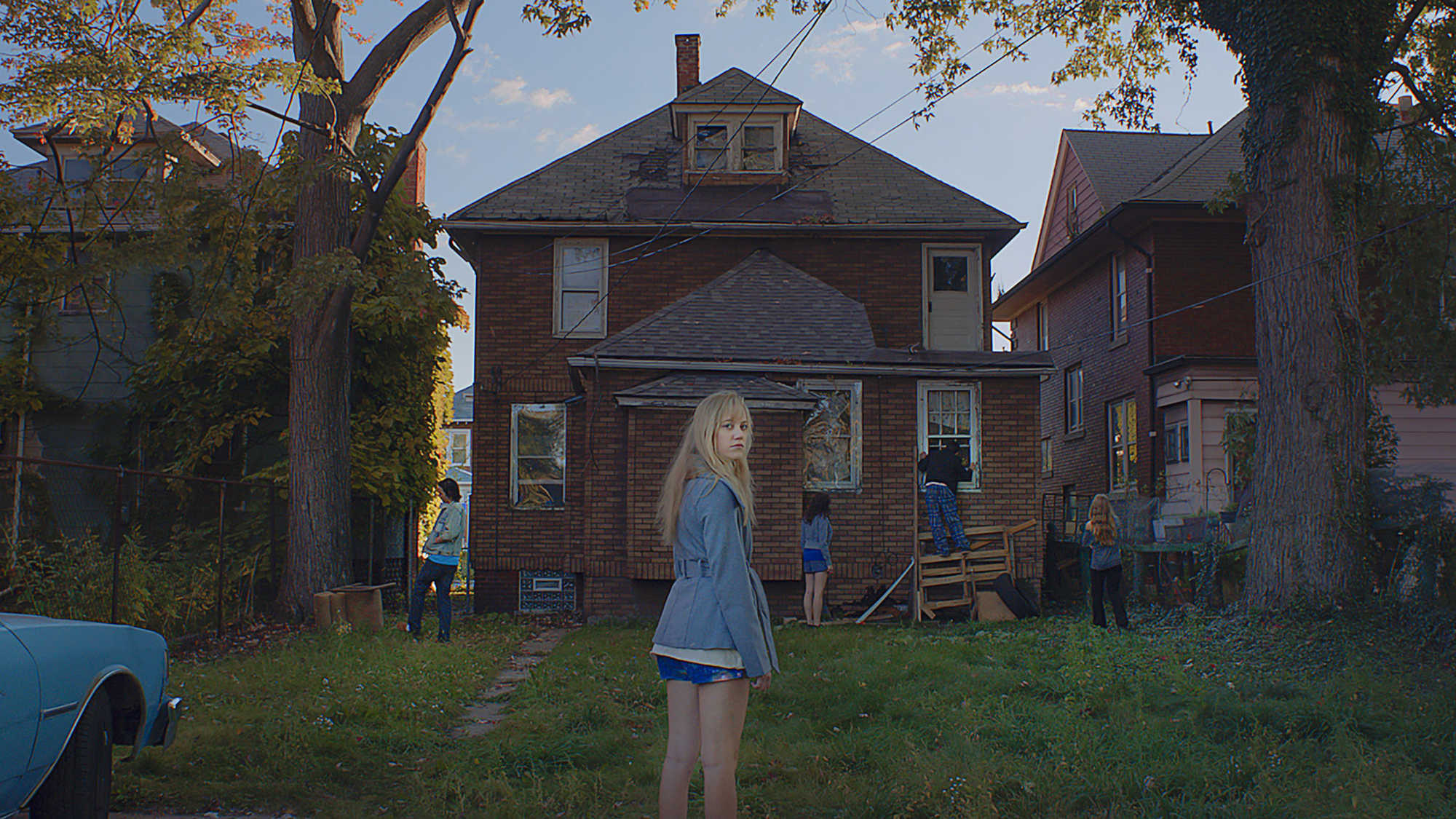
1. It Follows

David Robert Mitchell invites you to the best American horror film in more than a decade.
Yes, It Follows is the STD or horror movies, but don’t let that dissuade you. Mitchell understands the anxiety of adolescence and he has not simply crafted yet another cautionary tale about premarital sex.

Mitchell has captured that fleeting yet dragging moment between childhood and adulthood and given the lurking dread of that time of life a powerful image. There is something that lies just beyond the innocence of youth. You feel it in every frame and begin to look out for it, walking toward you at a consistent pace, long before the characters have begun to check the periphery themselves.

Mitchell borrows from a number of coming of age horror shows, but his film is confident enough to pull it off without feeling derivative in any way. The writer/director takes familiar tropes and uses them with skill to lull you with familiarity, and then terrify you with it.

Mitchell’s provocatively murky subtext is rich with symbolism but never overwhelmed by it. His capacity to draw an audience into this environment, this horror, is impeccable and the result is a lingering sense of unease that will have you checking the perimeter for a while to come.

Isn’t It Bromantic?

Point Break

by Hope Madden

Just like a shiny new toy waiting to be unwrapped, Point Break is available for your viewing pleasure this Christmas Day.

Kathryn Bigelow’s 1992 MTV Award winning surfing/bank robbing/pathway to enlightenment classic wears some new trunks courtesy of director Ericson Core (Invincible).

Johnny Utah (yes, that’s still his name) was a YouTube phenom thanks to some extreme mountain biking and whatnot, but tragedy and guilt motivated him to change his life. One man-bun later, he’s a fledgling FBI agent with a nose for extreme sportsman heists.

Dude, I totally think those bank robbers are trying to perform the Ozaki 8.

That’s right, they’re not common criminals. They are extreme eco-warriors and poly-athletes.
Well now they’re just making words up.

Luke Bracey seems at times to channel Keanu Reeves, his predecessor in the rich and meaty role of Utah. Indeed, he boasts the sun kissed locks of a young Patrick Swayze as well as the utterly wooden acting presence of Reeves – quite a combination.

In the role of Jedi Master Bodhi is Edgar Ramirez, an actor who, in fact, has talent. You won’t see evidence of it here, though, as he struggles through dialog, such as, “All you see is lines. All we see is truth.”

Heavy.

Replacing the spunky Lori Petty in the role of Utah’s love interest is Teresa Palmer as Samsara. Look how adorably enlightened she is! She climbed a rock pile – yay!

But you don’t come to Point Break (either version) for the acting. If you can make it past the insufferable masculine posturing, the film looks great. Yes, the first two set pieces rip off the Mission Impossible franchise, with a little Fight Club robbery thrown in later, but who has time for originality?

The scenery is stunning, the stunts genuinely impressive, and Core is wise enough to limit dialog and plot to a minimum, allowing plenty of time for filling the screen with sky, valley, waterfall, and mountain top – you know, everything a real man conquers. For enlightenment.

Verdict-2-0-Stars


Not So Young and Restless

Youth

by Hope Madden

Like writer/director Paolo Sorrentino’s 2013 Oscar winner The Great Beauty, his latest effort, Youth, offers a visually sumptuous rumination on aging and regret.

Michael Caine leads a marvelous cast as Fred Ballinger, a retired composer who’s done with life. He’s wasting time at a luxurious Swiss hotel, sharing a room with his daughter (Rachel Weisz) and hanging out with his longtime pal Mick (Harvey Keitel).

Keitel and Caine shine. A fragile, passionate Keitel delivers his strongest performance in decades as the over-the-hill filmmaker grasping for one last “testament.” Meanwhile, the more restrained Caine is no less heartbreaking. Together they tease out a lived-in friendship that’s a bittersweet joy to watch.

Weisz, equal parts vulnerability and fire, joins a delightfully sly Paul Dano in support of the geriatric leads, all of them part of an unusual and high-brow population at this resort.

A parade of images, both grotesque and gorgeous – and the absurdity of that mixture – is the essence of the film. Sorrentino’s channeling a couple of compatriots with this one. You see the influence of Fellini in many ways, as Sorrentino gives life to poet Pavese’s quote, “The closing years of life are like the end of a masquerade party, when the masks are dropped.”

He’s helped immeasurably by cinematographer Luca Bigazzi, whose lens finds glamour and decay in equal measure, giving the film a dreamy cinematic quality. David Lang’s evocative score emphasizes the hypnotic quality of the visuals. It’s a visual and aural feast, though the concept that aging men see lost vitality encapsulated solely in the image of beautiful young women is wearisome.

This is a film marked, more than anything, by one concentrated feeling: longing. Sorrentino captures this beautifully, and his cast is more than capable of breathing life into characters saddled with a yearning for what is lost.

Segues into elegantly whimsical moments of fantasy are particularly enjoyable, but Sorrentino’s greatest triumph here is the sucker punch awaiting audience and characters alike with the introduction of Jane Fonda’s character.

A salty, aging diva, Fonda offers a swift kick to all this languid, self-congratulatory cinematic nonsense. She’s a blistering triumph, garish and glorious.

There are slow spots and questionable indulgences, but Youth, with the help of a stellar veteran cast, showcases something rarely offered in modern film – the power of age.

Verdict-3-5-Stars


Bloodying Lines

Over Your Dead Body

by Hope Madden

When you’re watching a film that blurs the line between art and reality, a story where actors in a play find that their real lives eerily begin to mirror the drama on the stage, you might think you can guess where things will take you. Unless that film was made by Takashi Miike. If that’s the movie you happen upon, all you know for sure is that things will, sooner or later, turn really ugly.

Such is the case with Miike’s 87th film, Over Your Dead Body. (He’s actually made four more since this one!)

The film begins slowly, but so did Audition, and that one eventually took audiences places we were ill-prepared to go. Something to keep in mind if you find yourself antsy during the first act.

Working from a script by frequent collaborator Kikumi Yamagishi, Miike employs unusual sound editing to immediately create a nightmarish atmosphere.

Miyuki (Ko Shibasaki) and her cheating boyfriend Kousuke (Ebizo Ichikawa) land the leads in a Kabuki style ghost story.

On stage and off, the lovers’ path is a rocky one, and Miike’s approach leaves you forever wondering whether you’re seeing any kind of reality – is this a hallucination? A descent into madness? Hell?

The ambiguity feeds the film’s horrifying dreamlike quality, but Over Your Dead Body is not all atmospherics and guessing games. The movie takes its first turn toward the supernatural when it introduces a creepy doll, but reminds you what you’ve signed up for once Miyuki starts rummaging around the utensil drawer.

Yikes!

Profoundly uncomfortable yet hypnotic and elegant, it’s a combination few manage quite like Miike. Over Your Dead Body is not the satisfying genre effort of Audition, nor is it the visceral wonder of 13 Assassins, and it lacks the macabre humor of many of the filmmaker’s previous collaborations with Yamagashi. The leaden first act doesn’t help, either, but you can expect a hell of a payoff. As always.

Verdict-3-0-Stars

Great Dane

The Danish Girl

by Hope Madden

Tom Hooper is a proven director. He followed an Oscar for The King’s Speech with an impeccable reimagining – perfectly theatrical and cinematic – of Les Miserables. He now turns his attention to the true life tale of what is likely the world’s first transgender surgery.

The Danish Girl is the gorgeously appointed, elegantly acted portrait of artist Einar Wegener (Eddie Redmayne – proving himself a chameleon of the same caliber as Tom Hardy or Tilda Swinton). His wife Gerda (a remarkable Alicia Vikander), an artist of less fame, needs a favor: her model has cancelled.

What begins as a favor – some silk stockings and fancy shoes – turns into a game for Gerda, but something else entirely for Einar.

The film works best as a study of marriage in turmoil, as Gerda’s riot of conflicting emotions is beautifully articulated by Vikander. Hers is an authentically tumultuous, tender and human performance.

Redmayne – Oscar winner for last year’s The Theory of Everything – is a fierce and nimble talent, no question. His graceful turn here is filled with vulnerability and longing. But The Danish Girl – and Redmayne’s performance, in particular – may be too restrained, too dignified for its own good.

Vikander’s character is fascinating from the beginning, and her fiery yet tender performance drives the film. But that’s kind of the problem. It’s Lili, the woman Einar is determined to become, that we should care for more, learn more about. The Danish Girl should be her story, but it really isn’t.

The fault is hardly Redmayne’s. He evolves slowly from a passionate if delicate husband to an even more delicate yet burgeoning woman, but he never invites us into Lili’s head. She’s an enigma.

The film never truly belongs to Gerda’s story, either, and the lack of true focus leaves the lovely film feeling superficial.

The story itself is astonishing, bordering on unbelievable. Lili Elbe was pioneering and tragic, fragile but fearless in a time when her journey was utterly unimaginable. The Danish Girl has a lot to offer, but it needed quite a bit more of Lili’s spirit if it was to leave a lasting impression.

Verdict-3-5-Stars