Tag Archives: MaddWolf

Isn’t It Romantic?

The Lovers

by George Wolf

Just who are The Lovers?

Michael and his mistress Lucy? Mary and her boyfriend Robert? Or, could it be Michael and Mary, even after all those years of marriage?

Credit writer/director Azazel Jacobs for turning the romantic dramedy inside out, weaving sly writing and touching performances into a thoroughly charming take on the resilience of love and the frustrating struggle to pin it down.

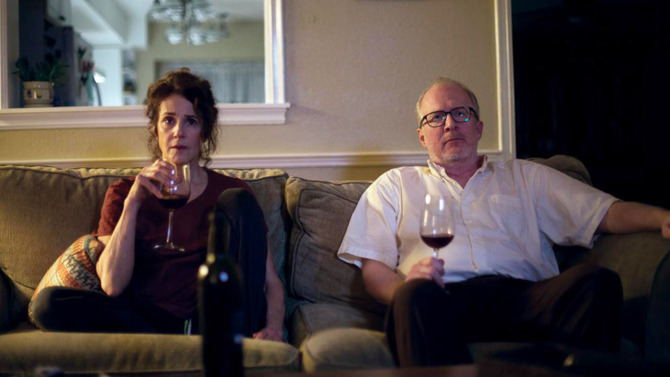
Tracy Letts and Debra Winger are both wonderful as Michael and Mary, a dispassionate husband and wife who have grown to give each other only slightly more regard than the pieces of furniture in their suburban home.

Lucy (Melora Walters) is impatiently waiting for Michael to ask for a divorce, while Robert (Aiden Gillen) is expecting the same from Mary. Both are assured the time will finally come after the upcoming visit from Michael and Mary’s son Joel (Tyler Ross).

But when an old spark is reignited, suddenly it’s the Mr. and Mrs. who are sneaking away from their side pieces for some passionate alone time.

Such a premise could easily crumble into sitcom-ready zaniness, but Jacobs isn’t mining for cheap laughs. His script does have moments of effectively dry humor, but The Lovers is just as likely to uncover truths through a heavy silence.

Both Letts and Winger effortlessly wear the weariness of their characters. We may not know exactly why they’ve drifted apart, but the actors convey such a reliable authenticity we are rooting for Michael and Mary almost immediately.

The Lovers is sneaky in its casual nature. Through subtle storytelling and stellar performances, it finds meaning in places rarely explored this effectively, and a gentle confidence that frayed emotions can still bond.

Verdict-4-0-Stars

https://www.youtube.com/watch?v=r1o-XSHgypE

Yo, Chucky!

Chuck

by George Wolf

I remember the sweaty, battered face staring at me from the cover of Sports Illustrated in 1975, a face that had taken plenty of punches, and was lining up to take more at the hands of The Greatest.

It was face of Chuck “The Bayonne Bleeder” Wepner, who was about to fight Muhammed Ali in the old Richfield Coliseum near Cleveland – then a sparkling new jewel – for the heavyweight championship and inspire a young Sly Stallone to write a screenplay about “The Italian Stallion.”

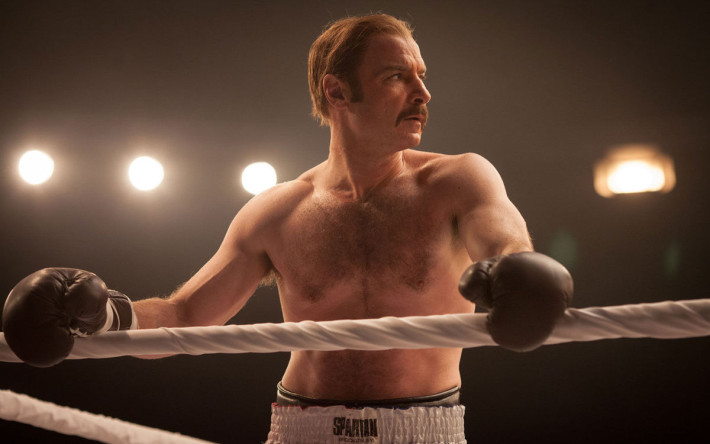
Chuck finally gets the story of the real-life Rocky on the screen, utilizing painful honesty, subtle humor and a compelling performance from Liev Schreiber to craft a touching look at hard lessons learned.

Director Philippe Falardeau (Monsieur Lazhar, The Good Lie) gets the 70s period details just right, and surrounds Wepner’s shot at the title with cinematic versions of the cliched boxer looking for his chance to be a contender, sharply illustrating how much Wepner defined all that is celebrated about life in the ring.

As Wepner claws his way to the New Jersey heavyweight championship, he watches 1962’s Requiem for a Heavyweight and longs for respect, even as he continually takes his wife (a terrific Elizabeth Moss) and daughter for granted while following his love for “wine, women and song.”

Besting all expectations, Wepner’s plan to “wear (Ali) down with my face” lasted into the 15h and final round, and he became one of the few opponents to actually knock Ali to the canvas. His increased celebrity status, and the news that the Oscar-winning Rocky was based on his life, only fueled Wepner’s primal urges and accelerated a downward spiral that included drugs, divorce, and fighting live bears.

Schreiber is transformational, adopting the voice, gait and body control of a lumbering man with a good heart and great survival instincts, but a child-like self control that often betrayed him. Schreiber commands the screen without ever being showy, blending easily with an outstanding supporting cast that includes Naomi Watts, Ron Perlman, Jim Gaffigan, Michael Rappaport and Morgan Spector (as Stallone).

Familiar in theme but illuminating with its intimacy, Chuck is a fascinating glimpse at life imitating art imitating life.

Verdict-3-5-Stars

Sexy Meddling Kids

Baywatch

by George Wolf

Did you hear about the lifeguards that fight crime?

“Wow, that sounds like a really entertaining but far-fetched TV show!”

So says Brody (Zac Efron), one of the new recruits on the super lifeguard team at Emerald Bay, and this very self-aware attitude is the main reason the big screen Baywatch works as well as it does.

Yes, the entire premise has always been a ridiculous excuse to ogle beautiful bodies, so director Seth Gordon (Horrible Bosses) wisely chooses to have some fun with that and not be stingy with the slo-mo!

Dwayne Johnson is Mitch, head of the Baywatch team and all-around King of the Beach. He’s got Stephanie (Ilfenesh Hadera) and C.J. (Kelly Rohrbach) as his veterans on the squad, while Summer (Alexandra Daddario) and Ronnie (Jon Bass) are rookies who just won their spots during open tryouts.

Then there’s Matt Brody (pinching his character name from two of the lead roles in Jaws is another clue this film’s tongue is in the right cheek), an Olympic swimmer nicknamed the “Vomit Comet” for the way his career flamed out thanks to gold medal partying.

Brody arrives thinking he’s God’s gift to Baywatch, quickly learns some humility, and joins the team just as they’ve stumbled onto another case. Could local business tycoon Victoria Leeds (Priyanka Chopra from TV’s Quantico) really be the biggest drug dealer on the beach?

And she might get away with it, too, if not for these lifeguards and their sexy meddling!

Writers Damian Shannon and Mark Swift come from the land of bad horror (Freddy vs. Jason, Friday the 13th reboot) but they’re able to tap into a witty and breezy R-rated vibe that tests some crude waters without ever diving in.

As often as the ladies flaunt buns and cleavage, Johnson and Efron’s suns out/guns out show gets even more attention, which seems only fair as their roles also have the most substance. It helps that the actors share an easy, likable chemistry and neither is above poking fun at their own image. Self-deprecation is usually endearing, and running gags involving Brody’s nicknames and a “mini-Mitch” aquarium decoration are consistent winners.

Hey, it’s summer, the perfect time for a trashy little novel to read by the pool. Baywatch fits that same bill, and ends up all the more fun for not trying to be anything else.

Verdict-3-0-Stars


https://www.youtube.com/watch?v=TDteZ0YrhSU

Murder on the Menu

by Christie Robb

I’ve been friends with a few vegetarians over the years who have made passionate, rational pleas for me to halt or at least cut back on my ravenous devouring of the animal kingdom.

I’ve read books and watched documentaries that explain in detail the often cruel practices that go into raising and processing my protein. And yet, to quote Pulp Fiction, “Bacon tastes good. Pork chops taste good.”

And I can’t help it, I loves me a good steak.

In the 30+ years that I’ve been a carnivore, I’ve never been directly responsible for what I’ve eaten. Delicious meats seem to appear magically.

At the grocery store, animal parts are wrapped up in pristine white paper or in glossy plastic like little delicious presents.

Despite my intellectual knowledge about where my food comes from, I still find myself fundamentally ignorant because I lack a concrete experience of when the animal becomes the meal.

So, I set myself a goal: to kill and then prepare my own dinner.

My initial plan is to bag a fish. But after a day out on the creek, I left with nothing more than a wicked sunburn. Sure, I saw some fish, but only around the marina docks…where you aren’t actually allowed to fish.

Don’t tell me that fish aren’t possessed with some sort of intelligence. These guys know how to hide.

Now, my options are limited. The bunnies in my backyard are too clever and adorable to seriously consider. So I decide to become the Grim Reaper to one of the only live animals sold regularly at the grocery store…a lobster.

The decision is both convenient and light on the guilt meter. Lobsters are tough and pointy and I figure their claws give them a fighting chance.

So I drive myself to the Clintonville Giant Eagle and nervously wheel my cart over to the fish counter.

The helpful fish guy is pretty chatty. “This one,” he said, “I named it Lefty because he was missing his right claw.”

Great, I thought. They have names.

I select two 1 ½ pounders that the guy wrangles out of the tank. To schlep them home I receive a lobster box—the same sort of box my childhood gerbils came in, except without air holes and with a recipe printed on the side.

At home I open the box, experimentally stare into the eyes of the lobster on the top, and poke it gently on the back. Its eyes retreat into its head. I shriek and shut the box.

I’ve read online that you can put lobsters in the freezer to lull them into a dormant state before killing them. Supposedly this helps dull their pain. So, I pop the box in the freezer, pour myself a glass of Sauvignon Blanc and hop on my laptop to research how to kill these beasties humanely.

I watch a few videos demonstrating the technique of splitting their heads in half before boiling. (This severs their nervous system and is apparently a much quicker path out of life than the hot tub version.)

I steel myself for the kill.

I extract the lobster box from the freezer and open it on the counter. The lobsters have shifted position. Now they seem to be hugging each other with their rubber-banded claws. The scene is full of pathos.

Placing a cutting board and a chef’s knife on the counter, I check that the water is boiling in my big stock pot. I remove lobster #1 and place it on the cutting board.

Tapping the tip of the knife at the center of its head, the lobster’s eyes again retreat, but this time less far. I hope that this indicates less sensitivity. I drag in a deep breath. This is the moment when I discover if I have what it takes.

I look into the beady little eyes of the crustacean and thank it for its service. Then, I angle the knife up and plunge it down.

My aim is bad.

Either I winced or the knife was too dull. But instead of a nice, neat slice right between the eyes, the cut is too far too the left. A third of the thing’s head is now flopping to the side, still kind of connected to the body.

I scream.

There is diluted bloody water streaming off the cutting board and onto the countertop.

“Is anything wrong?” my husband calls from the living room.

I jump up and down quietly in socked feet, flapping my arms around, the knife flinging droplets of lobster blood across the kitchen. I swallow a squeal.

“Everything is fine,” I choke out.

The lobster is starting to wiggle on the counter. Clearly it’s starting to thaw out and is probably at the very least inconvenienced by the massive head wound. My hand clenches on the knife and I approach the counter, taking careful mincing steps to avoid the lobster blood now pooling on the linoleum of the floor.

I reposition the knife. The lobster squirms in a seeming attempt to flee.

“There is no escape,” I mutter as I swing the knife down.

My next cut is cleaner and I sever its head lengthwise and throw all the lobster bits in the boiling water.

I turn to lobster #2.

“Sorry you had to see that,” I say.

“Are you talking to me?” my husband hollers.

I ignore him, trying to think my way through my next kill.

All the experts say that the clean slice through the head is the best way to go. But probably not if you botch it. I look back over my shoulder at the pot. Any more delay and I’m going to have to deal with two separate cooking times. I’m already feeling stress about having to clean up so much lobster blood.

So, I pick up lobster #2 and dump it, still wriggling, into the pot on top of the body of its mangled companion. Its legs wiggle. Its tail flexes and curls around the edge of the pot. Is it attempting to climb out? I wonder. I stab at the tail with my knife and poke it down into the pot.

Slamming the pot lid on and slumping against a section of unbefouled countertop, I realize my heart is thumping against my ribs and my hands are trembling with an excess of adrenaline.

Twelve minutes later dinner is served, bright red and steaming. As we crack open the lobsters with kitchen shears and a garlic press (not owning the correct tools) my husband turns to me and tells me I did a very good job with dinner. Then he screams when he discovers a greenish bit inside his lobster.

“Is this his guts? Is this his guts?” he asks.

I have no idea.

This dinner is tasty and somehow more real than any other dinner I’ve ever had.

I don’t think I have it in me to become a vegetarian. But I might have it in me to become a murderer.

Betting on the Right Horse

Norman (The Moderate Rise and Tragic Fall of a New York Fixer)

by George Wolf

“What do you need? I’ll help you get it.”

When does Norman Oppenheimer ever sleep? He’s always there in that same coat and hat, stalking New York City for more people to connect, more circles to infiltrate, and more favors to curry.

But beyond mere social status, Norman (Richard Gere) wants to be a part of something that matters, and he thinks he’s finally found it after “betting on the right horse.” In Norman’s world, that means doing a favor for Eshel (Lior Ashkenazi-terrific), a struggling young politician, at precisely the right time.

It takes three years, but Norman’s long shot pays off when Eshel becomes Prime Minister of Israel. Suddenly, after a lifetime of exaggerating his influence and connectivity, Norman really does have a friend in a very high place.

People begin paying more attention to Norman, which isn’t always good news for his powerful friend.

Writer/director Joseph Cedar skillfully creates an utterly fascinating character who maneuvers through an equally intriguing web of politics, friendship and desperation. And Gere, as good as he’s ever been, makes it feel authentic.

Much as Bruce Dern dug deep into the lead role in Nebraska, Gere relishes his chance to flesh out a character as ripe as Norman Oppenheimer. He’s pushy, pathetic and often socially awkward, yet endearing in his tireless quest to seem worthwhile, both to others and himself.

It’s a performance that should not be forgotten come award season, and it anchors a smart, detailed film as compelling as any political thriller, yet as familiar as your last little white lie.

Verdict-4-0-Stars


More Coffee, Marge

David Lynch: The Art Life

by Hope Madden

Filmmaker David Lynch is nearly as enigmatic a cultural fixture as his films. Indeed, as is the case with most of his cinematic output, you might be tempted to assume that his own folksy exterior covers something dark and lurid.

The new documentary David Lynch: The Art Life does what it can to confirm that impression. While it hardly resolves anything in a concrete way, if Lynch’s art imitates the artist, then this film imitates both.

Co-directors Jon Nguyen, Rick Barnes and Olivia Neergaard-Holm recorded Lynch as he mused on childhood stories and the events that led him into the world of art and film. The audio is used to narrate footage – some recent, some archival – working together to illuminate the artist and his work. To a point.

Nguyen, who produced the doc Lynch about the making of the auteur’s 2006 film Inland Empire, has created another appropriately Lynchian film.

Once again there is a sweetness, almost innocence, about the filmmaker that feels wildly at odds with the darkness and macabre of the art we watch him create – and at the same time, seems fitting.

Much of the film is spent with Lynch in his studio as he molds, spreads and sculpts materials for art pieces. His artwork is far more immediately disturbing than his films, which tend to situate the horrifying inside a landscape of beauty. On canvas, the horror is right up front.

The work and process behind it give the film a wonderfully tactile quality and the team of directors frame and shoot the proceedings in a style Lynch himself would appreciate.

The doc takes us through Lynch’s artistically formative years and ends somewhat abruptly around the time of Eraserhead. The goal is not to document his life’s work, nor even to truly shed light on the conundrum of his particular artistry.

Instead it is a fascinating and beautifully filmed piece of what you might expect. You’ll find a lot of cigarette smoke and Coke bottles, unassuming odd-duckery and gruesome imagery.

But if you’re hoping for insight into what exactly inspires David Lynch’s fears, obsessions and grim work, be warned: The Art Life does more to continue the mystery than to solve it.

Verdict-3-5-Stars

I Want to Believe

The Dark Tapes

by Charlotte Orr

A ten foot tall demon, devil possessed mistresses, and lizard-like aliens. All promise a terrifying movie experience, but does The Dark Tapes succeed?

Vincent Guastani and Michael McQuown’s film is a found-footage anthology documenting “transdimensional entities.” The first couple stories are enjoyable – I’m glad they reserved the better actors for these sections.

The remaining stories, however, couldn’t keep my attention. Unfortunately, the acting quality distracted greatly from their plots.

It’s a good thing there isn’t much to miss out on anyway. The installment “cam girls” has some of the worst acting in the whole film. I have to give the actors some slack though, seeing as they didn’t have much to work with. The script was unbelievably bland and predictable.

Same goes for “Amanda’s Revenge,” which gives little explanation as to what exactly is going on. This would normally be fine as long as enough is given to allow the viewer to run free with their own conclusions, but there just isn’t enough substance to formulate one’s own theories.

Each storyline in this film goes for the unexpected twist at the end, and these two simply fail to surprise.

With that aside, not every short in the anthology is lacking. The complex science behind the “To Catch a Demon” storyline required all my attention, and the eerily convincing demon was able to keep it. Kudos goes to Guastani for special effects and creature design.

The end of “The Hunters and the Hunted” left me pleasantly surprised. Initially my notes read, “not unlike every other ghost hunting film.” Which I subsequently had to cross out after a major twist.

The Dark Tapes proudly states that it’s the found-footage horror movie with the second most awards and nominations, coming in at 61. As a whole, this film failed to be up to par with others in the genre, such as Paranormal Activity.

It certainly was a valiant effort, but they should have focused on those couple storylines with potential and ditched the rest.

Verdict-2-0-Stars

Fright Club: Toolbox Horror

Who’s idea was this? Because this was super fun. Horror filmmaker can get positively inspired by what they find in a tool box or garden shed.

But where to even start? Every Friday the 13th movie, every Sleepaway Camp – basically, every camping movie.

Plus, some films really give it away with their title: Driller Killer, Toolbox Murders (both), Saw (all of them), The Texas Chainsaw Massacre (all of them).

It’s a good beginning. To narrow down the list of best horror scenes using tools, we started by categorizing. Here’s what we came up with.

5. Saws: The Texas Chainsaw Massacre (1974)

Saws are big in horror. Lots to choose from:

  • Pieces (1982) – a lot of chainsaw action here, but the girl in the bathroom is the best/worst
  • Tucker & Dale Versus Evil (2010) – bees and chainsaws! Hooray!
  • Evil Dead reboot (2013) – after Mia tears her own hand off, she tears into Evil Mia’s head with a chainsaw
  • Evil Dead 2 (1987) – Ash puts Linda’s head in a vice, then accidentally knocks a chainsaw into her re-animated body

Winner: Texas Chainsaw Massacre (1974)
– You hated Franklin, admit it. You should probably feel bad about that, but the point is that he is the only one who actually takes the chainsaw in TCM.

https://www.youtube.com/watch?v=vTlDmehDmsQ

4. Drill: The Loved Ones (2009)

Again, a power drill is an excellent go-to for onscreen carnage. It’s like being at the dentist, only far bloodier. Several films made great use of it.

    • Driller Killer (1979) – basically every death scene
    • Body Double (1984) – our favorite scene here: Jake runs across to save the woman he’s been peeping on, and gets there in time to see the drill come through the ceiling above him, then all the blood

Winner: The Loved Ones (2009)

Bonus – also nails!

Lola (Robin McLeavy) and her dad make some effective use of several household items, but it’s the moving father/daughter bonding over the power drill that really makes an impression.

https://www.youtube.com/watch?v=0hakZ4o5FPA

3. Hammer and Nail Family: Misery (1990)

A lot to work with here! Crucifixions, genetical spiking, Home Alone style shenanigans.

  • Evil Dead (2013) – nail gun to the face!
  • Serpent and the Rainbow (1988) – a serious nightmare scenario
  • You’re Next (2011) – underestimated Erin knows how to make use of all kinds of household wares, including that jug of nails she finds in the basement

Winner: Misery (1990)
Yes, it’s a mallet, but that’s in the hammer family, and no scene made 1990 movie audiences more uncomfortable than this. Poor James Caan. You know he’ll badass his way out of this situation at some point – but homey ol’ Annie (the BRILLIANT Kathy Bates) will have her way for a while.

https://www.youtube.com/watch?v=1Zzg3UP-x8k

2. Lawnmowers: Dead Alive (1992)

Fewer options here, and most of them goofy.

  • Dr. Shock’s Tales of Terror (2003) – Here’s an obscure one, and not a great film. But, in one of the shorts (Garden Tool Murders), someone’s buried to their neck has their head’s run over with a lawnmower.
  • Friday the 13th VII: The New Blood (1988) – Yes, it’s a weed whacker. Close enough.

Winner: Dead Alive (1992)
This is the scene that made us realize we needed this countdown. Not just because it is an utterly inspired piece of splatter gore, but because it’s really the turning point for poor, sweet, milquetoast-y Lional Cosgrove.

https://www.youtube.com/watch?v=RC1d7dw24Gg

1. Scissors/Shears: Antichrist (2009)

Toughest choices here. So many outstanding possibilities!

  • The Burning (1981) & Friday 13th: The Final Chapter (1984) use gardening shears, but it’s your ordinary house scissors that do the most inspired damage.
  • May (2002) – sweet May’s first kill is an impressive piece of action with her sewing scissors
  • Felt (2014) – that puppet making is all leading somewhere…
  • Oldboy (2003) – if you haven’t seen this, we don’t want to ruin it. Suffice it to say, Dae-su wants to make sure he never says.
  • Inside (2007) – Oh, what Beatrice Dalle can do with a pair of scissors. They’re used repeatedly and really well.

Winner: Antichrist (2009)
If you haven’t seen Lars von Trier’s one all out horror show or the scene in question, we’re not going to tell. We’re not going to show you, either. We want you to be as effected by the act as MaddWolf writer Christie Robb was. We lent her the screener and she watched it while she was on a treadmill. She fell off and did herself an injury.

Not as bad as the injury in the film though, thank God.

Guilt Trip

Snatched

by George Wolf

In the opening few minutes of Snatched, we see inside a photo album with various shots of an unforgettable face.  It’s a younger Goldie Hawn, and all the snapshots bring a warm reminder of just how long she’s been an effortlessly likable piece of pop culture. Making her a big part of  Amy Schumer’s follow-up to the hilarious Trainwreck seems like a fine idea.

Check that, it is a fine idea, and a missed opportunity.

The photos remind Emily (Schumer) how fun and adventurous her mom Linda (Hawn) used to be, so she coaxes Mom into joining her on a trip to Ecuador, where they’ll “put the fun in non-refundable!”

They’re promptly kidnapped, manage to escape, and director Jonathan Levine (The Wackness, 50/50, Warm Bodies) fills the rest of the film with Goldie and Amy running from the bad guys and doing what they can with contrivance, obvious gags and a lackluster screenplay that Schumer unfortunately did not write. The Trainwreck script, plus her TV work, have shown Schumer can bring both laughs and smarts, and Snatched could use more of both.

Instead, the script from Katie Dippold (The Heat, last year’s Ghostbusters – both underrated) finds more solid footing with supporting characters, such as Ike Barinholtz as Emily’s brother, Wanda Sykes as a nosy fellow traveler, and Christopher Meloni as a wannabe hero.

These two leads deserve better than a by-the-numbers romp with only scattershot giggles. Where’s that confident, “take some chances” attitude that Emily wants Linda to re-discover?

Still missing, apparently.

Verdict-2-5-Stars

Don’t Talk to Strangers

Hounds of Love

by George Wolf

Driven by a fiercely invested and touchingly deranged performance from Emma Booth, Hounds of Love makes a subtle shift from horrific torture tale to psychological character study. In 108 grueling minutes, writer/director Ben Young’s feature debut marks him as a filmmaker with confident vision and exciting potential.

It is the late 1980s in Perth, Australia, and at least one young girl has already gone missing when the grounded Vicki (Ashleigh Cummings) sneaks out her bedroom window to attend a party. This isn’t nearly as dumb a move as is accepting a ride from Evie White (Booth) and her husband John (Stephen Curry).

As the couple dance seductively and drink to celebrate, Young disturbingly conveys the weight of Vicki’s panicked realization that she is now their captive. It is just one in a series of moments where Young flexes impressive chops for visual storytelling, utilizing slo-motion, freeze frame, patient panning shots and carefully chosen soundtrack music to set the mood and advance the dreadful narrative without a spoken word.

And then, just when you might suspect his film to wallow in the grisly nature of the Whites’ plan for Vicki, Young turns to dialog sharp enough to upend your expectations, and three vivid characters are crafted in the suffocating dread of the White’s neighborhood home.

Slowly, Vicki realizes her best hope may be outsmarting the insecure Evie, and, much like Catherine Martin tempting Precious away from Jame Gumb, Vicki sets her sights on driving a wedge between her captors.

The three leads, all impressively committed, find the layers necessary to make the terror resonate more deeply than your standard dose of human cruelty. No slight to either Cummings of Curry, but the film turns on how Booth consistently finds the edges of Vicki’s psychotic worldview to make her the biggest wild card in this horror show.

No doubt, events get brutal, but never without reminders that Young is a craftsman. Subtle additions, such as airplanes flying freely overhead to contrast with Vicki’s captivity, give Hounds of Love a steady dose of smarts, even as it’s shaking your core.

Verdict-4-0-Stars