Tag Archives: MaddWolf

Best of 2017 So Far!

Land a’ goshen, the year’s half over already! How the F did that happen? Well, we’ve watched 161 films so far this year. Whew! Which have been the best? The new episodes of both Planet of the Apes and Spider-Man would’ve made the cut, but our judges said July releases didn’t count, so….let’s have a look at what did.

1. Get Out

You want to know the fears and anxieties at work in any modern population? Just look at their horror films.

You probably knew that. The stumper then, is what took so long for a film to manifest the fears of racial inequality as smartly as does Jordan Peele’s Get Out – an audacious first feature that never stops entertaining as it consistently pays off the bets it is unafraid to make.

2. The Survivalist

 Lean, mean futuristic science fiction that feels unsettlingly like reality, The Survivalist ranks among the best dystopian films in recent memory. And as writer/director Stephen Fingleton creates an utterly plausible and devastatingly grim future, the film marks a first time filmmaker with an awful lot to say.

3. It Comes at Night

Deep in the woods, Paul (Joel Edgerton, solid as always), Sarah (Carmen Ejogo) and their teenage son Travis (Kelvin Harrison, Jr.) have established a cautious existence in the face of a worldwide plague. They have boarded their windows, secured their doors, and enacted a very strict set of rules for survival.

At the top of that list: do not go out at night.

But what are the dangers, and how much of the soul might one offer up to placate fear itself?

In asking those unsettling questions, It Comes at Night becomes a truly chilling exploration of human frailty.

4. The Beguiled

Snugly hidden near the fighting in Confederate territory, a girls’ school takes in a wounded Union soldier. Delicately shifting allegiances, power struggles, competition, longing, fear, and danger waft between the columns of Miss Farnsworth’s Seminary for Young Ladies.

Sofia Coppola develops a languid and ornate atmosphere, punctuated where necessary to create a sense of dread and urgency. Her cast is uniformly excellent, their commitment to character leading to a finale that’s as devastating as it is inevitable.

5. Logan

Bloody and bleak, tossing F-bombs and the franchise’s first flash of nudity, Logan is not like the other X-Men.

Logan relies on themes of redemption – a superhero’s favorite. Director James Mangold pulls ideas from Children of Men and Mad Max Beyond Thunderdome, but his film reminds me more of The Girl with All the Gifts. (If you haven’t seen it, you should.)

The point? The children are our future and Logan’s real battle has always been with himself. Almost literally, in this case.

6. Baby Driver

Start to finish, the soundtrack-driven heist flick Baby Driver has a bright, infectious charm – and you can dance to it.

The beats offer more than a gimmick to ensure the flick dances along – the tunes getaway driver Baby (Ansel Elgort) has buzzing through his ear buds give rhythm to his impressive high speed antics.

The game cast never drops a beat, playing characters with the right mix of goofiness and malice to be as fun or as terrifying as they need to be. For all its danceability, Wright’s film offers plenty of tension, too.

7. Hounds of Love

 Driven by a fiercely invested and touchingly deranged performance from Emma Booth, Hounds of Love makes a subtle shift from horrific torture tale to psychological character study. In 108 grueling minutes, writer/director Ben Young’s feature debut marks him as a filmmaker with confident vision and exciting potential.

No doubt, events get brutal, but never without reminders that Young is a craftsman. Subtle additions, such as airplanes flying freely overhead to contrast with the theme of captivity, give Hounds of Love a steady dose of smarts, even as it’s shaking your core.

https://www.youtube.com/watch?v=UNEurXzvHqE

8. Raw

 A vegetarian from a meat-free family, Justine (Garance Marillier, impressive) objects to her new university’s freshman hazing ritual of eating a piece of raw meat. But once she submits to peer pressure and tastes that taboo, her appetite is awakened and it will take more and more dangerous, self-destructive acts to indulge her blood lust.

Writer/director Julia Ducournau’s has her cagey way with the same themes that populate any coming-of-age story – pressure to conform, peer pressure generally, societal order and sexual hysteria. Here all take on a sly, macabre humor that’s both refreshing and unsettling.

9. Norman

 Writer/director Joseph Cedar skillfully creates an utterly fascinating character in Norman (Richard Gere), who maneuvers through an equally intriguing web of politics, friendship and desperation. And Gere, as good as he’s ever been, makes it feel authentic.

It’s a performance that should not be forgotten come award season, and it anchors a smart, detailed film as compelling as any political thriller, yet as familiar as your last little white lie.

10. The Blackcoat’s Daughter

 Winter break approaches at a Catholic New England boarding school. Snow piles up outside, the buildings empty, yet Kat (Kiernan Shipka) and Rose (Lucy Boynton) remain. One has tricked her parents for an extra day with her townie boyfriend. One remains under more mysterious circumstances.

Blackcoat’s Daughter behaves almost the way a picture book does. In a good picture book, the words tell only half the story. The illustrations don’t simply mirror the text, they tell their own story as well. If there is one particular and specific talent this film exposes in its director, it is his ability with a visual storyline.

Pay attention when you watch this one. There are loads of sinister little clues to find.

11. Split

 A transfixing James McAvoy is Kevin, a deeply troubled man harboring 23 distinct personalities and some increasingly chilling behavior. When he kidnaps the teenaged Casey (The Witch‘s Anya Taylor-Joy) and her two friends (Haley Lu Richardson, Jessica Suva), the girls are faced with constantly changing identities as they desperately seek an escape from their disorienting confines.

The split personality trope has been used to eye-rolling effect in enough films to be the perfect device for writer/director M. Night Shyamalan’s clever rope-a-dope. By often splitting the frame with intentional set designs and camera angles, or by letting full face close-ups linger one extra beat, he reinforces the psychological creepiness without any excess bloodshed that would have soiled a PG-13 rating.

12. Free Fire

 Imagine if the entire 93 minutes of Reservoir Dogs took place in that last act shootout among the pack.

The noteworthy fact about Free Fire is not that it has a ballsy first act, but that the entire film is a third act. With scarcely a word of context, we’re rolled into an empty warehouse just in time for a shootout to begin, and there we will stay until the film concludes.

There is a barely controlled, very funny, incredibly bloody chaos afoot here, and it is a wild and entertaining sight to behold.

13. Colossal

 Colossal could also describe the height of writer/director Nacho Vigalondo’s latest concept, but despite some shaky interludes, it’s one worth the investment. Anne Hathaway and Jason Sudeikis make a compelling pair, and as secrets of the film monster’s history are revealed, Vigalondo lands some solid satirical blows about self-absorption and personal demons.

Perhaps best of all is how Colossal works out of the conceptual corner it backs into. Much like the Koreans who keep coming downtown no matter how often the monster appears, Vigalondo is committed to the end, delivering a strange but satisfying in-the-moment fable.

14. The Lovers

 Credit writer/director Azazel Jacobs for turning the romantic dramedy inside out, weaving sly writing and touching performances into a thoroughly charming take on the resilience of love and the frustrating struggle to pin it down.

The Lovers is sneaky in its casual nature. Through subtle storytelling and stellar performances, it finds meaning in places rarely explored this effectively, and a gentle confidence that frayed emotions can still bond.

15. Guardians of the Galaxy 2

 Is that second mixtape ever quite as awesome as the first? Rarely, and that’s the Catch-22 of the original film’s surprising blast of space zaniness. While we never saw that one coming, this new one arrives with weighty expectations.

No, Volume 2 can’t match the ruffian charm of the first, and there are some stretches of not-much-happening-here. But James Gunn’s sequel shares a lot of heart, swashbuckling visuals and more than a few solid belly laughs.


Yes, we did like these, too:


Evil Twin Powers…Activate

Despicable Me 3

by George Wolf

I’ll be honest, it took a little research before I remembered anything at all about Despicable Me 2 that wasn’t a minion.

And even when those little yellow scene-stealers got their own movie, the result was surprisingly mediocre.

The entire franchise has been memorable only for being so easily forgettable. So how’s part 3?

It’s fine.

Steve Carell returns as the voice of Gru, the super villain-turned good guy who’s now teamed up with wife Lucy (Kristen Wiig) for double the secret agent heroics. And, their three adopted daughters are back to say “fluffyyyyyyyyy!’ and other adorable things.

The family ties get more tangled when Gru meets his long lost twin brother Dru (also Carell), who convinces him to return to the dark side and steal a massive diamond from an 80s-obsessed baddie named Balthazar Bratt (South Park‘s Trey Parker).

The writing and directing teams are full of animation vets who have been at least some part of every film in this franchise, so it’s little wonder DM3 can’t find ways to revitalize the brand. It doesn’t really want to.

While all the films have been pleasantly amusing, part 3 may actually land the greatest number of solidly funny gags. The “minions in prison” sequence is an inspired hoot, and an 80s dance-off between Gru and Bratt keeps silly going long enough for a decent payoff.

But again, while the latest Despicable Me will satisfy the kids with its frenetic zaniness and give the parents some escapist smiles, it might raise a question once part 4 comes calling.

“Which one had the twin brother again?”

Verdict-3-0-Stars

Casualties of War

All Eyez on Me

by George Wolf

After being woven through films such as Notorious and Straight Outta Compton, the life of Tupac Shakur finally gets its own treatment in All Eyez on Me, an earnest biopic ultimately too comprehensive for its own good.

Demetrius Shipp, Jr., boasting an uncanny resemblance in an electric screen debut, captures Tupac’s fire and swagger, while Danai Gurira (The Walking Dead, Mother of George) is ferociously compelling as Tupac’s mother (and former Black Panther) Afeni Shakur. Their scenes together consistently deliver the emotional heft lacking elsewhere.

Director Benny Boom, a veteran of music video and television projects, is committed but becomes waylaid with an unfocused meandering.

After a promising start fleshing out the drive and outrage that sprung from Shakur’s upbringing, Boom and his writing team get bogged down with a scope more dutiful than effective. In an effort to tell as much of Tupac’s story as possible, All Eyez on Me loses the chance to show us the depth that made him an icon.

Verdict-3-0-Stars

https://www.youtube.com/watch?v=6VC0aSPfyQk

Back to the Track

Cars 3

by George Wolf

As great as the Disney/Pixar lineup is -and it’s pretty great- the Cars franchise sits low in the batting order, especially after the debacle that was Cars 2 six years ago. Cars 3 rebounds nicely, but still can’t match the meaningful substance of Pixar’s best.

We catch up with legendary race car Lightning McQueen (voiced by Owen Wilson) in a changing sports world. Suddenly, a new generation of “NextGen” cars, led by rookie sensation Jackson Storm (Armie Hammer), is taking over. New team owner Mr. Sterling (Nathan Fillion) brings in a young trainer named Cruz (Cristela Alonzo) to get McQueen adapted to the new technology, but her “senior project” only fuels the feeling that the legend should stay in the garage for good.

Animation vet Brian Fee helms his first feature as director/co-writer with Cars 3, and while the visual style is characteristically luscious, the story that he’s telling never quite rises above the pleasantries of showing kids some talking cars and introducing a new line of tie-in merchandise.

The gags are amusing but seldom funny and the plot takes some turns that may confuse the young ones, but the bigger concern is what’s missing.

As Cruz reveals her true love is not training but racing, and McQueen reflects on his tutelage under Doc (Paul Newman), the movie has the chance to find the poignancy and resonance that has driven Pixar’s most touching classics.

You’ll find it in Lou, the Pixar short the runs before the feature.

Alas, Cars 3 drives on by, satisfied with “believe in yourself” mantras that are greeting card ready, and a first-place trophy for the cheerfully harmless.

Verdict-3-0-Stars


Fear Itself

It Comes at Night

by George Wolf

Two years ago, Krisha served as a stunning feature debut for writer/director Trey Edward Shults. Gripping in the intimate nature of its truths, it heralded Shults as a new filmmaker with tremendous potential.

That potential is realized with It Comes at Night.

He may have bigger stars and a larger budget this time out, but Shults shows storytelling instincts that are already well-seasoned. Resisting any pressures to mainstream his scope and “go bigger,” Shults get even more intimate. While Krisha showed a very tangible threat infecting a family, It Comes at Night is more abstract, an intensely personal take on fear and paranoia.

Deep in the woods, Paul (Joel Edgerton, solid as always), Sarah (Carmen Ejogo) and their teenage son Travis (Kelvin Harrison, Jr.) have established a cautious existence in the face of a worldwide plague. They have boarded their windows, secured their doors, and enacted a very strict set of rules for survival.

At the top of that list: do not go out at night.

This rigid domestic order is tested when the desperate Will (Christopher Abbott) breaks in. He has a wife, Kim (Riley Keough) and toddler to protect, and is offering all they have in exchange for refuge.

It Comes at Night has been on horror fans’ radar for some time, but it will test the patience of those satisfied with cheap jump scares or spoon-fed explanations. As with Krisha, Shults builds the film around his own experiences, using Travis to often mirror how Shults himself dealt with a death in the family. Through Travis’s nightmares, we are kept off balance, questioning just what is real and who can be trusted.

Shults explores the confines of the house with a fluid camera and lush cinematography, slyly creating an effective sense of separation between the occupants and the dangers outside.

But what are those dangers, and how much of the soul might one offer up to placate fear itself?

In asking those unsettling questions, It Comes at Night becomes a truly chilling exploration of human frailty.

Verdict-4-0-Stars

Magic Mushrooms

by Hope Madden

There was a time when, for at least a second or two, my boss thought I might have a severed human appendage in a filthy Kroger bag under my desk.

How did get myself into this mess?

I blame the mushrooms.

Each fall and spring I look into my yard to find that everything’s coming up fungi. During the moist, temperate seasons my lawn becomes home to the most heinous mushrooms you have ever seen. Their white 5 – 6 inch shafts end with a helmet-like, purplish brown tip.

Sound like anything to you?

Picture it, if you will.

Yes, it’s that bad.

And then picture a few dozen standing at attention throughout my lawn.

I never have seen this particular brand of fungus anywhere else on earth but in my yard. Lucky me.

They are upsetting to look at. Their unseemly appearance drives my neighbor kids crazy. One boy – normally sweet and smiley – cannot abide them. The minute he sees a bloom he gives it a swift kick.

Do you know what looks worse than a yard full of erect mushrooms?

A lawn littered with amputees.

I’m surprised the mailman will even deliver to our house.

I’ve tried to find out what type of mushroom they might be, hoping in vain to eliminate the fungus without killing my lawn. But they’re hard to describe if you’re looking for a serious answer.

The internet is no help at all. Type “mushrooms” into Google and you’ll come up with 15.1 million possible links. Narrow the search terms and you’ll likely get descriptions like “sexy science,” which, at first blush, looks like it actually might have the information you seek, until you realize the mushroom they’re talking about is only two inches long.

My mushroom is bigger than your mushroom.

Meanwhile, my husband, George, was doing his own sleuthing. He works for a radio station and, at that time, the station ran a gardening show on Saturday mornings. George emailed a picture of the plant to the show’s host for an explanation.

The host sternly responded, “I do not do that type of counseling. Try Dr. Ruth.”

I once had a colleague who believed, sight unseen, that these were the pre-bloom stage of a spectacular orchid. She advised me to dig them up and keep them in clear glass jars in my basement.

I appreciated the suggestion, but I feared what would happen on the holidays when all our nieces and nephews go downstairs to play ping pong and find a large collection of these severed appendages on my cellar shelves.

Merry Christmas, kids!

I’m creepy enough as it is.

Another colleague had run a landscaping business years ago and offered to take a look. She thought she’d dealt with the same lawn care menace once in a Dublin neighborhood. I bet it went over really well there.

So I dug up a sample and put it in a plastic bag to bring to work. But the stench! I hadn’t known about the odor – this is not the kind of plant you bend down to sniff – until I had one in hand.

It smelled exactly as I would imagine a severed body part left too long in a filthy plastic bag might.

My colleague was late to work and I simply couldn’t tolerate the odor, so I grabbed the bag to take it to the restroom garbage. Unfortunately, I ran into my boss.

“What have you got there?”

I wasn’t sure what would be more jarring and inappropriate, describing it or showing it to him.

I decided the least suspicious thing I could do was dash past him to flee to the ladies’ room, leaving behind a hideous stench. His horrified expression suggested that he got a glimpse of the package.

So that happened.

The Man Upstairs

Wakefield

by George Wolf

“Who hasn’t had the impulse to put their life on hold for a moment…just vanish completely?”

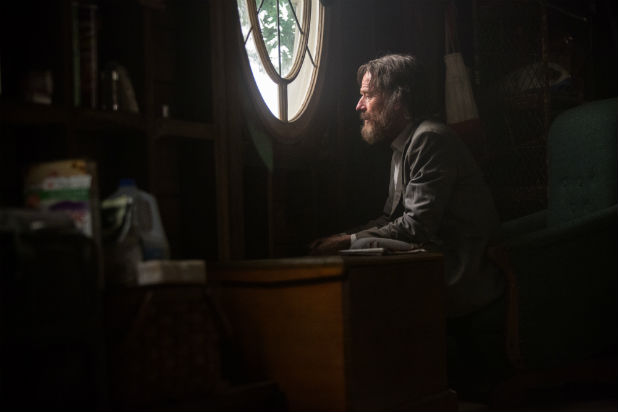
Howard Wakefield (Bryan Cranston) gives in to that impulse, and his moment of resignation becomes months in a self-imposed exile, wallowing in self-pity and watching his family from an attic window.

Sure, Howard has a nice job, beautiful family and sweet home in suburban New York, but he’s been lulled into a stupor by the whole domestic routine. After yet another trying day, Howard ventures up to the attic above his separate garage…and decides to stay there.

Writer/director Robin Swicord adapts E.L. Doctorow’s short story with a workmanlike precision, dutifully providing all the building blocks for this high-concept parable, but never finding the depth or profundity she seeks.

Cranston, here’s a shocker, is fantastic, digging commendably deep in a search for the humanity his character badly needs. Howard has some first-world problems, as he labels suburbia a place people can feel “protected from what’s wild,” but can’t challenge his privilege with anything more dire than dumpster diving or poor hygiene. Howard is far from likable, and though Cranston is all in, finding a reason to root for his quest is tough sledding indeed.

As he spies on his wife (Jennifer Garner) and two daughters, Howard fancies himself the veritable wise old hermit, observing the folly of modern life and dispatching simple truths. It’s well-meaning, but these truths are of the standard greeting card variety, rendered even less impactful from the film’s inherent need to tell (through voiceover narration or talking-to-himself musings) instead of show.

At times, Wakefield has the feel of a one-man show. With Cranston, the man makes it worth watching, even when the show can’t quite keep up.

Verdict-3-0-Stars


Fright Club: The Help

From The Omen‘s Mrs. Baylock to Rocky Horror Picture Show‘s domestic and handyman, you’ll find questionable help aplenty in horror (and not quite horror). Chan Wook Park’s The Handmaiden explored the dual sized anxiety of having a stranger living in your house – or being the stranger living in someone else’s house.

Good horror directors know how to pick that scab, because having a stranger inside the household is unnerving, but being that stranger can be even worse.

6. Estranged (2015)

Going home again can be a drag, but it proves especially tough for January (Amy Manson) in director Adam Levins’s Estranged. Recovering from a near-fatal accident, she’s wheelchair-bound and stricken with amnesia. Even so, something feels completely wrong about the stately mansion and doting family she returns to for her recovery.

Estranged pulls you slowly through the twisty mystery of January’s recuperation and the unusual family she’s found herself a part of. So much of what Levins is working with could easily feel stale – amnesia? Wheelchair-bound invalid in a spooky, isolated manor? There’s even a butler in full gear. All you need are Scooby and the Mystery Machine and we’d have some real sleuthing on our hands.

The film offers an appealing blend of familiar and novel, repellent and elegant – forever playing with the idea that there is something foul and festering beneath the surface of this lovely home. His eye for detail and his cast’s natural ability help pull the whole ordeal together into a satisfying, if understandably unpleasant, product.

5. I Am the Pretty Thing that Lives in the House(2016)

Writer/director Osgood Perkins (Blackcoat’s Daughter) spins an effective ghost story with this one.

Lily (Ruth Wilson) has been hired to nurse famous New England author Iris Blum during her final months. Blum made her name writing spooky books Lily’s too afraid to open, and she regularly mistakes Lily for someone named Polly.

Polly is the main character in Blum’s most famous novel, about a beautiful bride who dies in an old New England home – not unlike the home Lily now finds herself rattling around with no company but the bedridden and mainly catatonic old woman.

A feat of atmosphere, very smartly written and quietly observed, the film generates tension early and builds on it masterfully for the full 87 minutes. Old fashioned but never dated, it’s a throw-back spook fest that can’t help but pull you in.

4. The Others (2001)

Co-writer/director Alejandro Amenabar casts a spell that recalls The Innocents in his 2001 ghost story The Others. It’s 1945 on a small isle off Britain, and the brittle mistress of the house (Nicole Kidman) wakes screaming.

She has reason to be weary. Her husband has still not returned from the war, her servants have up and vanished, and her two children, Anna and Nicholas, have a deathly photosensitivity: sunlight or bright light could kill them.

The new servants seem to understand their roles – maybe too well.

With the help of cinematographer Javier Aguirresarobe and supporting actress Fionnula Flanagan, Amenabar introduces seemingly sinister elements bit by bit. It all amounts to a satisfying twist on the old ghost story tale that leaves you feeling as much a cowdy custard as little Nicholas.

https://www.youtube.com/watch?v=0bMEGtUxajY

3. The Shining (1980)

You know who you probably shouldn’t hire to look after your hotel?
Jack Nicholson.

A study in atmospheric tension, Kubrick’s vision of the Torrance family collapse at the Overlook Hotel is both visually and aurally meticulous. It opens with that stunning helicopter shot, following Jack Torrance’s little yellow Beetle up the mountainside, the ominous score announcing a foreboding that the film never shakes.

The hypnotic, innocent sound of Danny Torrance’s Big Wheel against the weirdly phallic patterns of the hotel carpet tells so much – about the size of the place, about the monotony of the existence, about hidden perversity. The sound is so lulling that its abrupt ceasing becomes a signal of spookiness afoot.

Nicholson outdoes himself. His early, veiled contempt blossoms into pure homicidal mania, and there’s something so wonderful about watching Nicholson slowly lose his mind. Between writer’s block, isolation, ghosts, alcohol withdrawal, midlife crisis, and “a momentary loss of muscular coordination,” the playfully sadistic creature lurking inside this husband and father emerges.

He’s not the caretaker management expected, but really, was Grady? Like Grady and Lloyd the bartender, Jack Torrance is a fixture here at the Overlook.

2. The Innocents (1961)

Little Miles and Flora – orphaned nephew and niece of a selfish London bachelor – need a new governess. Uncle hires the clearly brittle Miss Giddens (Deborah Kerr) based on her letter confessing that more than anything, she loves children.

The ease with which he charms her into taking the position, and the first of the film’s regular mentions of imagination as a gateway to the truth, predict quite a lot.

Quietly desperate and delicately high strung, Kerr’s performance is the perfect central image in The Innocents, the best of many screen adaptations of Henry James’s The Turn of the Screw. Is Kerr’s hypersensitive governess turning delusional as she spirals toward spinsterhood, or are her angelic charges in danger of becoming possessed by the spectral lovers who seem to haunt the property?

Thanks to Kerr, the wickedly cherubic turn by Martin Stephens (the most popular child actor in England’s Fifties and Sixties) as young Miles, and Freddie Francis’s gorgeous black and white photography, this eerie ghost story is a glorious study in the shadowy line between reality and imagination.

1. Get Out (2017)

When white Rose (Alison Williams) takes her black boyfriend Chris (Daniel Kaluuya) home to meet the fam, she assures him race will not be a problem. How can she be sure? Because her Dad (Bradley Whitford) would have voted for Obama’s third term “if he could.” It’s the first of many B.S. alerts for writer/director Jordan Peele, and they only get more satisfying.

Rose’s family is overly polite at first, but then mom Missy (Catherine Keener) starts acting evasive and brother Jeremy (Caleb Landry Jones) gets a bit threatening, while the gardener and the maid (Marcus Henderson and Betty Gabriel, both black – whaaat?) appear straight outta Stepford.

Peele is clearly a horror fan, and he gives knowing winks to many genre cliches (the jump scare, the dream) while anchoring his entire film in the upending of the “final girl.” This isn’t a young white coed trying to solve a mystery and save herself, it’s a young man of color, challenging the audience to enjoy the ride but understand why switching these roles in a horror film is a social critique in itself.

Get Out is an audacious first feature for Jordan Peele, a film that never stops entertaining as it consistently pays off the bets it is unafraid to make.

https://www.youtube.com/watch?v=A2JbO9lnVLE