H&G talk through their most anticipated film of the summer, Hereditary, along with Ocean’s 8, Hotel Artemis, First Reformed, Mary Shelley, On Chesil Beach and what’s what this week in home entertainment.
Listen in HERE.
H&G talk through their most anticipated film of the summer, Hereditary, along with Ocean’s 8, Hotel Artemis, First Reformed, Mary Shelley, On Chesil Beach and what’s what this week in home entertainment.
Listen in HERE.
by Hope Madden
In a world where the U.S. government stops supplying bottled water to Flint, Michigan residents while international asshats Nestle are allowed to increase their pumping of clean water from just 100 miles away…
Well, that may not have been the inspiration for Hotel Artemis—the inspiration was probably that cool hotel in John Wick—but it is the kind of social disaster that will lead to the Mad-Max-like rebellion that backdrops writer/director Drew Pearce’s crime thriller.
Los Angeles, 2028, and the bloodiest riots the city has ever known have broken out over the privatization of water. With the police very, very busy, it’s a perfect time for a bank heist. But timing isn’t everything—skill helps—and soon a trio of wounded nogoodnicks are headed to the one place they can safely receive emergency care: the exclusive, subscription-based, criminal-only hospital, Hotel Artemis.
It may have a staff of only two—the nurse (Jodie Foster) and the orderly (Dave Bautista)—but it is chock full of high tech medical equipment, old-school security and strict rules. It may also be the best place to ride out these riots. Unless the tensions inside the hotel reach the same height as those outside.
It’s an intriguing premise, one rife with tense and bloody opportunity. A collection of bad people is trapped in an enclosed, retro-seedy space hoping to survive the storm.
If the story intrigues, the cast convinces. Jodie Foster nails the wearied, accepting, down-to-business Nurse. Though the dialog throughout is not as savvy as Pearce thinks it is, Foster delivers it beautifully and her physical mannerisms are even more convincing.
Bautista charms as her tender strongarm. Sterling K. Brown does no wrong ever, here again radiating an intensity that mingles sadness, obligation and moral authority.
Luckily for the entire ensemble, Pearce is more invested in character development than action. He creates a moody tension inside the walls, exacerbated by the explosion of rage and violence outside.
All of which hits fever pitch when LA crime boss the Wolf King (Jeff Goldblum as Jeff Goldblum) shows up wanting to break the rules.
Pearce and his top-to-bottom impressive cast deserve credit for sidestepping expectations and instead crafting a contained, absurd-yet-believable drama. Things get away from the filmmaker when he tries to complicate the plot with backstory, and there are two minor side plots that serve as little more than a distraction.
It’s also an awful lot of tension-building with little in the way of a final release. But Pearce and team have done something remarkable in the summer months: delivered a fresh, imaginative, original film.

by Hope Madden and George Wolf
Grief and guilt color every somber, shadowy frame of writer/director Ari Aster’s unbelievably assured feature film debut, Hereditary.
The Graham family is maybe less grief-stricken over the loss of Grandma than you might expect. Daughter Annie (Toni Collette) delivers a eulogy that admits her mother was difficult, secretive. Her oldest son Peter (Alex Wolff) seems nonplussed by it all. He’s probably stoned, though.
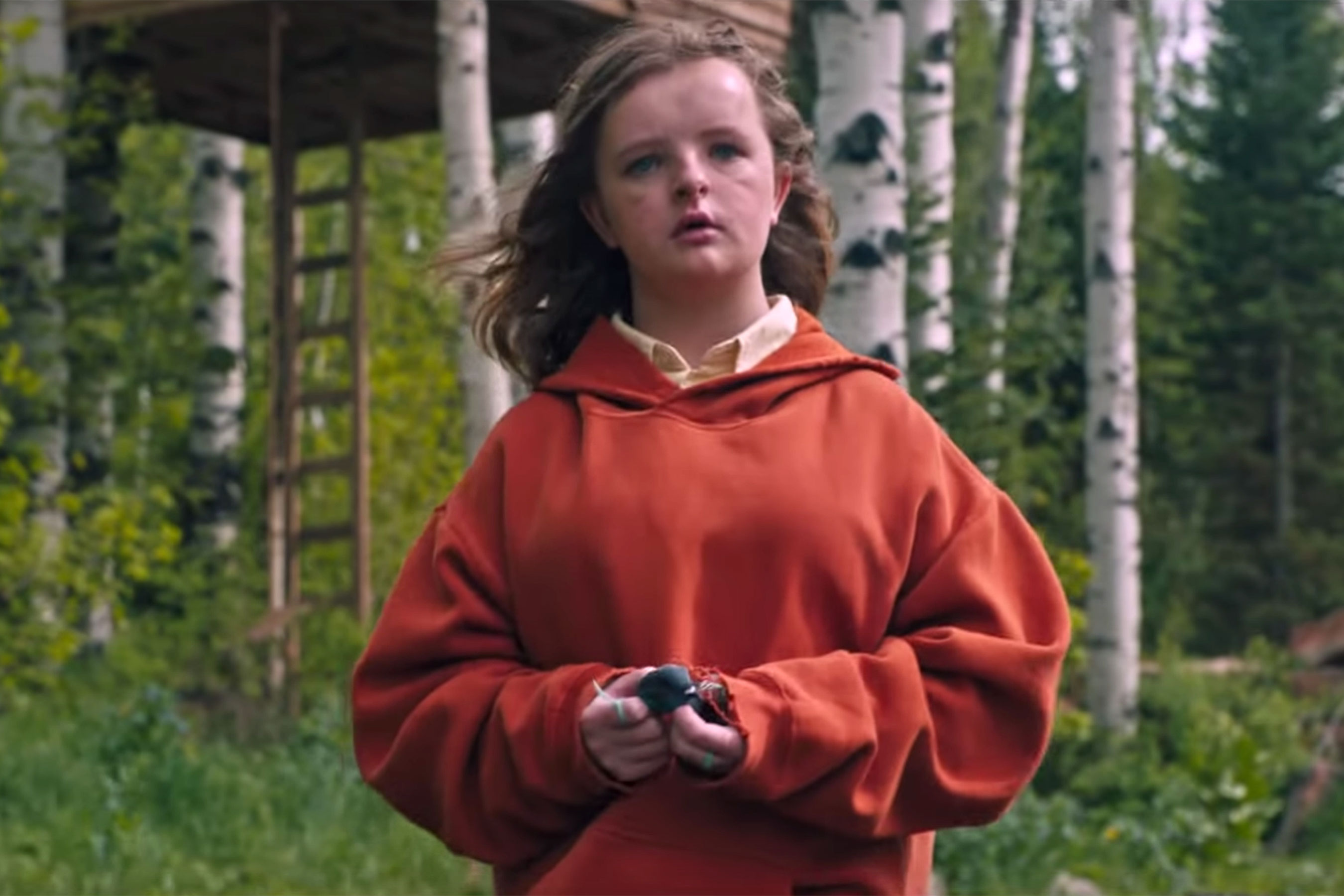
Supportive but exhausted husband Steve (Gabriel Byrne) is almost relieved, but the loss does bother the Graham’s socially isolated younger daughter, Charlie (Millie Shapiro, in one of the more chilling performances this year).
With just a handful of mannerisms, one melodic clucking noise, and a few seemingly throwaway lines, Aster and his magnificent cast quickly establish what will become nuanced, layered human characters, all of them scarred and battered by family.
The eulogy caps a striking film opening, where serpentine camera movement intertwines the Graham family with the intricate miniatures Annie creates inside their grand, secluded house. What we see suggests a scaled-down world of its own, lifelike but lifeless.
Art and life imitate each other to macabre degrees while family members strain to behave in the manner that feels human, seems connected, or might be normal. What is said and what stays hidden, what’s festering in the attic and in the unspoken tensions within the family, it’s all part of a horrific atmosphere meticulously crafted to unnerve you.
If horror fare such as The VVitch or It Comes at Night is not your bag, then you probably don’t care for the slow, detailed burn that A24 studio regularly serves. For those that do, hooray! Here’s another “adult” horror film, one that invests more in character development than in jump scares (though there are a few, including one so jarring it awakens the potential of the device).
Aster takes advantage of a remarkably committed cast to explore family dysfunction of the most insidious type. Whether his supernatural twisting and turning amount to metaphor or fact hardly matters with performances this unnerving and visual storytelling this hypnotic.
Applause to cinematographer Pawel Pogorzelski for turning this intricately designed home into a foreboding character all its own. Like Rosemary’s Baby, The Shining, The Haunting, The Others and any number of brilliant genre hauntings, Hereditary uses its surroundings to create a space where the most mundane moments take on a diabolical chill.
The family dynamic at work here is gut-punch authentic. Collette anchors the film with a performance full of grief, insecurity, bitterness and terror. It’s another in a string of award-worthy turns, and the support she gets from the ensemble, including a game Ann Dowd, elevates the tension in every intricately detailed frame.
You will have been quietly unnerved, startled from your seat, and then unsettled by the time the supernatural elements overtake the story. The peppering of hardline genre tropes in act 3 may feel like a cop out, but Aster’s interplay with the differing family members is too careful for such an easy summation.
The web of mental states, understandable suspicions and direct bloodlines layer the brutally effective fable, and Aster wields these weapons with stealthy precision. His work here is so smartly embedded that Hereditary continually tempts potential non-believers to dismiss where it leads as something you’ve seen before.
Don’t. You haven’t.

by Rachel Willis
Reminiscent of both Andrei Tarkovsky and Robert Bresson, writer/director Paul Schrader delivers a nearly flawless meditation on faith and despair with First Reformed.
Schrader’s film centers around Reverend Toller (Ethan Hawke), overseer of the small church, First Reformed. Reverend Toller lives a simple life. He delivers a Sunday sermon to a very small congregation, gives tours of the 250-year-old church, and occasionally ministers to a youth group. It’s a simple, but seemingly pleasant existence.
His life changes drastically when he’s approached by a young, pregnant woman named Mary (Amanda Seyfried). Mary seeks counsel for her despondent husband, Michael, and Toller agrees to meet with him. It’s a decision that will open the door to the question: Will God forgive us?
Much of the film’s success rests on Hawke. In what is possibly his best performance, he perfectly portrays the inner turmoil and anguish that seizes Reverend Toller. It’s a slow slide from a pleasant façade to destructive rage, and Hawke perfectly captures every emotion, every nuance of Toller’s internal crisis and its external manifestations.
The majority of the supporting cast is able to meet Hawke’s intensity with equal verve. Seyfried’s Mary is the dynamic foil to Toller, and she mostly manages to stay on Hawke’s level. At times, however, she seems out of place, unable to convey the depths of Mary’s feelings.
Schrader’s commentary on the state of the world is bleak, and there’s not much hope to be found in First Reformed. However, it can be seen in simple moments Toller spends with Mary. It provides a few moments of balance, and light, as Toller questions the right way forward.
As the tension builds, the understated score plays a phenomenal role in pulling the audience into Toller’s world. As he contemplates his future, there is a sense of dread that stays just beneath the surface, waiting to be released. There are many moments in which the stress is palpable.
Schrader’s film is a masterful character study that asks thoughtful questions about how our choices will be viewed in the eyes of God.
by Hope Madden
Saoirse Ronan is a treasure. The fact that she follows up one raucous, very American coming of age film (Lady Bird) with a delicate, very British coming of age film (On Chesil Beach) without hitting a false note is hardly a surprise. She is maybe the most versatile talent of her generation.
On Chesil Beach reunites the performer with novelist Ian McEwan, whose Atonement garnered Ronan her first Oscar nomination back at the tender age of 13.
Adapting his own novella this time around, McEwan deliberates on the romantic struggle of two young lovers, Florence Ponting (Ronan) and Edward Mayhew (Billy Howle, who also co-stars with Ronan in an upcoming adaptation of Chekhov’s The Seagull).
Florence is a highly-strung classical musician from money. Edward comes from less, hopes to write history books and sometimes behaves rashly. Regardless of their differences, they are endearingly in love.
They are also identifiably at an age where a person may see this very moment in time as the only moment, the only way it will ever be, the only way they will ever feel. This terrifying, ignorant, innocent moment is something Howle, Ronan, McEwan and director Dominic Cooke capture effectively.
Elsewhere, they falter.
The film and its story revolve around one night on Chesil Beach where the two newlyweds contemplate their present and future while we’re given a glimpse of their past. For a number of different reasons (some explained, some just suggested) Florence has an abiding revulsion of sex.
Edward does not.
Expectations, yearnings and dread come to a boil on their wedding night, when a lack of wisdom and an abundance of insecurity convince the two (one of them quite rashly) to make a questionable decision.
Though Ronan’s performance perfectly captures both Florence’s love and her reticence, Howle struggles to convince as an impetuous, even volatile young lover. He seems nervous and sweet, and every sudden outburst feels out of place.
Director Dominic Cooke, known primarily for stage work, has trouble creating a welcoming atmosphere. Cooke keeps you at arm’s length from the lovers, less likely to empathize with them than to judge.
The gravity of one rash decision weighs heavily on both, and though McEwan’s beloved pages may make that felt, Dominic’s film does not, so when we revisit Edward years after that pivotal moment at the beach, it’s tough to buy his situation or feel much for him.
On Chesil Beach is a pretty film and a nice story, but never finds the depth to break your heart.
by Hope Madden and George Wolf
More than 15 years ago, Steven Soderbergh recast the Rat Pack, pointing out a set of Hollywood A-listers led by George Clooney who were as stylish and cool as Sinatra and the fellas.
Three films later (four, if you count Soderbergh’s hillbilly version Logan Lucky, and you should) and the Ocean family is drawn once again to the big payoff.
This time it’s Danny Ocean’s sister Deb (Sandra Bullock). A life of crime runs in the family, it seems. Fresh from incarceration, Deb is looking to execute the con she’s been fine tuning over the last 5 years in lockdown.
What Debbie needs is a team, and she knows what kind.
“A ‘him’ gets noticed. A ‘her’ gets ignored.”
That’s a line well-placed and well-played, and though the film seems awfully familiar from the jump, that’s not necessarily a bad thing. The music bumpers, throwback scene segues, strategy meetings and comfortable pacing set the cool vibe, and Ocean’s 8 is cheeky enough in its outright impersonation of the previous installments to shrug off feeling derivative. Instead, it comes off as second class, which may be more disappointing.
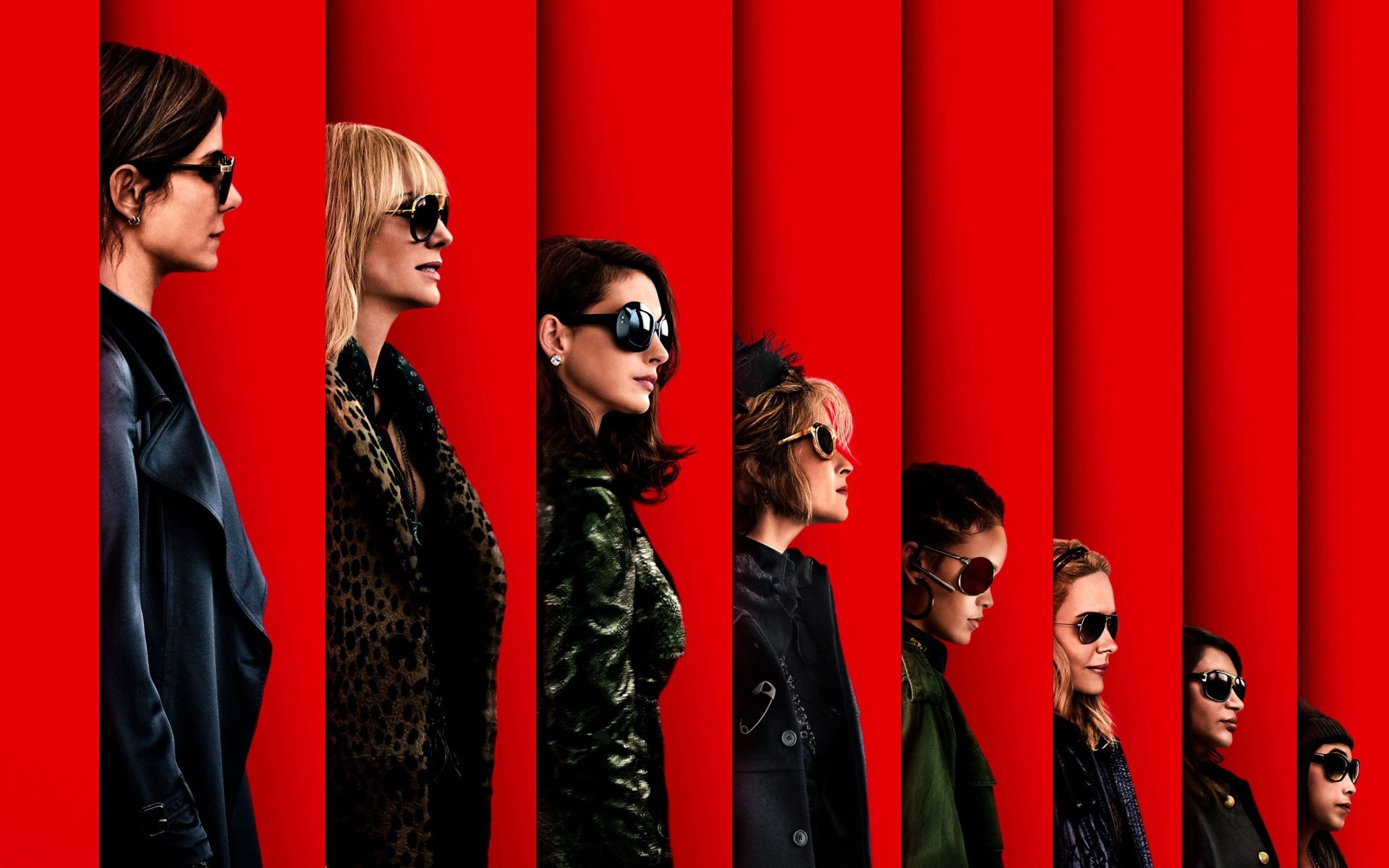
Though director Gary Ross (The Hunger Games) can crib the style—his cast (including Cate Blanchett, Sarah Paulson, Helena Bonham Carter, Mindy Kaling, Rihanna and a spunky Awkwafina) can’t generate the same chemistry. No one does a bad job, far from it, but Ocean’s 8 lacks the overlapping dialogue and easy rapport of earlier efforts. They have the talent, they just don’t have the material.
Anne Hathaway is the real thief in this caper, stealing every scene with a fun and funny send-up of the Hollywood diva persona (including her own). James Corden, popping in as a fraud expert investigating the theft of a multi-million dollar Cartier necklace during the Met Gala, brightens up the third act as well with his fresh perspective and savvy delivery.
Otherwise, the side characters are neither as meaty or as interesting as in previous franchise efforts. Surprisingly it’s Blanchett who disappoints most. Too dialed down, her Lou lacks the color and definition to be effective as Debbie’s second banana, and Blanchett’s casual greatness feels wasted.
The best of the Ocean’s films rely on sharp characterizations and sharper sleight of hand. You believe you’re watching the con unfold only to find that …whaat?….the real heist was somewhere you weren’t looking. It is you who’s been conned.
While 8 follows that formula it succeeds only to a degree, its script simply not crisp enough to charm you into buying all in. The con itself is not believably intricate and Ross, who co-wrote the screenplay with Olivia Milch, cops out in act three with heavy exposition.
But hey, heist movies are fun, and movies with this much star power are fun. Ergo, Ocean’s 8 is a fun time at the movies.
Glitzy, forgettable fun.
by Hope Madden
Mary Shelley was a fascinating person. She was the offspring of a radical feminist, sure. Still, what fire it must have taken to abandon societal pressures at the time in favor of a scandalous relationship with the married Percy Bysshe Shelley.
Of course, she was 16 and 16-year-olds make poor decisions.
Mary famously went on to outdo both her poet/philosopher husband and his poet/lover Lord Byron when, during a rainy spell in their summer together, they took part in a challenge to write a ghost story.
What then, did Byron or Percy Shelley write? Who can recall? But we do remember Mary’s.
Mary Wollstonecraft Godwin penned Frankenstein: or, The Modern Prometheus when she was 18 years old.
Such a life story would seem like fertile ground for a stirring biopic.
We’ll have to settle for Haiffa Al-Monsour’s stiff and middling effort, Mary Shelley.
Elle Fanning portrays Mary, a melancholy rebel who has yet to find her literary inspiration or her voice. She does become muse to Shelley (Douglas Booth), a handsome scoundrel more opportunistic than idealistic.
The film hopes to encapsulate the abandonment, longing and loneliness that fueled the creation of Mary Shelley’s novel, and more directly, her creature. But there is no life in these scenes—none of the gumption that must have fueled Mary’s early decisions.
Fanning’s listless performance casts an awfully prim shadow. She’s surrounded by perfectly reasonable if somewhat anemic turns by her supporting cast. All this subdued hush only makes Tom Sturridge’s bluster that much more, easily stealing scenes as the lothario, Byron.
Al-Monsour seems unsure of her intent. She struggles to illustrate the power struggle between male and female inside this free-loving environment. But more than anything, she fails to find any kind of spark or passion to propel her central character or her film.

An abundance of stay-cool-indoors options this week in home entertainment. If you missed the spectacular Thoroughbreds, now is your chance to remedy that. If you believed the trash talk about A Wrinkle in Time, you can undo that nonsense now, too. The rest—meh—but Hurricane Heist at least delivers what it promises.
Click the film title for the full review.

https://www.youtube.com/watch?v=UhZ56rcWwRQ

https://www.youtube.com/watch?v=v_I4zqC7GN8&t=1s
Thanks to S.A. Bradley of Hellbent for Horror for joining us to finish out our look at the best endings in horror movie history. A tough list to finalize, for sure, this one hits on some of the most brutal and memorable parting shots on film.
Ben Wheatley’s diabolical 2011 indie slides from grim Brit crime thriller into something far more sinister.
Hitman Jay (a volcanic Neil Maskell) is wary to take another job after the botched Kiev assignment, but his bank account is empty and his wife Shel (an also eruptive MyAnna Buring) has become vocally impatient about carrying the financial load. But this new gig proves to be seriously weird.
The final act offers something simultaneously fitting and surprising. Wheatley’s climax recalls a couple of other horror films, but what he does with the elements is utterly and bewilderingly his own.
If there’s one thing a successful Stephen King adaptation needs, it’s a writer/director who knows how to end a story. For all of King’s many strengths, ending his tale is no a strong suit.
Frank Darabont has certainly proven to have a knack for King’s source material, having helmed among the most successful and beloved films based on King’s books. But with The Mist, he outdid himself.
Thomas Jane plays a writer who, along with his young son, finds himself trapped in a grocery store when an opening in the space/time continuum allows giant, bloodthirsty creatures into New England. What begins as a wonderful creature feature turns into a terrifying Lord of the Flies before setting us up with a gut punch of utter, devastating perfection in a horror film ending.
https://www.youtube.com/watch?v=ktqNNsVJhUE
Another excellent King adaptation, Brian De Palma’s Carrie streamlines King’s sprawling ending to focus our attention where it will do the most damage.
And yes, the entirety of Act 3 is magnificent, but De Palma started something with those final, lingering images. He goes back to the cheese-cloth fuzziness of the earliest moments of the film as Sue Snell (this is really all your fault, Sue Snell!) glows with goodness and self-sacrifice. Only she truly loved poor, misunderstood Carrie.
Sue carries white flowers to the unholy ground where Carrie White lies.
And BLAM! De Palma has invented a new and forever mimicked horror movie ending.
Holy shit. This film is a brilliant and brutal test of endurance.
Writer/director Pascal Laugier’s mystifying sense of misdirection shares the aching, dysfunctional love of two best friends as one descends into madness. But that is not the point.
A couple of abrupt story turns later and we learn the point of the film and the film’s title. That’s about the time we meet Mademoiselle (Cahterine Begin, perfect).
And after ninety minutes of dread and terror, the climax Pascal and Mademoiselle have in store for you may not be satisfying, but it is perfect.
From the brightly lit opening cemetery sequence to the paranoid power struggle in the house to the devastating closing montage, Night of the Living Dead teems with the racial, sexual and political tensions of its time. An unsettlingly relevant George A. Romero knew how to push societal panic buttons.
As the first film of its kind, the lasting impact of this picture on horror cinema is hard to overstate. His inventive imagination created the genre and the monster from the ground up.
Still, the shrill sense of confinement, the danger of one inmate turning on another, and the unthinkable transformation going on in the cellar build to a startling climax – one that utterly upends expectations – followed by the kind of absolutely genius ending that guarantees the film’s eternal position in the annals of horror cinema.
https://www.youtube.com/watch?v=X6IDNqHuHmE
by Hope Madden
An outsider love story, a chilly whodunit, a psychological thriller—Beast is all and none of these.
This remarkably assured first feature from writer/director Mark Pearce keeps its focus on Moll (Jessie Buckley), the highly-scrutinized woman living with her parents in a small island community.
We open serenely enough on an angelic church choir rehearsing, a peace that’s harshly broken by the choir leader’s remark: I need more from you, Moll.
Geraldine James is haughty Hilary Huntington, the choirmaster; Moll is her grown daughter.
Soon a rugged stranger draws Moll out of her unhappy life, makes her feel awake and seen. She is destined to love this boy regardless of the string of missing girls in her village, regardless of his shady past, and in spite of the warnings of the smothering community.
Pearce’s skills keep you entranced, no matter the tropes he so easily picks up, throws off or reinvents. Sunlight, shadow, earth, sea—all these serve the visual storyteller’s purpose, while angles and frames keep you off kilter as you puzzle through the tale at hand.
You’re as invested, cautious and curious as Moll, but it’s actually Buckley’s performance—her depiction of Moll’s internal conflict—that is the most compelling and mysterious. As Moll changes demeanor, exploring her own identity becomes more important than determining her lover’s.
Johnny Flynn impresses as well as the local no-account presumed guilty, sharing a misfit chemistry with Moll that is both primal and tender. Tenderness is not what she’s used to from her severe mother, an epic James.
Together with the washed out colors of the characters’ bleak world, the film offers a harsh backdrop for Moll’s dizzying grasp on her own reality. The conflict, duality and self-discovery in Beast cannot help but draw you in, asking you about your own inner beast.
Without hitting a single false note, no matter the choir leader’s opinion, Buckley ushers us through a moral quagmire with a fire and authenticity that is gorgeous to behold.