Tag Archives: MaddWolf

Killer Style

Deerskin

by Hope Madden

What makes a good midlife crisis? What gives it swagger? Physicality? Style? Maybe a little fringe?

Deerskin.

Oscar winner Jean Dujardin (The Artist) is Georges, a man willing to pay an awful lot for a jacket—so much that his wife locks him out of their account. No matter, Georges will just hole up in this little French town, learn how to use the digital camera that came with his purchase, and spend some quality time with his new jacket.

If that sounds absurd, it should. You’ve just stumbled into the one-paragraph synopsis of the latest bit of lunacy from filmmaker Quentin Dupieux. As he did with 2010’s Rubber (a sentient tire on a cross-country rampage), Dupieux sets up one feature-length joke.

It’s funny, though.

Again the filmmaker draws hysterically deadpan, even confused performances from the many nameless characters supporting his leads. Adèle Haenel (Portrait of a Lady on Fire), playing town barkeep and would-be filmmaker, offers a wily and enjoyable counterpoint to Dujardin’s earnestness.

Aside from a couple of utterly priceless Dupieux flourishes, it’s Dujardin that sells this film. He’s deeply committed to the wildly wrong-headed internal logic of the film and the character. There’s an underlying sadness to it, and the willful obliviousness required of a character so willing to commit to a plan as ludicrous as Georges’s. He’s wonderful.

Deerskin is also slyly autobiographical in a way Dupieux’s other films are not. An odd duck wants to follow his vision (in this case, the obsessive love of a deerskin jacket) and make a movie. Creative partnerships and collaboration, while possibly necessary, also soil the vision and make the filmmaker feel dumb.

No one understands him!

Or maybe they do and his ruse is up.

No matter. He still has killer style.

I Can’t Go Out – Week of April 28

The time will come within weeks that we have no post-theatrical releases to discuss. How insane is that? Until then, you can pass the time with two early 2020 releases that, according to box office, you probably missed. Both are worth a look – one is actually excellent.

Click the film title to link the complete review.

The Assistant

The Rhythm Section

For Art’s Sake

Beyond the Visible – Hilma af Klint

by Hope Madden

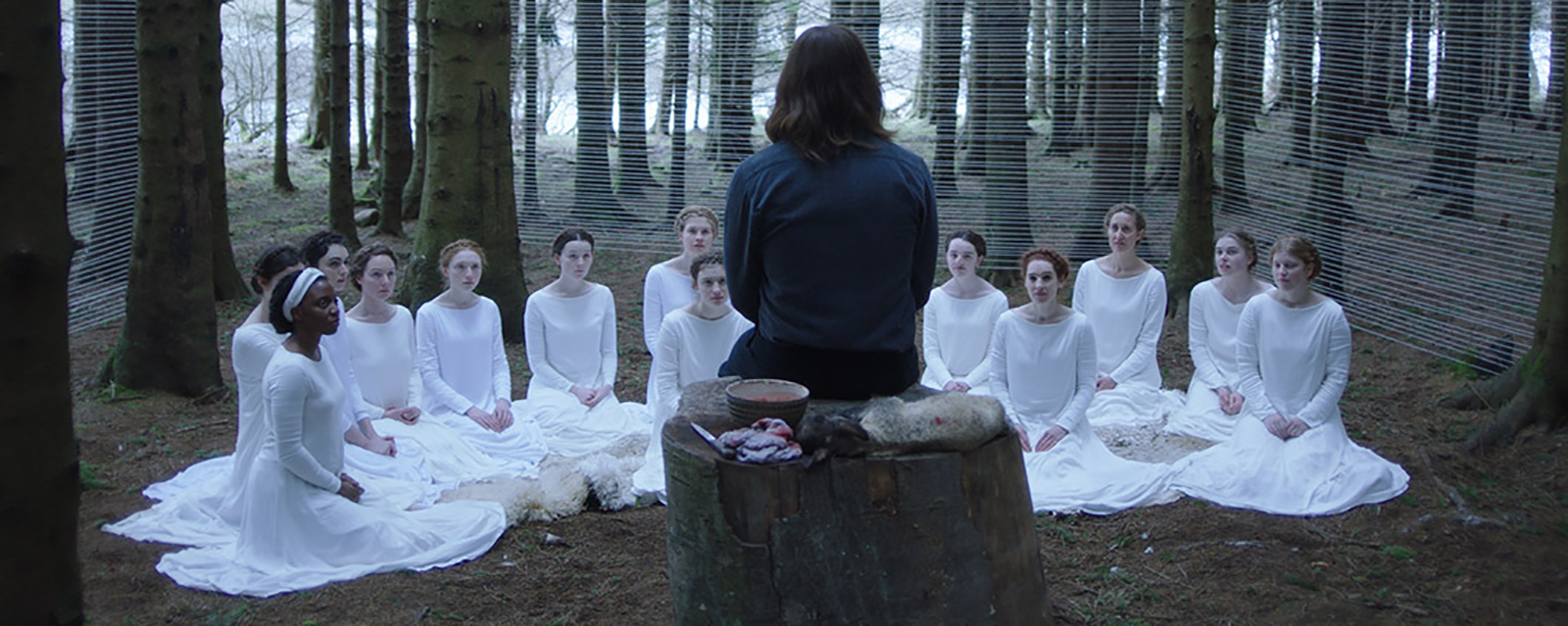
Film pioneer Alice Guy Blache and contemporary art ground-breaker Yayoi Kusama were copied, hidden and disregarded by the predominantly male industry that determined not only financial success but historical acknowledgment.

In 1906 – five years before Kandinsky painted Composition VII, long considered the genesis of abstract art—Sweden’s Hilma af Klimpt had already created a breathtaking series of abstracts. Not that you’ve heard of her.

How could you? As Halina Dyrschka’s documentary Beyond the Visible – Hilma af Klint points out, she wasn’t accepted in her time.

Not uncommon for a great artist. What Dyrschka and those she speaks with in the documentary find far more frustrating is that today, even when her genius is acknowledged (more than a million visitors have taken in the current exhibition of her work), art history shuns her.

Leaving behind hundreds of paintings and thousands of pages of journal entries and sketches, af Klint offers an unusual story of a singular life. Inspired by science, nature and spirituality in ways that would seem wildly uncommon today and must have been outright bizarre in her time, she devoted herself to a vibrant artistic exploration.

The filmmaker lingers lovingly on the work, devoting every inch of screen to the vivid color and fascinating images. She surrounds footage of the paintings with landscapes, architecture and even talking head footage framed for elegance. The material balances the energy of af Klint’s work with a calm that’s sometimes even quietly spiritual.

Still, the underlying outrage at history’s reluctance to accept the truth gives the film an energy matched by the excitement of discovery, which is never lost on the filmmaker. As impatient as the film is with the unhurried acknowledgment of genius, it’s equally thrilled to be able to share this genius with an eager if unknowing audience.  

Bite Club

Bit

by Hope Madden

There is something appealing to the glam trainwreck that is Bit, Brad Michael Elmore’s anti-Twilight.

An angsty adolescent fresh from high school graduation voice overs: “You know those teen vampire movies that feel like the horny soap opera fever dreams of an 8th grade diary? Here’s how mine began.”

Like it. It’s self-aware, a little deadpan funny, a little whatever. Go on.

Laurel (Nicole Maines), the recent grad, packs up her Oregon-plated car and takes off to spend the summer with her brother in LA. On her very first night in town, she’s hit on by  the super hot girl Izzy (Zolee Griggs), brought to an after hours full of incredibly cool people, and immediately she feels as if she’s found acceptance, found home.

Naturally, Izzy and her also-hot friends are lesbian vampires who see Laurel’s specialness and invite her to Bite Club.

First rule of Bite Club: No. Fucking. Boys.

Maines is a transgender actress, a fact that elevates Laurel’s angsty “oh, high school was kind of a horror show” schtick because it probably was. Maines does not show an enormous amount of range, unfortunately, and Elmore’s script offers her few opportunities to shine.

She’s entirely convincing with her eyes at half mast, enduring the well-meaning but clueless affection of her family. But Elmore penned very few realistic reasons for Laurel’s behavior and Maines is left struggling to convince us, simply repeating the phrase “I’m fine” ad nauseam.

Diana Hopper, on the other hand, cuts an impressive figure as Bit’s Tyler Durden. Hopper elevates Elmore’s sometimes weak dialog (there are times when it works) with wearied badassedness.

It is fun and sometimes really witty the way Bit mocks boys, though, even if Elmore’s core theme is, “Some of us are OK!” Indeed, Bit undercuts its feminist intent as often as it offers genuine insight.

But maybe its main thesis is that kids are stupid, because Laurel’s philosophy for the future of the human race is…well, it’s stupid.

Still, there’s low-rent garbage fun to be had with this. Everything about it could have been better, but like most guilty pleasures, it appeals in a sugar high kind of way.

Dishonor Among Thieves

The Wild Goose Lake

by Brandon Thomas

A vicious fight breaks out between rival gangs. Chairs fly. Knives are pulled. A spectator takes a bite of a pickle. A man has his prosthetic leg pulled from his body. 

And this is all within the first 10 minutes of The Wild Goose Lake.

Small-time mobster Zhou Zenong (Hu Ge) finds himself in the spotlight after mistakenly killing a police officer during a turf dispute with another gang. With dozens of police searching for him, and rival gangs looking to collect the bounty on Zhou’s head, he’s forced to team up with a mysterious woman (Gwei Lun-mei) and go on the run.

In the grand tradition of so many other neo-noir films, Wild Goose Lake walks a tightrope of mood and style. Many scenes play out long and with few cuts – drawing out the tension. The maze of buildings, streets and corridors are shot deep in shadows. The visual claustrophobia unsubtly mimics that of the main characters. And when the violence hits – it hits quickly and brutally. 

The depiction of violence is where the black humor comes out. There’s more Sam Raimi and Peter Jackson in the violence here than there is Francis Ford Coppola. A killing involving an umbrella had me hooting and clapping my hands in delight. Not to mention the inventive decapitation via forklift.

Hu Ge makes for a stoic lead as Zhou. At the beginning of his story, Zhou is a perfect example of cool, calm, and collected. In the opening fight, he casually dispatches opponents in a flurry of fists and kicks. Sharp contrast to later in the film when Zhou more or less resembles a trapped animal.

Gwei Lun-mei is equally impressive as the standard femme fatale, Liu Aiai. Like any good noir femme fatale, Liu’s motives remain murky at best. Like Zhou, Liu’s resolve begins to crumble as the weight of their situation bears down on her. Gwei does a terrific job of adding subtle layers to Liu. 

It’s hard to look at Wild Goose Lake and not be reminded of Fritz Lang’s noir masterpiece M. In M, Peter Lorre famously plays a serial killer hunted by both the police and the criminal underworld. The narrative themes and strong visual cues helped shape the noir genre as we know it today.

By embracing what makes film noir so riveting, Wild Goose Lake manages to satisfy movie lover’s expectations, and sometimes soar above them. 

Kelly Green

True History of the Kelly Gang

by George Wolf

Planting its flag unapologetically at the corner of accuracy and myth, The True History of the Kelly Gang reintroduces a legendary 1870s folk hero through consistently bold and compelling strokes.

His death imminent, Australian outlaw Ned Kelly (1917‘s George MacKay in another impressive turn) is writing a letter to the daughter he will most likely never see. With a promise to “burn if I speak false,” Kelly wants his child to separate fact from fiction in the family history.

It’s an audacious, somewhat cheeky opening from director Justin Kurzel, considering that the film itself is based on a historical novel. Kurzel and screenwriter Shaun Grant – the duo behind the true crime shocker The Snowtown Murders nine years ago – go bigger this time, trading spare intimacy for a tableau of grand visual and narrative ideas.

After a heroic act in childhood, Ned gets the chance at a proper education. That offer is spurned by his angry and defiant mother (Essie Davis, terrific), who instead passes Ned off to notorious Aussie bushranger Harry Power (Russel Crowe in a sterling cameo) for an intro into the outlaw life.

With a direct nod to the moment when “the myth is more profitable than the man,” Kurzel spins an irresistible yarn that manages to balance the worship of its hero with some condemnation for his sins. And as the road to Kelly’s guns-blazing capture unfurls, the film incorporates elements of both a tense crime thriller and a Nightingale-esqe reminder of savage colonialism.

Does the legend of Ned Kelly owe more to history or myth? Hero or murderer? True History…. aims higher than one word answers, with storytelling that often soars before landing.

Sloppy Dead

Why Don’t You Just Die!

by Hope Madden

Given that 75% of writer/director Kirill Sokolov’s Why Don’t You Just Die! takes place in a single apartment—one room of that apartment, really—you might be surprised to learn that it’s an action film.

It’s pretty heavy on the action, actually, amplified by inspired framing, kinetic cinematography, sometimes hilarious but always eye-popping choreography, and blood.

Just a shit ton of blood.

This movie is a hoot!

And, yes, it is Russian, so there will be some reading. Not a lot, honestly, and Sokolov’s grasp of visual language is so firm that you really would not have to read a single word to understand every nuance of the film.

Scrappy thug Matvei (Aleksandr Kuznetsov) waits outside an apartment door, wary to ring the bell. Behind his back he hides a hammer, tightly gripped. When the door opens, the imposing Andrei (Vitaliy Khaev) looms. Suspicious, big, bald, effortlessly alpha (just ask the neighbor’s yipping dog), he eyes Matvei.

Matvei eyes back.

Things move inside.

Sokolov sets up a raucous mystery. Why is Matvei here? What does Andrei’s daughter have to do with it? Why isn’t Natasha in the country? How can Yevgenich help?

Does every single one of these people have reason to want Andrei dead?

The answer to the last one is yes.

As these characters limp into and out of the apartment (or don’t), Sokolov helps you keep track by virtue of theme music. Each character has his or her own. The quiet, brooding Matvei’s music, for instance, soars like a Morricone Western theme.

But is he a black hat or a white?

With a spare script, visual wonder and energy to burn, Why Don’t You Just Die! promises to snatch your attention like a duffle bag of cash and hang on until exactly enough blood is spilled.

That’s a lot.

Pop Goes the Scary

0.0 Mhz

by George Wolf

Imagine it’s 1984.

One of the members of Banarama has joined one of the members of Duran Duran in the cast of a new horror movie. That movie is assembled with the ideas and scenes from much better films, but young pop music fans probably haven’t seen any of ’em, so who cares?

Now, put on your mask and join us back in 2020. A similar mindset seems to propel 0.0 Mhz, a Shudder original that brings two stars of the South Korean K-Pop phenomenon to the screen.

Jung Eun-ji, lead singer of the band Apink, also takes the lead here as So-hee, the newbie in a teen team of ghost-chasers known as “Club 0.0 Mhz.” See, that’s the best frequency to call ghosts (don’t argue), and So-hee’s first outing with the group is to a supposedly haunted house in the woods where the kids aim to dial up a little necromancy.

But what Sang-Yeob (Lee Sung-yeol from the band Infinite) and the rest of the gang don’t know is…their new recruit comes from a long line of dead people-seers.

The local at the general store who tells them all not to go to there is just the first in a string of heavily borrowed narrative checkpoints. Pulling from The Grudge to Elm Street to The Conjuring to The Exorcist, first time director Sun-Dong Yoo adapts Jang Jak’s popular webcomic with barely a whisper of originality or visual flair.

But 0.0 Mhz is clearly aimed a notch below anyone who has seen those films. This is strictly teenage fare, content to provide good-looking idols to swoon over and warmed-over scares for kids who want to scream but not have nightmares.

It accomplishes that, and not much else.

So when get-togethers are all good again, 0.0 Mhz will be more than ready to slumber party!