Tag Archives: MaddWolf

Space Stationary

Proxima

by George Wolf

I don’t know how many jobs are more challenging than astronaut, but there can’t be many. And it is via that intense work experience that French writer/director Alice Winocour’s Proxima ruminates on the career struggles faced by women in every profession.

Eva Green carries this weight gracefully as Sarah, the only female member of a team of astronauts training for a year-long stint at an international space station. This means a year away from her young daughter Stella (Zelie Boulant), who will stay with her father/Sarah’s ex-husband Thomas (Lars Eidinger).

From the moment Sarah is introduced as a crew member by team leader Mike (Matt Dillon), her gender is fodder for subtle (and not so subtle) condescension. Resisting a heavy hand, Winocour (Mustang, Disorder) revels in the details of the job, showcasing the added strain carried only by Sarah.

The setting may center on spaceflight, but this is not a film about going into space. It is about preparing to go into space, preparing to leave your child, and preparing to be separated from your mother. And all of that preparing is work.

Green has never been better, and Winocour continues to display understated insight as a filmmaker. Like that walk among the stars that Sarah has long dreamed about, Proxima is quiet, but often emotionally dazzling.

Wounded, Not Even Dead

Jungleland

by George Wolf

Jungleland is a film with a path that’s so well marked and worn, the biggest attraction becomes what a new group of actors can bring to such recognizable characters.

Director/co-writer Max Winkler has two fine ones in the lead. Jack O’Connell is “Lion” Kaminsky, a talented bare knuckle fighter in Boston who’s constantly at the mercy of bad decisions made by his brother Stanley. Yes, Stanley Kaminsky, which doesn’t make you think of Stanley Kowalski at all.

Charlie Hunnam plays Stanley, and he and O’Connell are able to craft an authentic brotherly bond that holds your attention as the film hits one familiar benchmark after another.

Stanley is in deep to a local crime boss (Jonathan Majors) who has a proposition. Go to San Francisco and enter the big Jungleland tournament. If Lion is king, it’s 100 large. And also, take this girl named Sky (Jessica Barden) with you.

Desperation breeds dreams of one big score and a better life. Sky has more secrets than just a fake name. Complications arise.

The storytelling is competent, the performances fine. But we have seen this so many times, contenders and pretenders begin to look pretty similar and you can’t help but wonder what point there is in another round.

Mummy Dearest

Kindred

by Hope Madden

It’s incredibly hard to make a film that feels fresh. Hell, it’s hard to get a film greenlit unless you can describe it to potential financers as a cross between something they’ve seen and something else they’ve seen. Most hope of originality is squashed early.

Writer/director Joe Marcantonio doesn’t exactly concern himself with originality in his feature debut, Kindred. He hopes a stellar cast and a thick, uneasy atmosphere can make up for some of his film’s predictability. For the most part, that does work.

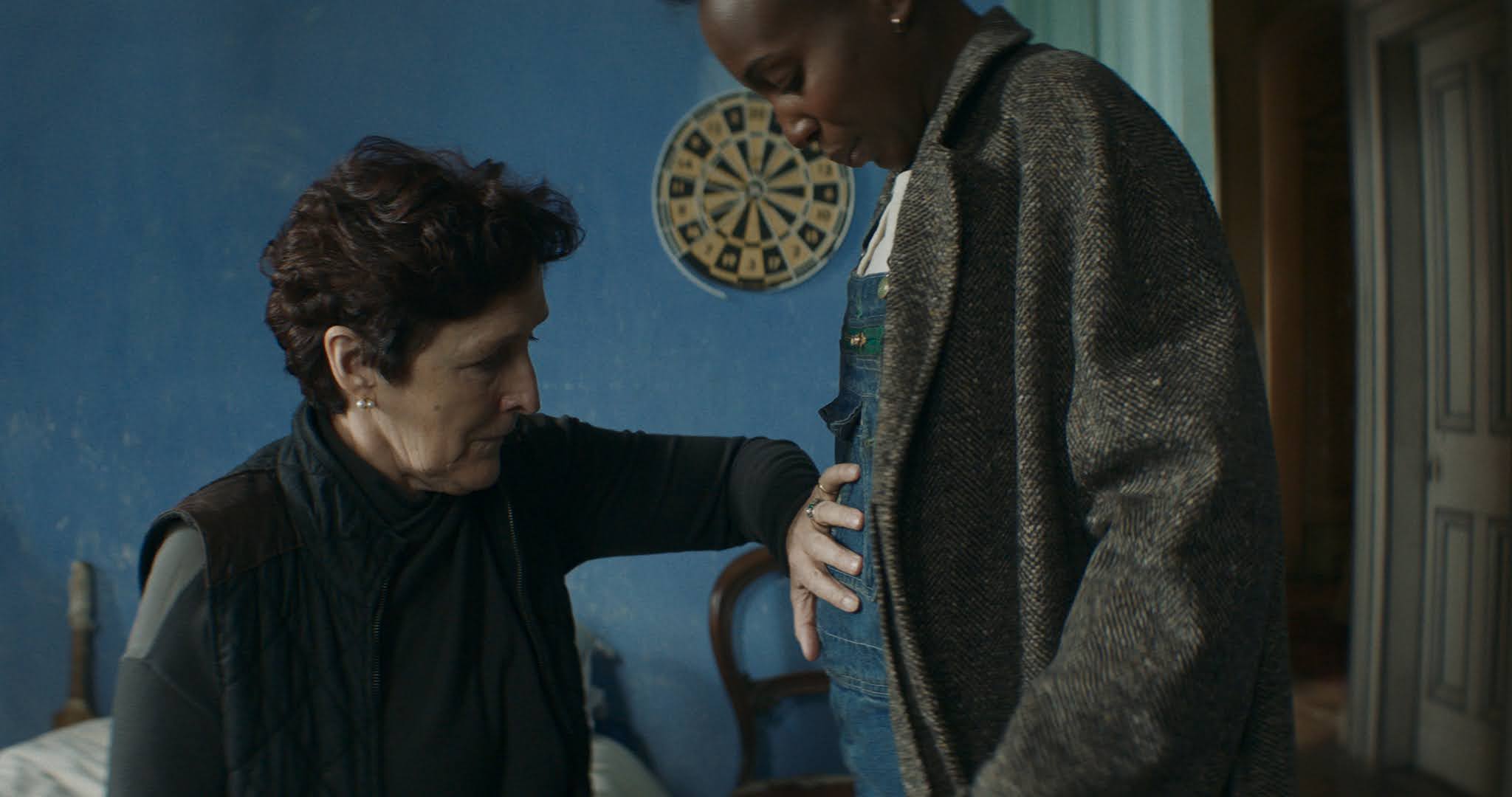
Charlotte (Tamara Lawrance) and her white boyfriend Ben (Edward Holcroft) intend to leave their isolated English village for Australia. Now it’s just telling Mum (Fiona Shaw, as formidable a presence as ever).

The first Sunday lunch with Mum and step-brother Thomas (Jack Lowden) effectively conveys all we need to know about the family dynamics, and Marcantonio tidily establishes a sense of dread that will only deepen as the moments pass until the final credits.

Charlotte, you see, is pregnant, and when Ben dies suddenly, Mum and Thomas offer hospitality that will quickly turn into an inescapable prison.

There are hints early in the film that perhaps Ben is more like his Mum—a bit controlling and manipulative, even if he doesn’t honestly realize it. This sets an intriguing conflict that will obviously balloon once Mum’s in charge.

It’s Rosemary’s Baby meets Get Out. See? Two outstanding movies that you may not want to see watered down into a terribly obvious story, but again, a great atmosphere and several fierce performances will pull you through it.

Shaw’s turn is a magnificent slice of will and bitterness, but it’s Dunkirk’s Lowden who steals the film. In his hands, Thomas is so eerily sincere that you never know quite what to expect. He’s simultaneously sympathetic, pathetic, and sweetly terrifying.

Lawrance works valiantly against a script that frustrates you with its lazy plotting of constant near-escape and recapture. Worse still is the way Marcantonio ignores his underlying themes of racism—something that could have given the old Gothic style fable of bit of new life.

Norwegian Would

Mortal

by Hope Madden

André Øvredal is a hard filmmaker to pin down. After his 2010 breakout Trollhunter, a giddy found footage flick concerning the impact giant trolls have on his native Norway, the writer/director got far more serious with his 2016 sophomore effort, the excellent horror show The Autopsy of Jane Doe.

Then it was all visuals and atmosphere in the more family friendly genre fare Scary Stories to Tell in the Dark. And now he abandons any hint of horror, returning to the mythology of his homeland for a superhero tale of sorts, Mortal.

Nat Wolff is Eric, a disheveled American in Norway. He keeps to the forests, isolates, but eventually runs afoul of a car full of teenage d-bags—much to the dismay of the marauding teens.

Under arrest and awaiting an American convoy, he’s befriended by Christine (Iben Akerlie) the Norwegian therapist asked to speak with him. She’s the first to recognize his burgeoning but uncontrolled powers, although the Americans who are coming for him seem to have some inkling.

What Øvredal has done here is to reimagine the superhero origin story. True to its title, Mortal examines a very human character, weighing the guilt, pressure, confusion and fear that come with this territory.

Some comic franchises—the X-Men, in particular—ask whether humankind is ready or even worthy of superior beings. Mortal does the same. In fact, it does a lot of the same things you’ve seen in other origin stories and superhero franchises. Its uniqueness may be in the afterthought about how the world would construe the existence of a superhero in terms of religious implications.

This is one of the truly interesting thoughts the film injects into the overcrowded genre. It’s not well developed, unfortunately. But there is something akin to swagger in watching this mid-budget action thriller wrangle Norway’s own mythology away from a far showier, exponentially more famous universe.

Creeping Dread

Acute Misfortune

by Brandon Thomas

Movies have always been a grand showcase for the tortured artist. The pain and darkness they use to create have made for some incredible films over the years. What we don’t normally see is how this darkness seeps its way into the lives of the people the artist is closest to. Acute Misfortune offers a bleak look at how the lines between friendship, work and art begin to blur by way of cruelty. 

Young journalist Erik Jensen (Toby Wallace) is sent by the Sydney Morning Herald to interview acclaimed artist Adam Cullen (Daniel Henshall). Despite Cullen’s intimidating presence, Jensen goes on to write a successful piece. Cullen then offers Jensen the job of being his biographer, which leads to the young journalist staying at the artist’s remote mountain home. As time marches on, Jensen finds himself becoming the target of Cullen’s toxic physical and psychological abuse. 

There are many biopics I’ve loved over the years; but the truth of the matter is that most of them are fairly similar, and sometimes rather bland. The same cannot be said of Acute Misfortune. More often than not, this film feels more akin to a simmering thriller. Not being well versed in the true story the movie is based on, I half expected this to turn into a cliche slasher movie.

The film draws its greatest strength from the tension created. The uncertainty around not only the narrative but Cullen’s actions keeps the audience on the edge of its seat. Director Thomas M. Wright films some scenes in backward motion – a cheap, yet effective, trick that pulls us further into the psychological degradation of our principal leads. It’s a visual gag that adds to the feeling of discomfort surrounding Jensen and Cullen’s relationship.

Wright approaches the material very matter-of-factly, neither overly stylish nor pompous in its manner. With its distinct tone, and by shooting in the 1.33:1 aspect ratio, Acute Misfortune recalls the infamous Henry: Portrait of a Serial Killer. Nowhere near as brutal – nor even really the same genre – but the ever creeping sense of unease was still just as palpable. 

With its distinct style and adherence to tone, Acute Misfortune is a powerhouse of tension and dread. 


Family Feud

Let Him Go

by George Wolf

It feels like Kevin Costner and Diane Lane have made ten movies together, doesn’t it? They haven’t, but their low key and lived-in chemistry keeps you constantly invested in Let Him Go, a slow burning and effective revenge thriller aimed squarely at the older demos.

Costner and Lane are George and Margaret Blackledge, a retired Sheriff and his wife loving their status as grandparents to little Jimmy Blackledge in late 1950s Montana. The simple life turns tragic when their son James (Ryan Bruce) dies in an accident, and complicated when their daughter-in-law Lorna (Kayli Carter) marries the brooding Donnie Weboy (Will Brittain).

Donnie’s an abusive husband and stepfather, and without warning, takes Lorna and Jimmy back to his family in North Dakota.

George and Margaret decide to track them all down, finding out pretty quickly the Weboy clan don’t appreciate attention from strangers.

The flashpoint to this Western Gothic blood feud is matriarch Blanche Weboy, brought to scenery devouring life by the glorious Lesley Manville. Dragging on her cigarettes and demanding obedience, Blanche is quick to show the Blackledges how far she’ll go to keep Lorna and their grandson under her thumb.

Writer/director Thomas Bezucha builds the tension well, then uses Manville’s entrance as the natural catalyst for amped intensity. Adapting Larry Watson’s novel, Bezucha carves out the road to vengeance and redemption like a less nuanced Cormac McCarthy. This isn’t poetry, but that doesn’t mean it’s not primal and satisfying.

Costner’s in his comfort zone as a weathered country lawman, more invested and touching than he’s been in years. Lane grounds Margaret with a wounded but determined heart, stepping easily into the soul of the film.

After a tender kiss, a sixty-something husband telling a fifty-something wife, “Don’t start anything you can’t finish” could seem like a cheesy ad for Viagra. It doesn’t here, and that’s a testament to the authentic bonds of time, grief and love formed by Costner and Lane.

Even at nearly two hours, the secondary character development does feel slight, and some thematic possibilities of the Blackledge’s friendship with a young and wayward Native American (Booboo Stewart) are never quite fulfilled.

But Let Him Go is here for the adults at the ranch, with a solid American genre yarn full of few surprises, but plenty of bang for your buckaroo.

Involuntary Tributes

Triggered

by Rachel Willis

If you’re looking for a not-so-scary, violent, sort-of funny horror film this post-Halloween, Triggered might be for you.

Director Alastair Orr’s (Indigenous) latest effort starts with a violent opening, but quickly shifts focus to nine twentysomethings camping in a remote location in the woods. We learn this is a reunion of friends who were involved in a horrible event back in high school.

After a night of partying, the nine wake to find themselves hooked up to bombs, each with a countdown timer. As the friends learn the rules of the “game,” we suddenly find our characters locked in a Hunger Games-type situation. (There’s even a character named Kato.)

It’s hard to root for people fighting for their lives when none of them are very likable. It’s also nearly impossible to give the characters more than superficial identifiers (the smart one, the quiet one, the bad boy, etc.) when there are so many involved. However, the filmmakers do a good job of introducing them slowly over the opening scenes so we can better keep track of who’s who.

If you don’t remember their names, it doesn’t really matter. They’re pawns in a game, not people to care about. It’s a wise move, limiting the time spent getting to know the characters. It thrusts us more quickly into the “kill or be killed” situation, which is a lot more fun.

Some of the film’s jokes land, but most don’t, and it’s hard to build tension when so much of dialogue is a forced attempt at humor. There are a couple of lines that elicit a few good laughs, though. (“That’s the herpes talking!”) If you can ignore some of the weaker moments, you’ll be happier for it.   

A few of the actors really get into their roles, bringing some entertainment value, but others play their parts without enthusiasm, clarifying an imbalance of talent among the nine.

There are few surprises in a movie without much imagination, so don’t expect too much of the revelations as they come – you’ll likely predict most of what’s going to happen before it happens.

However, it’s easy to have fun with this movie – as long as you check your expectations at the door.

Game Off

True to the Game 2

by Darren Tilby

Full disclosure: I never had the pleasure of seeing the first True to the Game movie, and so my thoughts here are based entirely on Jamal Hill’s sequel True to the Game 2 and what little I managed to garner from it about the first movie.

Picking up a year after the murder of her husband – Quadir – by rival gang leader Jerrell (Andra Fuller), Gena (Erica Peeples) is determined to leave her life in Philly behind her, moving to New York City and reinventing herself as a journalist. But the past has a way of catching up, and soon the drug gangs she thought she had escaped are closing in.

At its heart, this is a story of black lives being torn apart by gang violence, and as such, you might expect it to be a profound or maybe even empowering experience. Regretfully, the only thing remotely profound or empowering here is that not absolutely everyone in the film is an utterly detestable stereotype—although most are.

Much of the film relies on broad stereotypes and genre clichés, as it grinds from one scene to the next, and from one two-dimensional character to another. And there are a lot of characters here, in fact too many. Each with their own branching story going on, many of them not particularly well written, and most with arcs never satisfactorily resolved. While there are many perfectly capable performances, I just can’t accept them as believable people.

Quite apart from that, the pacing is off, the soundtrack feels like an afterthought and the plot is quite dull. It’s not bad, but nor is it exciting; there is nothing here that we haven’t seen before, and seen done better. The camera work, however, is really rather splendid. Framing is solid, and how the camera drifts and floats throughout and from scene to scene is skillfully done and pleasing.

True to the Game 2 didn’t work for me, on any level whatsoever. I disliked many of the characters, I was disinterested in the story, and I was bored by the predictability of its cliché-ridden writing. Fans of the first film (True to the Game), and perhaps fervid fans of the crime genre itself, may get something out of this, or at least more than I did. But suffice to say, I won’t be climbing the walls in anticipation for a sequel.

Sheep Go to Heaven, Goats Go to Hell

The Dark and the Wicked

by Hope Madden

I’ve been a Bryan Bertino fan since The Strangers because of course I have. How could I not be? That loyalty paid off in 2016 with the moving allegorical horror The Monster, and it rewards viewers again this weekend with the supernatural terror of The Dark and the Wicked.

A twisty old Southern Gothic that relies on practical effects and imagination, the film arrives somewhere in deeply rural America with Louise (a terrific Marin Ireland). She’s about a day behind her brother Michael (Michael Abbott Jr., The Death of Dick Long), back at home because of Dad’s deteriorating health.

Mom (Lynn Andrews) does not want them here.

Bertino is not a filmmaker to let his audience off the hook—if you’ve seen The Strangers, you know that. Like that effort, TD&TW is a slow burn with nerves fraying inside the isolated farmhouse as noises, shadows, and menacing figures lurk outside.

Bertino and cinematographer Tom Schraeder work the darkness in and around the goat farm to create a lingering, roaming dread. There are clumsier moments that feel like pre-ordained audience scares, and they really stand out in a film that otherwise just seeps into your subconscious. But where Bertino, who also writes, scores extra points is in crafting believable characters.

Too often in horror you find wildly dramatic behavior in the face of the supernatural. One character adamantly denies and defies what is clearly happening while another desperately tries to communicate with “it.” No one would do either, but this is the best way to serve the needed action to come in lesser films.

Here, Bertino, Ireland and Abbott give us real characters honestly grappling with something extraordinary.

The don’t want to be here. They don’t want to leave. So, they just do what they can, like the rugged folks they are.

“Well, if I’m here, I’m gonna work.”

Like Natalie James’s Relic from earlier this year, TD&TW has the long, slow, debilitating experience of parental illness on its mind. Like that film, this movie has a deeply aching center that makes the horror in the house as tragic as it is scary, and more horrifyingly, somehow inevitable.