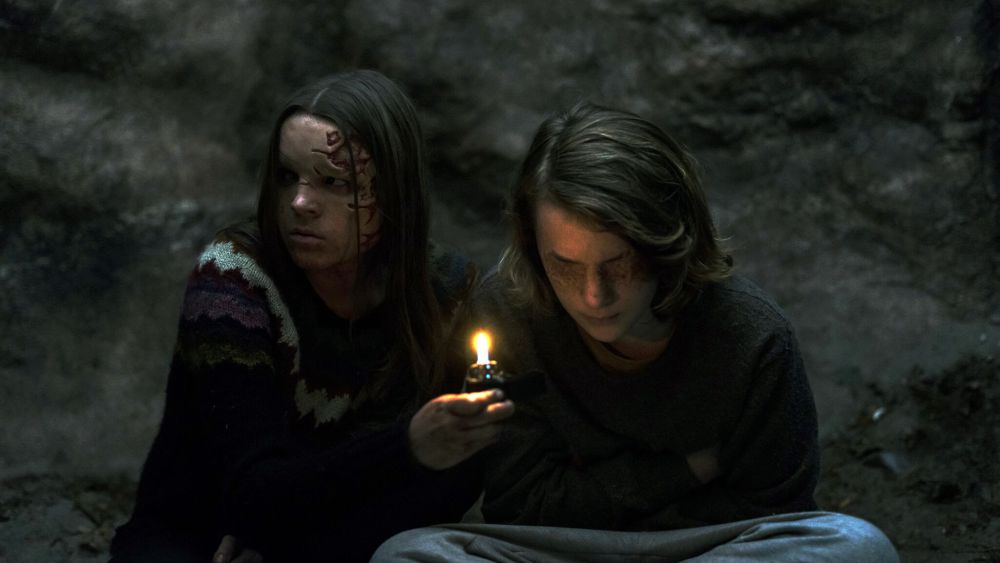
There are a lot of ways to approach a zombie film, few of them fresh. Zombie flick as YA (young adult) melodrama isn’t even a new idea anymore—2015 saw a surprisingly nuanced Arnold Schwarzenegger nurse his reanimated teen (Abigail Breslin) in Maggie, the best of the batch until now.
Still, writer/director Justin P. Lange has something on his mind with his debut feature The Dark, and he has found a compelling way to tell not-just-another zombie story.
We open on a twist to a familiar scene. A man in a rush, likely a fugitive of some kind, grabs some supplies at an out-of-the way gas station. He opens a map. The lone, wizened clerk points him toward an assumed destination: Devil’s Den.
As familiar as even the twist feels, the truth is that Lange gets more mileage from that old warhorse than you immediately realize. And he will continue to wield our assumptions and biases against us to better direct his story.
The blandly titled The Dark is, at its heart, a guide to overcoming trauma. Nadia Alexander is Mina, the creature that haunts Devil’s Den—a merciless, relentless, thoughtless killer. Until, that is, she comes across Alex, a blind young man (Toby Nichols) who reminds her of what she once was and what could have saved her.
Lange makes a series of clever narrative choices besides simply using our preconceived notions to surprise us. The Dark is, in part, a vengeance fable far less preoccupied by punishing those who do damage than those who should have been there for protection.
Alexander impresses as the beast unhappily and involuntarily rediscovering her humanity. Her silences, particularly in later scenes, are haunting.
As her mirror image and polar opposite, Nichols embodies vulnerability and resilience. There’s an optimism alongside a brokenness in his performance that is both necessary and heartbreaking.
The Dark occasionally skirts mawkishness, but what YA film doesn’t? In truth, Lange doesn’t run from the baggage associated with his chosen genres. He embraces it, forgives it, makes something powerful out of it.
Well, one of them (Peter) just updated Driving Miss Daisy. Nope, it is not a provocative but good natured spoof. It is Oscar bait.
The director and co-writer penned Green Book, a road picture telling the true tale of 1960s musician Dr. Don Shirley (Mahershala Ali) and Tony Vallelonga (Viggo Mortensen), the New York City nightclub bouncer Shirley hired to drive him throughout his tour of the deep South.
It’s a nice story, buoyantly directed. It’s another odd couple, two people with nothing in common who learn a lot from each other. And it’s hard to pick apart a true story for being so achingly convenient.
The film, co-written by Vallelonga’s son Nick, owes what artistic success it offers to two strong central performances.
Ali and Mortensen are veteran actors who just do not ever give an inferior performance. They are both excellent, always, and Green Book is no different. Their rapport and chemistry are the stuff of movie magic, and it is a joy to ride along with them.
Credit Mortensen for making more of Tony than a working class cliché, and to Ali for finding so many layers in what could have been a one-dimensional character. In his hands, Don Shirley is not simply the high class genius Tony first sees. Ali finds more in the character even than the lonely outsider Tony comes to understand. In Ali’s hands, there is a level of otherness, isolation and loneliness that borders on masochism, and it makes for a far more fascinating and far less knowable character.
Little else onscreen suggests layers.
Green Book is a film that tries very hard and wants so badly not to offend. Yes, the unlikely duo faces some challenges on their journey, but honestly, their struggle—indeed, everything about the movie—feels easy. Neutered.
Equally problematic is the point of view, which is, of course, the white male lead’s. It’s his lessons we’re really interested in, right? And he learns to have deep sympathy for Dr. Shirley.
But that is the primary problem with Green Book. It sympathizes greatly, but has absolutely no idea how to empathize.
Hey, do you guys remember Guy Ritchie’s King Arthur? I mean, of course you don’t. It made like $9.
Had it been anything other than a global box office disaster, a likeminded retooling of the British legend of Robin Hood might have made sense. And yet, here we have it: a poor man’s Guy Ritchie (Otto Bathurst) trying to anachronism his way through the old bandit’s tale.
Taron Egerton stars as the Hood, billed by imdb as “a war-hardened Crusader” but coming off more as a precocious 12-year-old. He’s joined by battlefield adversary and post-war comrade John (Jamie Foxx), who insists on calling him English regardless of the fact that they are in England and, you know, every single person is English. (Let’s not even talk about his accent.)
Eve Hewson and Tim Minchin round out the merry band as the politically liberal/inappropriately dressed Marian and the only actor who doesn’t embarrass himself, respectively.
Ben Mendelsohn shoulders the evil Sheriff of Nottingham duties this go-round. If you only know Mendelsohn from Ready Player One, Rogue One or Dark Knight Rises, please believe me when I say that he needs to stop playing scenery-chewing baddies. He is one of the most versatile and talented character actors in film today. Please go watch literally anything else he’s ever made. (Give yourself the gift of the Aussie film Animal Kingdom.)
Writers Ben Chandler and David James Kelly blandly reimagine Robin of Loxley’s origin story, casting aside any historical authenticity in favor of hip fun. Tragically, the result is never hip and rarely fun.
The film details some ludicrously debauched ties with the church and a global plot to bilk a few hundred peasants of more money than the whole of England would possess. Where do all those golden bowls and goblets come from? How many peasants are dining so flamboyantly?
They also reach to give the sheriff some Trumpian moments, though that backfires as well. As fine an actor as Mendelsohn is, it is tough for him to come off as a dumb ass.
The score feels cribbed, the action is video-game superficial and the costuming came directly from Forever 21.
It would not surprise us if we saw a new wave of ecological horror in which our own mistreatment of the environment and our irresponsible handling of pharmaceutical progress creates flesh hungry critters, pissed off two-headed bears, opioid addicted tapeworms, whatever. Let’s prepare by looking over history’s forewarnings, shall we?
Here are our favorite mutant animal films—cautionary tales about big pharma, careless planet keeping and sex.
5. Shivers (They Came from Within) (1975)
In an upscale Montreal high rise, an epidemic is breaking out. A scientist has created an aphrodisiac in the form of a big, nasty slug. That slug, though, spreads wantonness throughout the high rise and threatens to overrun the city with its lusty ways.
Not Cronenberg’s best film, but this is his first feature length horror and it announces not only his arrival on the genre scene, but it predicts so many of the films to come. The film obsesses over human sexuality, social mores, the physical form, physical violation and infestation, medical science, conspiracy, and free will. He’d revisit all of these preoccupations throughout his career, most obviously in his very next feature film, 1978’s Rabid, which is weirdly similar in every way.
Shivers takes a zombie concept and uses it to pervert expectations. (See what we did there?) They’re not here to eat your brains, after all. It’s the first film where Cronenberg marries ideas of the repugnant with the pleasurable, medical monstrosity with human body. It would be several years before his skill with performances (or maybe casting) matched his other directorial talents, but Shivers is still a worthwhile, utterly bizarre pleasure.
https://www.youtube.com/watch?v=eK9Wal9Dvic
4. Isolation (2005)
In 2016, writer/director/Irishman Billy O’Brien made an effective and lovely – yes, lovely – creature feature called I Am Not a Serial Killer. But about a decade earlier, he started down that path along a muddy, ruddy Irish roadside that wound ‘round to an out-of-the-way farm.
It’s the kind of a depressing, run-down spot that would catch nobody’s eye – which is exactly why it drew the attention of runaway lovers Jamie (Sean Harris) and Mary (a young Ruth Negga – wonderful as always). The solitude and remoteness also got noticed by a bio-genetics firm.
Down-on-his-luck Farmer Dan (John Lynch, melancholy perfection) has little choice but to allow some experimentation on his cows. He doesn’t really mind the required visits by veterinarian Orla (Essie Davis – hooray!).
But when one cow needs help delivering – genetic mutations, fetuses inside fetuses and teeth where no teeth belong. Nasty.
O’Brien and his truly outstanding cast create an oppressive, creepy, squeamish nightmare worth seeking out.
3. Black Sheep (2006)
Graphic and gory horror comedy seems to be the Kiwi trademark, no doubt a product of the popularity of native Lord of the Gastro-Intestinal-Splatter-Fest-Laugh-Riot, Peter Jackson.
First-time writer/director Jonathan King uses the isolation of a New Zealand sheep farm and the greedy evil of pharmaceutical research to create horror. He does it with a lot of humor and buckets full of blood. It works pretty well.
Evil brother Angus (Peter Feeney) has bred some genetically superior sheep while smart but sheep-phobic brother Harry (Nathan Meister) has been away. But the new sheep bite (a recurring problem with bio-genetically altered farm animals). Victims turn into, well, were-sheep. Of course they do.
The result is an endearing, often genuinely funny film. Cleverly written with performances strong enough to elevate it further, Black Sheep offers an enjoyable way to watch a would-be lamb chop get its revenge.
2. The Host (2006)
Visionary director Joon-ho Bong’s film opens in a military lab hospital in 2000. A clearly insane American doctor, repulsed by the dust coating formaldehyde bottles, orders a Korean subordinate to empty it all into the sink. Soon the contents of hundreds of bottles of formaldehyde find its way through the Korean sewer system and into the Han River. This event – allegedly based on fact – eventually leads, not surprisingly, to some pretty gamey drinking water. And also a 25 foot cross between Alien and a giant squid.
Said monster – let’s call him Steve Buscemi (the beast’s actual on-set nickname) – exits the river one bright afternoon in 2006 to run amuck in a very impressive outdoor-chaos-and-bloodshed scene. A dimwitted foodstand clerk witnesses his daughter’s abduction by the beast, and the stage is set.
What follows, rather than a military attack on a marauding Steve Buscemi, is actually one small, unhappy, bickering family’s quest to find and save the little girl. Their journey takes them to poorly organized quarantines, botched security check points, misguided military/Red Cross posts, and through Seoul’s sewer system, all leading to a climactic battle even more impressive than the earlier scene of afternoon chaos.
1. The Fly (1986)
After a couple of interesting, if un-medical films, the great David Cronenberg made a triumphant return to the laboratory of the mad scientist in his most popular film to date.
But it’s not just Cronenberg’s disturbed genius for images and ideas that makes The Fly fly; it’s the performance he draws from Jeff Goldblum.
Goldblum is an absolute gift to this film, so endearing in his pre-Brundlefly nerdiness. He’s the picture’s heartbeat, and it’s more than the fact that we like his character so much. The actor also performs heroically under all those prosthetics.
He and Geena Davis make the perfect pair, with their matching height and mullets, and their onscreen chemistry does give the film a level of human drama traditionally lacking from the Cronenberg canon. Atop that, there’s the transformation scene in the bathroom – the fingernails, the pustules – all classic Cronenberg grotesquerie, and still difficult to watch.
Join us in the Screening Room this week to hash out the good and the bad in theaters this week: Fantastic Beasts: The Crimes of Grindewald, Widows, Instant Family, Boy Erased and Border. We’ll also go through the mostly-bad in new home entertainment.
There are few films I have been more geeked to see than Widows.
Co-writer/director Steve McQueen (12 Years a Slave, Shame) and co-writer Gillian Flynn (Gone Girl, Sharp Objects) update a British miniseries from the ‘80s about a heist.
Wait, Steve McQueen made a heist movie? A filmmaker so punishing you watch a little Lars von Trier to lighten the mood?
He totally made a heist movie. It is a layered, deeply cynical, wildly faceted take on politics, organized crime, familial grief and the plight of a powerless woman. So, OK, maybe not your run-of-the-mill Liam Neeson flick. But Liam Neeson is in it.
Neeson is Harry Rawlings, top man in a group of criminals who hit vaults around Chicago. This last hit went south, though, and the bad men he fleeced need that cash back. Poor Mrs. Rawlings (Viola Davis, glorious as is her way), is handed the bill.
McQueen has not made an Oceans 11. Widows is not fun. It is smart, riveting entertainment, though.
McQueen’s Chicago landscape is peopled mainly with folks desperately in need of a change: the criminal trying to get into politics (Brian Tyree Henry), the career politician with daddy issues (Colin Farrell), but mostly the widows of Harry’s crew (Michelle Rodriguez, Elizabeth Debicki), all left as cash-strapped as Mrs. Rawlings.
It does not pay to marry a criminal.
Every member of the enormous ensemble runs with the opportunities this script allows, no matter how much or how little their screen time. Daniel Kaluuya relishes every sadistic moment he has as an enforcer, while Jacki Weaver establishes one character’s entire history with her two fascinating minutes onscreen.
But it’s Viola Davis who anchors the film. She is the grieving heart and the survivor’s mind that gives Widows its center and its momentum. She wastes nothing, never forgetting or allowing us to forget the grim reality of her situation.
There is a heist, don’t get me wrong. There are double crosses, flying bullets, car chases, explosions—genre prerequisites that feel like new toys for the super-serious director. McQueen proves a versatile a filmmaker, though he has certainly left his own distinctive mark on the action flick.
Maybe they miss the romantic notion of outsiders among outsiders, or the oh-so-earnest world of good versus evil. J.K. Rowling enchanted a generation with a densely populated world of magic and mayhem and an awful lot of people long to go back. So many, in fact, that they will mostly settle for the sloppy bastard Fantastic Beast series.
It is still Rowling’s words, after all—the author pens the screenplays, inviting us back into that wizarding world, albeit about a generation or two earlier.
Fantastic Beasts: The Crimes of Grindewald picks up six months after its blandly likeable predecessor, 2016’s Fantastic Beasts and Where to Find Them. Odd duck Newt Scamander (Eddie Redmayne) is banned from international travel by the Ministry of Magic. Grindewald (Johnny Depp) is in prison. Credence Barebone (Ezra Miller)—who conveniently survived what was clearly his death in the previous effort—wants to know who he is and where he belongs.
The second installment opens well, offering more vitality, thrill and sinister mayhem than you’ll find in its predecessor’s full 133 minutes.
Redmayne is as adorable as last time. Depp brings something seductively sinister to the role. And Rowling’s clear distaste for leaders who bang the drum for racial supremacy and fear mongering is both understandable and nicely executed.
David Yates returns to direct his sixth Potter-verse flick. He finds opportunities for the visual flourish that was the only true strength of the first Fantastic Beasts film, but manages far stronger narrative momentum this time around.
All of which really only leads to the frustration of realizing at the 134-minute mark that this film doesn’t end. In fact, the last scene is basically the beginning of the movie. The 130- minutes previous basically amounts to exposition that sets up the next film.
Which is funny, since the previous entire film amounts to little more than a preface to an actual narrative.
Characters are quirky, wardrobe is glorious, Ezra Miller broods well—all of which is a lot of what we’ve already seen. What Grindewald doesn’t offer is anything new, or any reason to care.
Sometimes knowing yourself means embracing the beast within. Sometimes it means making peace with the beast without. For Tina—well, let’s just say Tina’s got a lot going on right now.
Eva Melander is Tina, a woman resigned to the solitary existence of an outsider. Her “chromosomal malady” has left her unbecoming to most of the people in her Danish border town, but it’s also gifted her with senses that allow her to notice criminals by the way they smell.
Those senses are thrown, though, by a stranger (Eero Milonoff) who makes her feel, for the first time in her life, that she’s not alone.
Border director/co-writer Ali Abbasi has more in mind than your typical Ugly Duckling tale, though. He mines John Ajvide Lindqvist’s (Let the Right One In) short story of outsider love and Nordic folklore for ideas of radicalization, empowerment, gender fluidity and feminine rage.
The result is both a sincere crime thriller and a magical fantasy. A perfect meshing of Michael Pearce’s 2017 indie Beast and Alex van Warmerdam’s dark 2013 folk tale Borgman, Border still manages to be entirely its own creature.
Melander is a force of nature under impressive prosthetics. Her fearless performance, one that requires an arc that feels simultaneously backward and progressive, guarantees that no matter the bracing images or ugly narrative, you will not look away. You won’t be able to.
Milonoff also impresses, as does a cast of support players blessed with an unusual and fittingly untidy storyline.
There are moments in Border that should have felt silly while others could easily have tipped into lurid territory, but they never do. Abbasi’s respect for his characters keeps even the most outlandish scenes on track. He boasts an impressive aptitude for blending a fantastical fairy tale nature with the realism of a thriller without ever losing one thread for the other.
The result is a film quite unlike anything else, one offering layer upon provocative, messy layer and Abbasi feels no compulsion to tidy up. Instead, he leaves you with a lot to think through thanks to one unyieldingly original film.
Join us in the screening room as we rate The Grinch, Girl in the Spider’s Web, Overlord, Can You Ever Forgive Me? and everything new in home entertainment.
Perhaps you don’t know this, but Nazi zombies have a horror genre unto themselves: Shock Waves, Zombie Lake, Dead Snow, Dead Snow 2, Blood Creek. Well, there’s a new Nazi Zombie Sheriff in town, and he is effing glorious.
Overlord drops us into enemy territory on D-Day. One rag tag group of American soldiers needs to disable the radio tower the Nazis have set up on top of a rural French church, disabling Nazi communications and allowing our guys to land safely.
What’s on the church tower is not so much the problem. It’s what’s in the basement.
Director Julius Avery stays true to the war film vibe. Though clearly Overlord lacks the scope of something like Saving Private Ryan, visceral scenes of war set the stage for a film about the monstrosity lurking inside man.
He’s aided immeasurably by two writers with a knack for tales of endurance. Billy Ray’s career is littered with tense political thrillers, and his co-scribe Mark L. Smith wrote The Revenant, for Lord’s sake. He knows how to put a man through some shit.
The fellas find cover in the home of a sympathetic French woman (Mathilde Olivier) and plot their next move. Too bad it’s in that church basement.
Pilou Asbaek offers another excellent performance, this time as the Nazi commander. He drips sinister and looks enough like a handsome Michael Shannon to terrify even when he’s not speaking.
All the performances are strong, and character arcs feel fresh even though you know—if you have ever seen a war movie—how they will progress. Because this is a war movie, but war is hell and hell is horror.
Avery creates the same kind of desperate tension you’d expect from a suicide mission, and when the tables turn and we’re suddenly inside some kind of filthy mad scientist horror, the film doesn’t lose a step.
Suddenly, through Avery’s eyes and the horrified reactions of our heroes, we see how easily not only war movies but Marvel comic book films can cross the line to blood chilling horror.
A satisfying Good V Evil film that benefits from layers, Overlord reminds us repeatedly that it is possible to retain your humanity, even in the face of inhuman evil.