Tag Archives: Madd at the Movies

Avenging Fred Hampton

Judas and the Black Messiah

by Hope Madden

Daniel Kaluuya’s range is simply unreal. From the vulnerable hero of Get Out to the chilling sociopath of Widows, he’s prepared us for quite a gamut of characters. I’m not sure he’s prepared us for his Chairman, though.

Kaluuya plays Fred Hampton, Chairman of the Illinois Chapter of the Black Panther Party circa 1969, in Shaka King’s Judas and the Black Messiah. A feeling of mortality permeates his performance, and with it a melancholy sense of urgency. His quiet moments swell with tenderness and turmoil, and his speeches burn through the screen. We’ve seen some great performances this year, but we’d give Kaluuya the Oscar right now.

That’s a lot to live up to, but the balance of King’s cast meets the task. LaKeith Stanfield, as police informant Bill O’Neal, strikes the right balance between cowardice and regret. He doesn’t try to make us pity O’Neal and the deal he’s struck with the devil, but he gives the character an energy that suggests more emotional and psychological layers than what’s found on the page.

As FBI Agent Roy Mitchell, Jesse Plemons is as solid as ever, delivering lines with enough genuineness that Mitchell doesn’t become an outright villain until he, along with O’Neal, have gone too far to pretend they’re anything else.

Their performances draw support from an understated Dominique Fishback as a firmly but not blindly committed comrade—Hampton’s girlfriend Deborah Johnson. Meanwhile, Dominique Thorne has badassedness to burn as part of a deep ensemble that impresses in most every turn.  

The film never feels like a biopic. The rendering is far more crime thriller, and had this been a simple fictional account of a mole in a political organization, King’s film would have been riveting. Performances alone would have elevated the genre beats.

The real star may be King’s script, co-written with Will Berson and Keith and Kenneth Lucas. There’s no placating. There’s no playing to the masses. King doesn’t water down Hampton’s message of unifying the poor or throwing off the oppression of a police state. In fact, this is a film that means to show the difference between revolution and the “candy coated façade of gradual reform.”

The Wrong Contractor

Paradise Cove

by Hope Madden

What’s that network that plays movies round the clock with titles like Cheerleader Murderer and Sultry Stepmom or Deadly Realtor? Because Paradise Cove is three F-bombs and an on-the-nose title away from fitting right in.

Martin Guigui directs Sherry Klein’s script. Either he did not read it first, or he did read it and simply didn’t understand it. I can think of no third option to explain this mess.

Knox (Todd Grinnell, henceforth to be known as “Cardboard Paul Rudd”) and Tracey (Mena Suvari) move into the beachfront Malibu property Knox’s mom left him after she died in a fire onsite. It needs a lot of work, but Knox is a contractor, and he’s certain that he sees a 6-million-dollar view.

With a little help from Griff (Eddie Goines) and a blind eye from the zoning department, maybe he and Tracey can flip this, build a home of their dreams far from Malibu, and start that family they’re already using fertility treatments to conceive.

But there’s this homeless woman (Kristin Bauer van Straten) who lives under their deck. Unfortunately, it appears that folks from Malibu stick up for other folks from Malibu—no matter how dangerous, homeless or insane—and outsiders aren’t welcome. It’s like Maine with Botox.

The script manages to provide opportunities for a genre-specific tension. Knox knows this woman can get inside their house, but an event keeps him from telling his wife. This single event should, if handled properly, create anxiety around whether or not she’s in the house while it develops conflict within the main character.

Instead, Guigui treats every scene as if no other scene has taken place. It doesn’t help that all of this tension non-building is in service of Knox’s character arc.

Is Knox that wholesome Midwesterner we first meet, the one so willing to hand $5 to the homeless vet out his car window? (FYI: The homeless are not treated with much respect by this film. )

Or is he something more, the product of a sketchy background, able to hold his innocent wife’s hormone treatment over her head whenever she thinks she might smell a rat?

Who knows? He’s being played by Cardboard Paul Rudd, who’s better suited to the role of Handsome Carpool Dad.

Offer It Up

Saint Maud

by Hope Madden

Never waste your pain.

What a peculiarly Catholic sentiment. Like old school, self-flagellating, “suffering cleanses” kind of Catholic: the agony and the ecstasy. It’s in the eyes of the martyrs. This is how you see God.

This is what Maud wants.

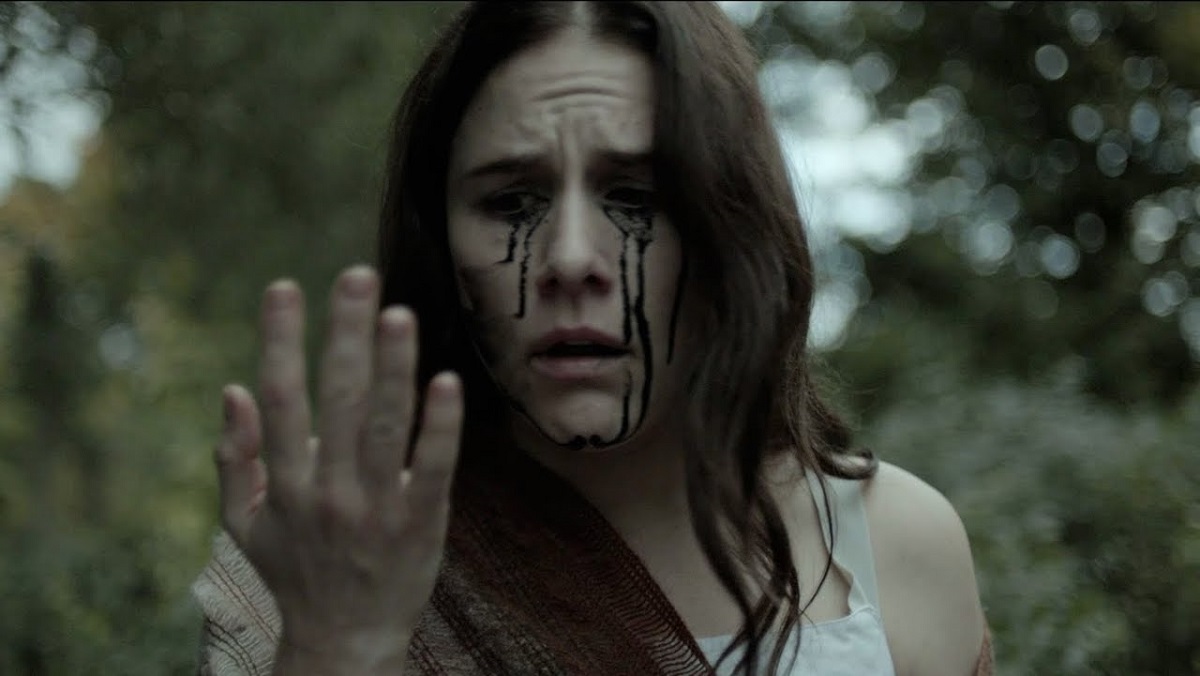
Writer/director Rose Glass knows that Catholicism is one of the most common elements in horror. You see it in the way she shoots down an old staircase in an alley, or up at the high windows of a lovely manor.

There’s been a glut of uninspired, superficial drivel. But there are also great movies: The Devils (1971), The Omen (1976), and the Godfather of them all, The Exorcist (1973). Saint Maud stakes its claim in this unholy ground with a singular vision of loneliness, purpose and martyrdom.

Maud (an astonishing Morfydd Clark) has some undefined blood and shame in her recent past. But she survived it, and she knows God saved her for a reason. She’s still working out what that reason is when she meets Amanda (Jennifer Ehle), a former choreographer now crumbling beneath lymphoma.

Maud cannot save Amanda’s body, but because of just the right signs from Amanda, she is determined to save her soul.

Ehle’s performance strikes a perfect image of casual cruelty, her scenes with the clearly delicate Maud a dance of curiosity and unkindness. Ehle’s onscreen chemistry with Clark suggests the bored, almost regretful thrill of manipulation.

Clark’s searching, desperate performance is chilling. Glass routinely frames her in ways to evoke the images of saints and martyrs, giving the film an eerie beauty, one that haunts rather than comforts. The conversations and pathos are so authentic that suddenly the behavior of one mad obsessive feels less lurid and more tragic.

As a horror film, Saint Maud is a slow burn. Glass and crew repay you for your patience, though, with a smart film that believes in its audience. Her film treads the earth between mental illness and religious fervor, but its sights are on the horror of the broken hearted and lonesome.

The Forest is Satan’s Church

Sator

by Hope Madden

There are a lot of films that can be considered a passion project. Sator fits the category, that passion coming from writer/director/producer/cinematographer/composer Jordan Graham.

Graham essentially did everything besides act, and it gives the film a specific vision that’s clearly undiluted by collaboration. That is in the film’s win column, but it’s also a bit of a loss.

Graham’s vision is one of isolation, dysfunction, paranoia, and mental illness—or it’s about the presence of a supernatural being with bad intentions concerning Adam (Gabriel Nicholson) and his family.

The sound design here is as impressive as the way Graham guides us visually. The filmmaker shifts slowly between different aspect ratios, as well as from black and white to color and back. The movement is so gradual as to almost hypnotize.

Meanwhile, somewhere in the background Nani (June Peterson)—Adam’s grandmother—talks on and on. The voice is pre-recorded, and she’s talking about, and sometimes talking for, a presence.

Graham slides in an out of the audio, which often mismatches the visual although all of it blends into a dreamlike horror. The film resembles a nightmare, but it may also simply resemble a form of mental illness that is itself a bit of a nightmare.

Graham’s slow burn unveils trauma as it wallows in its aftermath, and the thick fog of delusion hangs everywhere. But films like this sometimes paint themselves into a corner because there are no real answers, and the audience investment needs to be repaid somehow.

Here’s where Sator comes up slightly short. Though the sudden punctuation of violence startles you from the dream of the film and provides a reasonable and horrific cap to the picture, it’s hard to shake the feeling that the whole adventure took too long. Act 2 feels too often like a slog, and the entirely unresolved images peppered here and there wind up feeling less like spooky ambiguity and more like points of frustration.

It’s not nearly enough to sink this Herculean effort. Graham’s film possesses an artistry that can’t be denied, and it succeeds more than it fails.

Witch Seeking Craft

Earwig and the Witch

by Hope Madden

More than 30 years ago, the great Hayao Miyazaki released a charming animated adventure that shadowed a little witch-in-training and her talking cat. Kiki’s Delivery Service is more interested in children finding their way in an adult world than in magic. The film is magical nonetheless, thanks to Miyazaki’s gorgeous art.

This weekend, Studio Gibli—the house that Hayao built—releases Earwig and the Witch. It’s the same movie, really, just not nearly as good.

Earwig is left as an infant at a proud English orphanage, where she stays for years tucked in among friends who do whatever she wants and staff who do much the same. But she’s adopted one day by a witch and a demon and she’s quite harrumphy about it all.

Director Gorō Miyazaki, Hayao’s son, keeps his focus on this willful little girl who intends to be a witch-in-training no matter what her new guardians expect.

Fans of the genre will immediately take umbrage at the animation style. It’s definitely not his dad’s. Don’t expect the little (or sometimes enormous) creatures that populate the fringes of classics like Spirited Away or My Neighbor Totoro.

That’s hardly where the dissimilarities end. Earwig tosses aside the sublime 2D look of traditional Gibli for a CG animation more in keeping with Pixar’s output. But there’s no nuance, no beauty or humanity in the rendering.

Anime fans may balk, but will children care?

Probably not, which means the film would be fine if only the younger Miyazaki had his father’s (or Pixar’s) grasp on basic storytelling. While Earwig conjures specific story details from Spirited Away and Howl’s Moving Castle, it fails to deliver on any of its plot suggestions. There’s a dungeonlike workroom brimming in equal measure with magical potential and filth, a mysterious redhead, a rock band, a shrouded heritage…all of which amounts to absolutely nothing.

Nothing ties together, and by the final scene’s reveal you feel like you’re watching the cliffhanger for an episodic series that you probably won’t commit to.

Making the Monster

A Nightmare Wakes

by Hope Madden

It’s hard not to be fascinated by Mary Wollstonecraft Shelley, who, at 18, wrote arguably the most iconic piece of Gothic horror or science fiction—or both in one—ever to be penned.

Writer/director Nora Unkel takes us back to that rainy summer night when young Mary, her lover Percy Shelley (Guillian Yao Gioiello) and his friend Lord Byron (Philippe Bowgen, over the top) participated in a challenge to write a ghost story.

We all remember what Mary came up with, right?

Alix Wilton Regan plays the young scribe. It’s an adequate performance in a fairly lifeless film that suggests writing and madness go hand in hand but plays it safe when it comes to what really haunts Mary.

As Mary Shelley suffers through indignities at the hands of a lover she believed to be a better man than he is, she escapes through writing. Aside from one particularly difficult scene, though, Percy’s behavior is largely sanitized or quarantined to offscreen antics we can only guess at.

Wilton Regan offers a needy heroine more likely to lash out at her sister (who may or may not deserve it, Unkel never really clarifies) than to stand up for herself. The performance might have delivered an intriguing central figure—unlikeable and almost impossible to root for.

It seems like a conscious creative decision between Unkel and Wilton Regan, given some of Mary’s behaviors. Creating an unlikeable female to anchor a film is an endlessly intriguing, brave and chancy decision, but the film you hang around her has to turn her performance into something worthy of the attention. Unkel can’t manage it.

Still, Mary descends into a kind of madness and soon enough, her creation takes on a life of its own.

Unkel is not the first filmmaker to conflate the writer’s life with the writer’s product. Just a few years back, Haiffa Al-Mansour’s biopic Mary Shelley convincingly drew Frankenstein as a near autobiography. That film didn’t quite deliver on its promise, either.

In Al-Mansour’s case, hero worship led to a superficial character (played soundly by Elle Fanning) with few faults and a lot of frowning. Unkel’s version is close to the opposite, but both filmmakers set out to depict what it was Mary Shelley was really trying to say when she wrote Frankenstein.

It’s a laudable goal. The problem may just be that Mary Shelley said it so much better.

Red Pill or Blue?

A Glitch in the Matrix

by Hope Madden

Nobody makes documentaries quite like Rodney Ascher.

You can see the 2010 short that first got him the attention of the Sundance Film Festival, S from Hell, in its entirety on YouTube right now. I think you should. It gives you just a taste of the mixture of absurd, earnest, terrifying and funny that inform his nonfiction recipes.

His 2012 documentary feature debut, Room 237, gave us a glimpse of his own fascination with personal obsessions. Ascher’s interest in the opinions and voices of his subjects clearly allows them to feel the safety necessary to share deeply held and seemingly ludicrous ideas. It also gives the film a sense of exploration rather than judgment. You are truly invited to wonder what if?

His most potent and terrifying invitation, The Nightmare, is so sincere in its sleuthing it may convince you that the film itself has infected you with a debilitating condition. So it’s no surprise that any new effort from Ascher draws awed anticipation from weirdos and cinephiles alike (not that there’s a big difference between the two).

Plus a ton of utterly fascinating footage of Philip K. Dick speaking.

A Glitch in the Matrix, premiering earlier this week at Sundance and opening digitally (appropriately enough) this weekend, explores Simulation Theory. You know, that zany notion that we’re not real, we’re all living in a simulating played by beings of a higher intelligence.

Nutty, right?   

Once again, Ascher’s meticulously built doc feels simultaneously playful and dark—two adjectives that suit the topic brilliantly. We’re reminded of Descartes attempts to prove that he exists, and before that, of Plato’s musings that we may be simply witnessing some form of life facsimile and not participating in reality at all.

So, it’s not a new idea. Perhaps the most intriguing notion the film brings up is that, when aquaducts were the height of technology, the world believed our bodies were at the mercy of our own humors. Once the telegraph became top tech, suddenly our bodies were run by electrical currents. And later, we “understood” that our brains were like computers.

It’s no surprise, then that in a virtual world, we lean toward the notion that reality is its own form of virtual reality. But Ascher digs much deeper, drawing images of a culture and personality type compelled by these ideas, and the hard potential consequences of a Matrix in the hands of someone less noble than Neo.

A Glitch in the Matrix becomes Ascher’s most complicated and poignant film.

Moon in Her Eye

The Reckoning

by Hope Madden

It’s been nearly 20 years since Neil Marshall first caught our attention with his remarkable military/lycanthropic standoff, Dog Soldiers. Just three years later, the writer/director offered his genre masterpiece, The Descent, and suddenly anticipation was high for a filmmaker who knew how to scare us.

A couple of disappointments later and the Englishman began to rebuild his reputation doing one-off TV episodes and horror shorts until possibly sinking his career forever in 2019 with the Big Box Office Bomb that was Hellboy.

The Reckoning won’t help things.

Marshall’s latest, co-written with Edward Evers-Swindell (Dark Signal) and star Charlotte Kirk, takes us back to the Dark Ages. The black plague is wiping out the English countryside, but witch hunters are a close second in terms of death toll.

Striking images are everywhere in this film—a home burning, a horse rearing, misty moors and the like. But the first sight that will really make you scratch your head is that of Grace (Kirk), humble-but-loving wife in full, never-to-be-flawed makeup. It’s so jarring given the plague-ridden scenes surrounding her that you cannot help but notice it.

And for the next hour 50 (at least 30 minutes longer than necessary), Kirk poses. She stands firm. She yearns. She dotes. She hesitates. She resolves. Yes, I believe that runs the full gamut of Kirk’s poses.

It doesn’t help matters that The Reckoning brings so little new to the historical witch torture genre. Grace’s ordeals, once her lascivious landlord brings her up on charges of witchcraft for spurning him, lead to increasingly gratuitous and sexualized torture.

And still, that nude lip liner never smudges.

Around Kirk’s showy performance is a wide variety of talent. Sean Pertwee and Steven Waddington offer fine, villainous turns, for instance.

The writing is not a real strength, as most of the plotting and dialog serve only to create new opportunities to pose. It’s hard to call The Reckoning a wasted opportunity because, aside from some solid framing and cinematography, there’s nothing here to even exploit. It’s a superficial ripoff of a worn out genre, built entirely around a laughable performance.  

A Little Familiar

The Little Things

by Hope Madden

When you see a film whose plot synopsis exactly mirrors hundreds of other movies, it is the little things you have to look for to set it apart.

Writer/director John Lee Hancock’s The Little Things introduces plenty of those small details: a massive cross high in the Hollywood hills, a gun casing, a barrette, a radio station, a dog. Like the 1990s setting, though, they mostly amount to little more than understated flourish.

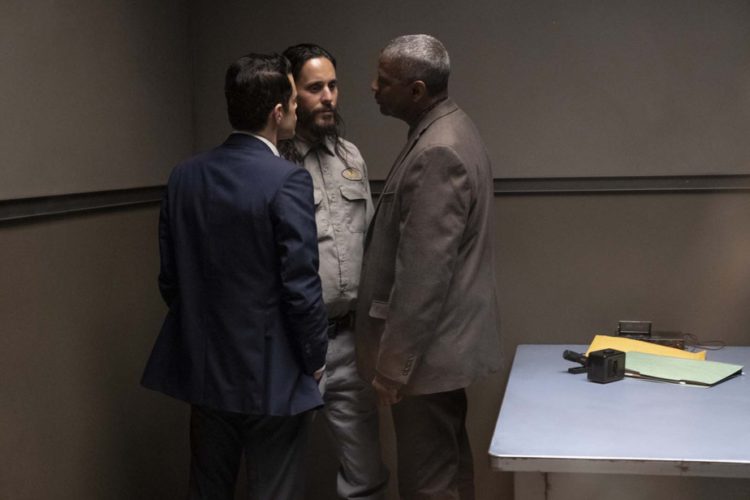
Hancock (who wrote and directed The Blind Side, but I will try not to hold that against him) introduces two cops. One, Deke (Denzel Washington, always a pleasure), is a Kern County sheriff’s deputy with bad blood back in LA. The other, Baxter (Rami Malek), is a climbing homicide detective hot shot in the big town.

When Deke is sent to the city to retrieve some evidence for a county case, Baxter inexplicably pulls him into a serial killer investigation, and there you have it: haunted veteran cop, ambitious newcomer, cold blooded killer (who may or may not be Jared Leto).

Again, that barebones description could be about 300 movies and TV series, including Netflix’s current true crime mini The Night Stalker (who is mentioned once during this film). How to elevate it?

Well, four Oscars among your three leads is a start. Perhaps that’s why this police procedural turns character study so quickly.

Washington’s worn out crime fighter offers a low key emotional center, which is a needed respite from the odd Baxter. Malek’s characterization of the by-the-books half of this duo is curiously manic, and Hancock spends frustratingly little time digging into Baxter’s motivation. Still, Malek and Washington offer quick chemistry that gives their scenes some depth.

Leto delivers a characteristically tic-heavy performance—perhaps also a tad overdone. Both he and Malek help generate a little energy with their accumulated weirdness, but it’s not enough to overcome the film’s general lack of momentum or purpose.

It doesn’t help that the color, period and low boil bring to mind two wildly superior Fincher efforts—Seven and, even more clearly, Zodiac. And however competently made (and it is) or impressively cast (obviously), The Little Things just can’t distinguish itself from the pack.

Queen of Mean

The Queen of Black Magic

by Hope Madden

Filmmaker Kimo Stamboel resurrects 70s exploitation horror with The Queen of Black Magic. Not a remake or really a sequel or reboot of the Indonesian cult classic, Stamboel’s film is more inspired by its namesake.

Fun throwbacks to Liliek Sudjio’s original over the end credits do more to remind you how comparably tame this one is.

Not that it is without merit. Or gore.

Hanif (Ario Bayu) returns to the orphanage where he grew up. The man who raised him is dying, and now Hanif and his two childhood friends reunite, families in tow, having come home to pay their respects.

But bad things haunt the old orphanage.

Of course they do! What are you, new?!

Stamboel and writer Joko Anwar can’t come up with anything particularly new when deciding what, exactly, is the problem with this orphanage. But they populate their scenes of carnage with actors who generate some empathy, and put those actors into scenes that are pretty compelling. Especially if you have a thing about crawly creatures. Or a sensitive gag reflex.

Anwar is a master of conjuring nightmarish environments, complete with nightmare logic. His 2017 remake Satan’s Slave and his 2019 original Impetigore throw narrative logic aside in favor of a denseness of dread punctuated with unseemly carnage.

The Queen of Black Magic makes more narrative sense, but somehow that seems to flatten it out a little. It feels less magically horrific and unsettling as the films Anwar directs. But strong, dimensional performances elevate every scene.

And both filmmakers know gore. They know what sounds make you wince, what sights make you look away. Between that, the performances, and a tight enough screenplay to keep your interest, they’ve pieced together a tough little horror flick worth a genre fan’s time.