Tag Archives: independent film

Moon in Her Eye

The Reckoning

by Hope Madden

It’s been nearly 20 years since Neil Marshall first caught our attention with his remarkable military/lycanthropic standoff, Dog Soldiers. Just three years later, the writer/director offered his genre masterpiece, The Descent, and suddenly anticipation was high for a filmmaker who knew how to scare us.

A couple of disappointments later and the Englishman began to rebuild his reputation doing one-off TV episodes and horror shorts until possibly sinking his career forever in 2019 with the Big Box Office Bomb that was Hellboy.

The Reckoning won’t help things.

Marshall’s latest, co-written with Edward Evers-Swindell (Dark Signal) and star Charlotte Kirk, takes us back to the Dark Ages. The black plague is wiping out the English countryside, but witch hunters are a close second in terms of death toll.

Striking images are everywhere in this film—a home burning, a horse rearing, misty moors and the like. But the first sight that will really make you scratch your head is that of Grace (Kirk), humble-but-loving wife in full, never-to-be-flawed makeup. It’s so jarring given the plague-ridden scenes surrounding her that you cannot help but notice it.

And for the next hour 50 (at least 30 minutes longer than necessary), Kirk poses. She stands firm. She yearns. She dotes. She hesitates. She resolves. Yes, I believe that runs the full gamut of Kirk’s poses.

It doesn’t help matters that The Reckoning brings so little new to the historical witch torture genre. Grace’s ordeals, once her lascivious landlord brings her up on charges of witchcraft for spurning him, lead to increasingly gratuitous and sexualized torture.

And still, that nude lip liner never smudges.

Around Kirk’s showy performance is a wide variety of talent. Sean Pertwee and Steven Waddington offer fine, villainous turns, for instance.

The writing is not a real strength, as most of the plotting and dialog serve only to create new opportunities to pose. It’s hard to call The Reckoning a wasted opportunity because, aside from some solid framing and cinematography, there’s nothing here to even exploit. It’s a superficial ripoff of a worn out genre, built entirely around a laughable performance.  

I Dream of Horses

The Wanting Mare

by Hope Madden

Light on plot, heavy on atmosphere, Nicholas Ashe Bateman’s feature debut drops us in a distant post-apocalypse. Here, those trapped on a sparsely populated island of dust and heat dream of boarding the once-yearly barge that transports the island’s wild horses to a wintry mainland.

Poetic and dreamy, Bateman’s tale plays out before us without allowing us to truly penetrate it. Moira (Jordan Monaghan) has one wish only: passage across. She’s plagued by nightmares of a fiery past—maybe the event that brought about the now-times, nightmares passed down to her from her own mother.

She saves a man. He promises her a ticket. But how good is a man’s word in a society like this?

Bateman’s vision is often transportive. There are leaps in timeline and in logic that you’ll forgive by virtue of the lyrical nature of his story. This is a fable, not a drama. The Wanting Mare has a fantasy for you, if you have the patience for it.

You will need patience, though. The 90-minute runtime feels much longer, partly because Bateman’s storytelling intentionally keeps you at arm’s length from his characters. Without any skin in the game, the game becomes tiresome.

It’s never less than beautiful, but it’s definitely less than compelling. There are brief scenes in the second act that almost offer excitement, plot twists, some genuine call for redemption. These are the only scenes in the film that Bateman rushes.

Performances are necessarily stilted and can’t be criticized for that. We are not meant to feel close to these characters, although Bateman himself does personalize his character. His own acting style is far more accessible and intimate than that of his co-stars.

The benefit: act 2 feels more emotionally compelling than the rest of the film. The drawback: the film’s point of view becomes muddy. We travel through time along with Moira and her offspring, but because we identify with Bateman’s nameless man, these women become even more distant and peripheral. They are idealized reasons for the film to be rather than a driving force or voice in the film itself.

And that’s what the film is missing. It’s a gorgeous effort, poetic and somber and dreamlike. But it lacks a central voice, and without that, any real connection with the audience.

Is Anyone There?

Go/Don’t Go

by Brandon Thomas

The opening minutes of Go/Don’t Go hint at a burgeoning relationship drama. Shy boy meets an outgoing girl. Girl draws the boy out of his shell. Hints of electricity crackle as they find themselves engrossed in conversation. The parts are all there, but as the scene comes to a close, Go/Don’t Go crosses into something a little more…sinister. 

Set in a not-so-distant future, Adam (writer/director Alex Knapp) spends his days completing routine tasks. He cleans, prepares meals and works on repairing a car. When not doing his day-to-day, Adam wanders the countryside, checks homes and marks areas on a map as “Go/Don’t Go.” Adam appears to be the only person left.

Isolation and loneliness exist in the periphery of every post-apocalyptic type movie. In Go/Don’t Go, the isolation is front and center. Adam doesn’t spend the entire running time evading cannibalistic marauders or dispatching shuffling zombies. No, Adam’s conflict exists in the haunted memories of a past love, K (Olivia Luccardi, It Follows). 

Looked at as a typical horror/thriller, Go/Don’t Go could be a frustrating watch for many. There’s a purposeful aloofness to the narrative that builds a lot of mystery, but also never shows much interest in resolving said mysteries. Adam’s flashbacks fill in interesting character gaps instead of explaining how Adam found himself in his current situation. 

The film’s most interesting angle is how it plays with metaphor. Is the landscape in which Adam lives even real? Every house he enters has running water and electricity. The market he goes to is always stocked full of fresh products. Maybe Adam’s shyness, hinted at in those opening minutes, has consumed him after the ending of a relationship. Of course, nothing is definitive and most of this is left to the viewer to decide. 

Knapp’s handling of familiar territory is a breath of fresh air. Despite the lack of momentum in the narrative, Knapp taps into a sense of urgency through clever editing. This allows layers of character to be peeled back piece by piece. It’s enough to keep us interested and invested in a story that moves at more of a sporadic pace. 

By focusing on character and theme, Go/Don’t Go manages to stand out in a sea of post-apocalyptic tales. 

https://www.youtube.com/watch?v=38k4Mmat_6I

Fear and Loathing on the Nile

Luxor

by Matt Weiner

Faulkner wrote that the past is never dead… it’s not even past. British aid worker Hana (Andrea Riseborough) is hellbent on putting this to the test in Luxor, a slow burn of a spiritual journey from writer/director Zeina Durra that brings together vibrant Egyptian settings and a remarkable, nuanced performance from Riseborough.

Hana, taking some time off from her medical work on the Jordan-Syrian border, returns to the city of Luxor. It’s a place that holds great meaning and memories for her, even if her PTSD has collapsed much of those memories into an unnerving fog of past and present events and regrets all confronting her at once.

Hana’s stay is further complicated by the appearance of Sultan (Karim Saleh), her ex-lover. Sultan is an archaeologist working on a dig, and it’s an irony that does not escape Hana’s notice that the two are back together in the ancient city to excavate their pasts—and come across a few noteworthy relics.

The collision between old and new is a recurring motif for director Durra, made physical with the temple ruins but even more poignantly through Hana’s fragile mental state. This is where the film’s evocative settings of the past come to life, powered by Riseborough’s urgent reveries that drag her from past to present, and finally force her to come to terms with the trauma she has fled.

Much of the film follows Hana and Sultan wandering the city, their conversations going around in metaphorical circles as Hana does her best to elide over any sort of catharsis. In a way, the film is like a spiritual counterpart to Michael Winterbottom’s The Trip series: those characters play their mid-life ennui up for laughs, but there’s an uncanny shared impulse to travel outside of one’s regular life to find whatever it is they think they’re missing.

It’s a journey that Durra treats with reverence, and with an emotional payoff that upends the film’s measured pace. Who knew archaeology could dig so deep?

18 and Life

18 to Party

by Hope Madden

Does every crappy small town in America have a dive called Polo’s where mangey kids—many of them well, well under age—line up to try to get in?

Well, if not, writer/director Jeff Roda’s 18 to Party makes that and just about everything else seem universal. His Linklater-esque exploration of near-adolescence runs its course in a single evening, but that doesn’t make it any easier to forget.

Sure, the high schoolers are all lined up out front waiting for the sun to go down and the bouncer to start letting people in. But Missy, Kira and James, Shel and Brad, Peter and Dean are stuck out behind the club, wasting time and hoping against hope that night manager Rizzo is cool enough to let them in.

Eventually.

Roda understands small town socializing and boredom enough to know that most of the evening’s intrigue, and most of its memories, will take place in those hours before Rizzo makes up his mind.

It’s 1984 and Generation X is, as happened to usually be the case, unsupervised. Well, Shel (a standout Tanner Flood) is supposed to be at Brad’s (Oliver Gifford). Everyone else’s parents are at the town meeting about the UFO sighting.

Thoughts of extra-terrestrials, worries about getting in, general social anxiety and inevitable personality clashes take a back seat to the realization that Lanky (James Freedson-Jackson, really excellent) is back.

No one’s seen him since that thing with his brother.

Roda’s approach is lackadaisical, although the energy that comes naturally off a gaggle of 14-year-olds is enough to deliver regular explosions. Why doesn’t Shel want to fool around with Amy? What is Brad so mad about? Why is Kira so weird?

The film and the evening are loosely structured, allowing for plenty of riffs that occasionally provide a wink to the times (“U2 ripped off The Alarm,” Kira claims. “Check back with me in 5 years and we’ll see who’s still aroud.”)

More often, though, Roda develops darker threads that suggest the kind of doom that can dog you even before you start high school, kiss a girl or get into your first party.

Roda has a light, meandering touch, far more interested in a slice of mid-Eighties life than in the specificity of a John Hughes retread. Characters are familiar, the situation feels authentic, and the mixture of nostalgia, dread and optimism paint a fascinating if unfinished picture.

https://www.youtube.com/watch?v=plO9K1DtXJM

Not So Happy Family

King of Knives

by Brandon Thomas

I think most modern movie-goers would agree that the last thing they want to see is another movie detailing the mid-life crisis of a rich New Yorker. It’s hard to muster even the most sarcastic crocodile tears while watching a sad advertising executive drive his sports car through Manhattan. Cynicism aside, King of Knives might appear to be the king of cliches at first glance, but this is a film that has a few tricks up its sleeve.  

Aforementioned Frank (Gene Pope) is our through-line into a family that, on the surface, looks to be typical, albeit with a few rough edges. The light banter that permeates through a celebratory anniversary dinner early on is quickly smothered as a hint of tragedy manifests itself. As the fractures in Frank and his wife Kathy’s (Mel Harris) marriage begin to show, their daughters (Roxi Pope and Emily Bennett) struggle with their own wants and relationships.

King Of Knives toys with our expectations from the get-go. There’s a whimsical edge that engulfs the early scenes – a tone that doesn’t feel too far off from a winky Julia Roberts movie of the 90s. The tone begins an interesting transition when family tragedy, infidelity, and mental illness enter the fray. It’s in this transition that King of Knives shows its hand. 

Brutal honesty gives King of Knives its power. This isn’t a movie looking for an easy happy ending. Instead, the characters are going through the painful process of finding what truly makes them happy. For Frank, it’s finally owning up to what a terrible father and husband he’s been. It’s not about Frank searching for pity, or the film doing so on Frank’s behalf. Instead, it’s about seeing a character confront the choices that caused so much pain for the people he loves. 

It’s not all blue Mondays, though. King of Knives is genuinely funny. The cast has a natural chemistry that allows them to bounce off one another. The comedy isn’t about bits being paid off but instead comes through its characters. 

First-time feature director Jon Delgado might not have the sharpest visual eye, but he also knows that this material isn’t looking for a flashy approach. Delgado lets the story and performances shine without letting his more technically-focused experience get in the way.  

King of Knives isn’t going to change your mind about rich New Yorkers, but you might approach the fictional kind with a little more empathy next time.  

And I Feel Fine

Save Yourselves!

by Hope Madden

“The world is f*cked and we should stop pretending it’s not.”

True enough.

This piece of insight comes from Su (Sunita Mani), one half of the Brooklyn couple who’s disconnected to enjoy a week in nature, away from the distractions of a life spent too much online. Yes, Su has brought an internet list of ways to improve as a couple, but she handwrote the list into her notebook, so it’s OK.

Meanwhile, longtime (maybe too long?) boyfriend Jack (John Reynolds, Stranger Things) is jonesing to YouTube his tips for humanely trapping a rabbit. But he will not give in!

No, the two are committed to staying off the grid and offline this week, no matter the cost.

Naturally, this is the week the world ends.

Writers/directors Alex Huston Fischer and Eleanor Wilson, a couple themselves, create a comfortable, hipster vibe. Su and Jack’s relationship is funny in a way that feels less like cynicism and more like compassionately self-referential mockery.

Both performances are charmingly irritating, if that’s a thing. It is here, which could be hard to sell but it’s imperative in this film. The couple is lightly self-obsessed and overly sensitive—an affectionate rip on millennials—but they are sincerely fond of each other, and we are, in turn, fond of them.

Things get sillier once the threat exposes itself. The earth has been overrun by fuzzy little puff balls the couple refers to as pouffes. Yes, the harmless looking—adorable, even—mayhem does feel remarkably similar to those tribbles that caused the Star Trek crew such trouble back in the day.

That’s not the only part of the filmmakers’ feature debut that feels somewhat borrowed, but don’t let them fool you. Just when you think the film itself is selling out, promoting a status quo, nuclear family vibe that would sink the entire production, nope.

The lighthearted cynicism and dystopian dread that marks a generation rears its pessimistic but nonetheless delightful head for an end that’s an unsettling mix of optimism and desperation.

Mr. Lonely

Kajillionaire

by Hope Madden

Can a film be absurd without really being cynical? That might be the miracle of Miranda July, who mixes heartbreak and humor like no one else.

Fifteen years since her groundbreaking Me and You and Everyone We Know and nine years since The Future, the writer/director returns to the screen with a film every bit as ambitious but perhaps more contained and intimate.

In Kajillionaire, a miraculous Evan Rachel Wood is Old Dolio Dyne, 26-year-old woman-child who knows no existence other than that of the low-rent cons she runs day in, day out with her disheveled but wily parents (Richard Jenkins and Debra Winger).

Like Hirokazu Koreeda’s delicate 2018 film Shoplifters and Bong Joon Ho’s 2019 masterpiece Parasite, Kajillionaire disregards the idea of the glamorous con and settles fully into the concept of scam as a daily grind. And, like Koreeda and Ho, July uses this workaday world to examine family. Although July’s vision is more decidedly comedic and highly stylized, she hits the same notes.

The Dynes make their home in an abandoned office space that shares a wall with a car wash. Every day—twice on Wednesdays—pink bubbles descend that wall and it’s up to the Dynes to collect, discard, and dry, lest the foundation of the building become besot with dampness and mold. The precision clockwork (their digital watches are timed to go off) and the pink ooze become ideal identifiers of Old Dolio’s rigid yet surreal existence.

Things get unpredictable when Mom and Dad take a shine to Melanie (an effervescent Gina Rodriguez). She loves their oddball qualities and wants to join the team, but Old Dolio is immediately put off by the disruption, and more than that, by her parents’ doting affection for Melanie.

July is a sharp, witty and incisive filmmaker, but Kajillionaire benefits more from the performances than any of her other films. Wood is like an alien visiting human life, then imitating and observing it, and the performance is oddly heartbreaking.

Jenkins and Winger are reliably magnificent, and Rodriguez’s bright charm is the needed light in an otherwise gloomy tale.

The film hits July’s sweet spot: gawky introverts struggling to find, accept and maintain human connections. The humor works as well as it does because the whimsy and eccentricity in the film is grounded in compassion rather than mockery.

Leave No Trace

Residue

by Matt Weiner

Residue begins as a wry bayonetting of gentrification, but the film slowly unfolds—languidly, and then with a dizzying crescendo—into one of the most powerful films to come out this year.

Director Merawi Gerima’s confident debut traces summertime in a fast-changing D.C. neighborhood, where the new white arrivals don’t so much coexist with the area’s long-time black residents as much as they pursue parallel existences. For one group, the area is the latest in affordable rentals.

But for Jay (Obi Nwachukwu), Q Street is home. Or was home, before Jay moved to California. Now grown and an aspiring filmmaker, he decides to visit his parents and childhood friends to collect material and, in his words, “give a voice to the voiceless.” (Gerima himself is a D.C. native who moved to California for film school.)

Not all of Jay’s friends welcome him back with open arms though. As Jay reconnects with friends— some still in the same house, others in prison or dead—he is reminded, forcefully, that the white speculators buying up investment properties and yuppies blissfully smoking pot without fear of long prison sentences (or worse) aren’t the only ones taking advantage of Q Street.

Gerima’s critiques are unsparing, but his direction is achingly beautiful. It’s a mournful sort of beauty—Jay’s washed out recollections of summer in the District, where the sounds of children yelling, fireworks and go-go beats take on a physical texture, only drive home how rootless everything is in the present.

As Jay lapses in and out of these reveries and confronts what has replaced them, elegy turns to horror. There’s a creeping dread with every new encounter, and we’ve seen enough videos on social media this year alone to know that there can be as much danger in Jay’s exchanges with police as with a dude named Josh.

When learning of Jay’s motivations, one of his old friends simply replies, “Who’s voiceless?” Gerima lets Residue speak for itself, an essential statement not just on everything happening right now but on film and art.

Gone Catfishin’

Summerland

by Rachel Willis

It’s hard to sympathize with a catfish – someone who pretends to be someone else online to develop a misleading relationship.

Yet, in the film, Summerland, directed by Lankyboy (the nickname for directing duo Kurtis David Harder and Noah Kentis), we’re asked to do just that.

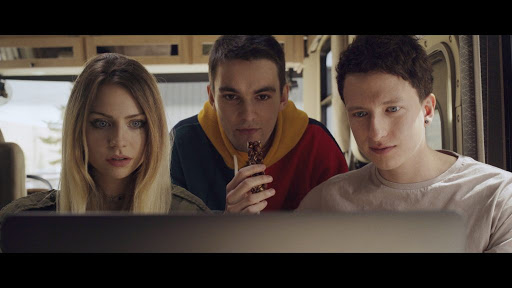
Bray (Chris Ball), who is pretending to be Victoria online, has made a connection with Shawn (Dylan Playfair) via a Christian dating site. Bray/Victoria has plans to meet Shawn at the music festival, Summerland.

Along for the road trip to Summerland is Oliver, Bray’s best friend, and Oliver’s girlfriend, Stacey. The problem? Bray has been using Stacey’s pictures to construct Victoria online. Once the trio gets to Summerland, will Bray be able to find Shawn before he finds Stacey?

Miraculously, as the film progresses, we do begin to sympathize with Bray. As a gay teenager, he is not accepted by his parents and struggles with his identity. He wants to meet someone, to have a relationship, and be himself. Despite the fact he has lied about his identity, he’s managed to be as open with Shawn as he has with anyone.

However, the film doesn’t let Bray off the hook entirely. We’re repeatedly reminded that he’s constructed a relationship around a lie. We must ask ourselves if some lies are forgivable when the liar struggles with what it means to be himself.

Most of the film is centered around the road trip to Summerland. Bray is anxious to get there so he can finally meet Shawn in person. Oliver wants to enjoy the journey. Stacey is rebelling against a stepdad she doesn’t like.

Lankyboy wants their movie to be quirky, but it’s a conventional road trip/relationship movie with some weird extras thrown in. Those weird moments are forced, don’t contribute much, and end up making a short movie feel intolerably long.

There are also far too many montages for such a short film.

The actors aren’t terrible in their roles. They’re not the worst trio to spend time with on a road trip movie, and the film does have one or two funny moments. But too much of the movie is focused on what it wants to be rather than effectively embracing what it is.

Unfortunately, what is ends up being is an unmemorable experience.