Tag Archives: independent film

Writers Unblocked

Can You Ever Forgive Me?

by Hope Madden

People forget that Melissa McCarthy was nominate for an Oscar. It’s a stiff year for female leads, but she might just nab another nom for her turn as a misanthropic writer in the true story, Can You Ever Forgive Me?

A one-time best seller, author Lee Israel (McCarthy) is feeling her shelf life. Unwilling to conform to any kind of expectations—particularly those placed on females in the publishing industry—she finds herself facing the reality that no one wants a book on Fanny Brice, and no one wants a book by Lee Israel.

McCarthy’s socially inept and down-on-her-luck biographer sits in a dingy bar midday, drinking away her unemployability, her cat’s illness and her writer’s block when in beams a boozy ray of sunshine disguised as upbeat alcoholic hustler Jack Hock (Richard E. Grant).

It’s here that director Marielle Heller’s film hits its stride. McCarthy’s energy, her dimples and her infectious good nature have buoyed any number of mediocre films. But here, she carves a low key, solitary figure unable and unwilling to open up. It’s a fascinating about-face for McCarthy.

Set Israel’s curmudgeonliness against the unbridled zeal and charm Grant brings to his character, and a compelling odd-couple-on-the-skids is born.

To pay her bills and exercise her talent, Israel begins forging letters from literary icons and selling those forgeries at bookshops across New York. The wondrous respect this film has for writers, for the written and spoken word, and the nostalgia it has for a past when those elements were likewise revered generates a lovely, literary atmosphere.

Co-writer Nicole Holofcener again subverts ideas of entitlement and self-destruction with a screenplay so full of empathy it’s impossible to dislike the deeply unpleasant Israel.

A great deal of that success, of course, comes from McCarthy’s authenticity. The performance is nuanced and understated, as is the entire film, and aching of self-inflicted loneliness. She creates an believable and yet unusual character—one who embarks on a deeply strange yet somehow fitting journey.

The story of Lee Israel offers a weirdly optimistic if cautionary tale for misfit women. It’s also a great reminder that Melissa McCarthy can really act.

Hooray for Hollywood?

The Other Side of the Wind

by Hope Madden

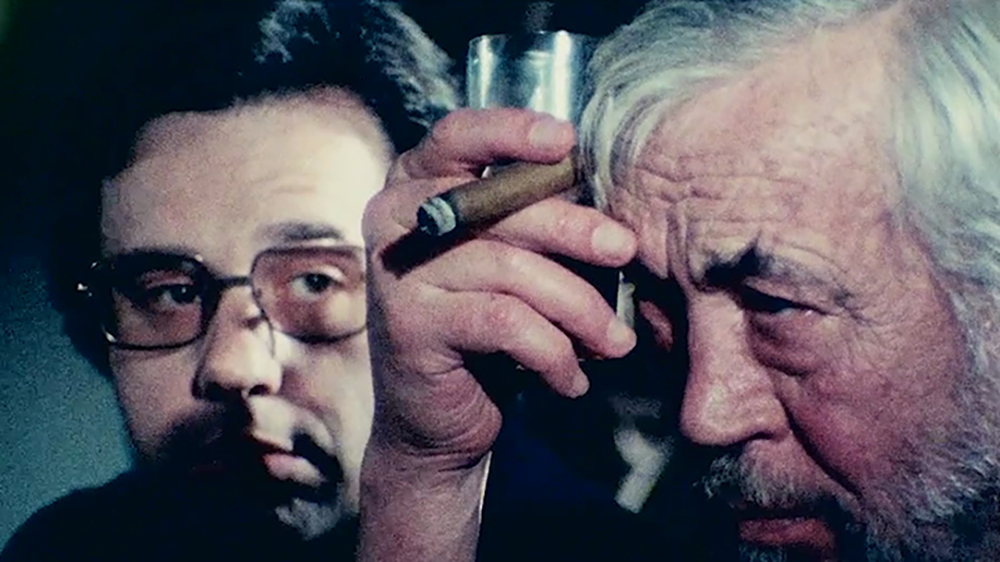
The Other Side of the Wind—how pretentious is that title? It’s supposed to be, of course, because it’s an Orson Welles film and he’s a genius. His latest, released more than 30 years after his death, explores his genius and the changing paradigm of the Seventies film industry.

Retrieved from hundreds of hours of footage filmed over 10 years, The Other Side of the Wind was meant to be a comeback or sorts from an idolized auteur whose funds were drying up in the face of a changing cinematic aesthetic.

It’s about an idolized auteur with dwindling funds who’s trying to launch a comeback in the face of a changing cinematic aesthetic.

Yes, Welles was meta before meta was even a thing.

Esteemed director, Jake Hannaford (John Huston) is to screen his new film at his 70th birthday party to an audience of cinefiles, sycophants, film critics, hangers-on, freaks and industry insiders.

The event becomes an ingenious satire of 70s moviemaking, and watching it more than 30 years after the fact gives the entire spectacle a time capsule appeal. It’s like a trainwreck you cannot turn away from.

Welles pokes fun at the pretentiousness of then-cutting edge filmmakers and their neurotic relationships with self-loathing, arrogance and idol worship—usually using directors from the period, acting as stand-ins for, well, themselves.

He doesn’t seem to have much respect for the films being made at the time, either. As Hannaford’s film unspools, one in-the-know viewer yells: “The reels are out of order!”

To which the projectionist replies, “Does it matter?”

Nope. It does not. Welles’s film-within-a-film is an unendurable, plotless hippie hallucination—a perfect parody of much of the arthouse output of the era. It’s as if Welles, by way of Hannaford, is asking: Is this what I have to do to get a movie made?

As well and as wildly as the movie-making satire plays, at the heart of this film is humiliation on exhibition. Hero worship is hollow, commerce is still king and a man who can’t pay can’t play.

The whole thing is just a big ball of Seventies.

Animal Logic

We the Animals

by Rachel Willis

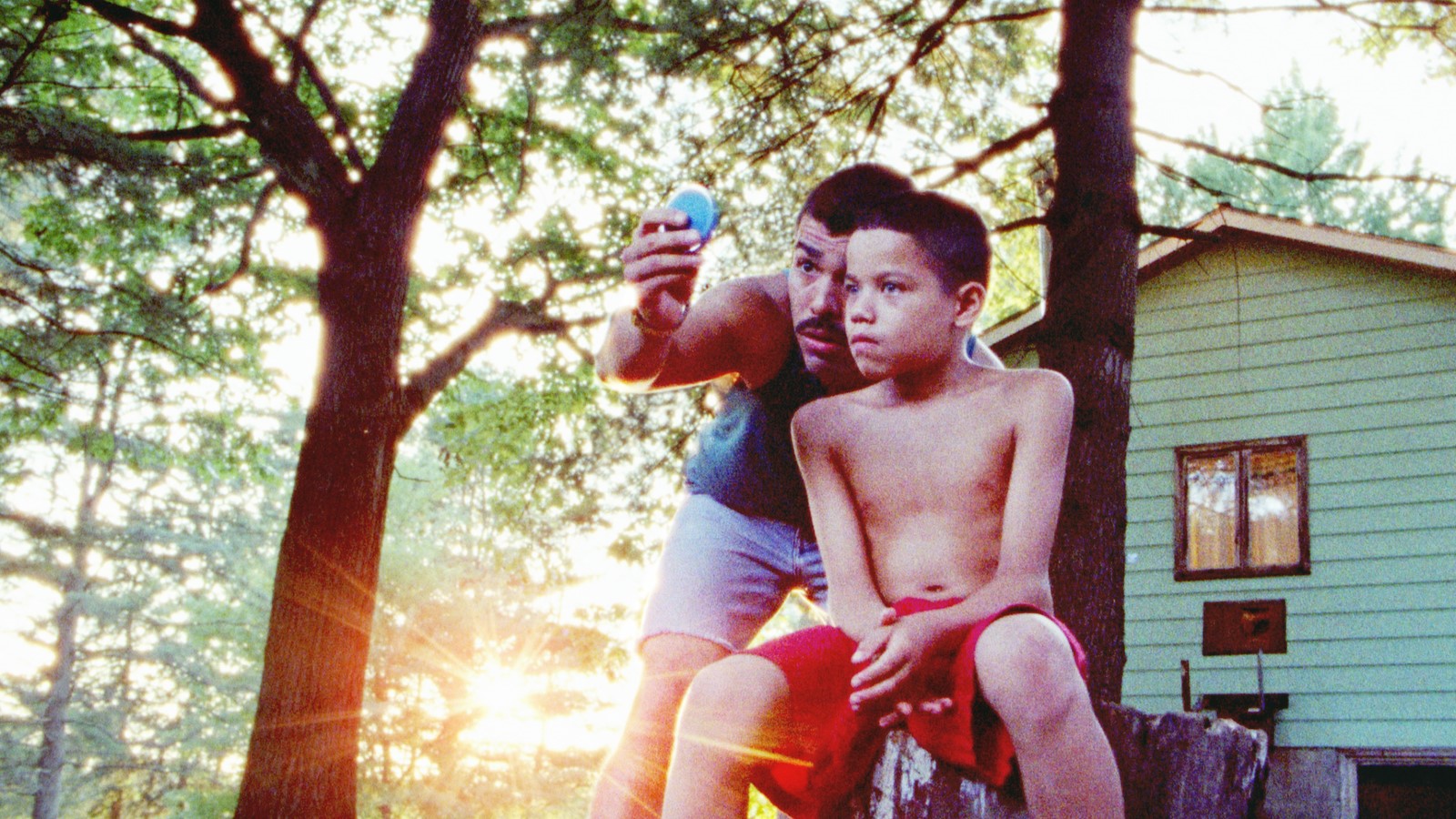
Imaginative Jonah is the focal point of director Jeremiah Zagar’s family drama, We the Animals. Based on Justin Torres’s novel of the same name, Zagar and co-writer Daniel Kitrosser successfully enter the realm of adolescent boys.

The youngest of three brothers, Jonah is the film’s narrator. His quiet observations allow him to remain nearly invisible to the adults around him. He sees things others might miss, and with an artist’s eye, he renders his observations into illustrations that jump off the page.

With his two older brothers, Manny and Joel, Jonah navigates his parents’ volatile relationship. Though there is love between his Paps and Ma, there are also moments of violence.

While the time period of the film is never explicitly stated, based on a few clues it’s likely the mid-1980’s. It’s a time when kids ran wild outdoors without cell phones or tablets in hand. The cinematography captures the sunny summer days when aimless kids roamed far and wide. It perfectly evokes the innocence and curiosity of young children.

As Joel and Manny enter into adolescence and leave childhood behind, Jonah falls further into his own world. The three brothers, at first inseparable, start to drift apart. While Joel and Manny seek to become men just like their father, Jonah tries to carve out his own identity. It puts him at odds not only with his siblings, but his parents as well.

There’s a dream-like quality to the movie reminiscent of films such as Beasts of the Southern Wild and Pan’s Labyrinth. Though Zagar’s approach is slightly less fantastic than either film, there is still a lovable, magnetic child at the center. As Jonah, Evan Rosado joins the ranks of child actors whose talent belies their age.

Zagar proves his mettle as both writer and director. His previous works include a number of solid documentaries (Captivated: The Trials of Pamela Smart, In a Dream), but as his first feature film We the Animals is a marvelous addition to his body of work.

https://www.youtube.com/watch?v=fghaoNoQcRU

40 Whacks

Lizzie

by Hope Madden

Screenwriter Bryce Kass has some interesting thoughts on the case of Lizzie Borden, the American woman suspected in the 1892 ax murders of her father and stepmother. In director Craig William Macneill’s hands, those intriguing ideas receive a proper, historical treatment.

Whether they have merit or not is mainly beside the point.

Lizzie (Chloe Sevigny) was a spinster of 32 when her parents died. She was home at the time, as was the family’s Irish immigrant servant, Bridget Sullivan (Kristen Stewart).

The film does not create a whodunit atmosphere, instead painting a historically realistic picture of some of the details that may have driven Borden to commit the crimes—likelihoods that wouldn’t have been considered in 1892 and have, therefore, rarely been taken into account over the years.

The struggle facing a single woman—economic and otherwise—is handled throughout this film with a desperate grace that elevates most scenes. Sevigny’s wily, lonesome outsider role plays to her strong suit. She shows here, as she did in 2016’s Love & Friendship, a capacity with the delicate language of the entitled.

Kristen Stewart continues to impress, even with a brogue. Yes, she is again morose, conflicted and put-upon, so maybe her range isn’t as strong as I’m suggesting, but she really knows her niche.

The way Macneill and Kass piece together the well-known pieces to this puzzle, this time considering how each may impact and be impacted by the fact that Lizzie was an unmarried woman, is consistently compelling.

Do the filmmakers take their somewhat subversive approach a step further than necessary, moving from honest if overlooked likelihood to vague possibility to “are they doing this just to be lurid”?

They do.

It doesn’t sink the film, though, mainly because Stewart and Sevigny commit to the direction and keep it from feeling exploitive. Plus, it is a fresh and believable take on a very old, oft-told story, so that counts for something.

https://www.youtube.com/watch?v=qwgtDHISXtQ

Another Man with No Name

Five Fingers for Marseilles

by Rachel Willis

How does one make a film that’s uniquely South African yet still feels like an American western? Director Michael Matthews and writer Sean Drummond answer that question with the stunning Five Fingers for Marseilles.

From the beginning, Matthews evokes Sergio Leone’s A Fistful of Dollars trilogy. Four boys stand facing each other, hands at the ready, waiting for a sign to fire their slingshots. When it comes, Tau, The Lion, stands victorious. It’s a scene that sets the tone for a film that not only calls up classics like Leone’s, but also Yojimbo.

Tau is described as ruthless and mean, but he’s also filled with an anger that makes him reckless. In apartheid-era South Africa, small enclaves such as Railway – a district within the city of Marseilles – are at the mercy of their oppressors. As Tau and his friends argue about how to resist the police that fleece them, he insists on using more than sticks. His brother, Zulu, demands he exercise caution.

However, when a friend is threatened with brutality, Tau’s anger leads to a careless decision. When he flees the scene of his crime, he not only leaves behind his friends but his responsibility. Those left behind suffer because of “The Lion”‘s heedless anger.

Decades pass before Tau returns to Railway. The town seems the same though apartheid has ended. Police still shake down the citizens, but another sinister element has also descended on the town, a gang led by a fearsome man known as The Ghost. Though Tau seeks to return untroubled, he is inevitably called to his former role as protector.

It’s a familiar story, and the political backdrop of a South Africa trying to find its way after apartheid lends itself well to the retelling. As Tau, Vuyo Dabula is a perfect representation of the man with no name. Though he is The Lion, a man with a past full of brutality, he seeks to start anew as Nobody. It’s the sinister nature of the world around him that draws him back into a world of ferocity and lawlessness.

There are few villains as perfect as Sepoko, also known as The Ghost. Every moment Hamilton Dhlamini is on screen, the tension escalates. The masterful score only magnifies this malevolent figure.

With desolate landscapes, brutal violence and characters with questionable moral compasses, Five Fingers for Marseilles is not only a magnificent Western, but an exquisite film.

Unauthorized

The Wife

by Hope Madden

You guys, Glenn Close has never won an Oscar. That’s insane, right?

She’s been nominated 6 times—Albert Nobbs, Dangerous Liaisons, Fatal Attraction, The Natural, The Big Chill, The World According to Garp—but never won. I get the feeling she’s looking to change that.

Björn Runge’s big screen adaptation of Meg Wolitzer’s novel The Wife sees Close as Joan Castleman. Joan’s husband Joe (Jonathan Pryce) has just won the Nobel Prize for Literature. The film shadows the Castlemans as they receive the news, celebrate the win and head to Stockholm to receive the award.

Through flashbacks we’re privy to the relationship between young Joe (Harry Lloyd) and Joan (Annie Starke—Close’s daughter) as it develops.

Close is perfect—steely brilliance, her character a wily manipulator of situations whose growing intolerance of her life threatens to crack the polished surface that has adorned this marriage for decades.

The entire film—and every sacrifice, struggle and misery of Joan’s life—plays out on Glenn Close’s face. Close ups reveal not only the resignation and resilience of Joan’s life, but the depths of Close’s talent for communicating her character’s essence. Everything you need to know—about Joe, about marriage, about being a woman, and about Joan’s particular misery—is etched on Close’s countenance. The rest of the film just verifies what you’ve learned.

Nearly equal to Close is Starke, who not only looks the part but whose characterization easily communicates the same studied behaviors Joan will eventually develop into a masterful façade.

Jane Anderson’s screenplay tends to overstate, which is unfortunate. The simple interplay between Close and Price—jubilantly nailing the narcissist whose selfishness cannot be contained—more potently unveils and reveals than any clear-cut narrative scene ever could.

Not that you’ll remember the needless extras: flashbacks illustrating an early pattern of sacrifice; parties and ceremonies depicting Joe as an attention whore incapable of recognizing his wife’s anguish; the slippery biographer (Christian Slater) or mopey son (Max Irons) clamoring for attention.

What you’ll remember is Close, delivering, as is her way, a tour de force performance that may finally land Close her own glittering acknowledgment.


Old Money, Old Problems

The Little Stranger

by Hope Madden

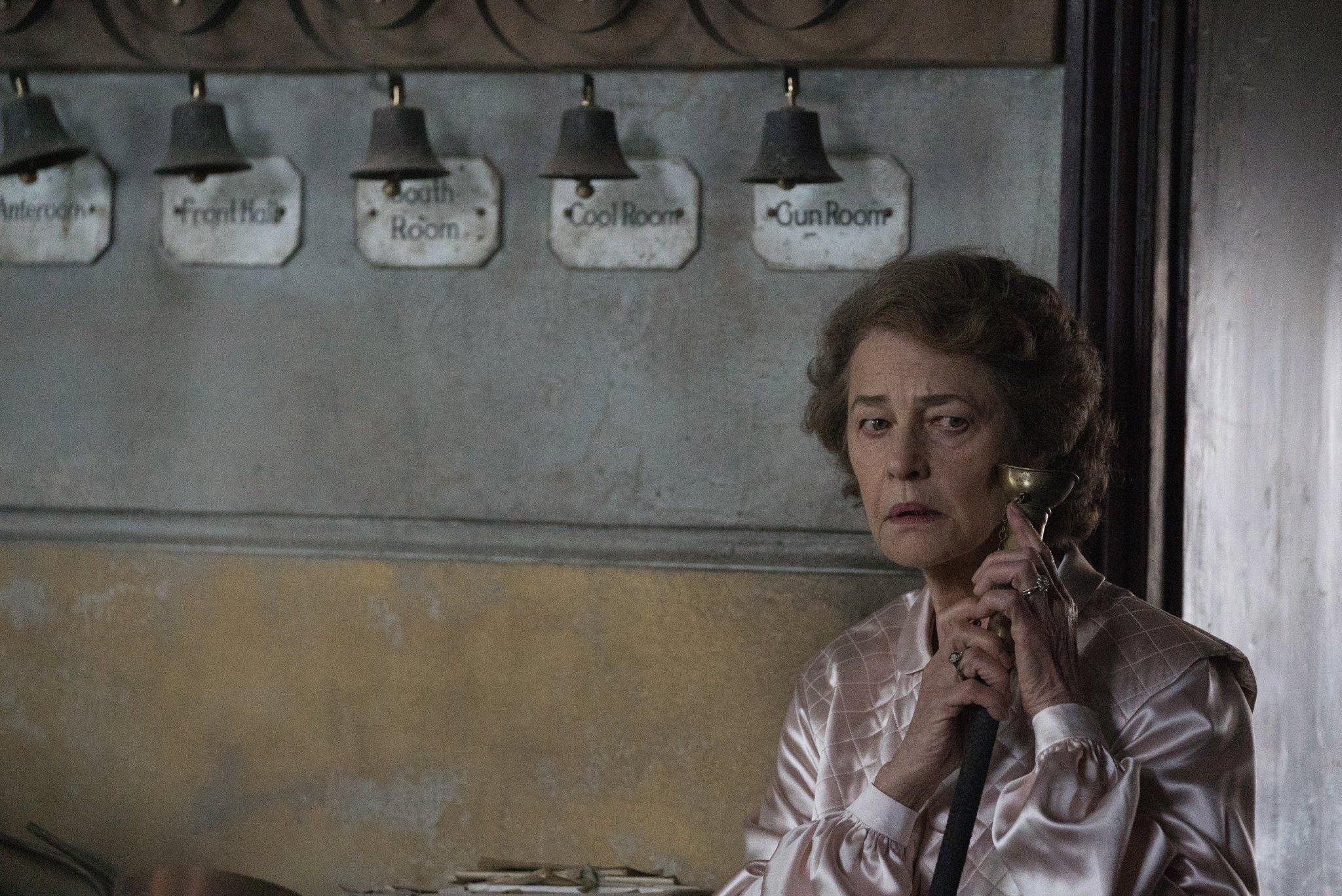
There were a lot of reasons to be excited about The Little Stranger.

The film is director Lenny Abrahamson’s follow up to his staggeringly wonderful 2015 film Room. It stars three of the most solid character actors you will find (whether you know the names or not): Domhnall Gleeson, Ruth Wilson and Will Poulter.

Who else? Oh, yes, Charlotte Rampling, who’s been a miracle of understated power since the mid-Sixties.

On top of all that, it may (or may not) be a period British ghost story, and who doesn’t dig that?

But something’s gone terribly wrong with The Little Stranger.

It looks stunning. Abrahamson’s camera captures postcard quality images of spooky old mansion quarters, lonesome countrysides, sparse bachelor apartments.

Gleeson’s performance is wonderful: restrained and proper to a degree that suits this particular character. Poulter (who is a marvelous and amazingly versatile actor) is underused, as is Rampling, although she cooly delivers enough decisive lines to make an impression.
Performances, too, are picture-perfect.

Wilson impresses most as Caroline Ayres, the put-upon sister in an old-money family that’s seen its share of heartache. She’s being courted, so to speak, by reserved country doctor Faraday (Gleeson), while she helps to care for her badly injured (inside and out) WWII veteran brother Roddy (Poulter), quietly helping him manage his responsibilities to the estate.

Caroline longs to be free. Longing is maybe the most palpable theme in the film, along with the underlying nod to classism. Unfortunately, by Act 3, you’ll be longing for some action of any kind.

Abrahamson’s film, adapted from Sarah Waters’s novel by screenwriter Lucinda Coxon (The Danish Girl), moves at an iceberg’s pace. Though the bumps, burns and bruises in the night are developed with the proper haunted house atmosphere, the resolution is so underdeveloped and slow in coming that the film cannot help but disappoint.

The reveal makes sense to a degree, and bravo to Abrahamson for expecting audiences to have paid enough attention to earlier dialog that we might fathom the conclusion. At the same time, with too much thought, that reveal can fall apart. So, if you’re not paying attention you will have no idea what just happened. Pay too much attention and the mystery’s resolution will disintegrate on you.

It’s unfortunate because there is an awful lot of talent and aesthetic going to waste here.

Ball of Confusion

BlacKkKlansman

by Hope Madden

Welcome back, Spike Lee!

It’s not like he’s really been gone. He’s made a dozen or more TV episodes, documentaries, short films and basement-budget indies since his unfortunate 2013 compromised vision Old Boy. But BlacKkKlansman is a return to form—to the envelope-pushing enjoyment that showcases his skills as storyteller, entertainer and activist.

Earmarks of his most indelible marks on cinema—Do the Right Thing, Jungle Fever, Malcolm X—these three elements have rarely joined forces since 1992. You might get one (Get on the Bus) or two (Inside Man, Chi-Raq), but not all three.

Why now? Lee isn’t the first filmmaker to realize how painfully relevant historical tales of systemic racism are at the moment. But it wasn’t until 2014 that Ron Stallworth published the book detailing how he, a black cop in Colorado Springs in 1979, infiltrated the KKK.

You see how it all comes together?

If you don’t, you really should. Lee balances unexpected shifts between humor and drama, camaraderie and horror, entertainment and history lesson, popcorn-muncher and experimental indie with a fluidity few other directors could muster.

The story itself is beyond insane—a zany, hair-raising misadventure destined for the big screen. Stallworth (John David Washington), a rookie in Colorado Springs’s intelligence office, stumbles upon an ad in the newspaper, makes a call, and joins the Klan.

Of course, he’ll need a second officer to actually show up. Enter Flip Zimmerman (Adam Driver—perfect), who sounds about as much like Stallworth as he looks, plus he’s Jewish, which could further complicate his face-to-face relationship with the hate group.

Much sit-com-esque absurdity and dramatic police procedural thrills follow, but it’s the way Lee subverts these standard formats that hits home. The insidious nature of the racism depicted in 1979 echoes in both directions—in the history that brought our country to this moment in time, and in the future Ron Stallworth undoubtedly hoped he could prevent.

Yes, there are laugh out loud moments in this film, but there are far more rallying cries.

Super Eight

Eighth Grade

by Hope Madden

You can’t be brave without being scared.

That is an insightful comment, but when it’s delivered earnestly by a lonely, introverted 13-year-old determined to come out of her shell in the meanest of all worlds—middle school—it is a gut punch.

Who would have thought that the most truthful, painful, lovely, unflinching and adorable tween dramedy in eons would have sprung from the mind of 28-year-old comic Bo Burnham? Or that the first-time feature director could so compassionately and honestly depict the inner life of a cripplingly shy adolescent girl?

But there you have it.

Elsie Fisher’s flawless performance doesn’t hurt.

Fisher (Despicable Me‘s Agnes, “It’s so fluffy!”) is Kayla, and we are with her, immersed in her world, for the last week of the eighth grade. God help us.

In Fisher, Burnham has certainly found the ideal vehicle for his story, but his own skill in putting the pieces together is equally impressive. Burnham’s as keen to the strangulating social anxieties of middle school as he is to the shape-shifting effects of technology.

This is the least self-conscious and most accurate portrayal of the generational impact of social media yet presented, and not just as part of the narrative. He uses social media as a storytelling device, whether the way the screen lights up the isolated face of a lonely teen, or the way the sound of the same girl’s YouTube videos narrate the very advice she wishes she were hearing from somebody.

It’s equal parts heartbreaking and sweet, and it miraculously never hits a false note.

He depicts both the normal that we all must tragically know, of being wildly out of your element even in your own skin, and the new normal that feels beyond bizarre. If your greatest ineptitude is human contact, how much harder to hone that skill when your only practice is in a virtual world?

Mercifully, Eighth Grade is not a cautionary tale about the dehumanizing dangers of an online world. It simply accepts that this is the world in which Kayla lives, depicting it as authentically and insightfully as he does a random lunch with the cool kids at the mall, or an unbearably awkward situation with a boy in a car.

Still, the best scene in the film—one that’s as uplifting as it is genuine—casts aside the glow of the phone for starlight and bonfire as Kayla and her dad, beautifully brought to life by Josh Hamilton, share a moment that will just fucking kill you.

Seriously, Burnham was never a 13-year-old girl nor has he ever been father to one. How the hell did he get all of this so insanely right?

I don’t know, man, but good for him. Good for all of us.

Hot Wheels

Don’t Worry, He Won’t Get Far on Foot

by Hope Madden

In case you are missing it, Joaquin Phoenix is having one hell of a year. The inarguable talent is fresh off the relentlessly wonderful You Were Never Really Here (watch it right now!). Later this year we’ll get the chance to see him in Mary Magdalene as well as Jacques Audiard’s Western, The Sisters Brothers—both films boasting extraordinary casts.

Sandwiched in between his turns as gun-for-hire (YWNRH) and Jesus (MM), the clearly versatile actor portrays cartoonist John Callahan in Gus Van Sant’s biopic Don’t Worry, He Won’t Get Far on Foot.

Portland-based Callahan used creating cartoons as an outlet for his frustration, creativity and humor following a car accident that left him paralyzed. His simple visual style (both arms and hands were badly compromised by the paralysis) and his dark, taboo-driven humor found favor and protest in his hometown newspaper.

Phoenix charms and breaks hearts in equal measure as Callahan. What the actor conveys in breathtaking fashion is discovery. After Callahan’s accident and through his fleeting moments of clear-headedness, the character affords Phoenix many opportunities to recognize, accomplish or notice things for the first time. His interaction with an adorably saucy sex therapist, for instance, is pure joy.

His is not the only wonderful performance in the film. Jonah Hill effortlessly conveys a wearied tenderness that reminds you how truly talented an actor he is. Jack Black has a small but gloriously Jack Black role, and the AA group (Udo Kier, Beth Ditto, Mark Webber, Kim Gordon and Ronnie Adrian) offer rich and interesting characters regardless of their minimal screen time.

Rooney Mara, on the other hand, seems like she’s acting in an entirely different film. I fully expected her character to be a figment of Callahan’s imagination, pulled intact from another movie.

Van Sant bounces back from a creative lull (The Sea of Trees, anyone?), showing, among other things, his remarkable knack for period detail.

And while the 12-step structure feels both too stifling and too familiar for such an irreverent central figure, Van Sant bursts through that frame with a non-chronological series of vignettes and wild antics. As the film progresses, step by dutiful step, Van Sant fills gaps with quick jumps back and forth through drunken episodes and pivotal moments.

As interesting and entertaining as these flashes are, the chaotic lack of chronology fits so poorly with the rigid timeline of the film around it that the whole feels like an experiment gone wrong.

But so much of the film goes very, very right—thanks in large part to another award-worthy performance by Phoenix.