What does a serial killer have in common with an indie filmmaker? Quite a lot, or so suggests indie filmmaker Lars von Trier.
We’ll say this with all sincerity: The House that Jack Built—a 2+ hour peek into the mind and methods of a murderer—is von Trier’s most lighthearted picture to date.
It’s also as tedious and self-indulgent as Nymphomaniac: Vol. II.
LvT’s artistry lies in his ability to make the viewer uncomfortable. His films are punishing, which is why his first foray into horror, the brilliant and wildly unnerving 2009 film Antichrist, was such a perfect fit. He returns to the genre with Jack, here allowing a sadistic murderer the opportunity to shed light on the filmmaker’s own discomforting artistry.
Which can work—Julian Richards’s The Last Horror Movie and Remy Balvaux’s Man Bites Dog both offer blistering achievements on the theme. But Jack falters, and von Trier falters, in two important ways.
The film does deliver sadistic glory, yet in terms of violence or depravity, it feels oddly safe. Not safe for all viewers, mind you, but horror fans and von Trier fans have seen far more envelope-pushing than what Jack depicts. There is one sequence—the picnic sequence—that is among the most perfect horror movie episodes ever filmed. Beyond that, much of this movie is competently made but ultimately tired.
We follow Jack (Matt Dillon, making the most of a surprising casting choice) through various instances of homicidal mania. As voiceover conversations with the mysterious Verge (Bruno Ganz) pay homage to Dante’s Divine Comedy, Jack’s bloody exploits become less darkly comedic and more brazenly sadistic, testing his claim that “the soul belongs to heaven and the body to hell.”
Just as the Nymphomaniac films traded provocative ideas for fist-shaking admonishments from filmmaker to critics, Jack devolves into an instrument wielded even less bluntly. Again, von Trier channels his tale through two voices: the protagonist and a straw man. Verge serves up the proselytizations on art and morality so Jack can knock ’em down, with snippets of von Trier’s previous films peppered in for anyone who still isn’t getting it.
Not that LvT’s ideas on this topic aren’t interesting – far from it- but the line between personal and self-indulgent is the same one that separates uncomfortable questions that resonate (as in von Trier’s own Dogville) from spoon-fed answers that do not. One side makes for an engaging film experience while the other falls short, no matter how impressive the visual set pieces (which Jack does indeed provide).
Von Trier has unapologetically wallowed in depravity his entire career, and those themes have served the narrative in amazing ways. Now he seems more interested in narratives that serve grandiose debates of his own artistic value.
Let’s hope that road has reached an end. While von Trier remains an artist worthy of attention, The House That Jack Built stands as another missed opportunity.
Only Women Bleed? Sunday Bloody Sunday? Let It Bleed? What song would we have chosen to open the new podcast? There are more possibilities than we might have imagined—in song and in film—as we celebrate the monthly curse with a talk about the best horror movies concerning menstruation. Do you have the stones to listen?
5. It Stains the Sands Red (2016)
We open with some impressive aerial shots of the smoking, neon ruin of the Las Vegas strip. Cut to another gorgeous aerial of a sports car zipping up a desert highway. In it, a couple of coked-up strip club lowlifes, Molly (Brittany Allen) and Nick (Merwin Mondesir), are escaping to an airfield where they’ll meet with other lowlifes and head to an island off Mexico.
Naturally, this isn’t going to work out. But what co-writer/director Colin Minihan has in store will surprise you. He’s made a couple of fine choices with his film. The point of view character is not only an unlikely protagonist – an unpleasant thug with a drug habit – but she’s also female.
Soon the car goes off the road and one meathead catches her scent, and suddenly Molly’s stripper shoes are not her biggest problem as she faces a 30-mile trek across the desert to the airfield.
What develops is an often fascinating, slow moving but relentless chase as well as a character study. With a protagonist on a perilous journey toward redemption, It Stains the Sands Red takes a structure generally reserved for the man who needs to rediscover his inner manhood and tells a very female story.
Very female. Menstruation and everything.
4. A Tale of Two Sisters (2003)
Writer/director Jee-woon Kim (I Saw the Devil) spins a hypnotic tale of family and ghosts—both literal and metaphorical. Tale of Two Sisters is a deep, murky and intensely female horror.
A tight-lipped father returns home with his daughter after her prolonged hospital stay. Her sister has missed her; her stepmother has not. Or so it all would seem, although jealousy, dream sequences, ghosts, a nonlinear timeframe and confused identity keep you from ever fully articulating what is going on. The film takes on an unreliable point of view, subverting expectations and keeping the audience off balance. But that’s just one of the reasons it works.
No line of dialog, no visual is wasted. The seemingly simple moment of one daughter needing to borrow a feminine product from her stepmother works in a dozen ways: to introduce blended identities, to exacerbate the uncomfortable familiarity, to foreshadow future horror.
Tale masters the slow reveal in large and small ways. Whether you’ve begun to unravel the big mystery or not, Tale always has something else up its sleeve. Or, under its table.
3. Excision (2012)
Outcast Pauline (a very committed AnnaLynne McCord) is a budding surgeon. She’s not much of a student, actually, but she does have an affinity for anatomy. Especially blood. Pauline really, really likes blood.
A horror film focused on an adolescent girl as antihero is likely to involve 1) menstruation, 2) a mom. Excision is no different. Well, it is a little different.
The mom is Traci Lords, in what is certainly her most assured dramatic performance. Her arc is interesting: overbearing and cold and, eventually, probably correct in her unfavorable assessment of her eldest girl.
Writer/director Richard Bates, Jr. takes more of an unusual course when bringing in Pauline’s cycle, though. I’m not sure we’ve seen it handled quite like this before, although to be fair, it’s definitely in keeping with the peculiar and beautifully realized character he and McCord have created.
2. Ginger Snaps (2000)
Sisters Ginger and Bridget, outcasts in the wasteland of Canadian suburbia, cling to each other, and reject/loathe high school (a feeling that high school in general returns).
On the evening of Ginger’s first period, she’s bitten by a werewolf. Writer Karen Walton cares not for subtlety: the curse, get it? It turns out, lycanthropy makes for a pretty vivid metaphor for puberty. This turn of events proves especially provocative and appropriate for a film that upends many mainstay female cliches.
Walton’s wickedly humorous script stays in your face with the metaphors, successfully building an entire film on clever turns of phrase, puns and analogies, stirring up the kind of hysteria that surrounds puberty, sex, reputations, body hair and one’s own helplessness to these very elements. It’s as insightful a high school horror film as you’ll find, peppered equally with dark humor and gore.
https://www.youtube.com/watch?v=Zoa1A987A_k
1. Carrie (1976)
What else? Nobody did moms, the pain of adolescence, the horror of the onslaught of womanhood, or period quite like Brian De Palma’s 1976 original. Is there a more tragic scene? Is there a scene that better establishes a character, a context or horror?
De Palma films the scene in question, appropriately enough, like a tampon commercial, all cheese cloth and beautific music. And then Carrie White (Oscar nominated Sissy Spacek) desperately claws at her classmates, believing she is dying. It’s the most authentic image of vulnerability and terror you can imagine, matched in its horror by the reaction she receives from those she seeks: laughter, mockery and contempt.
Beyond the epitome of adolescent mortification that the scene represents, it also clarifies the unspoken relationship between Carrie and her as-of-yet unintroduced mother, who has never told her teenaged daughter that this was coming.
The result is the ultimate in mean girl cinema and an introduction to a nearly perfect horror film.
Do you ever watch a movie and wonder how it got that elusive green light? I just did.
The Possession of Hannah Grace is not a terrible movie. It’s not a provocative movie, not a scary movie, not a gory movie, not an interesting movie. It’s just not a movie you’ll be able to keep straight a few weeks after you see it. You’ll be combining what few moments you recall with other movies.
You’ll be wondering, was that Hannah Grace, or was it The Last Exorcism? Did that happen in Hannah Grace or in The Corpse of Anna Fritz? Or maybe in The Autopsy of Jane Doe? And then you’ll just forget this movie entirely. It’s been 20 minutes for me and I’m already struggling to recall the bland details.
In a nutshell, Dutch filmmaker Diederik Van Rooijen’s first English language film follows troubled ex-cop Megan (Shay Mitchell) on her first days in her new routine: nighttime morgue attendant followed by an early morning AA meeting with sponsor, Lisa (Stana Katic).
But on Night #2, things go funny as the corpse of a mutilated, burned and inexplicably naked young woman is brought in. Hannah Grace (Kirby Johnson) is not your garden variety naked, contorted, burned corpse, though.
How do you cast this, exactly? “Hey, how would you like to play the title role in my new movie? You will be nude for 90 minutes and you have exactly no lines. You in?”
The jump scare morgue marathon amounts to a long and very tortured metaphor about addiction. Kudos to Van Rooijen and writer Brian Sieve for setting you up for one of two clichéd endings, and then sidestepping both. Too bad they sidestep clichéd endings in favor of nothing at all.
That’s about what you can expect from Hannah: 85 minutes of not too much—not much point, very little action, not a lot of scares and even fewer answers. But it is indeed a horror film that could be completed with three total locations and a cast of about 10, so, you know, why not go ahead and make it?
There are a lot of ways to approach a zombie film, few of them fresh. Zombie flick as YA (young adult) melodrama isn’t even a new idea anymore—2015 saw a surprisingly nuanced Arnold Schwarzenegger nurse his reanimated teen (Abigail Breslin) in Maggie, the best of the batch until now.
Still, writer/director Justin P. Lange has something on his mind with his debut feature The Dark, and he has found a compelling way to tell not-just-another zombie story.
We open on a twist to a familiar scene. A man in a rush, likely a fugitive of some kind, grabs some supplies at an out-of-the way gas station. He opens a map. The lone, wizened clerk points him toward an assumed destination: Devil’s Den.
As familiar as even the twist feels, the truth is that Lange gets more mileage from that old warhorse than you immediately realize. And he will continue to wield our assumptions and biases against us to better direct his story.
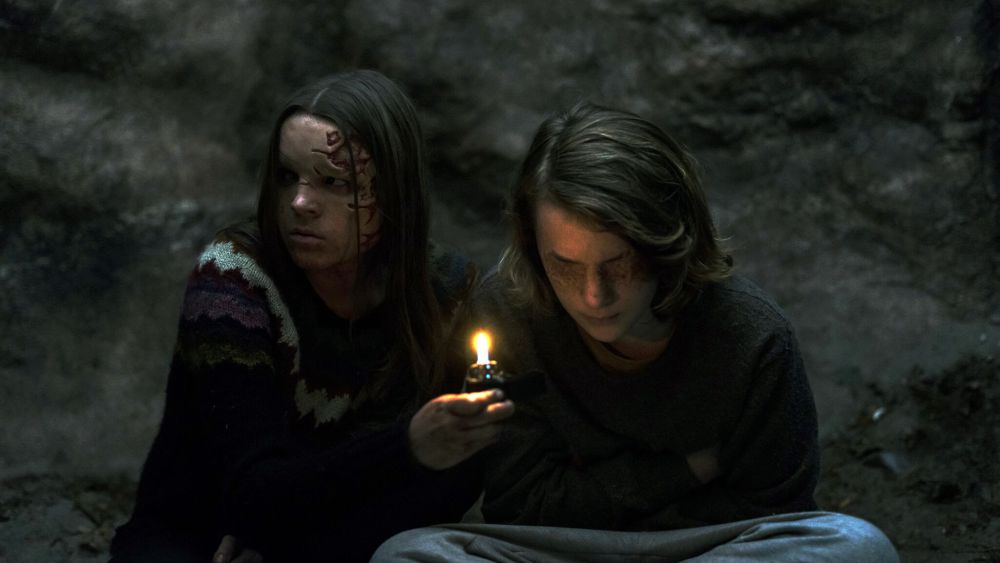
The blandly titled The Dark is, at its heart, a guide to overcoming trauma. Nadia Alexander is Mina, the creature that haunts Devil’s Den—a merciless, relentless, thoughtless killer. Until, that is, she comes across Alex, a blind young man (Toby Nichols) who reminds her of what she once was and what could have saved her.
Lange makes a series of clever narrative choices besides simply using our preconceived notions to surprise us. The Dark is, in part, a vengeance fable far less preoccupied by punishing those who do damage than those who should have been there for protection.
Alexander impresses as the beast unhappily and involuntarily rediscovering her humanity. Her silences, particularly in later scenes, are haunting.
As her mirror image and polar opposite, Nichols embodies vulnerability and resilience. There’s an optimism alongside a brokenness in his performance that is both necessary and heartbreaking.
The Dark occasionally skirts mawkishness, but what YA film doesn’t? In truth, Lange doesn’t run from the baggage associated with his chosen genres. He embraces it, forgives it, makes something powerful out of it.
It would not surprise us if we saw a new wave of ecological horror in which our own mistreatment of the environment and our irresponsible handling of pharmaceutical progress creates flesh hungry critters, pissed off two-headed bears, opioid addicted tapeworms, whatever. Let’s prepare by looking over history’s forewarnings, shall we?
Here are our favorite mutant animal films—cautionary tales about big pharma, careless planet keeping and sex.
5. Shivers (They Came from Within) (1975)
In an upscale Montreal high rise, an epidemic is breaking out. A scientist has created an aphrodisiac in the form of a big, nasty slug. That slug, though, spreads wantonness throughout the high rise and threatens to overrun the city with its lusty ways.
Not Cronenberg’s best film, but this is his first feature length horror and it announces not only his arrival on the genre scene, but it predicts so many of the films to come. The film obsesses over human sexuality, social mores, the physical form, physical violation and infestation, medical science, conspiracy, and free will. He’d revisit all of these preoccupations throughout his career, most obviously in his very next feature film, 1978’s Rabid, which is weirdly similar in every way.
Shivers takes a zombie concept and uses it to pervert expectations. (See what we did there?) They’re not here to eat your brains, after all. It’s the first film where Cronenberg marries ideas of the repugnant with the pleasurable, medical monstrosity with human body. It would be several years before his skill with performances (or maybe casting) matched his other directorial talents, but Shivers is still a worthwhile, utterly bizarre pleasure.
https://www.youtube.com/watch?v=eK9Wal9Dvic
4. Isolation (2005)
In 2016, writer/director/Irishman Billy O’Brien made an effective and lovely – yes, lovely – creature feature called I Am Not a Serial Killer. But about a decade earlier, he started down that path along a muddy, ruddy Irish roadside that wound ‘round to an out-of-the-way farm.
It’s the kind of a depressing, run-down spot that would catch nobody’s eye – which is exactly why it drew the attention of runaway lovers Jamie (Sean Harris) and Mary (a young Ruth Negga – wonderful as always). The solitude and remoteness also got noticed by a bio-genetics firm.
Down-on-his-luck Farmer Dan (John Lynch, melancholy perfection) has little choice but to allow some experimentation on his cows. He doesn’t really mind the required visits by veterinarian Orla (Essie Davis – hooray!).
But when one cow needs help delivering – genetic mutations, fetuses inside fetuses and teeth where no teeth belong. Nasty.
O’Brien and his truly outstanding cast create an oppressive, creepy, squeamish nightmare worth seeking out.
3. Black Sheep (2006)
Graphic and gory horror comedy seems to be the Kiwi trademark, no doubt a product of the popularity of native Lord of the Gastro-Intestinal-Splatter-Fest-Laugh-Riot, Peter Jackson.
First-time writer/director Jonathan King uses the isolation of a New Zealand sheep farm and the greedy evil of pharmaceutical research to create horror. He does it with a lot of humor and buckets full of blood. It works pretty well.
Evil brother Angus (Peter Feeney) has bred some genetically superior sheep while smart but sheep-phobic brother Harry (Nathan Meister) has been away. But the new sheep bite (a recurring problem with bio-genetically altered farm animals). Victims turn into, well, were-sheep. Of course they do.
The result is an endearing, often genuinely funny film. Cleverly written with performances strong enough to elevate it further, Black Sheep offers an enjoyable way to watch a would-be lamb chop get its revenge.
2. The Host (2006)
Visionary director Joon-ho Bong’s film opens in a military lab hospital in 2000. A clearly insane American doctor, repulsed by the dust coating formaldehyde bottles, orders a Korean subordinate to empty it all into the sink. Soon the contents of hundreds of bottles of formaldehyde find its way through the Korean sewer system and into the Han River. This event – allegedly based on fact – eventually leads, not surprisingly, to some pretty gamey drinking water. And also a 25 foot cross between Alien and a giant squid.
Said monster – let’s call him Steve Buscemi (the beast’s actual on-set nickname) – exits the river one bright afternoon in 2006 to run amuck in a very impressive outdoor-chaos-and-bloodshed scene. A dimwitted foodstand clerk witnesses his daughter’s abduction by the beast, and the stage is set.
What follows, rather than a military attack on a marauding Steve Buscemi, is actually one small, unhappy, bickering family’s quest to find and save the little girl. Their journey takes them to poorly organized quarantines, botched security check points, misguided military/Red Cross posts, and through Seoul’s sewer system, all leading to a climactic battle even more impressive than the earlier scene of afternoon chaos.
1. The Fly (1986)
After a couple of interesting, if un-medical films, the great David Cronenberg made a triumphant return to the laboratory of the mad scientist in his most popular film to date.
But it’s not just Cronenberg’s disturbed genius for images and ideas that makes The Fly fly; it’s the performance he draws from Jeff Goldblum.
Goldblum is an absolute gift to this film, so endearing in his pre-Brundlefly nerdiness. He’s the picture’s heartbeat, and it’s more than the fact that we like his character so much. The actor also performs heroically under all those prosthetics.
He and Geena Davis make the perfect pair, with their matching height and mullets, and their onscreen chemistry does give the film a level of human drama traditionally lacking from the Cronenberg canon. Atop that, there’s the transformation scene in the bathroom – the fingernails, the pustules – all classic Cronenberg grotesquerie, and still difficult to watch.
Perhaps you don’t know this, but Nazi zombies have a horror genre unto themselves: Shock Waves, Zombie Lake, Dead Snow, Dead Snow 2, Blood Creek. Well, there’s a new Nazi Zombie Sheriff in town, and he is effing glorious.
Overlord drops us into enemy territory on D-Day. One rag tag group of American soldiers needs to disable the radio tower the Nazis have set up on top of a rural French church, disabling Nazi communications and allowing our guys to land safely.
What’s on the church tower is not so much the problem. It’s what’s in the basement.
Director Julius Avery stays true to the war film vibe. Though clearly Overlord lacks the scope of something like Saving Private Ryan, visceral scenes of war set the stage for a film about the monstrosity lurking inside man.
He’s aided immeasurably by two writers with a knack for tales of endurance. Billy Ray’s career is littered with tense political thrillers, and his co-scribe Mark L. Smith wrote The Revenant, for Lord’s sake. He knows how to put a man through some shit.
The fellas find cover in the home of a sympathetic French woman (Mathilde Olivier) and plot their next move. Too bad it’s in that church basement.
Pilou Asbaek offers another excellent performance, this time as the Nazi commander. He drips sinister and looks enough like a handsome Michael Shannon to terrify even when he’s not speaking.
All the performances are strong, and character arcs feel fresh even though you know—if you have ever seen a war movie—how they will progress. Because this is a war movie, but war is hell and hell is horror.
Avery creates the same kind of desperate tension you’d expect from a suicide mission, and when the tables turn and we’re suddenly inside some kind of filthy mad scientist horror, the film doesn’t lose a step.
Suddenly, through Avery’s eyes and the horrified reactions of our heroes, we see how easily not only war movies but Marvel comic book films can cross the line to blood chilling horror.
A satisfying Good V Evil film that benefits from layers, Overlord reminds us repeatedly that it is possible to retain your humanity, even in the face of inhuman evil.
Just weeks after David Gordon Green gave 1978’s Halloween the sequel it deserved, director Luca Guadagnino re-imagines 1977’s giallo classic Suspiria as a gorgeous rumination on the horror of being haunted by echoes of your past.
Wait, wasn’t the original about witches?
It still is, more than ever. Guadagnino and screenwriter David Kajganich (True Story, A Bigger Splash, the upcoming Pet Sematary remake) remove the guesswork about the dance academy coven in favor of a narrative much more layered, meaningful and bloody.
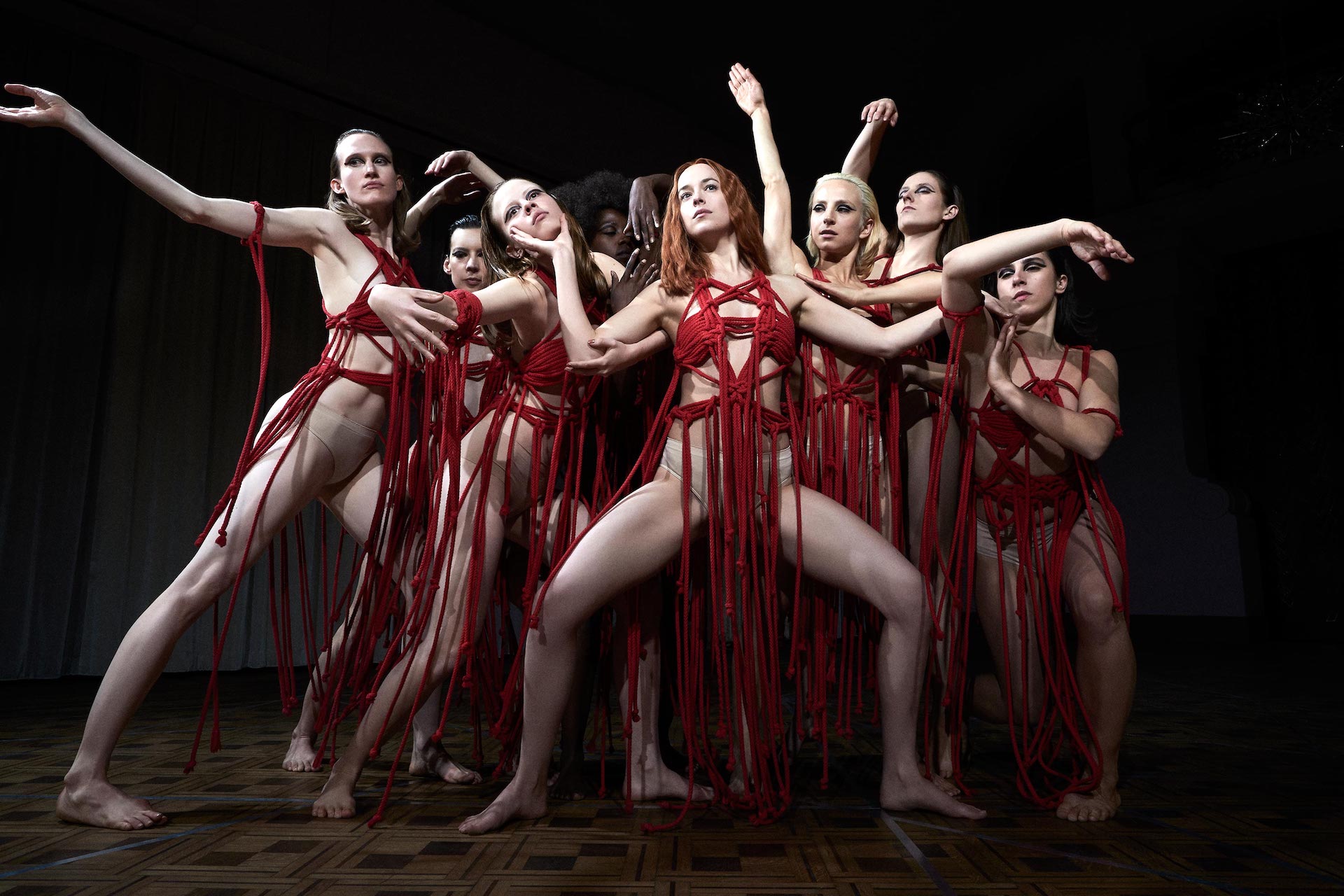
The building blocks remain the same. It is 1977 in “a divided Berlin,” when American Susie Bannion (Dakota Johnson, nicely moving the character from naivete to complexity) arrives for an audition with a world-renowned dance company run by Madame Blanc (Tilda Swinton, mesmerizing). Susie impresses immediately, and is soon given the lead in the company’s next production.
This “cover version” (The Tilda’s phrase, and valid) of Argento’s original lifts the veil on the academy elders early, via the diaries of Patricia (Chloe Moretz), a dancer who has fled the troupe in fear. While whispers paint Patricia as a radical member of the anti-fascist Red Army Faction, she tells psychotherapist Dr. Josef Kiemperer (also The Tilda, under impressive makeup) wild tales of witches and their shocking plans.
Guadagnino continues to be a master film craftsman. Much as he draped Call Me by Your Name in waves of dreamy romance, here he establishes a consistent mood of nightmarish goth. Macabre visions dart in and out like a video that will kill you in 7 days while sudden, extreme zooms, precise sound design and a vivid score from Thom Yorke help cement the homage to another era.
But even when this new Suspiria is tipping its hat, Guadagnino leaves no doubt he is making his own confident statement. The color scheme is intentionally muted, and you’ll find no men in this dance troupe, serving immediate notice that superficialities are not the endgame here.
Guadagnino’s stated goal of “de-victimizing” women in this film shows early and often. They move in strong solidarity both onstage and off, dancing with a hypnotic power capable of deadly results. In fact, most of the male characters here are mere playthings under the spell of powerful women, which takes a deliciously ironic swipe at witch lore as it creates a compelling bookend to what’s going on away from the dance academy.
Dr. Kiemperer, still searching for his wife missing since the end of WWII, becomes a personal illustration of Germany’s struggle with its Nazi legacy. When paired with Patricia’s rumored involvement in the “German Autumn” uprising of ’77, we get two important pillars of an epilogue that, admittedly, some may find a head-scratching overreach.
But after the finale that precedes that epilogue, the bigger problem may be breath-catching. A glorious celebration of the grotesque, it explodes into a cathartic mix of Ken Russell’s The Devils and GOT‘s Red Wedding that more than affirms the film’s intense, obsessive build. Guadagnino has thrown so much at us, he knows we deserve a payoff and damn, he delivers one.
It cements a vision of Suspiria that’s as ambitious and it is uncompromising, one that explores different definitions of horror while ultimately delivering more outright shocks and shivers than Argento ever attempted. Who knew a silly witch story could support so much mind-fuckery?
We are thrilled to be a part of a circle of movie podcasts spending the month of October talking about Universal monster movie sequels. And how lucky are we to have drawn the Bride of Frankenstein?
For our money, not just the best Universal monster sequel but the best Universal monster movie, Bride is a special. So special, she gets her own podcast. No lists, no competition, but to do it justice, we thought a special guest was in order. We are thrilled to have Dino Tripodis join us for the conversation.
The Bride of Frankenstein (1935)
James Whale and Boris Karloff – with tag along make-up man Jack Pierce – returned to Castle Frankenstein for an altogether superior tale of horror. What makes this one a stronger picture is the dark humor and subversive attitude, mostly animated by Frankenstein’s colleague Dr. Pretorius (Ernest Thesiger).
Thesiger’s mad doctor makes for a suitable counterpart to the earnest and contrite Henry Frankenstein (Colin Clive, again), and a sly vehicle for Whale. This fey and peculiar monster-maker handles the most brilliant dialogue the film has to offer, including the iconic toast, “To gods and monsters.”
The sequel casts off the earnestness of the original, presenting a darker film that’s far funnier, often outrageous for its time, with a fuller story. Karloff again combines tenderness and menace, and Elsa Lanchester becomes the greatest goth goddess of all film history as his Bride.
Any sequel to an iconic horror—particularly one that introduced a nightmarish, game changing villain—is bound to disappoint in some fashion because our imagination has attached its own terror to the story and the boogeyman that no one else can match.
Though they certainly tried their best with the Michael Myers franchise, to the tune of seven sequels and two reboots preceding this 40th anniversary comeback, Halloween.
Wisely, director/co-writer David Gordon Green and his writing partners Danny McBride and Jeff Fradley ignore all those other films, creating a universe where only John Carpenter’s 1978 original exists.
Jamie Lee Curtis returns to the star-making role of Laurie Strode, Carpenter’s final girl who has spent the last 40 years struggling to recover from the trauma of that Halloween night by stockpiling guns, booby-trapping her home and alienating her family.
She’s not the only character with a one-track mind. Myers’s attending doc, Dr. Sartain (Haluk Bilginer) thinks of, studies and devotes himself to nothing else but his star patient.
“You’re the new Loomis,” Laurie Strode quips upon meeting him—exactly what we were thinking. And though Bilginer’s performance borders on camp (and not in that respectable way Donald Pleasance had of overacting), his musings articulate the film’s basic principles. After 40 years of obsessing over having failed to achieve their goals—neither killed the other—Laurie Strode and Michael Myers are as connected as they might be if they were still siblings.
See, that came up in 1981’s Halloween II, so no longer canon.
Green’s direct sequel is, above all things, a mash note to the original. Visual odes continually call back to Carpenter, often in ways that allude to an intriguing about face the film is leading to.
Aside from Bilginer and Andi Matichak—unmemorable as Strode’s high school-aged granddaughter, Allyson—the cast is far stronger than what any of the other sequels could boast.
The humor peppered throughout the film, mainly as dialog between characters about to be butchered, too often undermines the tension being built. But Green, whose style refuses to be pinned down, embraces the slasher genre without submitting to it.
Kills—more numerous and grisly than the first go round—are often handled offscreen, just the wet thud or slice of the deed to enlighten us until the corpse gets a quick showcase. The result is a jumpy, fun, “don’t go in there!” experience reminiscent of the best of the genre.
The film takes it up a notch in its final reel, as tables turn, panic rooms open and cop heads become Jack-o-lanterns. The result is a respectful, fun and creepy experience meant to be shared with a crowd.
Horror movies mirror the anxieties of a population. If you look at the best horror in any decade, what made it relevant, what gave it punch, was that it spoke to the anxieties of the society at that point in time.
Case in point: Godzilla. Not long after the end of WWII, a Japanese filmmaker spun a yarn about the end of civilization as a giant kaiju brought about by atomic bombs. You can see how that spoke to folks at the time.
You can also point to one particular film that changed the trajectory of the genre. To use Godzilla as the example again, after that film, you were hard pressed to find a horror film that was not a creature feature.
Here’s our quick primer, decade by decade, on the films that marked the genre, predicted the coming decade’s cinematic output, and articulated the social anxieties of the day.
1914 to 1918 saw the first global war. Germany, France and the US also happened to be the three countries investing the most in film. And while many in the US protested the idea of paying our money to see German films at the time, the most interesting horror was coming from German writers and directors who could feel the ideological changes that would inform not only WWI, but the more horrifying underpinnings of the next generation’s war.
Required viewing:
• Nosferatu (1922)
• Phantom of the Opera (1925)
Era defining film: The Cabinet of Dr. Caligari (1920)
Non-practicing Jewish/German director Robert Weine would eventually escape from Germany and make films in Hungary after the Nazis came to power. His expressionistic presentation in this film, much of it owing to an ingenious way to deal with a limited budget, had a lasting impact on cinema worldwide.
But it was the writers of Caligari – Carl Mayer and Hans Janowitz – who bring the social anxieties into focus. Both were in the military in WWI and both had a profound distrust of power, which influenced this amazing film.
1930s
This was the calm between world wars. Advances in medicine meant that more soldiers came home from WWI than what would have happened in any earlier war. Many of those people were physically disfigured to a degree that we would never have seen before these medical advances.
The films of the 1930s—Universal’s sweet spot—focused almost exclusively on shady Eastern European evil that unleashes disfigured monsters, often sympathetic monsters whose pain and ugliness are no fault of their own, on an unsuspecting population.
It played on audiences fear of the sinister European other, that mysterious presence of evil that they could never hope to fathom. It also picked those scabs of seeing the monstrous in their own home towns.
Era defining film: Frankenstein (1931)
James Whale’s brilliant take on Mary Shelley’s novel looked at Frankenstein’s monster and saw the cruelty humanity was capable of committing. For him, the monster was the central and most interesting figure. Unlike Shelley’s antihero, Whale’s creature was utterly sympathetic, an oversized child unable to control himself, making him simultaneously innocent and dangerous.
Barons and aristocracy, the European setting – the film distrusts scientists and public officials as fools unable to reign in their own ambitions no matter the dire consequences.
https://www.youtube.com/watch?v=McUce_xwxeA
1940s
WWII was in full swing and Americans were looking for escapism. In a way, though, the 40s were more of the same. Still monster movies, mostly based on Universal’s success. RKO began its run with Jacques Tournier/Val Lewton films that- because of smaller budgets – relied on audience audience imagination over pricey make up effects. The success resulted in a change, however temporary, toward smarter, suspenseful films.
But the real enemy was German. While most of the monster movies of the decade saw some kind of shadowy European figure of power or evil, one really exemplifies the era and where it is.
Required viewing:
• Cat People (1942)
• I Walked with a Zombie (1943)
• The Uninvited (1944)
Era defining film: The Wolf Man (1941)
For George Waggner’s 1941 classic, Lon Chaney Jr. plays the big, lovable lummox of an American back in his old stomping grounds—some weird amalgamation of European nations.
In a real sense, this film was the answer to a formula, an alchemy that printed money. The Chaney name, Bela Lugosi co-stars, and we pit a sympathetic beast against some ancient European evil. But it’s much more pointed than it seems. The evil is purely German, gypsies sense it and yet can do nothing but fall victim to it, and it is an evil with the power to turn an otherwise good man—say, your average German man—into a soulless killing machine.
Few eras have earmarked their horror output with social anxiety as thoroughly as the 1950s. The war was cold and it was everywhere.
You were hard pressed to find any horror film in that decade that were not specifically about fear of the Communist and/or atomic threat unless you looked overseas. Those who needed a minute away from the mutant monsters that followed Godzilla to box office gold found it in England’s fledgling horror company, Hammer.
Required viewing:
• Invasion of the Body Snatchers (1956)
• Dracula (1958)
• The Bad Seed (1956)
• Diabolique (1955)
Era defining film: Godzilla (1954)
More than any other film in the genre, Godzilla spoke directly to global anxieties, became a phenomenal success, and changed the face of horror.
As Japan struggled to re-emerge from the 1945 bombings of Hiroshima and Nagasaki, director Ishiro Honda unleashed that dreaded kaiju—followed quickly by a tidal wave of creature features focused on scientists whose ungodly work creates global cataclysm.
Far more pointed and insightful than its American bastardization or any of the sequels or reboots to follow, the 1954 Japanese original mirrored the desperate, helpless impotence of a global population in the face of very real, apocalyptic danger. Sure, that danger breathed fire and came in a rubber suit, but history shows again and again how nature points out the folly of man.
Civil Rights, Vietnam, women’s rights, the pill—the Sixties was a decade that changed an awful lot. And with change comes social anxiety.
A woman’s right to control her own body became front page news with the release of the birth control pill, and worries generated there spilled into horror, the best of these being France’s Eyes Without a Face and Polanski’s Rosemary’s Baby.
The decade saw a slew of other true classics, from The Innocents to Psycho and more, but the effects of the social change – which would become even more pronounced in the cinematic output of the next decade – was articulated best by the bargain basement budget zombie film that changed every single thing.
Required viewing:
• Psycho (1960)
• Eyes Without a Face (1960)
• The Innocents (1961)
• Rosemary’s Baby (1968)
Era defining film: Night of the Living Dead (1968)
Romero’s first zombie film – the first proper zombie film – hit upon cultural anxieties aplenty. The war in Vietnam – televised almost constantly, and for the first time – was reflected in Romero’s onscreen broadcasts of unimaginable horror. He depicts the changing paradigm of the generations in the power struggle going on inside the besieged house.
More than anything, though, Romero hit a nerve with his casting. The filmmaker has long said that African American actor Duane Jones got the part as the lead because he was simply the best actor in the cast. True enough. But his performance as the level headed, proactive, calm-under-pressure alpha male – followed by Romero’s gut-punch of a finale – spoke volumes and is one of the main reasons the film remains as relevant today as it was when it was released.
The rise of independent film in the US in the Seventies led to maybe our greatest era in film. Taxi Driver, The Godfather, One Flew Over the Cuckoo’s Nest, A Clockwork Orange, Apocalypse Now, Chinatown, Mean Streets, Rocky—it’s dizzying to think of the filmmakers who established themselves in that decade with fresh, gritty, realistic, genius films.
Horror benefitted from the same boon in independent filmmaking. Some of what would become the strongest voices of the genre were making their first sounds: David Cronenberg, Stephen King, Wes Craven, Tobe Hooper, among others.
It’s a time when the TV coverage of Vietnam has begun to dull the population’s senses to violence. We saw horror movies that did two things. First, filmmakers came up with a way to wake people up to violence, either with extreme violence or with larger-than-life violence.
The second thing was a sense of pitting evil against the status quo. People were wearying, as the decade waned, of the constant state of flux. They longed for simple, wholesome answers. Sue Snell challenged the status quo by showing kindness to Carrie White, and look what happened. Teenagers rebelled in suburbia by partying and having sex when they were supposed to be babysitting, and Michael Myers appeared to punish their unholy behavior.
The most iconic film of the Seventies—horror or otherwise—saw just one way to contend with modern evils.
Era defining film: The Exorcist 1973
A single mother, a daughter on the verge of puberty and sexual awakening, an opening for evil—much of the grounding concepts of William Friedkin’s masterpiece is simply that the status quo in the Seventies was being challenged and we needed God to come straighten things out again.
The concept that the Catholic Church will save us now seems almost so quaint as to be offensively naïve. But at the time, Friedkin combined this sensibility with an impeccable script, uncompromising direction and breathtaking performances (the film raked in two Oscars and another 8 nominations) to scare the hell out of viewers.
Conservatism, consumption, capitalism—the Eighties had it all. Everything was bigger, splashier, louder. Music videos and their phenomenal influence on teenage buying habits meant movies catered more to a younger audience, partly by ensuring that a short attention span could be kept engaged.
Thanks to the rise of VHS, everybody learned that you could turn a profit more easily with horror – the go-to rental property – than with any other genre of film. They could be made cheaply and they were the most likely to be rented, immediately and repeatedly.
The slasher was king – there were 8 Friday the 13th films in the decade, 4 Halloween films, 5 Nightmares on Elm Street alone. There were also some good movies, but the one that looks the most like the Eighties is one that comes from the era’s most iconic icon, Spielberg
Required viewing:
• The Shining (1980)
• American Werewolf in London (1981)
• The Thing (1981)
• Henry: Portrait of a Serial Killer (1986)
Era defining film: Poltergeist 1982
Tobe Hooper’s love child with Steven Spielberg may not be the best or most important horror film of the Eighties, but it is the most Eighties horror film of the Eighties. In both of Spielberg’s ’82 films, the charade of suburban peace is disrupted by a supernatural presence. In E.T., though, there’s less face tearing.
Part of Poltergeist’s success emerged from pairing universal childhood fears – clowns, thunderstorms, that creepy tree – with the adult terror of helplessness in the face of your own child’s peril.
Splashy effects, excellent casting, Spielberg’s heart and Hooper’s gut combine to create a flick that holds up. Solid performances and the pacing of a blockbuster provide the film a respectable thrill, but Hooper’s disturbing imagination guarantees some lingering jitters.
The Nineties was a fairly calm time, although the angst in the music suggests otherwise. More than anything, the social anxiety of the Nineties was more about rebelling against the conservative, self-centered, larger-than-life Eighties. And without a single, overarching, global worry to inform horror, the output of the decade was a mixed bag.
The decade started off with the best film horror may ever see. The Silence of the Lambs won all 5 major Oscars that year – actor, actress, film, screenplay, director – absolutely unheard of for a horror film. It is a perfect movie, and its success led to more heavyweight directors working with a big budget.
The decade would end with a phenomenon that created its own subgenre: The Blair Witch Project. Takashi Miike’s Audition was one of the burgeoning J-horror genre that would have a huge influence on American horror in the next decade.
But the film that reestablished horror among fans and changed the entire trajectory of the genre was Wes Craven’s Scream.
Required viewing:
Cape Fear 1991
Silence of the Lambs 1991
The Sixth Sense 1999
The Blair Witch Project 1999
Audition 1999
Era defining film: Scream 1996
In its time, Scream resurrected a basically dying genre, using clever meta-analysis and black humor. What you have is a traditional high school, but director Wes Craven’s on the inside looking out and he wants you to know it.
What makes Scream stand apart is the way it critiques horror clichés as it employs them, subverting expectation just when we most rely on it. We spent the next five years or more watching talented TV teens and sitcom stars make the big screen leap to slashers, mostly with weak results, but Scream stands the test of time. It could be the wryly clever writing or the solid performances, but I think it’s the joyous fondness for a genre and its fans that keeps this one fresh.
Here’s where things get nutty. New technologies made filmmaking more affordable and made it easier for US audiences to access foreign films.
What we learned with the insane financial success of the bargain basement Blair Witch Project is that horror turns a profit. Netflix, on-demand viewing, online viewing – all of which was in its infancy in the last decade – meant that these outlets needed content.
In terms of high quality horror, we saw an incredible influx from abroad, mainly visceral foreign horror.Required viewing:
28 Days Later (2002)
Dawn of the Dead (2004)
Wolf Creek (2005)
The Descent (2005)
The Loved Ones (2009)
Let the Right One In (2008)
Era defining film: The Ring (2002)
Gore Verbinski’s film achieves one of those rare feats, ranking among the scarce Hollywood remakes that surpasses the foreign-born original, Japan’s unique paranormal nightmare Ringu. Verbinski’s film is visually arresting, quietly atmospheric and creepy as hell.
The film announced Verbinski as a filmmaker worthy of note, brought Naomi Watts into our consciousness, and unleashed countless (sometimes fun) copycats. We saw more PG-13 horror, more remakes, and so many J-horror remakes.
2010
We’ve settled into a world where you can find dozens of brand new horror films from anywhere on earth at any moment of the day or night via countless channels. This means we benefit from a bounty of possibilities never before seen. In this decade, horror has spawned some of our biggest blockbusters.
Horror is suddenly not only a realistic go-to for studios looking for a blockbuster, it’s also become one of the more highly regarded genres for quality, though-provoking, challenging and brilliant content.
The Babadook deals unapologetically with something we’d honestly never seen in film before. It Follows deals with the changing paradigms of adolescence in a way that was fresh and devastating. Hereditary looks at family dysfunction, The Witch contends with the roots of radicalization.
But the movie we’re proudest to call horror is Get Out. Blockbuster, Oscar winner and a brilliant slice of social commentary made by a filmmaker who clearly loves the genre, it will change the face of the genre.
Required viewing:
The Babadook (2014)
A Girl Walks Home Alone at Night (2014)
It Follows (2014)
The Witch (2015)
Hereditary (2018)
Era defining film: Get Out (2017)
What took so long for a film to manifest the fears of racial inequality as smartly as does Jordan Peele’s Get Out.
Peele writes and directs a mash up of Guess Who’s Coming to Dinner, Rosemary’s Baby and a few other staples that should go unnamed to preserve the fun. Opening with a brilliant prologue that wraps a nice vibe of homage around the cold realities of “walking while black,” Peele uses tension, humor and a few solid frights to call out blatant prejudice, casual racism and cultural appropriation.
Peele is clearly a horror fan, and he gives knowing winks to many genre cliches (the jump scare, the dream) while anchoring his entire film in the upending of the “final girl.” This isn’t a young white coed trying to solve a mystery and save herself, it’s a young man of color, challenging the audience to enjoy the ride but understand why switching these roles in a horror film is a social critique in itself.