Tag Archives: horror movies

Fright Club: Nobody Dies

Leave it to our Correspondent from the Future, Cory Metcalfe, to come up with this killer topic. We rank the best horror films in which not one single person dies—not during the running time, anyway. And yet, they’re scary. Well, they range from funny to spooky to unsettling to terrifying, but these films prove that a good filmmaker can terrify you without pushing the knife all the way in.

5. Compliance (2012)

Compliance is an unsettling, frustrating and upsetting film about misdirected and misused obedience. It’s also one of the most impeccably made and provocative films of 2012 – a cautionary tale that’s so unnerving it’s easier just to disbelieve. But don’t.

Writer/director Craig Zobel – who began his career as co-creator of the brilliant comic website Homestar Runner (so good!) – takes a decidedly dark turn with this “based-on-true-events” tale. It’s a busy Friday night at a fast food joint and they’re short staffed. Then the police call and say a cashier has stolen some money from a customer’s purse.

A Milgram’s experiment come to life, the film spirals into nightmare as the alleged thief’s colleagues agree to commit increasingly horrific deeds in the name of complying with authority.


4. They Look Like People (2015)

Christian (Evan Dumouchel) is killing it. He’s benching 250 now, looks mussed but handsome as he excels at work, and he’s even gotten up the nerve to ask out his smokin’ hot boss. On his way home from work to change for that date he runs into his best friend from childhood, Wyatt (MacLeod Andrews), who’s looking a little worse for wear. Christian doesn’t care. With just a second’s reluctance, Christian invites him in – to his apartment, his date, and his life.

But there is something seriously wrong with Wyatt.

Writer/director Perry Blackshear’s film nimbly treads the same ground as the wonderful Frailty and the damn near perfect Take Shelter in that he uses sympathetic characters and realistic situations to blur the line between mental illness and the supernatural.

3. The Conjuring (2014)

James Wan’s classic haunted house tale delivered real scares from start to finish. Yes, this is an old fashioned ghost story, built from the ground up to push buttons of childhood terror. But don’t expect a long, slow burn. Director James Wan expertly balances suspense with quick, satisfying bursts of visual terror.

Wan understands the power of a flesh and blood villain in a way that other directors don’t seem to, eschewing CGI for practical effects and understanding that our physical danger is not always as terrifying as what could happen to our souls.

2. Freaks (1932)

Short and sweet, like most of its performers, Tod Browning’s controversial film Freaks is one of those movies you will never forget. Populated almost entirely by unusual actors – midgets, amputees, the physically deformed, and an honest to god set of conjoined twins (Daisy and Violet Hilton) – Freaks makes you wonder whether you should be watching it at all. This, of course, is an underlying tension in most horror films, but with Freaks, it’s right up front. Is what Browning does with the film empathetic or exploitative, or both? And, of course, am I a bad person for watching this film?

Well, that’s not for us to say. We suspect you may be a bad person, perhaps even a serial killer. Or maybe that’s Hope. What we can tell you for sure is that this film is unsettling, and the final, rainy act of vengeance is truly creepy to watch.

1. The Babadook (2014)

You’re exhausted – just bone-deep tired – and for the umpteenth night in a row your son refuses to sleep. He’s terrified, inconsolable. You check under the bed, you check in the closet, you read a book together – no luck. You let him choose the next book to read, and he hands you a pop-up you don’t recognize: The Babadook. Pretty soon, your son isn’t the only one afraid of what’s in the shadows.

Writer/director Jennifer Kent’s film is expertly written and beautifully acted, boasting unnerving performances from not only a stellar lead in Essie Davis, but also the alarmingly spot-on young Noah Wiseman. Davis’s lovely, loving Amelia is so recognizably wearied by her only child’s erratic, sometimes violent behavior that you cannot help but pity her, and sometimes fear for her, and other times fear her.

Much of what catapults The Babadook beyond similar “presence in my house” flicks is the allegorical nature of the story. There’s an almost subversive relevance to the familial tensions because of their naked honesty, and the fight with the shadowy monster as well as the film’s unusual resolution heighten tensions.

Feeling Seen

The Invisible Man

by Hope Madden and George Wolf

Leigh Whannell likes him some mad science.

Two years ago the Saw and Insidious writer found his footing as a director with the unreasonably entertaining Upgrade. In what amounted to Knight Rider as imagined by David Cronenberg, the film gave the old yin/yang concept a robotics feel thanks to the work of an evil genius.

The evil genius concept is back for Whannell’s reimagining of The Invisible Man. But the most interesting thing about this version of the old H.G. Wells tale is that the man—invisible or not—plays second fiddle.

Instead of the existential ponderings that generally underscore cinematic Invisible Man retellings, Whannell uses this story to examine sexual politics, abuse, control and agency.

It’s a laudable aim, but the reason it works is casting.

How fucking great is Elisabeth Moss?

Not just in this film—but make no mistake, she’s fantastic. Whether it’s her TV work, small bits in indies like The Square or The Kitchen, or leading film roles, she’s been brilliant in everything she’s ever done. (Last year’s Her Smell is making its cable TV rounds – watch it!)

Whannell’s script is smart, with much needed upgrades to the invisibility formula as well as the havoc wrought. There are a handful of unrealistic moments, mostly in terms of character development, but a game cast (including Aldis Hodge, Storm Reid, Harriet Dyer and Michael Dorman) consistently elevates the material.

There is also an irritatingly convenient employment of security footage: there when it suits the film, but weirdly unmentioned when it would derail the plot.

The fight choreography, on the other hand, is evenly fantastic, and these one-sided battles had to be hard to execute.

But the success of The Invisible Man is almost entirely shouldered by Moss, who nails every moment of oppressed Cecilia Kass’s arc. And early on, Moss has to sell it – pardon the pun- sight unseen. We’re only told Cecelia is abused, but Moss makes sure we never doubt that it is so.

Cecelia’s desperation, her fear, her logic, self-doubt as well as belief—all of it rings absolutely true. When you’re building a fantasy film in which one character is invisible and most actors are responding to an empty room, authenticity is key (and often very hard to come by). Moss makes it look easy.

But beyond the sci-fi and horror elements, Whannell’s success at weaving this tale through a #metoo lens comes from our total investment in Cecelia as a person first, personification of a systemic problem second. Without that, the gaslighting is less resonant and the eventual payoff less earned.

The two-hour running time does come to feel a tad bloated, but this new monster vision boasts plenty of creepy atmospherics, controlled tension and – wonder of wonders – well developed jump scares.

At its core, The Invisible Man is an entertaining B-movie horror propped up by contrivance. Whannell’s aim is to give the story new relevance, and thanks to Moss, his aim is true.

Winter Wonderland

The Lodge

by Hope Madden

It’s Christmas, and regardless of a profound, almost insurmountable family tragedy, one irredeemably oblivious father (Richard Armitage) decides his kids (Jaeden Martell and Lia McHugh) should get to know the woman (Riley Keough) he left their mother for. A week in an isolated mountain cabin during a blizzard should do it.

Dad stays just long enough to make things really uncomfortable, then heads back to town for a few days to work. Surely everybody will be caroling and toasting marshmallows by the time he returns.

Though everything about The Lodge brings to mind A24 horror—for a number of reasons, Hereditary in particular—the film is actually a Hammer effort. No longer the corset-and-bloodletting studio, Hammer’s millennial output has been sparse but often quite good.

Choosing to back filmmakers Severin Fiala and Veronika Franz making their follow up to the supremely creepy Goodnight Mommy should be a solid risk to take. Here the pair does not shy away from the body of “white death” horror that came before The Lodge, with eerie and sometimes humorous nods to The Thing and The Shining, among others, haunting the piece.

The film also brings to mind A24’s It Comes at Night, another quiet film that saw Riley Keough trapped in an isolated abode with unsettling family dynamics. Keough is riding an impressive run of performances and her work here is slippery and wonderful. As the unwanted new member in the family, she’s sympathetic but also brittle.

Jaeden Martell, a kid who has yet to deliver a less than impressive turn, is the human heartbeat at the center of the mystery in the cabin. His tenderness gives the film a quiet, pleading tragedy. Whether he’s comforting his grieving little sister or begging Grace (Keough) to come in from the snow, his performance aches and you ache with him.

A healthy ability to suspend disbelief will aid in the experience The Lodge has to offer, but there’s no denying the mounting dread the filmmakers create, and the three central performances are uniquely effective. Thanks to the actors’ commitment and the filmmakers’ skill in atmospheric horror, the movie grips you, makes you cold and uncomfortable, and ends with a memorable slap.

Fright Club: Bad Date Horror

I can see where you might believe that these are films in which bad dates occur. While that might be a fine, future podcast and list, the fact is that today we explore the worst horror movies to watch while you are on a date.

While horror movies can sometimes make for excellent date night choices, these, we predict, will turn the date sour. They are also highly likely to douse any romantic sparks. (And if they don’t, your date is a sociopath. Be warned.)

5. Audition (1999)

The prolific director Takashi Miike made more than 70 movies in his first 20 or so years in film. Among the best is Audition, a phenomenally creepy May/December romance gone very, very wrong.

Audition tells the story of a widower convinced by his TV producer friend to hold mock television auditions as a way of finding a suitable new mate. He is repaid for his deception.

Nearly unwatchable and yet too compelling to turn away from, Audition is a remarkable piece of genre filmmaking. The slow moving picture builds anticipation, then dread, then full-on horror.

By the time Audition hits its ghastly conclusion, Miike and his exquisitely terrifying antagonist (Eihi


4. Irreversible (2002)

French filmmaker/provocateur Gaspar Noe does not play well with his audience. Every film, no matter how brilliantly put together or gloriously filmed, is a feat in masochism to watch. Later efforts, like Enter the Void and Climax, spread the misery out for its full running time, but for Irreversible, he gave it to us in two horrifying scenes.

Filmed in reverse chronological order and featuring those two famously brutal sequences, Noe succeeds in both punishing his viewers and reminding them of life’s simple beauty. While the head bashing is tough viewing, the film centers on a rape scene that is all but impossible to watch.

Noe’s general MO is to punish you through sheer duration. The scenes last so long you feel like you cannot endure another minute, and this scene certainly does that. Not shot even momentarily for titillation, and boasting a devastatingly excellent performance from Monica Bellucci, it justifies its own horrific presence. There are other films with necessary and difficult rape scenes – Straw Dogs, I Spit on Your Grave, The Last House on the Left, Henry: Portrait of a Serial Killer – but none is harder to stomach than this.

There’s no denying the intelligence of the script, the aptitude of the director, or the absolute brilliance of Monica Bellucci in an incredibly demanding role.

3. Teeth (2007)

Of all the films built on the hysteria of impending womanhood, few are as specific as Teeth, a film in which a pubescent discovers a sharp set where teeth ought not be. This is a dark comedy and social satire that is uncomfortable to watch no matter your gender, although I imagine it may be a bit rougher on men.

Treading on the dread of coming-of-age and turning male-oriented horror clichés on ear, Teeth uses the metaphor implicit in vagina dentata—a myth originated to bespeak the fear of castration—to craft a parable about the dangers as well as the power of sexual awakening.

Written and directed by artist (and Ohioan!) Roy Lichtenstein’s son Mitchell, Teeth boasts an irreverent if symbol-heavy script with a strong and believable lead performance (Jess Weixler).

Weixler’s evolution from naïveté to shock to guilt to empowerment never ceases to captivate.

https://www.youtube.com/watch?v=J-qd-k0Vg7s

2. Antichrist (2009)

Lars von Trier’s foray into horror follows a couple down a deep and dark rabbit hole of grief. Von Trier’s films have often fixated on punishing viewers and female protagonists alike, but in this film the nameless woman (played fearlessly by Charlotte Gainsbourg) wields most of the punishment – whether upon her mate (Willem Dafoe) or herself.

Consumed by grief, a mother allows her husband—also grieving—to become her psychotherapist as they retreat to their isolated cabin deep in the woods where they will try to overcome the horror of losing their only child.

They won’t succeed.

Like dental scenes, gynecological horror draws a particular reaction. Whether it’s the abuse scene at the beginning of Proxy, nearly any scene in the brilliant French film Inside, or the final feast in Trouble Every Day, scenes of this ilk can be tough to watch. But to watch as Gainsbourg – who’s already inflicted some serious pain on Dafoe’s character – takes the scissors to herself is next to impossible.

https://www.youtube.com/watch?v=w4U5rdi9w-U


1. A Serbian Film (2010)

This is not a movie we would recommend to basically anyone. That’s not to say it’s a bad film – it’s well directed, acted, and written. It’s just that the co-writer/director Srdjan Spasojevic is trying to articulate the soul-deadening effects of surviving the depravity of war.

The title is no coincidence – the film is meant to reflect the reality of a nation so recently involved in among the most horrific, unimaginable acts of war. It’s as if Spasojevic is saying, after all that, what could still shock us?

Milos (Srdjan Todorovic) was a porn star before the war. He’s lured back for one lucrative “acting” effort, but there’s a reason it pays so well.

The entire film is an assault, but there is one scene in this one that catapults it to the top of this list, and you probably already know what that is. Milos (Srdjan Todorovic) finally realizes the depths of his new director’s evil when he sees his latest effort: newborn porn. There is no unseeing this.


Fright Club: Skeletons in the Closet, 2020

It’s the hap-happiest time of the year! Oh, our favorite thing about Oscar nominations is the excuse it gives us to dredge up those old horror flicks lingering in every good and bad actor’s past. This year’s crop was especially ripe, too. Here are the handful that made the final cut.

5. Al Pacino & Charlize Theron: The Devil’s Advocate (1997)

A guilty pleasure, this one. Theron’s screen debut just two years earlier came from an uncredited role in the clearly inferior Children of the Corn 3, but she has no lines in that and how do we pass up a two for one like this movie?

Al Pacino plays to type as Satan, disguised as NY lawyer John Milton who invites unbeaten Florida lawyer Kevin Lomax (Keanu Reeves) to join the firm (after Lomax knowingly gets a child molester acquitted). Lomax and his saucy wife Mary Ann (Theron) head north, but Milton keeps Kevin working late and Mary Ann becomes isolated and then paranoid and then possessed.

Theron’s performance is solid throughout and Pacino’s a lot of fun chewing scenes and spitting them out. Reeves is Reeves. But this is such a ludicrous, over-the-top morality play—one that Theron plays for drama and Pacino plays for camp—that Reeves’s goofball in the middle feels somehow right.

4. Tom Hanks: He Knows You’re Alone (1980)

Tommy’s first show biz performance came by way of Armand Mastroianni’s bride stalker, He Knows You’re Alone.

The first problem with the film is the plot. It is absolutely impossible to believe that any knife wielding maniac is scarier than a bride just 24 hours before her wedding. She’d kick his ass then slit his throat, all the while screaming about seating arrangements.

The bride thing is a weak gimmick to introduce a slasher, so we watch a shiny knife catch the light just before slicing through some friend or acquaintance of bride-to-be Amy (Caitlin O’Heaney).

In the film that’s little more than a smattering of ideas stolen from Wes Craven and John Carpenter, surrounded by basic stock images and sounds from early 80s slashers, the only thing that stands out is Hanks. In an essentially useless role, Hanks introduces the idea of comic timing and natural character behavior. Too bad we have to wait a full hour for his first scene, and that he only gets one more before his girlfriend’s head finds its way into the fish tank and he vanishes from the film.

3. Renee Zellweger: Texas Chainsaw Massacre: The Next Generation (1995)

Written and directed by Kim Henkel, Tobe Hooper’s co-scriptor for the original, Texas Chainsaw Massacre: The Next Generation amounts to one bizarre cabaret of backwoods S&M horror. You’ll think for a while it’s a regular ol’ slasher, what with the unlikable teens, broken down car, and bad decision-making. But if you stick it out, you’ll find it tries to be something different – something almost surreal, kind of madcap. It doesn’t work, but it counts that they tried, doesn’t it?

A profoundly unconvincing set-up involves Renee Zellweger as well as several colleagues no longer in the acting profession. They deliver teen clichés while wandering into a truly weird situation. The four prom-goers are terrorized by Matthew McConaughey, now leader of Team Leatherface, and his bizarre band. It’s not necessarily weird in a good way, but weird is rarely ever entirely bad.

There’s a visit from a limo-driven S& M maestro of some kind, paranoid delusions of Big Brother control, a more clearly cross-dressing Leatherface, but absolutely no tension or terror, and shocking little in the way of horror, either, regardless of Freaky Limo Guy’s line: I want these people to know the meaning of horror.

(Hint: they should watch the original.)

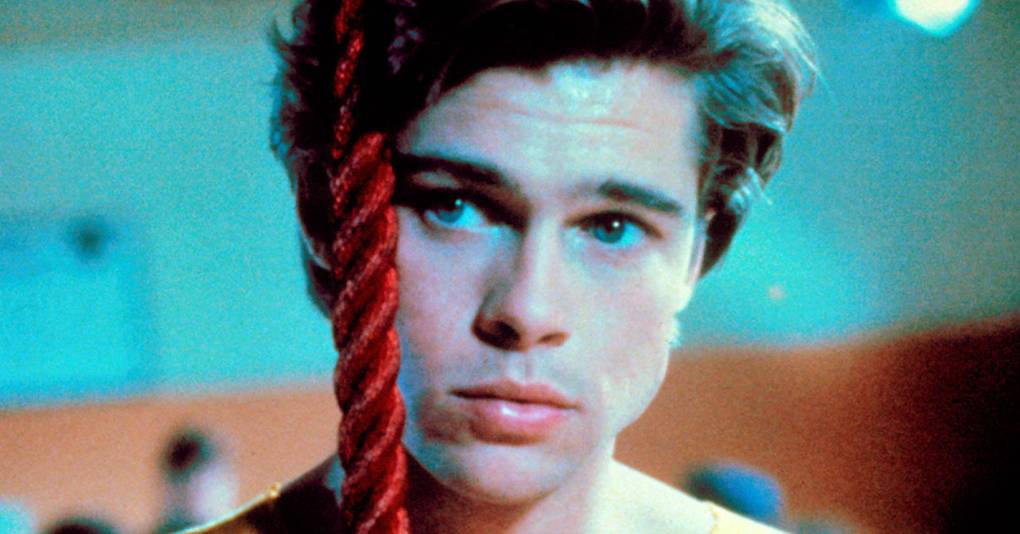
2. Brad Pitt: Cutting Class (1989)

Someone’s killing off folks at the nameless high school where Pitt, as Dwight Ingalls, portrays the horny, popular basketball star repressing rage concerning his overbearing father. Perhaps he’s bottling up something more?

Sexual frustration, no doubt, as he spends every second on screen trying to get somewhere with girlfriend Paula (Jill Schoelen, frequent flier on bad 80s Horror Express).

Usually, when you look back on a superstar’s early career and find low-budget horror, one of two trends emerges. Either the superstar stands out as clearly the greatest talent in the film, or else they just cut their teeth on a very small role. Sometimes both. In Pitt’s case, well, at least he looks like Brad Pitt.

Still, it’s fun to see him try on some tics and idiosyncrasies he’ll come to rely on in later, better roles. (Like Pitt’s Oceans character Rusty Ryan, Dwight eats in every scene.)

The freakishly uneven tone, the film’s episodic nature, each scene’s seeming amnesia concerning other scenes’ actions, and the whiplash of comedy to psychological thriller to comedy all add up to an exercise in incoherence.

1. Laura Dern: Grizzly II: The Concert (1987)

Here’s the crowning jewel for nearly any Skeletons in the Closet feature. It features not just a current nominee, but one past winner and ever-the-winner Charlie Sheen. It’s hard to come by and even harder to watch. The sequel to William Girdler’s 1796 forest-astrophe Grizzly was filmed in 1983 and never completed, but sort of, kind of released anyway in 1987. Every death scene ends just before the death itself, because the bear side of the struggle was never shot. So, we get a lot of bear’s eye view of the victim, but never a look at the bear side of the sequence. It’s surreal, almost.

Sandwiched somewhere between the non-death sequences is a never ending faux-eighties synth pop concert. The concert footage is interminably long, nonsensical enough to cause an aneurism, and awful enough to make you grateful for the aneurism. You will lose your will to live. So, why bother? Because this invisible grizzly puppet kills Charlie Sheen, Oscar nominee Laura Dern, and George Clooney. (Dern and Clooney are making out at the time, which actually probably happened).

https://www.youtube.com/watch?v=2B4EyMoMmzY

Rite Here, Right Now

Color Out of Space

by Hope Madden

HP Lovecraft has influenced horror cinema in ways too varied and numerous to really articulate. But true Lovecraft is tough to bring to the screen for a number of reasons, chief among them that his madness tends to involve something indescribable: a color no one’s ever seen before, a sound entirely new to the human ear, a shape that defies all laws of geography and logic.

Alex Garland pulled inspiration from Lovecraft’s 1927 short Colour Out of Space for his brilliant 2018 mindbender, Annihilation. But for direct adaptations, Richard Stanley’s newest may be the best.

Naturally, the film’s success is due in large part to Nicolas Cage’s performance, because who descends into madness quite as entertainingly?

Cage plays Nathan Gardner. Nathan and his wife (Joely Richardson), their three kids and their squatter (Tommy Chong – nice!) live a quiet life in the New England forest not far from Arkham. A meteorite changes all that.

Cage basically strums a favorite old tune, landing somewhere on his “nice guy gone insane” spectrum just this side of Brent (Mom and Dad) and Red Miller (Mandy). In fact, the voice that begins emerging once the meteorite hits is gleefully reminiscent of Peter Lowe from Vampire’s Kiss (a call back I can get behind).

Is that the only reason to see the movie? No. Tommy Chong is a hoot, Richardson gets one especially creepy carrot chopping scene, and things go a little Cronenberg just when you want them to.

There’s a lot wrong with the film, too. Scenes are sloppily slapped together, one rarely leading to the next. The film’s budget is betrayed by its FX and supporting performances are not especially strong.

But Stanley’s long-awaited comeback (this is his first narrative feature since being fired from The Island of Dr. Moreau in 1996) infuses Lovecraft with a much needed dark streak of comedy and entrenches his tale of madness within a loving family dynamic, offering an emotional center to the story that the author rarely delivered.

The film lacks the vibrant subversiveness of Mom and Dad and comes nowhere near the insane vision of Mandy, so Cage fans might be only mildly impressed. Lovecraft fans, though, have reason to be excited.

Fright Club: Time Loop Horror

Ever feel like you’ve been here before? This week we celebrate that spooky feeling with some of the best horror movies to take advantage of time loop nuttiness.

5. Haunter (2013)

Nicolas Vincenzo (Cube) starts off with the standard Groundhog Day premise—surly teen Lisa (Abigail Breslin) wakes up to the walkie talkie sound of her brother playing hidden treasure with an imaginary friend. It’s not Sonny & Cher, but it’s not that far off.

But Vincenzo (working from Brian King’s screenplay) starts bending the time loop structure, blending it with a more recognizable horror trope and subverting expectations. Breslin delivers a solid performance, and Pontypool’s Stephan McHattie’s outstanding as the devilish Pale Man. Plus, excellent support work from Siouxsie Sioux’s big face on Lisa’s tee shirt!

The film does kind of collapse on itself by the third act as it gets all Frequency (or Lake House or Don’t Let Go) on us, but for a good chunk of time Haunter delivers.

4. Happy Death Day (2017)

Tree (Jessica Rothe) wakes up on her birthday in some rando’s dorm room with no memory of the night before, a raging hangover and an attitude. She’s murdered that night by a knife-wielding marauder in a plastic baby mask, only to wake up back in that same dorm room under that same They Live poster.

It doesn’t take too many déjà vu mornings before Tree decides there is a mystery to solve here and just like that, we’re off in Phil Connors territory: reliving the same day again and again gives you the chance to become a better person, right?

Director Christopher Landon (Scout’s Guide to the Zombie Apocalypse) wisely mines Scott Lobdell’s screenplay for laughs. Rothe boasts strong comic timing and a gift for physical comedy, a skill that transitions nicely to the demands of being repeatedly victimized by a slasher.

3. The Endless (2017)

There is something very clever about the way Justin Benson and Aaron Moorehead’s movies sneak up on you. Always creepy, still they defy genre expectations even as they play with them.

Camp Arcadia offers the rustic backdrop for their latest, The Endless. A clever bit of SciFi misdirection, the film follows two brothers as they return to the cult they’d escaped a decade earlier.

It is this story and the pair’s storytelling skill that continues to impress. Their looping timelines provide fertile ground for clever turns that fans of the filmmakers will find delightful, but the uninitiated will appreciate as well.

2. Timecrimes (2007)

This one is nutty, and absolutely required viewing for anyone with an interest in space/time continuum conundrums.

Writer/director/co-star Nacho Vigalondo (Colossal) mocks our desire for control and our fear of the doppelganger with a very quick and dirty trip through time. So much can go wrong when you travel just one hour backward. The less you know going in, the better.

An always clever experiment in science fiction, horror and irony, Timecrimes is a spare, unique and wild ride.

1. Resolution (2012)

Not exactly a traditional time loop horror, Resolution plays with the concept of time in ways that are baffling and eerie.

Michael (Chris Cilella) is lured to a remote cabin, hoping to save his friend Chris (Vinny Curan) from himself. Chris will detox whether he wants to or not, then Michael will wash his hands of this situation and start again with his wife and unborn baby.

But Michael is in for more than he bargained, and not only because Chris has no interest in detoxing. Directors Aaron Moorhead and Justin Benson (working from Benson’s screenplay) begin with a fascinating and bizarre group of characters and a solid story, layering on bizarre notions of time, horror and storytelling in ways that are simultaneously familiar and wildly unique. The result is funny, tense, and terrifying.

Under the Sea

Underwater

by Hope Madden

Kristin Stewart has been stretching.

Yes, she will probably forever be first known as that girl from Twilight, unfortunately. But, in the same way her ex-vampire lover Robert Pattinson has relentlessly carved a stronger impression via challenging independent film roles, Stewart has been honing her craft and developing a reputation as a solid talent via varying roles in small budget films.

The few dozen or so of us who saw her versatility over the last few years in Personal Shopper, JT LeRoy, Lizzie, Certain Women, Still Alice and Clouds of Sils Maria no longer think first of Twilight’s Bella Swan.

But Ellen Ripley?

William Eubank’s deep sea horror Underwater sees Stewart as Nora, a no-nonsense, quick thinking, fast acting survivor—the kind who just might keep the remaining crew alive as they try to make their way from an irreversibly damaged deep sea drill rig to a nearby vessel that might have pods to float them to safety.

But what caused the damage in the first place and what is making that noise?

Eubank has assembled a surprisingly solid cast for his “Alien Under the Sea” flick. Joining Stewart as the rig’s humbly heroic captain is the always excellent Vincent Cassel, while John Gallagher Jr. plays the latest in his long line of effortlessly likeable good guys, Smith. Chubby comic relief is delivered by T.J. Miller.

If that sounds like your basic set of recognizable stereotypes assembled to be picked off one by one, you’ve detected the first major problem with Eubank’s film: a breathtaking lack of originality.

The script, penned by Brian Duffield (The Babysitter) and Adam Cozad (The Legend of Tarzan), offers nothing in the way of novelty and much of the dialog is stilted, and Nora’s third act reveal of the emotional damage she must overcome is false and forced.

Luckily, Eubanks somehow convinced a bunch of genuinely talented actors to deliver these lines, so they mainly come off fine. And while the director frustratingly and consistently undercuts the claustrophobic tension he’s begun building, his monsters are pretty cool looking.

Stewart gets to try on the action hero role, and she’s not too bad. For a 95 minute sea monster movie, neither is Underwater. It’s not too good, either, but at least there are no sparkly vampires.

Trying Not to Hold One

The Grudge

by Hope Madden

Any time a film is remade, you have to ask why. Not to be cynical, but because it’s a legitimate query. Is there a compelling reason to watch this new one?

Nicolas Pesce hopes there’s reason to watch his retooling of The Grudge.

The Grudge began in 2000 with Takashi Shimizu’s Japanese horror Ju-on, which spawned three Japanese sequels and now four English language reworkings, two of which Shimizu directed himself. His 2004 version starring Sarah Michelle Geller became a tentpole of our J-horror obsession of the early 2000s.

Pesce, working with co-writer Jeff Buhler (The Midnight Meat Train—that was your first problem), pulls story ideas from across the full spate of Ju-on properties and braids them into a time-hopping horror.

Is there room for hope? There is, because Pesce landed on horror fanatics’ radars in 2016 with his incandescent feature debut, The Eyes of My Mother.  He followed this inspired piece of American gothic in 2018 with a stranger, less satisfying but utterly compelling bit of weirdness, Piercing.

And then there’s this cast: Andrea Riseborough, John Cho, Lin Shaye, Betty Gilpin, Jacki Weaver, Frankie Faison, Damian Bichir—all solid talents. You just wouldn’t necessarily know it from this movie.

Pesce’s basically created an anthology package—four stories held together by a family of especially unpleasant ghosts. But that one sentence contains two of the film’s biggest problems.

Let’s start with the ghosts. Shimizu’s haunters—Takako Fuji and Yuya Ozeki—were sweet-faced, fragile and innocent seeming. The perversion of that delicacy is one of the many reasons Shimizu’s films left such a memorable mark. Pesce’s substitute family loses that deceptive, macabre innocence.

The way the film jumps from story to story and back again undermines any tension being built, and each story is so brief and so dependent on short-hand character development (cigarettes, rosaries, ultrasounds) that you don’t care what happens to anyone.

Jacki Weaver, who seems to be in a comedy, is wildly miscast. Go-to horror regular Shaye has the only memorable scenes in the film. Riseborough, who is a chameleonic talent capable of better things, delivers a listless performance that can’t possibly shoulder so much of the film’s weight.

Jump scares are telegraphed, CGI and practical effects are unimpressive, editing is uninspired and, worst of all, the sound design lacks any of that goosebump-inducing inspiration Shimizu used to such great effect.

So, no. There was no reason to remake The Grudge.

Fright Club: Best Horror Movies of 2019

It’s time! The year has come to its end and we need to sift through all the glorious horror 2019 had to offer and put it in some kind of order. Four of the most promising names in horror— Peele, Eggers, Kent and Aster—join some bold newcomers including Jennifer Reeder, Issa Lopez, Lane and Ruckus Skye to lead a pack of unforgettable horrors.

Truth is, there were an awful lot of great films that we had to leave off this list. But that just means the actual list is that strong. Here you go:

10. Ready or Not

At midnight on Grace (Samara Weaving) and Alex’s (Mark O’Brien) wedding night, everyone assembles in the Le Domas family game room: Mom and Dad (Andie MacDowell and Henry Czerny), Aunt Helene (Nicky Guardagni), other siblings and in-laws. It’s a ritual. Just one quick game of hide and seek. What could go wrong?

The inky black comedy plays like a game of Clue gone mad with arterial spray, the film’s comic moments coinciding most often with the accidental slaughter of servants.

The filmmakers take advantage of Weaving’s grit and comic timing, skipping from one bloody comic set up to the next. The plot and the chase move quickly enough to keep you from dwelling on the shorthand character development, the errant plot hole and the occasional convenience. It’s fun, it’s funny, and it’s a bloody mess.

9. Climax

Hey, club kids, it’s a Gaspar Noe dance party!

Noe’s usual reliance on extended takes, stationary cameras and overhead shots makes the dance sequences utterly intoxicating, the performers’ energy creating exciting visual beauty and a palpable exuberance for their art. These seductive odes to dance are interspersed with sometimes graphically sexual conversations between the dancers, sharpening character edges and laying down an interpersonal framework that will soon be turned on its head.

What spurred this sea change, and who is to blame? Noe turns that mystery into a greater conversation about the opportunity of birth, the impossibility of life and the extraordinary experience of death, and as is his wont, batters your senses while doing it.

8. Reckoning

Welcome to Reckoning, Lane and Ruckus Skye’s lyrical backwoods epic, grounded in a lived-in world most of us never knew existed. One of the most tightly written thrillers in recent memory, Reckoning peoples the hills of Appalachia with true characters, not a forgettable villain or cliched rube among them. The sense of danger is palpable and Danielle Deadwyler’s commitment to communicating her character’s low key tenacity is a thing of beauty.

Reckoning remains true to these fascinating souls, reveling in the well-worn but idiosyncratic nature of their individual relationships—a tone matched by sly performances across the board. And just when you think you’ve settled into a scene or a relationship, Reckoning shocks you with a turn of events that is equal parts surprising and inevitable.

It’s a stunning film, and a rare gem that treats Appalachians not as clichés, but certainly not as people to be messed with.

7. One Cut of the Dead

For about 37 minutes, you may feel like Shin’ichirô Ueda’s One Cut of the Dead delivers, cleverly enough, on a very familiar promise.

One Cut opens as a micro-budget zombie movie, which soon reveals itself to be a film within a film when real zombies show up on set. As the bullying egomaniac director continues filming, ecstatic over the authenticity, Ueda appears to deconstruct cinema.

And though that may sound intriguing on the surface, the truth is that what transpires after that 37 minute mark officially defines Ueda as an inventive, gleeful master of chaos and lover of the magic of nuts and bolts filmmaking.

6. Knives and Skin

Falling somewhere between David Lynch and Anna Biller in the under-charted area where the boldly surreal meets the colorfully feminist, writer/director Jennifer Reeder’s Knives and Skin offers a hypnotic look at Midwestern high school life.

Knives and Skin’s pulpy noir package lets Reeder explore what it means to navigate the world as a female. As tempting as it is to pigeonhole the film as Lynchian, Reeder’s metaphors, while fluid and eccentric, are far more pointed than anything you’ll find in Twin Peaks.

And everyone sings impossibly appropriate Eighties alt hits acapella. Even the dead.

5. The Nightingale

The Nightingale is as expansive and epic a film as Kent’s incandescent feature debut The Babadook was claustrophobic and internal. In it she follows Clare (Aisling Franciosi), an Irish convict sentenced to service in the UK’s territory in Tasmania.

What happens to Clare at the hands of Leftenant Hawkins (Sam Claflin), the British officer to whom she is in service, is as brutal and horrifying as anything you’re likely to see onscreen this year. It’s the catalyst for a revenge picture, but The Nightingale is far more than just that.

Kent’s fury fuels her film, but does not overtake it. She never stoops to sentimentality or sloppy caricature. She doesn’t need to. Her clear-eyed take on this especially ugly slice of history finds more power in authenticity than in drama.

4. Tigers Are Not Afraid

Lopez’s fable of children and war brandishes the same themes as Guillermo del Toro’s masterpiece Pan’s Labyrinth, but grounds the magic with a rugged street style.

Tigers follows Estrella, a child studying fairy tales—or, she was until her school is temporarily closed due to the stray bullets that make it unsafe for students. As Estrella and her classmates hide beneath desks to avoid gunfire, her teacher hands her three broken pieces of chalk and tells her these are her three wishes.

But wishes never turn out the way you want them to.

3. The Lighthouse

Director/co-writer Robert Eggers follows The Witch, his incandescent 2015 feature debut, with another painstakingly crafted, moody period piece. The Lighthouse strands you, along with two wickies (Willem Dafoe, Robert Pattinson), on the unforgiving island home of one lonely 1890s New England lighthouse.

For everything Eggers brings to bear, from the Bergmanesque lighting and spiritual undertones to the haunting score to the scrupulous set design to images suitable for framing in a maritime museum – not to mention the script itself – The Lighthouse works because of two breathtaking performances.

This is thrilling cinema. Let it in, and it will consume you to the point of nearly missing the deft gothic storytelling at work. The film is other-worldly, surreal, meticulous and consistently creepy.

2. Midsommar

In Midsommar, we are as desperate to claw our way out of this soul-crushing grief as Dani (Florence Pugh). Mainly to avoid being alone, Dani insinuates herself into her anthropology student boyfriend Christian’s (Jack Reynor) trip to rural Sweden with his buds.

Little does she know they are all headed straight for a modern riff on The Wicker Man.

Like a Bergman inspired homage to bad breakups, this terror is deeply-rooted in the psyche, always taking less care to scare you than to keep you unsettled and on edge.

1. Us

From a Santa Cruz carnival to a hall of mirrors to a wall of rabbits in cages—setting each to its own insidious sound, whether the whistle of Itsy Bitsy Spider or Gregorian chanting— writer/director Jordan Peele draws on moods and images from horror’s collective unconscious and blends them into something hypnotic and almost primal.

Loosely based on an old episode of Twilight Zone, Us is a tale full of tension and fright, told with precision and a moral center not as easily identifiable as Get Out‘s brilliant takedown of “post racial America.”

While it’s fun to be scared stiff, scared smart is even better, a fact Jordan Peele has clearly known for years.

https://www.youtube.com/watch?v=5fnbhWoWaVM