A prestigious art critic (Claes Bang) with a mysterious new fling (Elizabeth Debicki) is hired by an uber wealthy dealer (Mick Jagger) to get his hands on a work from a reclusive master (Donald Sutherland).
Things slowly unravel.
With The Burnt Orange Heresy, director Giuseppe Capotondi and writer Scott B. Smith adapt Charles Willeford’s novel into a stylish thriller that casts a cynical eye on art, criticism, privilege and honesty.
The writing is playfully seductive and the cast is a joy, setting a delicious hook that keeps you guessing, at least for a while. And while the finale struggles with consistency, the final shot sends an undeniable message.
Made It Italy is a romantic comedy that follows a veteran artist and his estranged adult son still struggling over the devastating loss of their wife and mother. The chance to restore an old house in Tuscany brings with it the chance for some relationship mending.
With the casting of Liam Neeson and his real life son Micheál Richardson in the leads, writer/director James D’Arcy isn’t shy about introducing life to art.
Richardson adopted his maternal surname two years ago to honor the memory of his mother Miranda Richardson, who passed away in 2009 after a tragic ski accident. Even during the film’s most familiar beats, this family history adds a constant, beneficial layer of feeling.
Son Jack Foster manages a British art gallery owned by the family of his soon-to-be ex wife. They’re selling and he’s desperate to buy, enough to call up his estranged dad Robert with a plan to raise the cash by selling their old Italian villa.
As you probably guessed by the words “Italian” and “villa,” the place is surrounded by incredibly picturesque beauty. A visit by a blunt real estate agent (Lindsay Duncan, always a pleasure) assures them she could find a buyer, but only after a major facelift.
Dad isn’t happy, but agrees to help, setting up construction montages and meals in town where Jack meets lovely restauranteur Natalia (Valeria Bilello).
D’Arcy, a veteran actor at the helm of his first feature, isn’t breaking any new ground here, just making the surroundings feel plenty comfortable. The comedy is rarely more than droll and amusing, but aside from the cartoonishly misplaced rich couple sizing up the place, it carries a simple charm.
The surroundings are gorgeous, the tidy ending is never in doubt, and the real life family ties provide unspoken warmth. It will no doubt remind you of places you’ve already been, but the soft edges and lived-in appeal of Made In Italy feel like a weathered welcome mat.
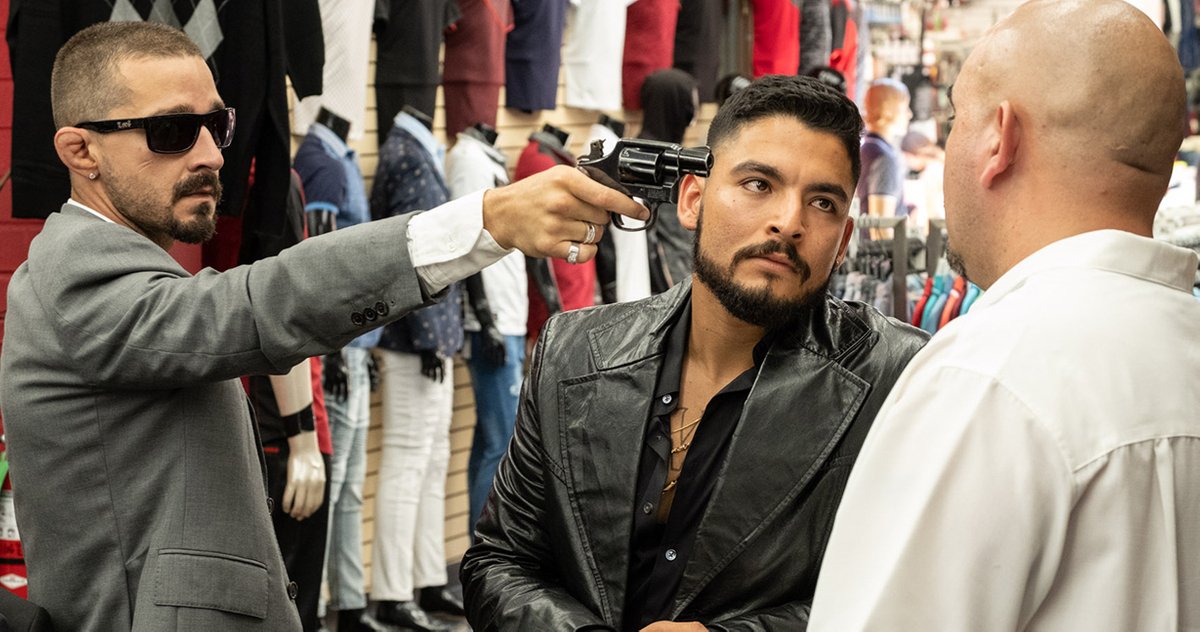
You may have heard Shia LaBeouf recently got his entire chest tattooed for his role as “Creeper” in The Tax Collector. Uncommon intensity from the gifted LaBeouf is nothing new, but why he would be motivated to do this is one of the many questions plaguing the latest from writer/director David Ayers.
Creeper is the supporting player here, the nattily clad and tightly wound muscle for organized crime boss David (Bobby Soto). Working for the mysterious Wizard (Jimmy Smits), David and Creeper collect “taxes” from each and every gang in L.A.
43 gangs at 30 percent each means David is living well. That is, until old rival Conejo (veteran rapper Jose Conejo Martin) returns with an aim to take over, and kill anyone who thinks that’s a problem. He does voodoo, too, so there’s a wrinkle.
Much of the film’s early going recalls Ayers’s scripts for both Training Day and End of Watch, as we follow David and Creeper on a loosely-connected series of stops, from violent tax collections to family business with David’s wife (Cinthya Carmona) and Uncle (George Lopez).
David’s expressed devotion to his home life sets up the chance of a Michael Corleone-type thread exploring the difficulty of balancing two worlds, but Ayers leaves it dangling for some stylish but empty brutality in a gang war.
Soto (from 2011’s wonderful A Better Life) and LaBeouf form an impressive duo, but they are continually let down by the script’s generic macho posturing (“We killing anybody today, homie?” “Shit’s getting real”) and over-the-top ambitions to “wash away our sins” by killing a boatload of people.
And as you might guess, LaBeouf playing a Latino gangster is troublesome. Though Ayers has pushed back by saying the character is one who has absorbed the world around him (a claim somewhat bolstered by Ayers’s own background), Creeper never gets the development needed to make LaBeouf’s committed performance land as much more than – at best – intense appropriation.
By the film’s final showdown, the biggest question here concerns the point of it all. It had to be more than that tattoo, or just standard revenge fare as deeply felt as a video game commercial.
But despite the slick camerawork from cinematographer Salvatore Totino, here we are. There are possibilities strewn about The Tax Collector that might have gelled into a robbers bookend for the compelling cops in Ayers’s End of Watch.
But like pesky overdue notices, ignore those possibilities too long and there’s a great big mess on your hands. Or on your screen.
I’m sure I’m not the only one who’s ever wandered past their old college apartment and thought about knocking, right? And then you realize how little the kids inside will care about your nostalgia (or worse, how adorable they’ll think your old ass is), and you just keep on wandering.
But what if you were invited in? And what if you stayed awhile? With I Used To Go Here, writer/director Kris Rey has a full semester of fun exploring that very idea.
30-something Kate (Community‘s Gillian Jacobs, fantastic) is bumming over a breakup and the cancellation of the promo tour for her very first book. A phone call from her old professor David (Jemaine Clement) perks Kate right up.
Would she come back to Illinois U. as a “Distinguished Alumni” and do a reading from her novel? She would.
Once on campus, Kate pauses to take a selfie outside her old place, and one of the students inside takes notice. Oh, you’re a writer? We’re writers, too. Hey, we’re having a party tonight, you should come.
Yes, some sit-com worthy situations ensue, but the point quickly becomes how well Rey wields them all to unleash a series of hilarious punctures into the illusion of aging while hip.
And while the big picture is endlessly charming, the little details aren’t forgotten. From the obligatory Che Guevara poster to Kate donning an orientation t-shirt, from the painful college prose to the serious battle brewing between Kate and her b-n-b host, Rey displays a keen sense for weaving humanity into hijinks.
She has a wonderful vessel in Jacobs, who channels many of Rey’s usual sensibilities with an endearing and warmly funny performance. Kate’s life may be an intermittent mess, but she’s always easy to root for, and Jacobs – with help from a stellar ensemble – confidently navigates the uneven ground between Kate’s ambition, her reality, and her attempt to find out if one of her new young college friend’s girlfriend is cheating on him!
Even at its nuttiest, I Used To Go Here is a deceptively smart look at the complexities of accepting adulthood. It’s Noah Baumbach’s While We’re Young with a lighter touch, a film that might make the “your future starts now” message on the back on Kate’s t-shirt ring true for both filmmaker and star.
We want to thank Cati Glidewell, also know as The Blonde in Front, for joining us to talk through some of the best blond(e)s in horror. There’s a lot of names here, but I think we may have proved that—with a few really bloody exceptions—blondes do seem to have more fun in these movies.
The Dudes
6. Francis Dollarhyde (Tom Noonan), Manhunter (1986)
Tom Noonan’s entire career is defined by a mixture of tenderness and menace. It begins with his unusual physical appearance, including his almost colorless locks, and ends with performances that realize everything broken and horrifying about a character—especially Francis Dollarhyde. The terrifying chemistry between Dollarhyde and a blind Joan Allen’s is heartbreaking perfection.
5. Mark Lewis (Carl Boehm), Peeping Tom (1960)
Like Norman Bates across the pond, England’s Mark Lewis (Carl Boehm) is an innocent. Boehm’s blank stare, his frightened mouse reflexes, his blond locks all contribute to a character so tender you can’t help but root for him—although it would be great if he’d stop murdering women.
4. Kakihara (Tadanobu Asano), Ichi the Killer (2001)
A bleach blond in a Japanese film will automatically draw the eye, but Kakihara’s not just here to catch your attention. Genius filmmaker Takashi Miike and Tadanobu Asano created this badass to upend your expectations. He’s the baddie, right? And man-child Ichi is the innocent? Or is Miike toying with you?
3. Gage (Miko Hughs), Pet Sematary (1989)
Get the Kleenex ready because the ridiculously cute Mike Hughs has a date with a semi. A toddler when he filmed this movie, Hughs really turns in a remarkable performance, whether he’s tugging your heart strings or slicing through Fred Gwynne’s Achilles tendon.
2. David (Keiffer Sutherland), The Lost Boys (1987)
Hubba hubba. The rock star duds. The homoerotic relationship with Jason Patrick. The mullett! Keiffer Sutherland’s bad boy David was so cool you couldn’t help wanting to hang out with him. Eating maggots seems like a small price to pay, really. Nobody said the cool kids’ table would be tasty.
1. John Ryder (Rutger Hauer), The Hitcher (1986)
There are those with a thing for bad boys, and then there are those with a thing for Rutger Hauer. He’s not a bad boy—he’s not even in the same zip code. His John Ryder will make you feel all kinds of weird things because he’s not your garden variety dangerous character. What he will do to you, to that nice family in the station wagon, to your new girlfriend, is more awful than anything you can think of.
The Women
6. Chris Hargeson (Nancy Allen), Carrie (1976)
When De Palma launched the ultimate in mean girl cinema, Nancy Allen delivered the ultimate mean girl. Chris Hargeson’s bloodthirsty princess energy has to convey something horrifying if she is to properly offset what poor Carrie White has to content with at home. Luckily for us (not so much for Carrie), she does.
5. Tomasin (Anya Taylor Joy), The Witch (2015)
Watching The Witch, you realize that writer/director Robert Eggers chose everything: every sound, every image, every color. And while Tomasin’s family looked like gaunt, hard working, colorless cogs in God’s wilderness wheel, Thomasin did not. Even as we open on Anya Taylor Joy, confessing her sins and begging forgiveness, she is lit from within. A beacon. It’s just that her light has caught the wrong kind of attention.
4. Casey (Drew Barrymore), Scream (1996)
The genius Wes Craven and his producer Drew Barrymore pulled an incredible and soon-to-be endlessly copied sleight of hand with Casey—the spunky female played by the biggest star in the cast. With this character, Craven introduces the meta-movie-commentary that defines this film while simultaneously upending our own unconscious investment in those tropes by killing Casey off in Act 1.
3. Carol (Catherine Deneuve), Repulsion (1965)
We went back and forth. Would it be Deneuve as gorgeous seductress Miriam in Tony Scott’s 1983 vampire film The Hunger, or innocent driven to madness Carol in Polanski’s Repulsion? (He does know how to torture innocent young women, doesn’t he?) Deneuve’s performance in Repulsion is so compelling and difficult—playing primarily alone for about half the film—that it won out, but either way, she’s a blonde to be reckoned with.
2. Pamela Voorhees (Betsy Palmer), Friday the 13th (1980)
The OG Karen (to steal a phrase from this episode’s co-host The Blonde in Front), Pamela Voorhees has a plan and she’s sticking to it. This funny business among the camp counselors needs to be addressed, corrected. Enough is enough. Betsy Palmer’s performance is spot-on, so comforting and in control before it goes completely batshit. Jason may get all the love, but Mrs. Voorhees took care of business first.
1. Carrie White (Sissy Spacek), Carrie (1976)
Like his idol Hitchcock, Brian De Palma had a thing about blondes—what that fair hair represented, what it could mean. For De Palma, it might be the bombshell of Angie Dickson’s character in Dressed to Kill, or the innocence of Carrie White. Of course, Sissy Spacek’s Oscar nominated performance in the film was what really sold this sheltered, shell-shocked little lamb, but you can’t deny she had that look.
In the forty years since J.M. Coetzee’s Waiting for the Barbarians was first published, world events have continued to re-frame its thematic relevance.
Now, the novel finally has a big screen adaptation, amid a tumultuous political climate that again makes Coetzee’s tale feel especially prescient.
In a vaguely historical era within an unnamed “Empire,” the Magistrate (Mark Rylance) governs his desert outpost population through moral conviction and a delicate harmony with the land’s indigenous peoples.
Conversely, Colonel Joll (Johnny Depp) – the soft spoken and sadistic head of state security – believes “pain is truth.” Joll arrives at the outpost to carry out random interrogations of the nomadic “barbarians” and learn the truth about an attack that he feels is imminent.
The Magistrate protests this view of the natives and the Empire’s directives, drawing the ire of Joll and later, his more overtly cruel lieutenant, officer Mandel (Robert Pattinson).
Coetzee’s debut screenplay adapts his own novel with delicate grace and an understated foreboding. But as relevant as the theme of creeping fascism remains, its bite is dulled by ambiguity and broadly-drawn metaphors.
The urge to speak more universally via an unspecified name, time and place is understandable, but it hampers the intimacy required to feel this warning in your gut.
The Oscar-winning Rylance (Bridge of Spies) almost makes up for this by himself, with a tremendous performance of quiet soul-searching. The film’s summer-to-the-following-autumn chapter headings paint the Magistrate as an obvious man for all seasons, and Rylance makes the Magistrate’s journey of fortitude and redemption feel almost biblical.
Depp and Pattinson provide worthy adversarial bookends. As Joll, Depp’s only eccentricity is a pair of sunglasses, but again he requires minimal screen time to carve an indelible figure.
Mandel is an even smaller role, but Pattinson makes him the eager realization of the ugliness Joll keeps bottled up. It’s another interesting choice for the gifted Pattinson, and another film that’s better for it.
Director Ciro Guerra utilizes exquisite cinematography from Chris Menges for a wonderful array of visuals, from beautifully expansive landscapes to artfully orchestrated interior stills. Though the film’s first act feels particularly forced, Guerra (Birds of Passage, Embrace of the Serpent) gives the remaining narrative – especially the Magistrate’s attempts at penance with the tortured Girl (Gana Bayarsaikhan) – the room to effectively breathe.
Waiting for the Barbarians is not a film that will leave you guessing. But the decades-old message remains painfully vital, and in its quietest moments of subtlety, the film gives that message sufficient power.
It might be a different type of faith-based flick, but Dare to Dream most definitely earns my usual disclaimer: judging these films is less about what they are preaching, and more about how well they tell a story.
Here, the gospel is the Law of Attraction, and the storytelling is unattractively dreadful.
The Secret first arrived nearly 15 years ago as a documentary and self-help book, both written by Rhonda Byrne, and each detailing how positive thinking can directly influence your life and bring you whatever it is you visualize.
Director/co-writer Andy Tennant (Hitch, Fool’s Gold) visualizes a narrative treatment that finds Vanderbilt professor Bray Johnson (Josh Lucas) ignoring hurricane warnings and driving down to New Orleans with an important message for one Miranda Wells (Katie Holmes).
Miranda is a widow with three kids, a boyfriend (Jerry O’Connell), and character development consisting of a succession of old graphic tees. She finds Bray before he finds her, by rear-ending him in traffic. Bray’s original mission is quickly sidetracked, and soon he’s fixing Miranda’s car, the hole in her roof, and whatever else his laid-back, dimpled philosophizing can help with.
Even before this handsome stranger effortlessly fascinates the wide-eyed Wells children with an example of how magnets work, not a lick of this bears any resemblance to real life.
Paper-thin characters recite banal dialogue carrying all the depth of a pop-up greeting card. Family strife about storm damage and money trouble is only dire enough to be a manufactured setup for Holmes to give a cute sigh and wonder, “What now??” while her kids pine for a computer or a pony.
Bray’s mission is never in doubt, and the film’s ultimate resolution becomes a tidy, manipulative pinch from the Nicholas Sparks playbook, right down to the throwing of a shameless trump card.
Whether you think The Secret is nothing but entitlement masquerading as feel good drivel, or a truly uplifting approach to finding happiness, a resonant film needs an attraction beyond preaching to the converted.
Or does it? Dare to Dream doesn’t really seem interested in finding out.
Honestly, I’m not digging this title, yet it somehow fits.
For the story of an intellectual giant, Radioactive seems too easy, too cheesy, and a bit dismissive. Similarly, the film itself becomes a sum of often conflicting parts, flirting with greatness while chasing too many bad pitches.
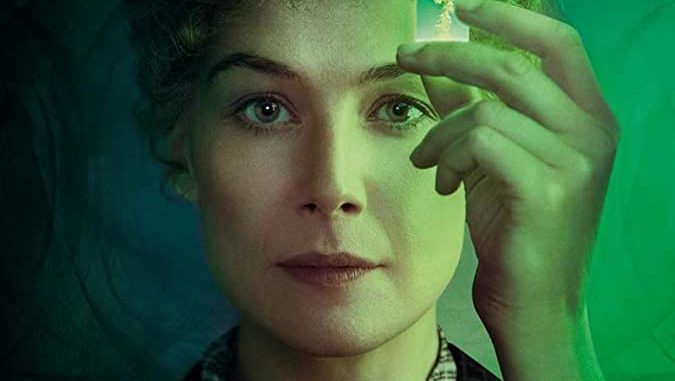
Rosamund Pike stars as Marie Sklodowska Curie, the Warsaw-born scientist who became the first woman to win the Nobel Prize, the first person to win it again and the only person to win it in two different scientific fields. Her groundbreaking work in France with husband Pierre Curie identified two new elements (polonium and radium) and the theory of radioactivity itself, leading to world-changing advancements in medicine and, of course, warfare.
Director Marjane Satrapi (Persepolis, The Voices) seems intent on honoring Curie’s spirit via the most experimental film treatment she can get away with. Animated graphics attempt to illustrate Curie’s theories on atomic movement, while tones are jarringly shifted with futuristic vignettes that glimpse the more devastating consequences of radioactivity.
Too often, Satrapi is hamstrung by screenwriter Jack Thorne’s overly broad and simplified adaptation of Lauren Redniss’s source book, which is itself a work of original art, photographs, graphics and text. Bringing such hybrid energy to the screen demands a unified vision from writer and director, but Satrapi and Thorne seem at odds whenever they try to expand their scope.
Pike is the unifier here, with an instantly engaging and fully formed portrait of a genius understandably ferocious about defending her work from being usurped or dismissed by male colleagues. Pike humanizes Curie with a mix of defiance and insecurity, frank sexuality and a fierce commitment to husband Pierre (Sam Riley, in a thoughtfully understated and effective turn).
The third act addition of Anya-Taylor Joy as the Curie’s eldest daughter Irene (who would also win a Nobel Prize in Chemistry) only cements the film as being most resonant when it is the most personal.
And it can’t go unnoticed that in these science-denying times, Curie’s story is a needed reminder of the importance of pursuing knowledge, of research and researchers.
Curie was one for ages. Radioactive does suffer from scattered elements, but ultimately turns in watchable, satisfying results.
In a remote Indonesian village, a garden of small headstones marks the effectiveness of a Shaman’s curse. Newborn after newborn dies, the one survivor growing to endure a mysterious, painful existence.
Creepy, right?
Shudder’s Impetigore scores some definite points there, which help to offset a narrative often hampered by convenience and confusion.
Maya (Tara Basro) and Dini (Marissa Anita) are best friends trying to make a go of it in the city. With no family to speak of, they scrape by with menial jobs while dreaming of a better future.
Though raised by her aunt, Maya learns of a spacious home left behind by her wealthy parents. Maya could very well lay claim to this valuable property through inheritance, so she and Dini make their way to the remote village, unaware of the curse and their place in it.
Writer/director Joko Anwar (Satan’s Slaves), an Indonesian genre veteran, seems to know he’s got some solid benchmarks here while not worrying too much about the strength of what binds them together.
Dialogue can range from awkward to WTF-worthy, amid a few convenient plot turns and one humdinger of extended curse explanation that strains coherence.
But when Anwar hits his creepy marks, Impetigore can leave one. The atmospheric isolation in the village feels authentic, and once blood begins letting, the tension is well-paced, bolstered with some satisfying visual payoffs.
There will be eyerolls, but if you’re keeping score, also enough frightful eyebrow-raising to make Impetigore a winning dive into twisted family values.