Tag Archives: film reviews

Beauty in the Beast

The Dark

by Hope Madden

There are a lot of ways to approach a zombie film, few of them fresh. Zombie flick as YA (young adult) melodrama isn’t even a new idea anymore—2015 saw a surprisingly nuanced Arnold Schwarzenegger nurse his reanimated teen (Abigail Breslin) in Maggie, the best of the batch until now.

Still, writer/director Justin P. Lange has something on his mind with his debut feature The Dark, and he has found a compelling way to tell not-just-another zombie story.

We open on a twist to a familiar scene. A man in a rush, likely a fugitive of some kind, grabs some supplies at an out-of-the way gas station. He opens a map. The lone, wizened clerk points him toward an assumed destination: Devil’s Den.

As familiar as even the twist feels, the truth is that Lange gets more mileage from that old warhorse than you immediately realize. And he will continue to wield our assumptions and biases against us to better direct his story.

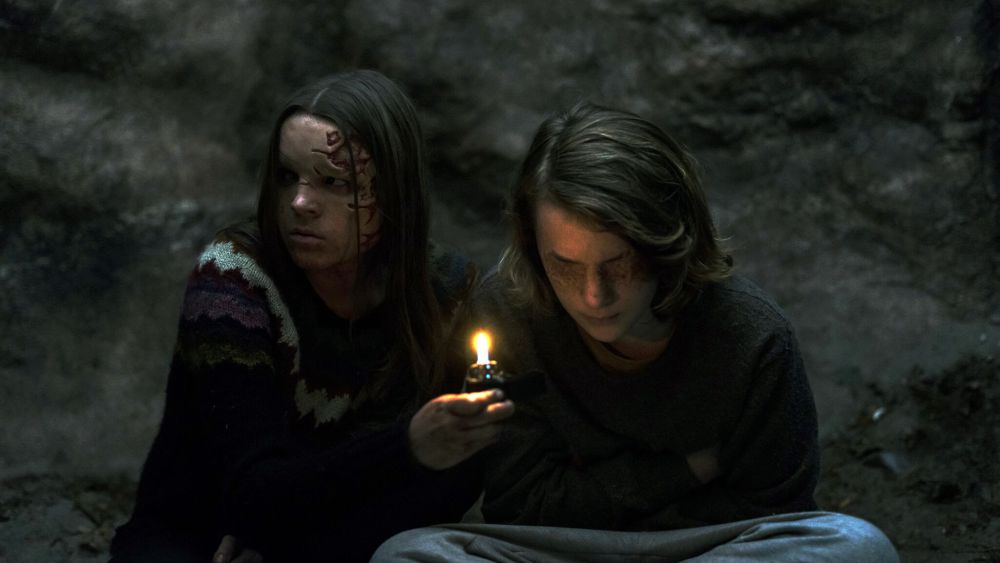
The blandly titled The Dark is, at its heart, a guide to overcoming trauma. Nadia Alexander is Mina, the creature that haunts Devil’s Den—a merciless, relentless, thoughtless killer. Until, that is, she comes across Alex, a blind young man (Toby Nichols) who reminds her of what she once was and what could have saved her.

Lange makes a series of clever narrative choices besides simply using our preconceived notions to surprise us. The Dark is, in part, a vengeance fable far less preoccupied by punishing those who do damage than those who should have been there for protection.

Alexander impresses as the beast unhappily and involuntarily rediscovering her humanity. Her silences, particularly in later scenes, are haunting.

As her mirror image and polar opposite, Nichols embodies vulnerability and resilience. There’s an optimism alongside a brokenness in his performance that is both necessary and heartbreaking.

The Dark occasionally skirts mawkishness, but what YA film doesn’t? In truth, Lange doesn’t run from the baggage associated with his chosen genres. He embraces it, forgives it, makes something powerful out of it.

Drive Safely

Green Book

by Hope Madden

What have the Farrelly brothers been up to?

Well, one of them (Peter) just updated Driving Miss Daisy. Nope, it is not a provocative but good natured spoof. It is Oscar bait.

The director and co-writer penned Green Book, a road picture telling the true tale of 1960s musician Dr. Don Shirley (Mahershala Ali) and Tony Vallelonga (Viggo Mortensen), the New York City nightclub bouncer Shirley hired to drive him throughout his tour of the deep South.

It’s a nice story, buoyantly directed. It’s another odd couple, two people with nothing in common who learn a lot from each other. And it’s hard to pick apart a true story for being so achingly convenient.

The film, co-written by Vallelonga’s son Nick, owes what artistic success it offers to two strong central performances.

Ali and Mortensen are veteran actors who just do not ever give an inferior performance. They are both excellent, always, and Green Book is no different. Their rapport and chemistry are the stuff of movie magic, and it is a joy to ride along with them.

Credit Mortensen for making more of Tony than a working class cliché, and to Ali for finding so many layers in what could have been a one-dimensional character. In his hands, Don Shirley is not simply the high class genius Tony first sees. Ali finds more in the character even than the lonely outsider Tony comes to understand. In Ali’s hands, there is a level of otherness, isolation and loneliness that borders on masochism, and it makes for a far more fascinating and far less knowable character.

Little else onscreen suggests layers.

Green Book is a film that tries very hard and wants so badly not to offend. Yes, the unlikely duo faces some challenges on their journey, but honestly, their struggle—indeed, everything about the movie—feels easy. Neutered.

Equally problematic is the point of view, which is, of course, the white male lead’s. It’s his lessons we’re really interested in, right? And he learns to have deep sympathy for Dr. Shirley.

But that is the primary problem with Green Book. It sympathizes greatly, but has absolutely no idea how to empathize.

Merry, Indeed

Robin Hood

by Hope Madden

Hey, do you guys remember Guy Ritchie’s King Arthur? I mean, of course you don’t. It made like $9.

Had it been anything other than a global box office disaster, a likeminded retooling of the British legend of Robin Hood might have made sense. And yet, here we have it: a poor man’s Guy Ritchie (Otto Bathurst) trying to anachronism his way through the old bandit’s tale.

Taron Egerton stars as the Hood, billed by imdb as “a war-hardened Crusader” but coming off more as a precocious 12-year-old. He’s joined by battlefield adversary and post-war comrade John (Jamie Foxx), who insists on calling him English regardless of the fact that they are in England and, you know, every single person is English. (Let’s not even talk about his accent.)

Eve Hewson and Tim Minchin round out the merry band as the politically liberal/inappropriately dressed Marian and the only actor who doesn’t embarrass himself, respectively.

Ben Mendelsohn shoulders the evil Sheriff of Nottingham duties this go-round. If you only know Mendelsohn from Ready Player One, Rogue One or Dark Knight Rises, please believe me when I say that he needs to stop playing scenery-chewing baddies. He is one of the most versatile and talented character actors in film today. Please go watch literally anything else he’s ever made. (Give yourself the gift of the Aussie film Animal Kingdom.)

Writers Ben Chandler and David James Kelly blandly reimagine Robin of Loxley’s origin story, casting aside any historical authenticity in favor of hip fun. Tragically, the result is never hip and rarely fun.

The film details some ludicrously debauched ties with the church and a global plot to bilk a few hundred peasants of more money than the whole of England would possess. Where do all those golden bowls and goblets come from? How many peasants are dining so flamboyantly?

They also reach to give the sheriff some Trumpian moments, though that backfires as well. As fine an actor as Mendelsohn is, it is tough for him to come off as a dumb ass.

The score feels cribbed, the action is video-game superficial and the costuming came directly from Forever 21.

Why did they make this movie again?

The Unchosen One

The Front Runner

by George Wolf

The Front Runner closes with Gary Hart (Hugh Jackman) dropping out of the 1988 Presidential race with a dire warning: Beware the day we elect leaders we deserve.

The film’s previous 110 minutes operate on the premise that day has come, pinpointing Hart’s very public fall from grace as the three watershed weeks that made it possible.

Hart, the Colorado senator who had been a surprise runner up to Walter Mondale for the 1984 Democratic nomination, emerged four years later as the assumed nominee and betting favorite to be the next President. But then, angered by questions about his marriage, Hart famously challenged the press to “put a tail on me, you’ll be bored.”

So they did, and they weren’t.

There was that yacht named Monkey Business (I swear, kids, look it up), the affair with Donna Rice, and damaging photos with another not Mrs. Hart. And before you could say “Dukakis” without laughing, we got President George H.W. Bush and a journalistic landscape that’s never been the same.

That’s more than enough meat for director Jason Reitman to chew on, and he gamely tries to balance all the ethical questions that remain startlingly vibrant today.

Should serious journalism embrace tabloid fodder? Are politicians entitled to private lives? Whose responsibility is it to hold powerful men accountable for their treatment of women?

Reitman, who also helped screenwriter Matt Bai adapt his own best seller All the Truth is Out, taps back into much of the groove that made his Thank You for Smoking such a mischievous treat.

The dialogue is fast and smart, often evoking a more easily digestible Aaron Sorkin. Salient points are made and then rebutted through the precise timing and intricate blocking of an outstanding ensemble (including greats such as J.K. Simmons, Vera Farmiga and Alfred Molina) that serves up indelible characters with relative ease.

Jackman is flat out terrific as the natural-born politician (“his hair alone is worth 6 points, 4 if it’s windy”) who could not, and would not, accept that the press were no longer giving men like him free passes.

Hart used his fame when it suited him and railed against its trappings when it didn’t. Jackman, in a thoroughly realized performance, is able to unveil this hypocrisy subtly enough to keep the authenticity of Hart’s political convictions uninjured.

The attention to narrative ebb and flow is detailed, becoming an absorbing dive into a historical clash of idealism, self-interest, and morality that seems almost quaint today. But strangely, it finds a depth that feels intentionally cautious, and the film never pounds a fist toward any viewpoint of its own.

Is that layup designed to encourage our own conclusions?

Maybe.

But Hart’s warning closes the film for a reason, and The Front Runner, much like the man himself, might have cut even deeper with more courage alongside those convictions.

I Can Has Sequel?

Ralph Breaks the Internet

by Christie Robb

Movies with an abundance of pop-culture references run the risk of dating themselves well before they’re released. Ralph (John C. Reilly) and Vanellope (Sarah Silverman) from 2012’s Wreck-It-Ralph stride directly into that potential minefield.

The film opens as playable racer Princess Vanellope von Schweetz has an existential crisis wondering if there is more to life than looping the same levels of her game, Sugar Rush, every day and drinking root beers with Ralph at Tappers every night. When her hero inadvertently breaks her game, the duo head off into the internet in search of the part they need to fix Sugar Rush and secure Vanellope’s monotonous future at the Litwack Family Fun Center & Arcade.

And, it’s…fine, I guess.

Flocks of blue Twitter birds soar over Google’s skyscraper and Amazon’s distribution center. Folks with signs pop up, baiting others to click on their content. There’s a search bar that’s kind of an actual bar, and there’s a whole Snapchat area off in the distance. But the film has none of the bonkers creativity of Sausage Fest’s imagined grocery store and more or less comes off as designed by an intercompany team of Silicon Valley marketing executives.

A fundamental misunderstanding about how eBay works results in Ralph and Vanellope needing to come up with $27,001 for the part they need. Now it’s a question of how they get rich quick on the Internet.

This leads to Vanellope’s discovery of Slaughter Race, a gritty, open world driving game a la Grand Theft Auto that becomes her happy place. And Ralph becomes needy, clingy, and self-destructive, refusing to let his best friend move on as he hustles for cash by making viral videos on a site called BuzzTube. This part drags as it trots out references to past time wasters like Chewbacca Mom, hot pepper challenges, and screaming goats.

Honestly, easily the best part of the movie is when Vanellope wanders over to the Disney website and hobnobs with the princesses while evading some Stormtroopers. It’s 10 minutes of Disney patting itself on the back for its ownership of a ludicrous amount of intellectual property. But it’s fun, creative, and silly in a way the rest of Ralph Breaks the Internet is not.

There’s a much better movie here that I hope is in the works.

What we get with Ralph is a pretty movie with some great voice acting that’s got enough detail in the background to make you smile. But it’s the kind of amusement you’ll probably forget about soon enough, like planking, Keyboard Cat, or Doge memes.


Cheap Tricks

Fantastic Beasts: The Crimes of Grindewald

by Hope Madden

People really miss Harry Potter.

Maybe they miss the romantic notion of outsiders among outsiders, or the oh-so-earnest world of good versus evil. J.K. Rowling enchanted a generation with a densely populated world of magic and mayhem and an awful lot of people long to go back. So many, in fact, that they will mostly settle for the sloppy bastard Fantastic Beast series.

It is still Rowling’s words, after all—the author pens the screenplays, inviting us back into that wizarding world, albeit about a generation or two earlier.

Fantastic Beasts: The Crimes of Grindewald picks up six months after its blandly likeable predecessor, 2016’s Fantastic Beasts and Where to Find Them. Odd duck Newt Scamander (Eddie Redmayne) is banned from international travel by the Ministry of Magic. Grindewald (Johnny Depp) is in prison. Credence Barebone (Ezra Miller)—who conveniently survived what was clearly his death in the previous effort—wants to know who he is and where he belongs.

The second installment opens well, offering more vitality, thrill and sinister mayhem than you’ll find in its predecessor’s full 133 minutes.

Redmayne is as adorable as last time. Depp brings something seductively sinister to the role. And Rowling’s clear distaste for leaders who bang the drum for racial supremacy and fear mongering is both understandable and nicely executed.

David Yates returns to direct his sixth Potter-verse flick. He finds opportunities for the visual flourish that was the only true strength of the first Fantastic Beasts film, but manages far stronger narrative momentum this time around.

All of which really only leads to the frustration of realizing at the 134-minute mark that this film doesn’t end. In fact, the last scene is basically the beginning of the movie. The 130- minutes previous basically amounts to exposition that sets up the next film.

Which is funny, since the previous entire film amounts to little more than a preface to an actual narrative.

Characters are quirky, wardrobe is glorious, Ezra Miller broods well—all of which is a lot of what we’ve already seen. What Grindewald doesn’t offer is anything new, or any reason to care.

Outlandos D’Amour

Border

by Hope Madden

Sometimes knowing yourself means embracing the beast within. Sometimes it means making peace with the beast without. For Tina—well, let’s just say Tina’s got a lot going on right now.

Eva Melander is Tina, a woman resigned to the solitary existence of an outsider. Her “chromosomal malady” has left her unbecoming to most of the people in her Danish border town, but it’s also gifted her with senses that allow her to notice criminals by the way they smell.

Those senses are thrown, though, by a stranger (Eero Milonoff) who makes her feel, for the first time in her life, that she’s not alone.

Border director/co-writer Ali Abbasi has more in mind than your typical Ugly Duckling tale, though. He mines John Ajvide Lindqvist’s (Let the Right One In) short story of outsider love and Nordic folklore for ideas of radicalization, empowerment, gender fluidity and feminine rage.

The result is both a sincere crime thriller and a magical fantasy. A perfect meshing of Michael Pearce’s 2017 indie Beast and Alex van Warmerdam’s dark 2013 folk tale Borgman, Border still manages to be entirely its own creature.

Melander is a force of nature under impressive prosthetics. Her fearless performance, one that requires an arc that feels simultaneously backward and progressive, guarantees that no matter the bracing images or ugly narrative, you will not look away. You won’t be able to.

Milonoff also impresses, as does a cast of support players blessed with an unusual and fittingly untidy storyline.

There are moments in Border that should have felt silly while others could easily have tipped into lurid territory, but they never do. Abbasi’s respect for his characters keeps even the most outlandish scenes on track. He boasts an impressive aptitude for blending a fantastical fairy tale nature with the realism of a thriller without ever losing one thread for the other.

The result is a film quite unlike anything else, one offering layer upon provocative, messy layer and Abbasi feels no compulsion to tidy up. Instead, he leaves you with a lot to think through thanks to one unyieldingly original film.

I Don’t Want to Go Out—Week of November 12

Wow, a lot of movies worth passing on available this week. But is The Meg the kind of fun you want to unwind with at home? What about Mile 22—that can’t be all bad, right? And what the hell is Alpha?

Let us walk you through it.

Click the film title for the full review.

Alpha

The Meg

Mile 22

Here and Now

Screening Room: Whos, Whys, Webs, and…What’s In the Basement?

Join us in the screening room as we rate The Grinch, Girl in the Spider’s Web, Overlord, Can You Ever Forgive Me? and everything new in home entertainment.

Listen to the full podcast HERE.


