Tag Archives: entertainment

Consider the Monarch

The Favourite

by Matt Weiner

Greek auteur Yorgos Lanthimos is someone you might charitably describe as “uncompromising.” His last two English-language films include a dystopian romantic comedy and a revenge thriller rooted in Greek mythology. So it is both a delight and a relief to see in The Favourite that Lanthimos at his most accessible is also his best yet.

The story for The Favourite was originally written by Deborah Davis, later joined by Tony McNamara but with no screenplay credit for Lanthimos—a rarity. The film covers the later years of Queen Anne’s reign, during which the War of the Spanish Succession and political jockeying in Parliament are tearing the indecisive, physically frail queen in multiple directions.

But the men of the court are little more than foppish pawns. The real palace intrigue takes place between court favorite Sarah Churchill, Duchess of Marlborough (Rachel Weisz) and her new maid, Abigail Hill (Emma Stone), daughter to a once-prosperous family that has fallen on hard times. Sarah and Abigail vie for Queen Anne’s affection and behind-the-scenes power, although those two things are entangled together to varying degrees for Sarah and Abigail.

The Favourite might be dressed up as a period piece, but it’s not a demandingly historical one. Lanthimos admits to taking significant poetic license with the relationship and events between the three women. The effect isn’t just practical (although this should come as some relief if, like me, you were dreading a Wikipedia deep-dive on Whiggism).

It’s also an avenue by which Lanthimos can smuggle in his trademark eye for the very contemporary and very weird, cruel ways we treat each other. And in this area, Lanthimos has cast the perfect leading women to keep up with—and even rise above—his vision.

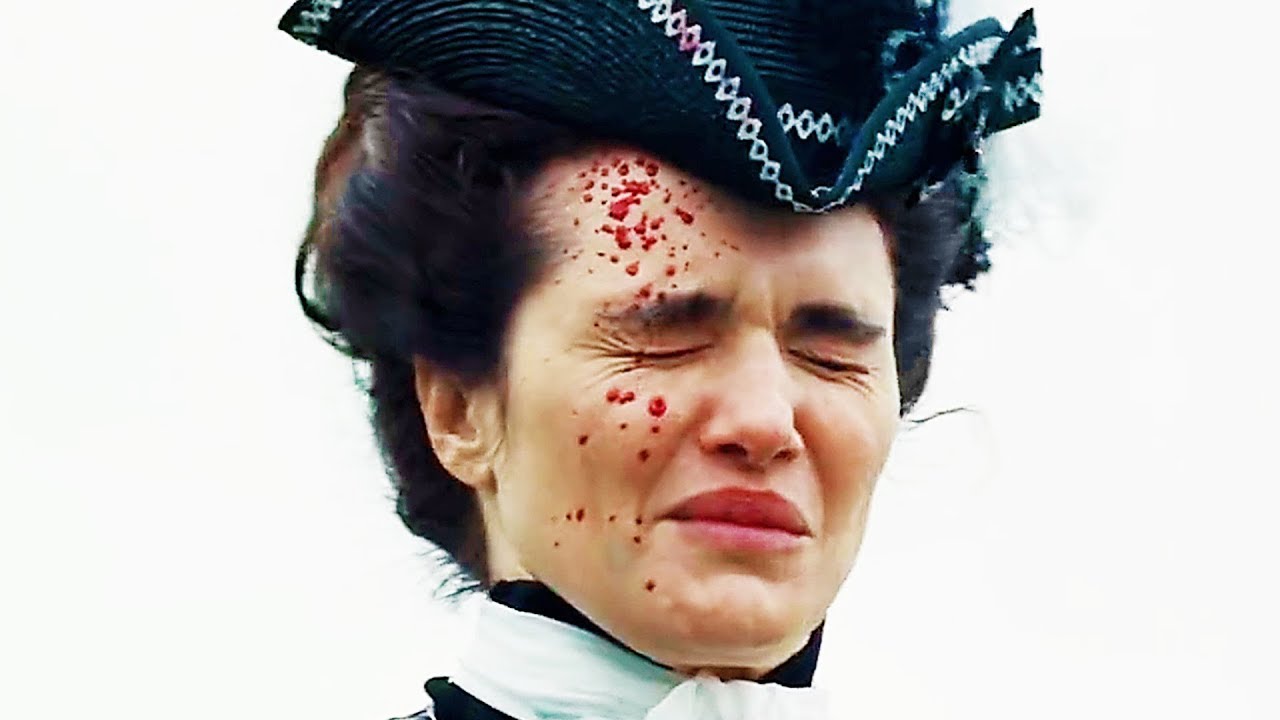
Stone and Weisz play off each other to perfection, with pitch black verbal volleys that threaten to turn as deadly as the war taking place beyond the mannered confines of the palace. But it’s Olivia Colman who dominates every scene, which is all the more impressive for her mercurial take on the physically deteriorating Queen Anne. Colman brings a measure of sympathy to Queen Anne that transcends what could have been played for easy mockery, and she deserves every award coming her way this year.

Lanthimos and cinematographer Robbie Ryan (American Honey, Slow West) keep the camera movement as brisk as the dialogue. The film’s frequent and disorienting use of fisheye is a recurring signature, but even the more conventional wide shots manage to combine a palatial sense of openness with Lanthimos’s signature creeping, queasy dread.

It felt strange to laugh out loud so much during a Lanthimos movie, especially with the undercurrents of violence and misanthropy that stalk The Favourite. Maybe it was the irrepressible performances from the leading women. Or maybe lines like “No one bets on whist!” are just inherently funny.

Whatever the reason, this deadly serious comedy of manners is among the director’s—and the year’s—best.

Stage Mother

Vox Lux

by Hope Madden and George Wolf

No doubt you’re hip to the talent of Natalie Portman.

But if you only know Brady Corbet as an actor (Funny Games, Melancholia, Simon Killer), or maybe don’t know him at all, get to know Corbet the visionary filmmaker.

Corbett writes and directs an astute and unusual pop ballad about celebrity—American celebrity, at that.

Vox Lux opens in 1999 as young Celeste (Raffey Cassidy, The Killing of a Sacred Deer) and her high school class are visited by a disgruntled young white male. Corbet’s camera plays with the horror of the scene as it dawns on those in the classroom as well as the audience what is about to happen.

As Celeste heals from a bullet to the spine, she and her older sister Eleanor (Stacy Martin) work through their collective grief and trauma by writing a song, which Celeste later performs at a memorial vigil.

Thanks to the astute strategy of a no-nonsense manager (Jude Law) and straightforward publicist (Jennifer Ehle), the song becomes a healing anthem and Celeste—her protective sister at her side—is launched into pop stardom.

Corbet’s chaptered “21st Century Portrait” (the proper subtitle to his film) offers infrequent omniscient narration from Willem Dafoe, a glib narrative device that’s part “Behind the Music” and part sociological commentary. Tragedy is commodity in modern America, a fact that can only mean more tragedy.

When the timeline shifts forward and Portman takes over in the lead, we see a new character fully formed from years of living that are only hinted at. Celeste is now a veteran megastar with a daughter of her own (also played by Cassidy) and strained relationships with everyone around her.

Portman’s performance is such an all-in tour de force it effectively divides the film into parts: with and without her. She commands the screen with such totality you’re afraid of what Celeste might do if you dare to shift your focus somewhere else.

Corbet knows better than to do that. With Portman as a mesmerizing guide, he crafts a fascinating fable with two uniquely American pillars – gun violence and celebrity culture. Vox Lux is shocking, funny, sad, and haunting, with plenty of visual flourish and even some new songs by Sia.

It’s a statement, and coming from a relatively unknown writer/director, a pretty audacious one.

Keep ’em coming, Corbet.


https://www.youtube.com/watch?v=dolxUIZzb3w

I Don’t Want to Go Out—Week of December 10

Bunches and bunches of options for home viewing this week. Oscar hopefuls to definitely-not-Oscar-hopefuls, take your pick. But let us help you out, will you?

Click the film title for the full review.

Colette

The Equalizer 2

Smallfoot

Lizzie

https://www.youtube.com/watch?v=qwgtDHISXtQ

Peppermint

Screening Room: Calm Before the Storm

It’s a great week to take a break from Hollywood bombast and invest in something independent. In the podcast this week we break down Tyrel, Maria by Callas and Divide and Conquer: The Story of Roger Ailes. Plus, a few quick thoughts on the Golden Globe nominations before heading out to the lobby to sort through new releases in home entertainment.

Listen to the full podcast HERE.

Ailes über Alles

Divide and Conquer: The Story of Roger Ailes

by Matt Weiner

The two most arresting interviews in the new documentary Divide and Conquer: The Story of Roger Ailes don’t involve any surprising new reveals about the Fox News media mogul himself. But it’s no accident of archival footage for director Alexis Bloom to let clips of Ailes, Bill O’Reilly, Matt Lauer and Charlie Rose hang on the screen just a few beats too long.

In July 2016, Ailes resigned from the network he built due to sexual harassment allegations, including those from high-profile current and former Fox News anchors. It would be another year before Me Too crystallized as a movement, but Bloom convincingly frames the rise and fall of Ailes within this broader national reckoning.

Ample time is given to Ailes’s accusers. Their stories are powerful, and serve as a constant reminder that the tragedy of these harassment incidents aren’t the “great men” we lose but rather all the potential talent that was silenced or forced to leave the industry too soon.

The most refreshing part of Bloom’s perspective is that it means we’re subjected to a surprisingly little amount of armchair analysis. A few of the industry talking heads wonder about the paths not taken for Ailes, and glimpses of his white picket fence upbringing in northeastern Ohio certainly fit neatly within his guiding ethos for Fox News as a revanchist counterweight to supposed liberal anarchy. But these tangents either slip away quietly or are forcibly punctured by the reality of his legacy. It’s a satisfying irony to see Bloom take control away from Ailes and his persona, even posthumously.

If the broad outlines of Ailes as both kingmaker and mythmaker are familiar territory in Divide and Conquer—from his prescient television savvy with Nixon up through the perfect singularity Fox News achieved through its fusion with Donald Trump—Bloom makes a good case that this story is still vital. And, for better or worse, unfinished.

That a paranoid old ogre could have built any world he wanted to with his boundless talent is about as nice a sentiment as the film can coax from his former colleagues. But so what? Ailes is dead now, and can only look up at the rest of us as we figure out how to live in or fight against the world he created.


A Star Is Spun

Maria by Callas

by Christie Robb

It’s an ambitious project to document the life of an international celebrity almost entirely in her own words. And that’s the task undertaken, not entirely successfully, by director Tom Volf in Maria by Callas.

The life of the mid-century opera singer is captured primarily through taped interviews, diary entries, letters to friends (read by the opera singer Joyce DiDonato), and, of course, recordings of Callas’s phenomenal performances.

We see the polished surface of a star born to humble beginnings in New York who rose to command stages across Europe and the Americas. It’s almost two hours of sweeping updos, elaborate costumes, chic evening wear, dripping jewels, swaddling furs, impeccable makeup, and pristine manicures.

Volf tracks Callas’s career from the 50s through the 70s, and lingers on close ups of Callas’s arias. She’s a waif—all bouffant hair, expressive eyes, and bird-like bones. You wonder how such a big voice can possibly come from such a tiny frame. She’s magnetic. Passionate. Commanding.

The singing is interspersed with autobiographical tidbits provided by Callas. But these are only sketches. Although she states again and again that she would give up her career to raise a family and it’s clear that at some point around her late 20s or early 30s she got married, the first time she utters her husband’s name in the documentary it’s to discuss their impending separation. We are left to wonder how genuine she is in saying that she’d give up her career for domestic life and how much she felt compelled to say that, given the prevailing gender norms of the years in which she was famous.

Much of the autobiography portion is consumed with Callas’s operatic 10 plus year affair with Greek shipping magnate Aristotle Onassis, which occurred both before and after his marriage to Jackie Kennedy. Through interviews and letters you can see Callas’s attempt to put a positive spin on what must have been quite a tumultuous relationship. Even while he is pulling away from her, Callas writes to a friend, asking for agreement on how he has changed for the better.

The final moments of the movie show Maria kicking back in Florida. Her hair is down for the first time. She’s wearing loose lounge wear instead of a corseted bodice. Her hair flows down her back, and she’s sporting thick glasses that magnify her myopic eyes. It’s clear how much effort has gone into the package of the public Callas persona.

The contrast between the woman and the artifice would have been more effective with a bit more exposition. It’s an admirable goal to have Callas in control of her own narrative, but to do so leaves out information that would be helpful to provide context to this life. For example, Maria’s rivalry with an older sister who was considered to be the pretty one in the family. The scandalous headlines. The qualities of her vocal talents. The year Maria decided to lose some weight mid-career and lost nearly 80 pounds. How the weight loss may have contributed to her vocal decline. How her changing voice impacted her attempted late-career comeback. Without the biographical backstory, the documentary seems too surface level.

If you don’t know a lot about Callas, do your research beforehand and come for the music and her arresting performances.

I Don’t Want to Go Out— Week of December 3

It’s a big-ass week in lounge around in your jammies movie watching. For some of these, you will want a very large TV.

Click the movie title for the full review.

McQueen

Mission: Impossible—Fallout

Operation Finale

The Happytime Murders

The Nun

Fright Club: Menstruation in Horror

Only Women Bleed? Sunday Bloody Sunday? Let It Bleed? What song would we have chosen to open the new podcast? There are more possibilities than we might have imagined—in song and in film—as we celebrate the monthly curse with a talk about the best horror movies concerning menstruation. Do you have the stones to listen?

5. It Stains the Sands Red (2016)

We open with some impressive aerial shots of the smoking, neon ruin of the Las Vegas strip. Cut to another gorgeous aerial of a sports car zipping up a desert highway. In it, a couple of coked-up strip club lowlifes, Molly (Brittany Allen) and Nick (Merwin Mondesir), are escaping to an airfield where they’ll meet with other lowlifes and head to an island off Mexico.

Naturally, this isn’t going to work out. But what co-writer/director Colin Minihan has in store will surprise you. He’s made a couple of fine choices with his film. The point of view character is not only an unlikely protagonist – an unpleasant thug with a drug habit – but she’s also female.

Soon the car goes off the road and one meathead catches her scent, and suddenly Molly’s stripper shoes are not her biggest problem as she faces a 30-mile trek across the desert to the airfield.

What develops is an often fascinating, slow moving but relentless chase as well as a character study. With a protagonist on a perilous journey toward redemption, It Stains the Sands Red takes a structure generally reserved for the man who needs to rediscover his inner manhood and tells a very female story.

Very female. Menstruation and everything.

4. A Tale of Two Sisters (2003)

Writer/director Jee-woon Kim (I Saw the Devil) spins a hypnotic tale of family and ghosts—both literal and metaphorical. Tale of Two Sisters is a deep, murky and intensely female horror.

A tight-lipped father returns home with his daughter after her prolonged hospital stay. Her sister has missed her; her stepmother has not. Or so it all would seem, although jealousy, dream sequences, ghosts, a nonlinear timeframe and confused identity keep you from ever fully articulating what is going on. The film takes on an unreliable point of view, subverting expectations and keeping the audience off balance. But that’s just one of the reasons it works.

No line of dialog, no visual is wasted. The seemingly simple moment of one daughter needing to borrow a feminine product from her stepmother works in a dozen ways: to introduce blended identities, to exacerbate the uncomfortable familiarity, to foreshadow future horror.

Tale masters the slow reveal in large and small ways. Whether you’ve begun to unravel the big mystery or not, Tale always has something else up its sleeve. Or, under its table.

3. Excision (2012)

Outcast Pauline (a very committed AnnaLynne McCord) is a budding surgeon. She’s not much of a student, actually, but she does have an affinity for anatomy. Especially blood. Pauline really, really likes blood.

A horror film focused on an adolescent girl as antihero is likely to involve 1) menstruation, 2) a mom. Excision is no different. Well, it is a little different.

The mom is Traci Lords, in what is certainly her most assured dramatic performance. Her arc is interesting: overbearing and cold and, eventually, probably correct in her unfavorable assessment of her eldest girl.

Writer/director Richard Bates, Jr. takes more of an unusual course when bringing in Pauline’s cycle, though. I’m not sure we’ve seen it handled quite like this before, although to be fair, it’s definitely in keeping with the peculiar and beautifully realized character he and McCord have created.

2. Ginger Snaps (2000)

Sisters Ginger and Bridget, outcasts in the wasteland of Canadian suburbia, cling to each other, and reject/loathe high school (a feeling that high school in general returns).

On the evening of Ginger’s first period, she’s bitten by a werewolf. Writer Karen Walton cares not for subtlety: the curse, get it? It turns out, lycanthropy makes for a pretty vivid metaphor for puberty. This turn of events proves especially provocative and appropriate for a film that upends many mainstay female cliches.

Walton’s wickedly humorous script stays in your face with the metaphors, successfully building an entire film on clever turns of phrase, puns and analogies, stirring up the kind of hysteria that surrounds puberty, sex, reputations, body hair and one’s own helplessness to these very elements. It’s as insightful a high school horror film as you’ll find, peppered equally with dark humor and gore.

https://www.youtube.com/watch?v=Zoa1A987A_k

1. Carrie (1976)

What else? Nobody did moms, the pain of adolescence, the horror of the onslaught of womanhood, or period quite like Brian De Palma’s 1976 original. Is there a more tragic scene? Is there a scene that better establishes a character, a context or horror?

De Palma films the scene in question, appropriately enough, like a tampon commercial, all cheese cloth and beautific music. And then Carrie White (Oscar nominated Sissy Spacek) desperately claws at her classmates, believing she is dying. It’s the most authentic image of vulnerability and terror you can imagine, matched in its horror by the reaction she receives from those she seeks: laughter, mockery and contempt.

Beyond the epitome of adolescent mortification that the scene represents, it also clarifies the unspoken relationship between Carrie and her as-of-yet unintroduced mother, who has never told her teenaged daughter that this was coming.

The result is the ultimate in mean girl cinema and an introduction to a nearly perfect horror film.

Dead on Arrival

The Possession of Hannah Grace

by Hope Madden

Do you ever watch a movie and wonder how it got that elusive green light? I just did.

The Possession of Hannah Grace is not a terrible movie. It’s not a provocative movie, not a scary movie, not a gory movie, not an interesting movie. It’s just not a movie you’ll be able to keep straight a few weeks after you see it. You’ll be combining what few moments you recall with other movies.

You’ll be wondering, was that Hannah Grace, or was it The Last Exorcism? Did that happen in Hannah Grace or in The Corpse of Anna Fritz? Or maybe in The Autopsy of Jane Doe? And then you’ll just forget this movie entirely. It’s been 20 minutes for me and I’m already struggling to recall the bland details.

In a nutshell, Dutch filmmaker Diederik Van Rooijen’s first English language film follows troubled ex-cop Megan (Shay Mitchell) on her first days in her new routine: nighttime morgue attendant followed by an early morning AA meeting with sponsor, Lisa (Stana Katic).

But on Night #2, things go funny as the corpse of a mutilated, burned and inexplicably naked young woman is brought in. Hannah Grace (Kirby Johnson) is not your garden variety naked, contorted, burned corpse, though.

How do you cast this, exactly? “Hey, how would you like to play the title role in my new movie? You will be nude for 90 minutes and you have exactly no lines. You in?”

The jump scare morgue marathon amounts to a long and very tortured metaphor about addiction. Kudos to Van Rooijen and writer Brian Sieve for setting you up for one of two clichéd endings, and then sidestepping both. Too bad they sidestep clichéd endings in favor of nothing at all.

That’s about what you can expect from Hannah: 85 minutes of not too much—not much point, very little action, not a lot of scares and even fewer answers. But it is indeed a horror film that could be completed with three total locations and a cast of about 10, so, you know, why not go ahead and make it?

Wolf Pack Mentality

Meow Wolf: Origin Story

by Rachel Willis

If you’ve never heard of Meow Wolf, an 88-minute documentary about their beginnings may seem pointless, but I promise it’s worth it. By the time the credits roll, you’ll be looking into the price of plane tickets to Santa Fe.

Santa Fe, New Mexico is one of the world’s most vibrant arts centers. Home to hundreds of galleries and dozens of museums, it’s known worldwide for its art markets, events and performances.

And it’s also home to Meow Wolf, an art collective comprising a handful of anarchistic artists who saw too much bourgeois capitalism in the local art scene. Seeking to break away from the idea of art as commodity, these creative individuals banded together to create something new, unique and entirely collaborative.

Using animations, archival footage and interviews with founding members of the collective, directors Jilann Spitzmiller and Morgan Capps create a visually engaging documentary. It would have to be to capture the spirit and brilliance of the art and artists behind Meow Wolf.

The major theme of the film, which is the major dilemma for Meow Wolf, is maintaining artistic integrity while creating a marketable product. From the very beginning of Meow Wolf’s inception, most of the group’s members were opposed to anyone trying to impose too much order into the creation process.

Spitzmiller and Capps document the bitter fights, the fissions within the group, and ultimately, the success when they manage to work together to find common ground. With a collective, each member is involved in the creation process. Each member has a say, and each person contributes to the final product.

Documenting a few of Meow Wolf’s early successes, the film culminates with their most ambitious endeavor: the House of Eternal Return. A 20,000 square feet interactive, immersive art installation, it’s one of the most incomparable and wondrous projects you’ll have the pleasure of viewing from conception to completion onscreen.

That George R.R. Martin of Game of Thrones fame helped fund the project only adds to its charm.

Watching Meow Wolf create ambitious, quirky projects is like watching a great band write game-changing songs. There are tense moments, fights and losses, but when things come together you’ll come as close as one can to true magic.