Fright Club: Dolls in Horror

Hard to believe we’ve been doing this so long and have never gotten into creepy doll horror! Well, with help from our friend Phantom Dark Dave, we do just that. Here is our salute to creepy-ass dolls!

Our focus is on the best movies with creepy dolls (rather than the creepiest dolls themselves), and we have a bunch to cover! Dave brings his list, we have ours, and of course, there are also-rans and left-overs. Take a listen!

5. Dead Silence (2007)

Somewhere between their career-defining Saw and their even leggier Insidious and Conjuring franchises, director James Wan and writer Leigh Whannell dropped a plastic-headed thud with this ventriloquism horror.

It’s kind of a shame because although the story meanders in and out of consciousness, the actual dolls are creepy as hell.

Mary Shaw (Judith Roberts) had all 100 of her “children” buried with her. So why does Buddy keep showing up? And why does Donnie Wahlberg insist on this weird Columbo impression?

No matter. We somehow end up crossing a moat into a gloomy old haunted house filled to bursting with ventriloquist dummies of every shape and description. Dead Silence pays tribute to their own Jigsaw doll as well as that creepy clown in Poltergeist while predicting Goosebumps and Toy Story 4 scares.

Are all those movies better than this one? Yes, but it gets points anyway.

https://www.youtube.com/watch?v=D4lnaNy0nmI

4. Pin (1988)

Who wants something weird? Because, man, does Pin deliver on weird.

Leon and Ursula have always felt close to their dad’s anatomically correct anatomical dummy. Sure, he uses it for doctor’s office stuff (and his nurse uses it as she sees fit!), but to the kids, he’s kind of a member of the family.

He means an awful lot to lonely recluse Leon (David Hewlett), who’s no hit with the ladies. It doesn’t help matters that Ursula (Cynthia Preston) is his favorite lady. I wonder what kind of advice Pin might have? He’s got a real knack with Dad’s nurse…

The point is, people die, people have sex with medical dolls, and Terry O’Quinn (The Stepfather) is again really not showing any natural paternal instincts.

3. Annabelle Comes Home (2019)

Writer Gary Dauberman, who’s penned every installment (as well as It, which seriously amplifies his credibility), takes on directing duties for the first time with the third film in the standalone franchise.

From that opening gag by the cemetery, the movie brings the high-spirited, popcorn-munching goods. It is fun, with generous writing that does not ask us to root against any of the kids, and performances that are far superior to the content. Plus a couple of real laughs, mostly thanks to a randomly hilarious pizza delivery guy.

2. Magic (1978)

Anthony Hopkins has made more horror movies than you realize, and no matter how much you may assume that a ventriloquist horror will be dumb, Magic is actually pretty creepy.

It helps that Hopkins is so effortlessly creepy. It also helps that the film was penned by William Goldman (Marathon Man, The Stepford Wives, All the President’s Men) and directed by Richard Attenborough (Gandhi).

It’s still goofy as all hell. Burgess Meredith sees to that. But Hopkins is fully on board, Ann-Margret was still a dream, and there is just something not right about Fats.

1. Child’s Play (1988)

Let’s be honest, it could probably have been any of the films in the original series, but Chucky had to be on this list. Hell, he had to be #1.

We went with Tom Holland’s original because that’s what it was—original. Brad Dourif and writer Don Mancini evolved the character over the next half dozen installments, but the original benefits from newness as well as Holland’s focus on the peril of little Andy (Alex Vincent). With a maniacal doll on one side and an unrelenting cop (Chris Sarandon) on the other, this kid’s in big trouble.

Still, it all begins and ends with that freckle-faced devil.

Brother’s Keeper

Blast Beat

by George Wolf

The most effective way a film can lead us to look at a complex issue from a new angle – or look at it at all – is to narrow the focus. Introduce the issue through characters worth caring about, and suddenly individuals make the stakes more tangible than memes and hot takes.

In his feature debut, Blast Beat director/co-writer Esteban Arango shows fine instincts for just this type of socially aware storytelling.

It is the summer of ’99, and brothers Carly and Mateo (real life siblings Mateo and Moises Arias, respectively) are spending their last few days with high school friends in their native Columbia. They’re moving to the U.S. with their mother (Diane Guerreo), where they will finally join their father Ernesto (Wilmer Valderrama) and build a new life in Atlanta.

A metalhead who’s also a science prodigy, the older Carly sees the move as getting him one step closer to the Georgia Aerospace Institute, and then to his dream job at NASA.

Ne’er do well Teo, though, feels differently. He’s a talented artist, but only seems happy when he’s acting out to show his unhappiness.

Both Arias brothers are terrific, and it is the strength of their performances that keep the film from collapsing when Arango pulls convenient and predictable pages from the Young Adult playbook. Each brother begins making friends, with Teo remaining the fuckup while Carly poses as a student at the Aerospace Institute so he can audit a class taught by a former astronaut (Daniel Dae Kim).

But when Ernesto is suddenly faced with deportation, and when broken promises and unscrupulous lawyers threaten all the family has planned, the film’s investment in character pays dividends. We’re pulling for this family, and these boys in particular.

The immigration question in America is a messy one. But beneath the heated rhetoric and political posturing are real families with complicated stories. Even in the moments when it chooses well-worn paths, Blast Beat brings that message home.

Fun Bus

Drunk Bus

by Brandon Thomas

When you’re sober, drunk people are annoying. Drunk college students are infinitely worse. But drunk college students on public transportation? The absolute worst. Entertaining, but still the worst. 

Thankfully Drunk Bus leans harder into the entertaining part of the drunkenness, and leaves the annoying portions on the cutting room floor.  

Michael (Charlie Tahan, Ozark) isn’t a college student anymore, but he’s still intimately involved in campus life. See, Michael drives a bus on campus during the late shift. Affectionately known as the “Drunk Bus,” the route typically consists of inebriated students and the more colorful townies. After Michael is assaulted during one of his shifts, his boss hires a tatted-up, punk rock Samoan security guard named Pineapple (Pineapple Tangaroa) to keep the peace. The two men couldn’t be any more different, but they quickly strike up a friendship that leads Michael on a path of rediscovering who he is.

I’m of the mind that a good comedy is typically light on plot. Sure, there should be an overall story being told, but no one is asking for anything as comically complex as Tenet. That being said, Drunk Bus hits the sweet spot for me by being more of a character study that also borders on being a hangout film. There’s situational and physical comedy to be sure, but the majority of the laughs come through the interactions of these characters.

Speaking of characters, there are more than a few memorable ones. Directors John Carlucci and Brandon LaGanke pepper interesting personalities with equally interesting faces throughout the film. The standout being the imposing Samoan, Pineapple. Tangaroa is relatively new to acting, yet he brings a naturalistic charm to the role. He and Tahan find fast chemistry that has to work with as much screen time they share. 

Characters with names like “Fuck You Bob” and “Devo Ted” also charmed me to my core. An elderly character that says nothing but, “Fuck you!” and a middle-aged drug dealer who’s really into Devo might sound one-note – and they are to a point – but they also help define this ridiculously eclectic world the filmmakers have conjured. 

Drunk Bus dips its toe into cliche now and again, but, really, what comedy doesn’t? The strength of the film is its dedication to character and letting those relationships feel real and lived in.

School Daze

Seance

by Hope Madden

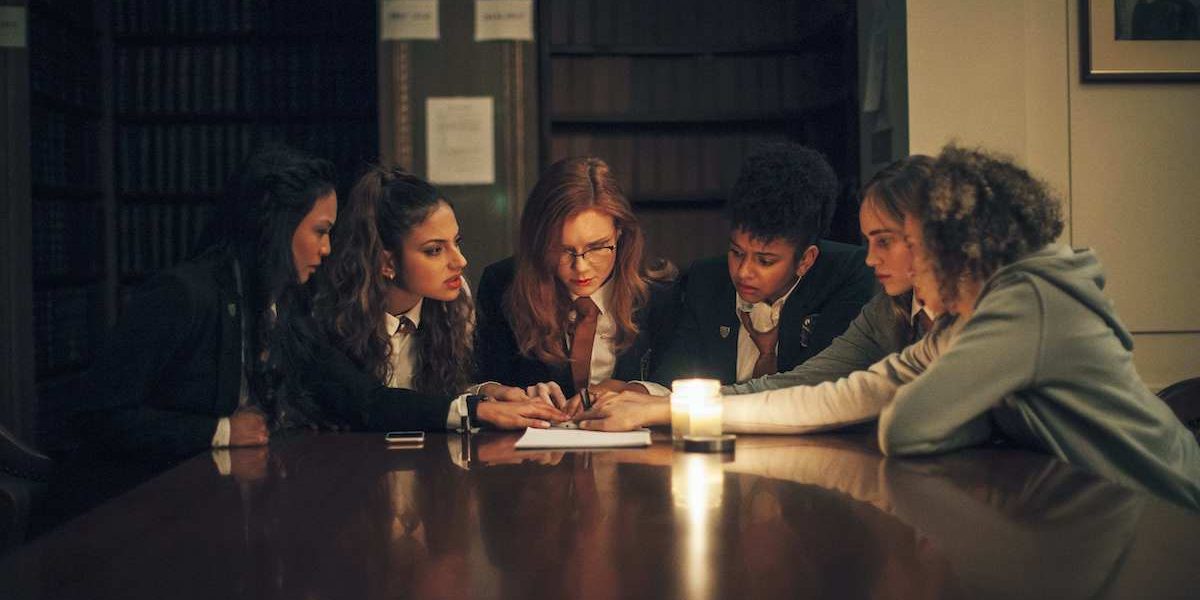
Off in the dusty old Edelvine boarding school, the girls are restless. They need something to pass the time, something to entertain them. They need a Séance.

Essentially, the mean girls gather in a dorm lav and Candyman the school’s ghost—saying her name 3 times at 3:13 am, the moment she died, in the very bathroom where it all happened.

Oooo, spooky!

Well, it’s all just a harmless prank until one of the girls winds up dead. Was it the ghost?

Fast forward a bit and Camille (Suki Waterhouse) arrives to fill the vacant room. More girls go missing or turn up dead in a film that cannot find a way to say anything new. Simon Barrett has written some good stuff: Blair Witch (2016), The Guest (2014), You’re Next (2011), Dead Birds (2004). He had not directed any features prior to Séance, but it’s hard to blame this film’s doldrums on its direction. The story just isn’t there.

Everything feels borrowed, not from any film in particular, but from the collective unconscious of dorm room horror that involves whispering ghosts, nubile schoolgirls, glinting blades and mystery. Barrett’s writing has tended to utilize tropes from the 80s and 90s to lull audiences into a sense of familiarity that allows him to deliver unexpected thrills.

His latest pulls most clearly from 90s staples like the Urban Legend franchise. But when he zigs instead of zags, the lull has turned stupor and Séance’s surprises just aren’t enough to snap us out of it.

Performances are fine, production values solid. There’s nothing embarrassing here, just nothing to get excited about. Some of the film’s sleights of hand are clever enough, but the storytelling is so anemic that it’s hard to applaud them. Barrett generates no dread and no sense of connection to any of the characters.

Unlike Guest’s Maika Monroe or You’re Next’s Sharni Vinson, who command the screen and drive the film, Waterhouse delivers a mainly listless performance. She’s neither scared nor curious, and though her bursts of ferocity feel cagey, it’s not enough to inject the film with any fire.

Cabin. Woods. Uh Oh.

The Retreat

by George Wolf

Does it matter that The Retreat is a “gay” horror film?

Well, no. And then yes.

Renee (Tommie-Amber Pirie) and Valerie (Sarah Allen) are on the verge of making their relationship permanent, but feel like some time away would do them good. The plan is to meet Val’s friends Scott (Turbo Kid‘s Munro Chambers) and Connor (Chad Connell) at a picturesque “gay BnB” for some quiet time in the Canadian countryside.

Or let’s just call it what it is: a cabin in the woods.

Uh oh.

Right, things escalate quickly. Scott and Connor are nowhere to be seen, and with just a touch of contrivance, the girls soon realize they’re being hunted by some sadistic Rambros (Aaron Ashmore, Rossif Sutherland).

From the minute Renee and Val stop for gas, director Pat Mills builds an air of dread and tension minus the usual gimmickry. And once the women are truly fighting for their lives, Mills keeps the adrenaline pumping with a quick pace and crisp editing that helps you forget the distractingly dark tones of the cinematography.

Writer Alyson Richards pens a lean, mean, bloody survival thriller that boasts some welcome surprises and a smart social conscience. Realized via strong performances from Pirie and Allen, Renee and Val’s relationship feels perfectly authentic, with a sexuality that’s never exploited by a leering camera. And while you may be reminded of 2018’s What Keeps You Alive, there is a critical difference.

The couple in that film could have been heterosexual, and it still would have worked. But here, the fact that it is a same sex couple being hunted matters very much to the story at work. It enables Richards and Mills to anchor a revenge horror show with a satisfying metaphor for the violent threats LGBTQ folks continue to face every day.

A big part of that satisfaction is from the blunt force trauma being reserved for the action, not the message. And for those who might be ready to accuse the film of doing some undue stereotyping of its own, take a breath.

A nifty little coup de grace proves The Retreat has seen you coming all along.

Jens Wick

Riders of Justice

by Matt Weiner

Men will single-handedly gun down an entire biker gang rather than go to therapy.

That’s the premise from prolific writer-director Anders Thomas Jensen, where he reunites with Mads Mikkelsen in the dark comic revenge fantasy Riders of Justice.

At least I think this was dark comedy. Mikkelsen stars as Markus, an accomplished soldier who has to return from active duty to take care of his daughter Mathilde (Andrea Heick Gadeberg) after his wife dies in a freak train accident.

Or was it an accident? Fellow survivor Otto (Nikolaj Lie Kaas), an out-of-work programmer, is convinced that he can prove the accident was the work of notorious Danish biker gang the Riders of Justice. He brings in friends and fellow IT outcasts, the extroverted Lennart (Lars Brygmann) and the perpetually bullied Emmenthaler (Nicolas Bro).

Together, the trio enlists the help of Markus as their agent of justice, using a mix of tactics both morally dubious (computer hacking) and sociopathic (Markus quickly amasses a body count that John Wick would envy).

What starts as a straightforward revenge story quickly goes off the rails, but always in truly weird, delightful ways. The violence, once it starts, is swift and brutal. Mikkelsen removes all traces of warmth as the short-fused Markus, with Otto and his friends instead shouldering most of the comedy.

But Jensen isn’t nearly as interested in the physical mayhem as the emotional wreckage his oddball characters are all coping with. Whether it’s Markus and Mathilde working out what it means to be a family with just each other, or Otto and friends learning that not every search for meaning can be solved mathematically, Riders of Justice treats its characters with such forgiving empathy that it’s easy to forget that the group is also almost certainly responsible for the most murders in Denmark since the Vikings.

There’s a moment in the film, while everyone is trying to make sense of their own losses, when someone points out that “Unless you die at a young age, you will end up burying most of the people you love.” It’s hard to imagine a line like that coming up at any point in the Taken franchise. And yet for Riders of Justice, it’s just another observation—punctuated with a bullet, sure, but also a strong commitment to its own madcap existential vision.

Viva Laz Vegaz

Army of the Dead

by Hope Madden

The single best feature film Zack Snyder ever made was his first: 2004’s Romero reboot Dawn of the Dead. (That is my hill.) For that reason (plus my sheer, giddy joy for zombie movies), I was far more eager about his latest zombie installment, Army of the Dead, than in anything else he’s made recently.

Even the title suggested that he was still on the Romero wavelength and, indeed, by his own 2005 Land of the Dead, the maestro of the undead was already dropping us into a town where the Z population had begun to organize.

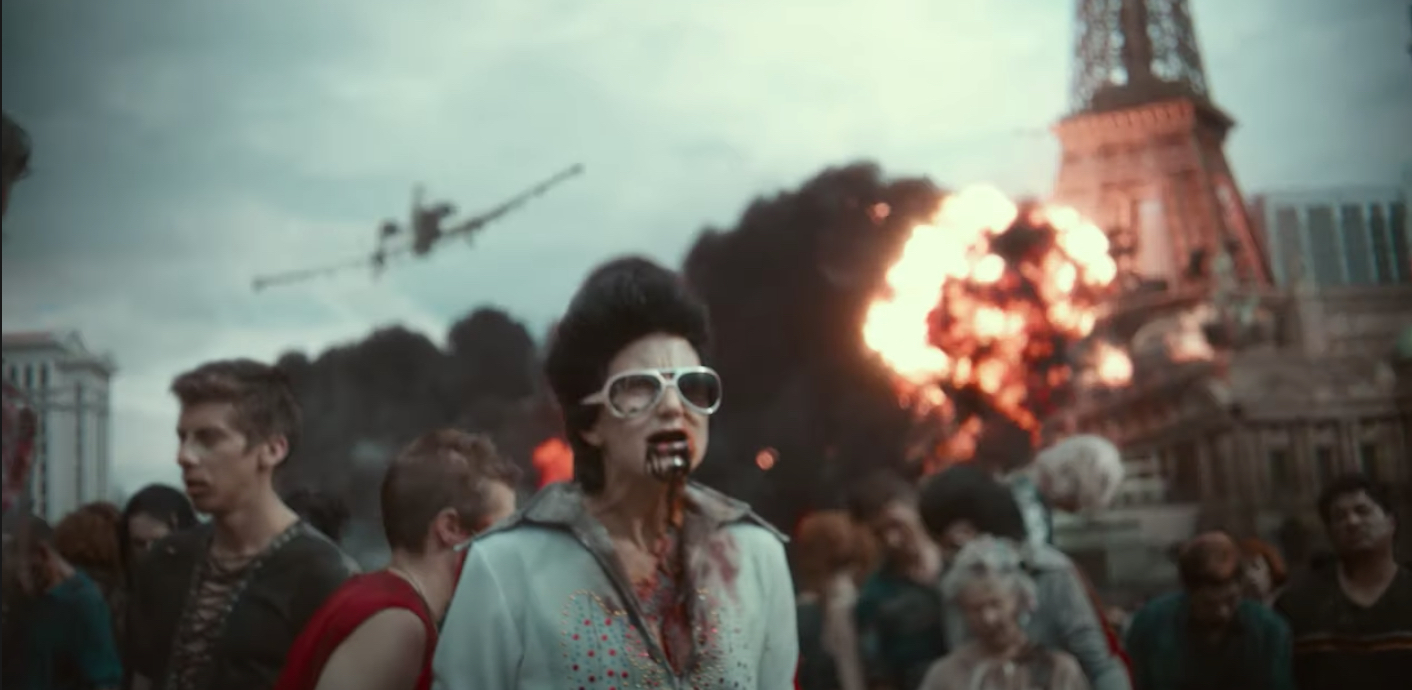
In Snyder’s case, it’s not just any town. We open on the catalyst—a rapid-fire transformation just over the hill from Vegas. Conjuring fond memories of his prior undead flick, Snyder cuts together an excellent opening montage with some inspired musical accompaniment to quickly bring us up to the film’s current plight. (Likely also offering a preview to their upcoming Netflix series.)

Not a moment or line of dialogue wasted. Which is great, because this is going to trudge on for another 2 ½ hours, which is entirely unforgivable for a zombie movie.

How about a zombie heist movie?!

I mean, the zombies aren’t stealing anything, and nobody’s stealing zombies. Instead, some smarmy billionaire (Hiroyuki Sanada) convinces a Z-war hero (Dave Bautista) to get a crew together and head into Vegas to steal a fortune inside his casino vault.

So, Train to Busan: Peninsula. That’s not where Snyder and co-writers Shay Hatten (John Wick 3) and Joby Harold (King Arthur: Legend of the Sword) got all their ideas, though. You will also notice Aliens, The Girl with All the Gifts, I Am Legend, Ghosts of Mars, World War Z, Raiders of the Lost Ark, and just a touch of Danny Ocean.

Still, Army of the Dead would be pretty entertaining if it weren’t so tediously predictable. (That does happen when you borrow so liberally, I guess.) Tig Notaro’s a fun piece of miscasting as the wise-cracking chopper pilot, Matthias Schweighofer delivers a bright performance (though it does feel as if it is part of another film entirely), and it’s always a delight to watch Garret Dillahunt weasel his way through a role.

The whole mess could have been mindless and merry were it not for its bloated running time. (Self-indulgence, thy name is Snyder.) It still delivers the goods here and there, but it won’t stick with you.

Do It For the Hwyl!*

Dream Horse

by George Wolf

How much of a feel good story is this? Dream Horse is the second film to tell it in just the last five years.

2016’s Dark Horse introduced it as a splendid documentary, with archival footage and first person accounts from the working class U.K. folk who pooled their money to breed a race horse. That horse, named Dream Alliance, become an unlikely winner, ultimately racing for the Welsh Grand National title.

If you’ve seen that doc (and I recommend it), it will come as no surprise that narrative filmmakers are having a go at the tale. I mean, it’s got majestic horses, regular Joes and Jans crashing the owners boxes, triumphant sports moments, and it really happened! Barton Fink couldn’t have cooked up anything more big screen ready.

Director Euros Lyn (lots of TV including Doctor Who) has a terrific anchor in Toni Collette, who stars as Welsh barmaid Jan Vokes. It was Jan’s idea to form a “syndicate” ownership group for a racehorse, leaning on bar regular Howard Davies (Damien Lewis) – a tax advisor with some experience around the track – for backup.

For Lyn and screenwriter Neil McKay (also a TV veteran), the challenge becomes keeping the generic sports cliches from overpowering the moments that transcend sport. And for the most part, they do.

Yes, you’re going to hear swelling music and a dismissive trainer admitting “there’s just something about him…” But more importantly, you see people finding a renewed joy in their very existence – and a touching pride in knowing they were a part of something worthy enough to outlive them.

One of the many joys of Dark Horse was getting to know this colorful gang in person – they are a collective hoot. Collette, Lewis and a solid ensemble bring them all to life in warm and witty fashion, while Lyn earns some bonus points for the refreshing way he brings out the real players for a curtain call.

The best sports movies are almost always about more than the sport. Dream Horse doesn’t forget that. You can bet on it.

*a old Welsh saying meaning doing something for the stirring sensation, fervour, emotion and enthusiasm

Hope Madden and George Wolf … get it?