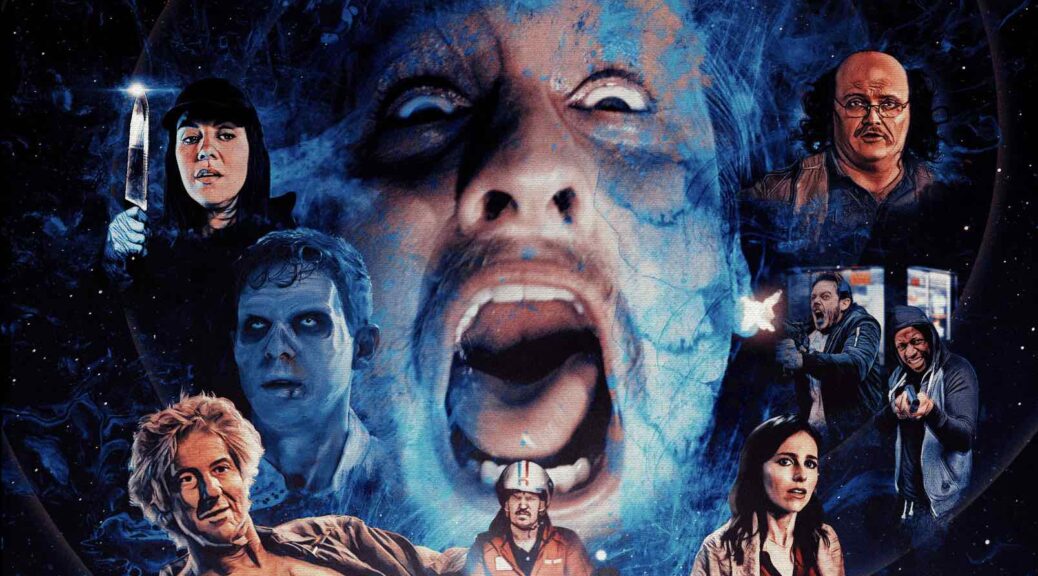
Unusual family dynamics tend to be at the heart of movies made by Adams Family Films, a collective that shares writing, directing, and acting duties.
They’re also a family: co-writer/co-director/co-star/mom Toby Poser, co-writer/co-director/dad John Adams, co-writer/co-director/co-star/daughter Zelda Adams, co-star/daughter Lulu Adams. No word on Cousin It.
The clan’s 2019 horror The Deeper You Digcentered on the bond between mother and daughter, both outsiders in a rural mountain town. The Family’s latest, Hellbender, orbits similar territory.
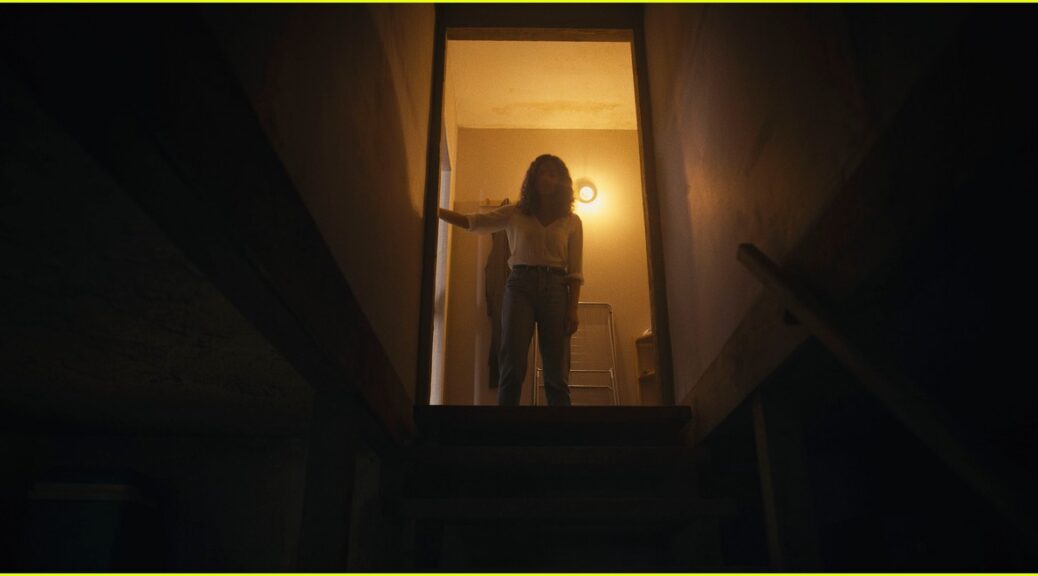
Poser — again cutting an impressive cinematic figure — is a mother who keeps her teenage girl Izzy (Zelda Adams) far, far from prying eyes. The two enjoy each other’s company, even playing in a 2-person punk band (bass & drums, hell yeah!) called Hellbender.
But Izzy is lonely, and she’s beginning to distrust her mother’s claims that illness prevents socialization. Izzy doesn’t feel sick.
It turns out, Mom isn’t trying to protect Izzy. She’s trying to protect everybody else.
A soundtrack full of the band’s music creates an effective atmosphere of rebellion, anger and evil. Zelda Adams haunts the film, a central figure of awkwardness and naivete blossoming with power.
There’s barely another face onscreen and even fewer behind the camera. Aside from Trey and Samantha Lindsay, who pull crew duties, every role from costume design to sound, editing to cinematography to music is handled by a member of the family.
They are impressive. Hellbender looks great. It sounds great. The story is fluid and creepy, punctuated with psychedelic carnage and informed by lived-in relationships.
A muddy backstory and slight anticlimax keep the film from utterly beguiling, but the coming-of-age center impresses. Hellbender delivers a moral ambiguity that questions society’s fear of female power.
The Adams Family doesn’t represent a gimmick or a “good for you for trying” brand of filmmaking. These people are the real deal and I look forward to their next effort.
“Hey, Bruce Willis, how many movies do you have coming this year?”
“Yes.”
In the month or so since the last Willis project with writer/director Edward John Drake – American Siege– was released, I’ve learned of the term “Geezer Teaser,” which is a perfect summation of how this genre usually operates. An aging star is featured heavily in the marketing, while their tangential character often just disappears midway through the film due to the star’s 1-day shooting schedule.
The good news for Gasoline Alley is that Willis hangs in ’til the end, and it’s clearly the best of the Willis/Drake collabs.
Luke Wilson joins in this time as well, playing Detective Vargas to Bruno’s Detective Freeman, and these two guys have four big problems. The bodies of four dead hookers have turned up, and a lighter found at the scene leads the two cops to Gasoline Alley, the L.A. tattoo parlor of ex-con Jimmy Jayne (Devon Sawa). Jimmy was also the last person seen with the dead hooker named Star (“If you forget it, just look up”), but do you think Jimmy’s going to sit back and just accept being framed?
Damn right he’s not. He’s going to let Willis and Wilson (Willison!) take some scenes off while he conducts his own investigation, sleuthin’ and shootin’ with an ever-present cigarette dangling perfectly from his steely pout.
Most everything about Drake’s films is varying degrees short of authentic. And though Gasoline Alley shows progress, details such as the set design, score and faux news reports still seem carelessly thrown together, which don’t give the forced noir dramatics much of a chance to cast a spell.
But if you’ve seen all of the Drake/Willis (Drillis!) catalog (and this is number five, with another currently in post-production), Gasoline Alley is a pleasant surprise.
Drake’s script (co-written with Tom Sierchio) has moments of self-aware humor – even poking fun at one of his previous films. And while Willis is again on autopilot, Wilson seems to be enjoying the “no F’s to give” attitude of his character, Sawa is commendably committed and Veep‘s Sufe Bradshaw turns in some fine support.
Is it ridiculous, overwrought and amateurish in spots? Sure, but this one is actually watchable.
Set in 1980s totalitarian Czechoslovakia, director Ivan Ostrochovský’s Servants follows teenage Catholic seminarians at Bratislava Theological Faculty. Here even religious texts are prohibited, banned as a threat to state security.
A real-world association of priests outwardly loyal to the Communist leadership, Pacem in Terris, controls the school and works in tandem with the government to uphold the Communist party line. This forces freethinkers who want full access to religious texts to go underground, exchanging books and meeting in secret.
The film starts with a noir-style drive along a secluded road. Eventually, the car parks under a bridge, two men emerge, and a body is dumped from the trunk.
One of the men is a priest, the other a State Security operative. Although they claim the dead man was a victim of a hit and run, it’s clear he’s been brutally tortured to death. The rest of the story is told mostly in flashback and relates the events of the previous 143 days.
Servants is a spare film. Shot in black and white, the camera often lingers—the white curl of smoke against a black background, the security operative’s bleak little apartment, overhead God’s Eye shots of the seminary boys playing in the courtyard, or agonizing behind the prison bar-like frames of their bunk beds about whether they should collaborate with the government and become informants or put themselves at risk of becoming targets.
A lot of the lingering shows the routine minutiae of life—eating, bathing, practicing a musical instrument, for example. This is in contrast to the oppressive feel of constant surveillance and possible eruptions of violence.
Combined with a very understated score, this illustrates how normalized the culture of censorship and menace became. But it also makes Servants a little hypnotic. It can be easy to let the mind wander to other things. Other banned reading materials. Other stirrings of authoritarianism.
Filmmaker Joe Wright hits and misses, but always with panache, which is why I look forward to each of his films. His take on Cyrano was especially appealing because Peter Dinklage plays the titular poet, and he never misses.
If your only experience with this material is Steve Martin’s 1987 rom-com Roxanne, prepare yourself. Wright’s reimagining is a musical version of Edmond Rostand’s 19th Century play, with an adaptation courtesy of Dinklage’s wife, Erica Schmidt. And it’s definitely not funny.
Originally, Cyrano de Bergerac was a man with a massive nose. Too ugly for his beloved Roxanne, he agrees to feed brilliant lines to the dim-witted Christian so that he may instead woo the lovely lady.
Molding the tale to fit Dinklage is the film’s greatest accomplishment. The brash, angry romantic has never been so heartbreaking or sympathetic, with every flash of pain, indignation and outrage playing across Dinklage’s face. Plus, he can sing!
Wright’s staging sometimes beguiles, sometimes bores. One musical number boasts intoxicating theatricality, the next resembles a seasonal fragrance ad. Still, the set design is astonishing throughout, and there is no denying this cast.
Haley Bennett’s sumptuous Roxanne cannot help but seduce you, while Ben Mendelsohn’s unseemly De Guiche drips with villainy. Kelvin Harrison Jr. brings sincere tenderness to the role of Christian, and the infamous scene where Cyrano speaks for Christian, winning him the first exquisite kiss, takes on a beautiful tenderness thanks to Harrison Jr.’s chemistry with Dinklage.
Schmidt’s script streamlines wisely enough, but something feels unbalanced in the material. The result is unwieldy and messy, though Wright captures a number of remarkable sequences. Every moment between Cyrano and Roxanne is exquisite, and the balance of the cast wrings emotion from each interaction.
Aside from one, the songs by Aaron and Bryce Dressner of The National are forgettable, and the one that does hit feels contextually tangential—as if they had a great song that had little to do with the story, but they wedged it in, anyway.
This new Cyrano is another hit and miss for Wright, but Peter Dinklage retains his crown as the most endlessly fascinating and watchable actor on the screen. He’s reason enough not to miss this movie.
Just like most – if not all – video game adaptations, Uncharted suffers from being driven more by cheat codes than character. And then later when some people you don’t really care about take time for flippant quips while free-falling over the Banda Sea, the stakes are never going to feel consequential.
But if you set all that aside and give in to the brazen ridiculousness of the latest Indiana Jones knockoff, there’s some fun to be discovered.
Tom Holland steps into the adventurin’ boots of Nathan Drake, a wannabe explorer who’s tending bar in New York when he’s recruited by seasoned treasure hunter Victor Sullivan (Mark Wahlberg) for a big score.
Sure, Nathan knows all about the legend of the “biggest treasure never found.” Somewhere there’s about $5 billion in gold that was stashed away eons ago by Magellan himself, and you know what that means!
It means they’re gonna be short one barkeep come Happy Hour, because Nate’s going globetrotting.
Of course, Nate and Sully aren’t the only ones calling for this booty, and in no time they’re battling a familiar mercenary known as Braddock (Tati Gabrielle), the mysterious Chloe (Sophia Ali), and various goons sent by the villainous Santiago Moncada (Antonio Banderas).
Holland proves adept at parkour and trading mildly amusing barbs with Wahlberg, leaving director Ruben Fleischer (Zombieland) to keep his foot on the gas and let the green screen whizzes go to Funkytown.
Not all of that greenery carries ready-for-prime-time polish, but the film’s second half makes sure there’s so much of it in your face you’ll hardly have time to notice.
And if you’re game to keep the brain unplugged, stay put during the credits to notice some extra derring-do that maps out directions for the next Uncharted course.
Smart, whimsical and decidedly analog, Kentucker Audley and Albert Birney’s Strawberry Mansion turns dystopian dreamscape into retro children’s television.
Audley and Birney co-write, co-direct and co-star in this pop-surrealist romance. Audley plays James Preble, mild-mannered government employee. Preble is an auditor for the agency that taxes dreams.
Let’s say there’s a buffalo in your dream. A dream buffalo apparently runs about 5k, which costs around a nickel in taxes. Likewise, a hot air balloon, a flower, a nice view—all of it taxable. But somehow Arabella Isadora (Penny Fuller) managed never to turn in any dream taxes, compelling Prebel to pay her a visit in her titular abode.
Once there, Prebel must work his way through thousands of VHS tapes of Bella’s dreams (rather than the digital downloads that were made legal requirements years ago) to assess back taxes.
Strawberry Mansion tells a story of government overreach, corporate greed and capitalist dystopia. But it spins this yarn of a near-future surveillance state within a weird and charming, vivid dreamscape. It’s Philip K. Dick meets H.R. Pufnstuf. Nostalgia becomes the filmmakers’ escape.
The dream sequences are unpretentious, jubilant nonsense that develop a parallel plotline. Tyler Davis’s cinematography of saturated colors celebrates the childlike tactile quality of the set design and creature design, which are both handcrafted magnificence. Dan Deacon’s evocative score meshes with the directors’ vision to blur the lines between dream and reality, life with death.
There’s a toad waiter, rat sailors, and more buckets of Cap’n Kelly’s Fried Chicken than a person could reasonably consume. Strawberry Mansion’s cynicism butts up against a wholesome romantic nature in one of many ways that the filmmakers’ form perfectly matches their purpose.
Prebel treads in others’ dreams, a voyeur in a nonsense world where nothing makes logical sense, but everything feels weirdly accurate. The same experience waits for the film’s audience.
Dog—the new Channing Tatum film about a former Army Ranger driving cross country with another former Army Ranger, this one an angry Belgian Malinois named Lulu—is not what you expect.
I wish that was a good thing.
Because what you expect is likely not that good to start with: hunky but irresponsible man learning love and responsibility from an anxious but lovable hound. And you do get that. The emotional trajectory of Dog is no more in question than whether the two bedraggled messes will make it on time to their final destination, the funeral of a fallen comrade.
But if you are expecting to laugh, even once, you are in for a surprise.
The film, co-directed by Tatum (his first effort behind the camera), makes a number of weak attempts at comedy. If you’ve seen the trailer, you’ve seen all of them. Not a single one lands, and each supposed joke is so lazy, so telegraphed and tired.
Dog is a road trip film, which is often an excuse to string together random comedy sketches. Sometimes this works (Vacation, The Mitchells vs. the Machines). Usually, it doesn’t. Certainly, Dog doesn’t take advantage of the opportunities for hilarity inherent in the cross-country trip.
But don’t dismiss Dog as simply a decidedly unfunny comedy. Tatum and co-director Reid Carolin, who co-wrote the script with Brett Rodriguez, use the gags as a sweetener on top of a very dark story about PTSD and living with the emotional and physical damage of war.
What lies just beneath the weakly attempted comedy is an incredibly dark film. Not a dark comedy—not by any stretch. Tatum and gang are not going for laughs at the expense of these two scarred veterans and their collective trauma.
Lulu is every embattled, broken veteran and we don’t want anything bad to happen to Lulu. Why, then, are we so careless with our broken and embattled veterans who are not also beautiful Belgian Malinois?
It’s a worthy message trapped in a sincere, tonally chaotic, humorless, lazily constructed mess of a movie. Dog has merit I did not expect going into it. I wish it was a better movie.
Even before the opening credits, The Long Walk (Bor Mi Vanh Chark) is a fascinating film.
The near-future setting that mixes sci-fi, horror and mystery thriller themes is interesting enough. But after a two-year wait for release, it becomes the first Lao film to screen theatrically in the States, as well as the latest project from Mattie Do, Laos’ first and only female director and the only Laotian filmmaker to work in the horror and fantastic genres.
If Do felt any added pressure from all those firsts and onlys, it doesn’t show. She crafts Christopher Larsen’s script into an emotional, compelling and culturally rich tale of life and death and afterlife.
The Old Man (Yannawoutthi Chanthalungsy) sees ghosts. It started when he was The Boy (Por Silatsa) and first encountered The Girl (Noutnapha Soydara) dying on the side of the road.
The ghost of The Girl became a silent friend to The Boy, and now, some 50 years later, The Old Man finds that his spiritual guide can transport him back in time to when his mother was near death from illness.
Alongside The Old Man’s time-traveling quest to ease his mother’s pain, he’s contacted in the present by Lina (Vilouna Phetmany), a woman whose mother is missing and presumed dead. Lina has heard of The Old Man’s psychic abilities, and seeks his help in locating the body so her mother’s spirit can find peace.
Do is in no hurry here, and not interested in clearly marking when the time or narrative thread is shifting. But stick with it and look closely to find another layer revealed that connects past to present in this Loatian village, along with subtle nods to the poverty and governmental policies that are no friend to lengthy life spans.
Ultimately, The Long Walk is more atmospheric than scary, and more enigmatic than thrilling, with even Do and Larsen (who are married) disagreeing over interpretations during a recent Q&A. But give it your time and attention, and the film will reward you with multiple stories in one, inviting you to consider universal themes from intimate new perspectives.
From its unsettling opening moments, Ruth Paxton’s A Banquet sets a tone that never eases. Holly’s (Sienna Guillory) life is certainly never the same.
The event that kicks off the film puts a generational horror in motion that flirts with the supernatural, bringing allegorical focus to the rippling effects of trauma in a family. As a caregiver, Holly likely blames herself for what happened, which makes it harder for her to focus properly on mothering her two teenage daughters, Isabelle (Ruby Stokes) and Betsey (Jessica Alexander).
At first blush, it seems Betsey has the worst of things. Having witnessed the trauma, she’s been particularly needy of her mother’s affection. Or is she hoping to prove to her mother that, indeed, Mom’s love is the cure she’d hoped it might be? Is Betsey trying to prove that to herself?
Or is there some larger force at play, as Betsey claims when she stops eating?
Justin Bull’s screenplay braids ideas associated with this theme of trauma, from anorexia to neglect to guilt and grief and isolation. Details unfold slowly, uncovering lived-in resentments and traumas that heighten tensions.
Paxon sets these ideas loose among an exquisite cast. A brittle Guillory carries the unforgiving emotional complexity scene to scene with appropriate weariness. Alexander brings an enigmatic quality to the role, while Stokes mixes heartbreak with anger to surprising effect.
The great Lindsay Duncan, whose grandmother character haunts the first act and delivers a bracing presence throughout the second, is magnificent.
Paxon’s camera ogles food, which is a trigger in the film, both a tool for caregiving and for Betsey’s rebellion. There’s so much to like about A Banquet — which is why it’s such a frustrating film to watch.
Paxon can’t decide where to take things. She’s filled the screen with exceptional performances, each character exploring fascinating, dark emotional corners. The filmmaker flirts early with body horror, diverts quickly to something more psychological, dips deeply into family drama and never lands on a tone.
This same lack of clarity or commitment begins with Bull’s script, which builds slowly to an energetic if fizzling climax. For all it has going for it, A Banquet answers none of the questions it asks and leaves you wanting.
One of our favorite offshoots of the zombie genre revolves around the worst creatures there ever were: Nazis. Here we dip a toe in Zombie Lake (actually, that one doesn’t make the final list) and talk through our favorite undead SS.
5. Blood Creek (2009)
What would be more compelling viewing than Superman Meets Batman? Henry Cavill’s run-in with a Nazi zombie played by Michael Fassbender. Clearly.
In Joel Schumacher’s Blood Creek, a Nazi scientist finds a Viking runestone on a West Virginia farm, where blood sacrifice turns him into an ageless monster, and a weird, runestoney ritual keeps him bound in the farmer’s basement. That guy – that Nazi zombie – is played by Michael Fassbender. Whose mind is blown?
Cavill comes into the picture when his character Evan comes looking for a long-lost brother. He offers a fine turn full of longing and regret, and Fassbender is mesmerizing. The guy cannot turn in a bad performance. He’s completely feral, totally unhinged. It’s like he has no idea that the movie he’s in is just not good.
4. Outpost (2008)
By 2008, the idea that the Nazis fiddled with occult ideologies in order to create a perfect killing machine was pretty played out in this subgenre. Steve Barker’s Outpost goes one further by embracing both that cliche and a tried-and-true action formula.
Is the result cookie shaped? It is, and yet the film benefits from an ensemble unafraid to exceed expectations and a cinematographer (Gavin Struthers, The Witcher series) who knows how to amplify claustrophobic tensions.
Ray Stevenson (Thor) stars as leaders of a group of mercs hired by a mysterious man to venture into the woods toward an old bunker. No reason to worry! Excellent support from Michael Smiley, Richard Brake and Julian Wadham round out a cast that works the hell out of this script.
3. Shock Waves (1977)
Wait, Peter Cushing AND John Carradine? Plus Nazi zombies? What kind of gift is this?!
Cushing is the SS Commander holed up on a deserted island since the war. He’s not in hiding, necessarily. He’s moored himself there on purpose to save us all from…something worse than Nazis.
Maybe the first Nazi zombie film on record, Shock Waves deserves credit for not only pioneering the idea but also sidestepping what would eventually become cliche. The makeup effects are simultaneously terrible and awesome. And as dumb as much of the script is, director ken Wiederhorn (Return of the Living Dead) lenses some genuinely creepy segments of the troops.
2. Overlord (2018)
Overlord drops us into enemy territory on D-Day. One rag-tag group of American soldiers needs to disable the radio tower the Nazis have set up on top of a rural French church, disabling Nazi communications and allowing our guys to land safely.
What’s on the church tower is not so much the problem. It’s what’s in the basement.
A satisfying Good V Evil film that benefits from layers, Overlord reminds us repeatedly that it is possible to retain your humanity, even in the face of inhuman evil.
Plus, Nazi zombies, which is never not awesome!
1. Dead Snow (2009)
Like its character Erlend, Dead Snow loves horror movies. A self-referential “cabin in the woods” flick, Dead Snow follows a handsome, mixed-gender group of college students as they head to a remote cabin for Spring Break. A creepy old dude warns them off with a tale of local evil. They mock and ignore him at their peril.
But co-writer/director/Scandinavian Tommy Wirkola doesn’t just obey these time-honored horror film rules, he draws your attention to them. His film embraces our prior knowledge of the path we’re taking to mine for comedy, but doesn’t give up on the scares. Wirkola’s artful imagination generates plenty of startles, and gore by the gallon.
Spectacular location shooting, exquisite cinematography, effective sound editing and a killer soundtrack combine to elevate the film above its clever script and solid acting. Take, for example, the gorgeous image of Norwegian peace – a tent, lit from within, sits like a jewel nestled in the quiet of a snowy mountainside. The image glistens with pristine outdoorsy beauty – until it … doesn’t.