Category Archives: Shudder Premiere

Sunglasses at Night

Dark Glasses

by Hope Madden

Giallo is the soap opera of horror, and you have to embrace that to appreciate it. Emotion and drama, tension, fear and sexuality are amped up to a ludicrous degree, with sense and sensibility tossed out the window.

Few have ever done this as well as Dario Argento. I’d argue Mario Bava, but many consider Argento the king of giallo, and with good reason – his landmark 1977 film Suspiria may be the high-water mark for the entire genre. After a decade away from filmmaking in general and longer still since his last giallo, Argento returns to form with Dark Glasses.

Passions run high and bad decisions are rampant as Diana (Ilenia Pastorelli) attempts to evade a serial killer. But wait, it’s more complicated than that! You see, she’s also blind and has sort of kidnapped this kid. It’s better if you don’t ask.

Though the score is not from Goblin, composer Arnaud Rebotini’s electronic soundtrack conjures classic giallo. Indeed, between those recognizable chimes and an early throat severing, you’d think you were watching Argento of old. But the filmmaker does have a couple new ideas in store, and marginally less misogyny onscreen.

Diana’s a harder-edged protagonist than what you find in other films from the Italian maestro. A high-end sex worker, she’s nonplussed about her line of work and disinterested in anyone else’s opinion of it. She’s a peculiar central character and Argento, who co-wrote the script with frequent collaborator Franco Ferrini (Opera, Phenomena), gives her more to do than elude victimization. She develops skills and bonds in the second act that feel reasonable and realistic, sometimes even tender. It helps ground the film in character before those characters step into a den of watersnakes and remind you that you are essentially watching a soap opera.

There are some inventive kills, gore aplenty, and loads of reminders of why Argento has developed such a boisterous following. This is by no means his best film, but it’s by no means his worst, either.

Everyone yells when they shouldn’t yell, everyone pauses when they shouldn’t pause, everyone talks when they shouldn’t talk, but who cares when the blood is this red and free-flowing?

Monster House

Deadstream

by George Wolf

If you’re old enough to remember Al Franken’s “one man news gathering unit” bits on SNL, you’ll get an extra few kicks out of Deadstream, a Shudder original that packs smart, sarcastic, silly and scary into a fun 87 minutes.

Joseph and Vanessa Winter share writing and directing duties, with Joseph also starring as Shawn Ruddy, a disgraced internet personality. After seven years hosting his “Wrath of Shawn” livestream stunt show, Shawn’s trying to win back the followers lost through a series of ill-fated hijinks (such as paying a homeless guy to fight him).

So Shawn figures there’s only way to pull off “the biggest comeback event since the first Easter.” He will confront his greatest fear live on camera.

Ghosts.

Strapping on a Franken-worthy solo streaming outfit, Ruddy begins a live broadcast from inside Death Manor, “the most haunted house in the United States.” Of course, the one man nature of Ruddy’s show means Joseph is the only actor in the early going, and he proves to be a naturally engaging and amusing guide through the possibly supernatural.

Even as the film’s pace moves from calm to chaotic, Joseph gives Ruddy some sharp comic timing, reacting to viewer comments with deadpan asides and his own accidental expletives with pleas of “don’t demonetize me!” Joseph is able to find that middle ground between clueless douchebag and lovable goofball, enough to make gags like Shawn’s cringe-worthy apology for a racist stunt land with a satirical LOL.

And just when you think this premise might be treading water, a Ruddy superfan (Melanie Stone) crashes the live stream to take the fear factor up more than a few notches.

The Winters also handled the film editing, which may be the real MVP. The multiple cuts between Ruddy’s camera, his computer screen, and security cameras in the house often come in a fast, furious nature, but the technical craftsmanship and narrative integrity never waver.

Deadstream is a slick piece of work. It lands solid wink-wink zingers at the expense of both horror tropes and internet culture, while earning the “horror” in horror comedy with some serious haunts in the house.

Log in, and smash that “like” button.

Under the Influencer

Sissy

by Hope Madden

Horror is especially preoccupied with the doppelganger nature of social media – how you can lose yourself in the make-believe world of the “you” you present online. Co-writers/co-directors Hannah Barlow and Kane Senes dig into that duality with their Aussie horror, Sissy.

Sissy – or as she’d rather be called now that she’s a grown up, Cecilia (Aishe Dee) – feels blessed. Thanks to her 200k followers and the products she gets paid to work into her videos, she has a fulfilling life. She is loved. She is enough. She is doing her best.

Maybe she’s not really doing that well, actually. She even hides when she spies her childhood BFF at the grocery store, but Emma (Barlow, who also stars) sees her anyway. She even invites Cecilia to tonight’s big bachelorette party, and tomorrow’s drive out to the country for a weekend-long celebration!

If you’ve seen Bodies Bodies Bodies or, indeed, any horror movie, you know that second part is not going to go well for everyone. Like Halina Reijn’s gruesome comedy, Sissy plays around with genre expectations and spotlights the ins and outs of Gen Z.

Dee works wonders as a woman trying to practice what she preaches, earn from what she practices, and find fulfillment in online followers when friends IRL are less welcoming. The cast that surrounds her is universally strong, each one manipulating the sly, darkly funny script to shock and delight.

Barlow and Senes never entirely abandon the old-fashioned slasher, either. Sissy delivers starling gore FX that feel simultaneously in keeping with the black comedy and somehow too disturbing to fit. Well done!

The filmmakers tease the new terrain of a world populated with virtual personalities. Who’s the good guy? Who isn’t? Is anybody? Sissy doesn’t break new ground here, but thanks to a knowing script and a lead performance that sells itself, you’ll enjoy the show.

Once Upon a Time in Africa

Saloum

by Hope Madden

There is no denying the stylistic mastery of Jean Luc Herbulot’s Senegalese horror Saloum. An opening voice-over describes revenge as a river that eventually drowns you, but a wise viewer will follow Herbulot’s current because this film knows where it’s going even when you don’t.

We open during the 2003 coups in Guinea-Bissau. In an incredible shot down an alley of endless bodies, we first meet three hooded men. These men are mercenaries, Bangui’s Hyenas, and they’ve come to extract a drug dealer from the dangerous city. But his escape goes south and soon Chaka (Yann Gael), Minuit (Mentor Ba) and Rafa (Roger Sallah) find themselves hiking across deserts, boating through winding waters, and laying low in an unusual little hideaway near the delta in Senegal.

Already we’ve gone from war movie to crime thriller to Western, and we’ve barely exited Act 1. Act 2 will float between mystery and revenge thriller before Herbulot finally embraces the supernatural horror we realize has been bubbling just beneath the surface all along.

A trio of fascinating performances keeps your eyes fixed on the Hyenas. Gael’s unreadable, unbreakable smile hides true intentions, charms and terrifies depending on the scene. Ba’s mystic/elder statesman helps the film transition from one subgenre to the next and gives the trio a center. Meanwhile, Sallah’s explosive Rafa is a constant surprise.

Gregory Corandi’s cinematography conjures each new genre beautifully without creating abrupt leaps from one to the next. Colors are amazing, vistas are both beautiful and dangerous, and there’s always movement just beyond where you look. Western slides into thriller, which bends toward horror, the popping action the one constant through the entire running time.

Herbulot splashes his cinematic influences across the screen: Leone, Woo, Peckinpah, Tarantino (whose own style amounts to a concoction of the previous three). It’s a heady mix. It’s not style over substance, although the style does draw attention away from the film’s weaker elements. Instead, it’s the calling card of a filmmaker leaving his mark on genre filmmaking.

24 Hour Party People

Who Invited Them

by Hope Madden

Perhaps the most terrifying horror born of neighborly manners is Michael Haneke’s unnerving Funny Games (either his 1997 German-language original or his 2007 English-language remake). Writer/director Duncan Birmingham doesn’t go that far. What he does is walk a tightrope that’s a little goofier, a little less horrifying, but effective nonetheless.

Margo (Melissa Tang) and Adam (Ryan Hansen) throw a housewarming party. Well, Adam throws it. Margo endures it. She doesn’t honestly know what was wrong with their old neighborhood. It doesn’t help that their 5-year-old has had nightmares every night since they arrived.

Adam invites all his colleagues and bosses, hoping to impress without coming off as douchey. He’s upwardly mobile, although the house —which he got at a steal because of that nasty double homicide—might make them look a little higher up than they really are.

Not that Margo and Adam are the only partiers who aren’t what they seem. That really good-looking couple—the two who look like they just came from a really hip funeral—does anyone know who they are?

Maybe Sasha (Perry Mattfeld) and Tom (Timothy Granaderos) are the neighbors, as they say.

But probably not.

What we can say for sure is that they do not want to leave.

What transpires after all the other guests have gone would be a comedy of manners except that it feels pretty clear that something awful lurks underneath the handsome couple’s evasion and gaslighting.

Birmingham’s film is a mystery of sorts, although you’ll have most of that intrigue figured out pretty early. There is also a subplot about Margo’s friends who are babysitting. This goes essentially nowhere. Worse still, Birmingham rushes Act 3 and leaves you feeling short-changed.

However, that 30 minutes or so that Margo and Adam and Sasha and Tom have on their own gets pretty uncomfortable.

Hansen unveils surprising warmth within the needy, insecure Adam. He and Tang take the married couple in surprising and welcome directions. Mattfeld and Granaderos are drolly perfect as the home invaders masquerading as partygoers who just can’t tell it’s time to go.

A tight script wastes little time and manages to surprise even if you figure out the main mysteries early. Who Invited Them isn’t flawless, but it is an anxious bit of fun.

Turning Different Screws

The Innocents

by Hope Madden

Sixty years ago, Jack Clayton and Henry James mined supernatural terror with little more than the austere atmosphere built in one spooky location and the unnerving creepiness of children.

Sure, the youngsters in writer/director Eskil Vogt’s new Norwegian horror The Innocents look more like the icy blondes of Village of the Damned, but his film shares much more than just a title with Clayton’s masterpiece.

Vogt’s first triumph is his casting. Rakel Lenora Fløttum is Ida, a cherubic blonde 9-year-old idly wandering the tower block of her family’s new apartment. She doesn’t know anyone yet and doesn’t really want to play with her older sister Anna (Alva Brynsmo Ramstad), whose nonspeaking Autism keeps Ida from seeing her as truly human.

As Ida explores the area and the looming forest just beyond, Vogt’s observant camera builds atmosphere and dread. The tower block itself is a menacing presence forever in the background, the trees on all sides penning in these children on the loose.

Unnerving cinematography from Sturla Brandeth Grøvlen (Another Round) makes tiny children appear like playthings in the foreground of towering, watching buildings. Aerials of children on bicycles, their shadows seeming to be moving the bikes, unnerve and beguile.

Slowly, Vogt unveils the reality of the situation. We learn as the children learn, and we take on their curiosity and logic as we do so. Because there are several children in this complex who have some unexpected powers. Anna discovers hers through a little neighbor girl (Mina Yasmi Bremseth Asheim) who can read her thoughts.

Ida learns that her own new friend Ben (Sam Ashraf) may not have the right temperament for his gifts.

What unfolds is an observant and often terrifying origin story of sorts. The Innocents plays like a superhero story told with none of the drama, though an awful lot of horror. These children first thrill as their abilities blossom with camaraderie and commonality. Then comes the tricky test of good and evil.

On display with unblinking eye is the casual brutality of childhood. The Innocents is a film that sneaks up on you, rattles you, and sticks around for a while after the credits roll.

Occupied!

Glorious

by George Wolf

I like to imagine the pitch meeting went something like this:

Picture it: a desperate man, trapped in a remote roadside rest stop with an ancient monster named Ghat.

Who’s playing the monster?

The voice of J.K. Simmons.

Go on.

So our man’s in one stall, with the monster in the other, offering commands from behind a glory hole.

What’s it called?

Glorious.

You’re damn right it is, and Shudder wants it for August.

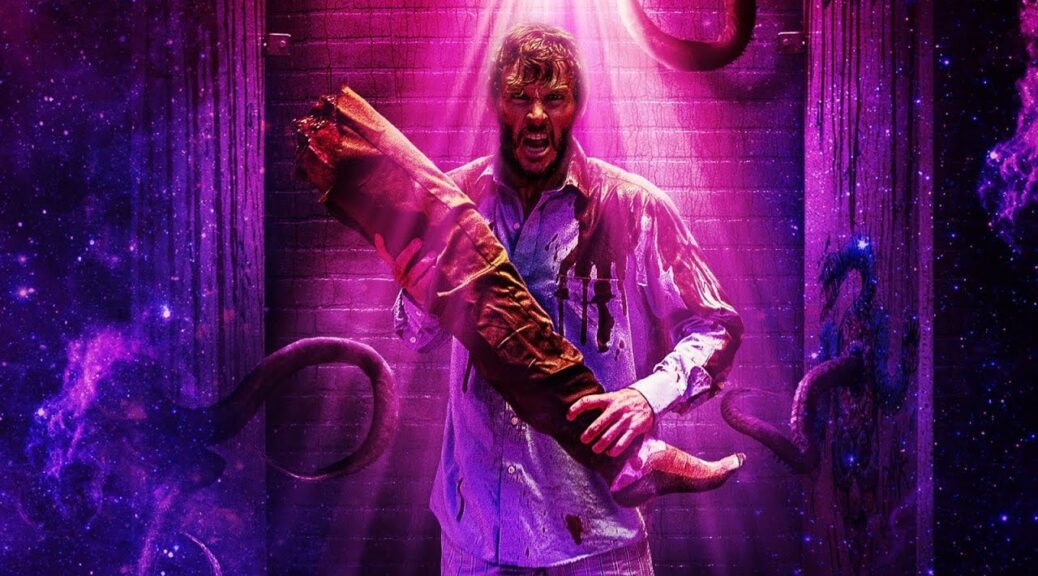
Well now it’s here, and while the downsized cast and location recalls a host of pandemic-era productions, director Rebekah McKendry makes the most of what she’s given. Glorious proceeds at an intriguing pace that never feels sluggish, showing us just enough of the tentacled bathroom beast to strike an effective balance between bloody Lovecraftian spectacle and doomsday humor.

True Blood‘s Ryan Kwanten is perfect as a sad, pantsless bathroom sack named Wes. Screenwriters Joshua Hull, Todd Rigney and David Ian McKendry give Wes a wisecrack-fueled arc that shifts from wallowing in the pain of losing Brenda (Sylvia Grace Crim) to bargaining with Ghat for the fate of humanity (and Simmons, of course, is priceless). While the character is never quite compelling, Kwanten settles in a notch of two below Ryan Reynolds on smartass scale, making it easy have an interest in where Wes’s trippy toilet trip ends up.

And you may catch on early to that destination, but the real test of how Glorious will hit you is how much love you have for Lovecraft. Even if it’s minimal, this is a bathroom break full of squalid, forgettable fun.

Father Knows Best

What Josiah Saw

by Hope Madden

Just when you think you know where director Vincent Grashaw’s Southern Gothic What Josiah Saw is going, you meet Eli.

One at a time, Grashaw introduces us to the Graham children. At first, it’s poor Tommy (Scott Haze), a simple fella living at home with Graham patriarch, Josiah (Robert Patrick). Josiah doesn’t think much of Tommy. He doesn’t think much of God, either, but he’s having a change of heart.

Then Grashaw switches gears and introduces us to Tommy’s brother Eli (Nick Stahl), who lives hard. He’s run afoul of some bad people (including Jake Weber in a welcome cameo) and is in some pretty desperate straits. Finally, we meet sister Mary (Kelli Garner), whose trauma sits far nearer the surface and strengthens our unease about the inevitable family reunion.

The Grahams reunite, drawn by the lure of oil money: the Devlin corporation hopes to drill on their land. The money could mean a fresh start for everyone. But some details need to be handled first.

Moving from story to story, What Josiah Saw keeps you on your toes. Grashaw glides easily from one style to the next, although Eli’s gritty thriller storyline is the most intriguing. It feels more complete, less bait and switch, and benefits from Stahl’s naturalistic, resigned performance.

Not every episode works as well. The stones left unturned and strings left untied from one tale to the next, though, give the film a rich, dark present-day. From the outset it’s clear there’s a traumatic backstory waiting to be revealed, so it’s to Grashaw and writer Robert Alan Dilts’s credit that the messy present keeps pulling our interest.

Patrick delivers a strong turn, mean-spirited and commanding. He’s at the center of the mystery, the center of everybody’s trauma in a film mainly concerned with how you live with the marks left by your childhood.

Ambiguity in the third act is becoming a theme in horror this year. Alex Garland’s Men, the recent stalker horror Resurrection, and now, What Josiah Saw. Sometimes it’s brave to let the audience own the experience and make the call. More often, it feels indecisive or muddy. I’m not sure all the clues are here to help make the determination for What Josiah Saw, but even without proper closure, Grashaw paints a creepy picture.

https://www.youtube.com/watch?v=RJ8vKfzewuk

Sticky Icky

This is GWAR

by George Wolf

“People like getting spewed on.”

True enough.

Back in the early 90s, I tended bar on the Ohio State University campus, at a place right beside a concert venue that Gwar would invade on a regular basis.

I can attest that fans lined up plenty early for a chance to be in the firing line of Gwar’s goo, and the kids poured out at show’s end with fists pumping after another slimy soaking.

But This Is GWAR wants you to know that goo was FDA approved, and the band behind it has traveled a long and sticky road that’s worth a closer look.

Director Scott Barber rolls out plenty of archival footage and first person interviews, taking us all the way back to the band’s creation by a group of misfit artists at Virginia Commonwealth University in the early 80s.

Hunter Jackson and Chuck Varga were art students who were told their fantasy-leaning stuff was dumb, so they planned to make a movie called Scumdogs of the Universe. Dave Brockie was singer and bassist for a local punk band named Death Piggy.

Then they all decided to put on costumes from the movie and open Death Piggy shows as a heavy metal band of barbarians that would sacrifice fake animals…and Gwar was born.

And when that opening band started drawing bigger crowds? Jackson, Brockie and a constantly rotating group of musicians adopted garish latex costumes and names like Flattis Maximus to set off as “barbarian interplanetary warlords” on a quest to search, spew and destroy.

Barber’s approach is well-rounded and determined, looking to put together not only a complete history of the band and the art collective that’s propelled it for decades, but also a tribute that would satisfy longtime fans.

Of course, you’ll find the arcs of excess and conflict that once drove Behind the Music to the heights of cliche, but this isn’t your normal band biopic simply because this band isn’t normal. And even if “the sickest band in the world” isn’t your jam, its history and the circus of talented people that keeps it running is just interesting.

But at just under two hours, the doc’s expanse errs more on the side of Gwar devotees (like Weird Al, one of the famous fans Barber features) than neophytes, and that’s probably as it should be.

Wear that goo as a badge of honor, This Is GWAR and this is for you.

Rattlin’ Bog

Moloch

by Hope Madden

A bog is a nice spot for horror, eh? You think you’re walking along a lovely field when suddenly, you’re sucked in. Like quicksand, only mossier.

Betriek (Sallie Harmsen) and her daughter Hanna (Noor van der Velden) live with Hanna’s grandparents on the edge of one such Dutch mire in Nico van den Brink’s Moloch. A body just turned up out there, perfectly preserved for maybe hundreds of years.

And then another appears. And another. And another—each a female from a different era. The discoveries trigger other unusual behaviors, all of it corresponding with the town’s celebration of an unsavory history.

It sounds a little contrived, a little familiar, but van den Brink’s naturalistic approach to the story offsets any hokeyness. Harmsen’s spooked but reasonable lead makes for a clear-eyed hero, one who rails against her lot in life quietly but surely. Her choices sometimes feel erratic but never unnatural, and the cast around her shares a lovely and reasonably strained chemistry.

All performances are more raw than polished, which amplifies an authenticity struggling to anchor the supernatural elements.

Because scary stories are scarier if you believe them.

Not that the film ignores its spectral side. Ringing bells, musical interludes, moments in an aquarium and other highlights of the film’s sound design lend Moloch a supernatural eeriness that deepens its dread.

Van der Velden shows keen instincts for allowing his tale to unravel in its own time. Close attention to detail allows a rich understanding of the story Moloch tells. Whether you devote that kind of attention to the film or not, Moloch gets its point across.