Category Archives: Shudder Premiere

Cry Little Sister

La Llorona

by Hope Madden

Another timely Shudder original plays upon the madness that can creep into a period of lockdown. The righteous anger of a population, the chanting and signs, corruption in the government—that all seems pretty of-the-moment, too, but this isn’t Portland. This is Guatemala, and if you think the context seems familiar, you should hear the title: La Llorona.

But co-writer/director Jayro Bustamante’s indigenous horror bears little resemblance to Michael Chaves’s middling 2019 effort (which was partly salvaged by a solid-as-always turn from Linda Cardellini). Instead, Bustamante retools the Latin American ghost story of the weeping woman to spin a yarn of righteous vengeance.

La Llorona takes us inside the home of a war criminal (Julio Diaz). El General’s home is on lockdown since his conviction was overturned. Angry Guatemalan citizens, and especially members of the Kaqchikel people most terrorized by his bloodlust, protest outside the door all hours of the day and night.

Inside, the General, his bitter wife (Margarita Kenéfic), their doctor daughter (Sabrina De La Hoz), her daughter (Ayla-Elea Hurtado), and two female servants (María Mercedes Coroy and María Telón) begin to crumble under the tensions.

Bustamante’s film is a slow boil as interested in those who’ve tacitly accepted evil as it is in those who’ve committed it. What goes unsaid weighs as heavily as what happens in front of us. Impressively, this is also the first horror film in decades to make truly effective use of a dream sequence.

The fact that justice, however slowly, comes in the form of generations of women is understated perfection.

Justice springs from compassion, which requires empathy—which sometimes depends upon courage and selflessness. No tears necessary.

Zoom and Gloom

Host

by Hope Madden

It was bound to happen, and no doubt the inanely titled Host is the first in a succession of films to tap into quarantine and pandemic frustrations to fuel horror. The fact that co-writer/director Rob Savage employs found footage for his of-the-moment horror show seems even more obvious.

Sometimes, though, it’s the most obvious choices that work out. Savage taps into the real emotional gap between face-to-face and virtual relationships as a handful of mates jump on a Zoom meeting for a bit if fun.

Separated because of lockdown, the buddies decide to create an event: an online séance. Haley (Haley Bishop) is hoping her friends will be respectful of the medium Seylan (Seylan Baxter), but those hopes are dashed when Teddy (Edward Linard) convinces the group to do a shot every time Seylan says “astro plane.”

“It’s astral plane,” Haley sighs.

Naturally, their irreverence is repaid.

Savage treads the same aesthetic as The Den or Unfriended: Dark Web, but in many ways his effort is even more successful—perhaps because it speaks so articulately to our immediate condition. Host is incredibly simple and spooky in the way that it exploits our isolation and the vulnerability that comes with that.

And while the medium itself is hardly groundbreaking and is sometimes irritating, Savage takes advantage of the limitations of found footage horror. The likability of the characters help you suspend disbelief during the portions where they’d clearly have put down the damn computer, and because the film manages to keep your interest, you get to enjoy the spook house effects. A lot of these jump scares are old school fun.

Lean and mean, running a brisk 56 minutes, the film doesn’t busy itself too much with why or how or really even what. Instead it quickly upends our new normal with old fashioned scares.

In Search of a Purpose

In Search of Darkness

by Hope Madden

The first thing you know about Shudder’s new original doc In Search of Darkness is that it’s an encyclopedic look at horror movies from the Eighties.

The second thing you need to know is that it’s 4 hours and 20 minutes long.

Right?!!

Why filmmaker David A. Weiner decided this had to be a standalone doc rather than a short series is beyond me. Certainly you can (and no doubt will) pause the film and come back to it, which is simple enough to do with Shudder. Still, having devoted about 1/3 of my waking day to a single documentary, I feel as if I should have learned more about Eighties horror than I did.

The bright spots: Tom Atkins is as delightful as you hope he is, as, of course, is Barbara Crampton. John Carpenter and Larry Cohen are as curmudgeonly; Keith David’s saucy baritone makes every anecdote extra fun; Alex Winter makes some interesting connections between films and society at large; and some of the industry insider talking heads seem knowledgeable.

There’s no real rhyme or reason to the specific titles discussed, but more problematic is the superficial treatment of the genre. In four and a half hours, I should have learned something, should have heard of a movie I’d never known about. In Search of Darkness refuses to connect any dots.

Some of the asides about VHS cover art, for instance, are briefly interesting, but other such tangents only emphasize the film’s overall weaknesses. The discussion of the final girl or of gratuitous nudity in 80s horror lacks any kind of insight, but when the piece on horror soundtracks did not mention Goblin, it dawned on me that in early 4 ½ hours, not a single foreign title is discussed.

No Argento, no Fulci, no Deodado – niente.

A ninety minute doc that contents itself with a nostalgic traipse down VHS store aisles would be fun. A doc series that contextualizes the phenomenal explosion in the popularity of horror in the Eighties, digging into sexism, feminism, foreign titles, changing music, the Reagan influence, the impact of VHS and MTV – that would be amazing. In Search of Darkness is neither.

Skin Trade

Impetigore

by George Wolf

In a remote Indonesian village, a garden of small headstones marks the effectiveness of a Shaman’s curse. Newborn after newborn dies, the one survivor growing to endure a mysterious, painful existence.

Creepy, right?

Shudder’s Impetigore scores some definite points there, which help to offset a narrative often hampered by convenience and confusion.

Maya (Tara Basro) and Dini (Marissa Anita) are best friends trying to make a go of it in the city. With no family to speak of, they scrape by with menial jobs while dreaming of a better future.

Though raised by her aunt, Maya learns of a spacious home left behind by her wealthy parents. Maya could very well lay claim to this valuable property through inheritance, so she and Dini make their way to the remote village, unaware of the curse and their place in it.

Writer/director Joko Anwar (Satan’s Slaves), an Indonesian genre veteran, seems to know he’s got some solid benchmarks here while not worrying too much about the strength of what binds them together.

Dialogue can range from awkward to WTF-worthy, amid a few convenient plot turns and one humdinger of extended curse explanation that strains coherence.

But when Anwar hits his creepy marks, Impetigore can leave one. The atmospheric isolation in the village feels authentic, and once blood begins letting, the tension is well-paced, bolstered with some satisfying visual payoffs.

There will be eyerolls, but if you’re keeping score, also enough frightful eyebrow-raising to make Impetigore a winning dive into twisted family values.

https://www.youtube.com/watch?v=2RfEwT2LI2M

The Water’s Not Fine

Lake of Death

by George Wolf

If your experience with Norwegian horror has you expecting Lake of Death to bring on the blondes and the folklore – you’re halfway there. The coifs check out, but writer/director Nini Bull Robsahm trades some homeland roots for flashes of decidedly American inspiration.

It’s a bit curious, since Robsahm (Amnesia) is updating the 1942 novel (and 1958 film) De dødes tjern– which is credited with kickstarting Norway’s interest in the horror genre. Clearly, a cabin in the woods can be creepy in any language.

A distracted Lillian (Iben Akerlie) brings a group of friends and one dog to a remote lakeside cabin for one more getaway before the place is sold. Her gang is ready for a good time, but Lillian is still haunted by the memory of her twin brother Bjorn, who disappeared one year earlier after taking a walk in these very same woods!

One of Lillian’s friends hosts a paranormal podcast, which is Robsahm’s device for filling everyone in on the local legend of the lake. You can get lost in its serene beauty, they say, lose touch with reality, and maybe even get the urge to kill.

Mysterious happenings, paranoia and suspicion ensue, but Robsahm sets the brew on a very slow boil, taking a full hour before we get one well developed visual fright. Lillian’s sleepwalking, hallucinations, and frequent nightmares lay down an overly familiar framework that’s peppered with music stabs and repeated name-dropping of horror classics from Evil Dead to Misery.

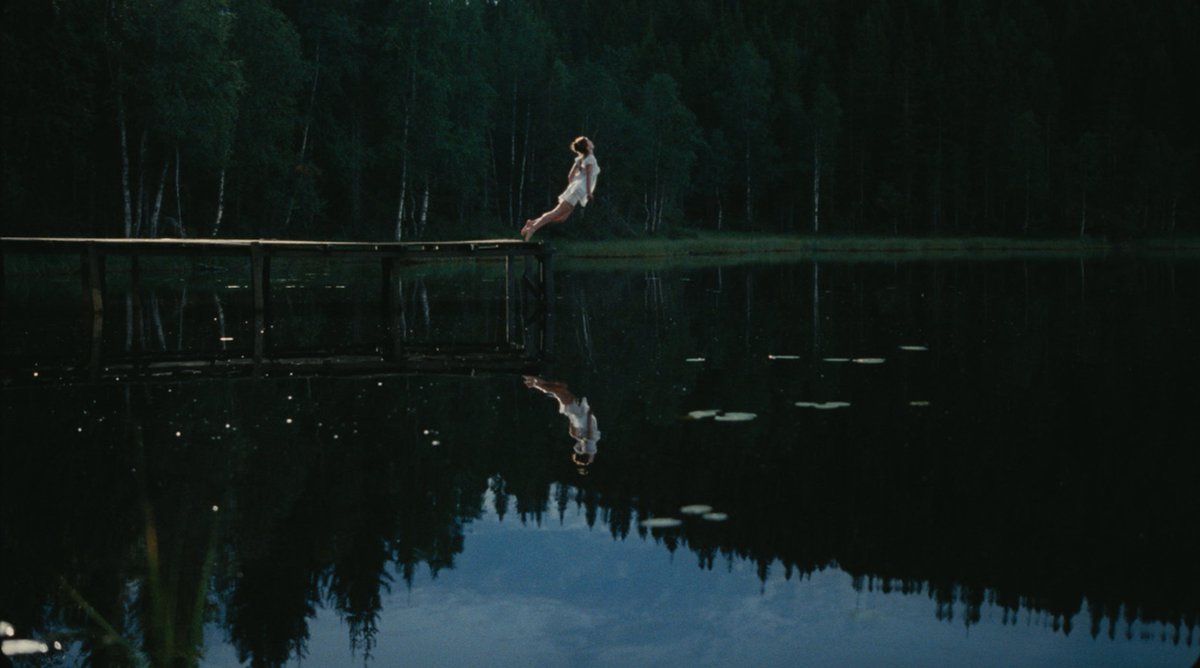
As an attempt to bridge generational horror, it’s all very commendable but little more than workmanlike. Robsahm has better success with her commitment to the lake’s spellbinding beauty, and with her repeated trust in cinematographer Axel Mustad.

Shooting in wonderfully earthy 35mm, Mustad creates a gorgeous tableau of woods and water, evoking the dreamy atmosphere required to cash the check written by the lake’s urban legend.

There may be little that surprises you in Lake of Death, but a sterling partnership between director and cameraman makes sure you have a fine souvenir from the visit.

High Tides and Good Vibes

The Beach House

by Hope Madden

An entitled young man and his put upon girlfriend head to his parents’ unused beach house to work some things out. They’re not alone, and I don’t just mean the lovely older couple who’d already made plans to borrow the vacation home.

Writer/director Jeffrey A. Brown sets up a situation that could go a lot of horrifying ways. He builds expectations and it’s up to you to wait and see which ones the film decides to indulge. The path Brown takes meshes terror and science fiction, beauty and body horror.

Noah Le Gros’s Randall is burdened with the privilege of always being wrong, of always making a mess for others to clean up, of always getting away with a sad-eyed apology but never, ever thinking that maybe he shouldn’t be the one making the decisions. Le Gros does an excellent job with the role – Randall isn’t contemptible, he’s just born this way.

Emily (Liana Liberato) is about to start work on an advanced degree in astrochemistry. Lucky thing, that—one of several conveniences The Beach House needs you to accept. But this budget-conscious indie is worth a little suspension of disbelief because, between the performances and the commitment to genre, it delivers a satisfying thrill.

Maryann Nagel provides a fine performance as Jane, the unsuspecting family friend already vacationing at Randall’s parents’ place. Her arc is terrifying because the performance is so compassionate. Likewise, genre favorite Jake Weber offers a heartbreaking turn as Jane’s beloved Mitch, a look-on-the-bright-side kind of guy who is quickly running out of sunshine.

At just about the time Brown digs in with some nasty body horror, he also starts to squander some of the good will he earned in the film’s early going. The action and anxiety of the last half of the picture rely too heavily on trope: a surprise in the basement, a conveniently placed CB, a timely announcement over an AM radio station.

But Brown and Liberato remain true to Emily’s arc, and that creates an intriguing new look at planetary evolution.

Faces of Death

Metamorphosis

by George Wolf

A deadly curse passed from house to house. A demon that can change identities at will. A young girl possessed, and desperate parents begging experts to investigate. A priest, wracked with guilt, seeking exorcism help from an older mentor. Deadly dopplegangers.

As a patchwork repackaging of several classic horror themes, South Korean Shudder original Metamorphosis (Byeonshin) works better than you might expect. Despite familiar tropes and convenient plot turns, director Hong-seon Kim scores with creepy atmospherics, sympathetic family strife and intermittent flashes of gore.

Gang-goo (Dong-il Sung) can’t believe the deal he got on the new house for his family. No other bids, imagine that! Shortly after move-in, though, the trouble starts with a very noisy neighbor and his alarming tastes in interior design.

But confronting him only brings evil closer to home, and soon Gang-goo, his wife and three daughters are facing increasing threats from each other. Or so they believe.

Turns out Gang-goo’s brother Joong-su (Sung-Woo Bae) is a priest with a tragic past, and he may be the family’s only hope to escape the demonic force that has gripped them.

Director Kim seems unfazed by the script’s lack of originality or moments of contrivance, confident in his ability to find new frights in well-traveled neighborhoods. For the most part, he does, even managing to touch a nerve that resonates beyond the horror genre itself.

Look beyond the inverted crosses, walls dripping blood and one unsurprising twist, and you’ll see Metamorphosis carrying a layer of horror-loving metaphor. We hurt each other in so many ways, and can be easily convinced that hurt is justified, or even divine.

There’s a devil in some of the details here, but the big picture is worthy.

https://www.youtube.com/watch?time_continue=2&v=-CgPzxcRTkE&feature=emb_logo

Nutritious, Too!

Yummy

by Hope Madden

Hey, are you squeamish?

Does Shudder have the movie for you!

It’s hard to do zombies well anymore. Mainly, you have to either come up with an entirely novel concept or hope that the bloody mayhem works in your favor.

In Yummy, the concept is only marginally original, but the bloody mayhem is more than on target. Co-writer/director Lars Damoiseaux assaults your gag reflex with a viscous mess of a horror flick. Blood and entrails, of course, but expect a pretty inspired use of pus, liquid body fat, tendons and other tissues and goos.

It makes for some slick surfaces, I tell you what! Plus some unexpected little monsters keep things interesting and fun.

Set inside a cut-rate Eastern European cosmetic surgery clinic, the film follows a mother, daughter and her boyfriend into a very bad decision. Mom (Annick Christiaens) is after a series of nips and tucks; daughter Alison (Maaike Neuville) wants breast reduction; boyfriend Michael (Bart Hollanders) is just a good dude willing to drive everyone even though he’s afraid of blood.

Here is a ripe premise for horror. Mom is a Cronenberg-esque vehicle for body horror as well as vanity shaming. Alison provides comedic possibilities (no one in the clinic can begin to understand her point of view). Hemophobic Michael offers the clear hero’s arc. (Or he’ll simply die of shock by the gooey second reel.)

And no, it’s not incredibly novel—zombie movies so rarely are. But it’s smart, witty and fun. Damoiseaux accomplishes much with his budget. Practical effects are great, performances are delightful, and nothing beats a little well placed Stooges. (The band, not the knuckleheads.)

Yummy represents Damoiseaux’s feature debut as director and writer, but he’s garnered attention and awards for years with his work in shorts. Award winning co-writer Eveline Hagenbeek (Rokjesdag) channels her affinity for conversational comedy into a script that may follow a familiar structure but delivers a believable, funny edge that the game ensemble takes advantage of.

Their collaboration is no masterpiece, but it is a lot of sloppy fun.

Handle with Care

Scare Package

by Hope Madden

Has there ever been a place as glorious as the video store? The brain trust behind the horror anthology Scare Package clearly understands the secret joys of the independent VHS retailer and their beloved horror wares.

“This weekend is all about no rules, no clothes, and no cell service,” begins Emily Hagins’s surprisingly fresh meta-horror Cold Open. It sets the stage for a really funny way to spend about an hour and 40 minutes.

Chad Buckley of Rad Chad’s Horror Emporium (directed by Aaron B. Koontz) is training a new employee, covering the ins and outs of the VHS game and dodging that creepy regular customer. Periodically we get a glimpse at the store’s rentals, taking shape as the set of horror shorts that make up the anthology.

Chris McInroy’s consistently funny One Time in the Woods plays like a good natured Troma flick. So, it’s a bloody, gooey, gore-soaked, viscera-saturated mess with a bright disposition.

Noah Segan (Knives Out) makes his directorial debut with M.I.S.T.,E.R., which boasts the great casting of Noah Segan (how’d he get him?!) as well as Jocelyn DeBoer (Thunder Road, Greener Grass). You wouldn’t call it inspired, but a nice sleight of hand and one subtly creepy bartender are enough to keep you guessing and entertained.

Anthony Cousins’s The Night He Came Back IV: The Final Kill doesn’t offer much in the way of a fresh perspective and feels especially tame compared to the two other meta-horror episodes in the package. The two shorts that bridge sci fi and horror—Courtney and Hilary Andujar’s Girls’ Night Out of Body and Baron Vaughn’s So Much To Do—don’t answer nearly as much as they ask, but they do keep your attention.

The collection is weaved together with love and a lot of nerdy horror know-how. Was it destined for Shutter? Well, that Jo Bob Briggs cameo couldn’t have hurt.

Scare Package sports an excellent use of budget for a fun, campy set of horror-loving films—the kind of short movies that lovingly mock the genre. Most of the episodes offer a knowing lampooning, and each ends abruptly enough to avoid wearing out its welcome.

Scary Movie: The Movie

Warning: Do Not Play

by George Wolf

Basing a horror film around the “scariest movie ever made” premise is ambitious. Is it smart?

Well, it’s ambitious. Because at some point, you’re going to have to show at least a snippet of this deadly frightening flick your film is referencing, and your audience is already poised to dismiss the impact.

Remember the “killer” tape in the The Ring? We had to see it, and if it didn’t totally creep us out when we did, the entire movie would have crumbled. But that video WAS creepy as Hell, giving The Ring the anchor it needed to stand as one of the best PG-13 horror flicks ever made.

Shudder’s Warning: Do Not Play remembers The Ring/Ringu quite well, building a familiar mystery around some urban legendary long lost film footage.

Mi-Jung (Ye-ji Seo) is a “film festival prodigy” on a two week deadline from a big South Korean studio to come up with a great horror script or she’s out.

She needs inspiration!

Film students at the local university hip Mi-Jung to the legend of a graduation film from years earlier. They can’t remember the title, but it supposedly screened once, with repercussions so dramatic the film was rumored to be directed….by a ghost.

Mi-Jung asks for help in an online forum and is instantly met with an ominous demand to cease the inquiries, which only draws her deeper into the mystery.

Writer/director Kim Jin-won provides some nifty atmospherics in the early going, but little else to demand your attention. While Kim doesn’t rely on cheap jump scares (thank you), he pushes the unreliable narrator trope via enough “waking from a dream” sequences to quickly become tiresome.

But the blood and the body count pick up in act two, as the film adopts some Blair Witch tactics – and openly cops to it, which is nice. Mi-Jung finds herself deep inside the cursed production, and we’re left to sort out the psychological strands of her experience.

The film-within-a-film may never grasp the elusive Ring ambitions, but hang in past the setup and Warning delivers a competent mystery and some fun terror in the aisles.