Category Archives: New In Theaters

Reviews of what’s out now

Original Artist

Love and Mercy

by George Wolf

Love and Mercy is a music biography that doesn’t follow the standard playbook. More abstract than similar films in the genre, its dual narrative approach is not only welcome, but one that feels entirely appropriate for the life involved.

Even if you’ve never heard a note of Brian Wilson’s music, one listen to “God Only Knows,” “Good Vibrations,” “Caroline, No” or countless other Beach Boys classics reveals a musical visionary like none other. His success, and inner turmoil, have both become legend, and director Bill Pohlad utilizes an ambitious script and fine performances to make Wilson’s story resonate with heartbreak and hope.

Rather than a complete overview of Wilson’s entire life, acclaimed screenwriter Oren Moverman (Rampart, The Messenger, I’m Not There) anchors the film around two watershed periods: the late 1960s, when Wilson stopped touring to concentrate on recording, and the late 1980s, when questionable treatment for psychological issues left him an emotional invalid.

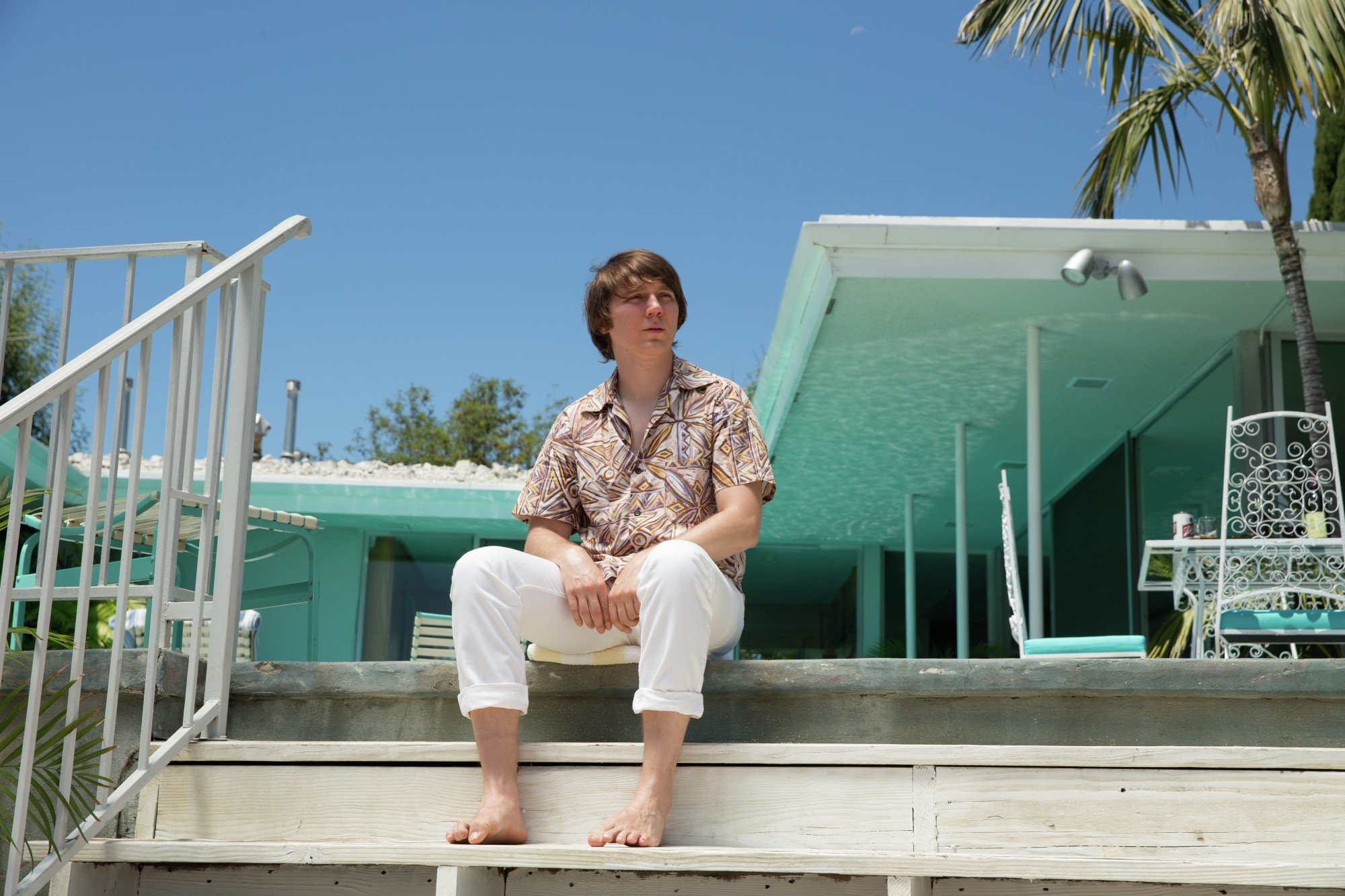
Paul Dano is flat out fantastic as the younger Wilson. Beyond the considerable physical resemblance, Dano is able to mine multiple layers of wonder, inspiration and doubt, as Wilson struggles to follow his vision in the midst of those who can’t understand it.

Pohlad, a veteran producer directing his first film in nearly 25 years, turns to John Cusack for the role of the older Wilson, and it pays off. Though not the physical match Dano is, Cusack nails Wilson’s speech pattern and hesitant gait and more importantly, he projects the weariness of a decades-long torment. Terrific support comes from Elizabeth Banks as the girlfriend who helped Wilson toward a breakthrough, and her chemistry with Cusack conveys a tender desperation.

Beyond some basic introductions of family and band members, Moverman’s script isn’t interested in spoon feeding. A degree in music history may not be necessary, but viewers already familiar with names such as Van Dyke Parks, Hal Blaine and Dr. Eugene Landy (a perfectly slimy Paul Giamatti) will feel even greater appreciation for the film’s disinterest in pandering.

Pohland crafts the studio segments with precision and an eye for detail. Rather than a greatest hits musical revue, we hear segments of the songs as they’re being constructed, and glimpse Wilson’s obsessive innovations in the studio, tirelessly directing the famed “wrecking crew” of studio musicians until he gets the perfect mix.

There are only minor bumps along the way. Pohland is a tad too preoccupied with time stamping via TV news reports and top 40 hits, and really, one closeup of Wilson trying to follow the sounds inside his head is enough to get the point across.

Variations on the Brian Wilson story have been attempted before, but Love and Mercy is an original tune that won’t need to be covered for quite some time.

 

Verdict-4-0-Stars


Bringing Back the Boys

Entourage

by Hope Madden

It’s been more than a decade since Vincent Chase hit LA, buddies in tow, to make it big and reap the benefits of stardom. Writer/director Doug Ellin checks back in on Vincent, Turtle, Drama, E and Ari with the unnecessary Entourage feature.

Now a full-fledged movie star, Vincent (Adrian Grenier) wants something more. Because Ari (Jeremy Piven – still the reason to watch) is no longer an agent but a major studio head, he’s in the position to offer Vincent the opportunity he craves – to direct.

Meanwhile, a Texas oilman’s son (Haley Joel Osment) wants the movie shut down, E’s (Kevin Connolly) sex life is spiraling out of control, newly rich and thin Turtle (Jerry Ferrara) has a crush on Ronda Rousey, Vince’s movie might suck, and Drama (Kevin Dillon) may become Hollywood’s biggest joke.

The fellas’ arrested adolescence feels less forgivable ten plus years on. There’s something sad about 35-year-old skirt chasers. What could once be chalked up to youth and ignorance now looks like stagnation and misogyny.

Returning to the role of a lifetime, though, Piven crushes it. He’s hilarious, horrible, and yet somehow likeable, and his bombast alone carries 90% of the film. Ellin pads that with dozens of cameos, hundreds of bare breasts, countless insider jokes and plenty of camaraderie – giving you basically the TV show on steroids.

A lot of films look at Hollywood from the inside out, only to find something repellant. Entourage isn’t so cynical. The boys from the neighborhood are still geeked to be able to take advantage of every opportunity. Their routine feels pretty stale as they mosey toward middle age, but fans of the series might enjoy this brisk and relatively painless check in.

Verdict-2-5-Stars

Fast Times in Blue Hawaii

Aloha

by Hope Madden

Aloha slips quietly into theaters this weekend. How is it that a Cameron Crowe film starring Bradley Cooper, Emma Stone, Rachel McAdams, and Bill Murray could fly under the radar with no critic screenings and barely a blip of an ad campaign?

Not a good sign.

No, on that cast alone this movie should have worldwide buzz. It should be the movie grown-ups see this weekend instead of San Andreas. Instead it’s an unwieldy, herky-jerky romantic comedy that leaves the romance and comedy behind in favor of goofy mush.

And what a waste of a cast! Hell, the sheer talent wattage nearly salvages the effort. Cooper is reliably compelling as military contractor Brian Gilcrest, a piece of seriously damaged goods with a chance to get back in with the big boys on this trip to Hawaii. McAdams shines as his former flame, and Murray is great as the charming, eccentric, billionaire villain.

Stone, however, drew the short straw with a wholly unrealistic character who’s equal parts Navy hutzpah and dreamy eyed innocent. Her hyperactive Captain Allison Ng, the Naval airman assigned to keep tabs on Gilcrest while he’s in town, rarely breaks beyond caricature and when she does it feels all the more inauthentic because of the broadly drawn comical foil we first meet.

Crowe’s writing is as likeable as ever, leaving cynicism behind and populating his islands with odd but lovable characters. He’s just not making any choices. Is this a romance? Because there’s a love triangle happening here that actually keeps your attention, under-developed as it is. Or is that cast aside in favor of one man’s dramatic attempt at redemption? Because that doesn’t work, either, as Crowe introduces a dark, political storyline that he tidies up with almost laughable convenience.

Crowe’s best work ranks among the better films you’ll ever see, but his last worthwhile film was 2000’s Almost Famous. Since then, his unchecked sense of wonder in the face of a cynical society has overtaken every film, none more so than Aloha.

Although, let’s be honest, it’s better than San Andreas.

Verdict-2-0-Stars

Bad Blue Blood

The Seven Five

by George Wolf

If current events haven’t satisfied your appetite for stories of cops behaving badly, take a trip back to the 1980s with The Seven Five. It’s a sobering look at the man dubbed “the dirtiest cop in history,” as well as the law enforcement code of silence that still appears shockingly prevalent.

Officer Michael Dowd joined New York’s 75th precinct in the early 80s, when the growing crack epidemic sent the crime rate skyrocketing and turned the Seven Five’s territory into what Dowd called “a war zone.” Starting out with the good intentions of a rookie cop, it wasn’t long before Dowd felt underpaid and under appreciated, and had a hard time finding reasons to think his work made any real difference.

The anxiety he felt after taking that first bribe didn’t last, and in the years that followed Dowd became head of the Seven Five’s very own crime family, brazenly involved in burglary, drug dealing, kidnapping and murder.

Dowd was eventually brought down, and director Tiller Russell uses footage from Dowd’s 1993 hearing testimony as an effective bookend to current interviews with Dowd and several of his cohorts. The chill that comes from a younger Dowd testifying that a good cop means “being 100 percent behind anything another cop does” only intensifies when you hear one of his old partners recalling the prevailing attitude of their criminal heyday.

“Prove it. You got me on video? It’s your word against mine, and I’m a cop.”

Obviously, the story crackles with urgency and timeliness, but Russell sometimes get carried away with the Goodfellas nature of it all. Dowd’s trail of lawlessness left countless victims behind, yet Tiller sometimes allows an air of perverse hero worship to creep into the film. No doubt this tale could be worthy of a Hollywood adaptation, but The Seven Five falters only when it gets too caught up in being the trailer for that non-existent film.


Verdict-3-5-Stars


Cups and Quakes

San Andreas

by George Wolf

San Andreas is a film made with the utmost commitment to artistic vision. It is the work of a director fully invested in the task at hand, and confident enough to never waver from the mission. Director Brad Peyton knows what he wants and explores every opportunity to get it in on screen as often as possible.

He wants cleavage.

And if there’s time, some nifty earthquake effects.

He gets both, along with the gun show that is Dwayne Johnson starring as Ray Gaines, an LA firefighter who specializes in helicopter rescue. Ray’s already dealing with his daughter Blake’s (Alexandra Daddario) plan to move away, when he learns his soon-to-be ex-wife Emma (Carla Gugino) is moving in with her uber-rich, ultra douchy new boyfriend Daniel (Ioan Ruffud).

So Ray’s feeling blue, and as he drives away from Emma we see her framed squarely in his rear view mirror. That’s the level of subtlety you can expect from San Andreas:  zero.

Then the big quake hits, and there’s no more time for talk. Ray has to jump into the role of superhero, rescuing Emma from the top of a crumbling LA high rise, and then heading off to go get their daughter in San Francisco. We know this from the number of times one of them looks at the other, pauses, and says, “Let’s go get our daughter!”

The quake is presented in often spectacular fashion, and the effect it has on the buttons of Gugino’s blouse is not ignored, either. Of course, that’s only after she’s spent the required amount of time running in a super tight tank top.

From the opening (and admittedly effective) sequence showing a young girl rescued from a wrecked car, straight through to the rubble-strewn, flag waving finale, nearly every female with a speaking role (and Daddario especially) wears a tight, often wet shirt while being framed at an angle high enough for optimal oogling. Sure, the tight tank is old hat for PG-13 jollies, but even Michael Bay might find this excessive.

Johnson has become a charismatic star, Gugino is always a treat, and the film should get some credit for actually pairing two age-appropriate leads. Paul Giamatti even shows up as a seismologist, but that ultimately just solidifies the point that no amount of acting talent can raise San Andreas much above the mindless threshold of blowing stuff up and catcalling the babes.


Verdict-2-5-Stars


Young Man Goes West

Slow West

by George Wolf

How about a good throwback western?

Slow West is just that. Quiet by summer blockbuster standards, but a solid piece of filmmaking, flush as it is with understated writing, authentic performances and stirring panoramic visuals.

16 year-old Jay (Kodi Smit-McPhee) is a young man on quite a mission. He set out from his home in Scotland, traveling alone across the frontier in 19th century America, with hopes of joining his beloved Rose (Caren Pistorious) for a new life in a new land. But there are complications to this true love story. A nasty bit of drama back home earned Rose and her father a price on their heads, which means plenty of outlaws are hunting them as well.

One of those is the strong, mostly silent Silas (Michael Fassbender). After crossing paths with the naive teenager and hearing his story, Silas secretly thanks Lady Luck and offers Jay a bit of protection on his slow journey to Rose.

Writer/director John Maclean, in his feature debut, taps into the spirit of classic westerns with an impressive level of confident restraint. These themes of innocence amid moral decay, of lost souls seeking redemption, are genre benchmarks, but Maclean knows they can still be effective.

He’s right. His script isn’t wordy, and his camera isn’t showy, but both set a solid foundation to make two outstanding shoot-out sequences that much more effective. Maclean’s instincts for actors isn’t bad either. Smit-McPhee is a believable babe in the woods, Fassbender delivers non-stop steely charisma, and Ben Mendelsohn, showing up midway through the film with an attitude as big as his fur coat, brings a fresh set of questionable allegiances.

Like its characters, Slow West is a film determined to make the destination worthy of the journey. Buoyed by talented actors, pristine cinematography and a filmmaker smart enough to know when less is more, it is.

Verdict-3-5-Stars


They’re Back

Poltergeist

by Hope Madden

Thirty three years ago, Steven Spielberg unleashed two tales of supernatural contact in anonymous, suburban neighborhoods. Things went better for Elliott.

Between producer Spielberg’s sense of awe and director Tobe Hooper’s capacity for imaginative terror, the original Poltergeist far exceeded expectations, and though several sequences have not aged well, it remains a potent horror show.

A generation later, we return to Glen Echo Circle, now the victim of a downturned economy, as are the Bowens. Sam Rockwell and Rosemary DeWitt play the parents unwillingly relocating their three kids to the neighborhood to accommodate their now-more-modest means. Their son Griffin (Kyle Catlett) doesn’t like his room because of the creepy tree outside, but little Maddie (adorable Kennedi Clements) is already making friends.

This is a tough film to remake. The original combined superficial thrills with primal fears and offered the giddy mix of Spielberg’s wonder and Hooper’s twisted vision. Wisely, director Gil Kenan started with a solid cast.

Rockwell is always a good bet and DeWitt is fast becoming the go-to for authenticity in the suburban mom role. Jared Hess offers a little panache as the medium who cleans houses, and the supporting performers turn in respectable work.

Kenan can’t seem to decide whether or not to embrace the original’s more iconic moments, and his revisions feel more like obligation than inspiration. What his version lacks is a big punch. He’s hampered by audience expectation – we kind of know what’s coming, after all – but that doesn’t excuse his lack of imagination.

The director proved a savvy storyteller with his Oscar-nominated animated nightmare Monster House, a film that was surprisingly terrifying for a kids’ movie. That kind of exuberance could have infected this production, but the sequel lacks energy.

Poltergeist is not a bad movie, just disappointing. A lot of reboots are, but there are some that feel like one filmmaker’s love letter to a movie. Films like The Ring, The Crazies, Dawn of the Dead, and more recently, Evil Dead work as reboots because they inhabited an old story but found a new voice. Kenan doesn’t find his. The result is entertaining and forgettable.

Verdict-2-5-Stars

Are We There Yet?

Tomorrowland

by George Wolf

Long before the credits roll, Tomorrowland will have you craving a theme park turkey leg and planning a meet up at Mr. Toad’s Wild Ride.

To be fair, it’s hardly the first time Disney has gone meta at the multiplex. They’ve had recent success with films based on their rides, and films based on their films. Now they’re moved on to an entire section of the Magic Kingdom, so why does it feel like you never stop standing in line?

Mostly, because there’s so much talk and little action.

George Clooney brings his considerable star power to the role of Frank, a former boy genius who was accepted into the other-worldly community of “Tomorrowland” in 1964. Twenty years later, he was exiled, apparently for inventing something that opened an unwelcome Pandora’s Box.

Now, in present day, Frank is convinced to make a return trip after receiving a surprise visit from Casey (Britt Robertson, mugging frequently), a scientifically-gifted teenager who just might be the key to saving the future.

That’s the short version. There are plenty more convolutions, conversations and explanations involved that only mute the magic the film so desperately seeks.

Director/co-writer Brad Bird made his name in animation (The Iron Giant/The Incredibles), but the considerable visual flair he brought to Mission Impossible: Ghost Protocol whet appetites for more live action ventures. Tomorrowland does sport plenty of cool-looking jet packs and rocket ships to-ing and fro-ing, but the film’s pace is slowed to a crawl from the heavy load of exposition. The fun just never has a chance to get airborne.

That’s not the only irony. Tomorrowland‘s message that children are our future is obvious and repetitive, but most likely lost on kids themselves. The little ones won’t keep up and the teens will roll their eyes at the pandering. Everybody else will just fight the boredom.

Verdict-2-5-Stars

https://www.youtube.com/watch?v=lNzukD8pS_s

A Bountiful Harvest

Tangerines
by Hope Madden

It’s 1992 in what had recently been the Soviet Union. The Abkhazians of western Georgia have declared independence and Civil War has broken out. The battle is almost at Ivo’s door, but even as natives kill for the land under his feet, the Estonian immigrant tends the Tangerines. He and a neighbor – also Estonian by birth – hope to harvest the crop before it is lost to the war.

It’s a lovely central image: two elderly men with no dog in the fight working against the clock tending to the region’s natural bounty. Unfortunately, the fight comes knocking. Gunplay between three Georgians and two Chechen mercenaries leaves two wounded men – one from either side of the battle – in Ivo’s care.

Writer/director Zaza Urushadze’s elegant film garnered nominations for best foreign language film from the Academy, Golden Globes and others, and rightly so. His succinct screenplay relies on understatement and the power in silence and in action to convey its pacifist message. The timeless ideas embedded in this intimate setting become potent. While the theme is never in doubt, Urushadze’s unadorned film never feels preachy.

A great deal of that success lies in Lambit Ulfsak’s powerful performance as Ivo. He has an amazing presence, inhabiting this character with weary wisdom. Resolute and morally level-headed, Ivo is impossible not to respect. He’s the film’s conscience and through him we quietly witness a powerful humanity – one that the film would like to see infect us all.

There are three other principals – Giorgi Nakashidze as the Chechen, and Misha Meskhi as the Georgian, and Elmo Nuganen as neighbor Margus. Each brings something muscular but tender to their role. Their work benefits from the dry humor and melancholy tone of Urushadze’s screenplay. The quiet evolution beneath their boisterous clashing feels more inevitable than predictable, which allows Urushadze’s point more poignancy.

We don’t get to see a lot of Estonian filmmaking over here, and that appears to be a shame. Ulfsak was recently named the country’s male performer of the century. It’s not hard to see why.

Verdict-4-0-Stars

Eye in the Sky

Good Kill

by Hope Madden

In 2013, Jeremy Scahill opened our eyes to the darker side of drone wars with his documentary Dirty Wars. Writer/director Andrew Niccol uses a more understated and intimate road to the same destination with his latest effort, Good Kill.

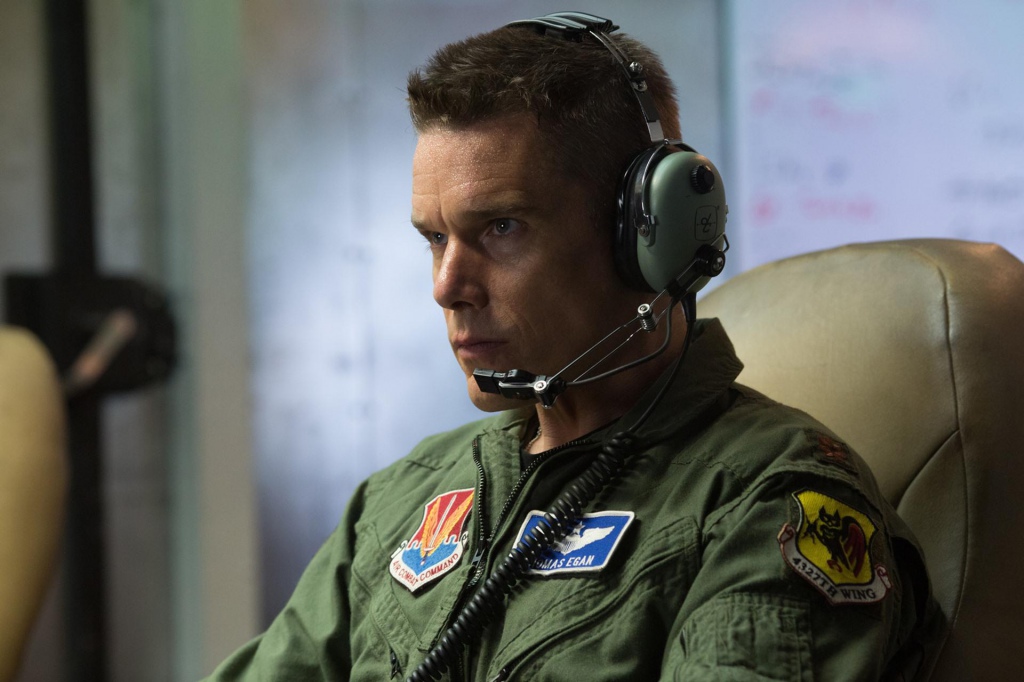
The film follows Tom Egan (Ethan Hawke), a man who flew 6 tours of duty in Iraq and Afghanistan and is now on his third tour in a Vegas cubical piloting drones. From 7000 miles away he watches, then eliminates Taliban threats. Then he goes home to barbeque.

As a writer, Niccol has a long history of mining similar ideas – the alienating power of surveillance as well as the business of war (The Truman Show, Lord of War). He’s on his game here, depositing points and counterpoints in the mouths of the right characters and watching each character evolve as their duties begin to look more like war crimes.

Niccol made some fine decisions as the director as well, keeping the tone understated and the tensions on low boil. He also slyly parallels the aerial images of the Middle East – dry, brown and dusty with neat rows of damaged houses – with aerials of Vegas. Once you get past the glitz and bombast of the strip, the landscape is eerily similar. Not only does this humanize the targets, but it exposes our own vulnerability.

Hawke, hot off a career-best performance in Boyhood, does a stellar job animating a mostly internal character. His struggle feels honest, and on the rare occasion that Tom articulates an issue, his thoughts are enlightening. “We got no skin in the game. I feel like a coward every day.”

Bruce Greenwood, reliable as always, carries a great deal of the weight in the film without ever taking the spotlight. Meanwhile, the great character actor Peter Coyote lends a smarmy, soulless voice as “Langley,” the CIA contact given control over Egan’s unit.

This is a meticulously written script, one that weighs issues without truly taking sides, and Niccol develops a hushed tension that builds to something powerful.

It’s a finely crafted and engrossing film that looks at the effects of a risk-free war from the eyes of one of the warriors being saved from combat. Without beating you about the head with its message, it’s about a lot more than that, too.

Verdict-3-5-Stars