Category Archives: New In Theaters

Reviews of what’s out now

Grasping for Resurrection

Alien: Covenant

by Hope Madden and George Wolf

“Do you want to serve in heaven or reign in hell?”

That’s just one of the big, existential questions Alien: Covenant has on its mind, though there’s plenty of blood as well, for those who thought Prometheus was a bit too head-trippy.

Director Ridley Scott returns to the helm of the iconic franchise he started, proving the years have done little to erode his skills at crafting tension or delivering visceral thrills.

Covenant picks up roughly ten years after the events of Prometheus, and this many sequels in, its inevitable that the franchise would fall victim to formula: a crew, most of whom we get to know only through intercom banter, lands somewhere, picks up an alien (or several), tries to get it off the ship. Quarantine protocol is rarely followed. (It is there for a reason, people!) Folks die in a most unpleasant way.

When Scott made Alien back in ’79, he made a straight genre flick, working from a script by horror go-to Dan O’Bannon. It gave Scott a career, though he didn’t return to the horror game for more than another two decades.

Meanwhile, the franchise took the action path, devolving eventually into the modern day equivalent of Werewolf Versus the Mummy.

Scott redirected that ship in 2012 when he regained control of the series, throwing off any ugliness in the sequel universe by making a prequel – one less interested in monsters than in gods. Prometheus may have been a mixed bag, but if there’s one thing this franchise delivers, it’s a great synthetic. Hello, Michael Fassbender.

Fassbender returns in Scott’s latest, bloodiest Alien effort, and he’s a lunatic genius. Playing both David, the synthetic from Prometheus, and a newer model named Walter, Fassbender delivers weighty lines with tearful panache, becoming more colorful, layered and interesting than anything else onscreen.

Strange then, that his charismatic performance almost hurts the film.

Why? Because we’re here for the aliens!

Yes, it is tough to keep a good xenomorph fresh for eight episodes, and Scott gives it a shot with new alien forms that wade into Guillermo del Toro territory . But there are too many variations, the incubation and bursting process is too expedited, the sources are too numerous – basically, there’s too much going on here and it’s diluting the terror.

And it is terror Scott is going for. There’s more carnage in Covenant than in Scott’s previous two Alien films combined, but he hasn’t entirely thrown the existential crisis overboard. Suffice it to say that we’re lead to a crossroads where a dying species is “grasping for resurrection.”

Scott wants us to ponder those themes of death and creation while we’re running from bloodthirsty monsters. It’s not always a perfect fit, but Alien: Covenant combats the overreach with enough primal thrills to be satisfying.

Verdict-3-0-Stars


The Duality of Man

Buster’s Mal Heart

by Cat McAlpine

“Life’s a riddle” croons the opening song of Buster’s Mal Heart. Hoo boy, it sure is.

At the start, two shadowy figures sit in a small row boat on the open sea. Despite being the first image of writer/director Sarah Adina Smith’s existential delight, this scene is one of the final pieces of the puzzle she creates.

Looking back, the plot is simple, in its bizarre sci-fi short story kind of way. But the resulting film is not simple. The order of events has been jumbled and small interactions are dragged out only to be pumped full of paranoia.

Each moment of Smith’s film is tense, uncomfortable and absolutely lovely. The soundtrack is a character all its own, often transitioning between different covers of the same song as scenes change from one reality to the other. The camera constantly finds an interplay of light and dark, whether bare trees against a winter sky or a glowing TV in a dimly lit office.

Buster’s Mal Heart contemplates the claustrophobia of working a dead-end job inside the machine of modern society, and Rami Malek (Mr. Robot) is the perfect canvas. You can see the quiet rage within him long before he lets it slip. He plays both cautious and wildly consumed by conspiracy with equal commitments. I would’ve watched him sit at his dingy concierge desk for the whole hour and a half.

DJ Qualls (The Man in the High Castle) is not to go unmentioned either, as The Last Free Man. He delivers wild cosmic theories with enough sanity to make them sound almost plausible. And in Buster’s Mal Heart, almost plausible makes the leap to utterly real without breaking a sweat.

This film begs to be consumed as a whole, a new rarity in our distracted age. There is no moment for you to sneak out for a bathroom break or check your texts. Even shots of Buster simply vacuuming the dining room somehow feel important and are key to mood that Smith has crafted.

Imagine the universe. It is impossibly large. Infinitely large. We exist within the universe, and yet have only theories of how it works. Allow yourself to panic at this idea, to become uncomfortable. Allow your own smallness to make your heart race and your brain stutter. Think about the things you do, every day, that have no consequence at all on existence at large.

Now, before you sprint headlong into the woods, go see this movie.

Verdict-4-5-Stars

Betting on the Right Horse

Norman (The Moderate Rise and Tragic Fall of a New York Fixer)

by George Wolf

“What do you need? I’ll help you get it.”

When does Norman Oppenheimer ever sleep? He’s always there in that same coat and hat, stalking New York City for more people to connect, more circles to infiltrate, and more favors to curry.

But beyond mere social status, Norman (Richard Gere) wants to be a part of something that matters, and he thinks he’s finally found it after “betting on the right horse.” In Norman’s world, that means doing a favor for Eshel (Lior Ashkenazi-terrific), a struggling young politician, at precisely the right time.

It takes three years, but Norman’s long shot pays off when Eshel becomes Prime Minister of Israel. Suddenly, after a lifetime of exaggerating his influence and connectivity, Norman really does have a friend in a very high place.

People begin paying more attention to Norman, which isn’t always good news for his powerful friend.

Writer/director Joseph Cedar skillfully creates an utterly fascinating character who maneuvers through an equally intriguing web of politics, friendship and desperation. And Gere, as good as he’s ever been, makes it feel authentic.

Much as Bruce Dern dug deep into the lead role in Nebraska, Gere relishes his chance to flesh out a character as ripe as Norman Oppenheimer. He’s pushy, pathetic and often socially awkward, yet endearing in his tireless quest to seem worthwhile, both to others and himself.

It’s a performance that should not be forgotten come award season, and it anchors a smart, detailed film as compelling as any political thriller, yet as familiar as your last little white lie.

Verdict-4-0-Stars


More Coffee, Marge

David Lynch: The Art Life

by Hope Madden

Filmmaker David Lynch is nearly as enigmatic a cultural fixture as his films. Indeed, as is the case with most of his cinematic output, you might be tempted to assume that his own folksy exterior covers something dark and lurid.

The new documentary David Lynch: The Art Life does what it can to confirm that impression. While it hardly resolves anything in a concrete way, if Lynch’s art imitates the artist, then this film imitates both.

Co-directors Jon Nguyen, Rick Barnes and Olivia Neergaard-Holm recorded Lynch as he mused on childhood stories and the events that led him into the world of art and film. The audio is used to narrate footage – some recent, some archival – working together to illuminate the artist and his work. To a point.

Nguyen, who produced the doc Lynch about the making of the auteur’s 2006 film Inland Empire, has created another appropriately Lynchian film.

Once again there is a sweetness, almost innocence, about the filmmaker that feels wildly at odds with the darkness and macabre of the art we watch him create – and at the same time, seems fitting.

Much of the film is spent with Lynch in his studio as he molds, spreads and sculpts materials for art pieces. His artwork is far more immediately disturbing than his films, which tend to situate the horrifying inside a landscape of beauty. On canvas, the horror is right up front.

The work and process behind it give the film a wonderfully tactile quality and the team of directors frame and shoot the proceedings in a style Lynch himself would appreciate.

The doc takes us through Lynch’s artistically formative years and ends somewhat abruptly around the time of Eraserhead. The goal is not to document his life’s work, nor even to truly shed light on the conundrum of his particular artistry.

Instead it is a fascinating and beautifully filmed piece of what you might expect. You’ll find a lot of cigarette smoke and Coke bottles, unassuming odd-duckery and gruesome imagery.

But if you’re hoping for insight into what exactly inspires David Lynch’s fears, obsessions and grim work, be warned: The Art Life does more to continue the mystery than to solve it.

Verdict-3-5-Stars

Guilt Trip

Snatched

by George Wolf

In the opening few minutes of Snatched, we see inside a photo album with various shots of an unforgettable face.  It’s a younger Goldie Hawn, and all the snapshots bring a warm reminder of just how long she’s been an effortlessly likable piece of pop culture. Making her a big part of  Amy Schumer’s follow-up to the hilarious Trainwreck seems like a fine idea.

Check that, it is a fine idea, and a missed opportunity.

The photos remind Emily (Schumer) how fun and adventurous her mom Linda (Hawn) used to be, so she coaxes Mom into joining her on a trip to Ecuador, where they’ll “put the fun in non-refundable!”

They’re promptly kidnapped, manage to escape, and director Jonathan Levine (The Wackness, 50/50, Warm Bodies) fills the rest of the film with Goldie and Amy running from the bad guys and doing what they can with contrivance, obvious gags and a lackluster screenplay that Schumer unfortunately did not write. The Trainwreck script, plus her TV work, have shown Schumer can bring both laughs and smarts, and Snatched could use more of both.

Instead, the script from Katie Dippold (The Heat, last year’s Ghostbusters – both underrated) finds more solid footing with supporting characters, such as Ike Barinholtz as Emily’s brother, Wanda Sykes as a nosy fellow traveler, and Christopher Meloni as a wannabe hero.

These two leads deserve better than a by-the-numbers romp with only scattershot giggles. Where’s that confident, “take some chances” attitude that Emily wants Linda to re-discover?

Still missing, apparently.

Verdict-2-5-Stars

Hometown Hero

Citizen Jane: Battle for the City

by Rachel Willis

When you think of a city, what is the first image that comes to mind? Great buildings rising into the sky or masses of people living, working and playing on the streets and sidewalks?

These two ideas form the diametrically opposing viewpoints of city planning and urban development at the heart of the documentary, Citizen Jane: Battle for the City.

The focus of Matt Tyrnauer’s doc is Jane Jacobs, a writer who studied urban development and the negative effects of urban renewal on formerly vibrant city centers. Her book, The Death and Life of Great American Cities, highlighted the ways the “top-down” approach to urban development ruined cities. Jacobs’s observations were based on her own experiences living in Greenwich Village, and on the large urban planning projects helmed by New York’s city planner, Robert Moses.

Using extensive archival footage, Tyrnauer paints the history of New York’s reconstruction starting at the end of World War II. Coming out of the Great Depression, the leaders of New York were eager to revive the city. For them, Moses was the man to undertake the massive project.

Citizen Jane highlights the detriment Moses’s plans brought to the people living and working in New York. Unfortunately, New York wasn’t the only city affected. Across the United States and the world, Moses’s vision was replicated.

Jacobs believed in a “bottom-up” approach to city development. Rather than taking a macro view, she advocated talking to the people who made up the city’s neighborhoods and using their input to move forward.

The documentary’s many interviews with architects, city planners, and historians back Jacobs’s views. Scenes of empty apartment buildings, desolate streets, and cities dissected by sprawling highways underscore the failure of Moses’s plans. On paper, the cities look vibrant, but in reality, they’re empty shells.

The cinematography blends well with the story Tyrnauer tells. Cities are portrayed as living, breathing ecosystems, emphasizing Jacobs’s writing. It’s clear that Tyrnauer understands the city as Jacobs saw it.

For both, the city isn’t a lifeless collection of buildings; it’s the vibrant heart that beats in the people who live there.

Verdict-5-0-Stars

Lock, Stock and One Smoking Sword

King Arthur: Legend of the Sword

by Hope Madden

Right, Guy Ritchie’s medieval-ish sorcery fable King Arthur: Legend of the Sword is bad.

But how bad is it?

Or more to the point, how Guy Ritchie is it?

The filmmaker mixes his trademark hypothetical-scenarios, quick-cut montages and period anachronisms with video game quality CGI, and it’s hard to decide which approach is more ill-suited to the material.

Or is the bigger issue the fact that this story – among the oldest, simplest, most re-told in the history of the English language – is befuddled beyond recognition once Ritchie and his team of co-writers have their way with it?

The film opens appealingly enough: King Uther (Eric Bana) hands his crown to his brother Vortigern (Jude Law) to hold while he single-swordedly defeats the villainous wizard Mordred – who controls super colossal elephant beasts with his mind!

This makes Jude Law’s nose bleed, so we know something’s up. Next thing you know, there are hungry sea-serpent siren things, Uther’s attacked, and little bitty Arthur finds himself floating Moses-like toward Londinium and the waiting arms of some golden-hearted prostitutes.

Flash forward through the first of several watch-him-become-a-man montages and Charlie Hunnam appears. Street savvy, tough, flippant and boasting what can only be the work of the most stylish barber in all of Londinium, he runs afoul of the king and accidentally pulls Excalibur from its stone. He’d just as soon put it back.

He’s reluctant! He doesn’t want all this! He’s just a regular guy – who looks like super-cut Charlie Hunnam and says things like “ya big, silly, posh bastard.”

And if you think he seems out of place in about-to-be-Arthurian England, check out Jude Law and his leather blazer and matching skinny jeans.

But what did you expect – that he wouldn’t Guy Ritchie this thing? It’s Game of Thrones meets Sherlock Holmes (the Ritchie version). And that wouldn’t necessarily be a bad thing.

The Arthurian legend can be a stiff slog, and a little shot of style could enliven things. Unfortunately, Ritchie buries every stylistic choice he makes under charmless and pace-deadening CGI.

It would take more than magic to save this thing.

Verdict-2-0-Stars

Don’t Talk to Strangers

Hounds of Love

by George Wolf

Driven by a fiercely invested and touchingly deranged performance from Emma Booth, Hounds of Love makes a subtle shift from horrific torture tale to psychological character study. In 108 grueling minutes, writer/director Ben Young’s feature debut marks him as a filmmaker with confident vision and exciting potential.

It is the late 1980s in Perth, Australia, and at least one young girl has already gone missing when the grounded Vicki (Ashleigh Cummings) sneaks out her bedroom window to attend a party. This isn’t nearly as dumb a move as is accepting a ride from Evie White (Booth) and her husband John (Stephen Curry).

As the couple dance seductively and drink to celebrate, Young disturbingly conveys the weight of Vicki’s panicked realization that she is now their captive. It is just one in a series of moments where Young flexes impressive chops for visual storytelling, utilizing slo-motion, freeze frame, patient panning shots and carefully chosen soundtrack music to set the mood and advance the dreadful narrative without a spoken word.

And then, just when you might suspect his film to wallow in the grisly nature of the Whites’ plan for Vicki, Young turns to dialog sharp enough to upend your expectations, and three vivid characters are crafted in the suffocating dread of the White’s neighborhood home.

Slowly, Vicki realizes her best hope may be outsmarting the insecure Evie, and, much like Catherine Martin tempting Precious away from Jame Gumb, Vicki sets her sights on driving a wedge between her captors.

The three leads, all impressively committed, find the layers necessary to make the terror resonate more deeply than your standard dose of human cruelty. No slight to either Cummings of Curry, but the film turns on how Booth consistently finds the edges of Vicki’s psychotic worldview to make her the biggest wild card in this horror show.

No doubt, events get brutal, but never without reminders that Young is a craftsman. Subtle additions, such as airplanes flying freely overhead to contrast with Vicki’s captivity, give Hounds of Love a steady dose of smarts, even as it’s shaking your core.

Verdict-4-0-Stars

Bon Appetit

The Dinner

by Hope Madden

Enduring a dinner party – in cinematic terms, it can lead to a cathartic catfight (Carnage), mass suicide (The Invitation) or an all out apocalypse (It’s a Disaster).

It would appear that having to remain civil through such a meal causes us, as a civilization, a lot of anxiety.

Writer/director Oren Moverman (Rampart, The Messenger) ignites that discomfort and then looks at it from all angles with his newest, The Dinner.

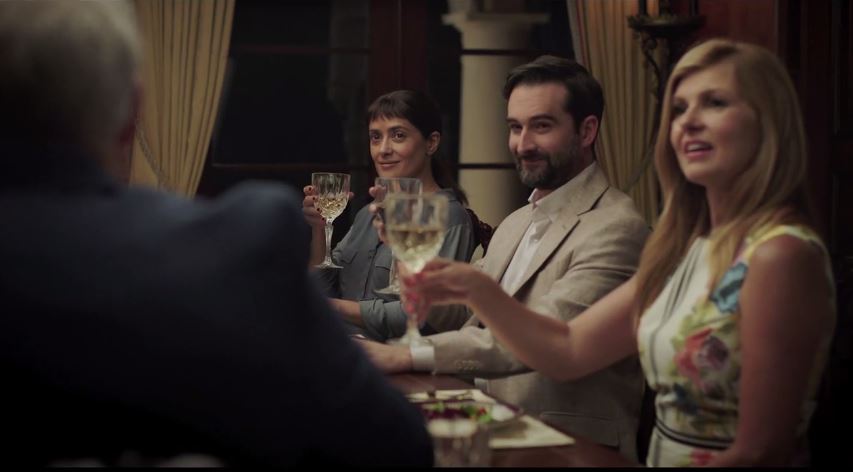
Richard Gere – that silver fox – is Stan Lohman. A politician with a congressional race on the line and an important bill currently up for a vote, he’s juggling a lot right now. So why stop everything to join his brother Paul (Steve Coogan), along with Paul’s wife Claire (Laura Linney) and his own wife Katelyn (Rebecca Hall) for a 5-star meal?

Well, it isn’t good news.

The restaurant of choice is beyond posh, its lushly appointed dining rooms and obscenely laden tables a fascinating surrounding for the drama unfolding. When Moverman remains with his primary foursome inside this restaurant, an involving and curiously repellant morality play unfolds.

Moverman has a particular talent – one that these veterans relish. He scripts characters who are rarely entirely what they appear at first blush, never go where you expect them to go, and somehow wind up being the same and yet remarkably different than what you’d imagined.

This kid of layered challenge can prove too much for many actors, but Hall, Coogan, Gere and especially Linney are custom made for such work. Indeed, in many respects these actors are superior to their material.

Linney and Hall suffer from underwritten characters, which is a shame because both find something primal under all their characters’ studied polish.

Gere is breezily at ease as the smooth politician, convincing himself and others of his genuineness as he works the room.

Coogan is the standout surprise, playing against his traditionally comedic type as the enigma in the middle of this conundrum.

Suffice it to say, the couples have a parental nightmare to contend with, and it’s when Moverman brings in flashback to enlighten the audience that his drama begins to lose its way. Mix in some additional flashbacks to illuminate Paul’s character, including an excruciating Civil War sequence (we get it – sibling rivalry – enough already!), and the slow film comes to a stand-still.

It’s a frustrating way to spend an evening, The Dinner, but not a waste of time. Every member of the cast has a moment of brilliance working with a script that also shines in fits and spurts.

Verdict-3-0-Stars

Awesome Mixtape: Side 2

Guardians of the Galaxy Vol. 2

by Hope Madden and George Wolf

Three years ago, James Gunn and Marvel became superfriends, making use of inspired casting, crisp writing and some classic 70s jams to make Guardians of the Galaxy the most fun to be had at the movies in 2014.

But is that second mixtape ever quite as awesome as the first? Rarely, and that’s the Catch-22 of the original film’s surprising blast of space zaniness. While we never saw that one coming, this new one arrives with weighty expectations.

No, Volume 2 can’t match the ruffian charm of the first, and there are some stretches of not-much-happening-here. But Gunn’s sequel shares a lot of heart, swashbuckling visuals and more than a few solid belly laughs.

But please, stop trying to make Howard the Duck happen.

Peter Quill (Chris Pratt, rugged everyman dufus) and his band of misfits-for-hire run into some troubles here and there across the galaxy. Yondu (Michael Rooker – hooray!) and his crew of Ravagers are still on their tail, and some pompous gold people from Sovereign (so they’re “Sovereign citizens” – well played) want Rocket dead.

But all might be well when Quill finally meets his father, Ego (who else but Kurt Russell?) and learns the surprising news of his lineage.

What – a comic book movie inspired by daddy issues? Stop it!

It may be a logical character arc for Quill, but when one too many tragic backstories build at the expense of fun, the running time starts feeling a bit bloated. Good thing Gunn has a fine instinct for when enough is about to become too much, pivoting from the dramatics with dazzling derring-do or exactly the right gag.

He also knows we’re already invested in these characters, and doesn’t mind spending some of the capital he earned last time out.

Bradley Cooper again offers ripe sarcasm as the voice of Rocket, but Dave Bautista is the breakout comedy anchor of GOTGV2. As the hulking Drax, Bautista’s booming guffaws or deadpan one-liners are a consistent treat. Zoe Saldana’s Gamora seems the odd Guardian out, too often given little more to do than deny Quill’s claim that they’ve got a “Sam and Diane unspoken thing” goin’ on.

And then there’s Groot (Vin Diesel).

As a baby.

Baby Groot.

For the win.

There are more great classic hits to re-discover (or, for you kids, get to know), including a fantastic piece of action set against the backdrop of…wait for it…Jay and the Americans’ “Come a Little Bit Closer.” Stingers? Oh, yes, during and after the credits, so just plan on staying around til the staff sweeps you out with the candy wrappers.

Does Guardians 2 seem like a rehash? Sure, at times, and there’s never any doubt whoever’s shooting at our heroes is bound to have horrible aim. But when a rehash serves up this much wit, eye candy and escapist fun, you know what they say….

“I am Groot.”

Verdict-3-5-Stars