Category Archives: New In Theaters

Reviews of what’s out now

More Bad Things

Rough Night

by Hope Madden

I did not have high expectations for this one, I’m not going to lie. Though the raunchy trailer offered a couple chuckles, I couldn’t help but think two things.

1) What is Scarlett Johansson doing in a “girls weekend” movie?
2) Isn’t this the same premise as Peter Berg’s 1998 black comedy Very Bad Things?

That first one is tough to answer, but the second is a very loud yes.

ScarJo plays Jess, wholesome politician lured into a bachelorette weekend with her college besties. She’s hoping for a quiet night, but she’s quickly guilted into binge drinking, casual drug use and, of course, a stripper.

Things get dark after that.

Yes, cinematic bachelor/bachelorette party zaniness is beyond tired. Still, there’s reason for hope. This cast, for instance.

Johansson is among the most talented and versatile actors working, as at ease with comedy as she is drama. Zoe Kravitz is strong as well, but the real reason for optimism is the rest of the party.

Kate McKinnon – flat out hilarious and able to steal scenes at will from anybody.

Ilana Glazer (Broad City) – effortlessly wrong-minded and hilarious.

Jillian Bell (Workaholics) – maybe the wrong-mindedest of them all.

The trio delivers, McKinnon in particular. Boasting that crazy-eye thing she does, as well as a ridiculous Aussie accent, her every moment on screen brings with it a “what exactly is she doing” quality that can’t help but infuse even flat scenes with a little electricity.

And there are flat scenes. Lucia Aniello makes her feature directing debut, working from a script she co-wrote with fellow Broad City alum Paul W. Downs (who also co-stars as Jess’s fiancé). Too much feels borrowed and several of the longer bits go nowhere.

But she and DownS are blessed with performers who know what to do with the material. Each creates a distinct and memorable personality. And the whole film has some fun at the expense of the state of Florida’s questionable laws.

There’s nothing new here. Honestly, nothing. But What Aniello and her talented cast do with a variety of set-ups is sometimes inspired and often very funny.

Verdict-3-0-Stars

https://www.youtube.com/watch?v=jYkgQuqvaBg

Casualties of War

All Eyez on Me

by George Wolf

After being woven through films such as Notorious and Straight Outta Compton, the life of Tupac Shakur finally gets its own treatment in All Eyez on Me, an earnest biopic ultimately too comprehensive for its own good.

Demetrius Shipp, Jr., boasting an uncanny resemblance in an electric screen debut, captures Tupac’s fire and swagger, while Danai Gurira (The Walking Dead, Mother of George) is ferociously compelling as Tupac’s mother (and former Black Panther) Afeni Shakur. Their scenes together consistently deliver the emotional heft lacking elsewhere.

Director Benny Boom, a veteran of music video and television projects, is committed but becomes waylaid with an unfocused meandering.

After a promising start fleshing out the drive and outrage that sprung from Shakur’s upbringing, Boom and his writing team get bogged down with a scope more dutiful than effective. In an effort to tell as much of Tupac’s story as possible, All Eyez on Me loses the chance to show us the depth that made him an icon.

Verdict-3-0-Stars

https://www.youtube.com/watch?v=6VC0aSPfyQk

Back to the Track

Cars 3

by George Wolf

As great as the Disney/Pixar lineup is -and it’s pretty great- the Cars franchise sits low in the batting order, especially after the debacle that was Cars 2 six years ago. Cars 3 rebounds nicely, but still can’t match the meaningful substance of Pixar’s best.

We catch up with legendary race car Lightning McQueen (voiced by Owen Wilson) in a changing sports world. Suddenly, a new generation of “NextGen” cars, led by rookie sensation Jackson Storm (Armie Hammer), is taking over. New team owner Mr. Sterling (Nathan Fillion) brings in a young trainer named Cruz (Cristela Alonzo) to get McQueen adapted to the new technology, but her “senior project” only fuels the feeling that the legend should stay in the garage for good.

Animation vet Brian Fee helms his first feature as director/co-writer with Cars 3, and while the visual style is characteristically luscious, the story that he’s telling never quite rises above the pleasantries of showing kids some talking cars and introducing a new line of tie-in merchandise.

The gags are amusing but seldom funny and the plot takes some turns that may confuse the young ones, but the bigger concern is what’s missing.

As Cruz reveals her true love is not training but racing, and McQueen reflects on his tutelage under Doc (Paul Newman), the movie has the chance to find the poignancy and resonance that has driven Pixar’s most touching classics.

You’ll find it in Lou, the Pixar short the runs before the feature.

Alas, Cars 3 drives on by, satisfied with “believe in yourself” mantras that are greeting card ready, and a first-place trophy for the cheerfully harmless.

Verdict-3-0-Stars


Farewell and Adieu

47 Meters Down

by Hope Madden

Is it Shark Week?

If it isn’t, why the hell not?

There’s a new shark attack movie in theaters this weekend. It’s no Jaws, but it’s no Sharknado, either. Johannes Roberts’s 47 Meters Down treads some similar waters as last year’s surprise hit The Shallows, with a little less intelligence and a lot more sharks.

Lisa (Mandy Moore) and Kate (Claire Holt) are sisters on vacation in Mexico. Lisa, the play-it-safe older sister, is nursing a heartbreak, which loose cannon Kate hopes to heal via the worst imaginable decisions. Like a shark cage expedition.

Cage goes in the water.

Sharks in the water.

Our shark.

Because tourists are stupid.

How stupid? Sea Captain Taylor (Matthew Modine) has to repeatedly say, “Stay inside the cage.”

But, if you can get past the idiocy – or even embrace it because, if YouTube is to be believed at all, people really are just this moronic – you’ll find some fun jump scares and genuine tension.

Something goes wrong and the girls and their cage drop to the sea floor, a dangerous 47 meters down. They have little oxygen and they’re surrounded by sharks. How will they survive?

The Shallows basically created the Girl Power Shark Movie, and Roberts and co-scripter Ernest Riera end up playing out a far less empowering tale. Roberts’s background is horror, though, so he does know how to deliver some visceral action now and again.

Plus, there is one shot that’s almost worth the price of admission.

Atmosphere is Roberts’s talent, and he creates a good deal of it. Aided by impressive CGI, the sisters’ plight on the ocean floor is often nearly as breathless for the audience as it is for the characters.

Dialog, on the other hand, is definitely a weaker point. Pair the banalities of the conversations with the contrivances that put the characters where they are, then add a first act that’s weighed down with cartoonishly ridiculous choices, and the cool shark sequences have a lot to overcome.

For a mindless, squirmy summer shark fest, though, it’s a fun time-waster.
Verdict-3-0-Stars

Paris Is Yearning

Paris Can Wait

by Matt Weiner

Have you seen the Coppola film about an unlikely star-crossed couple touring a foreign country? In Paris Can Wait, Eleanor Coppola, better known for her documentaries, writes and directs her first feature film.

Diane Lane plays Anne, the long-suffering wife and de facto personal assistant to a hard-driving producer husband Michael (Alec Baldwin, literally phoning most of his lines in). When Anne needs to get to Paris from Cannes, Michael’s business partner Jacques all too happily offers to drive.

Jacques has a spontaneous lust for life as well as an endless appetite that turns a one-day drive into an unexpected long weekend in close quarters for the pair. Paris Can Wait has some very loud echoes of the meandering “stranger adrift in a strange land” in Sofia Coppola’s Lost in Translation.

But the comparison does Eleanor Coppola no favors, instead showing just how respectively undeveloped and soulless Anne and Jacques are. At least Bob Harris knows that his distinguished charm act is just another form of kabuki, whereas Jacques comes across as sincerely committed to his hedonistic shtick.

This by itself wouldn’t torpedo the film, given Arnaud Viard’s effortless bonhomie. But it’s impossible to ignore the complete lack of agency given to Anne up until the very last frame of film. Jacques’s disquisitions on food and wine, art and local history are far too boring to be as one-sided as they are. All their outings together are gorgeously filmed, but Jacques’s conversational M.O. is to recite the first two lines of Wikipedia on any and every subject that comes into his field of vision.

In return, Anne is supposed to derive value from being pelted with the encyclopedia every five minutes. Call it homme-splaining, and then also call the police to rescue Anne from her whimsical weekend of nonconsensual self-discovery.

It’s not that two strangers wandering around a foreign country and talking can’t work—Richard Linklater got a sublime trilogy out of it. But the whole of France isn’t scenic enough to make up for Jacques’s tour guide/hostage taker balancing act. Just how bad is it for Anne? If the film swapped out the soundtrack for tense horror strings, there’s not a single excursion with Jacques that couldn’t naturally segue to a scene of Anne lashed to a bed with both her legs broken.

And somehow the trip stirs up life-changing feelings for both characters. (To be fair, spending an entire weekend feeling like each new adventure is a prelude to a murder would probably change anybody’s outlook on life.) Anne and Jacques each get a last minute, pathos-drenched backstory. But the result is not only forced, it also weakens Lane’s last-ditch attempt to inject a flash of mischief and mystery into Anne’s final moments onscreen.

This makes Paris Can Wait tragedy, not comedy. If Lane is going to be typecast in this sort of role, at least allow her character to flourish. Instead we’re stuck with the Jacques tasting menu: course after course of attractive fluff whether you want it or not, and then someone else gets stuck with the bill.

Verdict-1-0-Star

Always Faithful

Megan Leavey

by George Wolf

Anchored by the powerful bond between a K-9 Marine and his handler, Megan Leavey is a thoroughly respectful and frequently touching testament to heroes of differing species.

Kate Mara is fantastic as Corporal Leavey, who was twice deployed to Iraq with her bomb-sniffing dog Rex, saving multiple lives until they were both wounded by an improvised explosive. After her return to civilian life, Leavey mounted an impressive campaign to adopt Rex, and was ultimately successful with an assist from her Senator, New York’s Chuck Schumer.

Director Gabriela Cowperthwaite, who nearly brought Sea World to its knees with the documentary Blackfish, builds Megan Leavey with impressive restraint in each of its themes. Never a jingoistic war film, shameless recruiting tool or schmaltzy ode to a dog’s purpose (pun intended), the film, like its subjects, does a job and does it well.

At times tense, loving, and even goosebump-worthy, Megan Leavey is a fine reminder that family comes in all breeds.

Verdict-3-5-Stars

Fear Itself

It Comes at Night

by George Wolf

Two years ago, Krisha served as a stunning feature debut for writer/director Trey Edward Shults. Gripping in the intimate nature of its truths, it heralded Shults as a new filmmaker with tremendous potential.

That potential is realized with It Comes at Night.

He may have bigger stars and a larger budget this time out, but Shults shows storytelling instincts that are already well-seasoned. Resisting any pressures to mainstream his scope and “go bigger,” Shults get even more intimate. While Krisha showed a very tangible threat infecting a family, It Comes at Night is more abstract, an intensely personal take on fear and paranoia.

Deep in the woods, Paul (Joel Edgerton, solid as always), Sarah (Carmen Ejogo) and their teenage son Travis (Kelvin Harrison, Jr.) have established a cautious existence in the face of a worldwide plague. They have boarded their windows, secured their doors, and enacted a very strict set of rules for survival.

At the top of that list: do not go out at night.

This rigid domestic order is tested when the desperate Will (Christopher Abbott) breaks in. He has a wife, Kim (Riley Keough) and toddler to protect, and is offering all they have in exchange for refuge.

It Comes at Night has been on horror fans’ radar for some time, but it will test the patience of those satisfied with cheap jump scares or spoon-fed explanations. As with Krisha, Shults builds the film around his own experiences, using Travis to often mirror how Shults himself dealt with a death in the family. Through Travis’s nightmares, we are kept off balance, questioning just what is real and who can be trusted.

Shults explores the confines of the house with a fluid camera and lush cinematography, slyly creating an effective sense of separation between the occupants and the dangers outside.

But what are those dangers, and how much of the soul might one offer up to placate fear itself?

In asking those unsettling questions, It Comes at Night becomes a truly chilling exploration of human frailty.

Verdict-4-0-Stars

Bad Wrap

The Mummy

by Hope Madden

Remember the first time you saw the trailer for the new Tom Cruise flick The Mummy, and you thought, “My God, that looks awful”?

Dude, you were so right.

Part Tomb Raider, part Suicide Squad – with huge bits stolen whole cloth from the immeasurably superior An American Werewolf in LondonThe Mummy lacks even a solid thirty seconds of fresh thought. It is as dusty and lifeless as its namesake.

But, because it’s some sort of artistic imperative that every movie we see for the next decade is planned out in huge corporate clusters – I mean cinematic universes – the Universal monsters are being revived. Aging leading men will be tapped for butts-in-seats duties as Dark Universe tries to create a series of nostalgic family(ish) fare neutered beyond recognition with CGI.

First up, Cruise.

A prologue riddled with plot holes leads to one wildly offensive piece of cultural flippancy, as Cruise Indiana Joneses his way into Iraqi insurgent territory in search of unnamed treasure.

He finds an Egyptian sarcophagus. In Iraq. It’s just one geographic discrepancy mentioned but never clearly explained. Part and parcel of a script-by-committee that hopes you’ll overlook its incessant nonsense.

Cruise, as Nick Morton, is Cruise – all superficial charm and charisma. He’s joined by one-note Annabelle Wallis as the archeologist in a white shirt that’s bound to get really wet at some point, and Sofia Boutella as a mummy with strategically placed wrappings.

And Russell Crowe as Dr. Henry Jekyll.

Will he turn into Hyde? Will it be among the film’s weakest, saddest, most pathetic scenes? No spoilers here.

Director Alex Kurtzman bandages together secondhand ideas, weak writing and an absence of onscreen chemistry with CGI aplenty. Sandstorms! Birds! More sand! And mummy/zombies that look like they should be gettin’ down with Michael Jackson.

If only!

Kurtzman’s impressive lack of instinct for pacing, tone and atmosphere match perfectly with the script’s hodgepodge of stolen ideas. And now we can wait for Hollywood execs to bring other moldering horror corpses back to life. Sigh.

Verdict-1-5-Stars

Sound Decisions

Violet

by Hope Madden

If you’re looking for a light hearted, talky romp, Bas Devos’s Violet is not for you. If, on the other hand, you’d like to see a thoughtfully delivered meditation on grief – and who doesn’t? – seriously, you should give this film a chance.

At thirteen minutes into the film, I’d yet to hear 20 words of dialog. But the sounds are hypnotic. It might be the click and whir of office machinery as the screen itself contains CCTV footage from mall security, capturing without notice the stabbing death of a teenage boy.

Or it could be the clatter of BMX bike wheels as Jesse (Cesar De Sutter) tries to resume normal life with his buddies after surviving the attack that ended his friend Jonas’s life.

Maybe it’s the airplanes overhead, the rain on awnings, or the sudden explosion of noise about 42 minutes in as Jesse and his friends attend the very heavy Deafheaven concert.

Whatever you’re hearing, it’s not an explanation of what happened, not details about how Jesse is coping. Devos has confidence that you can suss that out without hand holding.

His dreamlike work, often recalling Gus Van Sant, sits with mourning. The delayed reaction, the inability to focus, the hypersensitivity and numbness that collide. Why didn’t Jesse do anything to help Jonas?

It’s a question you can see on Jesse’s father’s face, on the faces of townies. With barely a word spoken, Devos offers insight into disappointment, masculinity, shock and the awkward, undramatic reality of day to day grief.

It’s a lovely effort, heavy with symbolism (sometimes too heavy). Devos is as confident with his visual storytelling as he is with sound design. Little touches – blue handlebars and peddles that match a BMX tee shirt, two dogs tearing at a trash bag on a corner – lead up to a quiet climax that matches symbol with reality in one overwhelming, terrifying and beautiful close.

It’s as insightful and respectful a representation of trauma and grief as you’ll find, but don’t expect tidy explanations or epiphanies. Devos is as patient with his subject as the theme requires.

Verdict-4-0-Stars

The Man Upstairs

Wakefield

by George Wolf

“Who hasn’t had the impulse to put their life on hold for a moment…just vanish completely?”

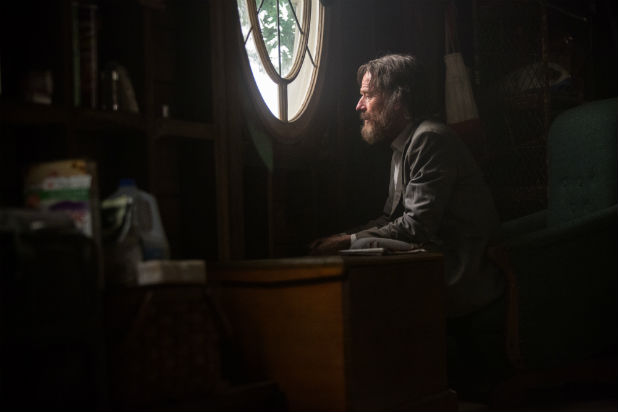
Howard Wakefield (Bryan Cranston) gives in to that impulse, and his moment of resignation becomes months in a self-imposed exile, wallowing in self-pity and watching his family from an attic window.

Sure, Howard has a nice job, beautiful family and sweet home in suburban New York, but he’s been lulled into a stupor by the whole domestic routine. After yet another trying day, Howard ventures up to the attic above his separate garage…and decides to stay there.

Writer/director Robin Swicord adapts E.L. Doctorow’s short story with a workmanlike precision, dutifully providing all the building blocks for this high-concept parable, but never finding the depth or profundity she seeks.

Cranston, here’s a shocker, is fantastic, digging commendably deep in a search for the humanity his character badly needs. Howard has some first-world problems, as he labels suburbia a place people can feel “protected from what’s wild,” but can’t challenge his privilege with anything more dire than dumpster diving or poor hygiene. Howard is far from likable, and though Cranston is all in, finding a reason to root for his quest is tough sledding indeed.

As he spies on his wife (Jennifer Garner) and two daughters, Howard fancies himself the veritable wise old hermit, observing the folly of modern life and dispatching simple truths. It’s well-meaning, but these truths are of the standard greeting card variety, rendered even less impactful from the film’s inherent need to tell (through voiceover narration or talking-to-himself musings) instead of show.

At times, Wakefield has the feel of a one-man show. With Cranston, the man makes it worth watching, even when the show can’t quite keep up.

Verdict-3-0-Stars