Category Archives: New In Theaters

Reviews of what’s out now

The Abyss of Freedom

All the Money in the World

by George Wolf

The eleventh-hour replacement of Kevin Spacey wasn’t just a boldly genius play by legendary director Ridley Scott – it was the only play, a cinematic Hail Mary that elevates All the Money in the World as a curiosity, a statement and a filmgoing experience.

Christopher Plummer steps in as the legendary J. Paul Getty, delivering a terrific, gravitas-rich performance that anchors Scott’s dramatic retelling of events surrounding the 1973 kidnapping of Getty’s teenaged grandson Paul (Charlie Plummer).

Scott digs in to a meaty script from David Scarpa (adapting John Person’s book) to deliver a highly engaging film filled with tension, insight, stellar performances and crackling relevance.

As Paul’s mother Gail Getty, Michelle Williams is award-worthy fantastic. Gail, no longer a “real” Getty after divorcing Paul’s father, must negotiate with both the kidnappers and her former father-in-law for her son’s safety, and Williams makes Gail’s mix of frustration, desperation and disgust emotionally genuine.

While refusing to pay the 17 million-dollar ransom, J. Paul enlists the help of former CIA agent Fletcher Chase (Mark Wahlberg) to recover his grandson. As the hunt intensifies, Scott gracefully balances the extremes on opposing sides of the boy’s fate, each one consumed with profits and losses.

Wahlberg again shows how effective he can be under a strong director, and Fletcher’s search for Paul becomes a taut nail-biter while the elder Getty -“not just the richest man in the world but the richest man in the history of the world“- shells out millions on the black market for a masterpiece canvas.

Getty’s defense of his interest in things over people is just one of several passages from Scarpa that are weighty with resonance. His script is full of biting, memorable dialogue, such as Getty’s explanation of an “abyss of freedom” that comes from extreme wealth, without ever succumbing to grand speechifying.

The “erasing” of Spacey is incredibly seamless, but long after those headlines fade, All the Money in the World holds plenty of capital. As both a fascinating historical drama and a telling reminder of what we value, it’s a film that can stand with the best of Scott’s storied career.

Let’s Get Small

Downsizing

by George Wolf

Word is, writer/director Alexander Payne has had the Downsizing idea for years, apparently waiting for when a satire of endless greed and unapologetic self-interest would feel the most relevant.

Good timing, then.

Payne, working with frequent co-writer Jim Taylor, returns to the political mindset he showcased so effectively in the classrooms of 1999’s Election. Here, their palette is a not-at-all distant future where science has come up with a solution for global sustainability: shrinkage!

By reducing people and communities to a ratio of 2.744 to 1, the potential for a guilt-free good life is off the charts! That sounds pretty great to Paul and Audrey Safranek (Matt Damon and Kristen Wiig), and a hilariously obnoxious info-mercial (Lauren Dern and Neal Patrick Harris, killing it) seals the deal.

Of course, it isn’t long before human potential meets human nature, familiar class systems develop and, as Paul’s smarmy neighbor (Jason Sudeikis) points out, getting small becomes more about saving yourself than saving the planet.

For three quarters of the film, the satirical slings and arrows find frequent marks, and layers deepen when Paul starts hanging with a crazy new neighbor (Christoph Waltz) and his cleaning lady (Hong Chau, in an award-worthy, film stealing performance).

Payne and Taylor aren’t as sure-footed when the satirical tone gives way to the absurd, or when a budding pretense makes the opening of a white man’s eyes feel a bit too heroic.

But while the scale of Downsizing is small, the film is thinking mighty big. The new world it envisions is engaging, with sharp comedy, unexpected turns and the keen observational structure to make it all impactful.

Big Top PT

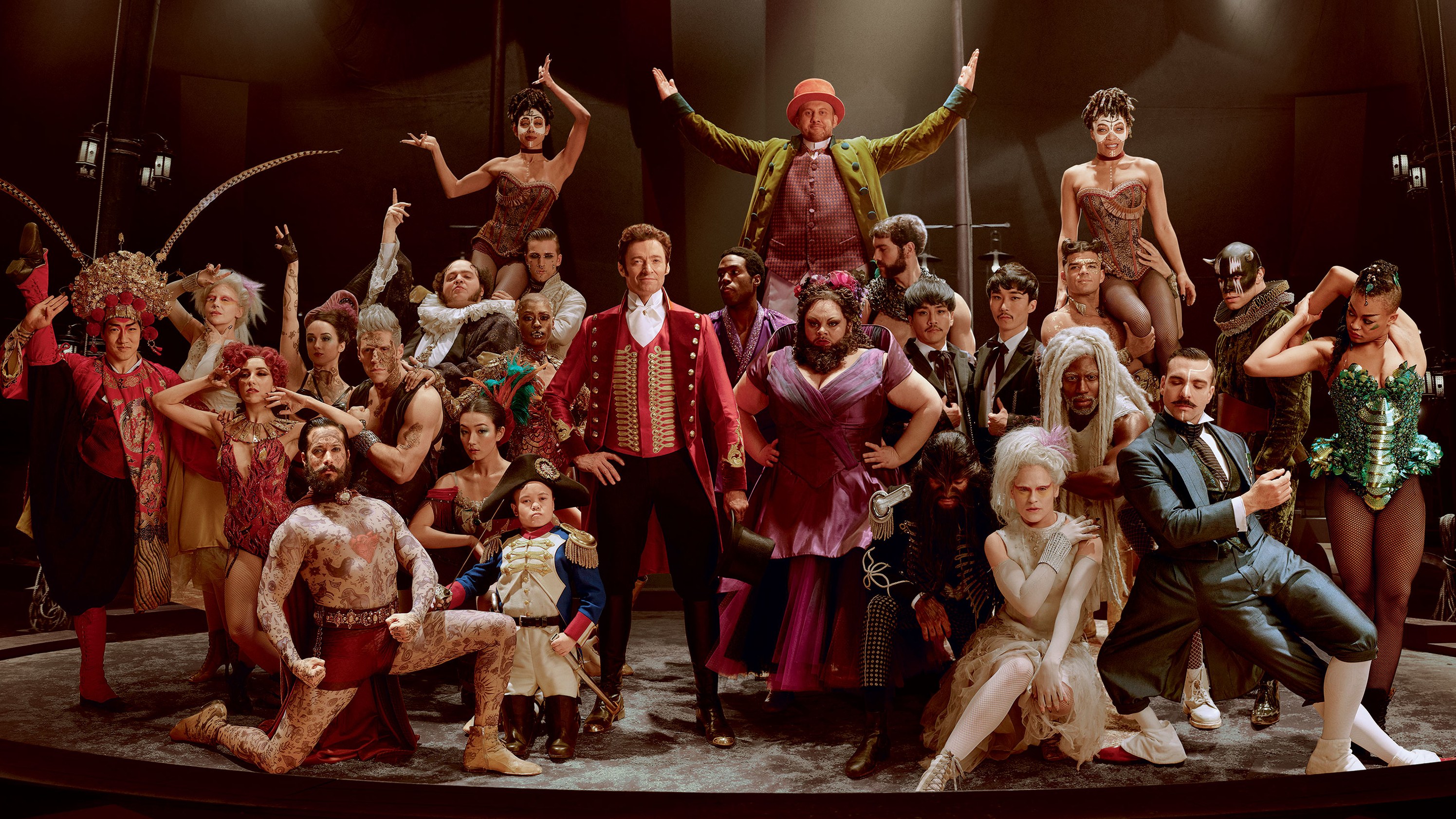
The Greatest Showman

by Hope Madden

In so many ways, The Greatest Showman is a wildly inappropriate vision of the life of PT Barnum—a politician, spokesman for temperance, abolitionist and, above all things, an outsized promoter and self-promoter. He’d been all these things for decades before he dipped his toe into the circus industry, but what fun is that story?

Let’s rewrite. We need romance, lessons, heartwarming children and resolvable, tidy drama. Barnum as a tot, working dirty-faced and split-shoed besides his father, tailoring for Dickensian clients and wages. But he has dreams. Big dreams.

Yes, the film simplifies the actual story of Barnum’s life to its barest lessons-to-be-learned minimum. The oversimplification spills into the core conflict (of many) in the man’s actual history: his presentation and monetization of “human curiosities.”

But maybe that’s where this movie is closest to the truth. It is selling you an enjoyable time, spinning your head with breathless setpieces, color, glamour, surprise, happiness. Sleight of hand. And at the same time selling the tale that, no matter how Barnum may have used these people for his own profit, this is really a story of empowerment.

“Some critics might have even called this show a celebration of humanity,” says Barnum’s harshest critic, New York Herald writer James Gordon Bennett.

As genuinely if superficially enjoyable as The Greatest Showman is, there is something unseemly in embracing so tidy a view.

Still, Hugh Jackman—maybe the most charismatic performer in modern film—is in great voice in yet another big, big musical. His earnest likeability and exuberance convince you to disregard your instincts on this film just as surely as his Barnum uses the same tactics to lure uncertain outcasts out of the shadows and onto the stage.

Michelle Williams fares less well as Barnum’s wife Charity, saddled as she is with the bottomless devotion and forgiveness that is the mark of the underwritten spouse character. Rebecca Ferguson mines for emotional clarity in a small role and a magnetic Keala Settle is a natural fit for the heart and soul of Barnum’s “curiosities.”

Director Michael Gracey, working from a script by Jenny Bicks and Bill Condon, crafts a Moulin Rouge-esque vision that transports you, which is appropriate when tackling the life of PT Barnum.

It also works to convince you that all this—the spotlight, the manipulation, the exploitation, the laughter and the admiration—was the best possible thing for Barnum’s performers.

Barnum might have liked that spin, too, but maybe that’s the problem.

The Pitch is Back

Pitch Perfect 3

by Hope Madden

Did anyone think to themselves this Christmas season, I wonder what those acapella singers from Pitch Perfect are doing now?

Me, either. And yet, Pitch Perfect 3 hits theaters this weekend.

The Bellas have mostly graduated from college by now, dealing with careers, the daily grind and wishing they were still singing in an all-girl, no-instrument band. So they take their talents to the USO to compete with a country group, a rock band and a hip hop duo to land the opening slot for DJ Khaled.

I know that almost sounds like a plot, and there is this side bit about an international criminal and a kidnapping, but honest to God, this is the most disposable, pointless movie of the season. (Full disclosure—I haven’t seen Father Figures yet.)

Director Trish Sie can’t find a pace or visual style to suit the project, which only emphasizes the weakness in any shadow of a storyline.

Anna Kendrick and Rebel Wilson, along with most of the Bellas, return to vocal action. There’s nothing fresh or appealing about the music, but if that’s your bag, there you go.

Wilson’s Fat Amy still says amusingly inappropriate things, as do the always welcome John Michael Higgins (“We’ll stick to you like mom jeans to a camel toe,”) and Elizabeth Banks. Why are the announcers of the college acapella championships involved in a USO gig?

Writers Key Cannon and Mike White realize this makes little sense, so they devise a knowingly ludicrous excuse for it. In fact, it’s this self-referential tendency that provides the film’s only clever laughs.

Well, “laugh” is a strong word, but there are passably enjoyable moments. The rest of it is mainly insufferable: catty, meandering and needless.

Fightin’ Words

Darkest Hour

by Hope Madden

Back in the day—before the mustachioed Commissioner Gordon or the bewitching Sirius Black—back in the way back of the 80s and 90s, Gary Oldman was known for disappearing into real-life characters. Whether it was his Sid Vicious or Lee Harvey Oswald or Ludwig Van Beethoven, Oldman could cease to be, leaving nothing behind but the most amazing reimagining of true life.

So the fact that he’s magnificent in Darkest Hour should come as no surprise.

Besides his physical transformation, thanks to what may be the single greatest achievement in fat suits in all of moviedom, Oldman convinces by capturing the spirit of Winston Churchill.

In retrospect we know Churchill’s fighting spirit was desperately necessary— his nation was facing unfathomable odds and dealing with an establishment’s inclination toward surrender. But it’s Oldman’s performance that makes us understand why so very few were able to trust not just Churchill’s vision, but Churchill.

With the aid of an excellent turn by Kristin Scott Thomas as Churchill’s wife Clementine, Oldman makes the Prime Minister knowable: driven, insecure, passionate, drunk, uncertain, romantic and somehow lovable. The performance is effortlessly layered and authentic and honestly the best work the veteran actor has done in decades.

Credit a crisp screenplay by Anthony McCarten for providing context by way of illuminating points of view, each one deftly animated by an understated ensemble delivering nuanced performances. Ben Mendelsohn’s King George and Stephen Dillane’s Viscount Halifax, in particular, quietly but assuredly manifest the uneasy but shifting perspective of a nation on the brink of possible annihilation.

Joe Wright’s direction sometimes feels fanciful given the seriousness of the story, but he works mightily with his poetic camera to enliven what could otherwise have been a claustrophobic chamber piece.

Instead, he’s crafted a fine bookend to Christopher Nolan’s Dunkirk. Darkest Hour glimpses the backroom politics that led to the ingenious and breathless rescue of England’s armed forces the summer of 1940. It lacks the gut-punch or cinematic mastery of Nolan’s film, but it does boast one hell of a performance.

The Safari Club

Jumanji: Welcome to the Jungle

by George Wolf

Do you hear a ruckus?

It’s coming from some easily identifiable high schoolers in detention, but this time they’re in an old storage room filled with everything from old magazines to a gaming system from the 1990s.

Turns out, that’s the same decade the soul-sucking Jumanji morphed from board to video cartridge, so the nerd, the jock, the queen bee and the outcast decide to power up this mystery game and kill some time.

In an instant, Welcome to the Jungle puts them all in the heart of one, playing for their lives as the avatars they chose, which just happen to be the polar opposites of their “real” selves.

Whaaat?

Yes, convenient, but director Jake Kasdan and an extremely likable cast squeeze a fine amount of fun from a colorful adventure that follows its own advice for a healthy self-image.

Nerdy Spencer becomes the muscular hero (Dwayne Johnson), athletic “Fridge” is now the diminutive sidekick (Kevin Hart), and introvert Martha becomes a Lara Croft-y babe (Karen Gillan) while the self-absorbed beauty faces life as Jack Black.

Some solid laughs are landed from the foursome discovering their new gaming strengths (“smoldering intensity”), weaknesses (“cake”) and body parts (“don’t forget to aim!”), with the actors’ willingness to poke fun at their own images only adding to the good vibes.

There are some effective set pieces, but the overall heroics required to get back home are fairly standard, and Kasdan (Bad Teacher, Sex Tape, the under-appreciated Walk Hard) wisely doesn’t overreach. He’s not tasked with one-upping Indiana Jones, and keeps things focused more on the breezy fun to be had with his stars. These moments when the tone hits a frisky groove of self-awareness (no doubt aided by Chris McKenna and Erik Sommers, two writers from the wonderful Spider-Man: Homecoming) are the film’s high points, making it easier to look past some shaky CGI or an overly cartoonish villain (Bobby Cannavale, in yet another over-the-top waste of his talent).

The teens have to learn something today, so Welcome to the Jungle can’t hold that tone throughout, but it displays enough of a commitment to character-based comedy for a ruckus worth exploring.

Seeing Red

Ferdinand

by Hope Madden

I’m thrilled to announce that Ferdinand, the new animated feature from Carlos Saldanha (Ice Age, Rio), did not ruin my childhood.

Whew!

The story of a peaceful if enormous bull who’d far rather sniff flowers than fight matadors was my favorite book as a little kid, but to stretch these 32 or so sentences into a 90-minute feature-length film, there would have to be padding.

I worried about the padding.

Credit a team of six screenwriters for finding—for the most part—organic ways to develop the story. We meet Ferdinand as a young bull being raised with a handful of other bulls specifically to fight in the ring. Then we follow him on his adventure to freedom from the ring and back into the sights of the matador.

That doesn’t mean the film never feels padded. It definitely does. But a slew of vocal talents including John Cena, Bobby Cannavale and Kate McKinnon helps to keep the film afloat.

Rarely laugh-out-loud funny, a bit bloated and a tad dark at times, Ferdinand still manages to entertain. It looks good, bears a social conscience and remains more or less true to the simple “be who you are” core that made Munro Leaf and Robert Lawson’s picture book so lovely.

https://www.youtube.com/watch?v=n7RkOfN8KvE

Swimming in Romance

The Shape of Water

by Hope Madden

In its own way, The Creature from the Black Lagoon is a tragic romance. But what if it weren’t? Tragic, I mean. What if beauty loved the beast?

It seems like a trend this year.

An unforgettable Sally Hawkins—an actor who has never hit a false note in her long and underappreciated career—gets her chance to lead a big, big show. She plays Elisa, a mute woman on the janitorial team for a research institute in Cold War era Baltimore.

Enter one night a malevolent man (Michael Shannon), and a mysterious container. Color Elisa intrigued.

Writer/director Guillermo del Toro is an overt romantic. So many of his films—Cronos, The Devil’s Backbone, Crimson Peak—swim in romance, but he’s never made as dreamily romantic or hypnotically sensual a film as The Shape of Water. And he hasn’t made a film this glorious since his 2006 masterpiece, Pan’s Labyrinth.

Del Toro favorite Doug Jones—Pan’s Pale Man and Hellboy’s Abe Sapien—gets back into a big, impressive suit, this time to play Amphibian Man. His presence is once again the perfect combination of the enigmatic and the familiar.

The supporting cast—Shannon, Octavia Spencer, Richard Jenkins and Michael Stuhlbarg—are among the strongest character actors Hollywood has to offer and del Toro ensures that they have material worthy of their talent. Each character is afforded not only his or her own personality but peculiarity, which is what makes us all both human and unique—important themes in keeping with the story. With Hawkins and Jones, they populate a darkly whimsical, stylish and retro world.

Characteristic of del Toro’s work, Shape of Water looks amazing. Its color scheme of appropriate greens and blues also creates the impossible truth of sameness within otherness, or the familiar with the alien.

The aesthetic is echoed in Alexandre Desplat’s otherworldly score and mirrored by Dan Laustsen’s dancing camera.

The end result is a beautiful ode to outsiders, love and doing what you must.

Day for Knight

Star Wars: The Last Jedi

by Hope Madden and George Wolf

Did The Force Awakens simply recycle our Star Wars memories and sell them back to us? It did, but not simply, damn near brilliantly.

Then we got the sneak attack from the surprisingly deep Rogue One, a highly effective prequel that only strengthened our bond with the original Star Wars trilogy, and our confidence in the filmmakers now at the helm of this historic franchise.

The Last Jedi makes any letdowns seem light years away. With a deft mix of character-driven emotion, high stakes action and mischievous fun, it waves a proud flag for the legacy of this cinematic universe while confidently taking big strides toward crafting a new one.

Visionary talent Rian Johnson (Looper, Brick) now has the con as both director and sole screenwriter. His affection for the franchise, coupled with an innovative sense of character arc and storyline, combine for a freshness that respects nostalgia even while priming you to move beyond it.

Like J.J. Abrams, Johnson revisits iconic images and bits from the predecessors, but even with much more screen time for Mark Hamill’s Luke, Last Jedi feels less indebted to the original trilogy than did Force Awakens. You’ll find more humor (an opening “on hold” bit is a riot), more action and more Kylo Ren.

As Rey, Leia (Carrie Fisher in a bittersweet appearance), Poe (Oscar Isaac) and Finn (John Bodega) gather their scrappy troops to resist the First Order’s plan for pasty-faced, black-clad tyranny, the yin and yang of the film pits Adam Driver’s dark Ren against the spunky light of Daisy Ridley’s Rey.

Force Awakens gave Ridley plenty of opportunity to claim her spot at the center of the franchise, but Last Jedi allows Driver the chance to fully expand into the role of series villain. A true talent, Driver delivers a Ren who is emotionally manipulative and yet sincere (so emo!), needy and conflicted as he struggles to prove himself more than the “child in a mask” derided by Supreme Leader Snoke (Andy Serkis – aided by improved CGI).

Last Jedi also completes the transition of Poe into the courageous, never-tell-me-the-odds “flyboy” we knew was his destiny since the fist moments of Force Awakens. Isaac never disappoints, and it’s a joy to see him buckle this swash so Han-dily (sorry).

While we meet some great new characters, too, there is little exposition and a near constant barrage of action which renders the extended running time meaningless. It might get a little too cute once or twice, but there’s enough social commentary here to be relevant, enough visual glory to look wondrous, and more than enough spirit to be confident in its vision.

Things happen to characters we care about and to others we just met, and nearly all of those things carry the emotional heft of torches being passed.

And The Last Jedi makes it feel not only right but necessary, and all the more satisfying.

Island Life

Wonder Wheel

by George Wolf

The sheer number of films Woody Allen continues to churn out almost guarantees that some will hit (Midnight in Paris, Vicky Cristina Barcelona) and some will miss (Cassandra’s Dream, Magic in the Moonlight).

Wonder Wheel is more of a pop foul.

Allen’s latest (I think…what time is it?) is wrapped in nostalgia for 1950s Coney Island, lovingly photographed and peppered with characters that never quite become as interesting as Allen intends.

Ginny (Kate Winslet) works as a waitress in a Coney Island seafood joint, frazzled by the antics of her budding arsonist son and disenchanted by life with husband Humpty (Jim Belushi – surprisingly good), who runs the Wonder Wheel carousel. Lately, Ginny has begun a secret affair with Mickey (Justin Timberlake), a younger lifeguard whose fourth-wall narration is awkward and unnecessary.

The arrival of Humpty’s daughter Carolina (Juno Temple) only adds to Ginny’s frequent migraines. Not only is Carolina on the run from some mobsters (The Sopranos’ Tony Sirico and Stephen R. Schirripa – nice!) but she might be catching Mickey’s eye as well.

Winslet is sensational, tapping squarely into Ginny’s maniacal desperation for any shred of hope for the future. Initially, Allen seems intent on building the film from Winslet’s performance outward (much like he did with Cate Blanchett in the sublime Blue Jasmine), only to over-indulge with repetitious dialog and pointless diversions.

Though set in the heart of Coney Island’s summer sun, Wonder Wheel’s mind is never far from stage nor screen. Ginny had dreams of being an actress, while Mickey fancies himself a writer, and we’re often reminded that life is a series of parts being played by characters with a succession of fatal flaws.

Allen’s story arc may be aiming for grand tragedy, but it can never move past bittersweet melodrama. Well-acted throughout and often striking to look at, Wonder Wheel ends up as an aimless kid at the amusement park, running in too many directions at once.