All posts by maddwolf

Ball of Confusion

BlacKkKlansman

by Hope Madden

Welcome back, Spike Lee!

It’s not like he’s really been gone. He’s made a dozen or more TV episodes, documentaries, short films and basement-budget indies since his unfortunate 2013 compromised vision Old Boy. But BlacKkKlansman is a return to form—to the envelope-pushing enjoyment that showcases his skills as storyteller, entertainer and activist.

Earmarks of his most indelible marks on cinema—Do the Right Thing, Jungle Fever, Malcolm X—these three elements have rarely joined forces since 1992. You might get one (Get on the Bus) or two (Inside Man, Chi-Raq), but not all three.

Why now? Lee isn’t the first filmmaker to realize how painfully relevant historical tales of systemic racism are at the moment. But it wasn’t until 2014 that Ron Stallworth published the book detailing how he, a black cop in Colorado Springs in 1979, infiltrated the KKK.

You see how it all comes together?

If you don’t, you really should. Lee balances unexpected shifts between humor and drama, camaraderie and horror, entertainment and history lesson, popcorn-muncher and experimental indie with a fluidity few other directors could muster.

The story itself is beyond insane—a zany, hair-raising misadventure destined for the big screen. Stallworth (John David Washington), a rookie in Colorado Springs’s intelligence office, stumbles upon an ad in the newspaper, makes a call, and joins the Klan.

Of course, he’ll need a second officer to actually show up. Enter Flip Zimmerman (Adam Driver—perfect), who sounds about as much like Stallworth as he looks, plus he’s Jewish, which could further complicate his face-to-face relationship with the hate group.

Much sit-com-esque absurdity and dramatic police procedural thrills follow, but it’s the way Lee subverts these standard formats that hits home. The insidious nature of the racism depicted in 1979 echoes in both directions—in the history that brought our country to this moment in time, and in the future Ron Stallworth undoubtedly hoped he could prevent.

Yes, there are laugh out loud moments in this film, but there are far more rallying cries.

A Not So Simple Plan

The Third Murder

by Matt Weiner

“He changes his story every time.”

This early warning might be the only straightforward point made in The Third Murder, a new film from Hirokazu Kore-eda that goes from courtroom procedural to riveting thriller to heady exploration of truth and objectivity in rapid succession.

Defense lawyer Shigemori (Masaharu Fukuyama) takes the lead in re-investigating a murder committed by Takashi Misumi (Kôji Yakusho), with an eye toward helping his client avoid the death penalty. A few small tugs at loose ends cause the official description of the case to unravel, presenting an entirely new take on the crime—and Misumi’s motivations in particular.

Kore-eda’s austere settings and still, unflinching direction for the legal proceedings suggest an air of impartiality at first. But the deeper Shigemori delves into what happened, and the more everyone’s stories start to come into conflict, it becomes clear that Kore-eda’s setup has been as misleading as the characters within it.

Balancing Shigemori’s dogged pursuit for the truth are his fellow lawyers, including his world-weary older boss and a bright-eyed new lawyer. The team reaches out to the family of Misumi’s victims, while also trying to learn more about their unhelpful client.

As with a typical legal thriller, the ideals of truth and justice are on trial along with the crime itself. Unlike lesser genre entries, however, Kore-eda’s characters are cursed with a hyperawareness that the parts they are playing are bigger than the justice system.

For all the lofty discussions of capital-T truth, the actors all keep their monologues from drifting into melodrama. As Misumi, Yakusho is especially compelling as a cipher for much of the movie (or “vessel,” as his lawyers might say). The inconsistent narratives only work if they’re believable, and frustration is rarely as delightful as watching everyone try to get a straight answer out of Misumi.

Learning that the legal system isn’t there to get people to tell the truth is punishing enough for even the most jaded lawyers in The Third Murder. Kore-eda’s methodical prodding offers a glimmer of hope that while easy resolutions might forever escape us, there’s a moral victory to be had in the examination, however pyrrhic.


I Don’t Want to Go Out—Week of August 6

What’s your pleasure? Loads and loads of new releases to peruse at home this week. There’s one powerful cowboy movie and a whole slew of badass women. Let us help you sort it out.

Click the film title for the full review.

The Rider

Revenge

On Chesil Beach

Life of the Party

Breaking In

Book Club

The Screening Room: Kid Stuff

One utterly amazing film and a bunch of not-so-terrible to talk through this week in the Screening Room. We love Eighth Grade! We also talk about Christopher Robin, The Darkest Minds and The Spy Who Dumped Me before turning our attention to what’s worth the effort in home entertainment. Listen in!

You can listen to the full podcast HERE.

Terrible Thing to Waste

The Darkest Minds

by Hope Madden

Let me not be misleading. I did not want to see this movie.

Not just because The Darkest Minds is yet another cinematic adaptation of a dystopian young adult novel.

No, wait. That is why. And if you think you already know every moment of this film, you are correct. The Darkest Minds = X-Men + Divergent + The Girl with All the Gifts. (Haven’t seen that last one? You should!)

Ruby (Amandla Stenberg) is one of the very few children in America who have survived a virus, but survivors have been left with super powers. Deemed threats by the US government, they are rounded up, placed in internment camps and quarantined.

That right. Within moments of “fade in,” the president of the United States is ordering that children be caged. I swear to God. The dystopian future is now.

But the horrifying reality of our day-to-day world is not novelist Alexandra Bracken’s point, nor is it the point of screenwriter Chad Hodge or director Jennifer Yuh Nelson (Kung Fu Panda 2 & 3). No, their point, as is required by their genre, is that our protagonist is so very special. So very special. She just doesn’t know it.

It’s also about evolution. It’s basically the youth of the world recognizing that they are the future and wondering why the hell they should wait to take over, seeing as how the adults are screwing things up to such a degree that we all may be dead before the youngsters can straighten things up.

That checks out.

To be perfectly honest, The Darkest Minds is nowhere near as awful as the trailer made it out to be. Yes, it is predictable to a fault, but the performances aren’t terrible. There are also shades of moral ambiguity here that are uncommon in this type of film.

Stenberg is a veteran of YA cinema—she’s Katniss’s beloved Rue from the original The Hunger Games, for God’s sake. That’s like ‘tween royalty. She’s exactly as awkward, angsty and unaware as she needs to be to become the vehicle for the “she’s so special” storyline. She’s surrounded by a capable cast of children and veterans that keep the story engaging and moving.

The action is adequate at best, the villain obvious and bland, and the climax will leave most people a bit underwhelmed.

And yet, I think these mutant kids may be right. They’ve convinced me. It’s time we just hand them the keys. They couldn’t do any worse, right?

Katie Galore

The Spy Who Dumped Me

by George Wolf

As late summer comedies go, we’ve done worse than The Spy Who Dumped Me. And like so many secret agents with a “particular set of skills,” this film has one.

It’s name is Kate McKinnon.

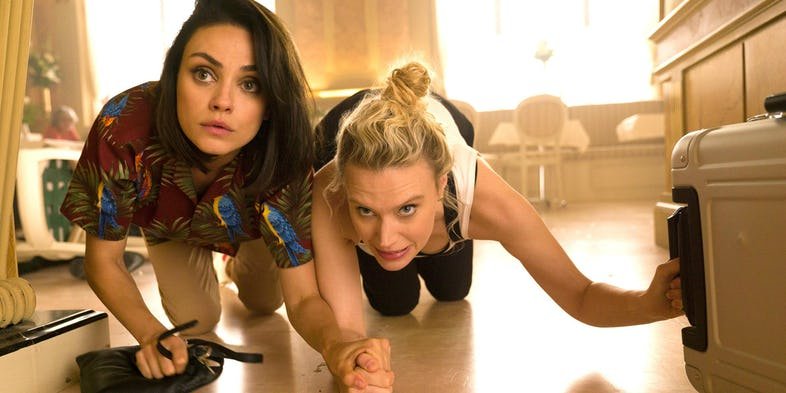
That’s not to throw shade on Mila Kunis, who flashes fine comic timing in the straight woman role, giving McKinnon plenty of space to do that thing she does. Be weird and funny and sometimes hilarious.

McKinnon is Morgan and Kunis plays Audrey, her longtime best friend who just got “text dumped” by boyfriend Drew (Justin Theroux). Just as the girls are setting fire to the stuff Drew left at Audrey’s place, they find out he was a spy, and that “2nd Place Fantasy Football” trophy of his is valuable enough to get them killed.

Director/co-writer Susanna Fogel cooks up the usual elements for a spy spoof, with amusing hijinx, scattershot action, globe-trotting locales, and a little touch of raunch to earn that R rating.

There’s also a couple quirky side characters (like the agent who keeps reminding everyone he went to Harvard) and some familiar faces (Jane Curtin, Paul Reiser, Gillian Anderson).

But Fogel’s MVP is McKinnon, and it’s pretty clear she knows it. McKinnon may not get a script credit, but it isn’t hard to imagine some of the pages saying little more than “have Kate do something funny.”

And she does, particularly skillful enough to make The Spy Who Dumped Me a goofy, enjoyable time-waster.


Sweeter Than Hunny

Christopher Robin

by George Wolf

Pooh! Who doesn’t love him?

Winnie T. Pooh and the gang from the Hundred Acre Wood have endured for decades, and now the second Pooh film is less than twelve months brings all the furry friends to live-action life.

Last year’s Goodbye, Christopher Robin was a bittersweet and uneven origin story, focusing on the inspirations for A.A. Milne’s Pooh tales.

Christopher Robin drops both the goodbye and the bitter in becoming a grown-up fantasyland with an easily digestible, greeting card-ready sentimentality.

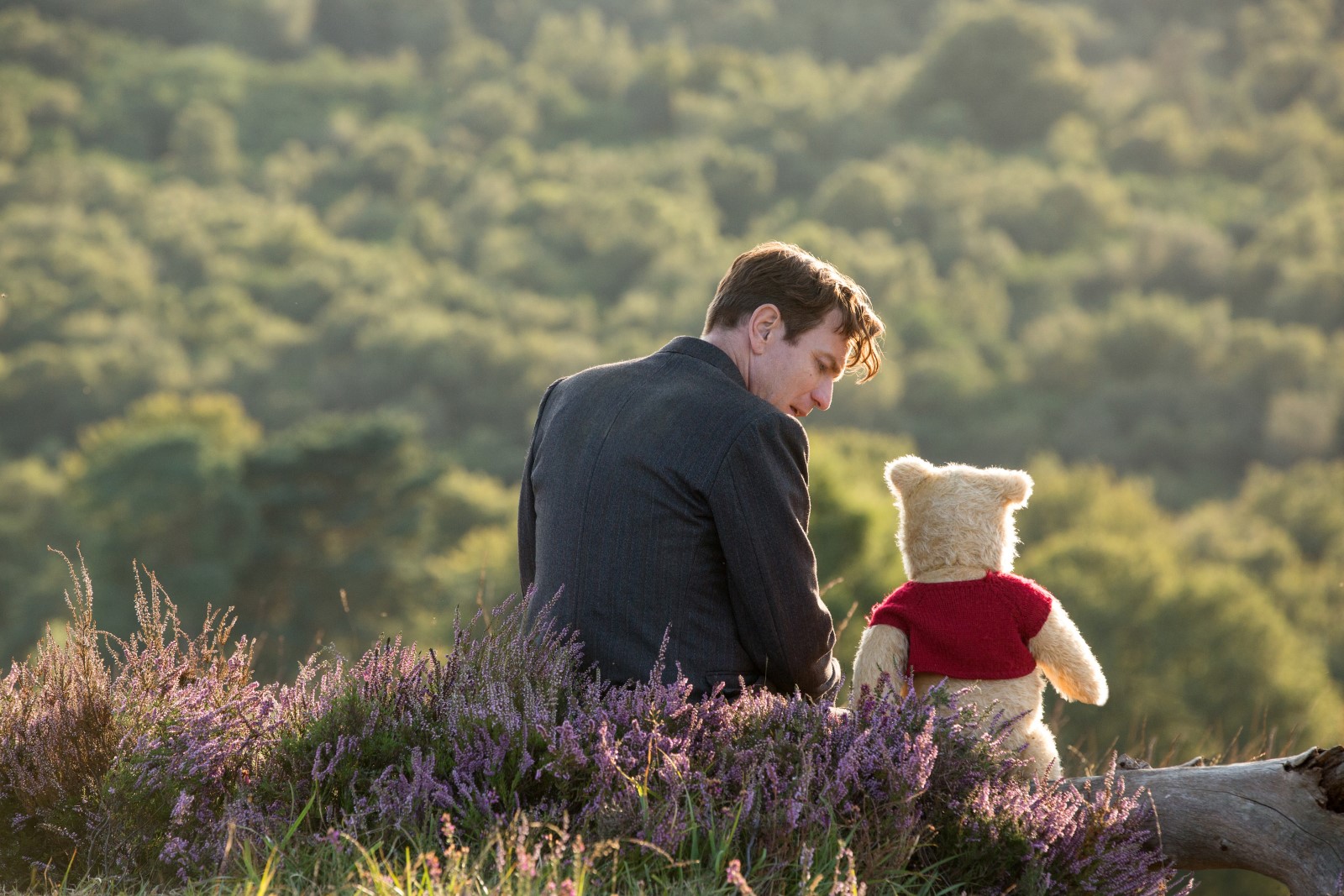
Mr. Robin (Ewan McGregor, charming as always) has put the Hundred Acre Wood long behind him, with a wife (Hayley Atwell), a young daughter (Bronte Carmichael – great name!) and a working-class job as an efficiency expert at a London luggage company.

He’s lost sight of the joy in life, and when a crisis at work means Christopher will miss another weekend family getaway, fate intervenes with a much-needed Pooh crew reunion.

The CGI effects that bring the animals to life are wonderful, the voice work  (including Brad Garrett, Toby Jones, Sophie Okonedo, Dr. Who‘s Peter Capaldi and voice acting veteran Jim Cummings) is spot on, the humor warm and the message fuzzy.

What’s missing is depth. There’s no real attempt to find any, and that’s a bit surprising with the filmmaking talent involved.

The director is Marc Forster, and the writing team includes Tom McCarthy and Alex Ross Perry. Between them, those three have some serious depth on their resumes, including Spotlight, Up, Listen Up Phillip, Queen of Earth, Monster’s Ball, Stranger Than Fiction, The Kite Runner and more.

The result is similar to David Lowery’s live-action take on Pete’s Dragon two years ago, where a filmmaker skilled at nuance within serious themes took on a children’s classic and struggled with when to stop simplifying.

Christopher Robin is sweeter than the “hunny” jars Pooh dives into, but nearly as empty as he leaves them. In trying to showcase the need for simple wonders, the film settles awkwardly between a child’s fable and wistful remembrances from grandparents.

There’s plenty to like, but little to love.

https://www.youtube.com/watch?v=0URpDxIjZrQ


Super Eight

Eighth Grade

by Hope Madden

You can’t be brave without being scared.

That is an insightful comment, but when it’s delivered earnestly by a lonely, introverted 13-year-old determined to come out of her shell in the meanest of all worlds—middle school—it is a gut punch.

Who would have thought that the most truthful, painful, lovely, unflinching and adorable tween dramedy in eons would have sprung from the mind of 28-year-old comic Bo Burnham? Or that the first-time feature director could so compassionately and honestly depict the inner life of a cripplingly shy adolescent girl?

But there you have it.

Elsie Fisher’s flawless performance doesn’t hurt.

Fisher (Despicable Me‘s Agnes, “It’s so fluffy!”) is Kayla, and we are with her, immersed in her world, for the last week of the eighth grade. God help us.

In Fisher, Burnham has certainly found the ideal vehicle for his story, but his own skill in putting the pieces together is equally impressive. Burnham’s as keen to the strangulating social anxieties of middle school as he is to the shape-shifting effects of technology.

This is the least self-conscious and most accurate portrayal of the generational impact of social media yet presented, and not just as part of the narrative. He uses social media as a storytelling device, whether the way the screen lights up the isolated face of a lonely teen, or the way the sound of the same girl’s YouTube videos narrate the very advice she wishes she were hearing from somebody.

It’s equal parts heartbreaking and sweet, and it miraculously never hits a false note.

He depicts both the normal that we all must tragically know, of being wildly out of your element even in your own skin, and the new normal that feels beyond bizarre. If your greatest ineptitude is human contact, how much harder to hone that skill when your only practice is in a virtual world?

Mercifully, Eighth Grade is not a cautionary tale about the dehumanizing dangers of an online world. It simply accepts that this is the world in which Kayla lives, depicting it as authentically and insightfully as he does a random lunch with the cool kids at the mall, or an unbearably awkward situation with a boy in a car.

Still, the best scene in the film—one that’s as uplifting as it is genuine—casts aside the glow of the phone for starlight and bonfire as Kayla and her dad, beautifully brought to life by Josh Hamilton, share a moment that will just fucking kill you.

Seriously, Burnham was never a 13-year-old girl nor has he ever been father to one. How the hell did he get all of this so insanely right?

I don’t know, man, but good for him. Good for all of us.

The Case For…A Quiet Place

by Madden and Wolf, Esqs.

Wait, A Quiet Place needs defending?

The idea felt funny to us, as well. The film has raked in buckets of cash and gotten enthusiastic high fives from most audiences.

But there’s a relatively small, yet very committed band of naysayers, eager to point out that so much of the film fails basic tests of logic.

Hey, you like what you like and nobody’s a bad person for dissing A Quiet Place, but MaddWolf Court is in session to consider the accusations.

1. “I can’t believe they let themselves get pregnant!”

When have people ever stopped fucking?

2. The nail.

So much gnashing of teeth about the nail! Much has already been written about it, and we agree with the most common defenses: these exposed nails have happened in the history of building things, removing it could be loud, and most importantly, the nail is there to mess with you.

We’d say it worked.

3. The dad is a dick.

Unlikeable characters can be okay, ambitious even.

4. You can’t step on a twig but you can scream in a basement.

The soundproofed basement? The one they soundproof through the entire film in preparation for the coming of the baby? The one that gets flooded and you realize how utterly screwed the mom is going to be now?

5. Why didn’t they just build their house by the waterfall?

Houses are hard and noisy to build, or move. The ground near a waterfall is probably not that stable. Lumber is hard to transport when you can’t start your car for fear of slaughter.

6. Everything else the parents do

This movie is about an invasion of the Giant Ear Monsters, and people are upset because the characters don’t follow the universally accepted playbook for dealing with GEMs?

It reminds us of the horrifically realistic film Compliance, which got much finger-wagging from viewers upset with characters acting so unrealistically under pressure.

“No way they would do that, I wouldn’t have done that!” Well, congrats, but the real-life case history says people did exactly that.

Point being: you may think you know just what’s appropriate when the GEMs come, but you don’t. You’re overthinking, just enjoy the taut, well-executed ride.

And in closing, we propose that the chorus of voices eager to prove themselves smarter than A Quiet Place is actually a testament to how intelligent the film really is. It entertains us, scares us, and it also challenges us, which can be uncomfortable.

But countless nubile young women, making idiotic choice after illogical choice, on their way to a braless slaughter? Who cares? Classic slasher!

It’s also curious why the one line in the film that invites a closer inspection seems to be overlooked.

“Who are we if we can’t protect them?”

As a timely, tense metaphor for parenting in an increasingly terrifying and uncertain world, we think A Quiet Place…..nails it.