So why would we take a trip to the coldest, windiest place on Earth, where there ain’t no sunshine for half the year?
Because Antarctica is where the Penguins are, and they’re the focus of Disneynature’s latest Earth Day doc for the family!
You might know the drill by now. Expect incredible nature footage, an approach geared more toward accessibility than science, with some easygoing humor and gentle reminders about the harshness of predators and prey.
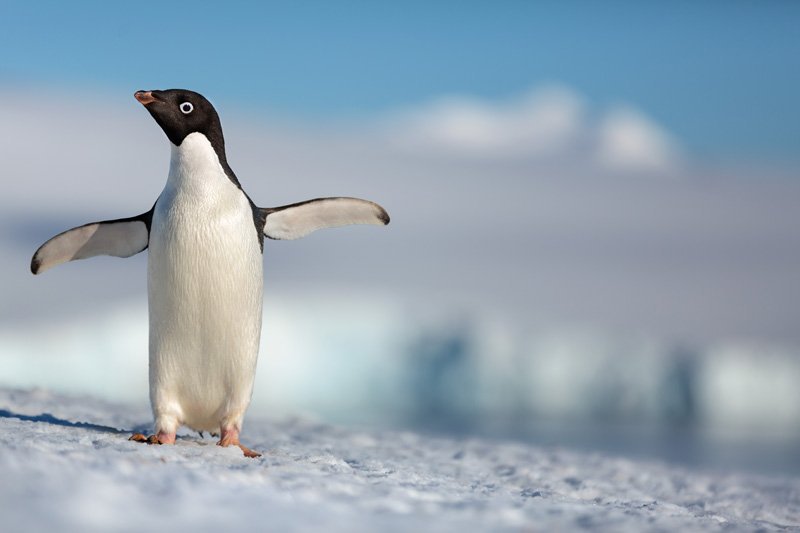
Ed Helms narrates this adventure, starring an Adelie penguin we’ll call Steve, who’s finally ready for his first mating season as a single-and-ready-to-mingle adult male.
On his long trek to the hookup point Steve passes through a tribe of his Emperor cousins, which reminds us that 1) this is like March of the Penguins, except different, and 2) Steve is a bit of a laggie.
But he catches up to the rest of the migrators, and after impressing a young coldie known as Adelene, Steve finds a mate and a new family. Together, Steve and Adelene must keep their chicks safe until they’re able to fend for themselves in the open sea.
The writing for this installment is less forced, with many of Helms’s asides for Steve (“She smells great! I gotta start working out…”) drawing chuckles without the added weight of manipulation that has hampered previous Earth Day episodes.
Directors Alastair Fothergill and Jeff Wilson (both Disneynature vets) hit all the right benchmarks in their 76 minutes: a penguin adventure that will delight the kids told through often breathtaking footage plus, for the adults, nostalgic odes to parenting and classic hits (Whitesnake! REO!).
And, per usual, stay through the credits for some nifty peeks behind the icy curtain.
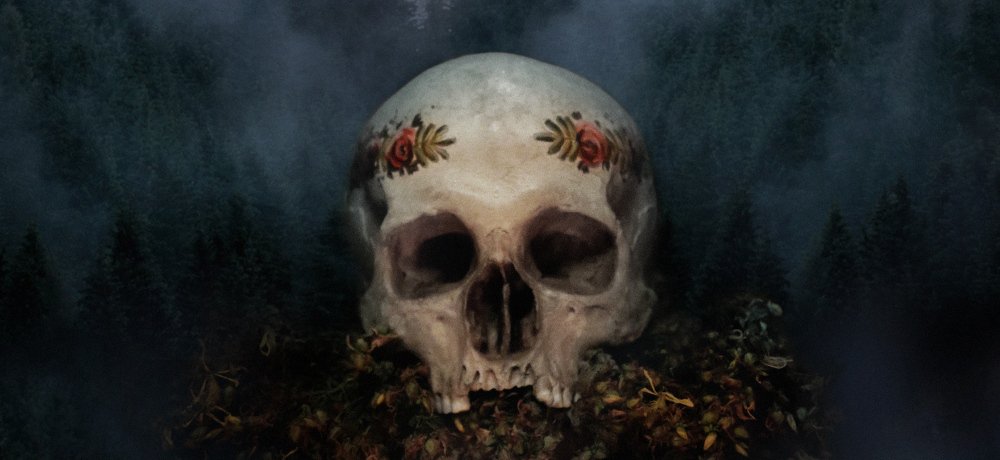
Making a remarkably assured feature debut as director, Lukas Feigelfeld mesmerizes with his German Gothic poetry, Hagazussa: A Heathen’s Curse.
Settled somewhere in the 15th Century Alps, the film shadows lonely, ostracized women struggling against a period where plague, paranoia and superstition reigned.
Young Albrun (Celina Peter) and her mother (Claudia Martini) make their way back to their isolated cabin before darkness falls. With a minimum of dialog and a maximum of atmosphere, Feigelfeld quickly establishes the dangerous isolation facing mother and daughter.
It’s an episode that will haunt Albrun well into adulthood, where she (Aleksandra Cwen) is now the single mother, still an outsider, still isolated from the village.
It would be easy to mistake the story Feigelfeld (who also writes) develops as a take on horror’s common “is she crazy or is there malevolence afoot?” theme. But the filmmaker’s hallucinatory tone and Cwen’s grounded performance allow Hagazussa to straddle that line and perhaps introduce a third option—maybe both are true.
Isolation, shunning and bullying lead to one tragedy upon the next. The village and its priest having deemed Albrun a witch, the line that defines the reality of the situation and the spiritual ugliness blur for both Albrun and the audience.
The film lends itself to a reading more lyrical than literal. Feigelfeld’s influences from Murnau to Lynch show themselves in his deliberate pacing and the sheer beauty of his delusional segments. One goat milking episode, in particular, is both startlingly erotic and disturbingly articulate of Albrun’s state of mind.
MMD’s ominous score strengthens the film’s overall sense of hypnotic menace, echoing sounds we’re not sure will frighten or comfort this mysterious woman at the center of the film.
Albrun’s is a tragic story and Feigelfeld crafts it with a believable loneliness that bends toward madness. He’s captured this moment in time, this draining and ugly paranoia that caused women such misery, with imagery that is perplexingly beautiful.
If you already know the name Nia DaCosta, the likely reason may be that Jordan Peele pegged her to direct the Monkey Paws-produced remake of 1992’s horror gem Candyman that’s due next year.
What had she done to so impress the new American emperor of horror?
Little Woods.
DaCosta’s feature directorial debut, which she also wrote, is not a horror film. It’s an independent drama of the most unusual sort—the sort that situates itself unapologetically inside American poverty.
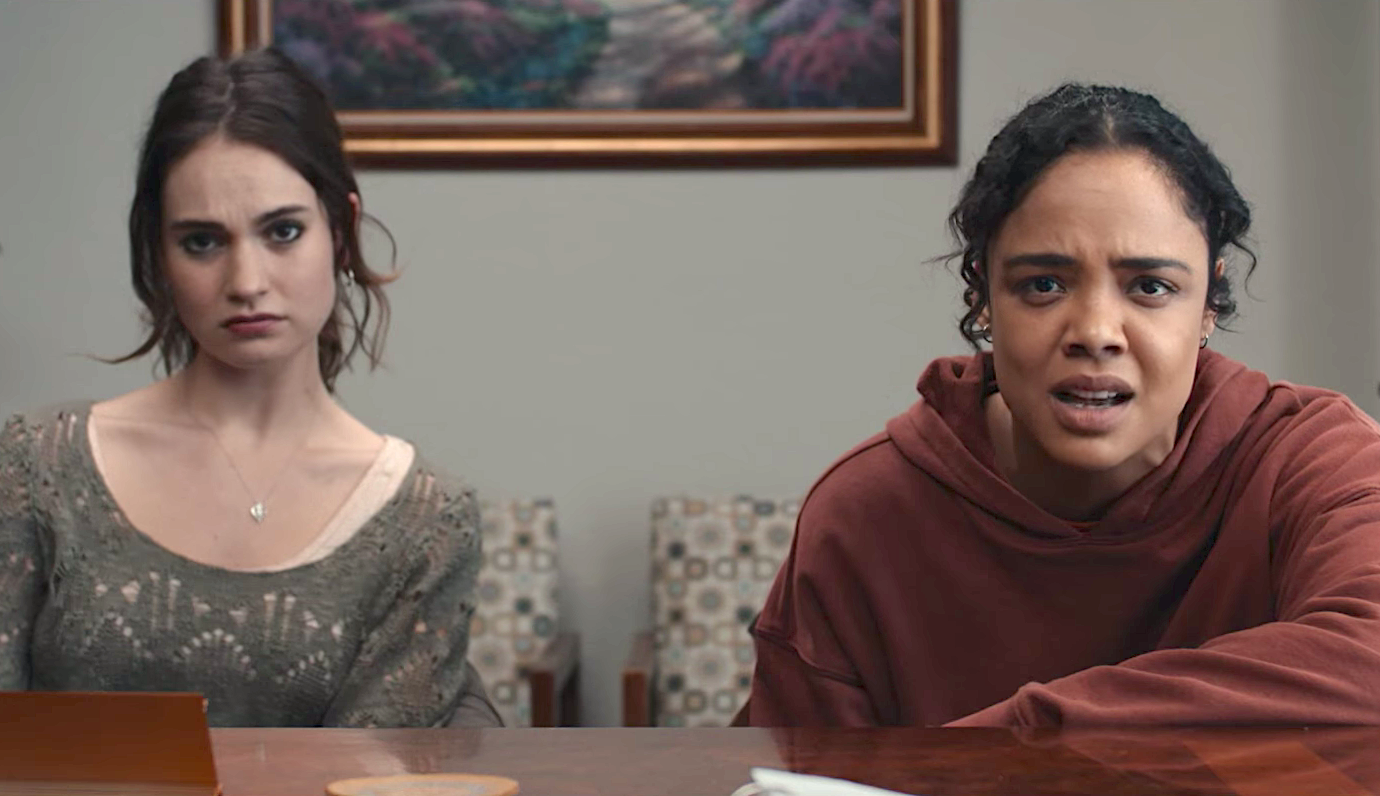
Tessa Thompson anchors the film as Oleander. She has 8 days left on her probation for running drugs across the Canadian border and she means to get the F out of her dead end town the first minute she can. Her sister Deb (Lily James) complicates things.
There is a predictability in the setup that DaCosta uses to betray your preconceived notions. While the traditionally structured narrative does its job to elevate tension, the characters within that tale veer wildly—or, authentically—from the expected.
This is less a film about the complicated pull of illegal activity and more a film about the obstacles the American poor face—many of them created by a healthcare system that serves anyone but our own ill and injured.
Films that honestly explore American poverty are scarce—The Florida Project, Frozen River, The Rider and very few others. Little Woods joins this list, all beautiful gut punch films that choose to present realistic tales with fully drawn characters rather than easy, noble tragedies.
The border crossing scene in Little Woods holds particular resonance, even more than it did back in 2008 when Courtney Hunt put Melissa Leo and her car on Frozen River‘s thin ice. Echoes of images from our own Southern border help to contextualize the nation’s narrative about saving society from the poor families and the criminals out to exploit our riches.
But politically savvy filmmaking is not the main reason to see Little Woods. See it because Tessa Thompson and Lily James are amazing, or because the story is stirring and unpredictable.
See it because it’s what American actually looks like.
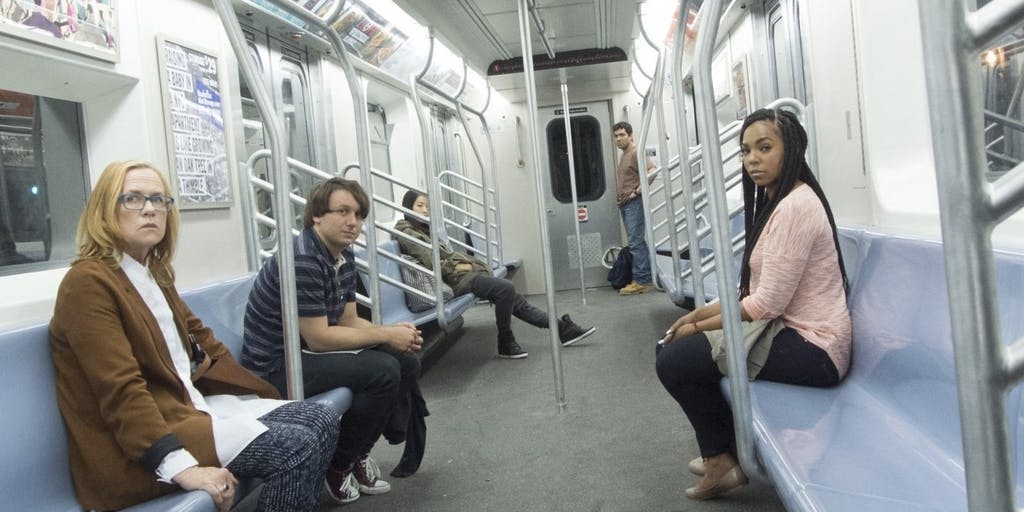
Based on the musical of the same name, director Michael Berry’s film Stuck is the story of six strangers trapped on a subway car who change each other’s lives in meaningful ways.
Or at least, that’s what the movie tries to achieve. Unfortunately, it doesn’t accomplish its goal.
The characters are all one-note stereotypes. During their time trapped on a subway car, they reveal their own prejudices toward each other, as well as huge details of their lives. The personal stories, the elements that attempt to make each character unique, are all shared through song. However, it’s easy to guess who each character will be because they’re roles we’ve seen many times before.
As each person shares a little more of themselves with the others, the characters’ facial expressions are meant to convey internal change. There are sympathetic looks, a few words of apology, but none of it feels like true growth. The characters who enter the subway car are the same characters when they leave the subway car.
One of the most frustrating elements of the film is the “all is forgiven” attitude toward one character who has been stalking another character for several days before the events of the film. Though we learn the intentions are “innocent,” it’s angering to watch as the other characters give him a pass because he’s a good artist.
The musical aspects here are the strongest elements. The choreography, the lyrics, the musical arrangements, and the performances are all effective, with the individual character songs among the only moments where genuine emotion is conveyed. The musical styles are unique to each character, giving them more depth than the dialogue conveys.
All the actors are strong singers, which is refreshing since several movies lately have featured actors who can’t sing well, or at all, in singing roles. It’s one of the areas where Stuck succeeds. Ashanti is particularly powerful in her vocal performance, though Giancarlo Esposito also stands out as an impressive vocalist.
Though Esposito sings several of the film’s songs, his character is the least explored. He isn’t given a backstory like the others, and it’s unclear if he’s meant to be a conduit for the others to reveal themselves or a character in his own right.
In a film like Stuck, the point is to never judge a book by its cover. The people we pass on the street everyday are dealing with things about which we will mostly likely never know. Hardships in their lives may be the reason why they’re impatient or cruel, so it’s a reminder to treat everyone with kindness.
It’s not a bad message. But it’s one that’s been delivered before in more effective ways.
These days, singers made from technology feel more like the rule than the exception. How cosmically right, then, that is it because of improved technology we can finally witness one of the world’s greatest singers at home with her genius.
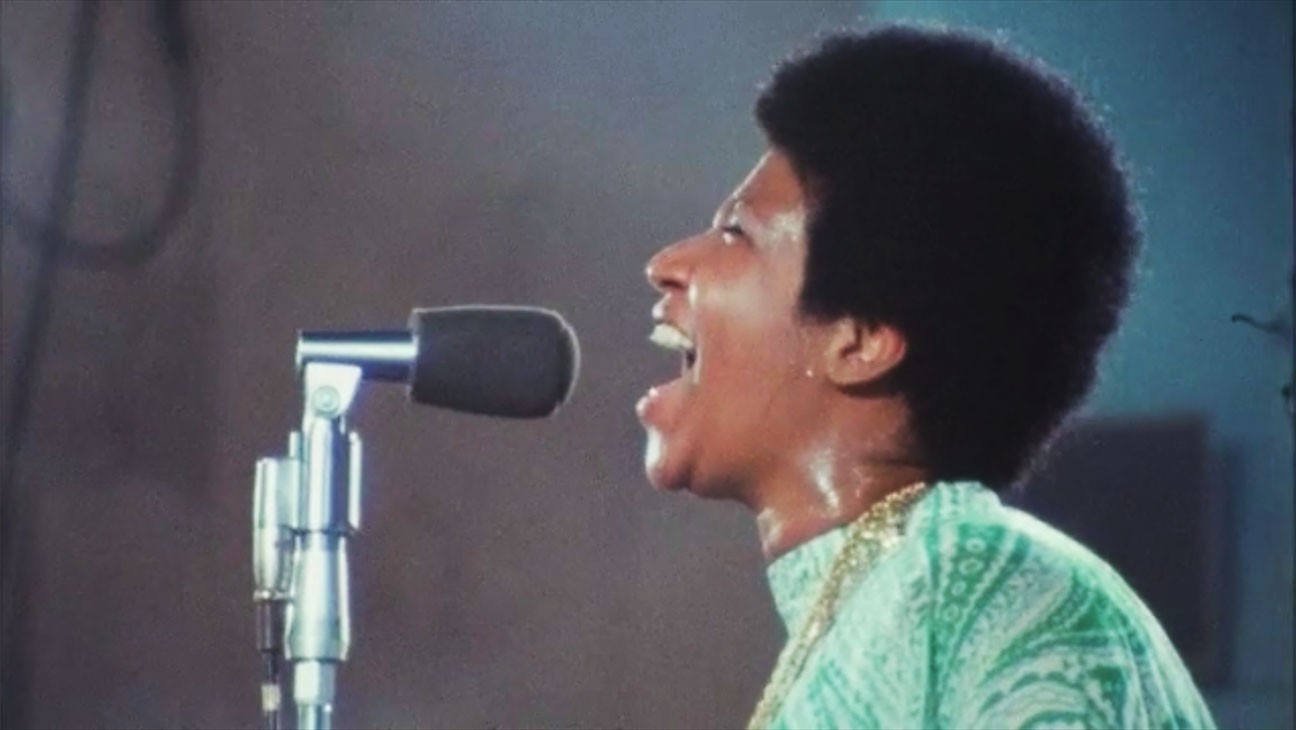
Already a living legend in January of 1972, Aretha Franklin wanted her next album to be a return to her gospel roots. Over two nights at the New Temple Baptist Church in Los Angeles, Aretha recorded live with the Reverend James Cleveland’s Southern California Community Choir as director Sydney Pollack rolled cameras for a possible TV special.
While it resulted in the biggest-selling gospel album in history, problems with syncing the music to the film kept the footage shelved for decades. Armed with the latest tech wizardry, producer/co-director Alan Elliot finally brings Amazing Grace to a glorious finish line.
Starting out by accompanying herself on piano, Aretha dives into gospel standards and modern medleys with a transfixing joy. As Rev. Cleveland (and later, Aretha’s father, the Rev, C.L. Franklin) sing her praises between songs, the Queen seems shy, almost embarrassed by the attention.
But when the music starts again, her eyes close and the beads of sweat dot her face, Aretha seems to be giving thanks for her gift, singing straight to the heavens with a soul-stirring euphoria that moves in brilliant unison with choir director Alexander Hamilton’s sublime ensemble.
To see her here is to see her at the absolute apex of her powers. taking that voice-of-a-lifetime wherever she pleases with an ease that simply astounds. Even with the recording session stop/starts that Elliot includes for proper context, Aretha’s hold on the congregations (which include the Stones’ Mick Jagger and Charlie Watts) is a come-to-Jesus revelation.
So is the film. It’s a thrilling, absolute can’t-miss testament to soul personified.
It’s the week of one-word movie titles. One of these couldn’t meet the high bar it set for itself, but it’s not such a bad movie. The other one is a bad movie. No question. Which is which? We’re here to clarify.
Lots and lots to cover in the Screening Room this week: Missing Link, Hellboy, Little, After, and Master Z: Ip Man Legacy. Plus just as many new home entertainment releases. Strap in!
According to my crack research staff (i.e. the twentysomething woman who was nice enough to talk with me after the show), Anna Todd’s After source novels began as fan fiction for the band One Direction.
That actually makes some sense, as Fifty Shades began as Twilight fan fiction, After‘s playbook is Fifty Shades lite (Fifteen Shades?) and I guess this is what we do now.
The smoldering Hardin (Hero Fiennes Tiffin – Harry Potter’s Tom Riddle) is a college student who’s “complicated, be careful!” Incoming freshman Tessa (Josephine Langford, showing moments of potential) isn’t careful, and in an instant is trading in her high school boyfriend and Mennonite-ready frocks for Hardin and one of his multiple Ramones t-shirts.
We’ve all seen this before, and so has Todd, whose story (adapted by Susan McMartin) checks off all the obligatory boxes for what is less a cohesive narrative and more a series of daydreams connected by desperately sensitive pop songs not by the Ramones.
Director Jenny Gage, whose All This Panic mined genuine young adult emotion, is powerless to shape this material into anything more than plug-and-play emptiness.
So after the slo-mo bad boy glances, the disbelief in love, the emotional moment in the rain, the ex who assures her what she did to him was fine, the assurances that someone finally sees her specialness and more, we get to the voiceover essay reading.
Of course we do, and when that essay tells us how deeply one character’s life has been changed by the other, it means nothing unless we’ve been shown some reason, any reason, to believe it.
It has been 15 years since Guillermo del Toro and Ron Perlman first brought Mike Mignola’s cat loving, iron fisted, soft hearted son of Satan to the big screen. You’ve got to feel for any filmmaker tasked with following in del Toro’s steps, especially when the film in question is a monster movie brimming with innocence and wonder. That is really his wheelhouse.
But Neil Marshall is no slouch. His first film out the gate back in 2002, Dog Soldiers, offered a wickedly funny war movie with werewolves. This gem he followed in 2005 with what may be contemporary horror’s scariest monster movie, The Descent.
Since then? Nothing to write home about. But that means he’s due for a comeback, eh? And Hellboy’s ready for a reboot. Right?
No to both.
The first difference you’ll note, maybe 15 words into the film with the first of many f-bombs, is that Neil Marshall’s Hellboy is rated R.
It’s also a horror movie, make no mistake. Hellboy is lousy with limb severing, blood gushing, intestine spilling action.
Also, it’s just lousy.
Hellboy (Stranger Things’s David Harbour, who does an admirable job) struggles against a prophesy and a lifetime in the shadows to decide his destiny for himself. Milla Jovovich is a witch. There is a boar monster, a scrappy teen medium, a were-cheetah and some seriously sketchy CGI.
Yikes, this movie looks bad.
There are those who will complain about Marshall’s gleeful gorefest, but not me. Demons ripping the flesh from the faces of innocents? Others may be hiding their eyes from the carnage, but what they’re mercifully missing is digital animation on par with Disney’s The Haunted Mansion (the 2003 film or the amusement park ride, take your pick).
Aside from two creepy images—one of Jovovich’s Blood Queen in flowing red robes beneath a shadowy, skeletal tree; the second a quick sideways glance into Baba Yaga’s pantry—Marshall’s vision is weak.
His storytelling is not much stronger. Working from a script by Andrew Cosby, the film opens with exposition, repeats that exact exposition midway through Act 2, and halts at least three additional times for one character to stand still and articulate a big block of story for us.
Often that character is dead and attached to the mouth of a young girl via a long, gurgly, worm-like body, which probably the most laughable element of the film.
Lesbians in horror have come a long way since Jesus DeFranco’s bloodthirsty nymphettes. In fact, we are now at the glorious point in history in which story leads can be lesbians for no particular reason—their sexual orientation not a metaphor for anything at all. They’re just characters. Nice!
There are so many great options that we had to leave many off. What were we looking for? Main characters whose sexuality is not showcased simply for titillation or as a twisted mark of the sinister. That doesn’t mean we’ve abandoned the villain, but if you’re looking for hot girl-on-girl action, well, yes, we have a bit of that, too, but who wouldn’t make out with Catherine Deneuve?
5. The Hunger (1983)
Director Tony Scott’s seductive vampire love story has a little bit of everything: slaughter, girl-on-girl action, ’80s synth/goth tunage, David Bowie. What more can you ask?
Actually the film’s kind of a sultry, dreamily erotic mess. Oh, the gauzy curtains. Catharine Deneuve is the old world vampire Miriam Blaylock—an inarguably awesome name for a vampire. David Bowie is her lover. But he suddenly begins aging, and she needs to find a replacement. Enter Susan Sarandon and her mullet as a medical specialist in unusual blood diseases and a fine actress who’s not above smooching other girls.
There are three reasons people will always watch this film: Bowie, Catherine Deneuve’s seduction of Susan Sarandon (classy!), and the great dark-wave Bauhaus number Bela Lugosi’s Dead. Together it’s a Goth Trifecta! And Goths do love them some vampires.
4. Thelma (2017)
We follow Thelma (Eili Harboe) through the uncomfortable, lonely first weeks of college we gather that her parents are very Christian and very protective.
Things could have gone all predictable and preachy from there, but co-writer/director Joachim Trier knows what you’re thinking and he plans to use it against you.
Thelma is a coming-of-age film at its cold, dark heart. The horror here lies in the destructive nature of trying to be something you are not, but here again, nothing in Thelma is as simple or cleanly cut as the beautiful framing and crystal clear camera work suggest.
Like Julia Ducournau’s magnificent coming-of-age horror Raw, Thelma dives into the issues swirling around post-adolescent freedoms and taboos in daring and insightful ways.
Thelma takes its time and lets its lead unveil a fully realized, deeply complex character full of contradictions—inconsistencies that make more sense as the mystery unravels. Though the result never terrifies, it offers an unsettling vision of self-discovery that’s simultaneously familiar and unique.
3. The Haunting (1963)
This may not seem like an obvious choice, but Theo (Claire Bloom) is a lesbian. And a great, badass character at that. That may not have been a widely held opinion when the great Shirley Jackson penned the novel in the fifties, or when the great Robert Wise directed the spooky and wonderful adaptation in 1963. But Mike Flanagan, director of the Netflix series based on the book, understood Jackson’s nuance and Wise’s subtlety and decided Theo would be out and proud. Good on ya, Flanagan.
In Wise’s original work, there is no overt mention of Theo’s sexuality, but there wouldn’t be, would there? It was 1963. Theodora is unmarried but refers to an “us” when discussing her home life. Her style, her confidence, her disinterest in being demure with the males, and the fact that Eleanor refers to her as “unnatural” all quietly make the case for us.
What’s great, though, is not just that a lead character is a lesbian, but that she’s a powerful and positive presence, and that she and Eleanor form a deep and supportive friendship. The Haunting (and Jackson’s magnificent novel) is about identity, and the fact that Theo is so very comfortable with hers is what makes this film an important addition to the list.
2. The Handmaiden (2016)
Director Park Chan-wook (Oldboy) mesmerizes again with this seductive story of a plot to defraud a Japanese heiress in the 1930s.
Weird is an excellent word to describe this film. Gorgeous and twisty with criss-crossing loyalties and deceptions, all filmed with such stunning elegance. Set in Korea, the film follows a young domestic in a sumptuous Japanese household. She’s to look after the beautiful heiress, a woman whose uncle is as perverse and creepy as he is wealthy.
Smart and wicked, stylish and full of wonderful twists, The Handmaiden is a masterwork of delicious indulgence.
1. Daughters of Darkness (1971)
Seduction, homoeroticism, drowsy lustfulness – this one has it all.
Countess Bathory—history’s female version of Dracula—checks into an all-but-abandoned seaside hotel. The only other guests, besides the Countess’s lover, Ilona (Andrea Rau), is a honeymooning couple.
Effortlessly aristocratic, Delphine Seyrig brings a tender coyness, a sadness to the infamous role of Bathory. Seyrig’s performance lends the villain a tragic loveliness that makes her the most endearing figure in the film. Everybody else feels mildly unpleasant, a sinister bunch who seem to be hiding things. The husband (John Karlen), in particular, is a suspicious figure, and a bit peculiar. Kind of a dick, really— and Bathory, for one, has no time for dicks.
Caring less for the victims than for the predator—not because she’s innocent or good, but because her weary elegance makes her seem vulnerable—gives the film a nice added dimension.
The accents are absurd. The outfits are glorious. The performances are compellingly, perversely good, and the shots are gorgeous. Indulge yourself.