I have always counted myself among the major fans of Kiwi horror filmmaking. Peter Jackson may mean Middle Earth to others, but to us he is king of splatter-gore comedy, and a generation of New Zealand horror filmmakers has embraced that same sense of viscous fun.
Not James Ashcroft. Nope, making his feature debut with the road
trip horror Coming Home in the Dark, the filmmaker is carving out a very
different style.
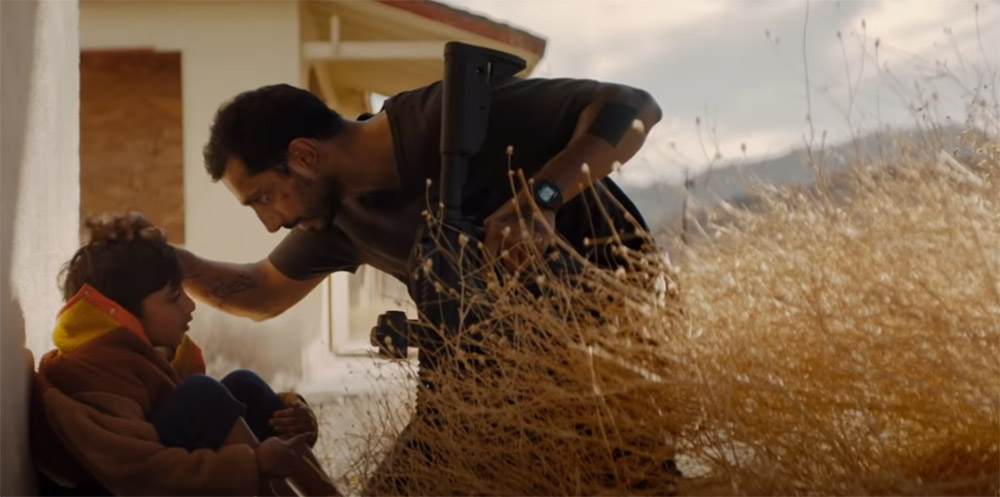
Not long into Hoaggie (Erik Thomson) and Jill’s (Miriama McDowell) weekend outing with their teenage sons, two armed drifters approach. The family is miles from anywhere, and it isn’t until they all stand by and let a car pass without incident that Ashcroft lets us in on two things.
“Looking back on today’s events, I think this will be the
moment you realized you should have done something.”
The moment Mandrake (Daniel Gillies, chilling) utters this sentence, Ashcroft lets you know that this story will not go well for the family. He also introduces the general theme of this film: do something while you have the chance.
Mandrake is the more talkative of the two villains, though friend Tubs (Matthias Luafutu) cuts an impressive figure. And in a style closer to that characteristic of Australian horror, Coming Home in the Dark offers a spare but unblinking span of gritty, punishing thrills.
Ashcroft, who adapted Owen Marshall’s short story for the screen
along with writer Eli Kent, crafts a deceptively layered drama. The trickiest
bit comes near the end, but it would be unfair to give that away.
Unfortunately, the audience has to be patient enough to wade
through what feels like preachiness to get to the sucker punch. Performances
are exceptional, loose ends are welcome, but with little in the way of visual
panache and lots in the way of discomfort, not everyone will stick it out.
I should confess that I firmly believe terror awaits anybody
who wanders out into the wilderness. I am the audience for this movie.
Murmurs, complaints, and whispers come in and out of focus as a camera meanders through an empty cemetery at midday: we hear souls telling the stories of their lives. We stop over the resting place of Christopher Moltisanti (Michael Imperioli). He has a tale to tell.
It’s a beautiful opening, spooky but with a bitter, familiar humor about it. With it, director Alan Taylor sets the mood for a period piece that lays the groundwork for one of the best shows ever to grace the small screen. The Many Saints of Newark brings Christmas early for Sopranos fans, but this is not exactly the story of Tony Soprano. In uncovering the making of the future, Taylor and writer Lawrence Konner invite us into the life of Uncle Dickie Moltisanti (Alessandro Nivola).
Nivola makes for an ideal choice to play the beloved “uncle.” The always reliable actor depicts the film’s central figure as the struggling, complicated result of his circumstances – an excellent theme given the film’s long game to uncover the forces that forged a future boss. In many ways, Uncle Dickie’s weaknesses, indulgences, strengths and goals create a mirror image of the Tony Soprano we would come to know over eight years and six seasons.
Longtime fans will have a bada bing blast recognizing familiar characters in their youth. Vera Farmiga is characteristically excellent as Tony’s formidable mother. John Magaro is a spot-on and hilarious Silvio, matched quirk for quirk by Billy Magnussen as Paulie Walnuts. Corey Stoll brings a younger but no less awkward Uncle Junior to life beautifully.
Of course, the one you wait for is young Tony, played with lumbering, melancholic sweetness by James Gandolfini’s son Michael. The resemblance alone gives the character a heartbreaking quality that feeds the mythology, but young Gandolfini serves Tony well with a vulnerable, believable performance that only expands on our deep investment in this character.
But the film is really more interested in those we never got to know: Tony’s father Johnny Boy Soprano (Jon Bernthal), Dickie’s father Aldo and uncle Sal Moltisanti (Ray Liotta, in two exceptional and very different roles), and stepmother Guiseppina Moltisanti (Michela De Rossi).
De Rossi and Leslie Odom Jr. (who plays colleague-turned-competitor Harold McBrayer) offer some of the most intriguing complexity and context in the entire film. The first half pokes holes in the “woe is me” backstory of the entitled white male Mafioso figure by spending some time with two characters who actually did have a tough go making a life for themselves in this community.
Taylor (Thor: the Dark World, Terminator Genisys, GoT) helmed nine Sopranos episodes, winning an Emmy for one, while Konner penned three solid episodes of his own, although his decades of work for the big screen has been mediocre at best.
But here the filmmakers combine for extended family drama that, despite one major plot turn landing as entirely illogical, weaves themes old and new in a ride that is often operatic and downright Shakespearean.
If the Sopranos family feels like family, turning back the clock on these indelible characters is just as giddy and delightful as it sounds. But The Many Saints of Newark impresses most by the balance it finds between fan service and fresh character arcs.
It’s an often cruel and bloody tale of wanton crime, treacherous deceit, family dysfunction and cold-blooded murder. And it just might be the most fun you’ll have at the movies all year.
Familial relationships can be a killer – especially in the hands of horror filmmakers. This week we look at the fraught relationships between fathers and daughters in horror movies.
5. We Are What We Are (2013, American)
As in Jorge Michel Grau’s original, one family’s religious custom is thrown into havoc when the family leader dies unexpectedly, leaving the ritual unfinished and the children left to determine who will take over. Both films look at a particularly religious family as a sort of tribe that evolved separately but within the larger population. Grau has better instincts for mining this paradigm to expose the flaws of the larger population, but Mickel takes an American Gothic tone to create an eerily familiar darkness that treads on common urbanite fears.
The always exceptional Michael Parks plays a gentle, rural doctor heartbroken over the years-old disappearance of his daughter and intrigued by some grisly bits unearthed by the recent flood. Meanwhile, the devout and desperate Parker family prepares for Lamb’s Day.
The film sets a tone that sneaks up and settles over you, like the damp from a flood. Mickel proves adept with traditional horror storytelling, casting aside any flash in favor of smothering atmosphere and a structure that slowly builds tension, and the impressive climax is worth the wait.
4. Dracula’s Daughter (1936)
Dad himself isn’t even in this film, but what Dracula’s Daughter does well is to depict the hold parents can have on us – if taken to beautifully melodramatic and metaphorical extremes.
Gloria Holden is the hypnotic and almost despondent daughter, Countess Marya Zaleska. After Von Helsing (spelled with an “o” in this movie for some reason) kills the Count, the Countess travels to London to steal the body, hoping to perform a ritual that would cure her of her own awful thirst.
Holden is wonderful, as is Nan Grey as the Countess’s first victim. Lambert Hillyer’s film suggests lesbianism as the shameful curse that can’t be cured – as many a Dracula film has pointed toward homoeroticism as the true curse of vampirism. Thanks to Holden’s melancholy performance, though, instead of feeling like some unwholesome threat, Marya’s desire for women feels more like something her father and now society has made her believe is shameful.
3. Train to Busan (2016)
We are always, always interested when a filmmaker can take the zombie genre in a new direction. Very often, that direction is fun, funny, political—but not necessarily scary. Co-writer/director Sang-ho Yeon combines the claustrophobia of Snakes on a Plane with the family drama of Host, then trusts young Su-An Kim to shoulder the responsibility of keeping us breathlessly involved. It works.
Kim plays Soo-an, a wee girl on a train with her overworked, under-attentive father (Gong Yoo). They are headed to her mother’s. The filmmaker will teach Dad what’s important in this life.
Sometimes funny, sometimes shocking, always exciting and at least once a heartbreaker, Train to Busan succeeds on every front.
2. Oldboy (2003)
A guy passes out after a hard night of drinking. It’s his daughter’s birthday, and that helps us see that this guy is a dick. He’s definitely not much of a father. He wakes up a prisoner in a weird, apartment-like cell. Here he stays for years and years.
The guy is Dae-su Oh (Min-sik Choi). The film is Oldboy, director Chan-wook Park’s masterpiece of subversive brutality and serious wrongdoing.
Choi is unforgettable as the film’s anti-hero, and his disheveled explosion of emotion is perfectly balanced by the elegantly evil Ji-tae Yu.
Choi takes you with him through a brutal, original, startling and difficult to watch mystery. You will want to look away, but don’t do it! What you witness will no doubt shake and disturb you, but missing it would be the bigger mistake.
1. The Host (2006)
Visionary director Bong Joon Ho’s film opens in a military lab hospital in 2000. A clearly insane American doctor, repulsed by the dust coating formaldehyde bottles, orders a Korean subordinate to empty it all into the sink. Soon the contents of hundreds of bottles of formaldehyde find its way through the Korean sewer system and into the Han River. This event – allegedly based on fact – eventually leads, not surprisingly, to some pretty gamey drinking water. And also a 25 foot cross between Alien and a giant squid.
Said monster – let’s call him Steve Buscemi (the beast’s actual on-set nickname) – exits the river one bright afternoon in 2006 to run amuck in a very impressive outdoor-chaos-and-bloodshed scene. A dimwitted food stand clerk (Joon Ho regular Kang-ho Song) witnesses his daughter’s abduction by the beast, and the stage is set.
What follows, rather than a military attack on a marauding Steve Buscemi, is actually one small, unhappy, bickering family’s quest to find and save the little girl. Their journey takes them to poorly organized quarantines, botched security checkpoints, misguided military/Red Cross posts, and through Seoul’s sewer system, all leading to a climactic battle even more impressive than the earlier scene of afternoon chaos.
If you have donated to our IGG fund, we thank you! If you have not and you care about horror movies (we know you do because you’re here!), women-led film and independent film, check out our awesome perks and give or share!
I never thought I would miss mumblecore, but here you have it. Co-writer/director Sean Daniel Cunningham transports us back to that time of slight, meandering plots, awkward vulnerability, and low-stakes white people problems.
The thing is, Hudson is pretty great.
As low-key as they come, Hudson follows two estranged cousins on a brief but somewhat eventful road trip one autumn day through Upstate New York. I mean, they don’t really leave the area – they go maybe a couple of hours from home, tops. A game of putt-putt becomes one of the most major events in the adventure. It’s not an edge-of-your-seat thriller is what I’m saying, but it is laid back, sweet and lovely.
Much of that is due to a spot-on performance in the title
role by David Neal Levin. Hudson is lovable, sweet and tender due to the recent
death of his mother. A middle-aged man still living at home, he mostly writes haiku
now, feeds his bird, maybe gets out a remote-control car. Levin’s performance
never mocks or belittles the character, never makes him the butt of a joke.
Then Hudson’s cool cousin Ryan (co-writer Gregory Lay) shows
up. He’s waiting to do some reshoots for his latest movie, has some time to
kill, missed the funeral but wants to hang out now.
The movie sinks or swims on the lived-in relationships. It’s like we’ve dropped into these lives mid-relationship until the cousins pick up a new friend who knows how to get them where they’re going.
Sunrise (played by producer Mary Catherine Greenawalt) gives the film, if not a jolt of energy, then maybe a quiver of it. Her presence allows the writers to explore the cousins’ personas and relationships more deeply, and offers more opportunities for good-natured if not gut-busting humor.
It’s a lovely film. It looks great, performances are solid in a very mellow way, and the resolution feels like a long-coming hug from a buddy. It’s nice.
Joseph swallows too loudly. His mother tells him so, which is just part of an uncomfortable family dinner where even eye contact is a chore.
Surge follows Joseph’s downward spiral during the hours after that awkward meal, when table manners become the least of his concerns.
Joseph (a mesmerizing Ben Whishaw) works security at London’s Stansted airport, where his days pass by with monotonous routine and lifeless social interaction. But unsettling encounters with two separate air travelers seem to puncture Joseph’s bubble of detachment, setting the stage for a 24-hour journey of primal indulgence.
In his feature debut, director/co-writer Aneil Karia leans heavily enough on handheld shaky cams and closeup framing to earn a warning for anyone triggered by such frenzied motion. Though this approach does work fine as a mirror to Joseph’s frayed psyche, and Paul Davies’s sound design is impeccably detailed, it’s really Whishaw’s Sundance award-winning performance that constantly keeps you invested.
The minimalistic script provides little insight into Joseph’s breakdown beyond the standard pressures of modern life and alienation. This keeps us at a distance as well, making it hard to relate to Joseph as much more than the latest guy who ate detergent.
Surge does have craftsmanship and style, leaving little doubt that Karia is a talented filmmaker with more deeply felt features in his future. But right now, he’s got a terrific actor to showcase, and that turns out to be just enough to get him by.
It’s not that Evan himself is hard to like, even flawed and unlikeable main characters can be ambitious and welcome. The real challenge for the big screen adaptation of Dear Evan Hansen is turning the young man’s choices into something truly hopeful and inspiring.
Evan (Ben Platt, whose Broadway performance garnered one of the musical’s many Tony awards) is a painfully shy, anxiety-ridden high school senior getting assignments from his therapist that involve writing letters to himself. Through a convoluted mixup that actually lands as plausible, one of those letters ends up in the hands of Connor Murphy (Colton Ryan), another troubled young man who can’t make friends.
When Connor takes his own life, his mother (Amy Adams) and stepfather (Danny Pino) read the letter and reach out to Evan, looking for comfort from someone they believe must have been their son’s best friend.
It’s a cruel and horrible lie, one that Evan ultimately indulges because it makes his own life better. Evan gains friends, he becomes close to Connor’s wealthy family while his own mother (Julianne Moore) works late to makes ends meet, and he gets alone time with Connor’s sister Zoe (Kaitlyn Dever), who just happens to be Evan’s longtime crush.
While the facade can’t last, it’s one that’s chock full of possibilities for another shallow YA specialness parade. But director Stephen Chbosky and writer Steven Levenson do manage to craft moments of truth that help offset the manipulative atmosphere.
Chbosky’s (The Perks of being a Wallflower, Wonder) choice to have the cast sing live is a smart one, bringing a needed intimacy to the music and giving Platt the chance to really impress. But while Chbosky often maneuvers into and out of the music with style, too many of those set pieces seem tentative, with only a few of the songs (“Requiem,” “Words Fail,” “So Big, So Small”) resonating beyond the frequent and generic “I feel seen” messaging.
Platt truly has a wonderful voice, but he has trouble trading what served him so well on the stage for a more nuanced film approach to emoting. Yes, at 27 Platt is a bit too old now for the role, but that’s less of a problem than surrounding him with such authentic screen talent. As Evan becomes less of an awkward outcast, Platt’s screentime with Adams, Moore and especially Dever (who gives the film its most honest moments) only highlights a need for understatement that Platt and Chbosky don’t address.
At a robust 137 minutes, Dear Evan Hansen has plenty of time to grapple with the moral conundrum at its core, but ultimately falls just short of the more universal insight it seeks.
The film shows us teens that are stressed and over-medicated, with feelings of inadequacy compounded by social media expectations and misunderstood by families and peer groups. Then when tragedy occurs, the shock opens avenues for exploitation and personal gain. Evan takes one of them.
There are teachable moments there, and the soaring melodies of Dear Evan Hansen will put occasional lumps in your throat. But is Evan’s journey a thoughtful and cautionary parable, or a shameless exploitation in itself?
In the end, neither. Much like its flawed main character, it’s a mess of awkward and misplaced intentions, as likely to generate facepalms as it is a loving embrace.
A quick synopsis of The Starling, the new drama from Hidden
Figures director Theodore Melfi, brims with potential, offers an
appealingly messy notion.
Lilly (Melissa McCarthy) and Jack (Chris O’Dowd) are
suffering, silently and separately, about a year after the death of their baby
girl. Jack waits out his grief in an institution while Lilly tries to tough it
out on her own. Eventually she decides to plant a garden, but a territorial, dive-bombing
starling makes that difficult. She turns to psychologist/veterinarian Larry
(Kevin Kline) for help.
That’s a lot to unpack, but when the core theme is grief,
complications are welcome. Hollywood tales of grief and relief tend to be too
tidy, the metaphors too clean, while the unruly emotion being presented is
rarely tidy or clean in real life. A good mess is called for.
Unfortunately, The Starling is not a good mess. Just
a regular old mess.
Matt Harris’s script never digs below the surface — not even
when Lilly is gardening. Melfi relies on the score to represent emotional
weight rather than leaning on his more-than-capable cast to depict that grief.
An anemic comic-relief subplot at Lilly’s gig managing a grocery store feels
wildly out of place and wastes real talent. (Timothy Olyphant has four lines –
funny lines delivered via a character that should be on a TV sitcom, not in
this movie.)
O’Dowd — who was the absolute picture of grief in John
Michael McDonagh’s masterful 2014 film Calvary – fares the best with the
material. Even though his character’s resolution feels unearned, there is heft
in the performance that allows human emotion to overcome a weakly written
character.
McCarthy suffers most, though. Unable to ad lib her way toward elevating a drama, she sinks beneath the unrealistic banter between Lilly and Kline’s Dr. Larry. Kline is solid, strangely aided by Harris’s weak characterization, which allows the actor to find a groove that conveys more than what’s on the page.
Moments of genuine emotion punctuate the film and, while welcome, they mainly serve as a reminder of what The Starling had the potential to become.
In the small village of
Nazareth, in the tiny Kingdom of Lesotho, a man recounts the wisdom his father
once gave to him. “My son, what they call progress…It is when men point their
damning finger at nature and proclaim conquest over it.” It is that poisonous
progress that the people of Nazareth are fighting against in This Is Not a
Burial, It’s a Resurrection, and it is a losing battle.
The
film follows 80-year-old widow Mantoa. After the death of her last surviving
child, she finds herself utterly alone and mired in grief. The story unfolds
like a mythic, dark fairytale with beautiful vignettes and discordant music.
Director Lemohang Jeremiah Mosese carries us from moment to moment as Mantoa
repeatedly has to contemplate her grief. Though she resigns herself to simply
wait to be buried alongside her family, a new challenge arrives with a blazer
and a megaphone. The village will be relocated, a dam will be built, their
fields will be flooded.
What
of the dead? What of Mantoa? The elderly woman convinces the village to resist
the spinning wheels of progress. Together they seek to find what is left for
their community in the land where their dead are buried. Twice we are reminded
that Nazareth is the name that new settlers gave the land. Before that, it was
always known as the Plains of Weeping.
Jerry Mofokeng delivers a reverent and deeply sad narration of Mantoa’s struggles. Using the framework of a narrator, with a different voice and perspective than Mantoa, further perpetuates the storybook feel. But this is not a happy children’s tale. This is a story about capitalism’s infinite reach. This is a story about grief, culture, and perseverance. This is a story about the dead.
Mary Twala is phenomenal in her final role as Mantoa. Her emotion is palpable even when she sits in silence. Her rage and her pain don’t slow the narrative or taint it with bitterness. Instead, Twala propels Mantoa with the depths of her grief. She is an absolute powerhouse, and the film would not succeed as well as it does without her.
And the film does succeed. It is incredibly beautiful, rich with color, light, and shadow. Every scene is a haunting painting. The cast, mixed with actors and non-actors alike, brings you to witness the erasure of a real place and real people, and you mourn with them. When Mofokeng intones that the dead buried the dead, he reflects on a village that will soon be hidden under water.
Though the people of Nazareth still live, something about them will be lost forever. They are some of the last of their kind as new roads, and new buildings, and new dams continue to creep into the quiet places of the world. Progress fills up little villages with the walking dead as ways of life are washed away.