All posts by maddwolf

Fright Club: Best Foreign Language Folk Horror

We were so inspired by Kier-La Janisse’s documentary Woodlands Dark and Days Bewitched that we decided to dive into some of the best films her 3+ hour documentary couldn’t spend much time on. In particular, we wanted to highlight some of the greatest folk horror films not in the English language.

We highly recommend Roh (2019, Malaysia), La Llorona (2019, Guatemala), and Luz, The Flower of Evil (2019, Colombia). But here are our five favorites:

5. Viy (Russia) (1967)

Drunken seminarians, farmhouses, witches – Viy sets you up from its opening moments for a classic folk tale. Three seminarians turned out for break get lost in the woods. They ask an old lady to let them sleep in her barn for the night. She’s not an ordinary old lady.

Konstantin Ershov and Georgiy Kropachyov’s silly, spooky yarn tells of class struggle and superstition. Poor Khoma, our bumbling, drunk hero, is screwed no matter what he does. State/religious authority will beat him, the wealthy will beat him, or supernatural evil will harm him in ways he can’t quite picture.

Even though there’s a clear element of silliness in this film, the core image of a man in over his head gives this Russian folk horror a punch.

4. November (Poland) (2017)

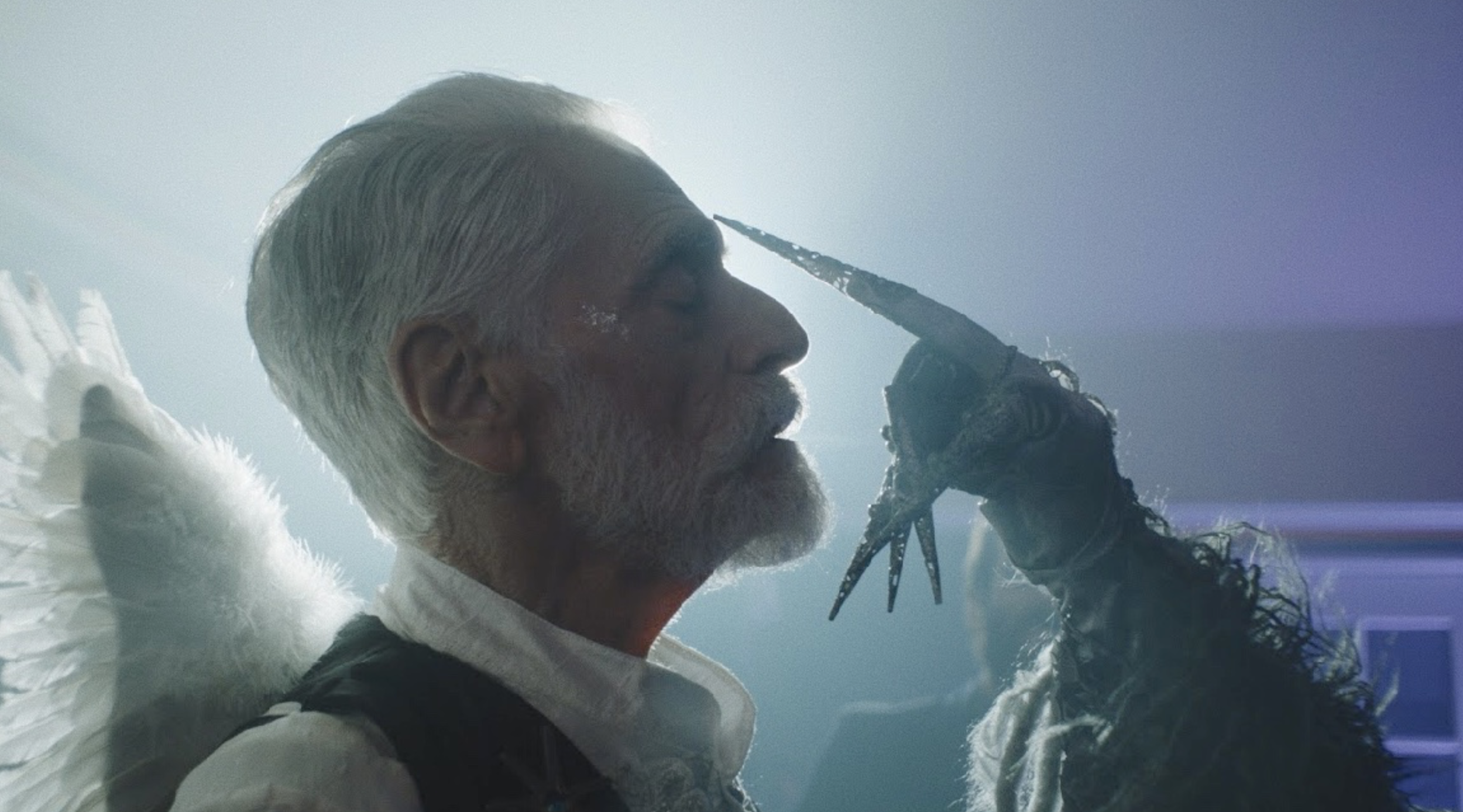
Imagine a world in which Bergman’s Seventh Seal made it with Burton’s Edward Scissorhands and you kinda get a sense of Rainer Sarnet’s November.

At the center of the film lies the unrequited love of two peasants. Liina (Rea Lest) is hopelessly in love with Hans (Jörgen Liik). Hans has the hots for the daughter of the local German baron. Lina and Hans each try to capture the attention of their beloved while communing with ghosts, employing the services of kratts and witches, managing lycanthropy, evading the plague, circumventing arranged marriages, and avoiding starvation during the impending long winter.

The movie is a mishmash of comedy, romance, fantasy, political theory, and philosophy all shot in exquisite black and white. Somehow it comes together, like the kratts, in a way that seems fresh, bizarre, and interesting.

3. Hagazussa (Germany) (2017)

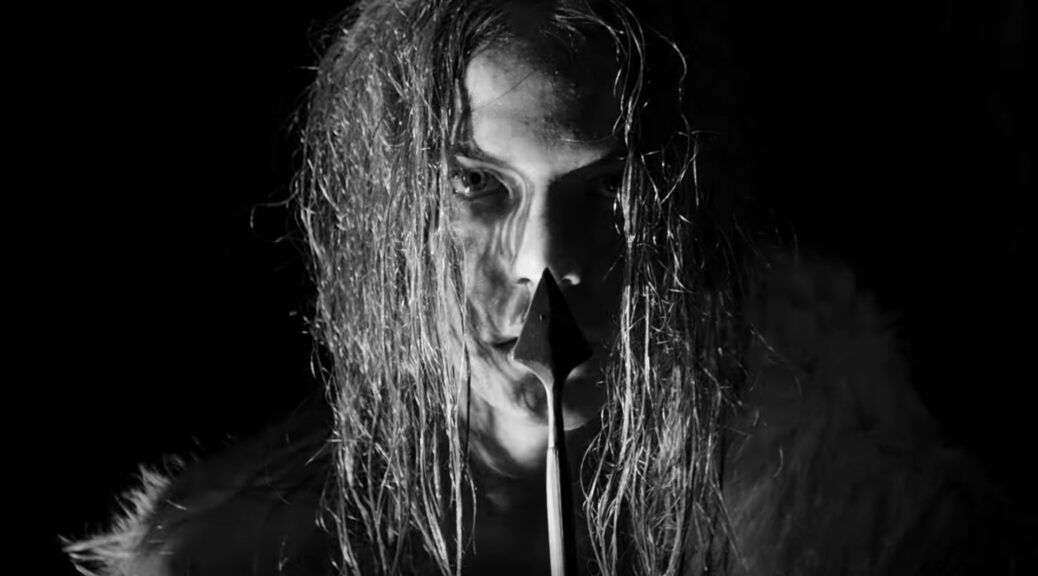
Making a remarkably assured feature debut as director, Lukas Feigelfeld mesmerizes with his German Gothic poetry, Hagazussa: A Heathen’s Curse.

Settled somewhere in the 15th Century Alps, the film shadows lonely, ostracized women struggling against a period where plague, paranoia and superstition reigned.

It would be easy to mistake the story Feigelfeld (who also writes) develops as a take on horror’s common “is she crazy or is there malevolence afoot?” theme. But the filmmaker’s hallucinatory tone and Aleksandra Cwen’s grounded performance allow Hagazussa to straddle that line and perhaps introduce a third option—maybe both are true.

The film lends itself to a reading more lyrical than literal. Feigelfeld’s influences from Murnau to Lynch show themselves in his deliberate pacing and the sheer beauty of his delusional segments. He’s captured this moment in time, this draining and ugly paranoia that caused women such misery, with imagery that is perplexingly beautiful.

2. The Wailing (South Korea) (2016)

“Why are you troubled?” Jesus asked, “And why do doubts arise in your hearts? Look at my hands and my feet. It is I myself. Touch me and see — for a spirit does not have flesh and bones, as you see I have.”

Though the true meaning of this quote won’t take hold until the final act, it presents many questions. Is this film supernatural? Demonic? Or, given the corporeal nature of the quote, is it rooted in the human flesh?

Yes.

That’s what makes the quote so perfect. Writer/director Hong-jin Na meshes everything together in this bucolic horror where superstition and religion blend. The film echoes with misery, as the title suggests. The filmmaker throws every grisly thing at you – zombies, pustules, demonic possession, police procedural, multiple homicides – and yet keeps it all slippery with overt comedy.

1. Lamb (Iceland) (2021)

Among the many remarkable elements buoying the horror fable Lamb is filmmaker Valdimar Jóhannsson’s ability to tell a complete and riveting tale without a single word of exposition. Rather than devoting dialog to explaining to us what it is we are seeing, Jóhannsson relies on impressive visual storytelling instincts.

His cast of three – well, four, I guess — sells the fairy tale. A childless couple working a sheep farm in Iceland find an unusual newborn lamb and take her in as their own child. As is always the way in old school fables, though, there is much magical happiness but a dire recompense soon to come. It is an absolutely gorgeous, entirely unusual and expertly crafted gem of a film. You should see it.
Screening Room: Turning Red, The Adam Project, Fear, The Seed & More

New Kid in Town

Fear (Strah)

by George Wolf

Okay, Fear. So what are we afraid of?

Writer/director Ivaylo Hristov takes a measured, confident approach in attacking the question at its roots, ultimately arriving at answers that are as universal as they are intimate, as tragic as they are timely.

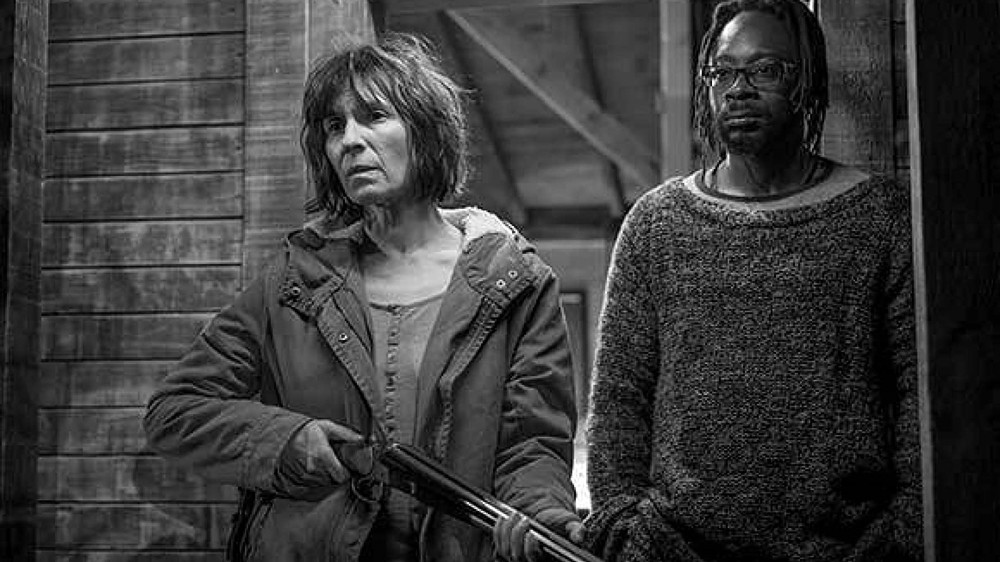
Svetla (Svetlana Yancheva, terrific) is a widow who lives alone in Bulgaria, very close to the Turkish border. Her sour mood is not improved by the loss of her job at the local school, or by the threat of refugees arriving in her village.

Armed with her hunting rifle when she crosses paths with Bamba (Michael Flemming, warm and wonderful), Svetla takes him prisoner. Bamba is a refugee from Africa, traveling on foot to Germany in search of a peaceful life. Svetla’s plan is to turn Bamba over to the border police, but a recent roundup of several Afghan refugees means they have no room in their modest quarters .

So Svetla takes him home.

The language barrier between them leads to some sweetly humorous moments, and of course Svetla comes to find Bamba is a gentle, intelligent soul who is fleeing a horrific situation, and who poses a threat to no one.

The village full of white faces feels differently.

“We are a hospitable people, but Bulgaria belongs to the Bulgarians.”

And what the village folk fear is more than just people who aren’t like them. Anyone who doesn’t share in their fear is also not to be trusted, and also deserving of whatever provocation it takes to make the villagers feel justified in their bigotry.

You’ll recognize early some of the places Hristov is taking you, but his touch is understated, which always makes the punches land that much harder. And while Fear is a film that doesn’t pretend to have the answers to the global issues on its mind, it does seem to have a firm grip on the basic question at the heart of these matters.

And that’s a start.

New Moon

Moon Manor

by Tori Hanes

“I’ve always thought it was the dumbest thing… people miss the one party where everybody gets up and says how great they are.”

The debut film for directing pair Machete Bang Bang and Erin Granat, Moon Manor follows the extraordinary life and death of James “Jimmy” Carrozo (played by Carrozo himself).

Centering around his “FUN-eral,” the world orbits Jimmy on his last day alive before taking his life as a final solution to his progressing Alzheimers. Lamenting to bright-eyed reporter Andrew (Lou Taylor Pucci), caretaker Remy (Reshma Gajjar), and death doula Fritti (Debra Wilson), Jimmy recounts his warm and fantastical past in relation to his cold, calculated end.

Thanks to the co-directors’ keen interest in the uncomfortable, the journey takes an unflinching stance toward the absurdity of death. Relishing in disjunct emotions, the directors play between amusing and terrifying drug-inspired hallucinations.

Helming this voyage is Carozzo, with a heroic performance as a man thoroughly finished with life but unsure of death. Carozzo’s semi-autobiographical character subtly asks the audience to consider their own mortality and the morality surrounding it. Through a masterful blend of performance and directing expression, Jimmy’s reality becomes your own.

Within the first few moments, the film leaves no audience member unscathed. However, the interesting perspective gets lost to meandering. Too many tertiary acquaintances are given half-baked plots, which take away from the soul of the story. 

Ultimately, the piece finds its power by exploring the tangled emotions of the characters closest to the impending death. When the directors are able to shed the unnecessary weight, they find the beauty in Jimmy’s story and, in turn, his death. 

The film ends as most human experiences do: messily, with loose ends unevenly tied. But yet, we feel seen. Through the example of one man’s convoluted final journey, sorrow, joy, terror, humor, and absurdity find a place to flourish harmoniously. While you may not feel comfort by the answers Moon Manor offers, you will feel painfully human.

Is This Thing On?

Heckle

by Brandon Thomas

You’ve only had to pay half attention to the entertainment world during the past few years to know that a lot of high-profile comedians have been outed as scumbags. It’s probably the worst kept secret in the industry. From Louis C.K. to Bill Cosby, a lot of comedy titans came under fire for their bad – or even criminal – behavior. 

This landscape seems ripe for a darkly comedic horror flick. Unfortunately, Heckle lacks the laughs or the scares to do this topic justice. 

Stand-up comedian Joe Johnson (Guy Combes) is riding a wave of success. His tours are popular and he’s about to star in a major film playing tragically murdered comedy icon, Ray Kelly (a supremely foul-mouthed Steve Guttenberg of Police Academy and Cocoon fame). All of that starts to crash as a particularly nasty heckler worms his way into Joe’s psyche. As his mental state begins deteriorating, Joe starts to believe that his physical well-being is also in danger from the obsessive heckler. 

Heckle spends a lot of time easing the audience into Joe’s world and his inner circle. Joe’s supposed to be this “big deal” comedian, yet the character is never really shown to be funny. The same process is used for Guttenberg’s character. The abrasiveness of the characters becomes the focal point to the detriment of everything else. It’s hard to buy this grand world of comedy legends if none of them are actually that funny.

The horror aspect suffers in the same regard. Nothing much happens for the first two-thirds of the film. There are some weak attempts to show Joe’s psychological decline, but none of it is particularly scary or thrilling. Mostly, these scenes come across as wheel-spinning to pad out an already short running time. By the time the actual carnage begins in the last act, it’s too little, too late. 

Heckle is full of starts and stops. The movie never quite knows if it wants to be a full-on horror film, a biting satire of the stand-up world or a comedy. Unfortunately for the audience, Heckle never truly succeeds at doing any of the three. 

Mojave Monster

The Seed

by Hope Madden

It’s got a little Brian Yuzna, definitely some Larry Cohen, a touch of Eraserhead, and the exact set of Revenge. Plus, sci-fi/horror flick The Seed maintains maybe the single most used premise of the last few years: three friends rent a place to stay and bad things happen.

There’s nothing necessarily wrong with that. A small cast and limited locations are just smart plays for an independent filmmaker working with budget confinements, and there are moments when writer/director Sam Walker transcends such trappings.

Just not many.

Vampy social influencer Diedre (Lucy Martin), her somewhat vapid bestie Heather (Sophie  Vavasseur), and their down-to-earth pal Charlotte (Chelsea Edge) head to a luxurious, isolated spot in the Mojave desert and witness a meteor shower.

It’s gorgeous, but now their phones are on the fritz, which means they can’t call an uber or get in touch with civilization at all. Worst of all, there’s some stinky dead armadillo bear thing oozing all over their pool deck.

There’s no question Walker is a fan of late 80s horror. The social media angle is the only element of The Seed that feels like it wasn’t hatched in 1985, actually. Walker goes for a sharpness in the color that does call Yuzna to mind, and attempts at social satire by way of body  horror link Cohen as well.

Walker just doesn’t seem to know where to go with it all.

Martin does. She elevates tired mean girl dialog and cuts an exceptional narcissistic presence. Both she and Vavasseur find the comedy in the script, and their bickering buddies often entertain.

Edge is the weak link, which is unfortunate because – given the 1980s roots and the wholesome character – she’s telegraphed early to be the film’s hero.

The fact that The Seed is set in the exact house Coralie Fargeat used to gorgeous, bloody extremes in her 2017 treasure Revenge only makes you want to see Walker do more with his location.

So little about this film feels fresh and that retro vibe only carries it so far. The beast itself is sometimes laughable, but not often enough to be fun, which is par for the course with the film. Walker wades into dark comedy/satire territory for the first two acts, then abandons it entirely for a dusty, predictable, humorless finale.

My Panda, My Choice

Turning Red

by George Wolf

With baseball still on hold for this year, it’s safe to say the most impressive batting average out there still belongs to Pixar. Twenty-four films in, and seeing that name at the top of the poster still has me expecting excellence.

Turning Red – Pixar’s twenty-fifth – keeps the winning streak alive with a frisky, meaningful and culturally rich update of a well worn message.

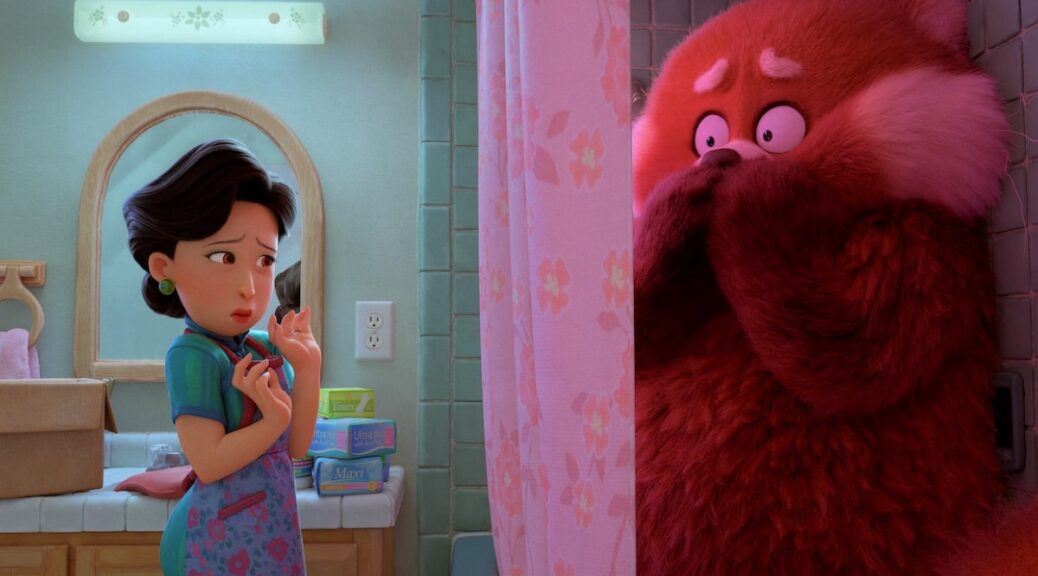
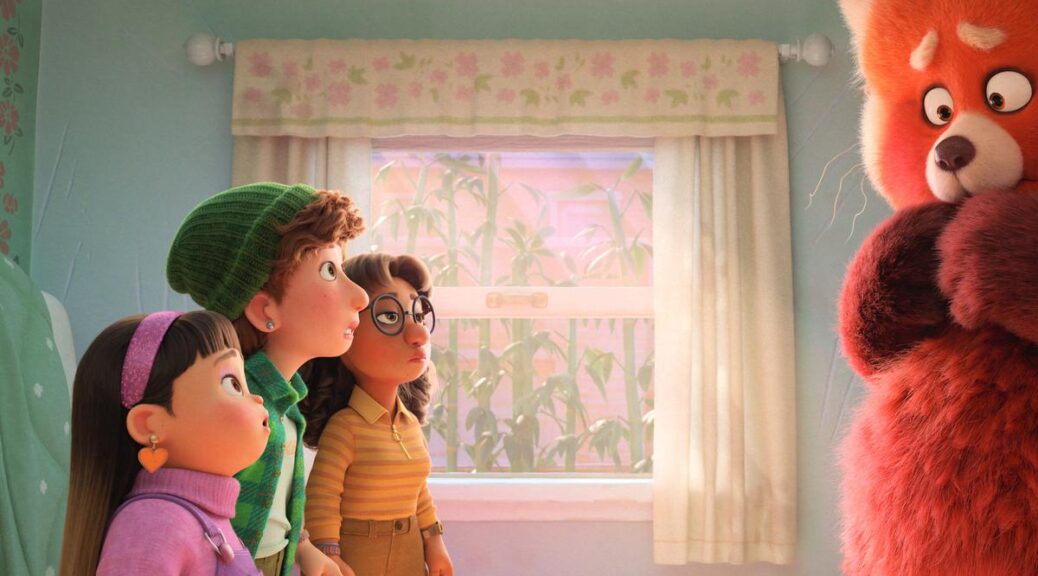
Meilin Lee (voiced by the completely captivating Rosalie Chiang) is a 13 year-old honor student in Toronto circa 2002. She loves math, her besties (Miriam, Priya and Abby), and the 5 singers in “4-Town” (the boy band craze is the most likely reason for the early 2000’s time stamp).

But above all, Mei lives by one rule: honor your parents!

Yeah, um…that rule is going to get tested when 4-Town comes to Toronto just as Mei’s world turns completely upside down.

Mother Ming (Sandra Oh) has never disclosed the “quirk” in their family history, and now it’s staring back at Mei from the bathroom mirror. The mystical powers wielded by ancient ancestor Sun-Ye promised that one day Mei would awaken as a giant red panda. That day has come, and once Ming understands it’s not that other red visitor that has her daughter locking doors in panic, Mom explains.

Strong emotions will release Mei’s inner panda, so she must keep a calm demeanor until the family can gather and perform the ancient Chinese ritual that will banish that bear forever.

Stay calm? Now? The 4-Town show is coming up, and the girls have to score some tickets without helicopter Ming finding out! And there’s this bully at school that needs to be taught a lesson! Plus, that dreamy Devon at the Daisy Mart has Mei feeling some strange new feelings…

Sure, the panda is a cute metaphor for the raging hormones of puberty, but director Domee Shi (who also co-writes with Julia Cho) has much more to offer in her feature debut. Here, the often generic moral of “be true to yourself” plays out with stakes that will feel authentic to both kids and parents. Pixar has a long history of finding true poignancy amid big laughs, but Turning Red feels like a turning point.

Not only is it the first Pixar film with a female director, women are also in leadership roles throughout most areas of the production. The mission was clearly to begin speaking to a slightly older target, with a tender honesty that adolescents – girls especially – could appreciate.

Mei’s feelings of pressure and confusion are laughed with, not laughed at, and her first fantasies of physical romance are presented with a refreshing, relatable warmth.

There’s also fresh air blowing through the animation department, realizing Shi’s self-described “Asian ‘tween fever dream” with an aesthetic that yearns for the big screens the film is not getting. Mei’s world is alive with modern vibrancy, yet full of bursts that recall more classic animation styles, including hand-drawn and slo-motion sequences, as well as eyes and mouths that suddenly pop open wide with anime homages.

Effervescent pop songs by Billie Eilish and Finneas O’Connell (who also voices 4-Town’s Jesse) blend joyously alongside Ludwig Göransson’s more traditional score, completing the film’s perfect ecosystem of subtext.

Respect the past, but embrace the possibilities of the future. That future is going to include parts of your true self that are messy, and that’s okay. In fact, accepting those awkward, messy parts is the first step to being okay.

Really, the most disappointing thing about this film is that it’s going straight to Disney+. A theater experience might make the promise of mother-daughter bonding feel even more memorable, if not downright eventful (as the trips to see the first Toy Story were for my son and me).

But Turning Red finds Pixar with a healthy and welcome new approach to its lineup. So wherever it’s found, that’s more than okay.

A Slow Slack through China

Striding into the Wind

by Christie Robb

Director Shujun Wei starts this film with a shot of identical white sedans slowly completing a set driving course. The cars follow each other down the established path until one jerks to a stop for a moment before peeling away, erratically weaving in and out of the course until the driver jumps out and runs away.

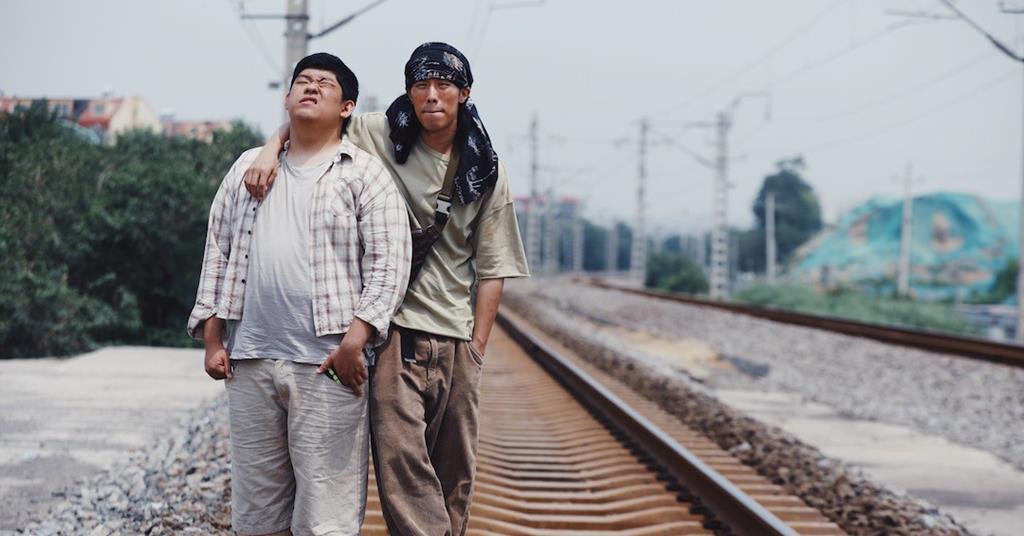
It’s a metaphor for the protagonist Kun’s (You Zhou) approach to life. A film school student studying to be a sound engineer, Kun takes his dad’s money and invests in a ’97 Jeep despite failing to obtain a license. The film, co-written by Shujun Wei and Gao Linyang, follows Kun as he and the Jeep erratically weave in and out of the life path others attempt to set.

As is the case in other slacker films, it’s clear here what Kun doesn’t want. But it’s unclear if he has anything in the way of a vision for himself and his future. Like a toddler having a tantrum, Kun wants to break what he doesn’t like, but he lacks the ability to envision what would make him happy. So all his flailing around results in quite a bit of self-harm.

Eventually, Kun, his mullet, and his Jeep make their way out of Beijing and out into the countryside of Inner Mongolia for a film shoot, suffering an escalating series of misadventures and indignities along the way.

Very slow in its pacing, the film’s best moments are Shujun Wei’s wry presentation of the Chinese film industry. It serves up amusing caricatures of crew members—the video guys who can’t be quiet enough to capture ambient sound, the needy director requesting reassurance that his aesthetic sensibilities are up to snuff, and the lead actress trying to make sense of vague instructions while rebuffing the advances of her co-workers.

In the end, it’s a solid enough entry in the manchild coming-of-age genre, even if the ending tends toward the bleaker edge of the spectrum.

Jacking and Jilling

Adventures in Success

by Rachel Willis

Fair warning – this film may be the most unpleasant experience you’ll ever have with the female orgasm.

Writer/director Jay Buim, along with co-writers Susan Juvet and Rachel Webster, has crafted one of the most uncomfortable, meandering and sometimes funny mockumentaries with the film Adventures in Success.

Focusing on the group Jilling Off, we follow “energy transformationist” Peggy (Pegasus) Appleyard (Lexi Mountain) as she leads a group of men and women to the Catskills to harness the energy of the female orgasm in “the womb room.”

Joining this group is newbie Erica (Yaz Perea-Beltran). At first, Erica’s seeming skepticism makes her feel like our straight woman among these guys and gals who use terms like “economic ejaculate.” A hilariously uncomfortable scene involving the extreme invasion of Erica’s personal space by another member is one of the film’s highlights.

There are several scenes that are so uncomfortable you can’t help but laugh. Otherwise, you might spend most of the film squirming in your seat.

As Peggy, Mountain embraces the role of sex goddess guru, and the film is better for it. A personal highlight was Peggy’s cover of Bruce Springsteen’s I’m On Fire, but it’s mostly a moment that doesn’t fit well into the overarching story. The movie is full of these, as if the writers didn’t know how to fill 90 minutes about a group whose sole purpose is ‘jilling off.’

Another downfall is the fairly large cast of characters – not just the Jilling Off members, but townspeople who pop up from time to time (many more than once), usually to give their two cents on the group who’s descended on their town. It’s hard to keep track of everyone.

The film tries to make you care about the members of the cult, but so much time is spent making fun of them it’s hard to feel sympathy for their struggles. Some films can strike a good balance, but Success never manages to do so.

The film sometimes offers a strangely empowering message about women’s sexuality and female pleasure. It’s too bad the filmmakers’ mocking tone buries it beneath a lot of silliness.