Tag Archives: thrillers

Secret Garden

The Secrets We Keep

by George Wolf

Anyone who saw the original The Girl With the Dragon Tattoo knows if you get on the wrong side of a score with Noomi Rapace, she’ll have no problem settling it.

As Maja in The Secrets We Keep, Rapace has a similar mindset. Settled into post-war Suburbia in an unnamed town, Maja and her physician husband Lewis (Chris Messina) run the local medical clinic while raising their young son, Patrick.

On one fateful afternoon, the Romanian-born Maja is shaken to her core by the sight of a man (Joel Kinnaman) she believes committed heinous war crimes against her and her family years before. After setting a successful trap, Maja kidnaps the man and holds him captive in her basement, finally detailing to Lewis the horrifying ordeal she has never spoken of.

Director and co-writer Yuval Adler sets an effective hook despite some forced visual cues (a literal bubble bursting, North by Northwest on a theater marquee). Rapace delivers the right mix of confused trauma, making Maja’s indecision between murder and interrogation ring true (much more so than the petite Rapace’s ability to maneuver the dead weight of Kinnaman).

Is the suburban hostage a Swiss immigrant named Thomas, as he claims, or is he the former Nazi Karl, whose war crimes haunt Maja’s dreams?

Adler seems to sense the need to distance the film from Death and the Maiden (and, to a lesser extent, Big Bad Wolves), but as events move further from the basement, an air of B-movie pulp emerges.

A visit from the neighborhood cop seems to exist only for contrived tension, while Maja’s burgeoning friendship with her captive’s wife (Amy Seimetz) and daughter can never quite move the shadow of secrets over the entirety of picket-fence Americana the way Adler intends.

And despite a terrific performance from Messina, Lewis lands as a frustrating and sometimes distracting presence. While Lewis’s struggle to believe Maja – even without a confession – is one of the film’s most resonant strengths, the bigger struggle concerns the film’s commitment to defining Maja on her own terms.

When it does commit, The Secrets We Keep rewards the investment. But when it cops out, there’s little here we haven’t already been told.

Late Shift

The Night Clerk

by Hope Madden

Any film centering on a character on the Autism spectrum is risking a lot. It’s far too easy to simplify this character to a handful of tics that lend themselves to a narrative device: Mercury Rising, Extremely Loud and Incredibly Close, Forest Gump. (That’s right. I said it.)

But if it’s done well, if the character is a character and not a narrative device, the film can benefit immeasurably.

The Night Clerk falls somewhere in between these two options.

Writer/director Michael Cristofer leans on a committed cast, including the always wonderful Tye Sheridan in the lead, to pull you into a mystery thriller that may be too simple for its own good.

Sheridan is Bart. He works nights at a hotel near his home and in his off hours he practices. He rehearses human interaction, small talk. He and his mother (Helen Hunt, a touching mixture of brittle and tender) live day to day in what has clearly become well-worn patterns. Most nights at work are probably uneventful, but on this particular night, Bart discovers a murder.

The detective on the case (John Leguizamo) suspects Bart, but Bart is distracted by a kind hearted and lovely new guest (a convincing Ana de Armas).

Without Sheridan’s committed performance, the film would fall apart. At no point does Sheridan, Cristofer or this film condescend to Bart. The audience isn’t one step ahead of the character; we are piecing through the mystery along with him. We aren’t asked by the film to pity Bart but to be frustrated along with him, and Sheridan is up to the task of keeping this character from tipping into martyrdom.

The problem with this film is not the characterization of a young man with Asperger syndrome. The issue is the writing.

Cristofer may nail the characters—and for the most part, with the help of talented performers, he does. But the lapses in logic when it comes to the policework, not to mention the basic simplicity of the plot itself, keeps the film from really engaging or staying with you.

The plot feels almost too uncomplicated to be a TV drama let alone a feature film. Tensions over the outcome never rise above a flutter, and regardless of how strong the performances—de Armas, Hunt and Sheridan, in particular—this is a thriller that rarely manages to generate any real tension.

As a character study it’s intriguing, sometimes comical and certainly respectful. It’s a showcase for solid acting, but not much else.

Good Beat, You Can Dance To It

The Rhythm Section

by George Wolf

The sexy assassin. The beautiful killing machine.

The Rhythm Section plays a tune that’s lately been as popular as Taylor Swift at the high school talent show. But hey, there’s still a ways to go before it catches up to the macho men, so have at it ladies, the right arrangement can always find some swing in the mustiest of standards.

Blake Lively is Stephanie, a top student at Oxford who falls hard after losing her family to an airplane bomber. How hard? She’s an addict and a prostitute, but her destructive spiral finds a new avenue when an investigative reporter seeks her out.

He’s on the trail of the terrorist responsible for the bombing, and Stephanie’s cooperation sets a chain of events in motion that quickly lead to an ex MI-6 operative (Jude Law) training her to be a killer.

And why would he do that, exactly?

Keep that question at bay and you’ll find a serviceable thriller that hits plenty of familiar beats, but is always kept watchable through Lively’s committed performance.

Screenwriter Mark Burnell adapts his own novel as a globe-trotting exercise in exorcising your demons. And while multiple character motivations can get murky, the relationship between Stephanie and her mysterious mentor is always engaging.

Director Reed Morano (I Think We’re Alone Now, TV projects such as The Handmaid’s Tale and Halt and Catch Fire) can stage a nifty fight scene and breathless car chase, but she too often seems desperately in search of a definitive style that never finds a groove.

While soundtrack choices and soft focus flashbacks feel forced, Morano’s detached treatment of Lively’s physical appearance may be the most original pillar in the film. Though her role is plenty physical and Lively never shrinks from it, even the obligatory “red sparrow” sequence offers an overdue counterpoint to the usual leering camera served up by Morano’s male counterparts.

Expect the usual questions of “who can I trust” and the usual fine performance from Sterling K. Brown (that guy’s busy), who shows up as an ex-CIA agent with valuable contacts.

But most of all, expect Lively to keep The Rhythm Section humming, even when it’s set on repeat.

Blue Wave

21 Bridges

by George Wolf

Okay, huddle up.

Sometimes, your team comes in the underdog. They run the same old plays we’ve seen so many times, it’s not hard to figure out the game plan. But stack that team with enough talent, and it just might succeed anyway.

Hut 21, hut 21…Bridges!

That’s a cliched analogy, perfect for a cliched film. 21 Bridges lives in a familiar world of drug deals gone bad, hero cops who might be crooked, damaged cops who might be heroes, ticking clocks and killers on the run.

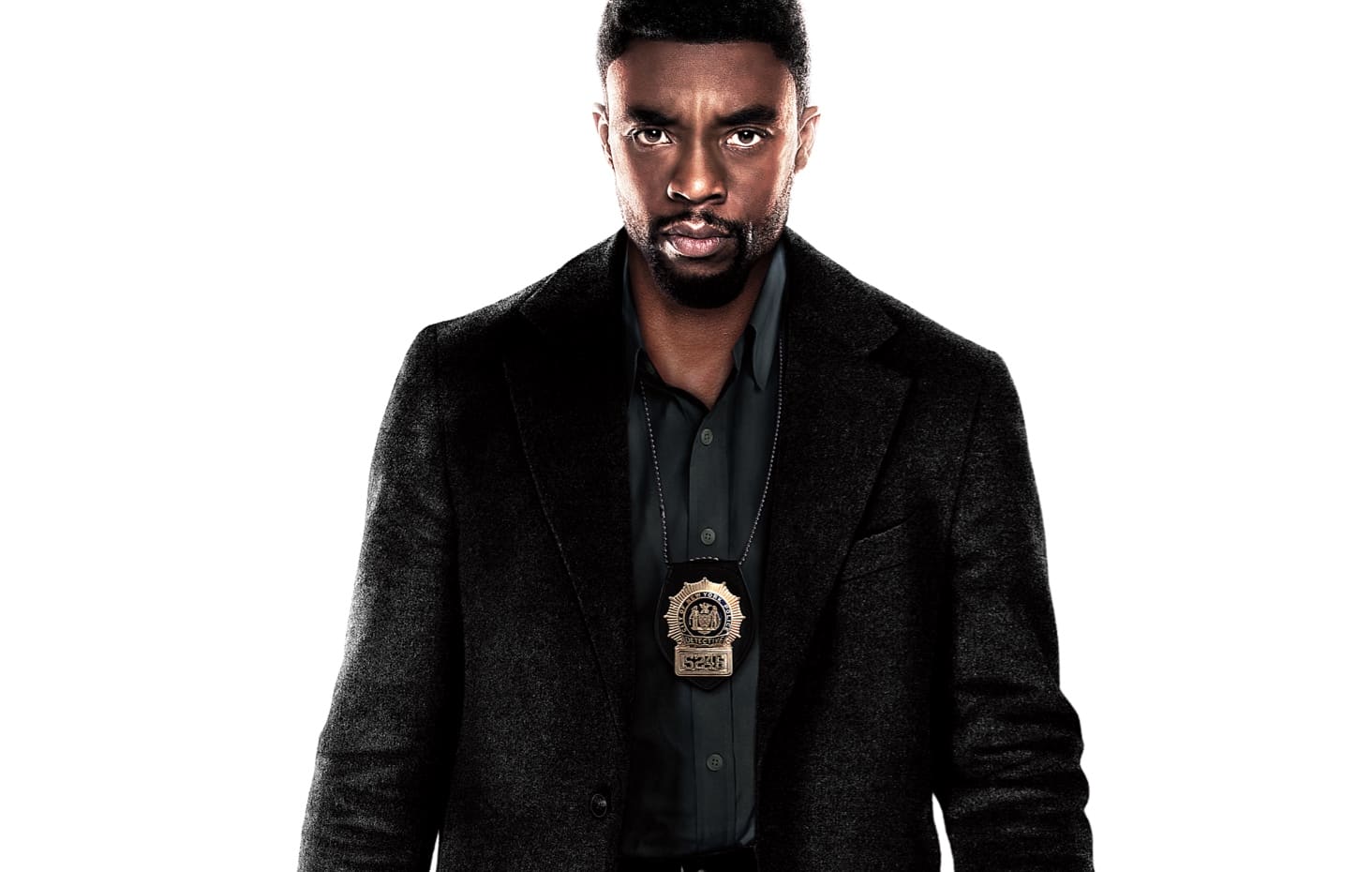
Chadwick Boseman stars as Andre Davis, a NYC detective with “cop in his DNA” since his father was gunned down on duty years ago. Andre has a reputation for being quick with the trigger, which is why Captain McKenna (J.K. Simmons) is happy to see him at a bloody Brooklyn crime scene.

Eight of McKenna’s cops are dead, after surprising two drug runners (Stephan James, Taylor Kitsch) during a botched cocaine robbery. McKenna is confident Andre will enforce their right to remain dead, but the Mayor’s (“he eats pizza with a fork!” – nice) flunkies make it clear hizzoner wants the perps alive for a campaign-friendly show trial.

But first, they have to find the two cop killers. Forced to accept help from narcotics officer Frankie (“fight me or use me”) Burns (Sienna Miller), Andre is granted a five hour window to shut down every possible avenue out of Manhattan, flood the island with blue, and get his men.

Director Brian Kirk, a TV vet helming his second feature, has clearly seen a crime thriller or two. The aerial shots of the city and shaky cam pursuits are standard moves, but Kirk manages to add his own layers of grit and intensity without ever letting the pace bog down.

One half of the writing team, Matthew Michael Carnahan, has some impressive credits, and about half the time, it shows. But even when the dialogue reeks of recycled cop drama, the talent of this cast manages to put a shine on it.

Simmons adds his usual mastery to a role that could have easily been one-note, and Miller again proves how good she is at morphing into completely different looks and personalities.

But this is Boseman’s film to carry, a nice break from his run of biopics and superheroics. The film’s success at exploring the paradoxes of a life in law enforcement is due mainly to Boseman. He finds a mix of outrage and conscience for Andre that feels true, often when the story around him doesn’t quite keep up.

There’s not much freshness to be found in 21 Bridges, just the visceral satisfaction and forgettable fun of talent winning out.

Fin Again Begin Again

47 Meters Down: Uncaged

by George Wolf

Two years ago, Johannes Roberts proved he could craft some fine sharky thrills amid the soggy dialog and questionable logic of 47 Meters Down.

He’s back as director/co-writer for Uncaged, with a bigger budget and a mission to deliver more of whatever you liked the first time. The scares? They’re jumpier! The sharks? They’re scarier! The water? Wetter!

Roberts builds these thrills on an unrelated shark tale. Four high school girls in Mexico go diving where they shouldn’t – an underwater Mayan burial cave. It’s currently being mapped by a team led by one of the girls’ Dad (John Corbett), which makes the cutting edge dive gear more believable than last time.

But all that gear is perfectly form-fitting for a group of teen girls, so…

So, forget it, and appreciate how Roberts borrows elements from the horror gem The Descent to create satisfying waves of claustrophobic, over the top terror.

If you remember the best scene from 47, you’ll see it re-imagined here, along with a very direct homage to Jaws and a nicely twisted and completely ridiculous finale.

Because if you haven’t noticed, Spielberg’s less is more approach to the monster has…say it with me…jumped the shark. For Roberts and Uncaged, more is more, and this film doesn’t stop until you’re shaking your head at the skillful outlandishness of it all.

This Year’s Model

Anna

by George Wolf

After films such as La Femme Nikita and Lucy, writer/director Luc Besson is no stranger to the “beautiful killing machine” genre, but it seems the sexual treachery of Red Sparrow and the ass-kickery of Atomic Blonde have inspired him to get back in that familiar saddle.

His Anna is built on the same sexy Russian assassin blueprint, then adds layers of confusing time shifts, obvious fake outs, and misguided feminist ambitions, all wrapped in a constantly leering camera gaze.

Anna (Sasha Luss, back with Besson after Valerian and the City of a Thousand Planets) is plucked from Russian poverty by agent Alex (Luke Evans) and groomed for the spy game by the humorless Olga (Helen Mirren).

Anna’s cover is her job as a high fashion model, and guess what is this season’s hottest accessory?

Big silencers, slowly screwed on big guns that are framed just so against Anna’s lingerie-clad pelvic region. Subtle.

Check that, it really is, next to the roommate (Lera Abova) whose only purpose is to ask Anna for girl on girl action, and the CIA agent (Cillian Murphy) whose code name must be Dog in Heat.

And yet through all the bad writing and contrivance, Anna’s true ambition never wavers. She asks only for a freedom she has never known, freedom from a world that only uses and objectifies her at every turn.

And then pot and kettle lived happily ever after.

Annie Are You Okay?

The Intruder

by George Wolf

If you caught Dennis Quaid creeping around your house on numerous occasions, would you be scared, or just figure he was bringing over some mac and cheese?

Quaid might be one of the ultimate likable dudes, and his playing waaay against type is one of promising threads that The Intruder squanders in its warmed over dish of jump scares and borrowed ideas.

Beautiful couple Scott (Michael Ealy) and Annie (Meagan Good) are living the good life in San Francisco, but Annie feels it’s time they move to the country and start a family. She finds her dream house at the Napa Valley home of Charlie Peck (Quaid), and as quickly as you can say “overly rushed setup,” they’re moving in.

Charlie says he’s selling to head South, so why is he still coming over to mow the lawn, assist with the Christmas decorations, and find reasons to be alone with Annie?

Whaddya bet he’s not really retiring to Florida, or that some guy at Scott’s office would like nothing better than dig into Charlie’s past to find what he’s hiding?

Director Deon Taylor (Traffik) and writer David Loughery (Lakeview Terrace) are both treading familiar ground, too much on autopilot to successfully mine the contrasts they introduce.

It’s old ways versus new, city versus country, and a red hat wearing white guy terrorizing a black couple.

That’s plenty to chew on, but everyone goes hungry while characters make one idiotic decision after another on the subtlety-free ride to a finale lifted verbatim from a 90s thriller.

At some point, Taylor and Loughery needed to chose a path: logical, layered tension or unhinged, over-the-top fun.

It’s clearly evident which one Quaid wanted, but both he and the film end up undecided on the remodeling plans. Like that old, musty spare room with the bad wallpaper, The Intruder is a little creepy, too often unintentionally funny and in need of some work.

A Friend in Need

Greta

by Hope Madden

Greta is a mess, and I don’t just mean the character.

In fact, I’m not sure the character is a mess at all, no matter how she hopes to fool you. Played by the inimitable Isabelle Huppert, the titular friend in need is, in fact, a crackpot. She’s a force to be reckoned with, and poor, wholesome Frances (Chloe Grace Moretz) doesn’t seem up to the reckoning.

A Midwestern transplant still grieving the loss of her mother, Frances lives in an irredeemably perfect New York apartment with her debutante bestie (Maika Monroe), but she feels a little untethered in the big city without her mom to call.

Enter Greta, the lonely older woman whose handbag Frances finds on the subway train and returns.

Director Neil Jordan hasn’t shot a feature since his underappreciated 2012 vampire fantasy, Byzantium. Here he shares writing duties with Ray Wright, who’s made a career of outright reboots and overt reworkings.

Like maybe Fatal Attraction with mommy issues.

There are elements to appreciate about Greta. Huppert is superb, her performance becoming more unhinged and eventually comical in that Nic Cage sort of way. Her time onscreen is creepy fun.

Moretz’s fresh-faced grief convinces for a while, and Monroe excels in an absolutely thankless role.

So what’s the problem? Well, number one, are we really afraid of this tiny, frail old lady?

No. We are not. Jesus, push her down already. I get it, you’re polite, but come on. I’m Midwestern and I’d have knocked her under a NYC taxi by now.

The terror is so unreasonable and yet so earnestly conveyed that scenes meant to be tense are comedic, and once you start laughing it’s hard to stop.

In fact, the sound of your own guffaws might distract you from the film’s truly breathtaking leaps of logic. It often feels as if whole reels were chunked out of this film and replaced with unconnected scenes from a private detective TV drama—one in which Stephen Rea’s dialog is inexplicably and unconvincingly dubbed.

What on earth?!

Well, par for the course with this film. It opens strong, develops well and relies on Huppert’s supernatural presence to create palpable tension before going entirely off the rails.


Case Closed

Destroyer

by George Wolf

Nicole Kidman got no Oscar love this year, which gives you some clue as to how many great performances we saw from women in 2018.

Her nuanced supporting turn in Boy Erased was certainly worthy, but Destroyer, released in select cities early enough for consideration, served up a menu that seemed more tailor-made for selection. She’s a major star playing way against type, she goes full anti-glamour and yep, she’s damn good.

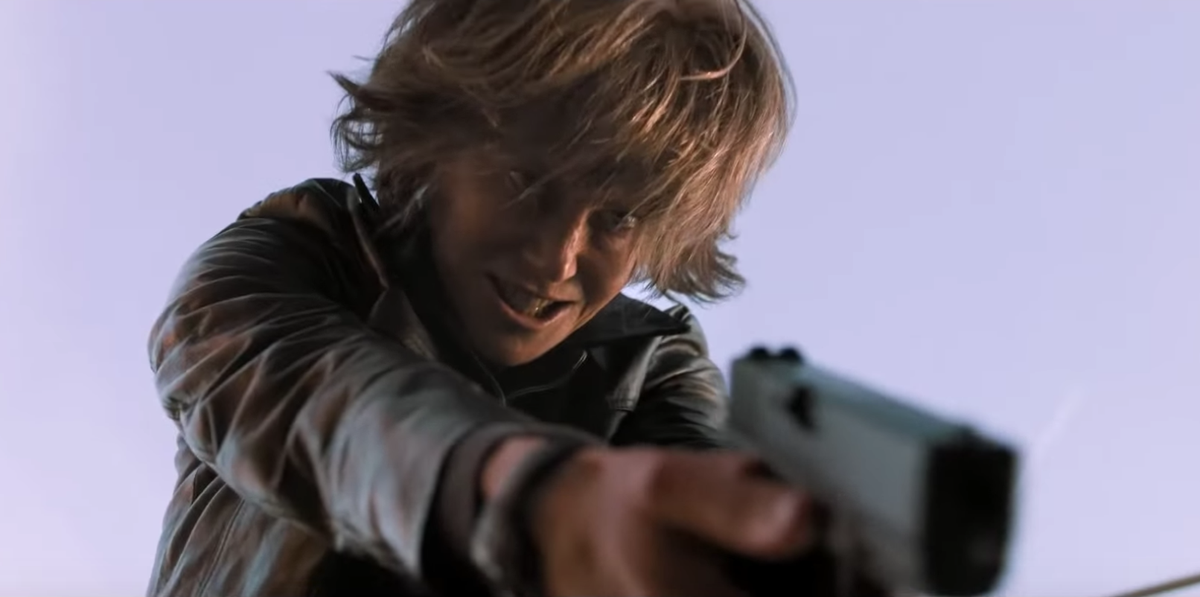
Kidman is Erin Bell, a police detective who looks, and acts, like death warmed over. When Erin and her hangover crash the crime scene of a newly discovered dead body, the local cops can mask their condescension with only the thinnest veil of respect.

But Erin knows more than they do about how this guy got dead, and director Karyn Kusama plays a gritty hand juggling the shifting timelines that will lead to Erin’s connection with the stiff, and to the roots of her frayed psyche.

Fans of HBO’s True Detective will feel right at home. Screenwriters Phil Hay and Matt Manfredi, who both teamed with Kusama for The Invitation and Aeon Flux, alternate between past and present to slowly reveal the details of an old case that led to Erin’s breakdown. She and partner Chris (Sebastian Stan) were deep undercover with a gang of bank thieves led by the slimy Silas (Toby Kebbell), and as Erin and Chris mixed business with pleasure, the lines separating their realities began to blur.

Kusama keeps up a knowingly effective pace, dropping just enough breadcrumbs to keep you interested until the twist reveal she’s sitting on. Of course, she’s also got Kidman’s range to lean on, occasionally forgetting it doesn’t need that much help getting noticed.

Kidman, with help from extensive makeup artistry, takes Erin from fresh faced ambition to grizzled hopelessness. Scattershot attempts to reconcile with her reckless daughter (Jade Pettyjohn) add emotional layers, and it’s only when Kusama pushes the melodramatic envelope that Destroyer seems overly desperate for us to appreciate its anti-heroine.

She doesn’t need that push. The film delivers a satisfying payoff to its slow burn, and Oscar nomination or not, Kidman crafts a transformative character arc that’s worth your attention.


Gaslight Anthem

A Simple Favor

by George Wolf

Stephanie is a suburban single mom who keeps an “oopsie” jar for swearing and volunteers for everything at her son’s elementary school.

Emily is passionately married, drops frequent f-bombs and has a painting of her vajayjay hanging in the living room.

But a play date for their sons leads to an unlikely friendship in A Simple Favor, a crazy fun mystery with plenty of surprises up its sassy sleeveless number.

The first may be seeing the director is Paul Feig, who made his name with blockbuster comedies such as Bridesmaids and Spy.

So, he’s doing dark thrillers, now? Nope, he’s doing a satirical comedy with strong women, nice diversity and a pretty sharp bite.

Perky Stephanie (Anna Kendrick – perfect) and glamorous Emily (Blake Lively – ditto) share martinis and secrets until Emily turns up missing. Steph provides case updates on her Mommy vlog (“cookies and origami” help to ease the strain!) while spending more and more time watching Emily’s son and “comforting” her husband (Henry Golding from Crazy Rich Asians).

You’ll guess some of what comes next, but there’s plenty you won’t, unless you read Darcey Bell’s source novel. Screenwriter Jessica Sharzer (Nerve) shapes it for the big screen as a Gone Girl for the gaslight age, where ridiculousness is a default setting, all information is equally true/false and irony is a security blanket never far out of reach.

There are plenty of black comedic laughs to be found here, as well as clever plot twists and knowing nods to the expectations that come with roles of “wife,” “mother,” “career woman” and “friend.”

The running time starts to feel bloated by the third act, and the film flirts with joining the mundane fray it had been so giddily rising above. But it rallies for the win with a satisfying finale of comeuppance and LOL updates on how some characters have moved on.

A Simple Favor is not what the trailer makes you think it is – which turns out to be the perfect setup for a film with plenty of head fakes that lead to a mischievous good time.