Tag Archives: movie reviews

Nuthin’ But a G Thang

House of Gucci

by George Wolf

Just four years ago, director Ridley Scott deconstructed the Getty family’s wealth of dysfunction in the masterful All the Money in the World. House of Gucci shows he’s still got money on his mind, and his mind on the rot that can take root in such mind-altering luxury.

Based on the true events detailed in Sara Gay Forden’s bestseller, the film dissects the complete unraveling of the Gucci family dynasty, a fuse seemingly lit by the unlikely relationship between Muarizio Gucci (Adam Driver) and commoner Patrizia Reggiani (Lady Gaga).

Though the Gucci name gets Patrizia’s attention at their first introduction, Muarizio didn’t seen to have much interest in the empire shared equally by his father Rodolfo (Jeremy Irons) and uncle Aldo (Al Pacino). But once he puts a ring on it, the mix of Patrizia’s ambition and Aldo’s invitations finally bring Maurizio into the family business.

Aldo’s own son Paulo (Jared Leto in some nifty makeup) is the Fredo in this clan, and it isn’t long before Paulo is trying to form his own back door alliance with Rodolfo, and Patrizia is Lady Macbeth-ing it everywhere from Italy to New York (complete with bewitching help from Salma Hayek as psychic Pina Auriemma).

You may have noticed that this is a pretty impressive cast. True, and even with their wheel-of-accents there’s little doubt that watching them all try to out-Italian each other in this trashy mash of The Godfather, I, Tonya, Shakespeare and The Real Housewives of Milan is the film’s biggest pleasure. But Scott and screenwriters Becky Johnston and Roberto Bentivegna can never establish a consistently compelling tone (overly random soundtrack choices don’t help, either), and the two and a half hour run time takes on curious contrasts. Even as the overall narrative has moments that drag, Maurizio’s transformation to the dark side still feels too rushed and convenient.

But Gaga proves worthy of another Oscar nom, and though the film never reaches the level of crackling relevance Scott mined in his look at the Gettys, she proves a fascinating window for the legendary director’s latest foray into an iconic family’s arc of greed, suspicion, betrayal and worse.

And if your Thanksgiving ends up going completely off the rails, House of Gucci is a star-powered and entertaining way to feel a whole lot better about your own family.

Tick, Tick, Boo!

Autumn Road

by Cat McAlpine

Riley Cusick does it all. He is the writer, director, and plays two leads in Halloween-themed horror Autumn Road. The film focuses on twin brothers Charlie and Vincent (Cusick), running a haunted house in their small hometown, and struggling actress Laura (Lorelei Linklater, Boyhood), who returns home for the anniversary of her sister’s disappearance.

Cusick establishes a wonderfully quiet but chaotic tone for his film. As a director, he has a great eye for establishing his shots, wonderfully capturing a small town filled with lonely people. A long shot of a spinning cup of cocoa. A lingering look at a dark parking lot. A masked man sprinting down a sunny highway. Cusick leaves a strong visual mark painted in warm tones.

It’s a good feature film debut done on the indie scale. But there’s room for growth. The script is weak, resulting in unrealistic dialogue that performs poorly paired with a handful of mostly wooden performances. Meanwhile, Cusick’s owl theme is haunting but heavy-handed.

Autumn Road still shines though, mostly when Cusick allows himself to become a little unhinged or when his monologues have time to ramp up into the insane. One such moment is when Vincent holds auditions for the haunted house. The scene is just the right mix of silly, campy, and genuinely disturbing.

Linklater does best with the more realistic dialogue, which allows her to be vulnerable and broken. She glows in a flashback scene with her sister. But she’s often saddled with difficult moments like suddenly mentioning her roommate’s recent death while making it about herself. “I’ve got bad luck in my bones. It follows me around like a dark cloud.” She says, conflating the disappearance of her sister with her roommate’s violent end.

Despite the genre, the violence of Cusick’s film is always shocking. Much of that violence never meets a resolution. In fact, most of the tension in the film remains unresolved, both painting a bleak picture and leaving the watcher unsatisfied. There seem to be no real-world consequences for the actions in Autumn Road.

Ultimately, Cusick’s feature-length debut is a fine effort. But his future endeavors may be best served if he dedicates his focus to a single role.

Every Little Thing She Does

Encanto

by Hope Madden

No one wants to believe themselves ordinary. Not even calm, supportive Mirabel Madrigal (Stephanie Beatriz). But ordinariness happens to be her defining quality because she is the first Madrigal in three generations who has no magical gifts.

Her mother can heal with food. Her sister has super strength. Her cousin can shape shift. But when the day came for Mirabel to receive her magical gift, nothing happened. When the magic of the Madrigal family — magic that has kept the entire town of Encanto in peaceful enchantment for decades — starts to crack, is it all because of Mirabel?

One of many reasons that Disney’s 60th feature Encanto charms is that this unsure adolescent does not find out she’s secretly a princess. She has no makeover. It isn’t romance that helps her see her own specialness. Thank God.

Lin-Manuel Miranda’s music is another reason. Infectious, upbeat and surprisingly insightful, the songs in Encanto speak to individual insecurities in a way that hardly suggests the magical nature of the film. Lyrics illustrate sincere worries about letting people down, living up to expectations and other universal and yet intimate worries.

If you worry the film sounds a bit drab and reasonable, fear not because the vibrant color, lush landscapes, intricate interiors and clever, high-energy animation keep the magic popping. Set in Colombia, Encanto reflects the magical realism favored in the literature of the land and that, too, makes for a unique cartoon experience.

John Leguizamo and Maria Cecilia Botero join Beatriz in a voice cast that brims with pathos, love and energy, just like the family they depict. Much about the complex interactions within the family feels like honest if uncharted territory for a Disney outing — flawed heroes, loving villains, and the notion that selfishness and selflessness as equally problematic.

The flip side of that coin is that the world of Encanto doesn’t feel very big and the stakes don’t feel very high. If that were the only drawback to co-directors Jared Bush, Byron Howard and Charise Castro Smith’s approach it would hardly be worth mentioning. Unfortunately, they undermine the complexity they find in familial love with a too-tidy ending that robs Encanto and its inhabitants of some hard-won lessons.

Screening Room: Ghostbusters Afterlife, King Richard, Tick Tick Boom, Zeroes and Ones and More

Remember 1984? Be a Lot Zuuler If You Did

Ghostbusters: Afterlife

by George Wolf

Have you tried to branch out, only to end up with a revolt on your hands? Perhaps fan service is right for you! In other words, if 2016’s Ghostbusters was The Last Jedi, Afterlife is The Rise of Skywalker. With a side of Goonies.

That doesn’t mean it’s not a fun trip down memory lane.

Director/co-writer Jason Reitman picks up the 1984 baton from dad Ivan, crafting a new adventure that casually ignores the 1989 sequel.

Egon Spengler’s long-estranged daughter Callie (Carrie Coon) is being evicted from her Chicago apartment, so she takes daughter Phoebe (Mckenna Grace – just terrific in a completely heroic arc) and son Trevor (Finn Wolfhard) to the only thing Dad left her when he died: a dilapidated farmhouse in small-town Oklahoma.

Ah, but this farm holds secrets, and it isn’t long before science whiz Phoebe is getting familiar with proton packs and Trevor is checking to see if the ECTO-1’s engine might actually turn over.

Good timing, too, because Phoebe’s teacher Mr. Grooberson (Paul Rudd) has been noticing some serious seismic activity in town that he cannot explain. Turns out the Sexiest Teacher Alive is also a big fan of the original Ghostbusters, and he clues in Phoebe and her conspiracy-happy friend “Podcast” (a charming Logan Kim) about Grandpa’s heroics back in the day.

Once Trevor’s crush Lucky (Celeste O’Connor from Freaky) makes it a quartet, it’s up to the kids to figure out the real reason Egon abandoned the GB’s all those years ago, what’s brewing under the farmhouse, and just how to wrangle a stage 5 apparition.

This is a film so steeped in the nostalgia for its source material that you cannot imagine it existing on its own. Is that a direct result of the savagery that greeted the female (and for what it’s worth, underrated) reboot or a natural reaction by a son following in his father’s footsteps?

Either way, the benchmark callbacks come early and often, with Reitman frequently holding the shot an extra beat just to make sure you pick up what he left for you. And while the Bill Murray zany-ness is replaced by Paul Rudd sarcasm and wisecracking from a cast of wonderful young actors, there is humor here, enough to justify the “comedy” label (which honestly, the original trailer had me questioning).

But is it fun? Oh yeah, with some slick CGI and high points that are zuuler than the other side of the pillow.

You’ll want to stay through the credits for two extra scenes, but there’s a good chance you’ll still be thinking about all that Reitman has in store during that finale. It’s plenty – maybe even enough for your eyes to stay as pufty as a certain marshmallow man.

Standoff

The Killing of Kenneth Chamberlain

by Brandon Thomas

Movies set in a single location have always been a favorite of mine. The intimacy and the claustrophobia can almost become unbearable. Like a stage play, this kind of film also becomes a showcase for the actors. The Killing of Kenneth Chamberlain is no exception.

Set in the wee hours of the morning, The Killing of Kenneth Chamberlain follows the events that led to Chamberlain being killed by White Plains, New York, police. Chamberlain (Frankie Faison, Do the Right Thing, The Silence of the Lambs) is an elderly veteran with bipolar disorder who lives alone. After accidentally setting off his emergency medical alert system, Chamberlain is awakened by police sent to perform a welfare check. Afraid and agitated, Chamberlain refuses to let the police into his apartment. Events escalate after the initial officers call in backup, and maintain that they will enter Chamberlain’s apartment by any means necessary. 

There’s no secrecy around what’s eventually going to happen in The Killing of Kenneth Chamberlain – I mean, it’s in the title. However, that doesn’t make the entire 83-minute running time any less anxiety-inducing. Director David Midell does a terrific job allowing the tension to slowly and excruciatingly build as the situation between Chamberlain and the police deteriorates. It’s one of the most uncomfortable, but riveting, films I’ve watched in ages. 

The ripped-from-the-headlines storyline feels only all too real in the latter half of 2021. Midell’s film is certainly a commentary on police misconduct, but also how even the most trivial situation can escalate unnecessarily. Knowing that the film is based on a true story only makes it more frustrating and upsetting. 

Faison is mesmerizing as the titular character. We only meet Kenneth Chamberlain for a short period of time, and Faison brings the character’s humanity to the forefront from the beginning. It’s a high-energy performance that never loses any ground and commands the audience’s attention from the get-go. On the flipside, Enrico Natale does a wonderful job playing a conflicted rookie officer. It’s a character that goes back and forth with audience sympathy, and Natale seems to know that. Despite being one of the few officers with a conscience, his character still toes the line and Natale beautifully conveys the guilt, hesitancy and fear the character feels throughout the film. 

Through deft use of the setting and a handful of outstanding performances, The Killing of Kenneth Chamberlain materializes as one of the more powerful dramas of the year. 

Death Cab to Smoochy

The Rumperbutts

by Matt Weiner

It’s life imitating art for Rumperbutts, a musical comedy about a husband-wife indie band who have grown to hate their lucrative but creatively unfulfilling second act as a children’s entertainment group. Magical intervention grants the duo another chance at the music career and life they always wanted together.

Rumperbutts, written and directed by Marc Brener, is getting a second chance of its own on digital after a brief release in 2015. Kori Gardner and Jason Hammel, real-life married couple behind Mates of State, star as the fictional Rumperbutts, Bonnie and Jack. The band also wrote the songs and music for the movie.

After a delirious opening performance reflecting to an audience of children where their career and marriage went off the rails, Bonnie and Jack receive a visit from Richie (Josh Brener). Part muse and part fairy godfather, Richie helps free the couple from their Rumperbutts job and sets them on the path to making music again.

Why they couldn’t do both—or why it even matters when the Rumperbutts songs sound the same as their non-corporate songs—is the sort of logical leap we’re just supposed to accept, but it’s tough to ignore as the central premise.

There’s a sweet core to the film, propped up by the band’s infectious pop and chemistry together. The flashbacks that slowly reveal Bonnie and Jack falling in and out of love stand well enough on their own without the magical framing to muddy the plot. But those flashbacks also bring up their own tantalizing regrets. Mainly, what could the movie have been without trying to force together Once and A Christmas Carol into the same concept?

Rumperbutts is the ideal vehicle for its pop songs. The winsome earworms don’t go very deep, but just try and get through the movie without nodding along.

Brothers in Harms

Zeros and Ones

by Hope Madden

Abel Ferrara, man. Dude refuses to follow a traditional film structure, and sometimes that works so well. Bad Lieutenant and The Addiction — two of my favorites — took on a dreamlike atmosphere thanks to the filmmaker’s loose structure and it suited both pictures.

Beginning with 2014’s Pasolini, Ferrara seems to have abandoned the standard framework entirely, his films becoming more dreamlike than lucid. His latest, Zeros and Ones, follows that path.

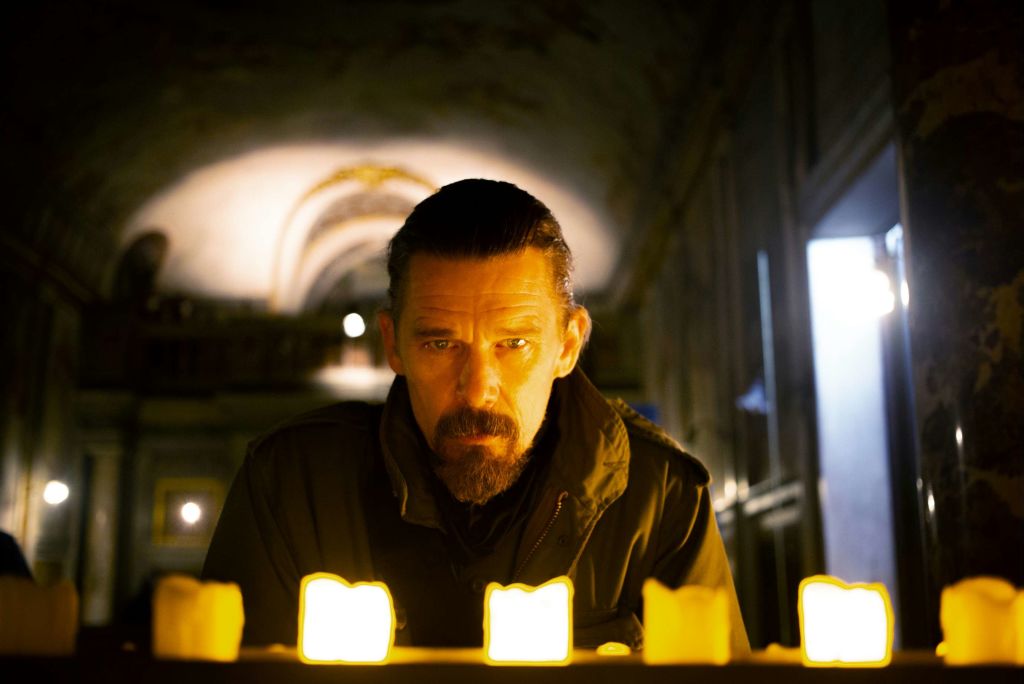
Ethan Hawke stars in this hazily connected sequence of scenes emphasizing one man’s journey toward a realization about himself, his brother and the world around him. Hawke plays both the journeyman, a military specialist of some kind, and his brother, a freedom fighter in Rome.

Hawke wanders empty post-pandemic Rome as bits of military and religious debauchery and double-crossing weave and bob across the screen. Meanwhile, Hawke’s voiceover oscillates between meta-Christian reflections and calls to action.

For his part, Hawke delivers two discernibly different characters, sure, but in keeping with Ferrara’s themes, two distinct types: apostle and wayward soldier. Nothing feels scripted, and with a veteran like Hawke, that works out fine. Like Willem Dafoe in so many of Ferrara’s recent films, Hawke inhabits the desolate dreamscape with a weary resignation, a ghost guiding us toward some dark inevitability.

Zeros and Ones is a pandemic film, but rather than feeling like a filmmaker doing whatever they can with the situation, this one seems like an opportunity Ferrara has been waiting for. He isn’t doing his best within unreasonable constrictions, he’s finally found that empty, nihilistic apocalypse he’s prepared for. The empty streets and lonesome, masked figures feel apiece of his greater goal.

What was that goal? What is it always? The world is filth, hope is futile, man is doomed. You’ve seen his films, right? If so, you probably already know where you’ll fall on Zeros and Ones. It is less poetic and self-indulgent than Tommaso or Siberia, less sensible than his earlier work, and less compelling than a lot of what he’s done. And the explosions look ridiculous.

And yet, there is nothing quite like an Abel Ferrara film.

Louder Than Words

tick, tick…BOOM!

by George Wolf

What’s an aspiring writer to do when his first major work is bypassed for the eager anticipation about what he’ll do next?

He takes his agent’s advice to “move on to the next one. And write what you know.”

Broadway trailblazer Jonathan Larson – Tony and Pulitzer Prize-winning writer and composer of Rent – agonized for 8 years over Superbia, a futuristic musical that never earned a full production. When Larson did move on to the next one, it became tick, tick…BOOM!, his autobiographical story of a composer named Jon whose final days as a twentysomething bring feelings of rejection and inadequacy.

ttBOOM! made it to off-Broadway in 1990, with revivals beginning in 2001,15 years after both the phenomenal success of Rent and Larson’s tragic death from an aortic aneurysm at the age of 35.

Now, director Lin-Manuel Miranda brings Larson’s story of struggling artistry to the screen with an infectious exuberance and undying respect for those committed to the roar of the greasepaint and the smell of the crowd.

Andrew Garfield stars as Jon, who waits tables in a New York diner, works on his musical and worries about how much other people have accomplished before turning 30 (“Sondheim wrote West Side Story at 27!”)

While Jon struggles to find enough money to keep the lights on, his longtime girlfriend Susan (Alexandra Shipp) mulls a tempting job offer in the Berkshires, and his best friend Michael (Robin de Jesus) decides it’s finally time to give up the Broadway dream and get a real 9 to 5 gig.

While everyone – including Sondheim himself! (a terrific Bradley Whitford) – tells him Superbia needs one more big song in the second act, Jon rebuffs any need for a life “backup plan,” even as his tenuous relationship status and a co-worker’s HIV diagnosis remind him of each precious tick of the clock.

Miranda and screenwriter Steven Levenson (Dear Evan Hanson, Fosse/Verdon) effectively layer the musical segments with real-life inspirations and one-man show beginnings that build to workshop performances and Broadway fantasies. From the birthday defiance of “30/90” to the pleading interplay between Garfield, Shipp and Vanessa Hudgens (as Susan’s stage persona) on “Come to Your Senses,” Miranda’s staging is lively and stylish, peppered by plenty of Easter eggs and cameos saluting years of musical greats (including Chita Rivera, Bernadette Peters, Bebe Neuwirth and two of Hamiton‘s Schuyler sisters in the show-stopping “Sunday” alone).

Garfield delivers an electric, committed performance, singing well and absolutely selling the manic, no-sleep-til-curtain-time tunnel vision that Larson clings to instead of admitting that there might be any other way to live.

And as a tribute to this life, the creative process and one man who personified both, tick, tick…BOOM! is a runaway hit. But in the process, it forgoes a sense of intimacy that might have brought us closer to Larson himself. That’s a trade-off the film ultimately seems comfortable with. Miranda, Garfield and company are going big here, and end up reaching the balcony with crowd-pleasing panache.

A Pair of Aces

King Richard

by George Wolf

You know how many parents are convinced their kid is destined for athletic greatness? Quite a few, and that’s just in your neighborhood.

So how – and why – did Richard Williams’s predictions for daughters Venus and Serena come so incredulously true?

That’s a compelling story, one that King Richard tells with enough restraint and humanity to sidestep most sports movie cliches and find layers of true inspiration.

The Williams family – Richard (Will Smith), wife Brandy (Aunjanue Ellis), Venus (Saniyya Sidney), Serena (Demi Singleton), and three additional daughters from Brandi’s previous relationship – weren’t exactly welcomed into the L.A. tennis community when Richard put his master plan in motion.

Tennis was a sport for the rich and the pale. They were a Black family from Compton, often dodging gang activity for a chance to practice on run down community courts. Richard was dogged in his search for a coach, first landing Paul Cohen (Tony Goldwyn) before Venus earned the entire family an invite to Rick Macci’s (Jon Bernthal, playing delightfully against type) exclusive training center in Florida.

In his debut screenplay, writer Zach Baylin follows a fairly standard biopic formula, but manages to weave in necessary layers of nuance. While we see that the doubt Richard encounters about his daughters’ future greatness is understandable, the added barrier of racism is understood without an overplaying the hand. In fact, Baylin’s script (or the editing bay) occasionally downplays obstacles that the Williams’s surely encountered all too often, seemingly mindful of the film’s 138 minute running time.

But director Reinaldo Marcus Green (Monsters and Men) has a good feel for pacing, with well-placed bits of tension, humor and impressively-staged tennis sequences that never let the film feel sluggish.

And while you can hardly be blamed for detecting the whiff of “Will Smith Oscar bait” in the air, don’t be surprised if he lands his third nomination. The film is an inspirational crowd pleaser that steers refreshingly clear of pandering, and Smith responds with a performance that leans into the colorful personality of Richard Williams while checking his penchant for heavy-handed mugging.

It helps that Smith is constantly elevated by Sidney and Singleton, the two wonderful young actresses playing Venus and Serena, and the always amazing Ellis (Lovecraft Country, Ray, The Help). Though Brandi’s character is often strong and silent, there are fine moments that prove just how vital she is to the Williams plan. And by the time Brandi is dressing down Richard as just another man that won’t admit he’s scared, it’s clear how vital Ellis is to the film’s resonance.

Though Venus and Serena get Executive Producer credits, the film doesn’t ignore some problematic areas in Richard’s personality, and Smith makes the mix of crazy-like-a-fox determination, gentle humor and hidden scars one that -like Smith himself – is hard to dislike.

As the older sister and the first to find success on the tour, it is Venus that gets much of the film’s focus. But Richard’s prediction for Serena (“the best ever”) serves as a natural pivot to send us home with a reminder about how lucky we’ve been to witness their greatness.

And as the best sports movies always do, King Richard scores often enough to land its message past the fault lines. The Williams plan may have been heavy on tennis, but it’s anchored by life lessons that not only benefitted all of Richard and Brandi’s children, but would undoubtedly be an asset in any arena.

So what made Richard’s vision so much clearer than every other parent in the stands?

Just some unending determination and confident stubbornness. Plus two daughters with once-in-a-generation gifts, the passionate drive to excel, and the desire to make the road a little smoother for the next young phenom that isn’t white or wealthy. That helps, too.