Tag Archives: MaddWolf

She Said She Said

Tyler Perry’s Acrimony

by George Wolf

Acrimony begins with an on-screen definition of the word “acrimony.” That’s how much credit writer/director/producer Tyler Perry gives his audience.

He doesn’t treat his lead much better, again creating a strong female character who must receive her comeuppance.

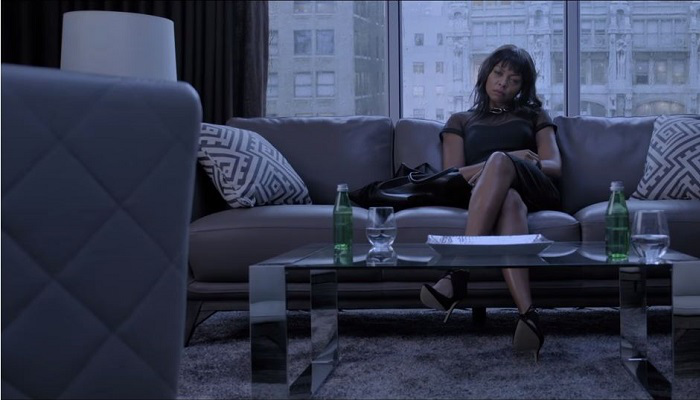
She is Melinda (Taraji P. Henson), who’s under court-ordered anger management after harassing her ex-husband Robert (Lyriq Bent) and his new fiancee (Crystie Stewart). As Melinda tells her therapist why her anger is justified, she tells us, too, and just keeps on telling.

Flashbacks give us the Melinda and Robert story, while constant voiceovers spoon-feed us enough information to qualify as an audiobook. The organic dialogue offers no more nuance (cell phone rings once: “He isn’t picking up!”)

It’s contrived and obvious at nearly every turn, and though Henson delivers her usual spunk, Perry’s penchant for demonizing women who don’t stand by their men is on display. The hand he plays for the film’s finale smacks of a cop out, a “get out of jail free card” for how he’s written Melinda’s character.

That card gets trumped, and the final showdown fizzles into borderline camp. It’s a fitting end to a mess of a movie.

 

Bury Your Gold

The China Hustle

by Cat McAlpine

Are you still upset about the 2008 housing crash? Of course you are. We all are. Ten years ago banks put the American dream up for sale and the market inevitably collapsed in on itself.

But when the American people were trying to pull themselves back up by their bootstraps, the financial industry had already moved on. To China.

Get ready to look up at the glistening spires of capitalism only to realize we’re all huddled under a house of cards.

Writer/Director Jed Rothestein weaves a thrilling, terrifying tale about the next financial disaster awaiting our country. Some of your neighbors have already lost their life savings. The current administration is actively stripping away financial regulations between the average investor and billions of dollars in fraud. Shady deals are happening now, and honestly, there’s probably nothing you can do about it.

Rothestein calls on the full spectrum of documentary devices: talking heads, voice-over narration, cartoon re-enactments, visual graphics, and more. They work for the most part, but some of the b-roll seems out of place. The most effective and evocative imagery is a series of long, sweeping drone shots of cities and factories.

Rothstein really hits his stride when short-seller Dan David tours his hometown of Flint, MI. Flint is the poster child of blue-collar suffering for white-collar crimes. The camera captures haunting images of the town that really reflect the tangible repercussions of corporate fraud.

China Hustle warns us of a new danger on the horizon. Billions of dollars are propped up in the empty shells of defunct American companies, waiting to collapse.

And then there’s the warning of a larger danger, entrenched in the very fabric of our society. No one is looking out for the American people. The SEC, the accreditation firms, the lawyers, and the bankers—they all invest in their own interests. Even the men blowing the whistle on fraudulent Chinese companies first make money off of them.

“Companies have companies’ best interests at heart.”

And that’s the real hustle.

Great Outdoors

Leaning Into the Wind: Andy Goldsworthy

by Rachel Willis

Patience.

It’s the first word that comes to mind while watching Thomas Riedelsheimer’s documentary about artist Andy Goldsworthy. But that’s not a critique on the film itself, rather a reflection on the meticulous nature of Goldsworthy’s work, as well as Riedelsheimer’s.

Crafting art from nature, Goldsworthy spends a lengthy amount of time gathering his materials—leaves, flower petals, branches—then fastidiously arranges and assembles his materials into stunning works of art. It’s not only an exercise in creativity, but patience. When a gust of wind destroys hours of work, Goldsworthy takes it in stride, even though it’s the kind of setback that would leave many fuming.

To truly sink viewers into Goldsworthy’s world, into his thought process, Riedelsheimer is with Goldsworthy from start to finish as he assembles each new piece. Interviews and time spent on the sidelines observing while he works is as close as one can get to being inside the mind of an artist.

With breathtaking cinematography, the film itself is a work of art. As the viewer follows Goldsworthy around the world, the film captures the beauty of nature as Goldsworthy sees it. Knotted tree roots take on deeper meaning. Ants marching become more than insects on the ground, but a reflection of society. One of Goldsworthy’s more impressive installations is sparked by the ants. Riedelsheimer is there to capture the moment of inspiration as it turns into a stunning work of art.

There are times when the film covers the same ground. Much of the viewer’s time is spent watching as Goldsworthy (sometimes alone, sometimes with his daughter, at times with an entire crew) works on different installations. While interesting to see, it’s also repetitive, and the documentary is most engrossing when we’re allowed to follow Goldsworthy as he mines the continent for ideas.

Often the film has the feel of a nature documentary. The camera fades into the background as Goldsworthy works, becoming a silent observer, which gives the viewer an intimate look into his world. Goldsworthy becomes a part of the environment around him. Using his body, he becomes absorbed in the environment. The viewer feels the same absorption as we’re drawn deeply into his universe.

Leaning Into the Wind is a gorgeous, glorious film.

Shall We Play a Game?

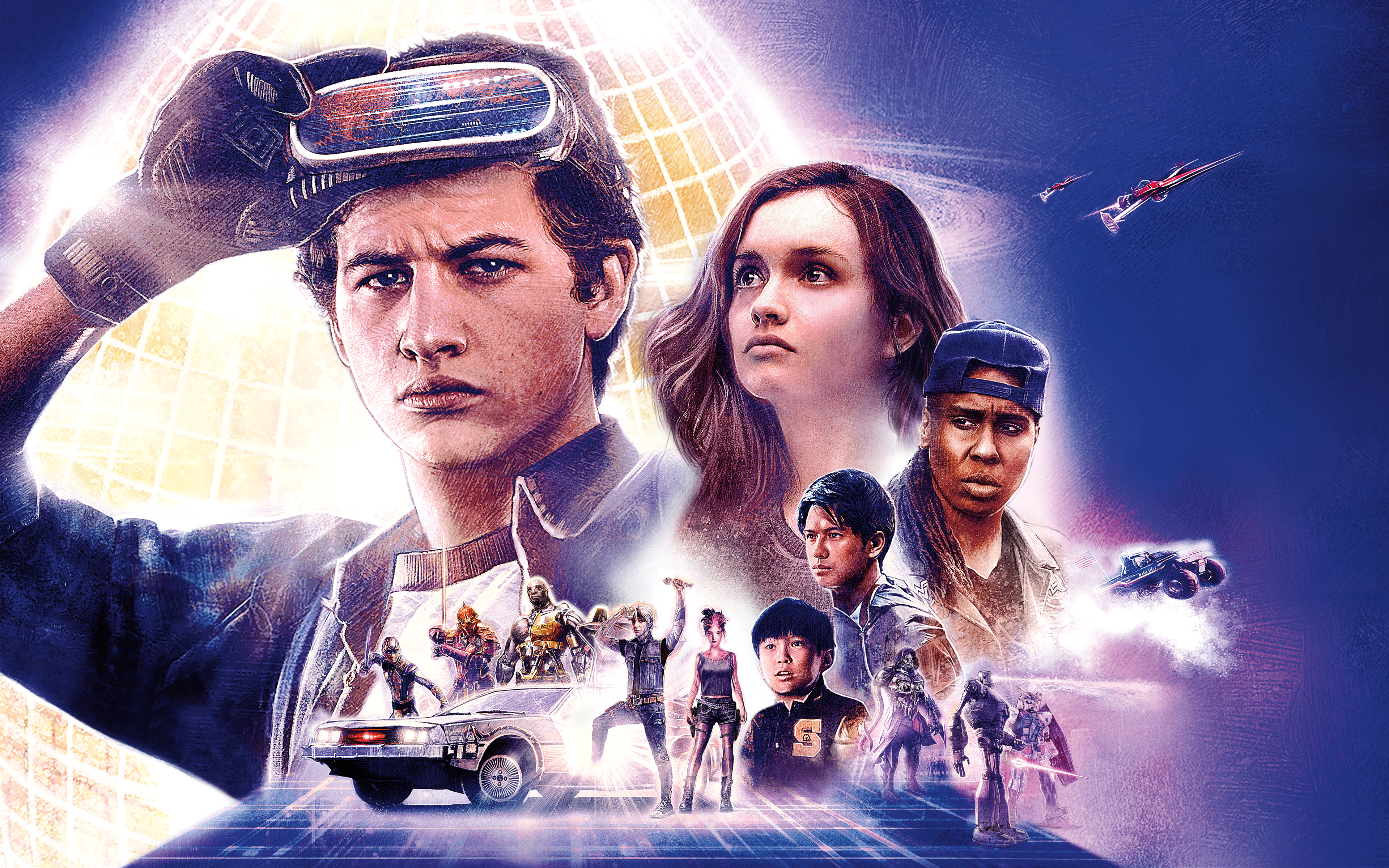
Ready Player One

by Hope Madden

Ready Player One may be the most Spielbergian of all Spielberg movies. It’s Spielberg on Spielberg. Meta-Spielberg.

You get the idea.

It’s 2045 in Columbus, Ohio and the world is so miserable for so many that they spend all day, every day inside their video games. OASIS is a virtual world where you can play anything against anybody at any time.

The creator of OASIS and every devoted gamer’s hero, James Halliday (Mark Rylance), died several years ago and has built a challenge into the game. The winner will own OASIS (and its trillion in worth) outright.

And that’s it. A ragtag group of nerds (led by Tye Sheridan and Olivia Cooke) must learn to work together so they can defeat the megalomaniacal tech firm run by a guy who doesn’t even like gaming (Ben Mendelsohn).

What? Misfit kids teaming up to learn from a master nerd and beat the suits? Smells like Spielberg!

Ready Player One is a celebration of gamer culture in the same way that The Lego Movie indulged in the sheer joy of building with Legos. It is also an 80s pop culture nerd’s wet dream. You want to see a guy wearing Buckaroo Banzai’s while driving Marty McFly’s DeLorean romance a girl on Tron’s bike or run across a bridge made of the Iron Giant? Done.

Want to know what the Zemeckis Cube does? (Bill and Ted know.)

The entire assortment of John Hughesisms is set to righteous beats from Bruce to Blondie.

And that’s where the film could easily have become fluffy nonsense were it not for the genius move of taking an 80s fanboy icon (Spielberg) and allowing him to simply provide an undiluted version of every nostalgic gimmick he has ever hatched.

Every time he borrows from himself or leans on old tendencies—tendencies he’s been trying to shed since 1985’s The Color Purple—it feels like it’s meant to be.

It’s basically a Spielberg movie inside an ode to Spielberg movies.

Plus, oh my God I want a The Shining video game!

Unfortunately, that’s all it really is. The performances are hammy fun but certainly not revelatory. The story is thin enough that it doesn’t get in the way of all the cool FX and callbacks. You’ve seen it all before, you just haven’t seen it quite this unabashed, with frame after frame nearly bursting with the exuberance of some kid whose parents just demanded he put down that homework, crank up the tunes and start gaming already!

Columbus GLOWs

Lady Wrestler: The Amazing, Unknown Story of African-American Women in the Ring

by Christie Robb

Writer/director Chris Bournea shines a well-deserved spotlight on a forgotten corner of American history, the Golden Age of Wrestling.

Columbus was the epicenter of professional wrestling during the 1950s and served as a home base for many prominent, powerful African American professional women wrestlers including the sister act of Babs Wingo, Ethel Johnson and Marva Scott.

Groomed like 60s music groups the Shirelles and the Marvelettes, the “Lady Wrestler” had to mix the sex appeal of the bathing beauty, the physical prowess of an athlete, and the glamor of a Hollywood star.

Manager Billy Wolf encouraged his ladies to dress in silk dresses and furs, to bedazzle themselves with diamonds, and to shun “masculine” habits like smoking in public. But in the ring, these women—who worked out three hours a day—executed holds and flips, and took strikes that would finish most men.

Balancing family life, career and fame, these women broke athletic color barriers and traveled internationally at a time when interstate transportation terminals were still segregated and women couldn’t apply for their own credit cards.

Told in a mix of Bournea’s own narration and interviews with the women and their families, Lady Wrestler: The Amazing, Unknown Story of African-American Women in the Ring is a testament to the physical and emotional strength of these trailblazing women.

I Don’t Want to Go Out—Week of March 26

You know a fun way to pass the time during a boring holiday weekend? With Star Wars movies. Lucky for us, the latest drops for home entertainment this week. Piss off your Fox News watching uncle and your most self-indulgent of white male nerd friends with the strong female lead and natural character arc of Star Wars: The Last Jedi.

For a full review, click the movie title.

Star Wars: The Last Jedi

The Screening Room: Monster Issues

Join us in the Screening Room this week to talk through the pros and cons of Pacific Rim: Uprising, Unsane, Death of Stalin, Loveless and all that’s new in home entertainment.

Listen to the podcast HERE.

Jaeger Bomb

Pacific Rim: Uprising

by George Wolf

I like to think it went down this way…

After hours, in a dimly lit Hollywood bar, the makers of Pacific Rim: Uprising met up with Michael Bay and his crew (let’s call them the Bay-o-nettes) for a good old-fashioned excess-off. As the final challenge was accepted, Uprising director/co-writer Steven S. DeKnight had agreed to break the record for use of the phrase “save the world,” AND include a bit of the “Trololo” viral video guy.

Done and done. And there’s some Transformer-type robot fighting.

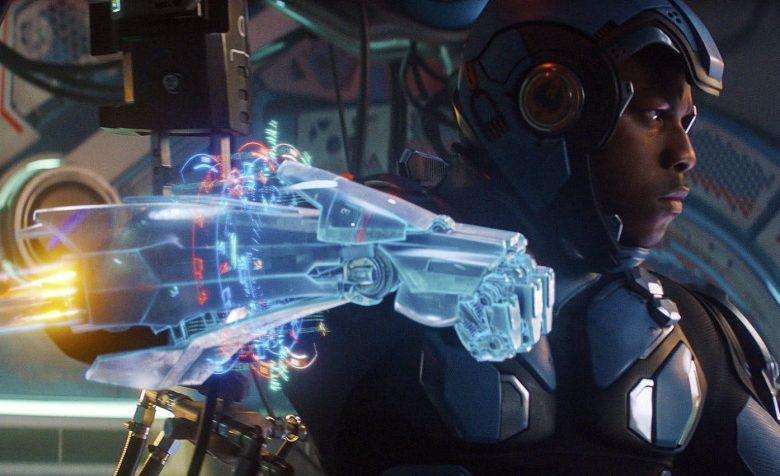
This unnecessary sequel to Guillermo Del Toro’s lackluster original picks up 10 years after the invading kaiju were defeated by giant Jaeger robots and their skilled pilots. Stacker Pentecost (Idris Elba) died cancelling that apocalypse and now Stacker’s son Jake (John Boyega) and his frenemy Nate (Scott Eastwood) must whip a rag-tag bunch of new recruits into shape just in time to battle a brand new threat and …pause for close up and crescendo…save the world (ding!)

After a number of TV projects, Uprising marks DeKnight’s feature debut, and it shows. Most every frame succumbs to an invasion of empty dialogue and the cliche of least resistance. The actors pose more than they move, and even the cheapest of attempts at emotional manipulation seem too much for this film to handle.

But hey, who cares, we’re here for the robot throwdown, amirite?

Probably, but even that, minus Del Toro’s stylish pizzazz, becomes a confusing and repetitious snooze. Seriously, the guy down the row from me at the screening was snoring (which was confusing at first and then repetitive).

Too bad, he totally missed the part when Pikachu showed up and slaughtered everybody.

Okay, that didn’t happen.

Dammit.


Unsafe House

Unsane

by Hope Madden

Sawyer Valentini (Claire Foy) is living your worst nightmare.

Having recently moved 400 miles from Boston to suburban Pennsylvania to escape her stalker, she begins seeing him everywhere. Shaken and without a support network, she visits an insurance-approved therapist in a nearby clinic.

She’s grateful for the ear, but upon completing her paperwork Sawyer finds that, due to the therapist’s diagnosis that Sawyer is a danger to herself or others, she is held involuntarily for 24 hours.

After punching an orderly she mistakes for her stalker, that 24 hours turns into one week. And now she’s convinced that the new orderly George is, in fact, her stalker David (Joshua Leonard—you know, doomed Josh from The Blair Witch Project!).

There a number of factors hard at work in Unsane‘s brisk 98-minute ride. Director Steven Soderbergh, by way of Jonathan Bernstein and James Greer’s script, lays bare some terrifying facts about our privatized mental health industry.

Seriously and deeply alarming.

He structures this critique with a somewhat traditional is-she-or-isn’t-she-crazy storyline. Anyone who watches much horror will recognize that uneasy line: you may be here against your will, but that doesn’t mean you shouldn’t be here.

And the seasoned director of misdirection knows how to toy with that notion, how to employ Sawyer’s very real damage, touch on her raw nerve of struggling to remain in control of her own life only to have another’s will forced upon her.

Part of the film’s success is Soderbergh’s ability to put you in Sawyer’s headspace, which he does primarily through the use of iPhone 7. He claims to have filmed entirely on these phones, and whether or not that’s true, the shallow, oversaturated aesthetic creates the sense of delusion.

Foy’s performance is refreshingly unpleasant. Sawyer is tough to like, but she’s damaged and savvy in a way that feels authentic.

Leonard’s cloying neediness and bursts of violence match Foy’s formidable if brittle performance and a strong supporting cast including Juno Temple, SNL’s Jay Pharoah, Amy Irving and a spot-on Polly McKie.

Soderbergh relies on familiar tropes to say something relevant and in doing so creates a tidy, satisfying thriller.

Dead Body Politic

The Death of Stalin

by George Wolf

Opening with a madcap “musical emergency” and closing with a blood-stained political coup, The Death of Stalin infuses its factual base with coal back humor of the most delicious and absurd variety.

The film cements director/co-writer Armando Iannucci (Veep, In the Loop) as a premier satirist, as it plays so giddily with history while constantly poking you with a timeliness that should be shocking but sadly is not.

So many feels are here, none better than the sheer joy of watching this film unfold.

It is Moscow in the 1950s and we meet Josef Stalin and his ruling committee, with nary an actor even attempting a Russian accent. Those British and American dialects set a wonderfully off-kilter vibe.

Iannucci has a confident grip on his vision, and the impeccable cast to see it through,

Who else would play Nikita Khrushchev but Steve Busemi? Then there’s Jeffrey Tambor and Simon Russell Beale as committee members jockeying for power after Stalin’s death, Andrea Riseborough and Rupert Friend as Stalin’s manically desperate kids, and Jason Isaacs arriving late to nearly steal the whole show as the uber-manly head of the Russian army.

As enemies lists are updated (“new list!”) and constant assassinations whirl, the hilarious barbs keep coming in dizzying succession, each delivered with bullseye precision by lead actors and walk-ons alike. Monty Python vet Michael Palin is a fitting face in the ensemble, with Iannucci structuring a few bits (like Buscemi and Tambor trying to slyly switch places at Stalin’s funeral-classic) that recall some of the finest Python zaniness.

It all flows so fast and furiously funny, it’s easy to forget how hard it is to pull off such effective satire. We end up laughing through a dark and brutal time in history, while Iannuci speaks truth to those currently in power with a sharp and savage brand of mockery.

Stalin is still dead.

Long live The Death of Stalin!