A veritable smorgasbord of films available this weekend – something for every appetite. We run through Aladdin, Booksmart, Brightburn, Shadow, Non-Fiction, The White Crow and all that’s new in home entertainment.
Listen to the full podcast HERE.
A veritable smorgasbord of films available this weekend – something for every appetite. We run through Aladdin, Booksmart, Brightburn, Shadow, Non-Fiction, The White Crow and all that’s new in home entertainment.
Listen to the full podcast HERE.
by Hope Madden
Sort of a mash up of Superman and The Bad Seed, Brightburn wonders what would happen if that special little guy you found in the crashed space ship turned out to be a super villain rather than a super hero.
But this comic book-esque origin story plays more like a straight up horror flick than an evolution of Josh Tank’s underappreciated 2012 SciFi gem Chronicle.
Elizabeth Banks stars as Tori, blue collar Kansasian. (Look it up.) She and homespun farmer husband Kyle (David Denman) always knew the day would come when they had to explain some things to their “adopted” son Brandon (Jackson A. Dunn).
While Brightburn echoes Superman in many ways, it’s far more deeply rooted in coming of age horror. It is on Brandon’s 12th birthday that he begins to change. He’s broody, more aggressive—here is where director David Yarovesky (The Hive) and Brian and Mark Gunn (brother and cousin, respectively, of producer James Gunn) abandon SciFi and dive headlong into horror.
And what we find is that, removed of their comic book splash and super hero protagonists, super villains don’t really make much of an impression in horror. Yes, Brandon has basically the same qualities as Superman—heat vision, flight, super strength—and he seems only vulnerable to his own ship (or perhaps any trace of his home planet?)—but the question is, would Evil Superman be that much more destructive than an immortal killing machine who visits you in your dreams? Or a demon from hell? Meh.
That’s is not to take too much away from Brightburn. It’s a fun B-movie with plenty of blood and gore. (It earns its R rating.) Banks is characteristically strong and Dunn does a fine job of moving from sweet boy to flat-affect sociopath.
There are definitely a couple of moments of inspired gore.
Brightburn is a capably made, well-acted piece of semi-schlock horror. It’s also the third film this year to follow a put-upon mother deciding what to do with a son whose grown almost overnight from precious baby boy to burgeoning psychopath.
And while this is a staple in the genre, Brightburn certainly taps an immediate social preoccupation with that moment that toxic masculinity ruins a boy. The film also mines the guilt that fuels insecure parents who had no real role models of their own.
The film doesn’t wind up being as clever a conceit as you might hope—again, Chronicle did it better. It’s not an entire waste of time, either.

by George Wolf
There was a brief interruption, but we now return to the usual mastery of Yimou Zhang.
While 2016’s The Great Wall (Zhang’s first English language film) stood less than tall, the return to his native tongue results in yet another rapturous wuxia wonder, one nearly bursting with visual amazements and endlessly engrossing storytelling.
Taking us to ancient China’s “Three Kingdoms” era, director/co-writer Zhang (Hero, House of Flying Daggers, Raise the Red Lantern) creates a tale of martial artistry, lethal umbrellas and political intrigue gloriously anchored in the philosophy of yin and yang.
After generations of warfare, the cities of Jing and Yang have been peacefully co-existing in an uneasy alliance. Now, thanks to a brilliantly devious plan for revenge that’s been years in the making, that fragile peace is threatened.
While the tragedies and backstabbings recall Shakespeare, Dickens and Dumas, Zhang rolls out hypnotic tapestries filled with lavish costumes, rich set pieces and thrilling sound design, all perfectly balanced to support the film’s dualistic anchor.
Working mainly in shades of charcoal grey with effectively deliberate splashes of color, Zhang creates visual storytelling of the grandest spectacle and most vivid style. There’s little doubt this film could be enjoyed even without benefit of subtitles, while the intricate writing and emotional performances combine for an experience that entertains and enthralls.
But seriously, you will never look at an umbrella the same way again.

by Hope Madden
Nothing ever changes. That appears to be the sentiment behind Olivier Assayas’s chamber dramedy Non-Fiction, a tale set in the middle of the dying publishing industry, a relic that either needs to embrace digital disruption or die trying.
Or does it?
Hard to say, although a lot is being said. This is perhaps Assayas’s talkiest and most Parisian film to date. And yet, it’s breezy and honest. It’s also cagey and cynical.
What Non-Fiction is depends on your mood, perhaps, because every scene unfolds in about thirty ways. Jubilant performances buoy whip-smart writing that skewers the very platitudes it seems to be promoting.
Novelist and lazy anarchist Leonard (Vincent Macaigne) prefers to ever-so-slightly tweak his own daily life and liaisons than create characters and plots. Unfortunately, the audience at large – and his friend and editor Alain (Guillaume Canet – incredible) in particular – have grown weary. Is it even fiction? And do the women so thinly veiled in the works have any right to their own stories?
Does it even matter? Audio books and eReaders are the hot tickets now, or so says Laure (Christa Théret), sent to the publisher to drum up excitement for a digital transformation.
Well, Alain’s wife Selena (Juliette Binoche, also spectacular) prefers real, concrete books. She’s an actress coming to terms with bingeable cop shows rather than stage work, except when she’s not.
Valerie (Nora Hamzawi) turns out to be the only straightforward and entirely decent character in the film. The fact that she is A) the only one entirely outside of entertainment and publishing, and B) indeed in politics, allows Assays to say quite a lot about his feelings for the industry.
And as everyone talks and talks and desperately talks about changing paradigms in taste, consumption and art, they are eating, drinking and having sex. Because truly, some things do not change—especially in French films.
Assayas keeps his incredibly verbose scenes aloft with a wandering camera that feels like another guest at the party. Bright, funny, biting performances highlight actors who relish the challenge of bringing the script to life. Binoche is at her slippery best.
Non-Fiction toes the line of being too smart for its own good, of losing its audience for its serpentine commentary. But it never does. Assayas and his savvy foursome are having too much fun themselves for their effort to do anything other than entertain.

by Hope Madden
Every generation has its pivotal high school graduation film: Superbad, Say Anything, 10 Things I Hate About You, Grease, High School Musical 3.
I mean, not all of them can be classics. Making her feature debut behind the camera, Olivia Wilde hopes to join the ranks of the classics with her smart, funny, raunchy yet quite loving tale of two besties preparing to go their separate ways, Booksmart.
Amy (Kaitlyn Denver) and Molly (Beanie Feldstein) approach the last day of high school with a certain earned swagger. Both have been accepted into the Ivy League by dedicating their previous four years to little more than study and each other.
And every other soon-to-be graduate? As Molly’s morning ritual self-help tape says, fuck them in their fucking faces.
So, this movie is very definitely R-rated, FYI. But it never loses a sweet silliness, rooting its episodic adventures in a believable bond between two true talents.
The catalyst for their one wild night? Molly realizes at the last possible minute that her classmates all seem destined for just as much post-high school greatness as she, and they also managed to have fun. They had it all, while she had only study and Amy.
And there is just one night left to rectify that wrong.
From a script penned by four (Susanna Fogel, Emily Halpern, Sarah Haskins and Katie Silberman), Wilde spins a female-centric story without abandoning the fun, the idiocy or the laughs you hope to find in this very specific kind of film.
Wilde’s confident direction leans on her leads’ chemistry to drive what could otherwise be a string of sketches. Instead, taken together they provide a riot of color, laughter and misadventure that celebrates sisterhood.
She and her leads are helped immeasurably by one of the strongest casts assembled for a teen party movie. Billie Lourde (Carrie Fisher’s daughter) steals every scene she’s in. Meanwhile Skyler Gisondo and Molly Gordon are both very solid while adults Jason Sudeikis, Will Forte, Lisa Kudrow and Jessica Williams all deliver in small roles.
Some of the bits—Williams’s teacher trajectory, in particular—feel too random, an overall tone that occasionally threatens the narrative. But Wilde’s instinct to keep each situation invested more in the friendship than the sketch pays off.
There are definite missteps. For as much thoughtfulness as the film directs toward the emotional longing of its lesbian protagonist Amy, the movie’s gay male characters are exaggerated stereotypes. Disappointing.
Comparisons to Superbad are unavoidable, particularly since Feldstein’s brother Jonah Hill starred in Greg Mottola’s 2007 high water mark. And while Booksmart may not quite hit that target, Wilde’s comedy is the most fun flick to join the party since McLovin and the Lube.
by Brandon Thomas
When I think about ballet and film, I drift toward the easy ones: The Nutcracker, Billy Elliot and The Red Shoes. Of course it’s also fun to throw Black Swan and Suspiria into that mix as well. The visual lullaby of those films is present in The White Crow, but with a dash of political intrigue.
Rudolf “Rudy” Nureyev (Oleg Ivenko) has poured hours of blood, sweat and tears into crafting himself as one of Russia’s premier ballet dancers. A prestigious tour of France gives Rudy his first glimpse of life in the mysterious “West.” All at once, this arrogant, naive and inquisitive dancer is thrust into a culture that opens his eyes and reinforces his already rebellious nature. Despite having no concern for his home country’s politics, Rudy is forced to make a contentious choice when those same politics threaten to destroy his career and his life.
On paper, The White Crow sounds like pure, unadulterated Oscar bait. It has all of the trappings: a scrappy young protagonist, a period setting, an actor as director and, most importantly, it’s set in Paris! Thankfully director Ralph Fiennes (yes THAT Ralph Fiennes – Voldemort himself!) has more on his mind than that short golden statue.
On a character level, The White Crow succeeds at diving right into Rudy’s laser-focused psyche. Dance is Rudy’s life and everything else – including people – exist only on the periphery. He claims to not care what people think, yet he fishes for praise from his renowned dance instructor (Fiennes himself). Rudy’s drive and the enormous chip on his shoulder are born out of his ultra-humble beginnings in rural Russia, and the sense of inadequacy this has instilled in him.
Casting Ivenko, an already famous Ukrainian dancer, adds a level of authenticity that would be missing had Fiennes gone another route. The long shots of Rudy dancing allow the audience to buy into the character’s self-proclaimed skill. The passion and emotion behind his movement pour off the screen.
Fiennes shows a sure and steady hand behind the camera. The movie jumps back and forth in time, and the filmmaker uses this to present each period in a different aspect ratio and style. The scenes depicting Rudy’s youth are shot in “scope” widescreen and use a more classical, static approach. The cold, stark landscape of his youth is brought to life with minimal emotion, but heightened visuals. This is contrasted with Rudy’s story as it moves into adulthood and his travel to France. Fiennes isn’t afraid to let the camera get close – or allow it to become more intimate.
The balance of visually impressive and focused filmmaking, along with deep character analysis, makes The White Crow one of the most interesting dramas of the year thus far.

Why fear the sea? The same reason to see menace in the deep, dark unknown of space or the dense and dizzying claustrophobia of the forest: because it’s really hard to see what’s in there.
That leaves us to our imagination, and when is that ever a good idea? Here, then, are some of the most imaginative ways horror filmmakers terrorized us with tales of what lies beneath.
Up from the depths, 30 stories high, breathing fire…you know the rest. Surely we had to have a Fifties science run amok beastie on this list, and while there was some stiff competition, nothing really bests Godzilla.
As Japan struggled to re-emerge from the 1945 bombings of Hiroshima and Nagasaki, director Ishiro Honda unleashed that dreaded kaiju—followed quickly by a tidal wave of creature features focused on scientists whose ungodly work creates global cataclysm.
Far more pointed and insightful than its American bastardization or any of the sequels or reboots to follow, the 1954 Japanese original mirrored the desperate, helpless impotence of a global population in the face of very real, apocalyptic danger. Sure, that danger breathed fire and came in a rubber suit, but history shows again and again how nature points out the folly of man.
Jaws wasn’t cinema’s only powerful shark horror. In 2003, young filmmaker Chris Kentis’s first foray into terror is unerringly realistic and, therefore, deeply disturbing.
From the true events that inspired it to one unreasonably recognizable married couple, from superbly accurate dialog to actual sharks, Open Water’s greatest strength is its unsettling authenticity. Every element benefits from Chris Kentis’s control of the project. Writer, director, cinematographer and editor, Kentis clarifies his conception for this relentless film, and it is devastating.
A couple on vacation (Blanchard Ryan and Daniel Travis) books a trip on a crowded, touristy scuba boat. Once in the water, they swim off on their own – they’re really a little too accomplished to hang with the tourists. And then, when they emerge from the depths, they realize the boat is gone. It’s just empty water in every direction.
Now, sharks aren’t an immediate threat, right? I mean, tourist scuba boats don’t just drop you off in shark infested waters. But the longer you drift, the later it gets, who knows what will happen?
Here’s a great Eastern European take on reimagined Eastern European fairy tales, like Norway’s Thale (2012) and Czech Republic’s Little Otik (2000).
Gold (Michalina Olszanska) and Silver (Marta Mazurek) are not your typical movie mermaids, and director Agnieszka Smoczynska’s feature debut The Lure is not your typical – well, anything.
The musical fable offers a vivid mix of fairy tale, socio-political commentary, whimsy and throat tearing. But it’s not as ill-fitting a combination as you might think.
The Little Mermaid is actually a heartbreaking story. Not Disney’s crustacean song-stravaganza, but Hans Christian Andersen’s bleak meditation on the catastrophic consequences of sacrificing who you are for someone undeserving. It’s a cautionary tale for young girls, really, and Lure writer Robert Bolesto remains true to that theme.
The biggest differences between Bolesto’s story and Andersen’s: 80s synth pop, striptease and teeth. At its heart, The Lure is a story about Poland – its self-determination and identity in the Eighties. That’s where Andersen’s work is so poignantly fitting.
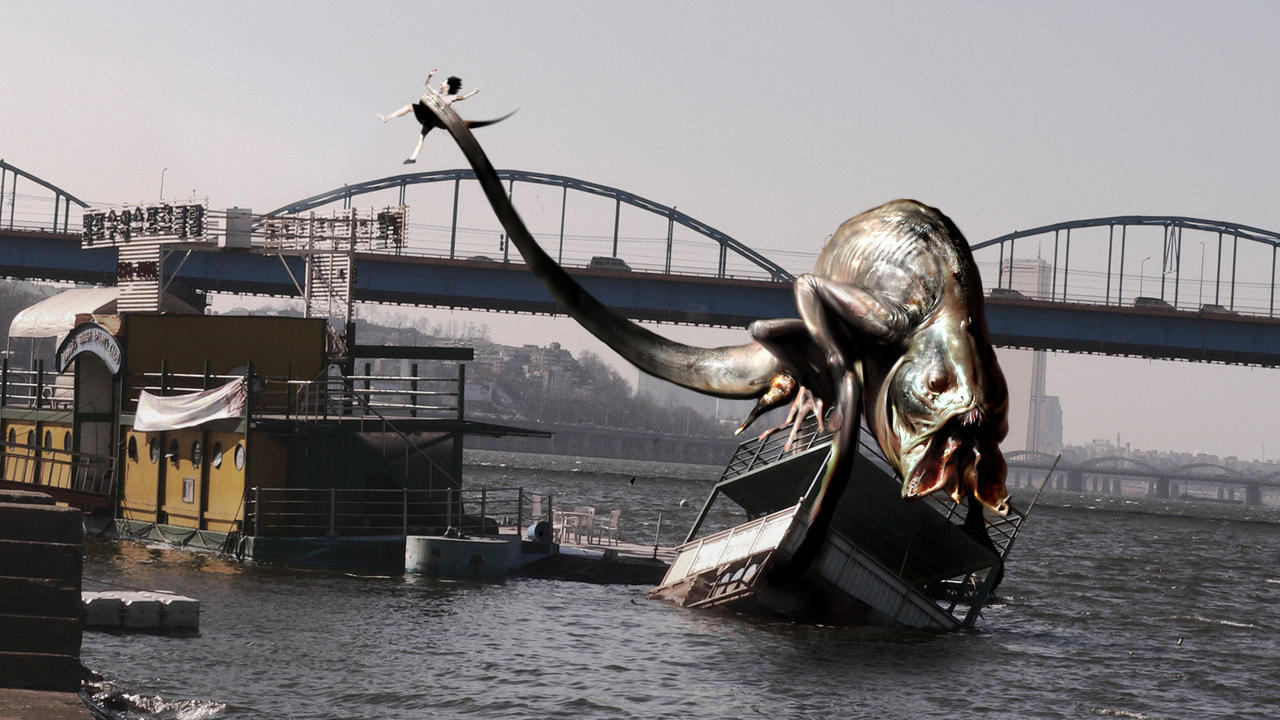
Visionary director Joon-ho Bong’s film opens in a military lab hospital in 2000. A clearly insane American doctor, repulsed by the dust coating formaldehyde bottles, orders a Korean subordinate to empty it all into the sink. Soon the contents of hundreds of bottles of formaldehyde find its way through the Korean sewer system and into the Han River. This event – allegedly based on fact – eventually leads, not surprisingly, to some pretty gamey drinking water. And also a 25 foot cross between Alien and a giant squid.
Said monster – let’s call him Steve Buscemi (the beast’s actual on-set nickname) – exits the river one bright afternoon in 2006 to run amuck in a very impressive outdoor-chaos-and-bloodshed scene. A dimwitted foodstand clerk witnesses his daughter’s abduction by the beast, and the stage is set.
What follows, rather than a military attack on a marauding Steve Buscemi, is actually one small, unhappy, bickering family’s quest to find and save the little girl. Their journey takes them to poorly organized quarantines, botched security check points, misguided military/Red Cross posts, and through Seoul’s sewer system, all leading to a climactic battle even more impressive than the earlier scene of afternoon chaos.
What else – honestly?
Twentysomething Steven Spielberg’s game-changer boasts many things, among them one of the greatest threesomes in cinematic history. The interplay among the grizzled and possibly insane sea captain Quint (Robert Shaw), the wealthy young upstart marine biologist Hooper (Richard Dreyfuss) and the decent lawman/endearing everyman Brody (Roy Scheider) helps the film transcend horror to become simply a great movie.
Perhaps the first summer blockbuster, Jaws inspired the desire to be scared silly. And in doing so it outgrossed all other movies of its time. You couldn’t deny you were seeing something amazing – no clichés, all adventure and thrills and shocking confidence from a young director announcing himself as a presence.
Spielberg achieved one of those rare cinematic feats: he bettered the source material. Though Peter Benchley’s nautical novel attracted droves of fans, Spielberg streamlined the text and surpassed its climax to craft a sleek terror tale.
It’s John Williams’s iconic score; it’s Bill Butler’s camera, capturing all the majesty and the terror, but never too much of the shark; it’s Spielberg’s cinematic eye. The film’s second pivotal threesome works, together with very fine performances, to mine for a primal terror of the unknown, of the natural order of predator and prey.
Jaws is the high water mark for animal terror. Likely it always will be.
Dogs and more dogs this week! Join us in the Screening Room to talk through all that’s new in theaters and home entertainment.
Listen to the full podcast HERE.
by Cat McAlpine
An alcoholic single mother (Glow’s Betty Gilpin) falls out with her dead husband’s family and struggles to juggle her floundering music career and responsibilities with her precocious young daughter (Abby Ryder Fortson, and later Kathryn Prescott). Is this a harrowing tale about the resilience of women and the litany of roles they must play?
Nope. This is A Dog’s Journey, sequel to the controversial 2017 hit A Dog’s Purpose. And the single mother is the bad guy – for many reasons, but largely because she doesn’t like dogs.
The film is based on the book sequel of the same name by W. Bruce Cameron. Cameron also penned the adaptation for film, with the help of three other writers. It took four people to write this movie.
I’m a strong believer that you should judge a movie within the genre it exists. A dog movie, for example, probably shouldn’t be judged against the same standards as, say Mad Max: Fury Road.
And yet, I can’t work A Dog’s Journey into a sphere where it achieves any kind of quality. This script reads like the bullet points from a rejected Hallmark channel feature. This film has less compelling dialogue and character development than Netflix’s notoriously bad A Christmas Prince. The human action only exists to serve up easy hits for a dog’s inner monologue about butts and bacon, but the action somehow also needs to be compelling enough that a dog’s spirit continually reincarnates.
To trick you into thinking this film is emotionally developed, they kill the dog at least four times, because anyone will cry at a dying dog. That’s the schtick in this series. If a dog loves you enough, it never truly dies, it simply returns as another dog.
What is this world, where it’s always golden hour and the river bank is littered with perfect clusters of sunflowers? Do these characters actually exist in a purgatory – where despite a perfect pastoral backdrop, nothing can truly die, and all living creatures remember their last violent death?
There’s an opportunity for a third movie which takes a sharp left into existential sci-fi horror, but I doubt that script would resonate with the crowd at my showing who repeatedly chuckled at Bailey (voiced by Josh Gad) rooting for romance with his catch phrase “Just lick faces already.” Maybe the existential sci-fi horror was that I had to watch this film in a room full of people who enjoyed it.
The reality is, people did and will enjoy this movie. It’s filled with easy to identify archetypes. It’s clear who the bad guys and the good guys are. There’s a bad mom, childhood hijinks, an abusive boyfriend arc, a car chase, a move to New York to “make it”, and a cancer scare and recovery all in 108 minutes. This movie requires zero brain power to consume because it’s a bland amalgam of all the unremarkable scripts that came before it – but with Gad’s sickeningly sweet puppy voiceover throughout.
I don’t know if dogs go to heaven, but I do know I’ll be seeing this film in hell.

by George Wolf
Every time I see the latest Young Adult romance fantasy on the big screen, I end up thinking about Barton Fink getting reprimanded for not sticking to the formula.
“Wallace Beery! Wrestling picture!”
Credit The Sun Is Also a Star for trying to stray outside the usual lines, even as it hits those same formulaic goalposts.
Natasha (Yara Shahidi) and Daniel (Charles Melton) are great-looking (and somehow, single) teens in New York City. Hers is a family of Jamaican immigrants facing deportation in 24 hours, while his Korean family runs a black hair care store in the neighborhood.
‘Tasha “doesn’t believe in love,” but meeting Daniel gives him the chance to win her over while she explores a last option to stay in the U.S.
Yes, there’s voiceover essay reading, yes he realizes her specialness after one faraway glimpse, and yes they both have to break free from the lives their parents have planned for them. Yes, in a city of millions they keep stumbling into idyllic situations where they’re all alone. Yes, it’s based on a YA novel and yes, some of the dialog is downright cringeworthy.
You knew much of that already (because “wrestling picture!”), but the film does mange to score some little victories.
Best of those is the assured direction from Ry Russo-Young (Nobody Walks, Before I Fall) , who keeps NYC’s melting pot as an ever-present supporting player. Paired with the diversity of the cast, the undercurrent of real lives upended by immigration policies comes in surprisingly deft waves.
But as Daniel waxes on about fate and the need for chemistry, it eventually becomes clear that Shahidi and Melton – both promising talents – don’t have enough of it.
That’s a problem, and it stands at the top of the list of things this film is selling that you just can’t buy.