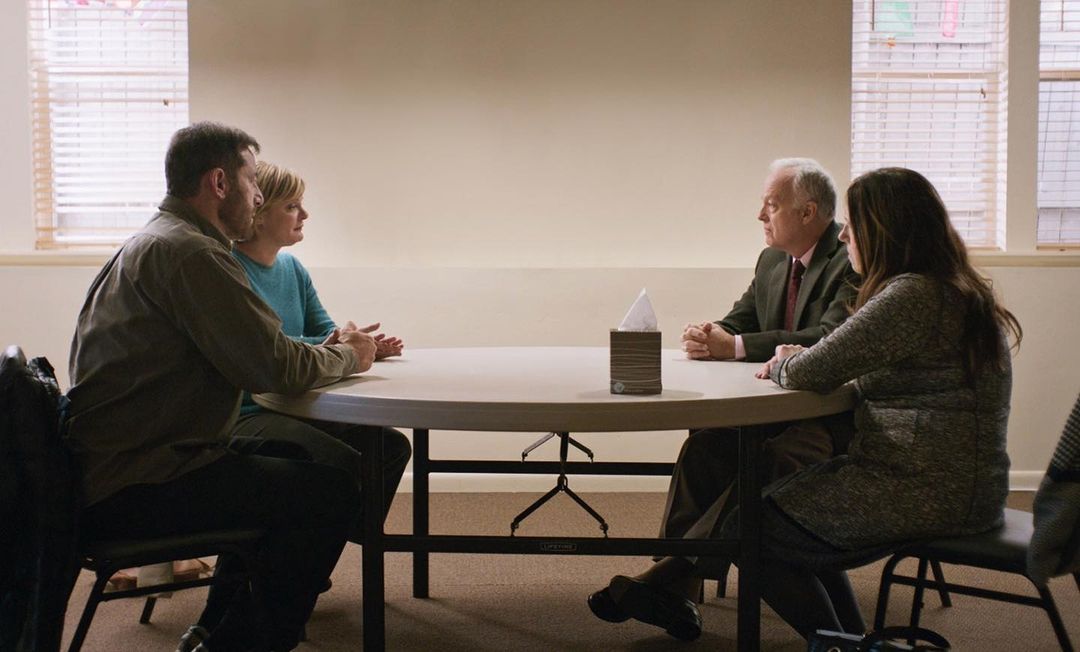
Jay and Gail (Jason Isaacs and Martha Plimpton) arrive at a local church, both uneasy about their planned meeting with Linda and Richard (Ann Dowd and Reed Birney). While the choir practices upstairs, a room has been reserved for the couples to talk.
There is a small table with four chairs. There is water. And there are tissues.
An unthinkable tragedy has connected these four people for life, and veteran actor Fran Kranz explores their journey of healing with a gently assured filmmaking debut full of shattering emotion.
Yes, you will need some of those tissues, too. But Kranz’s touch is so perfect, and the characterizations so real, that you never feel preached to, even with a large crucifix dominating the room.
The four actors are raw and touching, each exploring different levels of anger, blame, guilt and forgiveness. Writer/director Kranz gives Gail the most complete journey, and Plimpton realizes it with an award-worthy turn, while Dowd finds the subtle grace in a final confession that could have easily turned overwrought.
Mass is a spare chamber piece that makes sure nothing comes easy. You hang on every word, afraid to intrude on this intimate pain yet welcoming the invitation. With insightful writing, superb performances and unassuming direction, it’s a cathartic film that deconstructs an all too common tragedy with overdue honesty.
There is a satisfying if confounding unpredictability about Emir Ezwan’s Malaysian folk horror Soul (Roh).
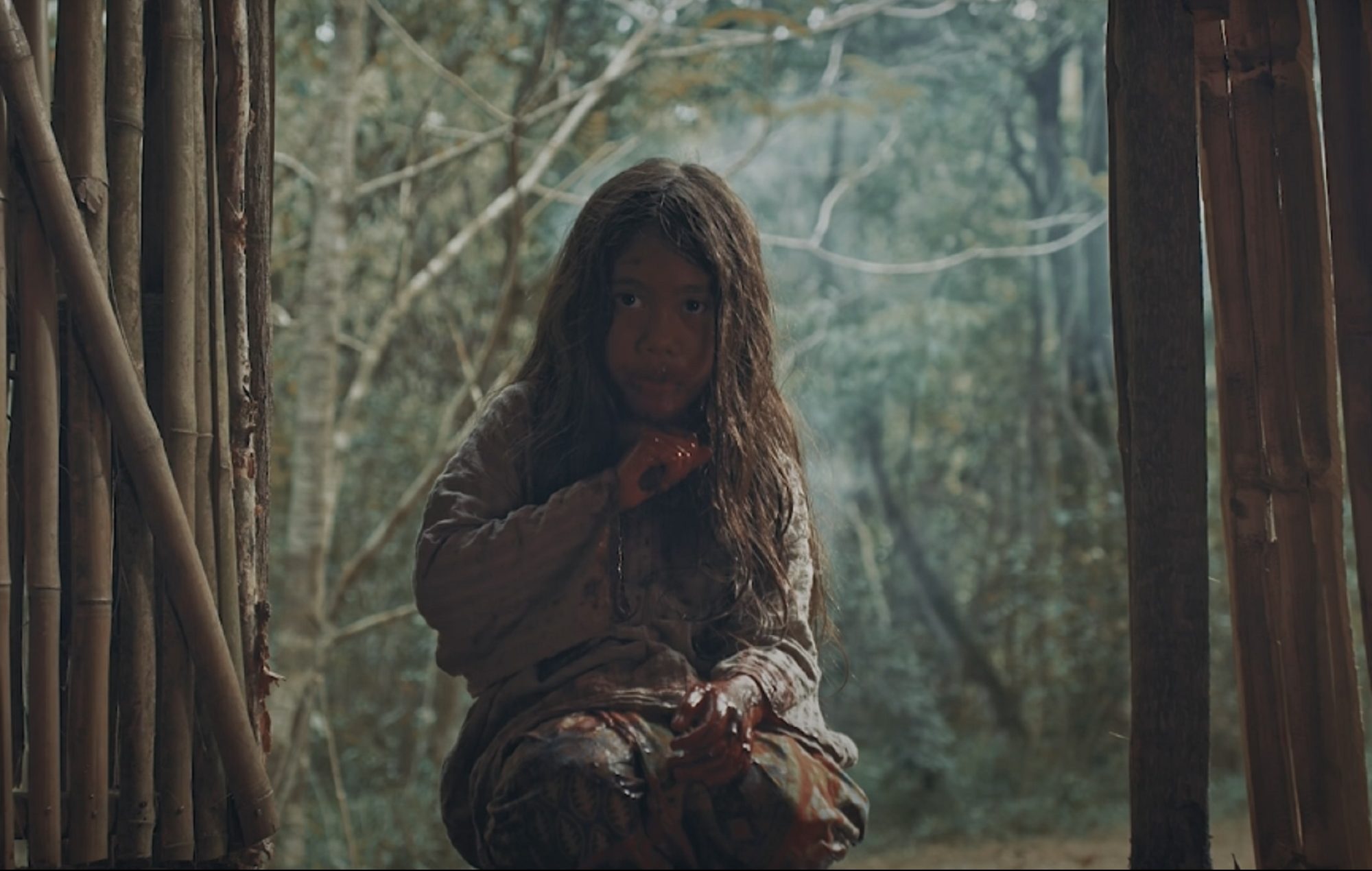
A slow burn set in an unspecified past, the film shadows a bloody, filthy little girl (Putri Qaseh) in a jungle as she watches a village burn before disappearing into the tree cover. When she later follows a pair of siblings back to their isolated hut, we know Mom (Farah Ahmad) probably should not take the straggler in.
But how could she turn her away?
What follows is a spooky tale of rural superstition that sees humans as gullible playthings to supernatural forces.
Ezwan draws naturalistic, believable performances from the cast of six, three of them children. Though Qaseh delivers only one line, she makes it count. But it’s Ahmad’s performance unadorned performance that generates the film’s uneasy central idea that a person’s character, choices, strengths or weaknesses are irrelevant in the face of a cruel and random power.
Whether that power is God or evil, nature or society doesn’t much matter.
Making the most of limited resources, the filmmaker casts a spell of a kind only found deep in the woods. The setting itself behaves as its own character, menacing and magical. Saiffudin Musa’s camera conjures the beauty and decay, both danger and sustenance around every turn.
You never know what you’ll find—true of the jungle and of this film.
There’s nothing showy about Ezwan’s feature debut. Instead, a raw but graceful understatement balances something supernatural with something profoundly earthly to deliver blood, dread and fear.
Hey, do you remember what a non-stop laugh riot Scott Cooper’s Out of the Furnace was? No? Well, compared to his latest — the long, long-awaited horror Antlers — it is.
The film takes us to depressed, smalltown Oregon at the height of the opioid crisis. Julia (Keri Russell) has returned after decades away. She lives with her brother, the town sheriff (Jesse Plemons), teaches middle school and deals with her demons.
Someone else’s demons are less metaphorical.
Cooper co-wrote the screenplay with Henry Chaisson and Nick Antosca, who adapts his own short The Quiet Boy. The short uses fairy tale language to cast an image of abuse and horror — an idea Antlers plays with but eventually abandons for more heavy-handed parallels between child abuse, addiction and economic blight.
At the center of the action is 12-year-old Lucas Weaver (Jeremy T. Thomas) in a remarkable turn. Hollow-eyed and tragic, he conveys secrecy and desperation in equal measure. And as soon as your heart breaks for Lucas, you see his little brother Aidan (a crushingly adorable Sawyer Jones).
The boys have a problem that seems unsolvable, but it might have played better if Cooper could have kept the focus a little more on the monster movie and a little less on the metaphor.
There is a monster —literal and figurative—in this film. The creature effects for the literal monster amaze and unnerve, thanks to an impressive design and to emotional seeds planted early in the film by actor Scott Haze.
Antlers looks great, whether cinematographer Florian Hoffmeister’s camera lingers in the woods, tiptoes down hallways, or witnesses red-flare lit doom in a mine. But Cooper is an odd choice for a supernatural film, and perhaps an entirely wrong-headed filmmaker to take on the perspective of a child to tell a horrific fairy tale.
Whimsical he ain’t.
In the end, the film suffers from a lack of imagination. Cooper and team lead us through a dour metaphor full of familiar genre tropes and leave us with a brutal, great-looking, well-acted lecture.
In New York’s Chinatown, those who smuggle humans into the country are known as Snakeheads. One woman, smuggled into New York herself and in debt to Dai Mah (Jade Wu), finds herself trafficking humans in writer/director Evan Jackson Leong’s film, Snakehead.
Sister Tse (Shuya Chang) is willing to do anything to survive, even if it means working for Dai Mah and her family of black market criminals. Like any criminal family, Dai Mah’s crew runs a few legitimate operations, but out of the eye of the law, they smuggle men and women into the country.
Writer/director Evan Jackson Leong’s film has an eye on the many pieces of operating a human smuggling operation. It’s dangerous work, but most of those involved are true villains. Dai Mah’s son, Rambo (Sung Kang), has no regard for the people he brings into the country. They’re cargo. His legitimate business is an aquarium, and he treats the fish he sells better than the people who are forced to rely on him for safe passage into America.
Sister Tse watches most of this with an observant eye. She’s tough, but she hasn’t lost her empathy for those in situations similar to hers. Though Sister Tse is higher up in the slave chain under Dai Mah, she is still a slave.
Chang crackles with unspoken rage as she watches the operations around her. She sells the role as a fierce woman who ingratiates herself into Dai Mah’s inner circle, but never forgets what she truly is. Wu can’t match Chang’s ferocity on screen. Though we watch her commit a violent act, she never sells herself as someone truly dangerous — a necessity for a woman who runs a crime organization. Slightly more convincing as a villain is Sung Kang, but even his character has a soft spot that stretches believability.
There are too many moments that require a hard suspension of disbelief. Though the immigrants’ predicament rings with truth, it’s the overarching operation that never lands as a believable enterprise.
Loosely based on real people and events, Snakehead is the kind of true-crime drama that tells a compelling story. The fictionalized element, though, tends to forget the victims who suffer as they seek a better life. Sister Tse is an attempt to remember, but as the more brutal elements of the film play out, it’s easy to be swept up in the action rather than rooted in the true horror of human trafficking.
Who’s ready for Wes Anderson’s most Wes Anderson-y movie to date?
It feels like we say that every time he releases a new film, but The French Dispatch is absolutely the inimitable auteur at his most Andersonesque.
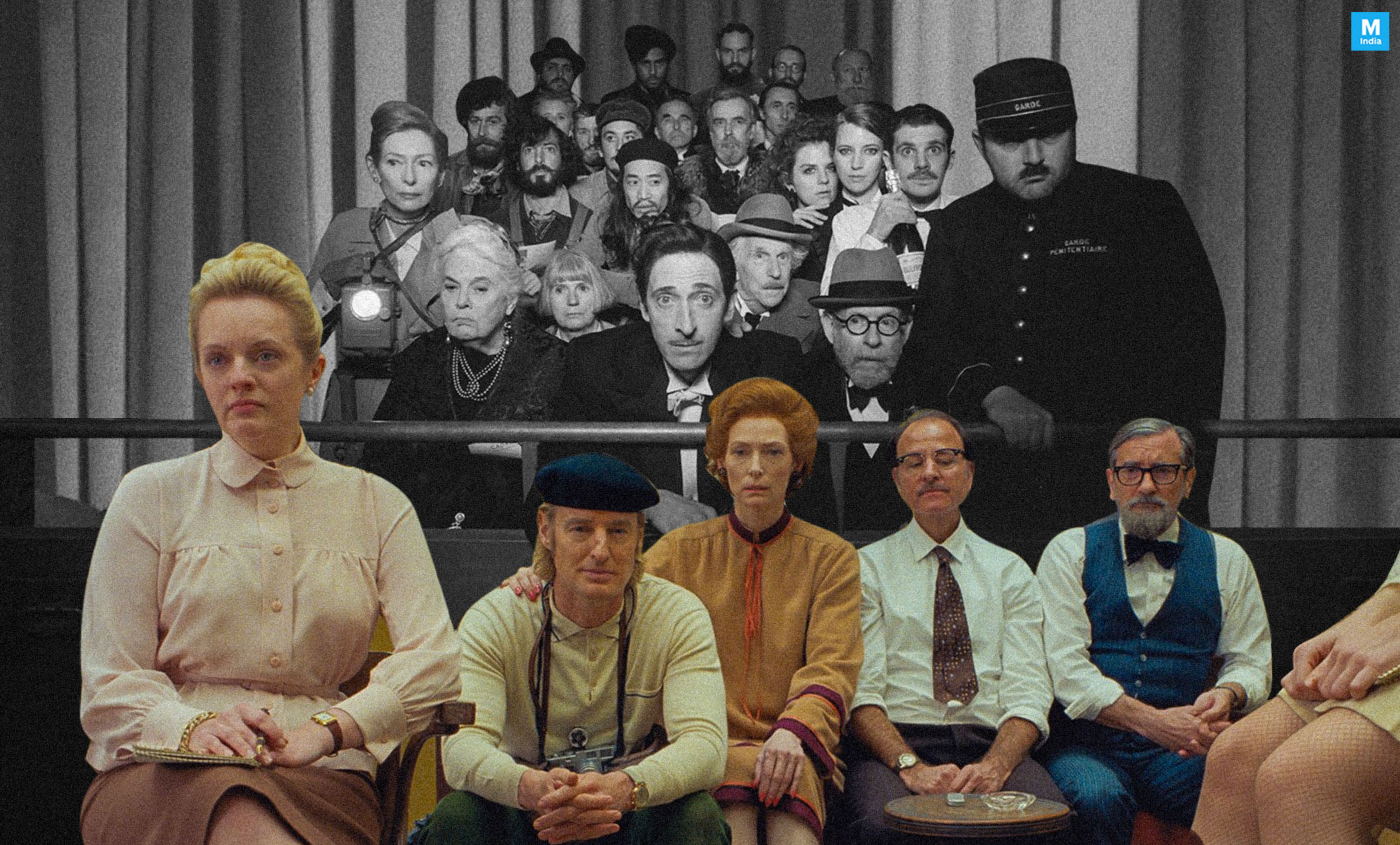
The French Dispatch is a magazine — a weekly addition to a Kansas newspaper covering the ins and outs of Ennui, France, the town where the periodical is based. The film itself is an anthology, four shorts (four of the stories published in the final edition) held together not by the one character each has in common, editor Arthur Howitzer, Jr. (Bill Murray), but by Anderson’s giddy admiration for France and The New Yorker.
Boasting everything you’ve come to expect from a Wes Anderson film — meticulous set design, vibrant color, symmetrical composition, elegance and artifice in equal measure, and a massive cast brimming with his own stock ensemble — the film is not one you might mistake for a Scorsese or a Spielberg.
Expect Anderson regulars Tilda Swinton, Mathieu Amalric, Lea Deydoux, Owen Wilson, Adrien Brody, Frances McDormand and newcomers Benicio Del Toro, Timothee Chalamet and Jeffrey Wright. And those are the big roles (although truth be told, no one is on screen all that long).
Blink and you might miss Saoirse Ronin, Willem Dafoe, Henry Winkler, Elisabeth Moss, Ed Norton, Christoph Waltz, Liev Schreiber and Jason Schwartzman.
In the segment filed under the “Taste and Smells” section, Dispatch writer Roebuck Wright (Wright) turns in a sprawling profile on master chef Nescaffier (Steve Park) that – to Howitzer’s chagrin – contains merely one quote from Nescaffier himself. As with the other pieces of the anthology, the many tangents of the piece are explained through Anjelica Huston’s narration, which can’t replace a truly emotional through line and holds the film back from resonating beyond its immaculate construction.
Anderson’s framing of symmetry and motion has never been more tightly controlled, and the film becomes a parade of wonderfully assembled visuals paired with intellectual wordplay and an appropriately spare score from Alexander Desplat.
As a tribute to a lost era of journalism and the indelible writers that drove it, Anderson delivers a fascinating and meticulous exercise boasting impeccable craftsmanship and scattershot moments of wry humor. But the layer of humanity that elevates the writer/director’s most complete films (Rushmore, Moonrise Kingdom, The Grand Budapest Hotel) never makes it from page to screen, and The French Dispatch ultimately earns more respect than feeling.
A pair of Beats headphones is Last Night in Soho‘s first clue that you’re not where you think you are.
The sights and sounds of young Ellie’s (Thomasin McKenzie) bedroom scream 1960s London. And though that’s where and when she’d really like to be living, Ellie is a modern-day British country girl, brought up by her Grandparents after her mother’s suicide years earlier.
Ellie dreams of a career as a designer, so she’s thrilled by an acceptance letter from the London College of Fashion. But once in the big city, the shy “country mouse” has trouble adjusting to the pace and the pressures of city life.
Her refuge becomes vivid dreams from the swinging 60s era she celebrates, detailed visions that put Ellie alongside Sandie (Anya Taylor-Joy), a young singer looking for fame and fortune among a sea of predatory men.
As Sandie’s trust in nightclub manager Jack (Doctor Who‘s Matt Smith) leads her down a dark and dangerous path, Ellie’s dreams turn truly terrifying. And the deeper Ellie is drawn into Sandie’s world, the more she believes a creepy old dude from her local pub (Terence Stamp) is really present-day Jack, who needs to pay for his past misdeeds with a succession of starstruck London girls.
Director and co-writer Edgar Wright slows his often frantic pace this time, trading those trademark edits for a more languid, appropriately dreamy vibe. His love of color is still front and center, and a giallo pastiche is just one in his Soho arsenal. There’s a time-hopping mystery here, sitting at the center of bloody thrills and a Black Swan-esque exploration of female trauma.
Wright hooks you early with delightful period details and – of course – some effortlessly hip throwback tunes for the soundtrack. His camera is nimble and his faming is precise, often using mirrors to exquisitely blend Ellie’s dreams with Sandie’s past.
McKenzie is doe-eyed perfection as the naive Ellie, an innocent somehow working out her own issues through the tragic past of a kindred spirit. Taylor-Joy is equally wonderful, bringing sad authenticity to Sandie’s quick descent from confident talent to broken soul. Stamp and Smith provide terrific support, eclipsed only by the bullseye casting of Diana Rigg (in her final role) as Ellie’s landlady.
Last Night in Soho is an often glorious mashup of settings and genres, and though you’ll recognize all of them, the package still carries a postmark that’s uniquely Wright’s. Maybe that’s why the resolution lands as curiously rote.
As was the case with the darling zom-rom-com Shaun of the Dead, it seems as if Wright doesn’t have the meanness to make a scary movie. He understands them, clearly, and bends their tropes to his will. Here he pulls apart Hitchcock and Argento to invert the genre’s fetishistic relationship with violence against women. Wright does this with such panache for 2/3 of the film that the final act feels abruptly tidy, too clear a reversal.
Does it spoil the Soho experience? Don’t be silly, baby! This film is a gas, but one that leaves you with with a little reminder that Wright’s most perfectly groovy film is still to come.
The Spine of the Night is a rotoscope-animated feature that presents a pseudo-H. P. Lovecraft story of humanity’s cosmic insignificance in the visual style of a higher-budget He-Man cartoon.
The film is mostly the backstory of a formidable, almost-naked, swamp queen who has trekked up the face of a mountain. She’s come to swap tales with a Guardian sworn to protect humanity from confronting its own vulnerability in the face of a vast and indifferent universe.
He’s guarding a blue flower that makes folks trip balls and contemplate the cosmic void. But a seed got away from him and floated to the fertile earth of the swamp. With the knowledge of the void comes magic power.
And humanity’s quest for this power has caused no end of trouble.
Like Lovecraft’s stories, the Spine of the Night has a slow, dreamy pace. The art style pays homage to the otherworldly and provocative covers of vintage pulp fantasy/horror novels, but with a welcome understanding that not all women are proportioned like Barbie dolls, and with more diversity in the race/ethnicity of its characters.
The theme of humanity’s fragility is underscored in the movie’s violence. Skin parts and limbs break off with the ease of a tortilla chip placed under the pressure of a slightly viscous dip. Viscera are just waiting to pop out of the body’s private cavities like trick snakes in a can of faux potato chips. People are cleaved in half.
Writer/directors Philip Gelatt and Morgan Galen King have assembled a roster of voice talent that helps bring the characters to life. Is there a better choice to play a badass swamp queen who is impervious to frostbite than Lucy Lawless? I don’t think so. Joining Lawless are Richard Grant as the Guardian, Joe Manganiello as the beefy soldier Mongrel, Betty Gabriel as a warrior-librarian, and Patton Oswalt as the whiny and entitled Lord Pyrantin.
As a child of the eighties, I was left feeling swaddled in nostalgia by Spine of the Night, wanting to pair it with some cozy PJs and a bowl of sugary cereal.
Remember Shudder’s 2019 documentary Horror Noire: A History of Black Horror from director Xavier Burgin? It was great, wasn’t it? And if you thought to yourself that you’d love a sequel, you should know that this week’s Shudder premiere Horror Noire is not that. Not exactly.
Instead, it is an anthology of six horror shorts made by Black filmmakers. Writers, directors, performers, ideas, perspectives, points of view — everything the documentary made us realize we were not getting – is delivered by the anthology.
Production values and performances in every film are solid. Familiar faces of veteran talent elevate the individual pieces. Tony Todd, Malcolm Barrett, Rachel True, Peter Stormare, Lenora Crichlow and others turn in memorable performances in creature features, Gothic horrors, psychological horrors and comedies.
Todd, True and Barrett star as a married couple pulled apart by a cult in one of the strongest entries, Rob Greenlea’s Fugue State, a sly comment on a common problem. Kimani Ray Smith’s Sundown is a fun reimagining of horror tropes led by Stormare’s characteristic weirdness and the action hero stylings of Erica Ash.
Julian Christian Lutz’s Brand of Evil reworks familiar ideas, turning them into an unexpected creature feature that’s both savvy and strangely touching.
Other shorts are a little less successful. Robin Givens’s Daddy digs into parental horror but can’t balance build-up with payoff. Zandashé Brown’s The Bride Before You brims with insight and style, but an overreliance on voiceover narration keeps the film from developing the kind of atmosphere it hopes for.
Joe West’s The Lake also falls just short of keeping you interested and guessing, although a fuzzy backstory allows for a more thought-provoking lead character than you might expect.
The full stash runs two and a half hours and might have played better as a short series. It’s a long commitment, and every film has weak spots, which makes the time really feel like a commitment. But there’s much to enjoy with each episode. Taken as a whole, there’s variety enough in style and substance to promise something for everyone.
Friends to the end – that’s the whole idea when horror filmmakers tackle friendship, isn’t it? Can they be trusted? Who will sacrifice what, and will it be worth it? Or are they both evil? Horror cinema has an excellent run of best friends in movies, but we’re looking at movies specifically about that friendship. Movies like Shaun of the Dead and Jennifer’s Body. (Both brilliant, but not on the list. We know! There are a lot of great ones!) So let’s get to it!
5. Bedevilled (2010)
Cheol-soo Jang’s first feature film bears witnesses not only to some horrific deeds, but to an amazingly confident new filmmaker who knows how to sidestep expectations, turn the screw, and offer surprising insight in a genre that doesn’t always generate that kind of thoughtfulness.
The film opens as beautiful if cold Hae-won (Sung-won Ji) witnesses a crime and chooses not to involve herself. She takes a (somewhat involuntary) vacation on the remote island where she grew up, to find her childhood friend Bok-nam (Young-hee Seo). On the isolated, backward island – though Hae-won is treated to rest and nurturing by her adoring friend – Bok-nam’s life is about as far from ideal as possible.
Jang captures the rugged, isolated beauty of the island and offsets both ideas with his leads – one, an elegant and pristine beauty, the other a rough-hewn image – and sees two sides of the same humanity. This is a morality tale, but it’s also a brutal but sympathetic (and seriously bloody) comeuppance. Jang does not leave off where you think he might, instead crafting a compelling and satisfying whole that will stick with you.
4. Tragedy Girls (2017)
Heathers meets Scream in the savvy horror-comedy that mines social media culture to truly entertaining effect.
Besties Sadie (Brianna Hildebrand) and McKayla (Alexandra Shipp) are looking for more followers to improve their brand, and they have been doing a lot of research to make their content more compelling. The Tragedy Girls plumb their small Ohio town’s surprising death toll with more insight than the local police seem to have. Where do they get their knowledge?
Provocative.
Hildebrand and Shipp (both X-Men; Hildebrand was the moody Negasonic in Deadpool while Shipp plays young Storm in the franchise proper) nail their characters’ natural narcissism. Is it just the expectedly shallow, self-centeredness of the teenage years, or are they sociopaths? Who can tell these days?
3. Tucker & Dale vs Evil (2010)
Horror cinema’s most common and terrifying villain may not be the vampire or even the zombie, but the hillbilly. The generous, giddy Tucker and Dale vs. Evil lampoons that dread with good-natured humor and a couple of rubes you can root for.
In the tradition of Shaun of the Dead, T&DVE lovingly sends up a familiar subgenre with insightful, self-referential humor, upending expectations by taking the point of view of the presumably villainous hicks. And it happens to be hilarious.
Two backwoods best buds (an endearing Tyler Labine and Alan Tudyk) head to their mountain cabin for a weekend of fishing. En route, they meet some college kids on their own camping adventure. A comedy of errors, misunderstandings and subsequent, escalating violence follows as the kids misinterpret every move Tucker and Dale make.
T&DVE offers enough spirit and charm to overcome most weaknesses. Inspired performances and sharp writing make it certainly the most fun participant in the You Got a Purty Mouth class of film.
2. Let the Right One In (2008)
In 2008, Sweden’s Let the Right One In emerged as an original, stylish thriller – and the best vampire flicks in years. A spooky coming-of-age tale populated by outcasts in the bleakest, coldest imaginable environment, the film breaks hearts and bleeds victims in equal measure.
Kare Hedebrant‘s Oskar with a blond Prince Valiant cut needs a friend. he finds one in the odd new girl (an outstanding Lina Leandersson) in his shabby apartment complex. She, as it turns out, needs him even more.
This is a coming-of-age film full of life lessons and adult choices, told with a tremendous atmosphere of melancholy, tainted innocence, and isolation. Plus the best swimming pool carnage scene ever.
The unsettling scene is so uniquely handled, not just for horrifying effect (which it certainly achieves), but to reinforce the two main characters, their bond, and their roles. It’s beautiful, like the strangely lovely film itself.
1. They Look Like People (2015)
Christian (Evan Dumouchel) is killing it. He’s benching 250 now, looks mussed but handsome as he excels at work, and he’s even gotten up the nerve to ask out his smokin’ hot boss. On his way home from work to change for that date he runs into his best friend from childhood, Wyatt (MacLeod Andrews), who’s looking a little worse for wear. Christian doesn’t care. With just a second’s reluctance, Christian invites him in – to his apartment, his date, and his life.
But there is something seriously wrong with Wyatt.
Writer/director Perry Blackshear’s film nimbly treads the same ground as the wonderful Frailty and the damn near perfect Take Shelter in that he uses sympathetic characters and realistic situations to blur the line between mental illness and the supernatural.
Wyatt believes there is a coming demonic war and he’s gone to rescue his one true friend. Andrews is sweetly convincing as the shell shocked young man unsure as to whether his head is full of bad wiring, or whether his ex-fiance has demon fever.
The real star here, though, is Dumouchel, whose character arc shames you for your immediate assessment. Blackshear examines love – true, lifelong friendship – in a way that has maybe never been explored as authentically in a horror film before. It’s this genuineness, this abiding tenderness Christian and Wyatt have for each other, that makes the film so moving and, simultaneously, so deeply scary.
The title of No Future also serves as an emotional
content warning for a film about heroin addiction, and it’s a warning to heed
if you want this kind of narrative tempered with breezy redemption.
But it’s not without hope. Rather, directors Andrew Irvine and Mark Smoot avoid sentimentality and addiction cliches in equal measure, and what’s left is a lean, emotional gut punch delivered by the small cast all turning in top performances.
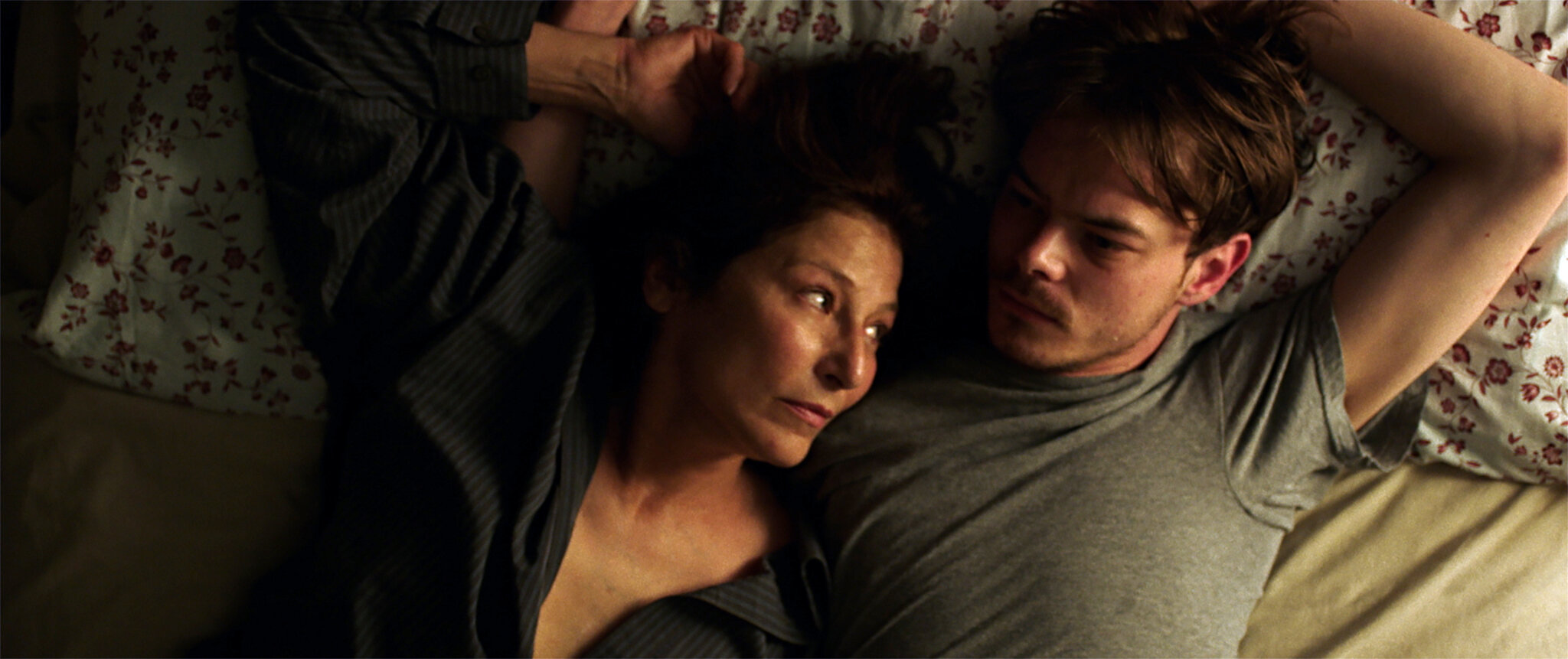
When an old friend dies of an overdose, Will (Charlie
Heaton), himself in recovery from heroin addiction, begins a tumultuous affair
with Claire (Catherine Keener), his dead friend’s mother.
The pair are drawn together by grief and guilt, a dynamic
that quickly goes from sympathetic to parasitic as the two spurn the numerous
more emotionally healthy therapeutic outlets available to process their loss.
Keener and Heaton are electric together, which is no small
feat for characters that veer wildly between retreating alone into their own
pain while showing a convincing attraction to each other. Keener in particular shines
as a woman who goes from casual fatalism to incandescent rage as she comes to
terms with losing her son Chris (Jefferson White).
The film flirts with thematic shortcuts, most notably in the
form of No Future—a band that Will and Chris played in together. But the more
Will and Claire wax philosophical about what brought them to this point in the
present, it becomes clear that it’s less nihilistic than it sounds.
The film is populated almost entirely with people who don’t allow themselves the luxury of looking any farther ahead than their open wound of the day. It’s raw and bracing to watch it all unfold, but if nothing else the impact lingers well into the future.