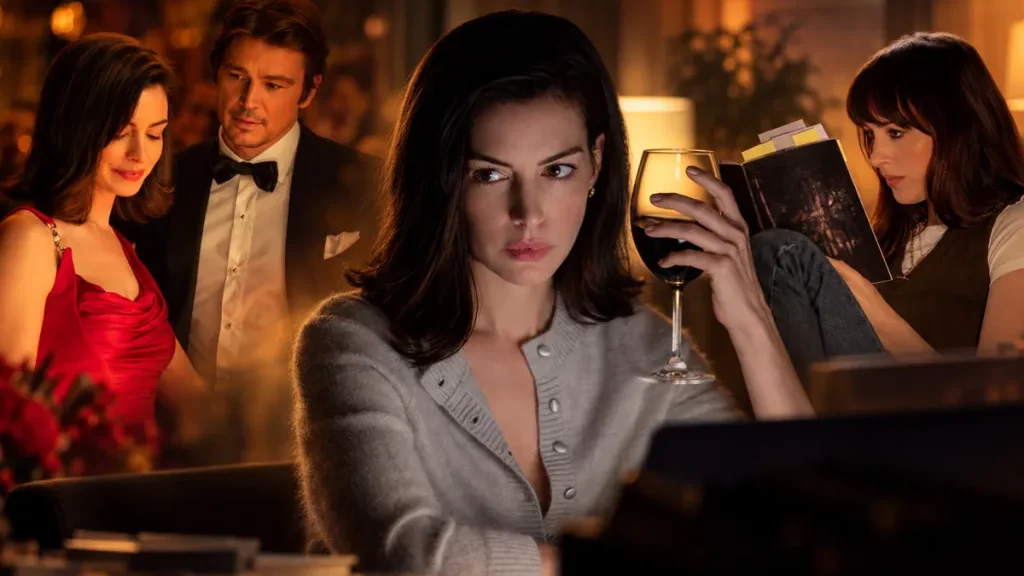
Verity
by George Wolf
The most interesting thing about Verity is what a stupefying mess it turns out to be. Anne Hathaway and Dakota Johnson aren’t just stars, but producers as well. And though Michael Showalter might seem a surprising choice to direct an erotic thriller, his resume includes some big wins (The Big Sick, Wet Hot American Summer).
Where did it all go wrong? Pretty much everywhere.
Based on Colleen Hoover’s best seller, the film follows struggling novelist Lowen Ashleigh (Johnson) as she is hired to finish a book series by world renowned writer Verity Crawford (Hathaway). Crawford is incapacitated after a car accident, so her husband Jeremy (Josh Hartnett) invites Lowen to stay in their Vermont mansion, pour over Verity’s notes and deliver three much-anticipated books.
But Lowen finds more than notes. She finds a flash drive holding a secret manuscript that appears to be an autobiography where Verity makes some earth-shattering confessions.
Cue the thunder claps and lightning strikes, and hold any trace of a winking nod to how ridiculous this all is. Hoover’s story (adapted by Nick Antosca) seems heavily borrowed from a couple more well-plotted novels, and Showalter’s humorless tone never leans into the pulpy aspects that might have made this a fun, guilty popcorn pleasure.
Sexy moments aren’t sexy. Jump scares aren’t scary. Witty banter isn’t witty, and the three very talented stars just seem confused. That’s a bad combo, one that allows for plenty of time for us to wonder about those breakdowns in internal logic.
But honestly, there isn’t much concern with any one thinking too much. An over-reliance on voiceover narration drains the shock value from big reveals, and ends up negating those seeds of doubt the film seems to think it is planting.
This type of Neo-noir blurring of truth and fiction has resulted in some twisty fun in the theaters over the last several years. But what might have been a self-aware ride on the order of A Simple Favor or The Woman in the Window barely rises to the level of Hathaway’s own curious dud Serenity.
Too much talent, not enough pulp. Sad to say, that’s Verity.



