I like to imagine the pitch meeting went something like this:
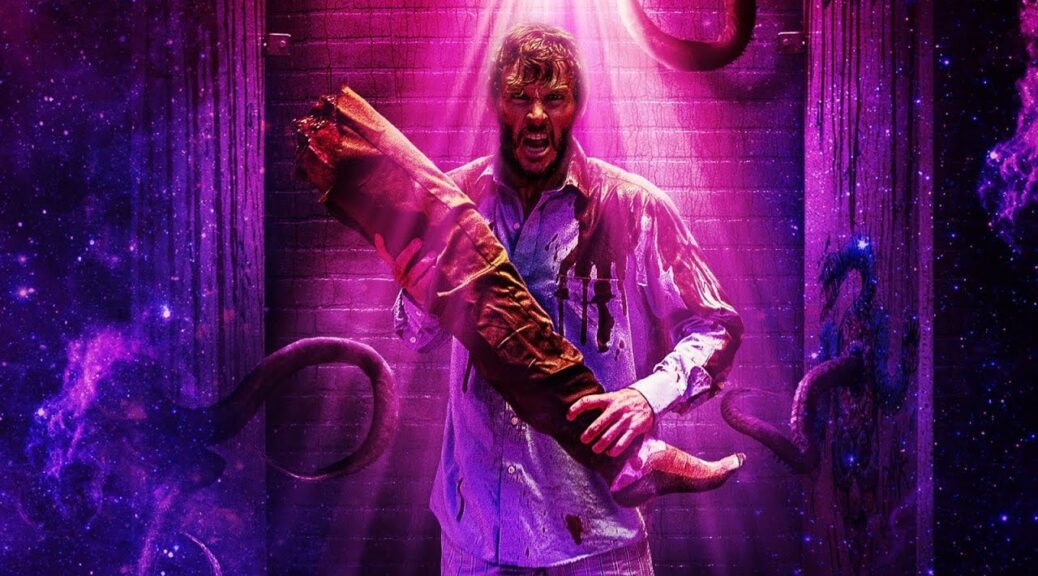
Picture it: a desperate man, trapped in a remote roadside rest stop with an ancient monster named Ghat.
Who’s playing the monster?
The voice of J.K. Simmons.
Go on.
So our man’s in one stall, with the monster in the other, offering commands from behind a glory hole.
What’s it called?
Glorious.
You’re damn right it is, and Shudder wants it for August.
Well now it’s here, and while the downsized cast and location recalls a host of pandemic-era productions, director Rebekah McKendry makes the most of what she’s given. Glorious proceeds at an intriguing pace that never feels sluggish, showing us just enough of the tentacled bathroom beast to strike an effective balance between bloody Lovecraftian spectacle and doomsday humor.
True Blood‘s Ryan Kwanten is perfect as a sad, pantsless bathroom sack named Wes. Screenwriters Joshua Hull, Todd Rigney and David Ian McKendry give Wes a wisecrack-fueled arc that shifts from wallowing in the pain of losing Brenda (Sylvia Grace Crim) to bargaining with Ghat for the fate of humanity (and Simmons, of course, is priceless). While the character is never quite compelling, Kwanten settles in a notch of two below Ryan Reynolds on smartass scale, making it easy have an interest in where Wes’s trippy toilet trip ends up.
And you may catch on early to that destination, but the real test of how Glorious will hit you is how much love you have for Lovecraft. Even if it’s minimal, this is a bathroom break full of squalid, forgettable fun.
We wanted to call this Dressed to Kill, but that would just be confusing. No, this is not about dressing the part [or about horror’s terrible history of confusing sexual orientation with psychosis]. Nope. This is about actual killer clothing.
5. The Red Shoes (2005)
In 2005, Kim Yong-gyun updated the old, horrifying Hans Christian Anderson story of vanity. Do you know that one? Spoiled girl with pretty red shoes is cursed so the shoes never stop dancing, her only relief is to have her feet cut off? Excellent children’s fare!
Like a lot of Asian horror of the time, the film follows a newly single woman and her daughter as they move into a shabby new apartment before finding a cursed object – in this case, shoes that are actually pink.
Though Sun-jai (Kim Hye-soo) brought home the discarded pair she found at the subway for herself, it’s her daughter (Park Yeon-ah) who becomes obsessed with them. Too bad they keep killing people!
There’s the obligatory sleuthing into the mysterious curse, but the filmmaker keeps you guessing, keeps the blood flowing, and comes up with a solidly creepy little gem.
4. Deerskin (2019)
What makes a good midlife crisis? What gives it swagger? Physicality? Style? Maybe a little fringe?
Deerskin.
Welcome to another bit of lunacy from filmmaker Quentin Dupieux. As he did with 2010’s Rubber (a sentient tire on a cross-country rampage), Dupieux sets up one feature-length joke.
It’s funny, though.
Deerskin is also slyly autobiographical in a way Dupieux’s other films are not. An odd duck wants to follow his vision (in this case, the obsessive love of a deerskin jacket) and make a movie. Creative partnerships and collaboration, while possibly necessary, also soil the vision and make the filmmaker feel dumb.
No one understands him!
Or maybe they do and his ruse is up.
No matter. He still has killer style.
3. Slaxx (2020)
Absurdism meets consumerism in co-writer/director Elza Kephart’s bloody comedy, Slaxx.
Sehar Bhojani steals every scene as the cynical Shruti, but the jeans are the real stars here. Kephart finds endlessly entertaining ways to sic them on unsuspecting wearers.
Where Romero mainly pointed fingers at the hordes mindlessly drawn to stores like CCC, Kephart sees the villains as those perpetuating clean corporate hypocrisy. Still, it’s their customers and workers she murders—by the pantload.
2. Clown (2014)
Sympathetic, surprising, and often very uncomfortable, Jon (Spider-Man franchise) Watts’s horror flick, though far from perfect, does an excellent job of morphing that lovable party favorite into the red-nosed freak from your nightmares.
Because clowns are terrifying.
Kent (a pitiful Andy Powers) stumbles across a vintage clown outfit in an estate property he’s fitting for resale. Perfect timing – his son’s birthday party is in an hour. What a surprise this will be, unless the suit is cursed in some way and will slowly turn Kent into a child-eating demon.
It does! Hooray!!!
https://www.youtube.com/watch?v=3iw4ZeNoTbg
1. In Fabric (2018)
My last note after watching In Fabric: “Well, that was weird.”
Weird in a good way. The film follows a red Ambassadorial Function Dress and the havoc it wreaks on its wearers.
Strickland, apparently, is about as fond of consumerism as Romero or Cronenberg. He’s also as fond of the color red as Argento. Unlike the giallo films that clearly inform Strickland’s aesthetic, here commerce, not violence itself, is the seductive, sexualized element.
Nobody blends giallo’s surrealistic seduction with dry British wit (two elements that, to be honest, should not fit together at all) like Peter Strickland. Subversive and playful while boasting a meticulous obsession with the exploitation films of the Seventies, Strickland creates vintage-futuristic fantasies that live outside of time and evoke both nostalgia and wonder.
His understated, excruciatingly tender 2015 horror They Look Like People certainly succeeds. And with his latest, When I Consume You, the filmmaker is at it again. Both films delicately explore mental illness—in this case, the lingering horror of childhood trauma.
Blackshear works with his regular troupe of actors: Evan Dumouchel, MacLeod Andrews and Margaret Ying Drake. Libby Ewing joins the gang as Daphne, big sister to Wilson (Dumouchel). The siblings are struggling to defeat a demon.
The film moves slowly and takes on an improvisational feel as Wilson ambles through life best he can, often landing on Daphne’s doorstep at 3 am so she can talk him through a panic attack. Blackshear never specifies the kind of childhood these two must have endured to leave them this scarred. Then again, the filmmaker doesn’t specify much.
This movie offers mostly atmosphere, situations that give the sense of the characters’ mental and emotional space. Blackshear also mimics the cycle of depression and anxiety with visual and audio callbacks: Daphne’s under the bed, later Wilson’s under the bed; Wilson’s on the sidewalk; later Daphne’s on the sidewalk. And there is the recurring audio cue: Get up.
This mostly works, creating a film that echoes with haunting attempts to break a cycle. Flashbacks are also employed, although they offer little to the narrative and only hinder a film already lacking forward momentum.
Dumouchel’s heartbreaking performance matches well with Ewing’s resigned turn. Blackshear’s cinematography emphasizes their intimacy, as well as their emotional incoherence, and the pair delivers a lived-in chemistry appropriate to two siblings who’ve been through the wringer.
Andrews is a volatile surprise I’m sorry we didn’t meet earlier in the film. He injects the movie with needed energy, but he also triggers a shift into more overt metaphor. While the film required some kind of structure, this tidy figurative direction feels false and forced.
They Look Like People possessed a deceptively loose narrative that, in fact, led inevitably to one of the tensest climaxes on record. When I Consume You feels like it’s trying to obscure its far more obvious framework.
The American Dream is a myth at best, a nightmare at worst in first-time filmmaker John Patton Ford’s lean indictment of capitalism, Emily the Criminal.
There’s a fearlessness born of anger in both Ford’s script and his lead’s performance. Aubrey Plaza flexes dramatic muscle as Emily, a savvy, hardworking young woman beset on all sides by forces crafted to keep the poor, poor—women in particular.
We meet Emily mid-interview, caught in a lie about her criminal record. Plaza’s roiling emotional reaction to the interview — a brilliant piece of acting — tells you all you need to know about the character’s character, backstory, and future.
Seventy grand in debt from art school, working catering gigs that barely put a dent in the loan interest, still holding out hope for a good, honorable, mainstream gig with an advertising agency, Emily’s on the ropes. Does she want to make a quick $200? The job’s illegal, but no one will get hurt.
Of course she does, and she’ll also take tomorrow’s $2000.
Ford’s tight script reveals only what’s necessary and rethinks nobility. Even as Emily begins to embrace and hone her criminality, she never loses sight of the true goal: comfy, secure, posh employment. But that’s as big a set up as college was.
It’s great to see Plaza not only playing a dramatic role but shouldering lead responsibilities. She’s in every scene —nearly every shot of every scene—and carrying that weight with grit. In her hands, Emily is defensive, cagey, and unafraid to be unlikeable. Plaza’s electric.
Theo Rossi provides a surprising, tender presence in a role where you wouldn’t expect it. He and Plaza sparkle together. You root for them, regardless of their occupation.
Emily the Criminal delivers the realistic inverse to a Tarantino or Scorsese. There’s no glamour to the criminal life. It’s a gig. And sometimes you gotta take the gig.
There are some rare talents with a unique set of skills that own a certain genre of film or character type. So much so that the mere mention of their name gives you a clear portrait of what is to be expected on the screen and an assurance that they are going to nail every bit of that role. Not to say they can’t play other roles well, but no one can play THEIR role the way they can.
Diane Keaton proves yet again that no one can play the manic-loveable woman in comedic crisis the way she can in Katie Aselton’s Mack and Rita – a comedy not so steeped in reality about remaining true to yourself during the social media age.
The film follows Mack (Elizabeth Lail), a 30-year-old woman with an old soul whose life changes forever when she transforms into her 70-year-old self “Rita” (Diane Keaton). This transformation prompts a quirky journey of self-discovery for our titular character(s) as she navigates love, friendship, and career woes.
The beginning of this film has a rocky start. The tone is unclear, many of the comedic beats seem a bit forced, and the devices used to push the story forward are lazy. Then Diane arrives… and makes everything better.
From the moment she appears on the screen the film is more interesting. The comedic moments seemingly designed for Keaton land much better. However, she is not the only player to save this film from its predictable and conventional plot.
The ever-charismatic Taylour Paige and the stunning Loretta Devine are exquisite in their roles and are clear standouts in this star-studded cast that includes the likes of Wendie Malick, Lois Smith and Amy Hill – all of whom are delightful.
Visually the film is also aided by fun costume pieces and a polished, somewhat campy aesthetic that fits the tone of the film perfectly.
While the performances are a treat and the costumes pleasing to the eye, Mack and Rita doesn’t offer anything new or inventive. If you are looking for a quick, light-hearted popcorn film, Mack and Rita is the film for you.
YouTubers are stupid. I think that’s the basic theme of Fall, the story of influencers proving their erroneous sense of immortality and bone-deep need for attention.
Lessons are learned and lunches are lost as two friends scale a defunct radio tower 2000+ feet into the sky. Becky (Grace Caroline Currey) is trying to overcome grief and find a reason to live again. Her best friend Hunter (Virginia Gardner) is the one who convinced her to face her fears, but if Hunter can impress her online fanbase while they’re at it, all the better.
It’s all superfluous, telegraphed nonsense because what’s the real point here? How well can director Scott Mann and cinematographer MacGregor (Vivarium) capture fit young women in gut-churning danger?
Pretty well.
Strong supporting performance by Garner’s bra, by the way.
The story itself is cobbled together from other sources–a touch of The Descent here, a whole scoop of The Shallows there, plenty of Open Water, lots of Frozen (no, not the “Let It Go” Frozen). Essentially, dumbasses get themselves into serious danger and we sit with them until they probably die.
Believable? No. Thrillingly shot? Yes.
Fall delivers gorgeous, stomach-churning action. The footage is really quite stunning, so if you’re going to watch it, find a big screen.
A story this spare can be and has been effective when done well, which is to say, when done lean and mean. Fall’s biggest downfall is not the acting (entirely competent), not the cloying emotional underpinnings (forgivable), not the leaps in logic. It’s not the dream sequences (the laziest plot device in all of cinema). It’s not even that one surprise twist that we all saw coming. Or the other one.
It’s the running time.
Fall clocks in at an hour and 45 minutes, which is far too long for this film. Mann and company can’t sustain the tension through the middle section well enough to merit the length. The Shallows ran under 90 minutes. Open Water delivered its powerful blow in less than an hour and twenty minutes. Shave half an hour off this film and you have yourself a brisk, dizzying effort worth a trip to the cinema.
Inu-Oh is one of those movies where the less you know going in, the more of a delight it becomes as the story unfolds. Stop right now, go see the movie and you won’t be disappointed.
To call director Masaaki Yuasa’s take on feudal Japan a Noh rock opera undersells the delirious places the movie goes, even for Yuasa (although if you watched his Devilman Crybaby on Netflix, you know what you’re in for). What starts with a ghost story and a brief history of the birth of Noh in 14th century Japan becomes a rollicking, righteous homage to the likes of Queen and Bowie.
The animation is as fluid and rhythmic as the music, and Inu-Oh is always beautiful to look at. But the music is where the film soars—along with its almost relentlessly on-message theme. The story focuses on the friendship between Tomona (Mirai Moriyama), a blind biwa player looking to avenge his father, and Inu-oh (Avu-chan), a demonic child who can only exorcise his curse through storytelling.
But these aren’t just any stories. Tomona and Inu-oh form a band and start staging modern rock performances that inspire crowds but anger the shogun and the more traditional troupes that will become the highly regimented Noh.
For Tomona, there is a creative imperative to be yourself and decide who that is, even under threat of execution. And for Inu-oh, their new form of expression is even more essential. As he tells these forgotten stories of dead Heike warriors, he slowly becomes more and more human.
The message isn’t subtle, and just in case, it’s spelled out explicitly by Tomona and Inu-oh. The songs are a way to honor memories. If our stories are forgotten, what do we have left?
Still, it’s hard to argue. And harder still to resist when delivered in the form of Yuasa’s brilliantly conceived stage performances that blend traditional, modern and downright trippy into something wholly new. It’s about as joyful a movie as you’re likely to get for a feudal ghost story about curses and family tragedy. It’s also a movie that manages to be both epic and immediate. History for Inu-oh is alive. And art needs to be as well if it’s going to have any lasting relevance for an audience
Brandon Lee was a mystery wrapped in an enigma inside the body of an awkward Scottish high schooler.
Or, maybe he was something else. My Old School revisits those teenage days for a light and entertaining look at a head-scratching scammer.
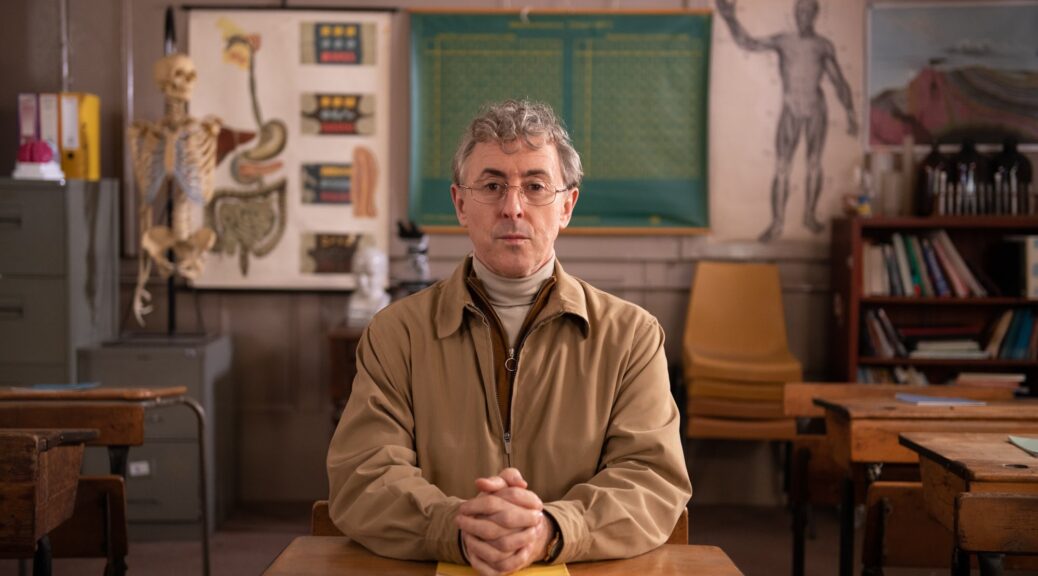
Brandon’s story was set to be told in a Mid-90s movie starring Alan Cumming. That project never got off the ground, but now Cumming finally gets his chance to play the part, lip-synching Brandon’s interview audio because the real guy won’t show his face.
And why is Brandon still hiding?
Well, that’s one of the mysteries writer/director Jono McLeod hopes to unravel.
Talking to Brandon’s former classmates and often re-creating their memories through animation, McLeod introduces us to the boy his peers first knew.
In 1993, Brandon enrolled as a 16 year-old at Bearsden Academy, a secondary school in an upper class section of Glasgow. His intelligence and behavior made him a favorite of the staff, but the kids found him weird.
Getting cast as Lt. Cable in the school’s production of South Pacific changed Brandon’s social status. And soon there were friends, holidays, brushes with the law, multiple passports and…oops.
Obviously, knowing as little as possible about this case benefits how the film will hit you, but even the biggest revelations don’t land quite as hard as McLoed seems to think they will. There are no jaw-on-the-floor twists on the order of 2012’s The Imposter, but some interesting questions are raised about selective memory and a belief in Jedi mind tricks.
An animation style that recalls MTV’s “Daria” and the laugh-it-off vibe of Brandon’s old classmates only fuels the feeling that the film is a little too forgiving of its subject.
Looking back, most everyone involved now admits that they should have looked closer at Brandon Lee. Entertaining a yarn as it may be, My Old School might have been more compelling by doing the same.
We’re invited to a turning point for four best friends. This is the last weekend of summer. On Monday, Daisy (Lia Barnett), Lola (Sanal Victoria), Dina (Madalen Mills) and Mari (Eden Grace Redfield) will be middle schoolers.
The first moments of Summering communicate the film’s strengths and weaknesses simultaneously. Heavy-handed, stilted voiceover narration sinks what is otherwise a jubilant, funny and very authentic opening.
Daisy, in voiceover, as we watch four adorable youngsters walk and talk through their suburban neighborhood: Summer has no walls. You can go anywhere.
Mari, on-camera dialog about that time her mom made her use the men’s room because the line for the women’s room was too long: Pee was everywhere. It was like a lake of man pee.
Summering walks that weird balance for its entire run time. One moment beams with the authentic lunacy of pre-adolescence. The next, adult male writers wax poetic and pretend that poetry sprung from the mind of a 12-year-old girl.
Director James Ponsoldt (The Circle, The Spectacular Now) and co-writer Benjamin Percy set the kids on an adventure before school and life changes the delicate balance of their circle. It amounts to a modern retelling of Stand By Me, with lower stakes, less ground to cover, and a wild lack of logic. Ponsolt and Percy seem desperate to capture the raw honesty of Reiner’s classic King adaptation, but their result’s a cloying mess.
The performances – especially Redfield and Megan Mullally as Mari’s mom – charm and endear with authenticity. Victoria and Mills succeed in crafting individuals, girls with backstories and personalities. Barnett, paired with an effective if woefully underused Lake Bell as the mom who drinks, struggles with the heavy emotion of an arc that’s clearly telegraphed.
It’s another way the storytelling rings false scene after scene.
Helicopter parents and cell phones, cartwheels and nostalgia, Ponsolt brings together all the elements for a modern ode to the last moments of childhood. And he tries really hard. But he’s unconvincing.