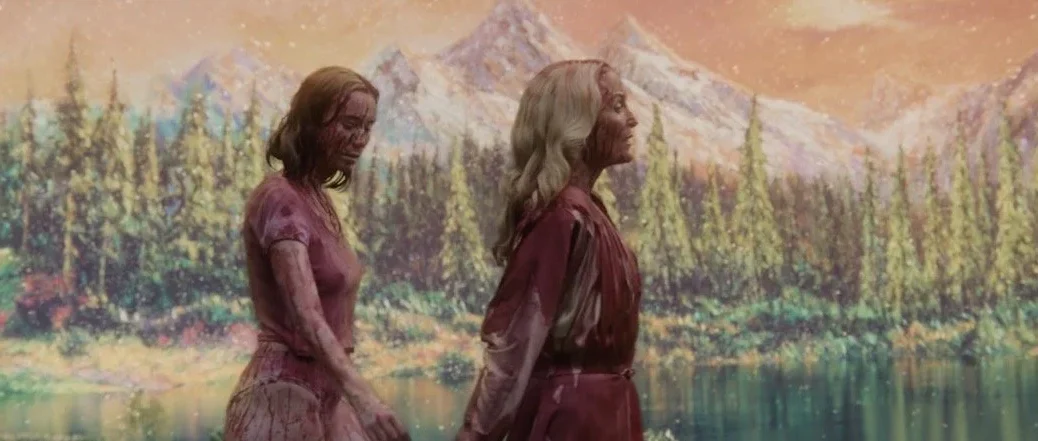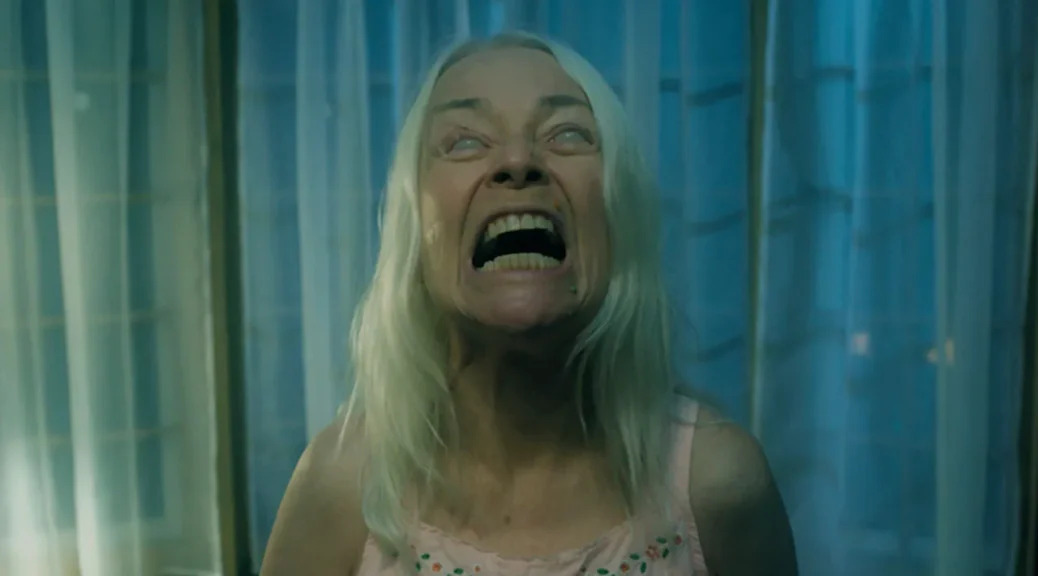
On this week’s Screening Room podcast, Hope & George review Mercy, Return to Silent Hill, The Testament of Ann Lee, H Is for Hawk, Magellan, and Mother of Flies.
by Hope Madden
When I used to pick my son up from his dorm, invariably there was a video game on whether anyone was playing or not. Mainly it was badly articulated characters delivering stilted, unrealistic but wildly dramatic dialog on an endless loop because, with no one playing, there was no action.
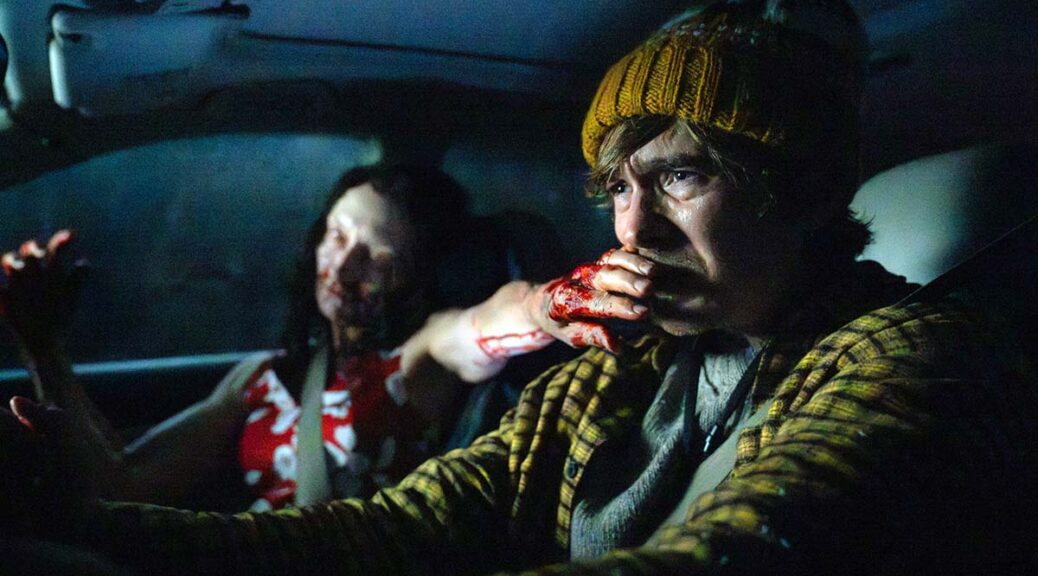
I could also be describing Christophe Gans’s twenty-years-in-the-making sequel, Return to Silent Hill.
I did not care for the filmmaker’s 2006 Silent Hill, a film that followed a mother into a supernatural town to save her adopted daughter. The sequel, also based on the incredibly popular video game of the same name, follows a distraught man (James Sunderland) who returns to a supernatural town to save his girlfriend (Hannah Emily Anderson).
Gans’s original at least boasted Radha Mitchell, who can, in fact, act. Gans didn’t give her much opportunity, but she tried. Do not look for that here. Though it doesn’t seem that acting is what Gans is after. He lights and frames actors specifically to make them seem less fleshy, less human. Their movement is stiff and unnatural, their dialog stilted and dumb. You truly feel like you’re watching a video game you’re not playing. Nobody’s playing.
You would hope that in the 20 years between projects, the creature design would have improved. Not the case. You rarely get a good eyeball on any of the creatures—and the video game does have a slew of creepy beasties to choose from—and when you do see them, they’re bland and they do nothing.
Because nothing happens in this movie. The entire film feels like being trapped in the between action set ups of a video game that nobody is playing. Nothing happens. There is no action.
Somebody thought the storyline, sans shootouts, without monster carnage, just the storyline of a video game was interesting enough to make a movie out of. They were incorrect.
Well, if you’re a horror fan, 2025 was your year, at least according to the Academy. All told, the genre racked up 27 Oscar nominations. Ryan Coogler’s period vampire epic Sinners led the pack with a record breaking 16 nominations. The previous high-water mark was 14 nominations.
Guillermo del Toro’s Frankenstein nabbed nine noms, while Zach Cregger’s Weapons got one—Best Actress in a Supporting Role for Amy Madigan—and Emilie Blichfeldt’s The Ugly Stepsister garnering a nomination for Best Makeup and Hair.
Films outside horror did quite well, too. Paul Thomas Anderson’s One Battle After Another received 13 nominations, Joachim Trier’s Sentimental Value nabbed five. Joseph Kosinski’s F1 received three Oscar nominations and Park Chan-wook’s No Other Choice received none. What?!
Wicked for Good got shut out, even in the makeup, costume, hair design and production design categories, which is a bit of a surprise. Otherwise, the Academy recognized what we all expected them to recognize, but, per usual, we have a handful of complaints.
Best Actor in a Supporting Role
Oh, glorious day, they recognized Delroy Lindo! This is a stacked category—Del Toro stole every scene he was in, and Sean Penn has not been such a hoot in any film in decades. Expected to see Paul Mescal, whose turn in Hamnet was so beautiful. Others who were great in smaller roles were Adam Sandler in the utterly forgotten Jay Kelly, and Miles Caton from Sinners. Not sure where we’d put them, though.
· Benicio Del Toro, One Battle After Another
· Jacob Elordi, Frankenstein
· Delroy Lindo, Sinners
· Sean Penn, One Battle After Another
· Stellan Skarsgård, Sentimental Value
Best Actress in a Supporting Role
Another stacked category with so much to be happy about. No real nits to pick here.
· Elle Fanning, Sentimental Value
· Inga Ibsdotter Lilleaas, Sentimental Value
· Amy Madigan, Weapons
· Wunmi Mosaku, Sinners
· Teyana Taylor, One Battle After Another
Best Actor in a Lead Role
This shook out the way we’d expected, although we would have loved to see Jesse Plemmons remembered for Bugonia. We’d have given Ethan Hawke’s slot to him or to Joel Edgerton for Train Dreams, although right now Hawke looks like he may be the upset winner, so what do we know?
· Timothée Chalamet, Marty Supreme
· Leonardo DiCaprio, One Battle After Another
· Ethan Hawke, Blue Moon
· Michael B. Jordan, Sinners
· Wagner Moura, The Secret Agent
Best Actress in a Lead Role
We are thrilled to see Hudson get attention for her delightful performance in Song Sung Blue, although the money’s on Buckley. Chase Infiniti would have been welcome for her fearless performance in One Battle After Another, as would Amada Seyfried for The Testament of Ann Lee, but again, not sure who we’d lose to make room.
· Jessie Buckley, Hamnet
· Rose Byrne, If I Had Legs I’d Kick You
· Kate Hudson, Song Sung Blue
· Renate Reinsve, Sentimental Value
· Emma Stone, Bugonia
Best Director
Would have loved to see Park Chan-wook on this list for just another masterpiece, No Other Choice, perhaps in Safdie’s place, but it’s a good group.
· Paul Thomas Anderson, One Battle After Another
· Ryan Coogler, Sinners
· Josh Safdie, Marty Supreme
· Joachim Trier, Sentimental Value
· Chloé Zhao, Hamnet
Best Casting
It’s the first year for the award, and the Academy only came up with four films. Given the sheer volume of acting nominations One Battle After Another received, seems funny they didn’t make this list.
· Hamnet
· Marty Supreme
· The Secret Agent
· Sinners
Best International Feature
Where on earth is No Other Choice? These films are great—intense, heartbreaking, fascinating—but only Sentimental Value and It Was Just an Accident deserve the spot over Park Chan-wook’s film.
· The Secret Agent, Brazil
· It Was Just an Accident, France
· Sentimental Value, Norway
· Sirãt, Spain
· The Voice of Hind Rajab, Tunisia
Best Score
What a great group! So thrilled for all five films, although we would have given Train Dreams the nod over Bugonia.
· Bugonia
· Frankenstein
· Hamnet
· One Battle After Another
· Sinners
Best Original Song
Loved seeing Train Dreams and Sinners in there.
· “Dear Me,” Diane Warren: Relentless
· “Golden,” KPop Demon Hunters
· “I Lied to You,” Sinners
· “Sweet Dreams of Joy,” Viva Verdi
· “Train Dreams,” Train Dreams
Best Adapted Screenplay
Not to beat a dead paper executive, but where is No Other Choice? We love you, Bugonia, but we’d have given your slot away.
· Bugonia
· Frankenstein
· Hamnet
· One Battle After Another
· Train Dreams
Best Original Screenplay
Maybe it would have been too much to ask for Weapons over Blue Moon?
· Blue Moon
· It Was Just an Accident
· Marty Supreme
· Sentimental Value
· Sinners
Best Documentary Feature
In another year of searing, heartbreaking, brilliant documentaries, great to see Come See Me in the Good Light get noticed.
· The Alabama Solution
· Come See Me in the Good Light
· Cutting Through Rocks
· Mr. Nobody Against Putin
· The Perfect Neighbor
Best Animated Feature
Solid choices in a relatively weak year in animation.
Best Cinematography
What an absolute gift we got in cinematography this year. Look at these gorgeous films!
Best Costume Design
Here’s one where Wicked: For Good is a surprise omission.
Best Film Editing
The Perfect Neighbor was a marvel of editing, and The Testament of Ann Lee was like a dream, but these choices are tough to argue.
Best Production Design
Wicked: For Good could be included here, too, but what to toss out?
Best Picture
F1? It was thrilling fun, but….
· Bugonia
· F1
· Frankenstein
· Hamnet
· Marty Supreme
· One Battle After Another
· The Secret Agent
· Sentimental Value
· Sinners
· Train Dreams
The 98th Academy Awards will be held Sunday, March 15th.
by Hope Madden
Lav Diaz’s 2-hour and 40-minute epic Magellan is not for the impatient viewer. With no exposition, a primarily stationary camera, and only one internationally known actor (Gael García Bernal in the title role), the filmmaker quietly undermines a historically accepted notion of exploration and perseverance.
Scenes have a painterly quality, the framing and lighting especially of interiors giving the impression of an oil painting. Each scene, threaded loosely together by time and location, feels more like a work of art into which characters tumble and behave.
Relying almost exclusively on long takes with an unmoving camera, Diaz emphasizes not the characters in a scene but its geography, its ecology. Even in sound design, the crash of ocean waves, the rustle of jungle leaves, the creak and moan of a ship at sea are given equal, sometimes even primary attention. These set ups let the environment dictate the scene, emphasizing the natural world and not the puny individuals so desperate to leave a mark.
Diaz, who generally films in black and white, revels in the hues and tones of the environments. Rich, deep browns in ship quarters conflict with the steely blue grey of the sky and ocean, which pale beside the rich greens of land. And the filmmaker insists that you notice, holding every shot far longer than expected so there’s nothing for you to do but take note of the brutal beauty.
The showiest thing about Magellan is its silences, what Diaz leaves unexplored and disregarded. Don’t go into this film expecting a rousing image of endurance and vision. This film is not impressed by the explorer. Diaz’s languid camera empties his film of the urgency you might expect of a film so pointedly critical of colonizers and exploiters, and that seems to be the point.
Diaz robs Magellan of the passion and romance often attached to his single-minded mission. The film’s unhurried nature subverts expectations and leeches the nobility from the history, leaving instead the impression of blundering, cruel acts performed by misguided, greedy men who died in the mud, far from home, while trying to steal land and enslave human beings.
by Hope Madden
Filmmaker Mona Fastvold (The World to Come) draws you into her latest by dancing into the woods with an ecstatic group dressed a bit like Puritans. The dance feels simultaneously choreographed and organic, but definitely somehow forbidden.
The Testament of Ann Lee spins its period tale, the true story of a founding leader of the Shakers, with none of the baggage expected of a historical drama. Snapshots of formative moments are held together with liltingly earnest narration from fellow shaker Mary Partington (Thomasin McKenzie), and with dance.
It’s a tough film to fit into a neat category, as, it would seem, was Lee herself. Played undiluted passion by Amanda Seyfried, Lee is a self-contained human in progress, aware of herself, her inclinations, and the pressures around her. She knows God in an uncompromising way and wants only to find community as devoted as she. She finds it with the Shakers, so named because, unlike the Quakers, they dance.
What Seyfried delivers is just shy of astonishing. There is no artifice, nothing calculated or naieve. And though the script offers you room to find reasons for Lee’s faith and the hang ups that fuel her fervor, it does not decide for you or judge her.
Fastvold’s script, (penned with Brady Corbet, with whom she wrote last year’s Oscar contender The Brutalist), does not ask you to believe that Lee was the second coming of Christ, as she and her assembly did. Nor does it ask you to disbelieve it. But it asks, quietly and regularly, all kinds of questions, delivers all kinds of information, suggests any number of possible answers. The approach to the writing is anthropological without being burdensome or dry, while the direction itself is passionate and bold, not an ounce of cynicism or pretension.
If you know little or nothing about the Shakers, we have that in common. Among the many joys of Fastvold’s film is that it unveils information without belaboring points. You’re left with questions, not because you can’t follow the film, but because you’re intrigued enough to want to know more.
This is a passionate, bold film about building community, finding and remaining true to yourself, and the unrivaled power of dancing.
by Hope Madden
Maxime Giroux’s gritty thriller In Cold Light keeps you off kilter, moving from dreamy confusion to full-on sprint and back again.
Maika Monroe is Ava, and our first sprint with Ava ends in a violent drug bust. But after her two-year sentence, she finds herself back in Ponoka, Alberta. No fresh start, she’s clean but she’s otherwise ready to return to leading the smalltime drug operation she left behind. But they’ve moved on.
Her twin brother (Jesse Irving) tries to reason with her, tries to convince her to take the 40k he’s been setting aside for her while she did her time, but Ava can see that her once small operation has bitten off more than it can chew and is now dealing with real big, real bad guys.
She’s right, and those bad guys are the reason for more sprinting.
The story itself is somewhat simple, but Giroux, working from Patrick Whistler’s script, keeps your attention by revealing information as necessary, and by situating Ava’s world inside something lived-in but not ordinary. The context gives the story roots, authenticity, and opportunity for some pretty wonderful, dreamlike sequences.
Monroe’s sharp. The character of Ava is interior, speaking only as necessary, always thinking, weighting options. The performance feels caged, desperate but simultaneously controlled. Monroe’s long been a master of using stillness to manipulate a scene and an audience. She did it with precision in Watcher, among other films. Once again, Monroe uses an electric silence to say more than dialog could properly manage.
Giroux surrounds her with a game supporting cast. Troy Kotsur delivers a particularly layered performance, and a cameo from Helen Hunt is chilling. There’s not a weak link in the ensemble, and barely a stray or needless phrase in the script.
If anything, the film could have used maybe a few more sentences of exposition, especially as it closes. To leave so much up to interpretation invites the suggestion of plot holes, which In Cold Light doesn’t have, but it does leave more to the imagination than it probably should. Regardless, it’s a more than solid thriller and another impressive turn from Monroe.
On this week’s Screening Room podcast, Hope & George review 28 Years Later: The Bone Temple, The Rip, No Other Choice, Dead Man’s Wire, The Choral, Night Patrol, Maldoror, Resurrection and Obex! PLUS! News & Notes from Daniel Baldwin, ada The Schlocketeer!
by Hope Madden
Deeply, darkly weird and surprising—that’s a good phrase to describe, to one degree or another, the films of Fabrice du Welz. His high-water mark for me is 2004’s Calvaire, a Christmas horror story that feels like something David Lynch might have done with Texas Chainsaw Massacre if he spoke French.
I am always eager to watch whatever springs next from a mind that conjures anything so harrowing and bizarre. His latest, Maldoror, is a true crime tale set in Belgium in the 1990s.
Paul Chartier (Anthony Bajon, Teddy) joins the Gendarmerie because he wants sincerely to make a difference. What he wants, as the film will slowly unveil, is to create for himself the life he was not born into—one with value, with family, with honor. For Paul, the unsolved missing persons case involving two small girls from the neighborhood provides the opportunity.
The crimes at the heart of the film are based on those of Marc Dutroux, a serial rapist, killer and pedophile who was able to continue to prey upon little girls in his community because of an inept and siloed legal system, as well as a corrupt justice department. Boy, there was a time when that would have sounded far-fetched, wasn’t there?
Du Welz surrounds Bajon with a large ensemble including the great Sergi López, always magnificent Béatrice Dalle, and du Welz regular Laurent Lucas. The filmmaker is at his loosest and most naturalistic with this film, a choice the cast embraces. Du Welz’s script, cowritten with Domenico La Porta, feels less well-suited to the approach.
The material is grim, covers more than a decade and casts a wide net. It’s sprawling and gritty, marked by a cynical unease about the possibility of finding truth or justice in a corrupt legal system. Yet somehow Maldoror becomes a tale of one man’s obsession, which neither fits the story being told nor the actor playing lead.
Bajon’s vulnerable, awkward cop and family man is played with an integrity that rings true. Even his early steps over the line in favor of eventual justice fit. But the character’s arc is a misfit for the film and the actor, and it reduces the story. Act 3 feels like it’s pulled from a different, lesser effort. The end result is that, though it boasts real tension and great performances, Maldoror feels like a misstep.
by Hope Madden
Crime drama, social commentary, action flick, vampire movie—Night Patrol bites off a lot. But since director Ryan Prows and writers Tim Cairo, Jack Gibson and Shaye Ogbonna’s last teaming combined an organ harvesting crime caper with the life of a luchador, it shouldn’t come as a surprise.
Night Patrol opens on a young man (RJ Cyler) bleeding from a weapon still poking out of his ribs. He’s in police custody, sitting across from a nonplussed LAPD officer (Nick Gillie), who’d like him to explain himself.
Prows then flashes back a couple of days, introducing the young man, the girl he loves, and the LA cops known as Night Patrol. What follows is an allegory about white supremacy dressed up as some kind of higher calling but behaving as bloodthirsty beasts.
Apt, particularly after what we all witnessed in Minneapolis last Wednesday night.
Justin Long co-stars as a cop looking to get to the bottom of whatever it is Night Patrol is up to, and he’ll go to some regrettable means to meet those ends. But he hopes to be remembered as “one of the good ones”.
It’s unfair to compare Prows’s film with the similarly themed Sinners because it’s unfair to compare any film at all with Ryan Coogler’s masterpiece. Prows’s ire is focused on the here and now, and probably bears a closer resemblance to Bomani J. Story’s 2023 film The Angry Black Girl and Her Monster as well as Remington Smith’s 2025 festival favorite LandLord.
The theme is clear-eyed and relevant: Systemic racism in the U.S. is monstrous, its willing participants are monsters.
Prows solicits game performances from Cyler, Long, and especially Nicki Micheaux who dominates every scene she’s in, as only her character could.
Where Night Patrol falters is in its wild mix of tones and genres. For all its bloodsucking, this is no horror film. The violence is action violence, but even that is sometimes lost in the loonier, funnier moments. The rival gang is preoccupied with supernatural entities, including Lizard Men, giving the film a bizarre sense of humor that doesn’t fully fit.
The hodgepodge approach to genre hampers its castmates—Cyler, in particular—from finding a suitable performing style. Long is custom designed for this character, and Micheaux elevates the material, but with no discernable genre, Night Patrol leaves you a little dizzy.
by Hope Madden & George Wolf
Maybe you enjoyed last year’s coming-of-age survival story masquerading as horror, 28 Years Later. Respect. But if you believe the film lacked the genuine terror required for this franchise, director Nia DaCosta has you covered.
She delivers the first great horror film of the year with 28 Years Later: The Bone Temple, also written by Alex Garland. It picks up the most intriguing threads left untied last time: those of the band of Clockwork Orange-esque marauders who saved young Spike (Alfie Williams) from the infected, and the beautiful soul covered in iodine and living amongst the bones, Dr. Ian Kelson (Ralph Fiennes).
There is more visceral horror in the first three scenes of DaCosta’s film than in the entire hour and fifty-five minutes of the previous installment.
Spike finds himself unwittingly and unwillingly one of the Jimmys, the seven blond-wigged disciples of Sir Jimmy Crystal (O’Connell). Meanwhile, die-hard Duran Duran fan (hell yeah!) Dr. Kelson might be making friends with Samson (Chi Lewis-Parry), the pantsless alfa-infected who left such an impression in the last film.
As the two stories lead toward inevitable collision, Garland, who wrote the 2000 genre masterpiece 28 Days Later before writing and directing some of the best genre films of the 2000s (Ex Machina, Annihilation, Men, Civil War), delivers smart storytelling, impeccable world building, and scares aplenty.
And again, Garland is able to display an intense social conscience, with timely and relevant nods to humanity fighting cruelty for survival, and the desperate allure of demagogues.
O’Connell’s never given a bad performance, and thanks to Sinners, the world knows what he can do with a villain role. But the man’s been doing the charismatic sadist better than any actor since his 2008 breakout, Eden Lake. His performance here is diabolical and unsettlingly funny.
Fiennes is again in wonderous form, soulful, earnest and dear. DaCosta surrounds them both with a strong ensemble that more than sells this story.
The filmmaker (Little Woods, Candyman, The Marvels, Hedda) returns to horror with aplomb, expertly weaving from the grimmest horrors the Jimmys can muster to the tender bromance blossoming over at the bone temple. And the climactic musical number she stages there is a thing for the ages.
Back in the summer of 2002, Danny Boyle released the single scariest movie to hit screens in a decade or more. The next two sequels are solid films. But credit DaCosta and her game and gamey cast for upping the ante to deliver everything a horror fan hoped to get last time out.