Screening Room: The Father, Tom & Jerry, Cherry, Billie Eilish, Billie Holiday and More
by Hope Madden
Scooby-Doo is having a moment. The franchise got its first wide release feature film last year, and the brains of the Mystery, Inc. outfit, Velma, just nabbed her own spin off show. Why not dig deep and reintroduce us to other cartoon favorites?
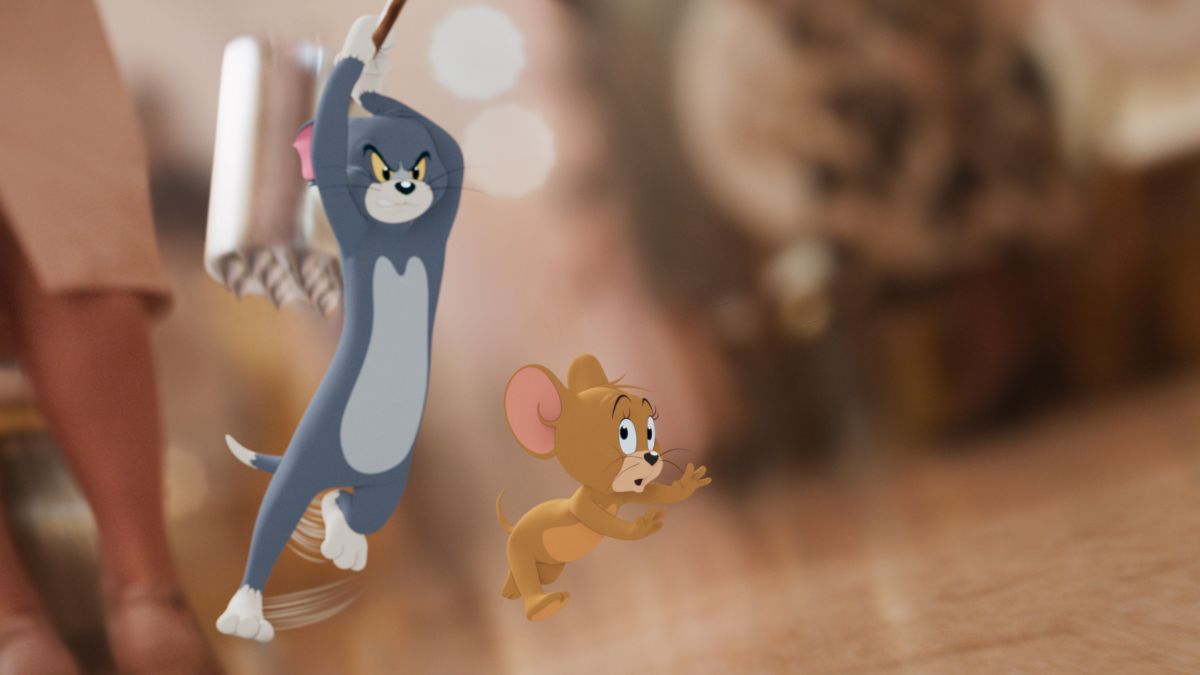
Tom and Jerry make their case for relevance with a live action/animation hybrid by director Tim Story (Ride Along, Barbershop). The film sees the squabbling cat and mouse team relocating to New York City, where Tom hopes (presumably – he doesn’t talk so it’s hard to say definitely) to become a musician.
Jerry just wants to keep being a jerk.
Is it me, or is Jerry really the villain in this twosome?
They run afoul of Kayla (Chloe Grace Moretz, who needs to fire her agent because she should definitely be getting better movies than this).
Kayla requires a new job after some insane, hand-drawn cat knocks her off her bike, ruining her delivery. She cons her way onto a hotel staff. Now if she can just prove that she is good enough and keep the guests’ (Pallavi Sharda and Colin Jost) wedding-of-the-century on the rails, she’ll be fine.
Or will there be animated chaos?
Trying to make old school ‘toons fresh and interesting for a modern audience does not always work. Even Scoob from 2020 was a miss, but Tom and Jerry’s failure to entertain lands closer to the colossal disappointment of Garfield (a film so bad Bill Murray apologized for it in a death scene in an entirely different movie).
The animation sequences are hand drawn, so that’s a great change of pace from the lifeless CGI churned out in films like Earwig and the Witch. Too bad Story doesn’t know how to blend them with live action in a way that feels at all engaging.
T&J is long. The story, by Brigsby Bear writer Kevin Costello, is over-stuffed and under-enjoyable. He mistakes idiocy for lunacy, busy for kinetic. A lot happens, none of it interesting, none of it funny, all of it surrounded by a bombastic soundtrack. Surprisingly little of the adventure really has to do with the ‘toons, either.
There are long stretches of Kayla learning valuable lessons and Michael Peña affecting some kind of unplaceably bizarre accent.
When your funniest joke is about scooping animated dog poop, no one is enjoying themselves.

by Hope Madden
For the garden variety movie viewer (myself included), it can be hard to get comfortable with the idea of spending a bunch of time alone in a room with a corpse, even if that’s your job.
We always expect to see a figure sit up under that drawn sheet.
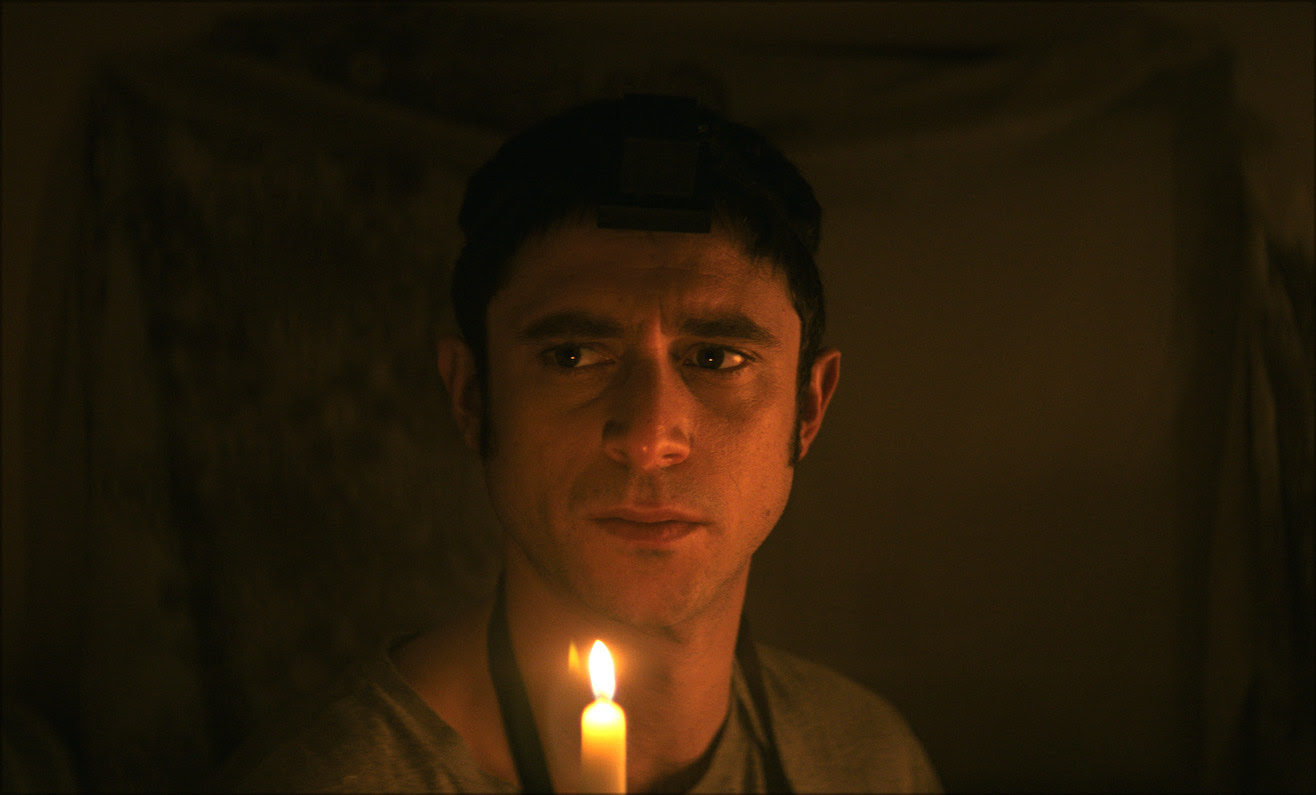
When done well, movies that pick that particular scab can be incredibly effective. Keith Thomas’s The Vigil is one such movie. He leaves us alone in a house with the late Mr. Litvak. But we’re not really alone, are we?
An endlessly tender Dave Davis plays Yakov, who has recently left the Hasidic Jewish community in Brooklyn. It’s so recent, in fact, that he goes to a support group of others like himself, all of them in need of some kind of training to figure out how to live a “normal” life. And as much as Yakov really does want to distance himself, when his former rabbi approaches him about Mr. Litvak, well, Yakov just needs the money.
Yakov will serve as Mr. Litvak’s shomer, sitting with the body for the night to protect Mr. Litvak’s soul until his body can be interred in the morning. Mrs. Litvak (Lynn Cohen, remarkable as always) doesn’t want him there.
It’s a straightforward enough premise, something Thomas executes with plenty of spectral dread. What the basic outline and many of the jump scares lack in originality, The Vigil makes up for with the underexplored folklore and customs specific to Orthodox Judaism. The general ideas are common to the genre, but the specific acts and images are precise and certainly new to horror cinema.
As Yakov’s night wares dangerously forward, he faces a Mazzik. But, as is usually the case in films such as these, the real demons Yakov faces are his own.
Thomas’s screenplay may present that metaphor more bluntly than necessary, and certain scenes are just so obvious (old footage projecting on a wall near a diorama of newspaper clippings and photos). But the compassion the filmmaker has for both Yakov and Mrs. Litvak, combined with the impressive performances from both actors, gives the film a soft spot that heightens the dread and terror.
It’s a solid effort, one that reframes a story you’re used to in a way that gives it more depth and emotional power.

by Hope Madden
Writer/director Mark P. Nelson is kind of fixated on the social rifts in America.
His 2018 film Domestics followed the aftermath of an apocalypse intentionally deployed by a ruling class looking to thin the herd. The smaller herds only fracture into groups of radicalized, violent maniacs, though, and even your white bread nuclear family types are threatened.
Which is to say, this filmmaker brings a different perspective to the inbred cannibal franchise, Wrong Turn.
Yes, big city liberals on a hiking trip run afoul of Virginia rednecks. But where Nelson varies from the script of the 2003 original is in reimagining the antagonists.
We know there’s trouble afoot from the opening scene when Matthew Modine drives into the quaint Virginia town looking for his character Scott’s missing daughter (Charlotte Vega). The lovely blonde was last seen here, along with her African American boyfriend, another heterosexual couple, and a gay couple, one of whom is Muslim.
Because apparently not one of these people has ever seen a horror movie.
The film gets into trouble early by conjuring moments from Tucker and Dale vs Evil, which is a great movie. It’s an insightful lampooning of movies just like the one Nelson is trying to make, though.
Nelson’s more successful when he borrows a bit from the likes of Green Room and The Ritual, although he plants Wrong Turn’s folkloric barbarism firmly on American soil. This is a film about America.
If you’re looking for a movie about cannibal families, you will most definitely be disappointed.
The horror is less unseemly, all of it in support of Nelson’s image of a divided America. There are some startling moments of gore, and other more harrowing ideas that suit the picture well.
Nelson takes too long getting to the point, unfortunately. The film runs just under two hours, which is at least 20 minutes too long. A trimmer runtime might have helped the film leave more of a mark. Instead, Wrong Turn is a decent if unremarkable backwoods thriller.

by Hope Madden
Life imitates art in a film about a struggling photographer, a young prostitute, and an art world more interested in profit than humanity (or art).
Choir Girl, writer/director John Fraser’s thriller, sets itself inside and outside the world of art. Eugene (Peter Flaherty) takes old school film photos of what he sees around him in his dicey neighborhood: kids overdosing, violence, prostitution.
The photos, like the movie itself, use pristine black and white to give even the most awful content an artful sheen. One photo, in particular, gets Eugene the attention of an ambitious art magazine editor with big things in mind. In it, an underaged girl (Sarah Timm) stares desperately from the abyss of the darkness around her.
From here Fraser’s film turns quickly to gritty thriller with overtones of Cronenberg’s masterpiece Eastern Promises and, even more strikingly, Gerard Johnson’s underseen 2014 thriller Hyena.
The separation and commingling of the two worlds—dangerous streets and high-end art—offers Fraser opportunities to compare and contrast. Who is being prostituted, exactly?
It’s not an uncommon critique of the industry of art, but Fraser’s insights are sincere.
Choir Girl’s success rises and falls with Flaherty’s performance. Eugene needs to be simultaneously sketchy and innocent—not one or the other—even in his own mind. Flaherty pulls off this balancing act with a performance that’s sometimes tender, often nasty, but one that never feels manufactured.
The surrounding performances are not as strong, although veteran Jillian Murphy brings layers to an important role.
Choir Girl asks ugly questions and gets ugly as it looks for answers. At times, the story feels dependent on too many contrivances. Never is that more evident than with the harrowing dramatic climax—a scene that is inevitable and yet unearned.
Credit to Fraser, the scene itself is not filmed to feel gratuitous. For a scene this lengthy and torturous to truly work, however, every element leading to it needed to justify it. Stronger storytelling would have helped.
It’s a big risk to take, and one that will undoubtedly displease some viewers, but that doesn’t limit the film’s powerful central performance or imaginative execution.
by Hope Madden
Nobody sees American poverty as honestly or as poetically as filmmaker Chloé Zhao.
Those who saw Zhao’s sublime 2018 cowboy story The Rider will recognize her romantic fascination with the American West. That’s not the only thumbprint the filmmaker leaves on her third feature, Nomadland.
She weaves a spontaneous, near-verite style into lonesome, wide vistas of a rugged America we think of as lost to time. In doing so, Zhao creates a lucid dream where struggle as reality is somehow beautiful but never sentimental.
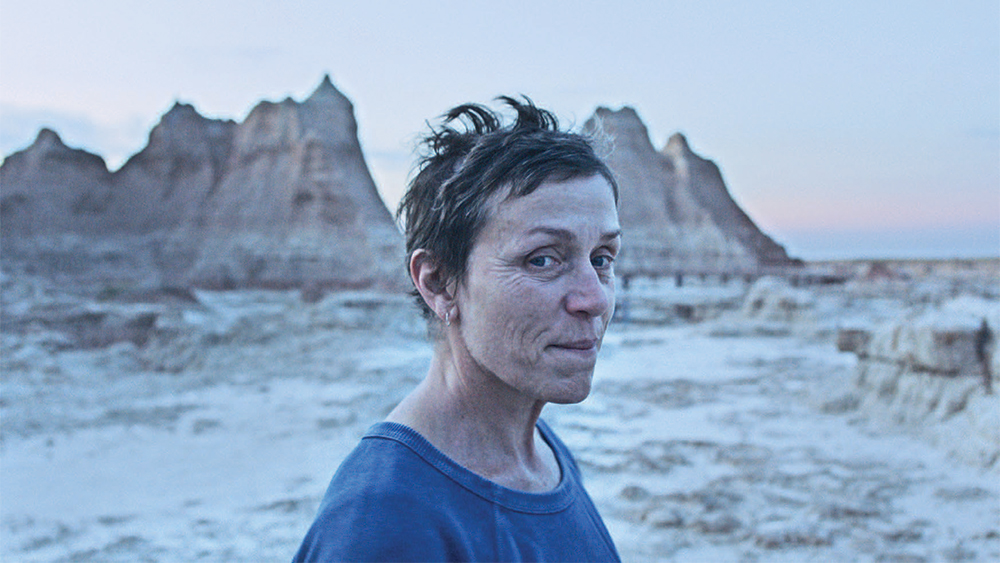
The incandescent Frances McDormand stars as Fern, an itinerant widow since her hometown of Empire, Nevada ceased to exist once the gypsum mine closed. We join Fern on her journey sometime after that collapse. She’s just beginning to customize “Vanguard,” the van that serves as her new home.
In that same loose style that’s marked Zhao’s previous films, Nomadland follows Fern through her days, boxing product for Amazon in the winter, working vacation rest stops and tourist destinations in season, and traveling the country in the meantime following work, looking for a safe place to park, and getting to know this country.
Zhao—who writes, edits, and produces as well as directs—based the screenplay on Jessica Bruder’s nonfiction book. Empire was a real place. Fern is a fictional character, but those who mentor her in her new life—including the endlessly endearing Linda May and brilliantly saucy Swankie—are, indeed, real nomads.
McDormand is perhaps the only perennial Oscar contender who could fit so seamlessly in this tapestry. Without an ounce of vanity or artifice, her performance allows this film to be one of resilience and promise. Given that Normadland is, in fact, the story of a penniless Sixtysomething widow who lives in a van, that is in itself a minor miracle.
But that’s the film—a minor miracle. Perhaps only in a year when the billion-dollar franchises were mainly held at bay could we make enough space to appreciate this vital and beautiful reimagining of the rugged American tale of individualism and freedom, which is almost always also a story of poverty.

by Hope Madden
People really hate social media influencers.
I mean, somebody must love them or who is it they influence? But horror definitely does not love them. Influencers have become the go-to objects of horror in recent years, seen as the vacuous product of a narcissistic culture that doesn’t value—or even make—human connections.
Meet Mia (Daisye Tutor). The rising makeup influencer has way more followers than her two besties and her boyfriend, so they’re unhappy when she pulls out of their livestream event this Saturday to dog sit for her sister.
But being selfless is totally on brand for Mia, and another makeup influencer just died trying to protect her own dog from a canine killer. Is it guilt? Is it opportunism?
Neither. It’s a setup for the premise of Shook. Mia is home alone with Chico (the dog, who’s awfully cute). But she’s never unplugged and soon someone is playing life or death games with her.
Writer/director Jennifer Harrington’s film really begins with a plot as old as the genre. It could be the babysitter and the escaped lunatic, the point is to have a vulnerable (and acceptably stupid) young woman alone, trying to protect those in her charge from an unseen and menacing force.
So, it doesn’t start out fresh, but movies have made a go of this plot. Harrington layers in newer cliches derived from our collective, plugged-in anxieties. The result is When a Stranger Calls meets Scream meets Unfriended.
It feels exactly that derivative, a fact that doesn’t entirely sink the film. It definitely never lives up to its opening, though.
Harrington makes her most incisive comment about the performance art that is influence culture as she pans back from a glamorous, opening red carpet photo shoot to show the bleaker reality of the staged event. It’s a smart, cinematic revelation that works on two levels.
Thematically, it underscores the film’s point about the artifice of Mia’s life. As a horror movie, we’re suddenly aware that someone is watching – someone who sees all of it.
Watching Shook, you’ll find solid filmmaking followed by two acts of uninspired, sometimes idiotic, sometimes enjoyable horror.

Is it ever too cold to ride? My God, yes – it is way too cold to ride. So instead, we invited our friend Jamie Ray from the Fave Five from Fans podcast to join us as we talk through our favorite chopper-themed horror flicks. Some of these are pretty bad – but so fun! – so prepare for a bumpy ride!
Oh, there were so many terrible films that could have taken this final slot. Would it be Blood Freak? Chopper Chicks in Zombietown? Werewolves on Wheels?
So many choices!
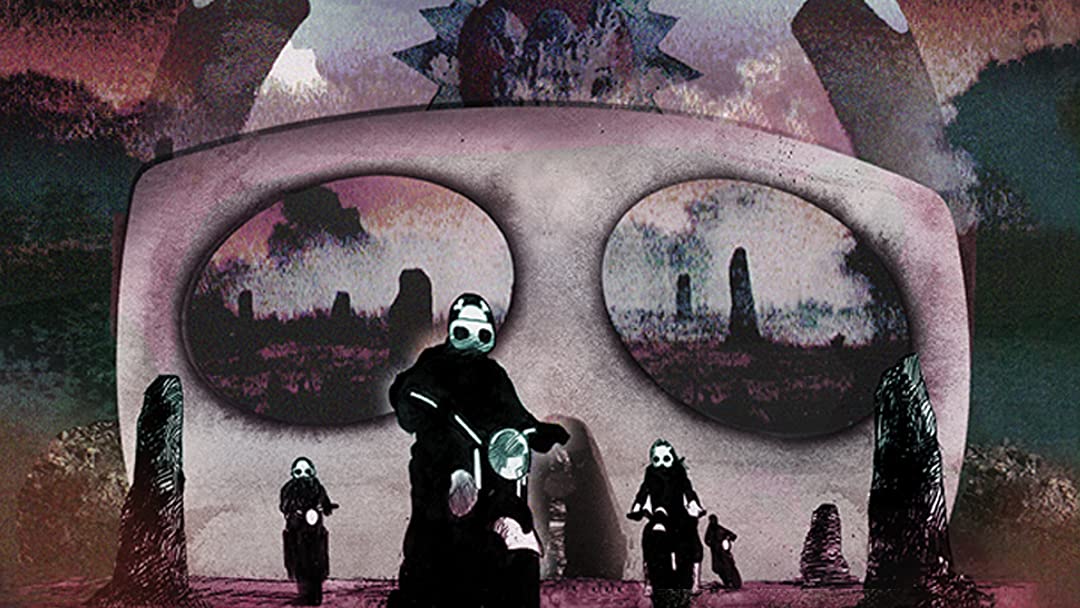
Deathmaster gets the nod because it combines all the required elements – Satanism, hippies, and motorcycles – but it cranks it up a notch. This subgenre owes its very existence to Charles Manson, who braided those three elements together in the minds of Americans. But Deathmaster takes that one step further by creating a specifically Manson-like character—the charismatic guru Khorda – and making him a vampire.
Why is he a vampire? Maybe because they cast Robert Quarry (Count Yorga), who already had the teeth. Who knows, it comes off as utter nonsense, but it makes for a little fun variety.
Black leather, black leather, smash smash smash
Black leather, black leather, crash crash crash
Black leather, black leather, kill kill kill
I got that feelin’ – black leather rock
That, in a nutshell, is how dumb this movie is. And yet, like the ludicrous theme song, it’s just weird enough to stay in your head.
Oliver Reed is at his youngest, sultriest, Oliver Reediest as the street tough who chases his sister and her older American boyfriend right into some kind of underground lair where radioactive children are kept.
Suddenly you’re in what appears to be an entirely different movie. It’s like somebody sewed A Clockwork Orange and Village of the Damned together, buried them under rock, and them lobotomized the final version.
Which is kind of appealing, isn’t it?
More adorably sketchy Brit motorbikers in this one. Some mods wreak havoc on their bikes (because apparently drivers in England have no idea how much more vulnerable a bike is than a truck). But they crave more!
More danger! More excitement!
So they decide that if they kill themselves they can will themselves back to life and become hip zombie bikers.
The film’s appeal has a strange longevity. It’s never scary for even a moment, and it’s often outright ludicrous – if not adorable – but it does have a style and a couple of performances you can admire.
Yes, Janet. Life’s pretty cheap to that type.
Whether it’s the Transylvanians traveling dto Time Warp with the doctor and his domestics, or the arrival (and quick removal) of Eddie, motorcycles play a significant role in this treasure of a film.
It was 1975, after all, and no self-respecting edgy, dangerous film could possibly convince the world of its anti-establishment bonafides if no one rode a motorcycle. It turns out, it’s the ones who aren’t riders you need to watch out for.
At some point somebody decided they were tired of seeing the motorcycle riders always turning out to be Satanic hippies. Nope, not this time.
The film re-teams Peter Fonda and Warren Oates – so great together in 1971’s The Hired Hand. They’re buddies taking a top-of-the-line RV out for a spin across Texas, along with their lovely wives. They stop to camp in the middle of nowhere, the guys take their bikes out for a stretch, and next thing you know, they’re being followed by Satanists and who knows which of these backwoods locals can be trusted?
The film generates real tension in much the same way Spielberg had done four years earlier with Duel. That tension, supported by solid, gritty performances, give this one surprising punch.
by Hope Madden
Daniel Kaluuya’s range is simply unreal. From the vulnerable hero of Get Out to the chilling sociopath of Widows, he’s prepared us for quite a gamut of characters. I’m not sure he’s prepared us for his Chairman, though.
Kaluuya plays Fred Hampton, Chairman of the Illinois Chapter of the Black Panther Party circa 1969, in Shaka King’s Judas and the Black Messiah. A feeling of mortality permeates his performance, and with it a melancholy sense of urgency. His quiet moments swell with tenderness and turmoil, and his speeches burn through the screen. We’ve seen some great performances this year, but we’d give Kaluuya the Oscar right now.
That’s a lot to live up to, but the balance of King’s cast meets the task. LaKeith Stanfield, as police informant Bill O’Neal, strikes the right balance between cowardice and regret. He doesn’t try to make us pity O’Neal and the deal he’s struck with the devil, but he gives the character an energy that suggests more emotional and psychological layers than what’s found on the page.
As FBI Agent Roy Mitchell, Jesse Plemons is as solid as ever, delivering lines with enough genuineness that Mitchell doesn’t become an outright villain until he, along with O’Neal, have gone too far to pretend they’re anything else.
Their performances draw support from an understated Dominique Fishback as a firmly but not blindly committed comrade—Hampton’s girlfriend Deborah Johnson. Meanwhile, Dominique Thorne has badassedness to burn as part of a deep ensemble that impresses in most every turn.
The film never feels like a biopic. The rendering is far more crime thriller, and had this been a simple fictional account of a mole in a political organization, King’s film would have been riveting. Performances alone would have elevated the genre beats.
The real star may be King’s script, co-written with Will Berson and Keith and Kenneth Lucas. There’s no placating. There’s no playing to the masses. King doesn’t water down Hampton’s message of unifying the poor or throwing off the oppression of a police state. In fact, this is a film that means to show the difference between revolution and the “candy coated façade of gradual reform.”