Tag Archives: independent film

Tart

Lemon

by Hope Madden

Lemon announces itself immediately.

As a documentary on the horrors of war plays on a TV, the camera pans a drab living room, finding a man asleep upright on a sofa. He wakes to realize he’s wet himself.

He is Isaac. Isaac is a lemon.

The documentary Isaac had slept and peed through provides the context for a story in which one man can so obliviously wallow in self-inflicted misery.

In quick succession, Isaac will dismiss what his (randomly blind) girlfriend Ramona (Judy Greer) has to say before publically humiliating a female student (Gillian Jacobs). Both are too focused on themselves.

Why aren’t they focused on him?

Co-writer Brett Gelman plays Isaac, a send-up of sorts of the self-pitying hero of so many indies.

Director/co-writer Janicza Bravo borrows and rebrands independent film stylizing – from Wes Anderson to Jared Hess to Todd Solondz – to deliver a wry satire of the quirky worlds they create. Her framing, color palette, set design and timing offer spot-on re-renderings of the atmospheres created in a generation of arthouse movies that follow the unraveling lives of misunderstood, entitled outcasts.

Bravo peppers the film with a handful of perfectly discordant scenes: Isaac running up a road with a stroke-impaired old woman in a wheelchair; Isaac awkwardly threatening and then kissing Michael Cera; Isaac and his profoundly dysfunctional family participating merrily in a rendition of the song A Million Matzoh Balls.

Individually, these scenes are amazing. Truly. But they don’t string together to form a cohesive image or a compelling narrative.

Gelman’s intentionally weird and flat performance engages, in a trainwreck sort of way that suits the effort. You believe him. And many – most – of the performances around him are clever, individual and memorable. Their interactions and the story, slight as it is, strain the imagination, though.

Nia Long’s Cleo, for instance, seems included solely to allow for a new series of awkward moments. Long’s performance rings true, from her friendly introduction through her polite if wearied response to Isaac’s racist flirtation.

Her actions, however, defy logic in a way that exposes a narrative weakness you’re less likely to find in the films of Anderson, Hess or Solondz.

Todd Solondz knows what to do with an unlikeable protagonist. You won’t enjoy it, but he will not pull any punches and you will have closure. This is the problem with subverting the work of superior filmmakers – your film invariably suffers by comparison.

Which is not to say that Lemon has nothing to offer. It offers a pantload of intriguing character work and suggests the vision of a worthy director. The script just needed another draft.

Verdict-3-0-Stars

Brother’s Keeper

Good Time

by Hope Madden

Regardless of the film’s title, Connie Nikas (Robert Pattinson) does not appear to be having a Good Time.

Connie is trying to keep the system away from his mentally impaired brother Nick (Benny Safdie, who also co-writes and co-directs). He uses what means he has, none of which are legal.

After a botched bank robbery sees the brothers separated and Nick incarcerated, Connie engages in ever riskier behavior in a desperate attempt to save his brother.

Safdie, alongside his real brother and filmmaking partner Josh, once again explores an urban underbelly. The two have proven with films like their 2014 festival favorite Heaven Knows What that they can tell a deeply human story set on the fringe of society.

Good Time is a bit more high energy than Heaven Knows What, but once again the Safdies create a world that’s simultaneously alien and authentic. It’s hard to believe people live like this, and yet every moment of Connie’s increasingly erratic evening rings true. Nuts, but true.

Pattinson delivers his strongest performance yet. His glittering vampire days long behind him, he’s shown versatility in recent projects including Cosmopolis, The Rover and Maps to the Stars. Here he balances a seedy survival instinct with heart-wrenching loyalty and tenderness.

Everything Connie touches, he poisons. In Pattinson’s hands, he’s righteous enough to believe in his own cause, even when it means convincing himself that he’s protecting someone – his brother, a teenage girl, another lowlife looking for a score – who’d be better off without him.

Benny Safdie impresses in front of the camera as well as behind. His understated performance shows no sign of artificiality, and his skill as a filmmaker has never shined more brightly.

His gift for pacing that matches the hustle – the constant shifting, shuffling and scheming needed for survival – keeps Good Time both exhilarating and exhausting.

The film showcases the kind of desperation that fueled many a New York indie of the Seventies, Midnight Cowboy among them. The urgency of a quick con that could lead to freedom but will undoubtedly end in tragedy seems the only kind of choice Connie ever makes.

It’s a grim film full of bruised people, but it never loses hope entirely.

Verdict-4-0-Stars

A Tale of Two Catherines

The Midwife

by Matt Weiner

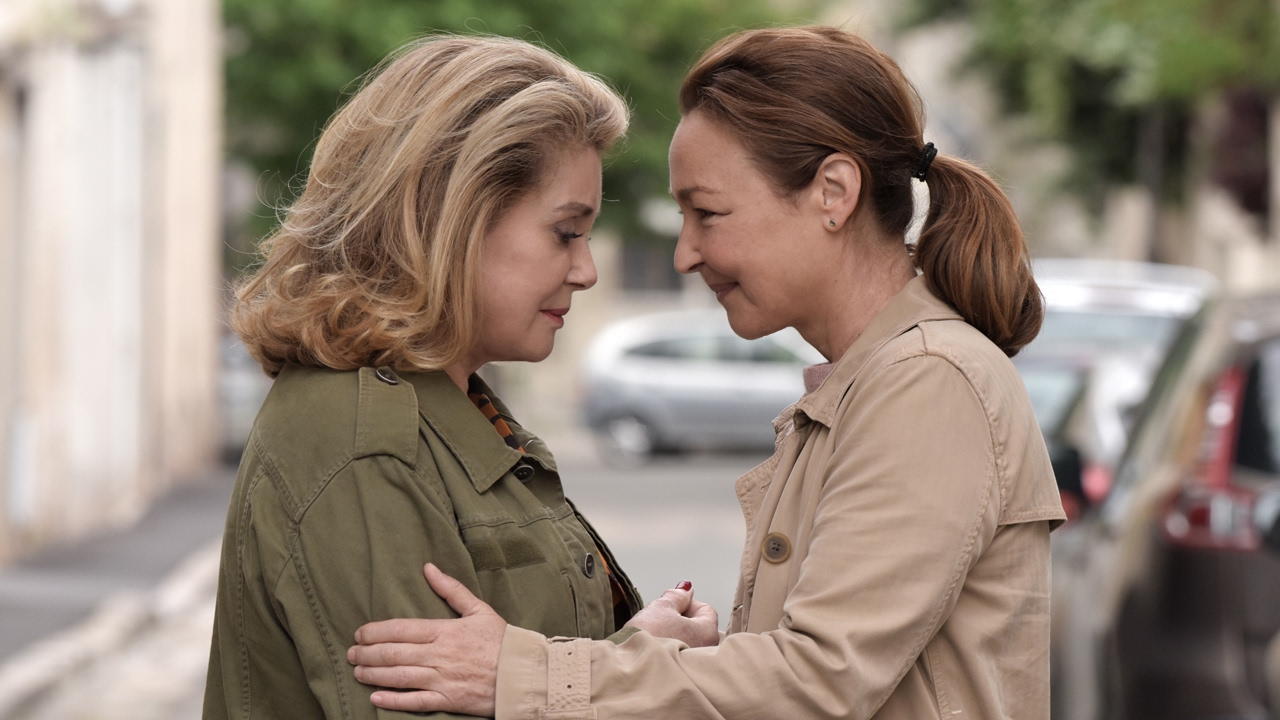
There is a scene early on in The Midwife that consists almost entirely of a conversation between Beatrice (Catherine Deneuve) and her doctor, in which Beatrice says barely a word and yet the camera doesn’t move from her face the entire time.

Director and writer Martin Provost allows moments like these to unfold again and again throughout the film, relying on superb performances and an unsentimental treatment of the material to present an arresting and spare meditation on love and the passage of time.

Claire (Catherine Frot) is an uptight midwife in Paris whose grim adherence to routine seems on the verge of upheaval, both professionally and personally. This coincides with the free-spirited Beatrice, the mistress of Claire’s dead father, reappearing out of nowhere.

It’s a familiar setup: Claire and Beatrice are natural foils, and they both have some unexorcised emotions to work out over the man they both loved, in their own ways. But that relationship between Claire and Beatrice is the main attraction, and the two actresses work off one another in a way that keeps things poignant, never melodramatic.

Deneuve, in particular, is equal parts devastating and disarming as Beatrice. It’s fitting that at this point in her career, she’s now deconstructing the haughty mystery that she become indelibly associated with over the last 50 years.

What happens when life finally strips away all the defensive layers and artifice that a woman like Beatrice has worked so hard to maintain? What remains when you’re all alone save a body that’s slowly betraying you?

The film doesn’t answer all these questions. And, beguilingly, neither does Deneuve. As circumstances force Beatrice to part with all her glamorous trappings, she holds onto her defiance. And some of her reticence.

In The Midwife, it’s not death that the characters are afraid of—it’s all the indignity that time heaps on us in between being born and dying. Babies “spring out from nothing,” Claire observes. Controlling as she is, Claire can only do so much for those she has brought into the world.

What anyone chooses to make of their time afterward, the film suggests, is all part of the mystery, joy and frustration of being alive.

Verdict-4-0-Stars

Vanishing America

Wind River

by Hope Madden

In many beautiful and horrific ways, the scripts of Taylor Sheridan (Sicario, Hell or High Water) felt like a reemergence of Cormac McCarthy.

His lean and often quite mean stories have been blessed with two of the more capable visionaries of modern film (David Mackenzie and Denis Villeneuve) – filmmakers whose camerawork, pacing and sense of urgency hauntingly animated the damaged Americana Sheridan’s stories announced.

With his latest, Wind River, Sheridan takes the helm, borrowing inspiration from both directors.

Another tale of violence, bureaucratic vagueries and the vanishing of American heritage, Wind River certainly feels like a Taylor Sheridan film.

Jeremy Renner plays Cory Lambert, sharp shooter for Wyoming’s department of fish and wildlife. He protects livestock from predators – like the three wolves surrounding a flock of sheep in the scene that immediately follows that of a young girl bleeding and dying alone in a frozen wasteland.

Behind the camera, Sheridan is a bit less subtle with symbolism than he might want to be. In fact, though Wind River spins a compelling murder mystery, it’s far more of a blunt instrument than the filmmaker’s last two – admittedly magnificent – efforts as writer.

Perhaps Sicario and Hell or High Water represent too high a bar for a director with only one feature, the 2011 horror flick Vile, under his belt.

Performances are wonderful. Renner’s stoic cowboy unveils genuine tenderness, Gil Birmingham’s brief screen time is a blistering blessing of tumultuous emotion, and Elizabeth Olsen breathes life into a surprisingly one-note role.

Sheridan doesn’t have quite the touch of Villeneuve or Mackenzie, and without it, his material feels a touch too preachy, a whisper too self-righteous, and most troublingly, too white.

Set on a Native American reservation, Lambert is enlisted to help Olsen’s fledgling FBI agent Jane Banner and an understaffed tribal police department solve the crime behind the girl’s death.

And though Renner brings his grieving hunter to the screen with an aching, restrained performance, it’s hard to understand why the character needed to be white. That piece of casting gives the film a “white savior” tenor that only exacerbates that nagging feeling of misplaced self-righteousness.

Wind River is a fine, if flawed, police procedural. Unfortunately, that makes it a bit of a disappointment coming from Sheridan.

Verdict-3-0-Stars

https://www.youtube.com/watch?v=zN9PDOoLAfg

Going the Distance

The Farthest

by Rachel Willis

Forty years ago, the first of two vessels was launched into space to begin the unmanned Voyager mission. To commemorate NASA’s monumental achievement, Emer Reynolds explores the operation from its beginnings in 1972 to present day in the documentary, The Farthest.

A lot of effort goes into the creation and execution of a space odyssey, and Reynolds brings the story to life through interviews with NASA scientists and engineers. There’s a lot of ground to cover, from the meeting with Nixon to approve the budget, to the technology on board the Voyager vessels, to the inclusion of the famous Golden Record, and Reynolds seeks to examine all of it during the documentary’s two-hour run time.

Because there are forty years of history to explore, oftentimes The Farthest feels like an overview. Rather than focusing on one aspect of Voyager, be it the rudimentary technology aboard the vessels or the first images of the planets farthest from the sun, the film instead follows the Voyager timeline.

By doing this, there is a lot of information glossed over, but Reynolds still manages to inject a touching poignancy into the documentary. The men and women who worked on Voyager are full of passion and wonder, and they convey this to the audience.

Arguably the most interesting aspect of the film, the most interesting aspect of Voyager, is the inclusion of the Golden Record.

As Voyager 1 and 2 were designed to go beyond our solar system into interstellar space, a decision was made to include a record of life on Earth. The records (one in each space craft) include images of Earth, music, and mathematical equations in an attempt to encapsulate what it means to be an earthling. The Farthest spends more time with the Record than any other aspect of Voyager, but in light of how far Voyager 1 and 2 have traveled, and how far they may still go, the idea that the Golden Record may end up in the possession of alien life is a wondrous prospect.

As Voyager 1 and 2 continue their journies, The Farthest celebrates the men and women who built them and sent them into the farthest corners of our galaxy and beyond.

Verdict-4-0-Stars

Arts and Crafts

Dave Made a Maze

by Hope Madden

Maybe you’re not up for 80 minutes of existential dread, of traversing the subconscious of a stunted artist – a man who cannot complete a project because you don’t have to fail if you never finish anything.

But do you feel like wandering through a cardboard maze? Because, dude, it is so cool in here!

Dave Made a Maze takes its millennial angst seriously enough to construct a remarkably thorough metaphor through the creation of this remarkable cardboard labyrinth.

Frustrated artist Dave (Nick Thune) has countless great ideas, no follow-through. All he really wanted to do while his girlfriend Annie (Meera Rohit Kumbhani) was out of town was fix the doorknob.

Ooo! Origami!

Hey! Woodwork!

No, wait…that doorknob…look! An ant farm!

Inspired by the ant farm, Dave builds the world’s most elaborate and amazing labyrinth inside cardboard boxes taking up the bulk of his apartment. To Annie’s dismay, he won’t – or can’t – come out once she arrives home.

Plus, there’s a minotaur in there!

As Annie and Dave’s friends attempt a rescue, a charming, nerdy horror comedy of sorts emerges as a mash note to self-loathing and the creative process.

Adam Busch, playing Dave’s bearded bestie Gordon, is a delight, while the gang’s documentarian buddy Harry (James Urbaniak) and his crew (Scott Narver and Frank Caeti) are a self-referential hoot.

First time director Bill Watterson, working from a screenplay he co-wrote with Steven Sears, serves up a charmingly spot-on metaphorical intervention, with an amazing assist from production designers Trisha Gum and John Sumner with art director Jeff White.

Their cardboard world of Dave’s subconscious is endlessly fascinating, adorably dangerous and fun. Existential dread has never been so charming.

Verdict-3-5-Stars

Plumbing Psyches, Having Tea

The Ghoul

by Hope Madden

The Ghoul opens on a crime scene. One detective leads another through the facts of the crime, which appear simple enough until you work in the bit about the victims walking toward the perpetrator even after being repeatedly shot.

Are we watching a cop drama, supernatural thriller or meditation on mental illness? Actor turned writer/director Gareth Tunley keeps you guessing.

As Chris (Tom Meeten), working with criminal profiler Kathleen (Alice Lowe), goes undercover to investigate a therapist who may be hiding a lead, Tunley’s story takes a series of mysterious turns.

In his feature debut behind the camera, Tunley’s instincts for leading and misleading pay off. His film moves quite slowly, wandering into fascinating territory now and again as it forever turns itself inside and out.

To say much more about the plot would rob it of its curious power, but the writing, in particular, deserves attention for accomplishing something few scripts manage.

An agile, believable lead performance helps.

Meeten’s quiet, often heartbreaking turn grounds the film, while Rufus Jones and Geoffrey McGivern, as patient and psychologist, respectively, offset the quiet with bright bursts of energy.

Tunley offers two equally viable interpretations for his film, echoing events and phrases to create a structure that mirrors the mystery unfolding. Reminiscent at times of memorable (if underseen) indies Tony, Locke and They Look Like People, The Ghoul still manages to tell its own peculiar and poignant story.

Verdict-3-0-Stars

Hello, Dolly

Annabelle: Creation

by Hope Madden

There are a lot of things James Wan’s 2013 hit The Conjuring got right. Leaning toward practical effects over CGI, casting high-quality talent, and digging into an allegedly true story – all good choices that, matched with his eye for framing and skill with mounting dread, led to a chilling and memorable flick.

There’s also a creepy doll, the element that seems to be driving this unexpected franchise and the only item from the original film that made the leap to Annabelle: Creation.

You remember her – she terrorized a young family, and later a pair of nursing students before being locked in a glass case in that creepy room at Ed and Lorraine Warren’s house.

But did you ever wonder what kind of demonic hijinks created her in the first place? Or do you just find yourself in the mood to watch orphans being persecuted? Either way, may I introduce you to Annabelle: Creation?

Director David F. Sandberg (Lights Out) does what he does best, relying on good, old-fashioned jump scares. If that’s your bag – and you don’t get side tracked with nit-picky things like how utterly ignorant writer Gary Dauberman is of actual Catholicism (so maybe he shouldn’t have chosen a Catholic orphanage!) – then this film may be for you.

Years after a doll maker and his wife lose their precious daughter, they accidentally conjure up a demon to live in the single ugliest doll any toy maker has ever seen fit to make.

Bad choice.

Worse choice? Inviting those orphans to move in.

Welp, empty-headed horror it is. And there is something to be said for that in a mid-August slump. This is the sequel to a weak film, itself a sequel of sorts to the kind of movie that felt like a one-off.

It seems unlikely a franchise was the expectation back when Conjuring hit screens in ’13. Since then, filmmakers have scrambled to cobble together a universe of supernatural spookiness to spin off and connect. (Look closely at the picture from Sister Charlotte’s convent – any of those nuns look familiar?)

Sandberg offers little in the way of originality. (He’s clearly a pretty big fan of Wan’s Insidious.) But there are jumps aplenty and a couple of very freaky images in the third act.

Because if you can’t have a creepy nun, may as well make due with a disfigured mother and a scarecrow.

Verdict-3-0-Stars

Still Just a Rat in a Cage

Some Freaks

by Christie Robb

High school, amirite? Setting of so many movies: The Breakfast Club, Heathers, Clueless, Mean Girls… and lately, Some Freaks, written and directed by Ian MacAllister McDonald.

McDonald’s perspective on high school is bleak, lonely. The other kids whisper about you behind your back, when not being physically menacing. The adults are absent. And even your closest friends are kind of douchey, sensing your weak spots and needling them under the guise of jokes.

The action starts with a one-eyed dude named Matt (Thomas Mann), who is stalked by classmates desperate to see what’s under the eyepatch. And maybe capture a photo of the gaping hole to upload to the internet.

He’s partnered up with the new girl, Jill (Lily Mae Harrington), to dissect a fetal pig in biology. Turns out she’s related to his only friend Elmo (Ely Henry), a fast-talking wannabe popular kid who monologues about getting into his jock crush’s gym shorts, but is quick to lash out at anyone but Matt who seems clued into his sexuality.

After school, Matt and Elmo chat while playing video games on Elmo’s couch, sharing some misogynistic fat girl jokes. Then Jill walks in.

She’s living with Elmo’s family for a while. She’s fat – and the clear butt of the jokes. But she just lets it slide. Jill has clearly been putting up with this bullshit for years and has a fairly thick skin when it comes to sexism and body shaming.

With this auspicious beginning, Jill and Matt stumble into the sort of romantic relationship you have when your main reason for being there is to put a temporary patch on the gaping wound of your own loneliness and poor self-esteem.

Jill flies across country to college, but Jill and Matt take their relationship long distance with Jill sending Matt provocative selfies.

After six months, Matt flies out, step one in his plan to move in with Jill permanently. She’s lost 50 pounds, changed her formerly green hair to a sunny blonde, and traded in her punk gear for a more boho vibe. All the photos she’d sent him were taken before her transformation. He hates it.

Unwilling to let Jill change, Matt attempts to regain the status quo. A quo in which Matt was the only man who could find her attractive (besides “elderly degenerates”), and thus, had no competition. No reason to think about how he measures up to other guys.

Contrary to movies like John Hughes’s The Breakfast Club, the coming together of these teenage misfits doesn’t do much to bond them and bolster their self-esteem. Instead, each of the central characters remains isolated with their own damage, even if sometimes physically close. Their very proximity gives them increased ability to wound each other.

The climax of the film, in which each character attends a party that provides a setting for them to confront their greatest insecurities, seems a little contrived. Some characters are underwritten, making their motivations in these moments a bit confusing.

However, the film is well acted. Each member of the cast does a decent job of portraying their character as a mixture of victim and aggressor. Harrington stands out, providing emotional depth behind her wariness and verbal armor, undergoing an impressive physical transformation for the role.

Some Freaks does not provide a cheery John Hughes ending, but may be a more authentic representation of the high school experience for some.

Verdict-3-0-Stars

https://www.youtube.com/watch?v=WFtR28a6Qf8

Missed Connections

Landline

by Hope Madden

Jenny Slate is the perfect mix of raunchy and sweet to anchor an indie dramedy. Co-writer/director Gillian Robespierre tested that theory in 2014 with the character study and edgy rom/com Obvious Child.

Following on those proven results, Robespierre re-tests her theory with the 1995 family saga Landline.

Slate plays Dana, the older, almost-married sister in an upscale Manhattan family. But she and her ever-since-college beau Ben (Jay Duplass) are maybe not everything Dana hoped they’d be.

Her own entanglements with infidelity happen to exactly coincide with a discovery younger sister Ali (Abby Quinn) makes of their father’s (John Turturro) erotic poetry, written for someone who is definitely not their mother (Edie Falco).

Things begin to fall apart. Ali’s lived-in resentment toward her overbearing mother is tested and turned instead toward her sweet, laid back father. Meanwhile Dana embraces recklessness and begins hanging out with her boundary-pushing teenage sister, drinking during the day and sneaking away for clandestine sexual encounters with Nate (pitch-perfect Finn Wittrock).

So, crumbling family dynamics in a well-to-do Manhattan family. Not exactly as edgy as a romantic comedy written around an abortion.

Still, between its loving nostalgia for the pre-cellphone days of the mid-Nineties and its truly game cast, Landline keeps you interested and entertained.

Falco and Turturro are unfortunately underused. Both are spectacular talents, and their well-worn relationship offers each the opportunity to create moments of sudden, honest, everyday heartbreak.

The characteristically effervescent Slate charms, and her off kilter chemistry with Quinn serves the film well. They’re irritated and protective, bitching and admiring all in the same breath. They often feel unsure of their own feelings toward each other, which reads as very authentic.

Quinn is the real heartbeat of the film. Equally vulnerable and mean, she’s less the cinematic equivalent of a conflicted adolescent than she is a conflicted adolescent, and the film takes on a sharp focus whenever she’s onscreen.

Unfortunately, that’s not all the time, and Robespierre – writing again with Elisabeth Holm – loses focus too easily. Landline, for all its insightful moments and clever lines, feels a bit unwieldy and murky.

Verdict-3-0-Stars