Tag Archives: independent film

You’re Killing Me, Smalls

It Stains the Sands Red

by Hope Madden

Given the recent, tragic passing of filmmaking icon George A. Romero, you may find yourself nostalgic for the walking dead. Not just any hungry, re-animated cadaver, but the kind that serve as a parable or vehicle for self-awareness. The slow moving kind. The kind you don’t know whether to fear, pity or admire.

It Stains the Sands Red is here for you.

Director/co-writer Colin Minihan, with co-writer Stuart Ortiz (formerly known collectively as The Vicious Brothers), tests your patience, but the effort mostly pays off.

We open with some impressive aerial shots of the smoking, neon ruin of the Las Vegas strip. Cut to another gorgeous aerial of a sports car zipping up a desert highway. In it, a couple of coked-up strip club lowlifes, Molly (Brittany Allen) and Nick (Merwin Mondesir), are escaping to an airfield where they’ll meet with other lowlifes and head to an island off Mexico.

Naturally, this isn’t going to work out. But what Minihan has in store will surprise you.

He’s made a couple of fine choices with his film. The point of view character is not only an unlikely protagonist – an unpleasant thug with a drug habit – but she’s also female.

Soon the car goes off the road and one meathead catches her scent, and suddenly Molly’s stripper shoes are not her biggest problem as she faces a 30-mile trek across the desert to the airfield.

Molly names her zombie pursuer Smalls, but she may as well call him Wilson.

What develops is an often fascinating, slow moving but relentless chase as well as a character study. With a protagonist on a perilous journey toward redemption, It Stains the Sands Red takes a structure generally reserved for the man who needs to rediscover his inner manhood and tells a very female story.

Very female. Menstruation and everything.

Credit to the formerly Vicious for investing in a female’s perspective, and for doing it some level of justice.

Allen makes a great anti-heroine. Convincingly hard-knock and difficult to like, she never becomes the would-be lunch meat you root against.

As is too often the case in film – horror, thriller or otherwise – the only way a female can tap that survival instinct is by way of the maternal one. This picture becomes too predictable and too sentimental once it embraces this cliché, but that’s not reason enough to condemn it.

Verdict-3-0-Stars

Striking Gold

Dawson City: Frozen Time

by Hope Madden

If art imitates life, then can the discarded art of a period tell us an insightful story of a forgotten time and place? Documentarian Bill Morrison thinks so, or his latest, Dawson City: Frozen Time, suggests as much.

A pastor and part-time backhoe operator in Dawson – a small town in the Yukon – unearthed a trove of nitrate film reels from the silent era while digging up the land behind Diamond Tooth Gertie’s gambling hall in 1978.

Adding a minimum of spoken explanation or context, all of which is quarantined to the opening and closing of his film, Morrison pieces together footage from the find with sometimes startlingly gorgeous photos and other craftily placed film bits, as well as onscreen type, to weave his tale.

His film tells of Dawson’s fascinating history – the romantic, dangerous kind usually reserved for Wild West legends. (Maybe something worthy of the name Diamond Tooth Gertie?)

Dawson was the last stop for a film, a location so remote and far flung, distributors refused to pay the postage to have their movies returned. Theater managers disposed of most of it in the same way the townspeople disposed of everything at the time – down river during the thaw.

But one crafty bank manager – because it was in the bank that many reels were held – decided to use it as landfill beneath the town’s ice rink. The permafrost kept the reels from deteriorating entirely, and their water damage only adds to the odd and dreamy style Morrison uses to sketch out this history.

Immersed in Alex Somers’s often hypnotic score, the film is a meticulously crafted near-silent film itself – a work full of insight on history and art. Perhaps too meticulous. Feeling every minute of its 2-hour run time, Frozen Time is often so bogged down in minutia that the bigger, more fascinating picture can get lost.

Though his documentary does share insights into Dawson’s labor, expansion, culture, science and the displacement of native peoples, Morrison is interested in more than the progression of the town.

His doc is also about film as art, and the ways that art can be manipulated to tell a compelling story. The filmmaker, relying heavily though not exclusively on reels uncovered by Frank Barrett’s backhoe, edits together images from wildly varying movies having nothing to do with Dawson. He uses these to articulate, in clever and sometimes wryly funny fashion, the history unfolding.

Verdict-3-5-Stars

I Will Choose Free Will

Afterimage

by Hope Madden

Painting in his room, the artist Wladyslaw Strzeminski (Boguslaw Linda) suddenly loses his light as an enormous red banner of Stalin is dropped in front of his building. He opens the window, reaches out with his crutch and tears a hole big enough to let in natural light.

It’s a scene heavy with symbolism as well as dread, and one of many that filmmaker Andrzej Wajda uses to evoke a sense of time, place and struggle. It is not how Afterimage opens, though.

In a painterly scene brimming with life and beauty, Strzeminski meets in a meadow with a group of students from his Academy of Fine Arts in Lodz. The WWI veteran missing one arm and leg tucks his crutches and rolls on his side down the hill, followed merrily by his students. A sunny, living painting – the bright spot is meant to give you a comparison as totalitarian post-war Poland crushes every glint of light in the artist’s life.

Wajda’s lean, focused film limits its scope to the days leading up to Strzeninski’s conflict with Poland’s Ministry of Culture and the deterioration of the artist after. His abstract work and outspoken views on “Socialist Realism” – propaganda disguised as art – are deemed counter to public interest.

What to do with an artist?

Linda’s understated performance grieves for hope – a pervasive feeling throughout the film.

Sharply written, lean and efficient, Afterimage engages with an unadorned vision. What emerges is the picture of systematic bullying aimed at breaking a man’s will.

Strzeminski’s story is not so atypical, and as angry a film as Wajda creates, there is no glory in the artist’s martyrdom. There is simply choice. Afterimge doesn’t deify the man. What it does is more honest.

It not only asks after the imperative of personal and artistic choice. It muddies that conversation intentionally with an accusation about the separation of art and commerce.

And it’s not difficult to find modern echoes in totalitarian catch phrases like, “Unfortunately, we have to educate,” and “Those who don’t work won’t eat.”

That’s a lot to cover in a brief run time, but Afterimage is not just an excellent picture of an artist Poland wanted us to forget. It’s a directorial feat to remind us that Wajda, making his last film before his death at 90, was a storyteller of the highest caliber until the end.

Verdict-4-0-Stars

This Dude Abides

The Hero

by Hope Madden

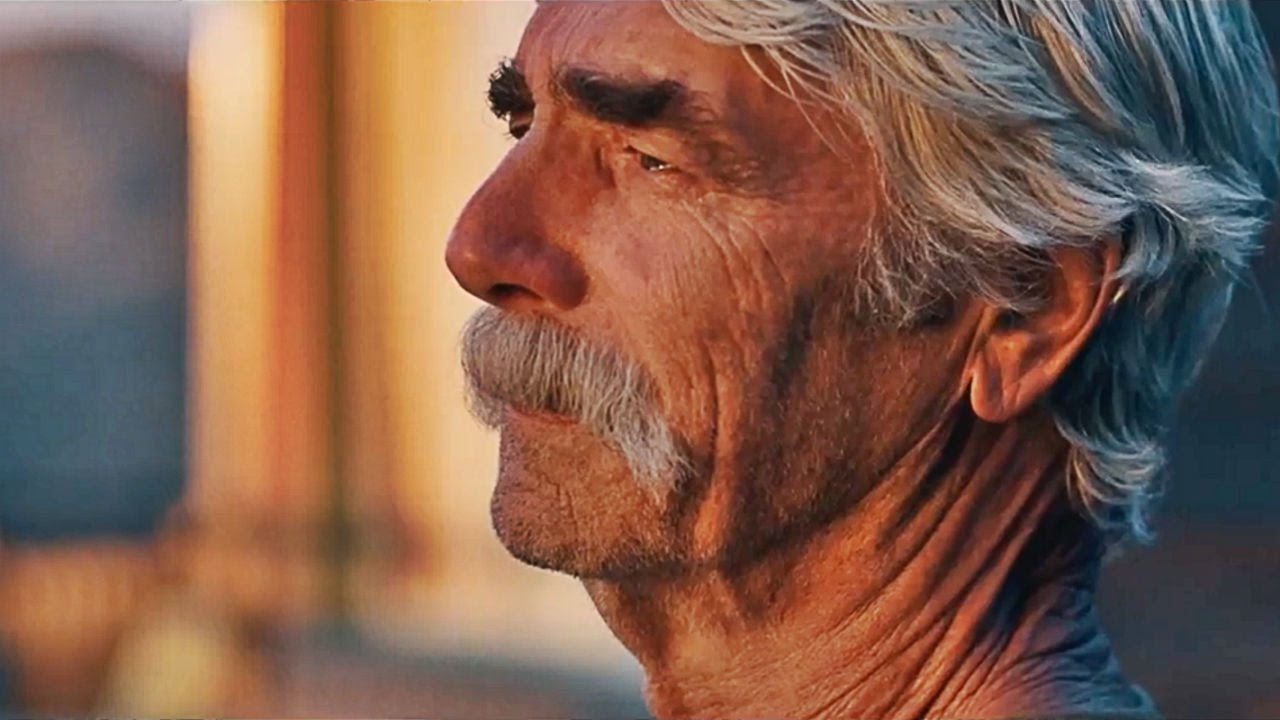
Somebody finally wrote a starring role for Sam Elliott. Let’s be honest, we all love him. What’s not to love? His lived-in masculinity, mannered charm and sonorous delivery make every line a comic/dramatic/romantic dream.

His latest film, the Brett Haley directed and co-penned The Hero, feels like an attempt to give Elliott his own The Wrestler or Crazy Heart.

I’m cool with that.

Haley was responsible for the 2015 life-renewing romance I’ll See You In My Dreams, a post-middle-age adventure starring Blythe Danner, with Elliott joining as her mustachioed gentleman caller.

With Hero, Haley places Elliott firmly in the lead of another “life begins when you decide it does” kind of story.

In a role undoubtedly written specifically for the actor, Elliott plays an aging performer who’s knocked around Hollywood for decades but is best known for his deep, cowboy voice. The film opens with that memorable baritone recommending, “Lone Star barbeque sauce – the perfect pardner for your chicken.”

It’s an inspired scene, full of humorous indignity and carried beautifully by the voice-over veteran. It’s really a shame Haley can’t build on it.

Elliott’s Lee Hayden has cause to reevaluate his life when a health issue, a lifetime achievement award, a viral video and a surprising new girlfriend all collide unexpectedly. Oh, so many reasons to contemplate your own mortality.

Elliott’s quiet, moseying way remains as enigmatic and charming as it ever has been, and seeing him play a character so very close to himself is sometimes eerie. Real-life wife Katharine Ross even plays his ex.

The film scores highest marks in two scenes with Ross, and in everything with a delightful Nick Offerman, playing against type as Lee’s goofy former co-star and current weed dealer.

It derails hardest, though, when it tries to juggle a distant relationship with a daughter (Krysten Ritter) and a new romance with a hot, much younger woman (Laura Prepon).

The Hero breaks no new ground. Had Haley and co-writer Marc Basch (who also co-wrote Dreams) thrown one or two fewer contrivances at us, or found perhaps a fresher way to contend with their obvious choices, they might have had something.

Instead they ride Elliott’s charm and settle for sentimentality, which is such a shame. It’s high time Sam Elliott gets to lead his own movie, but he deserves a little more than this.

Verdict-3-0-Stars

Stars, Stripes & Appetites

The Bad Batch

by Hope Madden

Three years ago, Ana Lily Amirpour dazzled moviegoers with her sleek and imaginative vampire fable A Girl Walks Home Alone at Night.

The film tells of a solitary female figure and the surprising impact of unlikely companionship. Amirpour called the film a “vampire western.”

If you haven’t seen the film (and you should, immediately), but you like the premise, then Amirpour’s follow up The Bad Batch might also appeal to you. It mines a similar vein, although the context is a bit more merciless.

The film’s provocative opening of mostly voiceover under credits introduces the concept of the “bad batch” – unwanteds. Drugs, immigration, petty crime – it’s never clear what this batch has been up to, but we know where they’re going. They’re headed to a quarantined expanse of arid Texas desert no longer considered part of These United States.

Once the images on screen take form, Amirpour creates an atmosphere of dystopian terror that the balance of the film never quite reaches again.

Newest resident Arlen (Suki Waterhouse – very impressive), realizes just how Mad Max this can get moments after gates are locked behind her. In a breathless and brutal piece of cinema, we are introduced to one of two communities thriving in this wasteland.

The Bridge People are hyper-bulked up, ultra-tanned cannibals represented by Miami Man (Jason Momoa). (They may not have access to steroids, but they’re certainly getting a lot of protein.)

The second community of Comfort offers a colorful, almost habitable environment led by charismatic leader The Dream (Keanu Reeves).

With these two communities, Amirpour moves very clearly into metaphorical territory, ideas she underscores nicely with strategic use of the American flag.

One version of America sees the vain, self-centered “winners” literally feeding on the weak. The second may seem more accepting, but it pushes religion, drugs and other “comforts” to encourage passivity.

It’s a clever but unwieldy storyline, and Amirpour has trouble concluding her tale.

She has a great cast, though. Joining Woodhouse, Momoa and Reeves are flashes of Jim Carrey, Giovanni Ribisi, Diego Luna and a host of the freakish and intriguing.

Amirpour has such a facility with creating mood and environment, and though the approach here is different than with her debut, she once again loads the soundtrack and screen with inspired images, sounds and idiosyncrasies.

Her opening sets such a high bar – one she fails to reach again – and her finale feels too conventional for this character and this world. They’re fairly slight criticisms, but with a filmmaker of such amazing talent, they can’t help but be a let-down.

Verdict-3-5-Stars

Paris Is Yearning

Paris Can Wait

by Matt Weiner

Have you seen the Coppola film about an unlikely star-crossed couple touring a foreign country? In Paris Can Wait, Eleanor Coppola, better known for her documentaries, writes and directs her first feature film.

Diane Lane plays Anne, the long-suffering wife and de facto personal assistant to a hard-driving producer husband Michael (Alec Baldwin, literally phoning most of his lines in). When Anne needs to get to Paris from Cannes, Michael’s business partner Jacques all too happily offers to drive.

Jacques has a spontaneous lust for life as well as an endless appetite that turns a one-day drive into an unexpected long weekend in close quarters for the pair. Paris Can Wait has some very loud echoes of the meandering “stranger adrift in a strange land” in Sofia Coppola’s Lost in Translation.

But the comparison does Eleanor Coppola no favors, instead showing just how respectively undeveloped and soulless Anne and Jacques are. At least Bob Harris knows that his distinguished charm act is just another form of kabuki, whereas Jacques comes across as sincerely committed to his hedonistic shtick.

This by itself wouldn’t torpedo the film, given Arnaud Viard’s effortless bonhomie. But it’s impossible to ignore the complete lack of agency given to Anne up until the very last frame of film. Jacques’s disquisitions on food and wine, art and local history are far too boring to be as one-sided as they are. All their outings together are gorgeously filmed, but Jacques’s conversational M.O. is to recite the first two lines of Wikipedia on any and every subject that comes into his field of vision.

In return, Anne is supposed to derive value from being pelted with the encyclopedia every five minutes. Call it homme-splaining, and then also call the police to rescue Anne from her whimsical weekend of nonconsensual self-discovery.

It’s not that two strangers wandering around a foreign country and talking can’t work—Richard Linklater got a sublime trilogy out of it. But the whole of France isn’t scenic enough to make up for Jacques’s tour guide/hostage taker balancing act. Just how bad is it for Anne? If the film swapped out the soundtrack for tense horror strings, there’s not a single excursion with Jacques that couldn’t naturally segue to a scene of Anne lashed to a bed with both her legs broken.

And somehow the trip stirs up life-changing feelings for both characters. (To be fair, spending an entire weekend feeling like each new adventure is a prelude to a murder would probably change anybody’s outlook on life.) Anne and Jacques each get a last minute, pathos-drenched backstory. But the result is not only forced, it also weakens Lane’s last-ditch attempt to inject a flash of mischief and mystery into Anne’s final moments onscreen.

This makes Paris Can Wait tragedy, not comedy. If Lane is going to be typecast in this sort of role, at least allow her character to flourish. Instead we’re stuck with the Jacques tasting menu: course after course of attractive fluff whether you want it or not, and then someone else gets stuck with the bill.

Verdict-1-0-Star

Sound Decisions

Violet

by Hope Madden

If you’re looking for a light hearted, talky romp, Bas Devos’s Violet is not for you. If, on the other hand, you’d like to see a thoughtfully delivered meditation on grief – and who doesn’t? – seriously, you should give this film a chance.

At thirteen minutes into the film, I’d yet to hear 20 words of dialog. But the sounds are hypnotic. It might be the click and whir of office machinery as the screen itself contains CCTV footage from mall security, capturing without notice the stabbing death of a teenage boy.

Or it could be the clatter of BMX bike wheels as Jesse (Cesar De Sutter) tries to resume normal life with his buddies after surviving the attack that ended his friend Jonas’s life.

Maybe it’s the airplanes overhead, the rain on awnings, or the sudden explosion of noise about 42 minutes in as Jesse and his friends attend the very heavy Deafheaven concert.

Whatever you’re hearing, it’s not an explanation of what happened, not details about how Jesse is coping. Devos has confidence that you can suss that out without hand holding.

His dreamlike work, often recalling Gus Van Sant, sits with mourning. The delayed reaction, the inability to focus, the hypersensitivity and numbness that collide. Why didn’t Jesse do anything to help Jonas?

It’s a question you can see on Jesse’s father’s face, on the faces of townies. With barely a word spoken, Devos offers insight into disappointment, masculinity, shock and the awkward, undramatic reality of day to day grief.

It’s a lovely effort, heavy with symbolism (sometimes too heavy). Devos is as confident with his visual storytelling as he is with sound design. Little touches – blue handlebars and peddles that match a BMX tee shirt, two dogs tearing at a trash bag on a corner – lead up to a quiet climax that matches symbol with reality in one overwhelming, terrifying and beautiful close.

It’s as insightful and respectful a representation of trauma and grief as you’ll find, but don’t expect tidy explanations or epiphanies. Devos is as patient with his subject as the theme requires.

Verdict-4-0-Stars

The Show Must Go On

The Wedding Plan

by Rachel Willis

The plot of The Wedding Plan would give one the impression that it’s a standard entry into the rom-com genre. When Michal (Noa Koler) is left by her fiancé, Gidi, thirty days before their wedding, she decides to go ahead with it anyway. While you could expect a comedic series of dates with random men while Michal tries to fill the groom void, what we get in writer/director Rama Burshtein’s film is something with much more depth.

While we do get scenes of awkward first dates, set up for Michal by her matchmaker, Burshtein is more focused on letting us know who Michal is and what she wants. While she wants to marry, the driving force behind her desire is a weariness with dating and a fear of being alone. When she decides to go ahead with her wedding, she gives herself over to God, believing that he will send her the “man of her dreams”.

As expected, the people in Michal’s life approach her plan with bemusement, incredulity, and sometimes outright aggression. However, the strength of Michal’s faith is what keeps us pulling for her. As Burshtein employs the romantic comedy tropes in her script, she manages to make them feel fresh by rooting Michal’s journey deeply in her faith. Though many characters see Michal as arrogant, the audience sees her as a women who believes so strongly in God’s plan that we can’t help but be awed by her sincerity.

Noa Koler is extraordinary. From the first moment she’s on screen, she brings a touching sweetness to Michal – we want her to be happy and find love. When her fiancé ends the engagement, the audiences feels genuine sorrow, even though we’ve spent a very short time with her.

At times, Burshtein takes on too much within the story. While most of the characters have depth, some of them are flat, only existing to push the story forward. When so many of your characters are so well-rounded, those that serve as pawns stand out roughly against the others.

Despite the flaws, Burshtein’s film is a endearing exploration of love and faith.

Verdict-4-0-Stars

https://www.youtube.com/watch?v=3TZTMurWtZ0

Just Turn Around Now

The Survivalist

by Hope Madden

Lean, mean futuristic science fiction that feels unsettlingly like reality, The Survivalist ranks among the best dystopian films in recent memory. And as writer/director Stephen Fingleton creates an utterly plausible and devastatingly grim future, the film marks a first time filmmaker with an awful lot to say.

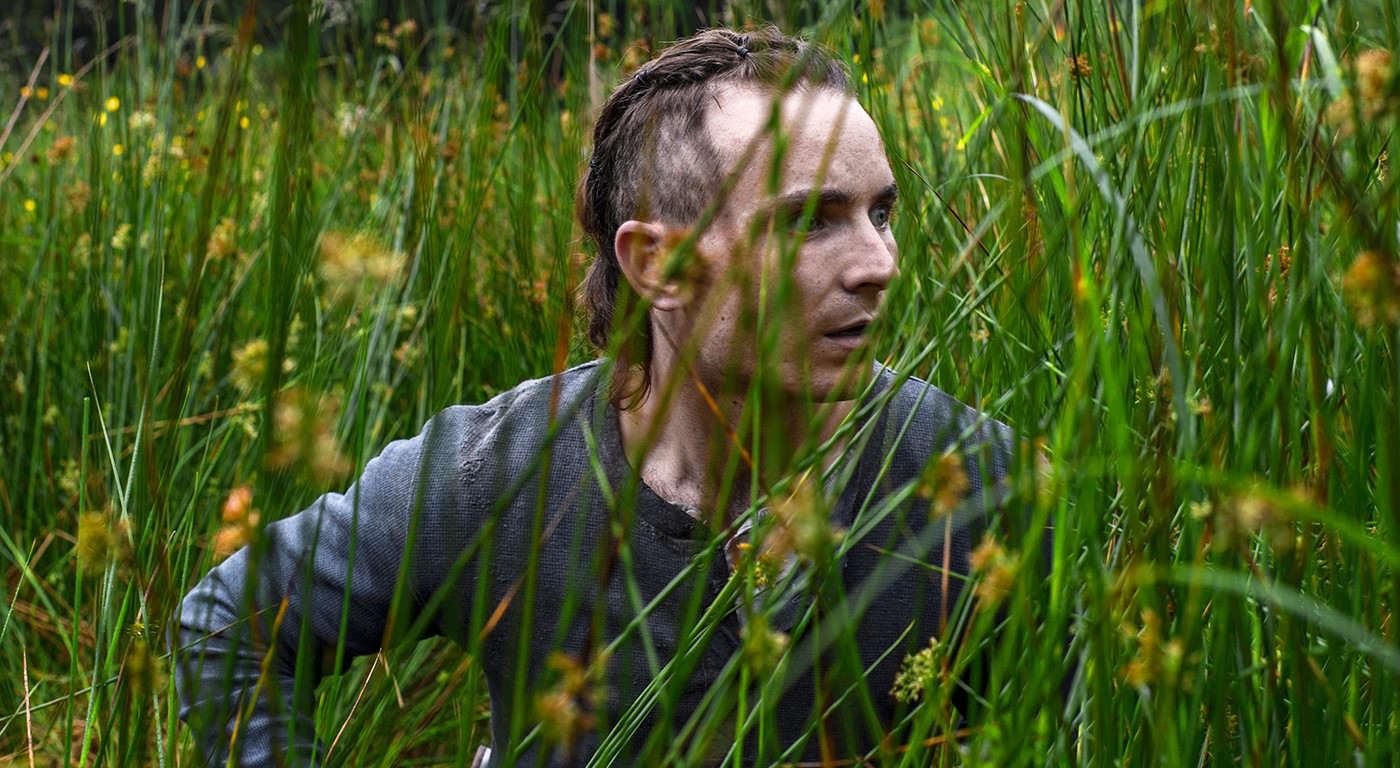
A solitary figure (Martin McCann – amazing) ekes out an existence in a shack hidden in the woods of Northern Ireland. His small field of crops is fertilized by the bodies of interlopers who happen upon him. He spends his days tending his vegetables and reinforcing his traps, but a haunted past and his own isolation are starting to wear at him.

Enter two hungry women: Kathryn (Olwen Fouere) and her daughter, Milja (Mia Goth).

His first inclination is to do with them what we’ve seen him do with others who come too close to his holdout. But he’s tempted, made an offer for something not necessary for survival. Something he wants more than he needs.

For Milja and her mother, this is still nothing more than survival, which is what puts the three people on different planes of existence. The survivalist (for we never do know his name) has entered the treacherous and vulnerable area of want, and then the even more dangerous ground of hope.

The shifting power and landscape of the relationships is fascinating, made all the more powerful for lack of dialog. Who is in control? The answer varies scene by scene.

The title could stand for any of the three, and this trio of performances consistently impresses.

Fingleton lingers on glances and body language to reinforce the pitiless practicality that has taken the place of civilization. McCann’s silent chemistry with each character offers more insight into his character than pages of dialog could, and he’s matched in his efforts – particularly by Fouere.

The film, like its protagonists, is unapologetically efficient. But Fingleton and his director of photography Damien Elliott occasionally offer a glimpse of the beauty left in this dystopia – a beauty that existed long before and will persist long after man’s involvement.

Together, cast and crew trap you in slow-boil of primal instincts with an explosion the inevitable consequence.

Verdict-4-0-Stars

The Duality of Man

Buster’s Mal Heart

by Cat McAlpine

“Life’s a riddle” croons the opening song of Buster’s Mal Heart. Hoo boy, it sure is.

At the start, two shadowy figures sit in a small row boat on the open sea. Despite being the first image of writer/director Sarah Adina Smith’s existential delight, this scene is one of the final pieces of the puzzle she creates.

Looking back, the plot is simple, in its bizarre sci-fi short story kind of way. But the resulting film is not simple. The order of events has been jumbled and small interactions are dragged out only to be pumped full of paranoia.

Each moment of Smith’s film is tense, uncomfortable and absolutely lovely. The soundtrack is a character all its own, often transitioning between different covers of the same song as scenes change from one reality to the other. The camera constantly finds an interplay of light and dark, whether bare trees against a winter sky or a glowing TV in a dimly lit office.

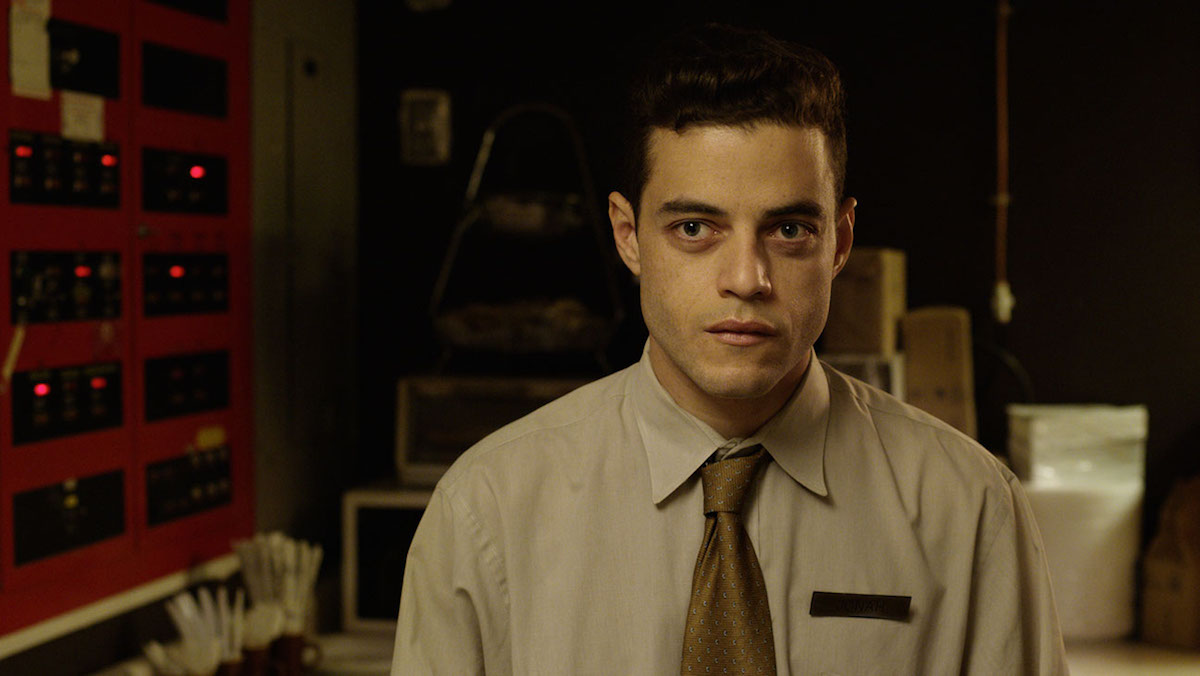
Buster’s Mal Heart contemplates the claustrophobia of working a dead-end job inside the machine of modern society, and Rami Malek (Mr. Robot) is the perfect canvas. You can see the quiet rage within him long before he lets it slip. He plays both cautious and wildly consumed by conspiracy with equal commitments. I would’ve watched him sit at his dingy concierge desk for the whole hour and a half.

DJ Qualls (The Man in the High Castle) is not to go unmentioned either, as The Last Free Man. He delivers wild cosmic theories with enough sanity to make them sound almost plausible. And in Buster’s Mal Heart, almost plausible makes the leap to utterly real without breaking a sweat.

This film begs to be consumed as a whole, a new rarity in our distracted age. There is no moment for you to sneak out for a bathroom break or check your texts. Even shots of Buster simply vacuuming the dining room somehow feel important and are key to mood that Smith has crafted.

Imagine the universe. It is impossibly large. Infinitely large. We exist within the universe, and yet have only theories of how it works. Allow yourself to panic at this idea, to become uncomfortable. Allow your own smallness to make your heart race and your brain stutter. Think about the things you do, every day, that have no consequence at all on existence at large.

Now, before you sprint headlong into the woods, go see this movie.

Verdict-4-5-Stars