That’s Eugene’s (Jack Rowan) line. He’s done working for his Dad (Nigel O ‘Neill), the meanest bastard ever to run a construction crew. Eugene’s happy to waste his youth drinking with his mates in The Stoker and ushering naive tourists to that pile of stones they come out to see – not that there’s really a vampire under there. Certainly not the one, true vampire that inspired Bram Stoker in the first place.
Right! So, many pints and backhoes and buddies later we find
out whether ol’ Abhartach under those stones is a myth or not.
As writer/director Chris Baugh adapts his 2013 short into a fun, effective monster flick, he begins by tossing out vampire tradition. Ireland’s own Bram Stoker had written a piece of fiction, after all, and this is reality. The new mythology is a little muddier and more monstrous than Dracula, but never less than fun.
Baugh taps into the same kind of smalltown boredom that situates
the nation’s most memorable monster movies, from Grabbers to Rawhead
Rex. He does a lot with a small budget, suggesting the monster more than showing
it until the final act, but there’s plenty of blood to make up for the
subtlety.
A couple of veterans (O’Neill, as well as John Lynch, also
on Shudder right now in Christopher Smith’s The
Banishing) give the cast a strong backbone. A solid group of young ne’er
do wells (Louise Harland, Michael Hough and Fra Fee joining Rowan) create a lived-in
camaraderie. The charm and familiarity among the ensemble are undoubtedly the
reasons the film works as well as it does.
Boys from County Hell is a horror/comedy, but it’s rarely laugh-out-loud funny. It’s actually a good deal more tender in its own endearingly bull-headed way, with a narrative more focused on the father/son dynamic than on coming of age or bloodshed. Baugh’s deep sense of these characters and this terrain benefit the relationship building and give the film a nice throughline.
This is a “what are you going to do with your life” film, and for some people, it takes a good, old-fashioned bloodletting to help them make up their minds.
Simultaneously sympathetic and vengeful, Corinna Faith’s ghost
story The Power sets an emotional tone that suits its core themes.
Today is Val’s (Rose Williams) first shift at a rundown
London hospital. It’s 1974, and a coal miners’ strike means rolling blackouts.
Val hadn’t anticipated still being at work when the lights went out, but a
power struggle with Matron (Diveen Henry) means putting up or shutting up.
Unfortunately, Val’s not great with darkness.
Williams provides a tender central figure, terrified of
everything: her new bosses, the sprawling building itself, the dark, failure. Val
doesn’t get a lot of support from the rest of the staff, particularly one
creepy janitor, a repugnant handyman and a viciously catty colleague (Emma
Rigby, spectacular).
When the abuses turn supernatural, Faith begins to dig into the
real terrors that faced women in 1974 (and in 974 and in 2021). But the
filmmaker never abandons her ghost story in favor of a podium. The Power
is an effective allegorical tale, but before that it’s a spooky horror story
set in an old hospital.
Why are those always so scary? Session 9 may be the high-water mark, but Faith taps into our fears of the powerlessness that comes with illness and institutions, and she exploits them.
The director makes good use of familiar elements—the
Seventies vibe, the crumbling edifice, the darkness—and not only to create an
unease that heightens the scares. She crafts an environment that amplifies and
clarifies the theme, whether it’s the strike, the systemic sexism and classism,
or just the insidious nature of abusing and silencing those without power.
Wonderful performances throughout elevate story tropes that could get old, and the filmmaker’s instincts for using light, shadow and reflection give the film an eerie quality that’s hard to shake.
Seriously, who still thinks camping in the woods is a good
idea?
There’s something about the woods that haunts us, so it’s
the perfect setting for many a horror movie.
In director Bruce Wemple’s latest film, Dawn of the
Beast, it’s the ideal locale for a group of cryptozoology students on the
hunt for Sasquatch.
Wemple likes the creature feature – a look at his past work uncovers another film about Bigfoot (Monstrous), as well as one about the mythological Wendigo. Writer Anna Shields must also enjoy the ‘Squatch, as she not only penned Monstrous, but Dawn of the Beast as well. You’d think with two movies about Sasquatch under their belts, these two would have something new to say about Mr. Foot.
And in a way, they do, but unfortunately, what they have to say about their monster is buried beneath a run-of-the-mill ‘cabin in the woods’ horror trope.
There is some fun in Dawn of the Beast. There are a few jokes, characters you root for, as well as one or two you root against, but there’s also a lot of drudge here. You find yourself sitting through too much filler while you wait for the more interesting moments.
Shields also co-stars in the film as Lilly, but her talents seem better suited to writing. There are some genuinely creepy moments – yellow lights (are those eyes?) drawing you into the woods, one or two effective jump scares, and some funny dialogue. And what Lilly and her classmates find in the woods is a lot more terrifying than the legendary Bigfoot.
However, the film’s best aspect is – far and away – the creature effects. They add a degree of tension and fear that would be otherwise absent without such convincingly scary monsters. In some films, the addition of a monster removes the tension; seeing too much destroys the mystery. But in this case, it really works.
It’s around the film’s third act that Dawn of the Beast begins to hit its stride, embracing the funnier elements and dropping the attempts to inject a seriousness to the film that it largely doesn’t need. A funny horror movie can still be scary, so anything too serious in this movie (a kidnapping, for example) is time wasted for the audience.
Perhaps if Wemple and Shields attempt a third Sasquatch film, it’ll be the charm that lands them a horror film that hits all the right notes.
Good old alien horror doesn’t come around as much as I’d like. Outside of the occasional Alien or Predator sequel, this subgenre is pretty much stagnant or banished to the realm of mico-budget dreck. Embryo might skirt the line of microbudget, but this eerie alien tale is anything but dreck.
The bulk of Embryo follows campers Kevin (Domingo Guzman) and Evelyn (Romina Perazzo) as they venture into the woods of southern Chile. Their camping getaway turns into a nightmare after Evelyn is abducted by extraterrestrials, leaving her in a state of shock. As the effects of her alien abductors take hold, Evelyn becomes increasingly more bloodthirsty, leaving a trail of bodies in her wake.
Director Patricio Valladares approaches alien abduction as a blend between Fire in the Sky’s creeping dread and Cronenberg body horror. Evelyn’s descent into other-worldly terror reveals itself in visceral, extreme violence. We’re talking lots of blood and guts here. However, the explanation of her metamorphosis is kept an enigma. The guessing game surrounding the aliens themselves is left to the deepest levels of the audience’s subconsciousness. It’s an act of omission probably born out of budgetary concerns, yet it ends up aiding the film more than the filmmakers could have foreseen.
Valladares throws a curveball when constructing the film’s narrative. There’s an occasional break in Kevin and Evelyn’s story where Embryo attempts to open up the world a bit more. This allows the filmmakers to weave together other tales of close encounters in this small Chilean town. Not only are the stories different, but so is the style of filmmaking. By switching to found footage, Valladares is able to emphasize suspense and dread over the fantastical gore that oozes through the main segment.
Despite telling three individual tales, Embryo clocks in at a scant 72 minutes. Even with the different stories, the film threatens to run out of steam on multiple occasions. There’s a repetitiveness to the Kevin and Evelyn segment especially that starts to detract from its overall effectiveness. I can’t believe I’m saying this, but there are only so many times Kevin can lose Evelyn only to find her feasting on a biker, doctor, or other camper.
Embryo doesn’t quite cross the finish line at full speed, but through deft tone management and a willingness to get gross, the film leaves an overall positive impression.
It’s the most wonderful time of the year! The Oscars are coming and we get to spend some time celebrating the worst of the horror movies made by nominees. Have they made great horror? Well, Daniel Kaluuya (Get Out) and Anthony Hopkins (The Silence of the Lambs) are nominees, so yes. In fact, there are a whole slew of horror films made by this year’s batch of nominees, most of them far too good to qualify for this list.
No, we want the skeletons. And every single year, nominees have them. Here are this year’s contenders.
5. Daniel Kaluuya: Chatroom (2010)
What is the matter with this movie? Writer Edna Walsh, who’d go on to pen the excellent films Disco Pigs and Hunger, adapted her own stage play. Hideo Nakata (Ringu, Dark Water) directed. The cast is exceptional: Daniel Kaluuya, Imogen Poots, Aaron Taylor-Johnson all play Chelsea teens who hang out in a new chatroom.
How did this to so terribly wrong? As five kids get to know each other online, it turns out that one is a predator looking for a very specific weakness and playing the others against each other. Not a terrible premise, and the overall design is surreal enough to avoid individuals at their laptops. Performances are solid as well.
But, ideas come and go, conflicts arise and disappear, characters appear without warning or introduction and vanish, and storylines fail to make any real sense.
https://www.youtube.com/watch?v=wP9eUK5IvEc
4. Amanda Seyfried & Gary Oldman: Red Riding Hood (2011)
A two-fer! Truth be told, there were plenty of two-fer opportunities with Oldman on this list (he also co-starred with fellow nominee Anthony Hopkins in both Bram Stoker’s Dracula and Hannibal).
But this is the one, because it lets us talk about another time he co-starred with Amanda Seyfried. Both are nominated for their work together in 2020’s Mank. Neither were nominated for this.
Twilight director Catherine Hardwicke helms this fractured fairy tale, and it looks gorgeous. The story is overly complicated and stupid, but it hits all the important marks: Valerie (Seyfried) is loved by two potentially dangerous boys whose passion might actually kill her. Oh, it’s such an angsty YA dream!
Seyfried is fine. Oldman is a ham, and he’s such a joy when he’s a ham. There’s a fun cameo from Julie Christie as well. But the weak writing and utterly laughable performances by the two suitors (Max Irons and Shiloh Fernandez) are enough to sink this one deep.
3. Anthony Hopkins: The Wolfman (2010)
Hopkins has a lot of horror in his closet, much of it bad. The Rite is the least watchable, but this is the one that’s the most fun to lambast. What a ludicrous waste of talent!
Sir Anthony bites through scenery (among other things) as Sir John Talbot, father of Lawrence Talbot (Benicio Del Toro). Their background is murky, their property is foggy, their accents are jarringly different.
Director Joe Johnson likes stuff big and hokey. You’ll find that here. The film won an Oscar for its make up, which we cannot get behind. The final battle looks like two rhoided-up Pomeranians duking it out.
Still, Emily Blunt and Hugo Weaving are good, and even though the great Del Toro sleepwalks through this embarrassment, Hopkins is always a bit of fun when he camps it up in a bad movie.
2. Gary Oldman: The Unborn (2009)
Oh, Gary Oldman, why do you so rarely say no?
He’s just in so, so, so many movies – mathematically speaking, it only makes sense that a lot of them will be terrible. Like this one, a film that feels less like a single cohesive unit and more like a string of individual scenes filmed as examples of cliches and non sequiturs.
Oldman plays a rabbi who works with a Christian minister played by Idris Elba to help an incredibly entitled young woman who looks like a blander version of Megan Fox (Odette Annable) exorcise a Jewish demon who likes twins.
Cam Gigandet, Meagan Good, James Remar and Carla Gugino also co-star for no logical reason. Well, writer/director David S. Goyer is also writer David S. Goyer (Blade trilogy & Nolan’s Batman trilogy). This movie came immediately on the heels of 2008’s The Dark Knight, which explains Oldman as well as some unmet expectations.
1. Youn Yuh-jung: Insect Woman (1972)
Youn Yuh-jung is a treasure. Her fifty years in movies boasts dozens of remarkable performances usually marked by quirky humor that never feels gimmicky. She’s had a hell of a 2020, with pivotal supporting roles in Beasts Clawing at Straws and the Oscar-nominated Minari.
She does what she can in writer/director Kim Ki-young’s inexplicably titled Insect Woman.
Oh my God, what a trainwreck! What is going on here? Youn plays a teen with nowhere to turn once her father returns to his wife. Now her mother, older brother and she must fend for themselves. But how? Well, maybe she can be mistress to an impotent (or is he?!) high school teacher.
The film swings back and forth between highly irrational melodrama to profoundly unsexy eroticism to unconvincing gritty street indie. An hour or more into this, they introduce a vampire baby.
I swear!
Then it’s on. Who knows what the hell is happening or is going to happen or why it’s happening or what the film is trying to say. If it were a better movie I’d think Insect Woman was trying to make a point about misogyny and classism in South Korea.
Writer/director Mark P. Nelson is kind of fixated on the social
rifts in America.
His 2018 film Domestics followed the aftermath of an
apocalypse intentionally deployed by a ruling class looking to thin the herd.
The smaller herds only fracture into groups of radicalized, violent maniacs,
though, and even your white bread nuclear family types are threatened.
Which is to say, this filmmaker brings a different
perspective to the inbred cannibal franchise, Wrong Turn.
Yes, big city liberals on a hiking trip run afoul of Virginia
rednecks. But where Nelson varies from the script of the 2003 original is in reimagining
the antagonists.
We know there’s trouble afoot from the opening scene when Matthew Modine drives into the quaint Virginia town looking for his character Scott’s missing daughter (Charlotte Vega). The lovely blonde was last seen here, along with her African American boyfriend, another heterosexual couple, and a gay couple, one of whom is Muslim.
Because apparently not one of these people has ever seen a
horror movie.
The film gets into trouble early by conjuring moments from Tucker
and Dale vs Evil, which is a great movie. It’s an insightful lampooning
of movies just like the one Nelson is trying to make, though.
Nelson’s more successful when he borrows a bit from the
likes of Green Room and The Ritual, although he plants Wrong
Turn’s folkloric barbarism firmly on American soil. This is a film about
America.
If you’re looking for a movie about cannibal families, you
will most definitely be disappointed.
The horror is less unseemly, all of it in support of Nelson’s
image of a divided America. There are some startling moments of gore, and other
more harrowing ideas that suit the picture well.
Nelson takes too long getting to the point, unfortunately. The film runs just under two hours, which is at least 20 minutes too long. A trimmer runtime might have helped the film leave more of a mark. Instead, Wrong Turn is a decent if unremarkable backwoods thriller.
Author Hailey Piper joins the club this week to tear through about 25 different cosmic horror movies, eventually landing on some fuzzy math favorites. Join us, won’t you?
6. Hellraiser
“The box…you opened it. We came.”
Man, those cenobites were scary cool, weren’t they?
Hellraiser, Clive Barker’s feature directing debut, worked not only as a grisly splatterfest suited to the Eighties horror landscape. It’s easy to see the film as an occult or supernatural horror, but it’s just as likely a cosmic tale of a dimension you could open without even trying, another reality on the other side of an afternoon’s puzzle past time.
5. Spiral (Uzumaki) (2000)
Higuchinsky’s mind bending 2000 Japanese horror went underappreciated upon release – likely because of the interest in ghosts and digital horror during that period. That’s too bad, because his adaptation of the not-yet-released Manga Uzumaki is a delight.
It starts with a snail shell. It ends with a town in chaos. If you missed it, you should remedy that now.
4. In the Mouth of Madness
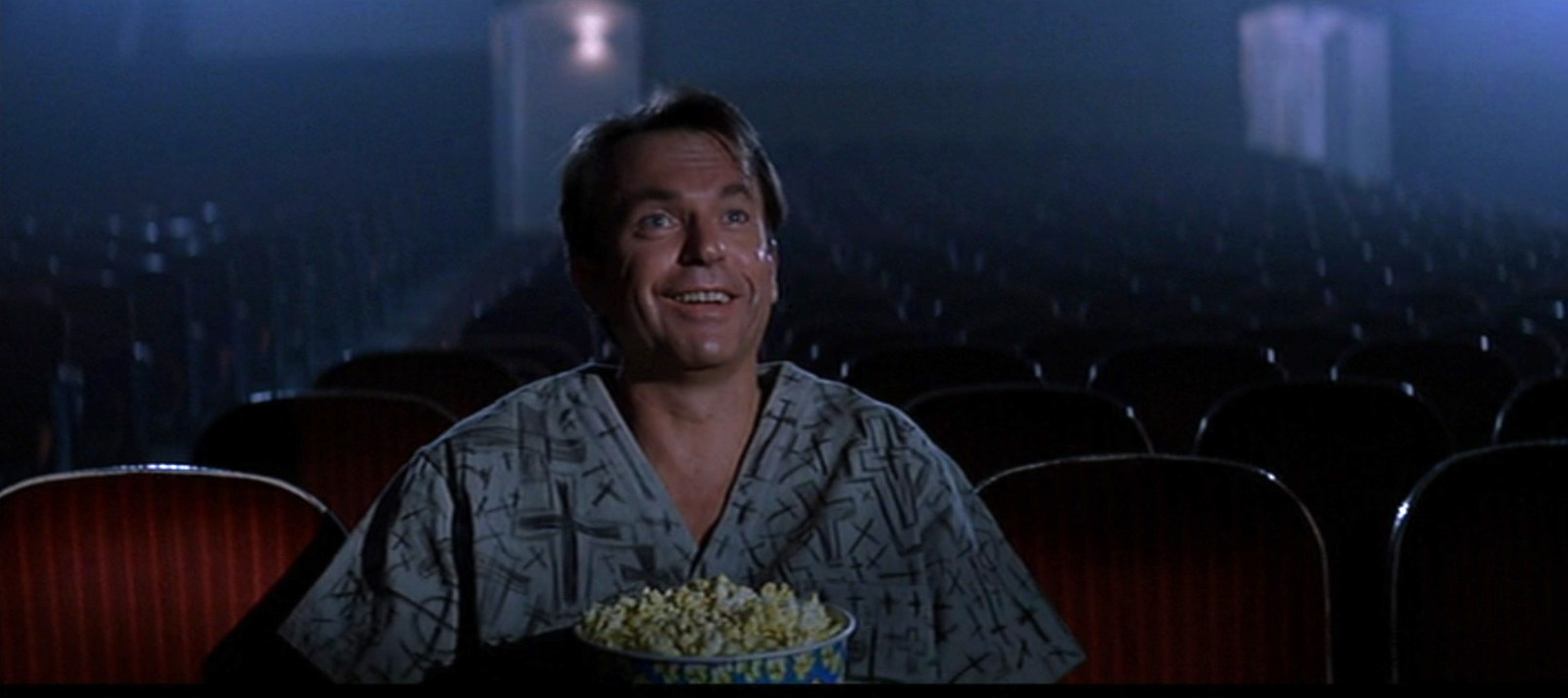
Sutter Cane may be awfully close to Stephen King, but John Carpenter’s cosmic horror is even more preoccupied by Lovecraft. The great Sam Neill leads a fun cast in a tale of madness as created by the written world.
What if those horror novels you read became reality? What if that sketchy writer with the maybe-too-vivid imagination was not just got to his own page, but god for real? This movie tackles that ripe premise while ladling love for both of the horror novelists who made New England the creepiest section of America.
3. The Endless
There is something very clever about the way Justin Benson and Aaron Moorehead’s movies sneak up on you. Always creepy, still they defy genre expectations even as they play with them.
Camp Arcadia offers the rustic backdrop for their latest, The Endless. A clever bit of SciFi misdirection, the film follows two brothers as they return to the cult they’d escaped a decade earlier.
It is this story and the pair’s storytelling skill that continues to impress. Their looping timelines provide fertile ground for clever turns that fans of the filmmakers will find delightful, but the uninitiated will appreciate as well.
2. Annihilation
Alex Garland’s work as both a writer (28 Days Later…, Sunshine, Never Let Me Go) and a writer/director (Ex Machina) has shown a visionary talent for molding the other-worldly and the familiar. Annihilation unveils Garland at his most existential, becoming an utterly absorbing sci-fi thriller where each answer begs more questions.
Taking root as a strange mystery, it offers satisfying surprises amid an ambitious narrative flow full of intermittent tension, scares, and blood—and a constant sense of wonder.
Just his second feature as a director, Annihilation proves Ex Machina was no fluke. Garland is pondering similar themes—creation, self-destruction, extinction—on an even deeper level, streamlining the source material into an Earthbound cousin to 2001.
1. The Mist
David Drayton (Thomas Jane) and his young son head to town for some groceries. Meanwhile, a tear in the space/time continuum opens a doorway to alien monsters. So he, his boy, and a dozen or so other shoppers are all trapped inside this glass-fronted store just waiting for rescue or death.
Marcia Gay Harden is characteristically brilliant as the religious zealot who turns survival inside the store into something less likely than survival out with the monsters, but the whole cast offers surprisingly restrained but emotional turns.
The FX look amazing, too, but it’s the provocative ending that guarantees this one will sear itself into your memory.
It’s hard to tell a new story. People have been telling
stories since the beginning of people, and eventually – probably millennia ago –
we realized we were just recycling the same dozen or so tales.
This week’s Shudder premiere, director Vincent Paronnaud’s Hunted,
feels especially familiar. He knows that, presumably, or the woman being chased
through a massive forest wouldn’t be wearing a red hooded coat.
It’s clear in every aspect of the telling of this story that the filmmaker (and a team of writers including Paronnaud, Lea Pernollet and David H. Pickering) want you to understand how familiar this is.
Indeed, Paronnaud’s tale of a man chasing a woman is so
ordinary that no matter how outlandish the circumstances, onlookers barely
register it as more than a moment’s blip in their day.
Hunted opens with a fairy tale, spun by fireside in a
deep, dark woods, of a group of men who turn on a woman. In this ancient lore,
things don’t turn out so well for the men, not because a savior steps in but
because of something more primal.
And so, eons later, the aptly named Eve (Lucie Debay) is
dealing with a boss who underestimates her and a husband who can’t stop
calling. She goes out for a drink. That might have been the last we ever heard
from Eve.
Instead, after a series of events that escalate beyond the point
of realism to something bordering on the absurd, the whole damn forest hears
her.
Debay’s transformation is also marked very obviously and very visually, underscoring the cartoonish nature of this particular enactment. She does a wonderful job of evolving from something in Act 1 that feels garden variety for horror into something surprising and fierce.
Arieh Worthalter equals her as the psychopath, often lensed
to give him the look of an animated wolf charming villagers.
Paronnaud’s background is in animation—he co-directed
Marjane Satrapi’s sublime black and white wonder Persepolis. His move to
horror benefits from his visual flair. While the red coat stands out as an
obvious nod (not to mention terrible camouflage), a later splash of blue feels
simultaneously insane and warrior-like.
Sometimes, you’re just in the mood for a B movie, especially
if it’s a creature feature.
Extra points if it’s a feminist take on a misogynist’s
story.
Shadow in the Clouds co-writer Max Landis has been
accused of sexual misconduct and/or outright assault by eight different women. And
while it’s tough to stomach any ticket purchase benefitting him, the truth is
that co-writer/director Roseanne Liang’s film has stylized fun in depantsing
exactly the kind of weak, entitled, insecure crybaby that makes you think of
Max Landis.
If you’ve seen the New Zealander’s 2017 horror short Do No Harm, you’ll recognize Liang’s writing here.
The film tags along on a non-combat WWII military flight out
of New Zealand. With seconds to spare, an unexpected female flight officer
named Maude Garrett (Chloe Grace Moretz) boards the flight carrying a duffel
bag with confidential contents.
The rowdy, boorish, some would say violently sexist crew
quickly stashes Maude – sans duffel – in the gun turret until take off.
This is a brilliant move, cinematically. It creates
immediate, palpable tension because she is locked into a tiny cell dangling
from a moving airplane and dependent upon the good nature of the mainly bad
natured men above.
It also allows Moretz and Liang the opportunity to introduce
any number of terrifying elements out there in the clouds.
But mainly, it gives Moretz the chance to own the film for a while, and she does. Together filmmaker and lead slyly reveal more about Maude, ratcheting tensions and thrills as they do. Liang leans into budgetary constraints, developing a cheesy retro vibe while finding appealing ways to introduce different characters.
In many respects, the writing is the weakness. Too often
scenes devolve into obvious but inauthentic ways to further the plot. Still, a
lot tends to be forgivable in an openly, charmingly B movie.
If the style doesn’t engage you immediately, abandon all
hope. The film builds on style, repaying your attention with increasingly
insane action ending in a climax where one fight, one monster stands in for
every belittling, dangerous, violent, controlling obstacle Maude has ever
faced.
You can picture Max Landis if you like.
Shadow in the Cloud is a ludicrous, over-the-top action horror. It knows what it is and it delivers on its promises.
What opens as a slyly comic take on a familiar horror scene turns – with a blinding light and the sound of a garage door – into something more silly and broadly funny. Born Again, Hands Off Productions’ 6 ½ minute visit with the “worst Satanists ever,” wastes no time and packs a comedic wallop.
Written by director Jason Tostevin and co-star Randall Greenland, the film’s success relies on a clever turn. Most of the pair’s collaborations, including 2015’s impressive (and award-bedecked) gangster short A Way Out, benefit from a similar subversion of expectations. But Born Again takes the team back to horror, and the sensibility here is much more enjoyably goofy.
Regular Tostevin collaborator, cinematographer Mike McNeese, lenses an impressive effort. The two handle the shift in tone beautifully, opening with sumptuous colors and tight close ups, then pivoting to a visual style that feels in on the joke.
Production values throughout impress, while performances – though brief – are strong. Tiffany Arnold, whose work relies almost entirely on facial expressions, is a riot, but the scene stealer is Greenland.
With sharp timing and a panda mask, Greenland perfectly represents Born Again: it’s so wrong, yet endearingly hilarious.