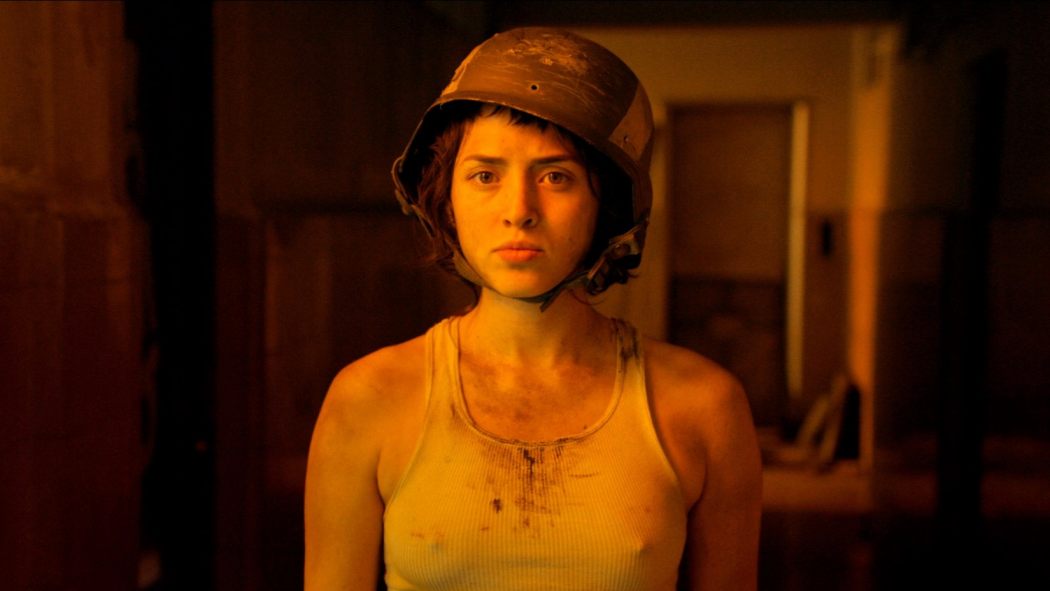
Much has been made of barf bags and fainting during screenings of writer/director Julia Ducournau’s feature debut, Raw.
A festival favorite, the film has been plagued by rumors of aggressive audience nausea, let’s say, as well as ambulance calls. Several theaters recently have offered vomit bags with ticket purchases.
Don’t let that cloud your expectations. Raw is no Hostel, no Human Centipede.
What you’ll find instead of in-your-face viscera and nihilistic corporeal abuse is a thoughtful coming of age tale.
And meat.
Justine (Garance Marillier, impressive) is off to join her older sister (Ella Rumpf) at veterinary school – the very same school where their parents met. Justine may be a bit sheltered, a bit prudish to settle in immediately, but surely with her sister’s help, she’ll be fine.
The film often felt to me like a cross between Trouble Every Day and Anatomy. The latter, a German film from 2000, follows a prudish med student dealing with carnage and peer pressure. In the former, France’s Claire Denis directs a troubling parable combining sexual desire and cannibalism.
Ducournau has her cagey way with the same themes that populate any coming-of-age story – pressure to conform, peer pressure generally, societal order and sexual hysteria. Here all take on a sly, macabre humor that’s both refreshing and unsettling.
A vegetarian from a meat-free family, Justine objects to the freshman hazing ritual of eating a piece of raw meat. But once she submits to peer pressure and tastes that taboo, her appetite is awakened and it will take more and more dangerous, self-destructive acts to indulge her blood lust.
In a very obvious way, Raw is a metaphor for what can and often does happen to a sheltered girl when she leaves home for college. But as Ducournau looks at those excesses committed on the cusp of adulthood, she creates opportunities to explore and comment on so many upsetting realities, and does so with absolute fidelity to her core metaphor.
She immediately joins the ranks of Jennifer Kent (Babadook) and Ana Lily Amirpour (A Girl Walks Home Alone at Night) – all recent, first time horror filmmakers whose premier features predict boundless talent.
Winter break approaches at a Catholic New England boarding school. Snow piles up outside, the buildings empty, yet Kat (Kiernan Shipka) and Rose (Lucy Boynton) remain. One has tricked her parents for an extra day with her townie boyfriend. One remains under more mysterious circumstances.
Things in writer/director Oz Perkins’s The Blackcoat’s Daughter quietly unravel from there – although quiet is not precisely the word for it. There is a stillness to the chilly, empty halls. But thanks to the filmmaker’s brother Elvis, whose disquieting score fills these empty spaces with buzzing, whispering white noise, a sinister atmosphere is born.
Like Perkins’s Netflix-produced follow up I Am the Pretty Thing that Lives in the House, Blackcoat’s Daughter breathes atmosphere and tension. Perkins repays your patience and your attention. You can expect few jump scares, but this is not exactly a slow-burn of a film, either.
It behaves almost in the way a picture book does. In a good picture book, the words tell only half the story. The illustrations don’t simply mirror the text, they tell their own story as well. If there is one particular and specific talent Blackcoat’s Daughter exposes in its director, it is his ability with a visual storyline.
Perkins is also a master at generating tension, a kind built on unsure footing. The filmmaker routinely touches on your expectations, quietly toying with them. He introduces characters and situations rife with horror possibilities, but equally plausible as images of safety: priests in a boarding school, cars on an icy road, James Remar in a motel room.
Remar’s mug can be associated with so many villainous characters that his presence in this film as a concerned father figure is perfect. There is one masterpiece of a scene between Remar and Emma Roberts – one that dances with to so many different rhythms of danger – and it perfectly encapsulates this filmmaker’s power over an audience.
When the slow and deliberate dread turns to outright carnage – when Perkins punctuates his forbidding atmosphere with hard action – he loses his footing just a bit. But Blackcoat’s Daughter is a thoughtful little horror show, its final act a fascinating rethinking of old horror tropes.
Pay attention when you watch this one. There are loads of sinister little clues to find.
Hard rock music makes for both an evocative soundtrack and theme for horror. It possesses a throbbing, angry darkness perfectly suited to imagery, behavior and pace. The hilariously wrong Kiwi flick Deathgasm and last year’s brilliant Green Room knew this.
Writer/director Sean Byrne recognizes this ripe musical landscape. He returns to the genre after too long an absence with his own head banging horror show – The Devil’s Candy.
In 2009 the Tasmanian filmmaker released one of my all-time favorite films, The Loved Ones. And while Candy can’t match the unhinged lunacy of Byrne’s previous classic, his skill with a story, a camera and a cast are still evident.
Ethan Embry plays Jesse Hellman, struggling metalhead painter who, with his wife and pre-teen daughter, just bought a bargain of a house out in the Texas sticks. Why so cheap? Amityville shit.
So, the demented son (Pruitt Taylor Vince) of the deceased former owners lurks about. Meanwhile Jesse’s art becomes more disturbing and consuming. But Byrne shifts expectations, setting the film up as a haunted house/possession terror that turns into more of a serial killer thriller.
Still, so much about this film smacks of redundancy. Too many movies follow a young family into the damned home of their dreams, generating tension with either the fear that one family member will turn on another, or that the parents cannot keep their child safe. Or both.
No, Byrne’s follow up film does not boast the same unbridled originality as Loved Ones. But he almost makes up for that flaw with well-crafted characters, excellent on-screen chemistry among his performers, and a genuine love of metal.
The crossroads between Satan and music – in imagery and lyric – have long influenced and been influenced by horror films. Black Sabbath and White Zombie took their names from scary movies, and the list of flicks that set Satan and rock music against the innocent is too long – and mostly too awful – to mention. (OK, a few: Trick or Treat, Phantom of the Paradise, The Gate, Suck, Liquid Sky, Queen of the Damned – remember that piece of garbage?)
Byrne does a better job of exploding the clichés associated with this line of thinking than perhaps any filmmaker who’s taken up Dio’s sign of the horns. No longer the hysterical outsider condemning that devil music, the film simply uses metal as its backdrop and vehicle, no judgment involved.
Byrne’s also blessed with a lead in Embry, whose caring and vulnerability shine through his tough- looking exterior. Vince is another reliable (if typecast) actor, easily generating sympathy and terror in equal measure.
Clocking in at under 90 minutes, Devil’s Candy is a tight little rocker. The lyrics are familiar, but the riffs still kick ass.
Film lost one of the great character actors earlier this year. Bill Paxton – forever reliable, always memorable, often quotable – died in February at the age of 61.
Gone far, far too soon, he’s the horror icon-of-sorts we pay tribute to today. The man made a lot of films, many of them horror: The Colony, Impulse, Future Shock, Club Dread, Deadly Lessons, Mortuary. Sure, these are bad movies, but that doesn’t mean they aren’t enjoyable.
We want to spend most of our time with the horror films that are really worth seeing. Three of them are even quite good!
5. Night Warning (1982)
Here’s a weird one. And convoluted, too. Orphaned Billy (Jimmy McNichol) lives with his horny Aunt (Susan Tyrrell), plays basketball, and necks with his girlfriend Julia (Julia Duffy). Aunt Cheryl kills the TV repairman, claiming he was trying to rape her. When police realize the TV repairman was actually the longtime lover of Billy’s basketball coach, an evenhanded treatment of homophobia arises – surprising, given the time period. Not that it’s the point of the film, but it is the biggest surprise.
No one is really trying to unravel the murder mysteries piling up here. Aunt Cheryl is too busy trying to keep Billy to herself while small town cop Joe Carlson (go-to bigoted cop figure throughout the 70s and 80s, Bo Svenson) just wants to know whether or not Billy’s gay.
You know who else does? Billy’s on-the-court nemesis Eddie (Paxton).
This is very definitely a low budget, early Eighties horror flick. Don’t get your hopes up. But it is such a peculiar movie. Susan Tyrrell is fascinatingly unhinged and so, so creepy that you cannot look away, and if you’re up for one hot mess of a movie, this is an especially absorbing time waster.
4. Brain Dead (1990)
What?! Bill Paxton AND Bill Pullman – is this some kind of lottery jackpot?
No, the two Bills co-starred as a good guy doctor and a sleazy corporate monster. Guess who plays which.
Paxton – working the gap-toothed smirk – needs his old pal Rex (Pullman) to use his skills as a brain surgeon to extract some info from an old colleague, played by Bud Cort. (Bud Cort?! This cast is like a precious gift.)
The film becomes one of those “descent into madness” horrors where the character isn’t sure whether he’s the doctor or the madman. The writing is weak and the direction laughable, but there truly is something going on her. Who knows why Pullman, Paxton or Cort all agreed to this gig. By 1990, all three of them could have done better. But they did this, God bless ‘em, and it is weirdly worth a viewing.
https://www.youtube.com/watch?v=QtmqGe7740g
3. Near Dark (1987)
Back in ’87, future Oscar winner Kathryn Bigelow brought a new take on a familiar theme to the screen. A mixture of vampire and western tropes, Near Dark succeeds mostly on the charisma of the cast.
The always welcome Lance Henricksen is campy fun as the badass leader of a vampire family, while the beguiling Mae (Jenny Wright) – nomadic white trash vampire beauty – draws you in with a performance that’s vulnerable and slightly menacing.
The most fun, though, is Bill Paxton as the truest psychopath among the group looking to initiate a new member. All the film’s minor flaws are forgotten when you can watch an unhinged Paxton terrorize a barful of rednecks. Woo hoo!
2. Frailty (2001)
Director Paxton stars as a widowed country dad awakened one night with an epiphany. He understands now that he and his sons have been called by God to kill demons.
Frailty manages to subvert every horror film expectation by playing right into them.
Brent Hanley’s sly screenplay evokes such nostalgic familiarity – down to a Dukes of Hazzard reference – and Paxton’s direction makes you feel entirely comfortable in these common surroundings. Then the two of them upend everything – repeatedly – until it’s as if they’ve challenged your expectations, biases, and your own childhood to boot.
Paxton crafts a morbidly compelling tale free from irony, sarcasm, or judgment and full of darkly sympathetic characters. It’s a surprisingly strong feature directorial debut from a guy who once played a giant talking turd.
1. Aliens (1986)
Stop your grinnin’ and drop your linen.
Of all Paxton’s unforgettable roles, his Private Hudson has to be the favorite. Better than Weird Science’s Chet, that talking pile of shit, better than the skeevy Simon from True Lies, better even than the punk who’s stripped naked by Arnold Schwarzenegger in Terminator.
Paxton takes a character that could have been a formulaic Marine ready for the monster’s picking and turned him into an interesting, memorable character. He’s the guy you quote, he’s the guy who made you laugh, he’s the guy who kept your attention.
Back in 2005, Aussie director Greg McLean made a name for himself with the brutal but brilliant Wolf Creek. A year later, writer James Gunn would make his feature debut behind the camera with the underseen and wonderful creature feature Slither. (You may know him better for a little something called Guardians of the Galaxy.)
Regardless of whether you do or do not know these two, the fact that they worked together on the new horror The Belko Experiment meant one thing to me: hoo-effing-ray!
There’s the ripe premise: office workers hear over a loud speaker that they have a few minutes to kill two people or the unseen speaker (a royal we) will kill 4. Things escalate. People go a little nuts. It’s Darwinism at its most microcosmic.
Plus McLean and Gunn have assembled a fine cast full of excellent character actors: Tony Goldwyn, John C. McKinley, James Gallagher, Michael Rooker and Gregg Henry, among others.
So what went so blandly, forgettably wrong?
The biggest surprise in The Belko Experiment is the utter absence of surprises. Each actor plays exactly who you’d expect him or her to play. Their Stanford Prison Experiment meets Lord of the Flies exercise turns people into exactly what you’d expect them to turn into.
There’s not even a single inventive death scene to distract you from the fact that you had really high expectations because you totally love these filmmakers and now you’re just wasting yet another lovely evening a darkened movie theater.
It is the top of the food chain that has the most reason to fear evolution.
Isn’t that the abiding tension in monster and superhero movie alike? The Girl with All the Gifts explores it thoughtfully and elegantly – for a zombie movie.
In 2010, director Colm McCarthy took an unusually restrained and intimate look at lycanthropy in his underseen Outcast – kind of a werewolf Romeo and Juliet among Irish travelers. This time he mines Mike Carey’s screen adaptation of his own novel with the same quietly insightful bent.
Melanie (startlingly strong newcomer Sennia Nanua) lives out her young life in a cell, then restrained head, hands and feet in a wheelchair as part of ongoing research conducted by Dr. Caldwell (Glenn Close).
Let’s pause. When 6-time Oscar nominee and all around acting badass Glenn Close deems a zombie film worthy of her talent, we should all pay attention.
So, what’s the deal? A horde of “hungries,” each infected with a plant-based virus, has long since overrun the human population. Dr. Caldwell, her researchers and the military are holed up while trying to derive a cure from the next generation, like Melanie – the offspring of those infected during pregnancy.
It is an unsettling premise handled with restraint and realism, bolstered by uniformly admirable performances.
Melanie aside, the characters could be standard fare zombipocalypse cogs: gung ho military guys, driven researcher, tender-hearted woman here to remind us all of the civilization we’re fighting to save.
But expect something surprising and wonderful out of every actor involved – from Paddy Considine as the Sarge with something to learn to Gemma Arterton as Melanie’s beloved teacher to Close, steely and cagey in a underwritten role.
But much of the weight sits on Nanua’s narrow shoulders, and she owns this film. The role requires a level of emotional nimbleness, naiveté edged with survival instinct, and command. She has that and more.
McCarthy showcases his bounty of talent in a film that knows its roots but embraces the natural evolution of the genre. It’s not easy to make a zombie film that says something different.
Girl brims with ideas and nods to films of the past – in many ways, it is the natural extension of the ideas Romero first brought to the screen when he invented the genre in ’68. It definitely picks up where his Day of the Dead left off in ’85, working in nods to 28 Days Later as well as other seminal flicks in the genre.
But what Girl has to say is both surprising and inevitable.
Releasing a film without a pre-screening for critics is usually a bad sign. A mid-February studio release is never good.
You know what else isn’t good? Rings.
If you’re wondering whether Samara’s story disappeared with the last VCR, puzzle no longer. Sadly, it did not. Indie hipsters at a garage sale take home some vintage equipment, find an old VHS tape inside and watch it.
If you’ll recall, watching said video of freaky images condemns the viewer to death within a week. The images relate to the accursed life of, in the English language films, a little girl named Samara.
Gore Verbinski’s 2002 The Ring managed to do two remarkable things. One: it surpassed its Japanese-language original (Hideo Nakata’s Ringu) in quality. Two: it was a deeply frightening PG-13 movie.
But Verbinski has talent, as does his cast, most notably 2-time Oscar nominee Naomi Watts. Rings director F. Javier Gutiérrez is playing without those kind of all-stars.
At this film’s heart is still that Scooby-doo mystery to solve that is the foundation of nearly every ghost story – and Samara’s tale is essentially that. In this episode – which forgets 2005’s The Ring 2 ever existed – two college freshmen do the sleuthing.
The leads are, as far as I can tell, made entirely of wood or wheat toast. Matilda Lutz is Julia the Bland, devoted girlfriend and courageous ghost hunter. Her boyfriend Holt (Alex Roe – yawn) participated in a wild psychological experiment led by his professor Gabriel (Johnny Galecki) – garage sale junkie. That experiment leaves Holt with 7 days to live…and his time is almost up.
The film’s running time isn’t, though. Oh, no. Holt’s fate is revealed and we still have at least 3/4 of the movie to suffer through.
Sadly, the genuinely talented Vincent D’Onofrio gets dragged into this at a certain point, his only real contribution is to remind the audience what acting actually looks like.
It is that time again – the time of year where the Academy of Motion Picture Arts and Sciences honors the best of the best, and we honor the worst of those best.
Yes, Skeletons in the Closet: Oscar Edition is back. It’s the day we dig around in Oscar nominee closets to find those low budget, horror bones hiding behind the fancier schmancier stuff.
And we can always find them. The great Viola Davis wasted her talent in the Rear Window/Fright Night knock-off Disturbia. The also-great Michael Shannon spent some time early in his career in the actually quite decent Dead Birds, while Ryan Gosling co-starred in the intriguingly titled Frankenstein and Me. Meanwhile, Octavia Spencer slummed it up in Pulse.
But there’s worse – and yet, somehow better – material to discuss. Here are our favorite not-good horror hiding in these A-listers’ closets.
5. Denzel Washington: The Bone Collector (1999)
Denzel! Just a year after the serial Oscar nominee and winner made the dark action thriller Fallen – not good, but not bad – he returned to the land of CSI with The Bone Collector. Must’ve had an itch to scratch.
In Phillip Noyce’s grim police procedural, Washington plays a quadriplegic homicide detective helping beat cop Angelina Jolie track down a serial killer who’s leaving grisly victims and frustrating clues.
Plus, Queen Latifah!
The film is bland, Noyce never able to focus on a physically immobile hero and still create an exciting pace. And yet, Washington commands your attention no matter how listless the scene or unlikely the rest of the casting.
4. Michelle Williams, Halloween 20: H20 (1998)
It’s been 20 years since Michael Myers escaped his confines and slaughtered all those people in Haddonfield. Thousands of miles away in a private school in Northern California, Laurie Strode and her brother come face to face again.
Who was excited? Back in 1998, we were. Jamie Lee Curtis was back, and we were allowed to forget Halloweens 3 – 6 ever happened. Plus – though he’s no John Carpenter – director Steve Minor does have a history with horror, and Curtis’s iconic mom Janet Leigh popped by.
The result was slick, and boasted a great deal more talent than the others: Alan Arkin, Joseph Gordon-Levitt and 2017 Oscar nom Michelle Williams. The 4-time Oscar nominee was saddled with the one-dimensional sweetheart role, and though you’d never have known she’d one day be among the most talented performers in film, you knew she was too good for this movie.
3. Jeff Bridges: The Vanishing (1993)
In 1988, co-writer/director George Sluizer unleashed a daring, meticulous and devastating film on an unsuspecting world. Spoorloos asked you to follow a grieving boyfriend down a rabbit hole – one with no escape.
Five years later, Sluizer returned to the scene of the crime, current Oscar-nominee Jeff Bridges in tow. Bridges plays just an ordinary guy indulging a particular fantasy. Unfortunately, Bernrd-Pierre Donnadieu played the same ordinary guy to far, far more believable and therefore chilling effect back in ’88.
Worse still, the fantasy itself is gutted with an “America’s not ready for the real thing” ending that just makes you want to kick a guy. Infuriating!
2. Viggo Mortensen: The Prophecy (1995)
This is one of those bad movies that is fun to watch. Somehow the unusually talent-stacked cast doesn’t feel wasted as much as it does weirdly placed.
There is no question this film belongs to Christopher Walken – as do all films in which he graces the screen. His natural weirdness and uncanny comic timing make the film more memorable than it deserves to be, but when it comes to sinister, Oscar nominee Viggo Mortensen cuts quite a figure as Lucifer.
Unseemly, gorgeous and evil, he seethes through his few scenes and leaves the celluloid scorched.
1. Casey affleck: Soul Survivors (2001)
Good God, this one’s bad.
Writer/director Steve Carpenter – auteur behind such classics as The Dorm that Dripped Blood – somehow convinced talent to join this cast. Who? A post-American Beauty Wes Bentley, an established Luke Wilson, and pre-Oscar nominee Casey Affleck.
Affleck stars as the tragically dead (or is he?) boyfriend of Cassie (Melissa Sagemiller) an awkward runner. (Yes, it’s tangential to any reasonable conversation about the film, but she runs in nearly every scene and I have never seen a more awkward runner.)
Who’s alive? Who’s dead? What’s happening? Well, in case you’ve been lobotomized and can’t keep up, luckily Father Jude (Wilson) will literally explain everything.
This is actually the first question my friend was asked in an interview for an internship with a meat packing plant, but it’s also a good piece of self-reflection before you sit down to We Are the Flesh.
First time feature writer/director Emiliano Rocha Minter announces his presence with authority – and a lot of body fluids – in this carnal horror show.
A hellish vision if ever there was one, the film opens on a filthy man with a lot of packing tape. He’s taking different types of nastiness, taping it inside a plastic drum to ferment, and eventually turning it into a drink or a drug. Hard to tell – loud drum banging follows, as well as hallucinations and really, really deep sleep.
During that sleep we meet two siblings, a teenaged brother and sister who’ve stumbled into the abandoned building where the hermit lives.
What happens next? What doesn’t?! Incest, cannibalism, a lot of shared body fluids of every manner, rape, maybe some necrophilia – depending on your perspective – a lot of stuff, none of it pleasant.
Minter has created a fever dream as close to hell as anything we’ve seen since last year’s Turkish nightmare Baskin.
Had Minter not found an anchor for the overwhelmingly lurid imagery, his movie would have felt like little more than self-indulgent horror porn (like literally horror and porn).
Noé Hernández conjures a goblin-like image, his unblinking eyes and demonic grin permanent fixtures as he mentors his teenage charges in his repellant ways. The boy he’s dubbed Skeletor (Diego Gamaleil) resists, though his consistently surprising sister (María Evoli) is less inhibited.
There’s little chance you’ll watch this film in its entirety without diverting your eyes – whether your concern is the problematic sexuality or just the onslaught of viscous secretions, the screen is a slurry of shit you don’t really want to see.
What opens as a post-apocalyptic hellscape eventually morphs into a social comment on Mexico City’s disposable population, which is both the film’s strength and its weakness.
Unfortunately, though Minter’s movie boasts deeply unnerving ideas and compelling performances, in light of other Mexican filmmakers making social commentaries – Jorge Michel Grau’s brilliant 2010 We Are What We Are, in particular – We Are the Flesh comes up slightly lacking.
From Truffaut’s Day for Night to Burton’s Ed Wood and countless others, films frequently take the setting of filmmaking as their playground. For horror, the meta-possibilities seem endless. What if a serial killer hired a documentary crew to capture him as he lived the tropes of the slasher? I give you Behind the Mask: The Rise of Leslie Vernon. Or what if a horror veteran reinvigorated a dying genre by creating a horror film where life imitated art – a serial killer struck a small town using all the slasher cliches in his arsenal – just as a horror film was being released about that town? Oh Wes Craven, you genius.
The options are numerous, but today we focus on those films that use filmmaking as a backdrop to explore both horror and filmmaking, all the while entertaining and horrifying us all.
5. Berberian Sound Studio (2012)
Mild mannered – even for a Brit – sound engineer Gilderoy (Toby Jones – perfect) flies to Italy to do the sound for a documentary about horses. But The Equestrian Vortex is, in fact, a gaillo horror film about torturing women – not that director Santini (Antonio Mancino) will admit that.
Gilderoy is bullied and misused, returning to his quiet room at night to miss his mum and work on some sound effects. As the harassment in the studio spills beyond his own bullying to something more sinister with one of the female voiceover talent, and the sounds and images he’s forced to work with become more and more brutal, Gilderoy begins to see the world differently.
This is a surreal look into the splintered imagination of a delicate man pushed into something ugly. It’s also a very slow but effective, absorbing meditation on horror.
4. The Editor (2014)
Adam Brooks plays Rey Cisco, the editor of gaillo films who finds himself at the center of a murder mystery resembling the very films he helps to create. Adam Brooks is also the editor of the film The Editor, a gaillo film about an editor caught inside a gaillo-film-like mystery.
Oh so meta!
If you do not know Italian horror well, this may feel like a slapstick piece of nonsense. But if you do know this very nichy genre, man, do Brooks and his co-writer/director Matthew Kennedy know what they are doing.
The reason the send up is so funny is not just because it’s very loving, but because an unreasonably popular line of films behaves exactly like this one. It’s just that this one knows it’s funny.
3. The Last Horror Movie (2003)
A clever concept handled very craftily, The Last Horror Movie is found footage in that we, the audience, have found it recorded over the VHS tape we are apparently watching. What serial killer Max (a top notch Kevin Howarth) has done, you see, is made a documentary of his ghastly habits and shared them with an audience that’s shown, by virtue of the movie it intended to rent just now, its predeliction for someting grisly.
There’s a lot of “yes, I’m a bad person, but aren’t you, too” posturing going on, and while it is an idea to chew on, it nearly outlives its welcome by the time Max applies his theory to concrete action. It’s an idea explored masterfully by Michael Haneke in 1997 (and again, ten years later) with Funny Games, and by comparison, The Last Horror Movie feels a bit superficial. (Not a huge criticism – few could withstand a comparison to Michael Haneke.)
But director Julian Richards deserves immense credit for subverting expectations throughout the film. Just when we assume we’re seeing a predator anticipating the pounce – just when we’re perhaps feeling eager to see someone victimized – the film makes a hard right turn. In doing this, Richards not only manages to keep the entire film feeling fresh and unpredictable, but he enlightens us to the ugliness of our own horror movie fascinations.
https://www.youtube.com/watch?v=McCUO5tQ5gk
2. Shadow of the Vampire (2000)
E. Elias Merhige revisits F. W. Murnau’s masterpiece Nosferatu with smashing results in Shadow of the Vampire. Wickedly funny and just a little catty, ‘Shadow’ entertains with every frame.
This is the fictional tale of the filming of Nosferatu. Egomaniacal artists and vain actors come together to create Murnau’s groundbreaking achievement in nightmarish authenticity. As they make the movie, they discover the obvious: the actor playing Count Orlok, Max Schreck is, in fact, a vampire.
The film is ingenious in the way it’s developed: murder among a pack of paranoid, insecure backstabbers; the mad artistic genius Murnau directing all the while. And it would have been only clever were it not for Willem Dafoe’s perversely brilliant performance as Schreck. There is a goofiness about his Schreck that gives the otherwise deeply horrible character an oddly endearing quality.
Eddie Izzard doesn’t get the credit he deserves, reenacting the wildly upbeat performance of Gustav von Wagenheim so well. The always welcome weirdness of Udo Kier balances the egomaniacal zeal John Malkovich brings to the Murnau character, and together they tease both the idea of method acting and the dangerous choice of completely trusting a director.
https://www.youtube.com/watch?v=uAn5uLNMmjk&t=10s
1. Man Bites Dog (1992)
In another bit of meta-filmmaking, Man Bites Dog is a pseudo-documentary made on a shoestring budget by struggling, young filmmakers. It is about a documentary being made on a shoestring budget by struggling, young filmmakers. The subject of the fictional documentary is the charismatic Ben – serial killer, narcissist, poet, racist, architecture enthusiast, misogynist, bird lover.
There’s more than what appears on the surface of this cynical, black comedy. The film crew starts out as dispassionate observers of Ben’s crimes. They’re just documenting, just telling the truth. No doubt this is a morally questionable practice to begin with. But they are not villains – they are serving their higher purpose: film.
At first.
Benoit Poelvoorde’s (who also co-directs) performance as Ben is just as quirky, ridiculous and self-centered as it can be. He’s perfect. His character needs to move the group toward fear, camaraderie, and sometimes even pity – but slyly, he also moves the audience.
The film examines social responsibility as much as it does journalistic objectivity, and what Man Bites Dog has to say about both is biting.