Writer/director Mickey Keating says his newest effort, Carnage Park, owes a debt to Sam Peckinpah and Peter Watkins – and their influence is certainly apparent, right down to the film’s title, cribbed from Watkins’s desert terror Punishment Park. Still, the film itself boils down to a poor man’s Wolf Creek as directed by Quentin Tarantino.
Actually, that sounds a lot better than it is.
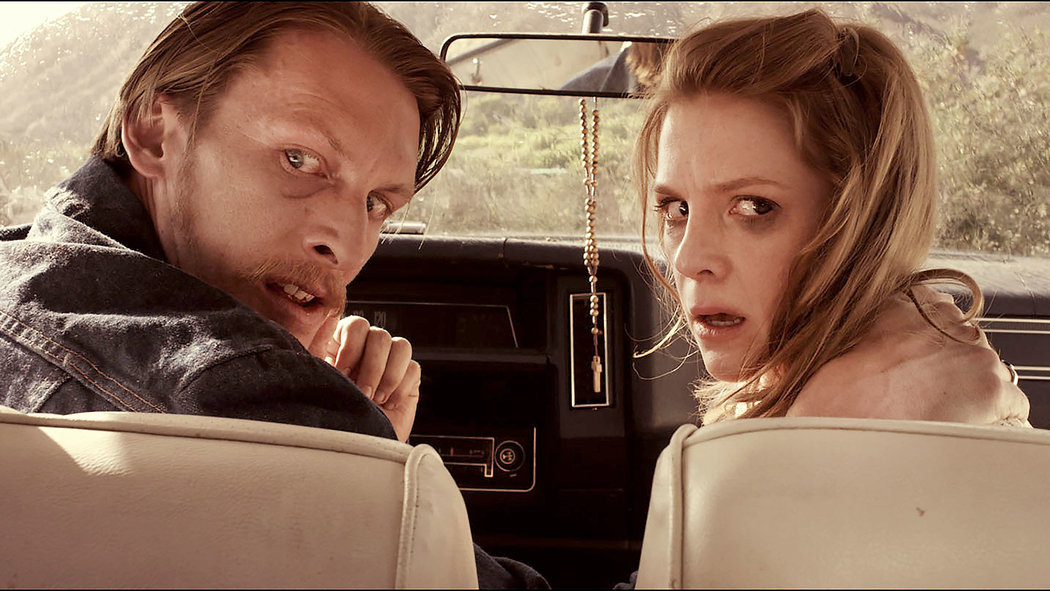
It’s the California desert of 1978. Two armed men carrying a bullet wound, bag of cash and hostage flee a small town bank heist. They lose a trail of cops via a hidden, hilly dirt road.
Big mistake.
All the swagger, dusty boots and retro Seventies soundtrack in the world can’t shield Scorpion Joe (James Landry Hebert) and farm girl hostage Vivian (Ashley Bell) from the much larger danger they’ve just driven into.
Keating’s amassing quite a list and variety of indie horror films. His style is homage. Where Carnage Park aspires to the gritty look and desperate feel of the road pics of the indie American Seventies, last year’s Darling offered a stylish ode to both Kubrick and Polanski.
This approach need not feel derivative. Let’s be honest, Tarantino’s become among the most lauded and watched filmmakers of his generation by doing the exact same thing. The big difference is that QT’s take on all the cinema that has come before is filtered through his own lunatic genius, the final product becoming uniquely, fantastically his own.
There’s something more workmanlike, less inspired in what Keating does.
That’s not to say Carnage Park is an abject failure. A game cast keeps the film intriguing. Bell is deceptively savvy (aside from a few wildly idiotic mistakes, but let’s be honest, screenwriter Keating is to blame for those). Genre favorite Pat Healy chews some scenery, playing against type as the damaged Vietnam vet cliché, while Larry Fessenden (a regular and welcome contributor to Keating’s canon) shows up for a quick and gory moment or two.
But from the bleached out yellow of the scenery to nearly every set piece, Keating’s habit of lifting from other films takes on the feel of compulsion. Larceny, even: The Hills Have Eyes, Texas Chainsaw Massacre 2, Reservoir Dogs – the list is bloody, hip and endless. And tired.
Keating has proven many strengths in his few years in filmmaking, but it is time for him to develop his own style.
Since Bonnie and Clyde and probably before, cinematic lovers on a bloody rampage have been entertaining and freaking out audiences the world over. Their escapades can be as grimly beautiful as Terrence Malick’s incandescent Badlands, or as bloody as – well, as the films we celebrate today. Dangerous lovers can really build a body count, as you’ll see here. Ain’t love grand?
5. Sweeney Todd: The Demon Barber of Fleet Street (2007)
Here’s a bizarre idea for a musical: The barber upstairs kills his clients and the baker downstairs uses the bodies in her meat pies. Odd for a Broadway musical, yes, but for a Tim Burton film? That sounds a little more natural.
As in most of Burton’s best efforts, Sweeney Todd stars Johnny Depp in the title role. Depp is unmistakably fantastic – consumed, morose, twisted with vengeance – and he’s in fine voice, to boot.
Helena Bonham Carter – ever the perfect Goth girl – gives Mrs. Lovett a wicked survivor streak balanced by a tender, pining affection. The romance dream sequence is a riot, and so perfectly Burton-esque. The two actors offset each other brilliantly, while their onscreen duo deserves credit for efficiency, if nothing else.
With Burton’s help, Depp found another dark, bizarre anti-hero to showcase his considerable talent. With Depp’s help, Burton gorgeously, grotesquely realized another macabre fantasy.
4. Hellraiser (1987)
Hedonist Frank Cotton solves an ancient puzzle box, which summons the fearsome Cenobites, who literally tear Frank apart and leave his remains rotting in the floorboards of an old house. Years later, Frank’s brother Larry moves into that house with his teenage daughter Kirsty and his new wife Julia (Clare Higgins) – who, oh yeah, also happens to be Frank’s ex-lover.
A gash on Larry’s leg spills blood on the floor, which awakens the remains of Frank, who then requires more blood to complete his escape from the underworld. Julia, both repulsed and aroused by her old flame’s half-alive form, agrees to make sure more blood is soon spilled.
Though the Cenobites are the real, lasting terror in this film – and how cool were they! – the sexual chemistry between Julia and that bloody lump of Frank is never less than unsettling. Higgins makes the perfect evil stepmother while redefining the term blood lust.
3. Sightseers (2012)
From the guttural drone of the opening segment, this film announces itself as a dryly, darkly hilarious adventure. Frumpy Tina (Alice Lowe, perfection) needs a break from the smothering mum who blames her for their dog’s death. Against Mum’s wishes, Tina will take a road trip with her new beau, the equally frumpy Chris (Steve Oram, amazing).
The film is a wickedly fresh British take on a familiar theme. Oram and Lowe wrote the script, alongside director Ben Wheatley’s go-to scribe (and wife) Amy Jump. The result is so absurd and hilarious – few films have had so much fun with moral ambiguity.
Wheatley blends the dark comedy of his first film, Down Terrace, with the sense of the unexpected that elevated Kill List to create enormously entertaining homicidal madness. It helps that his cast could not be better, draining all the glamour of the road trip assassin couple trope without relying on that as a gimmick. There’s a deeply British weirdness to the proceedings, which are handled with bone-dry aplomb by all involved.
2. The Hunger (1983)
Tony Scott’s seductive vampire love story has a little bit of everything: slaughter, girl-on-girl action, ’80s synth/goth tunage, David Bowie. What more can you ask?
Actually the film’s kind of a sultry, dreamily erotic mess. Catharine Deneuve is the old world vampire Miriam, David Bowie is her lover. The two spend years – perhaps centuries – together seducing victims. But he suddenly begins aging, and she needs to find a replacement. Enter Susan Sarandon as a medical specialist in unusual blood diseases and a fine actress who’s not above smooching other girls.
Bowie and Deneuve are both so effortlessly cool and sexy that you can almost forgive them their nighttime savagery. You find out just how dangerous he is once he begins the rapid-aging process, but once you get a peek into Miriam’s attic you find that she’s been far more dangerous – to her lovers and everyone else – for a very long time.
1. Alleluia (2014)
In 2004, Belgian writer/director Fabrice Du Welz released the exquisite Calvaire, marking himself a unique artist worth watching. Ten years later he revisits the themes of that film – blind passion, bloody obsession, maddening loneliness – with his newest effort, Alleluia. Once again he enlists the help of an actor who clearly understands his vision.
Laurent Lucas plays Michel, a playboy conman who preys upon lonely women, seducing them and taking whatever cash he can get his hands on. That all changes once he makes a mark of Gloria (Lola Duenas).
Du Welz’s close camera and off angles exaggerate Lucas’s teeth, nose and height in ways that flirt with the grotesque. Likewise, the film dwells on Duenas’s bags and creases, heightening the sense of unseemliness surrounding the pair’s passion.
Duenas offers a performance of mad genius, always barely able to control the tantrum, elation, or desire in any situation. Her bursting passions often lead to carnage, but there’s a madcap love story beneath that blood spray that compels not just attention but, in a macabre way, affection. Alleluia is a film busting with desperation, jealousy, and the darkest kind of love.
“Why are you troubled,” Jesus asked, “and why do doubts arise in your hearts? Look at my hands and my feet. It is I myself. Touch me and see — for a spirit does not have flesh and bones, as you see I have.”
Biblical quotes are a common, often effective way to open a horror film. Of course, they usually come from Revelation or contain some other wrath-of-God kind of sentiment. Don’t be fooled, though, because South Korean writer/director Hong-jin Na knows where he’s doing with his third genre-bending epic, The Wailing – even if you don’t.
Though the true meaning of this quote won’t take hold until the final act, it presents many questions. Is this film supernatural? Demonic? Or, given the corporeal nature of the quote, is it rooted in the human flesh?
Yes.
That’s what makes the quote so perfect. Na meshes everything together in this bucolic horror where superstition and religion blend. The film echoes with misery, as the title suggests. The filmmaker throws every grisly thing at you – zombies, pustules, demonic possession, police procedural, multiple homicides – and yet keeps it all slippery with overt comedy.
In rural Korea, lackadaisical police sergeant Jong-gu (Do-won Kwak) is baffled by the rash of ugly homicides striking the village. And they are ugly – not only because of their brutality, but because of the boil-covered state of each perpetrator.
Some locals blame toxic mushrooms, but others say it’s the work of that solitary foreigner (Jun Kunimura) who recently moved to the outskirts of town.
Backwater beliefs, small town hysteria, mob mentality – or is it? The filmmaker toys with your preconceived notions, partly by crafting Jong-gu – with the help of the dramatically agile Kwak – into an endearingly flawed hero. A comically bumbling cop, Jong-gu’s sudden appreciation of the seriousness of the situation only amplifies tensions because he – like the audience – is in over his head. As he puzzles through clues in an attempt to save his stricken daughter (an amazing Hwan-hee Kim), Na’s feats of misdirection come to an unbearable head.
The languid pace, which makes the most of DP Kyung-pyo Hong’s gorgeous photography, may feel like needless expansion, but it serves to let images and questions settle. It lets the misery soak in a bit.
If horror films reflect the hysteria and fear of the moviegoing public, then we, as a planet, are definitely afraid of our children – or of children in general. There are countless examples of murdering, mutant, bloodthirsty, demonic youngsters. Whether they are born monsters or have been claimed by the Dark One, whether they belong to roving bands of toughs or happen to be your own evil offspring, children seem to play upon our deepest fears. So let’s celebrate that today with a count down of the scariest children ever!
6. Let The Right One In (2008)
In 2008, Sweden’s Let the Right One In emerged as an original, stylish thriller – and the best vampire flicks in years. A spooky coming of age tale populated by outcasts in the bleakest environment, the film breaks hearts and bleeds victims in equal measure. Kare Hedebrant‘s Oskar, with his blond Prince Valiant haircut, falls innocently for the odd new girl (an outstanding Linda Leandersson) in his shabby apartment complex. Reluctantly, she returns his admiration, and a sweet and bloody romance buds.
As sudden acts of violence mar the snowy landscape, Oskar and Ali grow closer, providing each other a comfort no one else can. The film offers an ominous sense of dread, bleak isolation and brazen androgyny – as well as the best swimming pool scene perhaps ever. Intriguingly, though both children tend toward violence – murder, even – you never feel anything but empathy for them. The film is moving, bloody, lovely and terrifying in equal measure.
5. The Bad Seed (1956)
The minute delicate Christine’s (Nancy Kelly) husband leaves for his 4-week assignment in DC, their way-too-perfect daughter begins to betray some scary behavior. The creepy handyman Leroy (Henry Jones) has her figured out – he knows she’s not as perfect as she pretends.
You may be tempted to abandon the film in its first reel, feeling as if you know where the it’s going. You’ll be right, but there are two big reasons to stick it out. One is that Bad Seed did it first, and did it well, considering the conservative cinematic limitations of the Fifties.
Second, because director Mervyn LeRoy’s approach – not a single vile act appears onscreen – gives the picture an air of restraint and dignity while employing the perversity of individual imaginations to ramp up the creepiness.
Enough can’t be said about Patty McCormack. There’s surprising nuance in her manipulations, and the Oscar-nominated 9-year-old handles the role with both grace and menace.
4. Them (2006)
Brisk, effective and terrifying, Them is among the most impressive horror flicks to rely on the savagery of adolescent boredom as its central conceit.
Writers/directors/Frenchmen David Moreau and Xavier Palud offer a lean, unapologetic, tightly conceived thriller that never lets up.
A French film set in Romania, Them follows Lucas and Clementine, a young couple still moving into the big rattling old house where they’ll stay while they’re working abroad. It will be a shorter trip than they’d originally planned.
What the film offers in 77 minutes is relentless suspense. I’m not sure what else you want.
Creepy noises, hooded figures, sadistic children and the chaos that entails – Them sets up a fresh and mean cat and mouse game that pulls you in immediately and leaves you unsettled.
3. The Brood (1979)
Dr. Hal Ragland – the unsettlingly sultry Oliver Reed – is a psychiatrist leading the frontier in psychoplasmics. His patients work through their pent-up rage by turning it into physical manifestations. Some folks’ rage turns into ugly little pustules, for example. Or, for wide-eyed Nola Carveth (Samantha Eggar), rage might turn into bloodthirsty, puffy coated spawn. This is Cronenberg’s reimagining of procreation, and it is characteristically foul.
Cronenberg is the king of corporeal horror, and The Brood is among the best of the filmmaker’s early, strictly genre work. Reed and Eggar both are unseemly perfection in their respective roles. Eggar uses her huge eyes to emphasize both her former loveliness and her current dangerous insanity, while Reed is just weird in that patented Oliver Reed way.
But it’s the climactic image of procreation – of motherhood and childbirth – and the way the filmmaker and his leading lady subvert that life-giving moment, turning it into something beastly, that will stick with you.
https://www.youtube.com/watch?v=RVQkJJxjdIM
2. The Omen (1976)
Gregory Peck brought impenetrable gravitas to this film, making everything seem very serious and worthwhile. This could be no ordinary horror flick – not with Atticus Finch in the lead.
Peck plays Robert Thorn, a rising politician and best friend to the President of the United States. He agrees to a delivery room switcheroo when he’s told his own son perished during childbirth, but another baby born simultaneously was orphaned. He brings home the tot, his loving wife (Lee Remick) none the wiser.
Eventually she does develop a sixth sense about the cherubic little Damien, though.
This mid-Seventies gem is gloriously over-the-top with its self-serious approach to the coming of the antichrist. Richard Donner – who would go on to direct a couple Superman movies, a bunch of Lethal Weapons, as well as the Goonies – made a name for himself as a director with this bloated and deadly serious bible thumper.
The film’s sinister elements – Mrs. Baylock, that dog, and Jerry Goldsmith’s intensely creepy (and Oscar winning) score – combine with Peck’s elegant heroism to keep the film fascinating, but all would have been for naught except for Harvey Stephens’s impish perfection as Damien.
1. The Ring (2002)
Gore Verbinski’s film achieves one of those rare feats, ranking among the scarce few Hollywood remakes that surpasses the foreign born original, Japan’s unique paranormal nightmare Ringu.
The Ring – thanks in large part to the creepy clever premise created by Koji Suzuki, who wrote the novel Ringu – is superior to its source material principally due to the imagination and edge of the fledgling director. Verbinski’s film is visually arresting, quietly atmospheric, and creepy as hell.
This is basically the story of bad mom/worse journalist Rachel (Naomi Watts) investigating the urban legend of a video tape that kills viewers exactly seven days after viewing.
The tape itself is the key. Had it held images less surreal, less Bunuel, the whole film would have collapsed. But the tape was freaky. And so were the blue-green grimaces on the dead! And that horse thing on the ferry!
And Samara.
From cherubic image of plump cheeked innocence to a mess of ghastly flesh and disjointed bones climbing out of the well and into your life, the character is brilliantly created. (It’s actually a full grown man who climbs herky-jerky out of the TV.)
The year is half over already?! Well, hell. Suppose we should argue over the best the genre has had to offer thus far? Senior Filmmaking Correspondent Jason Tastevin joins us to debate whether 10 Cloverfield Lane is a horror film or not, whether The Witch is any good, and to count down the best in horror so far this year.
5. Southbound
“For all you lost souls racing down that long road to redemption…”
Successful anthology horror is difficult to pull off. Southbound manages to do so as it spins its diabolical tale, interlocking five stories of travelers on a particularly lonesome road.
The film opens strong as two bloodied passengers rush to a desolate gas station to clean up and take stock of their situation – a situation we’re given very few clues about. But the immediately menacing, we-know-something-you-don’t-know atmosphere inside that gas station sets us up for the nightmarish episode that will unravel.
What follows are pieces on similarly distressed wayfarers – a rock trio with a flat tire, a distracted driver, a brother searching desperately for his missing sister, a family on an ill-planned vacation, then back to the original bloodied pair heading for gas.
Rather than feeling like five shorts slapped together with a contrived framing device, the segments work as a group to inform a larger idea – together they help to define this particular and peculiar stretch of highway.
4. Nina Forever
Brothers Ben and Chris Blaine crafted their feature debut as a “fucked-up fairy tale.” The truth is, that tag line sells their bleakly comedic, emotionally relevant, disquietingly familiar film short. Though you may laugh, Nina Forever swims a wellspring of sadness.
Check out girl Holly (Abigail Hardingham, wonderful) falls hard for mopey, over-aged stock boy Rob (Cian Barry), who’s still suicidal over the motoring death of his longtime girlfriend Nina (Fiona O’Shaughnessy). Whenever the two living lovers hook up, Rob’s viscera-and-glass-shard-covered ex writhes her way into their embrace.
As an analogy for those awkward relationships you just can’t seem to let go of, Nina Forever excels in its amplification of all that is awkward and unruly. The filmmaking duo, who also write, avoid clichés and easy answers while their talented cast creates unpredictable and dimensional characters.
There is real depth and authenticity to a film that constantly surprises without really feeling contrived. Few seasoned directors handle tonal shifts with as much confidence as the Blaines in their feature debut.
https://www.youtube.com/watch?v=1IokJt_05co
3. Baskin
If you’ve ever wondered what hell might look like, first time feature director Can Evrenol has some ideas to share. They are vivid. You’ll swear they even have an odor.
Evrenol’s Baskin is a loose, dreamily structured descent into that netherworld in the company of a 5-man Turkish police unit. (Baskin is Turkish for “police raid.”) The serpentine sequencing of events evokes a dream logic that gives the film an inescapable atmosphere of dread. We are trapped along with this group of somewhat detestable, somewhat sympathetic men as they respond to a call for backup in an “off the map” nearby area. What they find is deeply disturbing.
Evrenol’s imagery is morbidly amazing. Much of it only glimpsed, most of it left unarticulated, but all of it becomes that much more disturbing for its lack of clarity.
There are moments when Baskin feels like a classier, more stylishly made Nightbreed, but there’s no camp factor here. Just a surreal exploration of the corruptibility of the human soul, and its final destination.
2. Green Room
The tragic loss of 27-year-old talent Anton Yelchin makes this one bittersweet. Young punk band the Ain’t Rights is in desperate need of a paying gig, even if it is at a rough private club for the “boots and braces” crowd (i.e. white power skinheads). Bass guitarist Pat (Yelchin) eschews social media promotion for the “time and aggression” of live shows, and when he accidentally witnesses a murder in the club’s makeshift green room, Pat and his band find plenty of both.
Along with concertgoer Amber (a terrific Imogen Poots), they’re held at gunpoint while the club manager (Macon Blair from Blue Ruin) fetches the mysterious Darcy (Patrick Stewart, gloriously grim) to sort things out. Though Darcy is full of calm reassurances, it quickly becomes clear the captives will have to fight for their lives.
As he did with Blue Ruin, writer/director Jeremy Saulnier plunges unprepared characters into a world of casual savagery, finding out just what they have to offer in a nasty backwoods standoff. It’s a path worn by Straw Dogs, Deliverance, and plenty more, but Saulnier again shows a knack for establishing his own thoughtful thumbprint. What Green Room lacks in depth, it makes up in commitment to genre.
Only a flirtation with contrivance keeps Green Room from classic status. It’s lean, mean, loud and grisly, and a ton of bloody fun.
1. The Witch (2015)
The unerring authenticity of The Witch makes it the most unnerving horror film in years.
Ideas of gender inequality, sexual awakening, slavish devotion to dogma, isolationism and radicalization roil beneath the surface of the film, yet the tale itself is deceptively simple. One family, fresh off the boat from England in 1630 and expelled from their puritanical village, sets up house and farm in a clearing near a wood.
As a series of grim catastrophes befalls the family, members turn on members with ever-heightening hysteria. The Witch creates an atmosphere of the most intimate and unpleasant tension, a sense of anxiety that builds relentlessly and traps you along with this helpless, miserable family.
As frenzy and paranoia feed on ignorance and helplessness, tensions balloon to bursting. You are trapped as they are trapped in this inescapable mess, where man’s overanxious attempt to purge himself absolutely of his capacity for sin only opens him up to the true evil lurking, as it always is, in the woods.
Some people dream of the hero. There are folks who swoon during Avengers films, choosing their fave from the assemblage of good guys, or wait with baited breath for Wonder Woman to get her stand alone film.
But what about the bad guys? Are you saying that, just because we like a date with blood on their teeth, there’s something wrong with us? Surely not! Tell us you didn’t get a little weak in the knees for Skeet Ulrich in Scream, or swoon just a little when Catherine Deneuve seduced Susan Sarandon in The Hunger. Of course you did! And why not?
So today, we celebrate the sexy villains. Join us, won’t you?
George Pick #3: Elizabeth Olsen – Silent House (2011)
Olsen is a tremendous talent, consistently excellent even in lesser films. Silent House starts off strong but eventually relies too heavily on a gimmick and Olsen’s tight shirt to keep you interested. Still, Olsen’s vulnerable yet badass character is undeniably hot – tight shirt or no.
Hope Pick #3: Tony Todd – Candyman (1992)
No, he’s not classically handsome. In fact, on paper, Candyman is not that sexy of a villain. He has a hook for a hand, bees in his chest, that moldy velvet robe thing has to smell awful. But Tony Todd’s voice is the push over the cliff. When he tells Helen (Virginia Madsen) “Don’t fear the pain. The pain is exquisite,” you can’t help but want to believe.
George’s #2 Natasha Henstridge – Species (1995)
Species is more a SciFi thriller than a horror movies, but George gets to choose so it’s not up to Hope and her picky rules. No one could blame the guy for landing on this one – Henstridge is fierce and sexy and very naked. What is he, made of stone?
Hope’s #2: Johnny Depp – Sweeney Todd: The Demon Barber of Fleet Street (2007)
Sweeney Todd is to Hope what Chocolat is to normal people. Sure, Depp is a dreamboat regardless of his role, but with Sweeney Todd, director Tim Burton finally lets him get a little mean. When he lifts that blade above his head, singing of his “old friend,” he is hypnotic.
George’s #1: Salma Hayek – From Dusk til Dawn (1996)
Duh. Bow your head, dogs! When Salma Hayak appears in Robert Rodriguez’s From Dusk til Dawn, everybody pays attention – everybody in the bar Titty Twister, and everybody watching. Hayek is easily one of the most gorgeous humans on earth, and her snake-bedecked dance is no doubt enough to lure many voluntarily to her eternal servitude.
Hope’s #1: Rutger Hauer- The Hitcher (1986)
Hope had been nursing a crush on Hauer since Blade Runner, but it was The Hitcher that sent her over the edge. Unsettling, given the tender age at which she saw the film? No doubt, but his brilliant eyes and steely delivery and the way he seduced girlie C. Thomas Howell on that drive across the desert was just more than her bored little heart could bear. Don’t judge her.
Who did we miss? Let us know on twitter @maddwolf!
Is The Shallows – Blake Lively’s new flick about a surfer trying to survive a shark attack – simply a girl power exercise wrapped in a sandy bikini?
Yes.
Still, it gets as much right as it does wrong.
Lively plays Nancy, a med student alone on a secluded, secret beach in Mexico. She’s here to be alone, to mourn, to surf. As the local drops her off on the beach and refuses her offer of cash, he asks how she plans to get back to town.
Excellent question.
There’s a great deal of convenient idiocy in this screenplay, but director Jaume Collet-Serra – who is no comrade of subtlety – actually handles most of these items deftly. After a few middling horror efforts, Collet-Serra made his name with a string of Liam Neeson films, so he knows a little something about a solitary figure fighting deadly odds.
Lively does a fine job in what is essentially a one-surfer-show. Nancy is smart. Not smart enough to avoid surfing alone in an isolated area of a foreign land, but a different kind of smart. MacGyver smart. And it’s with a balance of delicacy and grit that she just about makes you believe the ludicrous.
The Shallows is gorgeously filmed – and not just Lively. Yes, the camera hugs her form more closely than a wet suit, but Collet-Serra treats the surf, sky and sand with as much ardor. A generous reviewer might even say he’s creating a parallel – something about breathtaking beauty that belies serious ferocity. I am not generous enough to buy that theory, but I am generous enough to throw it out there.
For stretches, The Shallows will have you believing you’re watching a tense, thoughtful survival drama. Eventually the shark becomes a vengeful-mythical-beast-warrior-machine-monster, and any hint of credibility is lost at sea. This is the age of Sharknado – maybe Collet-Serra didn’t think he could keep his audience’s attention until the shark tried to scale something with his teeth?
Whatever the case, it’s a wild mashup of efforts: equal parts empowerment and ogling, survival thriller and Sharkasaurus Rex.
Sympathetic, surprising, and often very uncomfortable, Jon Watts’s horror flick, though far from perfect, does an excellent job of morphing that lovable party favorite into the red-nosed freak from your nightmares.
Because clowns are terrifying.
Kent (a pitiful Andy Powers) stumbles across a vintage clown outfit in an estate property he’s fitting for resale. Perfect timing – his son’s birthday party is in an hour. What a surprise this will be, unless the suit is cursed in some way and will slowly turn Kent into a child-eating demon.
It does! Hooray!!!
Watts, who co-wrote with the talented Christopher Ford, weaves a fantasy of Nordic folklore turned modern nightmare. There are moments of grotesque brilliance and edgy horror as poor Andy slowly, painfully morphs into a monster who feeds on children.
Because of the victim pool, the film is likely to upset a lot of people, so keep that in mind as you going in. For those who are prepared for this, though, there is a Chuck E. Cheese scene that is pretty vintage.
Most of the balance of the cast is comparatively weak, but a weird-as-ever supporting turn from Peter Stormare helps the film overcome other acting let-downs.
Watts fails to maintain consistent tension or momentum, but gets credit for taking the horror places you might not expect, and for squeezing as much sympathy as possible before that last swing of the ax.
Why captivity horror? Because we want to talk about Lucky McKee’s amazing The Woman, and this seemed like a good excuse. McKee’s must-see horror joins a host of incredible films that explore our fears of being held against our wills as they look at the ugliest side of human nature. Plus, cookies. Fun!
5. Cube (1997)
Making his feature directing debut in 1997, Vincenzo Natali, working from a screenplay he co-wrote, shadows 7 involuntary inmates of a seemingly inescapable, booby-trapped mazelike structure. Those crazy Canucks!
Cube is the film Saw wanted to be. These people were chosen, and they must own up to their own weaknesses and work together as a team to survive and escape. It is a visually awe inspiring, perversely fascinating tale of claustrophobic menace. It owes Kafka a nod, but honestly, stealing from the likes of Kafka is a crime we can get behind.
There is a level of nerdiness to the trap that makes it scary, in that you know you wouldn’t make it. You would die. We would certainly die. In fact, the minute they started talking about Prime Numbers, we knew we were screwed.
What Natali was able to accomplish within the limitations he has – startlingly few sets, a very small cast, a 20 day shoot schedule – is astounding. An effective use of FX, true visual panache, and a handful of well-conceived death sequences elevate this far above Saw and many other films with ten times the budget.
https://www.youtube.com/watch?v=37EjGw7jV98
4. Compliance (2012)
Compliance is an unsettling, frustrating and upsetting film about misdirected and misused obedience. It’s also one of the most impeccably made and provocative films of 2012 – a cautionary tale that’s so unnerving it’s easier just to disbelieve. But don’t.
Writter/director Craig Zobel – who began his career as co-creator of the brilliant comic website Homestar Runner (so good!) – takes a decidedly dark turn with this “based-on-true-events” tale. It’s a busy Friday night at a fast food joint and they’re short-staffed. Then the police call and say a cashier has stolen some money from a customer’s purse.
A Milgram experiment come to life, the film spirals into nightmare as the alleged thief’s colleagues agree to commit increasingly horrific deeds in the name of complying with authority.
Zobel remains unapologetically but respectfully truthful in his self-assured telling. He doesn’t just replay a tragic story, he expertly crafts a tense and terrifying movie. With the help of an anxious score, confident camera work, and a superb cast, Zobel masterfully recreates a scene that’s not as hard to believe as it is to accept.
3. Green Room (2015)
Young punk band the Ain’t Rights is in desperate need of a paying gig, even if it is at a rough private club for the “boots and braces” crowd (i.e. white power skinheads). But when bass guitarist Pat (Anton Yelchin) accidentally witnesses a murder in the club’s makeshift green room, band and concertgoer Amber (a terrific Imogen Poots) find trouble. They’re held at gunpoint while the club manager (Macon Blair from Blue Ruin) fetches the mysterious Darcy (Patrick Stewart, gloriously grim) to sort things out. Though Darcy is full of calm reassurances, it quickly becomes clear the captives will have to fight for their lives.
As he did with Blue Ruin, writer/director Jeremy Saulnier plunges unprepared characters into a world of casual savagery, finding out just what they have to offer in a nasty backwoods standoff. It’s a path worn by Straw Dogs, Deliverance, and plenty more, but Saulnier again shows a knack for establishing his own thoughtful thumbprint.
And yet, Saulnier manages to let some mischievous humor seep out, mainly by playing on generational stereotypes. Poots, barely recognizable under an extreme haircut and trucker outfit, has the most fun, never letting bloody murder alter Amber’s commitment to bored condescension. Love it.
It’s lean, mean, loud and grisly, and a ton of bloody fun.
2. The Woman
There’s something not quite right about Chris Cleek (an unsettlingly cherubic Sean Bridgers), and his family’s uber-wholesomeness is clearly suspect. This becomes evident once Chris hunts down a feral woman (an awesome Pollyanna McIntosh), chains her, and invites the family to help him “civilize” her.
The film rethinks family – well, patriarchy, anyway. Notorious horror novelist and co-scriptor Jack Ketchum may say things you don’t want to hear, but he says them well. And director Lucky McKee – in his most surefooted film to date – has no qualms about showing you things you don’t want to see. Like most of Ketchum’s work, The Woman is lurid and more than a bit disturbing.
Aside from an epically awful performance by Carlee Baker as the nosey teacher, the performances are not just good for the genre, but disturbingly solid. McIntosh never veers from being intimidating, terrifying even when she’s chained. Bridgers has a weird way of taking a Will Ferrell character and imbibing him with the darkest hidden nature. Even young Zach Rand, as the sadist-in-training teen Brian, nails the role perfectly.
Nothing happens in this film by accident – not even the innocent seeming baking of cookies – nor does it ever happen solely to titillate. It’s a dark and disturbing adventure that finds something unsavory in our primal nature and even worse in our quest to civilize. Don’t even ask about what it finds in the dog pen.
1. Oldboy
So a guy passes out after a hard night of drinking. It’s his daughter’s birthday, and that helps us see that the guy is a dick. He wakes up a prisoner in a weird, apartment-like cell. Here he stays for years and years.
The guy is Min-sik Choi. The film is Oldboy, director Chan-wook Park’s masterpiece of subversive brutality and serious wrongdoing.
This is not a horror film in any traditional sense – not even in South Korean cinema’s extreme sense. Though it was embraced – and rightly so – by horror circles, this is a refreshing and compelling take on the revenge fantasy that takes you places you do not expect to go. But that’s the magnificence of Chan-wook Park, and if you have the stomach, you should follow where he leads.
Choi takes you with him through a brutal, original, startling and difficult to watch mystery. You will want to look away, but don’t do it! What you witness will no doubt shake and disturb you, but missing it would be the bigger mistake.
Join us for a live Fright Club podcast taping and screening the second Wednesday of every month at Gateway Film Center!
The thing that made James Wan’s 2013 ghost story The Conjuring so effective – more than the solid cast, more than the tense atmosphere, more than those hideous Seventies fashions – was Wan’s use of practical effects.
That woman on top of the wardrobe?! Terrifying!
It helped that he had a creepy story in the hands of capable actors. More importantly, he knows how to frame scenes in a way that trains the audience to scan corners, peer into shadows and look through empty windows, constantly on edge waiting for that next spooky moment.
With his sequel, he still boasts two of those three elements.
Vera Farmiga and Patrick Wilson return as Lorraine and Ed Warren, real-life paranormal investigators working with the Catholic church to validate claims of hauntings and possessions. It’s 1977, and the two are still recovering from that incident in Amityville when they’re asked to help a single mum with four kids living in North London.
The put-upon family is sympathetic enough. Wilson and Farmiga are compelling enough. The period detail is nice. Well, The Clash’s London Calling wasn’t actually released until 1979, but all is forgiven because of the utterly fantastic use of Starsky & Hutch posters.
So, what’s wrong with C2?
A few things.
The story never feels particularly cohesive – more like a series of vignettes strung together. Because of this, characters never seem fully formed and relationships feel forced. Supernatural clues and plot twists border on the nonsensical. (Seriously, ask yourself about the bite marks.) Maybe that’s because there’s a red herring, but too much valuable time is wasted with that thread and not enough devoted to true scares.
There are two demonic images in the film – both excellently chosen nightmare images from childhood (mine, anyway) – but some video game editing and CGI identify them quickly as movie magic, leeching their power.
Most importantly, there’s no inspired, memorable, terrifying jump scare. Wan is an absolute master of the spooky longshot, the creeping camera, but in this film’s predecessor those unendurably tense spans were punctuated by some of the best spook house scares in recent memory. Think clapping hands.
Though there are some startles and above-average scares, there’s nothing to elevate this film above mediocrity.