The installation of a state-sponsored satellite dish on the roof of an apartment building is the inciting event for ominous, Orwellian horror in writer/director Orçun Behram’s first feature, The Antenna.
A commentary on the political situation in modern day
Turkey, Behram’s debut film is focused on oppression. Though oppression takes
many forms (the oppression of youth, the patriarchy, the status quo), the movie
is most interested in the state’s suppression of speech and expression.
From the moment the satellite is fitted onto the roof of the
building, sinister events occur. A black ooze, which emanates from the antenna,
leaks through the walls, something Mehmet (Ihsan Önal), the building’s evening
landlord, discovers when he’s called to a tenant’s bathroom to address the
seeping goo.
The ooze creeps through the building, infiltrating more and more apartments as the night progresses toward the launch of the new state-run programming.
The kick-off event for the state’s broadcasting system is the “Midnight Broadcast.” Building superintendent, Mr. Cihan, has been advertising it to all the residents to ensure maximum audience participation. The Leader (who bears a certain resemblance to Recep Erdoğan) hosts the broadcast, and while the Leader’s delivery seems benevolent, the underlying message is a sinister reminder that dissent will not be tolerated.
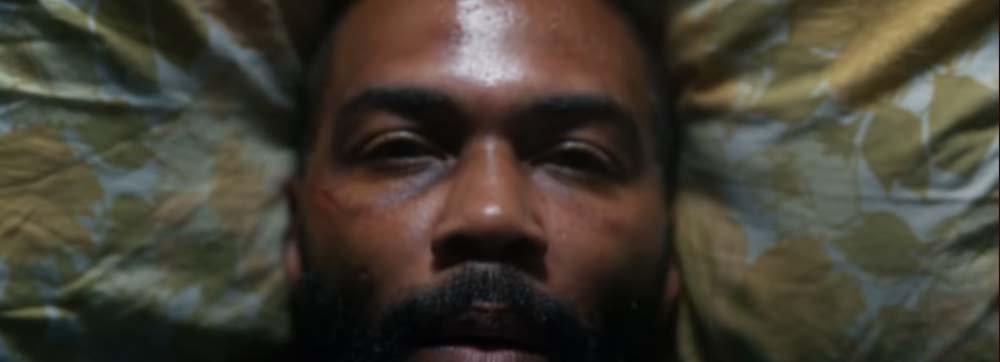
Helping to tie the film’s many many pieces together is Mehmet. As odd and menacing events happen in the hours leading up to the Midnight Broadcast, he becomes increasingly invested in the fates of the residents in his building. Mehmet experiences a few disturbing visual and auditory assaults, all of which propel him to action.
The black ooze is a not-so-subtle metaphor for the insidious nature of state propaganda. But when you want to deliver a warning to your audience, knocking them over the head with the message is sometimes worth doing.
There is a lot working for Behram’s film. As we watch the
events unfold, dialogue between characters is replaced by broadcasts from a
threatening voice that emanates from every radio and TV. The tense score puts
you on edge, and the climax is almost unbearably stressful as the auditory
assaults reach their peak.
This is a reminder of what’s at stake when you take your freedom for granted in a world that seeks to rob you of it at every turn.
It takes a good while to get to the creature in this creature feature, but that’s hardly the most misplayed hand in Tar. It isn’t until the last few minutes that the film serves up the kind of winky-winky that would have gone a long way toward saving it.
A group of employees in an office building above L.A.’s old La Brea Tar Pits is under a tight deadline to clear out. The smarmy landlord is evicting them all with one day’s notice, and they have to be gone by 6am or face a big penalty. Then of course the building’s power is cut mid-move, but there are bigger, messier problems.
Underground construction work on the subway expansion has awakened La Brea’s Matchi Manitou, and it ain’t happy.
Director/co-writer/co-star Aaron Wolf gets Timothy Bottoms and Graham Greene to head up his cast, which is good for the poster but bad for the rest of the actors who can’t keep up.
Wolf employs a narrative structure heavy on flashback, and the moments of tension that manage to avoid that roadblock are awkward and clearly telegraphed.
The ensemble of evacuees/possible victims (including Emily Peachy, Sandy Danto, Tiffany Shepis and Nicole Alexandra Shipley) has the depth and logic to only reinforce the point of that horror spoof Geico ad. And after about 90 minutes, the film’s eureka moment makes you wonder about the Drive-In pleasure Tar might have been if it hadn’t waited so long to tap a self-aware vein.
A vampire didn’t choose that destiny, nor the zombie, nor
even the werewolf. All three are victims of fate.
The witch, however, comes to her dark powers by choice. And maybe – as Robert Eggers pointed out in his 2015 masterpiece The VVitch—that choice might even make some sense.
Since Eggers’s beguiling horror show, a number of filmmakers
have joined him in his ruminations. Lukas Fiegelfeld’s mesmerizing 2017 debut Hagazussa
and Luca Guadagnino’s 2018 feminist reprise of Suspiriarepresent the strongest among the resulting films.
Few if any will ever tell the tale so powerfully or so well
as Eggers, but writer/director Thomas Robert Lee has a go with The Curse of
Audrey Earnshaw. His film is interested in women’s agency, their oddness,
what they owe, what they should and shouldn’t be deciding for themselves, and what
they are willing to sacrifice.
It’s August of 1973, but it could just as easily be the 1950s or the 1880s. (So why 1973? It was a big year in women’s rights, after all.) A rugged woman, isolated from the nearby religious community, stands silhouetted against her barn, ax and woodpile.
She is Agatha Earnshaw (Catherine Walker), and she has a
secret.
Things haven’t been right in the village since the eclipse 17 years back, but things have been especially troubling lately. Agatha has the only farm that’s producing, the only animals that haven’t taken sick.
Performances are wonderful in a film that looks rustic and
spooky, creating a time out of time. Walker, who was so effective in the
wonderful little Irish horror Dark Song, cuts an impressive figure of
maternal ferocity. She’s orbited by consistently impressive turns, whether the
sincere pastor (Sean McGinley), entitled patriarch (Tom Carey), distraught husband
(Jared Abrahamson), or young woman finding her voice (Jessica Reynolds).
Each man, however sympathetic or compassionate, represents danger. Like a lot of horror films, The Curse of Audrey Earnshaw is a coming-of-age cautionary tale: fear the power of womanhood. But Lee is careful to keep asking who, exactly, is the villain here?
The direction is too often obvious: a cough, a handkerchief, blood. At other times, cinematic choices betray the film’s low budget. The Curse of Audrey Earnshaw will never reach the ranks of classic, but it makes a lot of bold choices and leaves an impression.
From director Darren Lynn Bousman (Saw II-IV, Repo: The Genetic Opera) comes a vacation horror romp that will bring you some thrills and chills. Nothing more, nothing less.
The highlight here is certainly the gorgeous island setting, which is a welcome departure from haunted houses and summer camps with bad reputations.
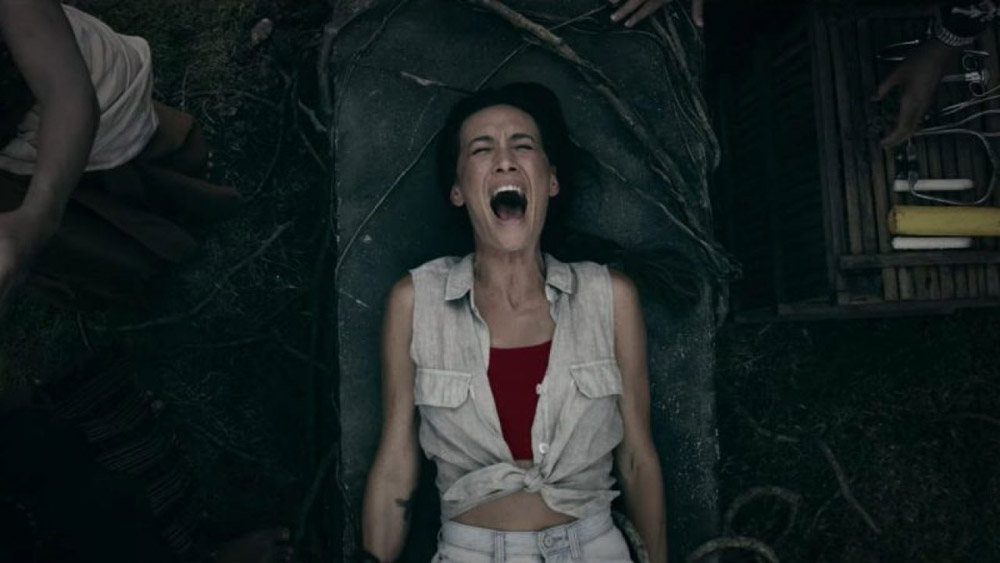
The panic begins when a vacationing couple (Maggie Q, Luke Hemsworth) on a remote island realizes they remember nothing from the previous night. The rather chilling race to get answers showcases some intense visuals and surreal editing techniques that help add excitement to the predictable—if surprisingly brutal—twists.
If you are a full on horror fanatic, you will probably have at least a decent time here. The film breaks no new ground but it hits its marks rather decently. The whole, “everybody knows whats going on except you” set up owes a lot to classics such as Rosemary’s Baby and The Wicker Man.
It’s also not hard to imagine that the success of Midsommar was a factor in greenlighting this film. It similarly attempts to incorporate a modern theme or two, including a very light commentary on consent and free will, which if fleshed out a bit more could have added some potency and depth.
Also sorry to be that guy, but in 2020, do we really need another film where island natives are portrayed as little more than villains who delight in the torture of the “civilized” Americans? It’s a hypothetical question, the answer is: no, probably not.
What Death of Me lacks in originality it sometimes makes up for with intense visual flourishes and dream sequences, but by the third or fourth “was it a dream or did it really happen?” moment, the horrific scenes begin to lose their sense of danger and traumatic permanence. Because of this, the film starts to flounder a bit in the middle section, just before we reach the rather satisfying, bloody climax.
It’s way off course from being a masterpiece, but for fans of the genre stuck inside during these COVID-19 days, you could do worse than this film that teleports you to a beautiful island for a few bloody thrills.
Writer’s block—it is a common theme in all writing, especially horror. Think about The Shining, for example. Fred (writer/director/star Josh Ruben) certainly is. And at first, writer’s block is what the writer/director in Ruben leads you to believe Scare Me is all about.
Fred takes a cab to a wintry cabin. He tries to dodge
questions from his driver, who, like Fred, fancies herself a bit of a writer. A
short time later, Fred stares at a laptop screen. He’s not typing.
A power outage and a chance encounter with “real writer” Fanny
(Aya Cash) lead to an evening of telling scary stories. And just like that stormy
night so long ago when Mary Wollstonecraft Shelley out-storied her companions Percy
Shelley and Lord Byron, the male ego is more easily wounded than any fictional
character.
At its best, Scare Me offers an intriguing look inside the mind of privilege. What is it like to be a decent-looking white guy who has to resolve himself to the fact that he actually has no claim to that top spot on the totem pole that he’s always been told is his?
At its worst, it’s an overlong bit of self-indulgence.
As Fred’s nemesis/love interest(?)/frenemy Fanny, Cash is straightforward, merciless, funny and full of insight—as is Ruben’s script. Scare Me has no time for entitled, lazy writers.
For any of the real tensions of the film to work, we have to recognize and, to a degree, empathize with—even root for—Fred. Thanks to a smart script and an eerily recognizable performance, we do.
Ruben does an excellent job of wading those familiar waters, sort of likable and loathsome, sympathetic and toxic. Fred is kind of a good guy, or he sees himself as a good guy. Of course, he also sees himself as a writer.
The film hits its high (pun intended) when pizza guy Carlo (SNL’s Chris Redd) joins the storytelling. It’s not quite enough to save a second act that simply goes on for too long. But a bloated midriff doesn’t spoil Scare Me entirely, a savvy piece of storytelling in itself.
That Faulkner quote gets a lot of action in writers/directors Gerard Bush and Christopher Renz’s social nightmare Antebellum.
The titular term describes the period in American history just prior to the Civil War. That’s where this thriller finds its horror, and where a prominent, present day African American sociologist/activist/author wakes up to find herself trapped.
Janelle Monáe crafts an impressive lead as Veronica, a PhD beaten, branded and forced to accept a slave name in a film that plays out like a disturbingly relevant Twilight Zone episode.
Enslaved on a reformer plantation, “Eden” works to stay alive long enough to plan an escape and outsmart two Confederate officers (Eric Lange, Jack Huston) and the mysterious mansion mistress (Jena Malone).
The hideous rise of white nationalism is the true nightmare here – fertile and bloody ground for horror. From Godzilla to Get Out, horror has always brimmed with social commentary and anxiety, so it should come as no surprise that a genre film tackles America’s racist shame this directly.
And while this approach certainly grabs your attention with its boldness, Bush and Renz can get too caught up in obviousness and speech-making. The second act suffers most from these heavy hands. The modern day shenanigans with Veronica and two friends (Gabourey Sidibe, Lily Cowles) push too hard, last too long and say very little.
But as much as Spike Lee has recently connected the past and present of racism with layered nuance, Bush and Renz go right upside our heads. Pulpy exploitation? It goes there. It’s a horror movie.
Horror movies exist so we can look at the nightmare, examine it from a distance, and come out the other side, unscathed ourselves. Antebellum is acknowledgment and catharsis, and not only because all those Black people being terrorized on the screen are fictional, instead of real victims in another cell phone crime scene. The film’s true catharsis – a highly charged and emotional payoff – lies in Act 3: comeuppance.
And it is glorious.
There are stumbles getting to the fireworks, but for sheer heroic tit for tat, Antebellum delivers the goods.
As colorful as a dream, Juan Diego Escobar Alzate’s feature
film debut Luz: The Flower of Evil looks like magic and brims with the
casual brutality of faith.
Set inside a religious community in the mountains of
Colombia, the film drops us into ongoing struggles with the group’s religious
leader, El Señor (Conrad Osorio). No one knows the devil as he does, he reminds
his daughter Laila (Andrea Esquivel).
She lives contentedly, devoutly, along with her two adopted
sisters. El Señor and the villagers consider the trio angels—just as they believe
the little boy chained up out back is the Messiah who will deliver the community
from its recent calamities.
Though never entirely detailed, the internal logic of the
film and the community is clear enough to feel simultaneously familiar and
horrifying. The way the filmmaker wrestles with what is and is not real, with
forgiveness and the morally ambiguous nature of man, and with our tendency to
blame God or the devil for our own shortcomings is frustrating and
intoxicating.
Alzate gets maximum impact for minimum budget thanks in
large part to Nicolas Caballero Arenas’s cinematography. His breathtaking visuals
add spooky richness, turning this Western of sorts into a beautiful, lyrical,
macabre Columbian folktale.
Lovely as it is, the film echoes of loss. The title itself conjures what is absent. As time wears on and the “angels” lose confidence in their father figure, remembered stories of the late mother figure Luz (Spanish for light) take the space for them that El Señor’s tales of God take for the rest of the community.
Luz: The Flower of Evil surprises as often as it relies on expectations to deliver its message. The film is more atmospheric than cautionary, its resolution a fitting end for characters’ whose own logic doesn’t likely reflect that of the audience. It is a vision, from its opening musical notes to its closing image, though, that marks a filmmaker worth discovering.
How many films, horror or otherwise, open as a moving van
leaves a fresh faced family unpacking in their new dream home? Kurtis David
Harder and his new Shudder thriller Spiral welcome you to the
neighborhood.
What feels like your typical suburban paranoia film, this
time given a fresh coat of paint with the introduction of a same-sex couple at
its center, turns out to be something else entirely.
Even as Malik (Jeffrey Bowyer-Chapman) and Aaron (Ari Cohen)
try to convince Aaron’s teenaged daughter Kayla (Jennifer Laporte) that she really
won’t miss the big city, Malik is seeing some things around the cul-de-sac that
worry him.
But Aaron isn’t ready to believe the neighbors are
homophobes (or racists, for that matter, even if Tiffany across the street
assumed Malik was the gardener).
Spiral quickly falls into a very familiar pattern.
Malik, who works at home as a writer, begins to let his research get the better
of him. Writer’s block has him paranoid—or maybe there’s a trauma in his past
that’s to blame? Is he really seeing something strange in his neighbors’
windows? Is Aaron right, did he go overboard with that new home security
system?
It sounds familiar—so much so that the film sometimes just figures your brain will fill in blanks left open. And while Spiral’s internal logic is never air tight, screenwriters Colin Minihan (It Stains the Sands Red, What Keeps You Alive) and John Poliquin are more interested in bigger patterns. Their social allegory doesn’t achieve the breathless thrills of Get Out, but Spiral swims similar waters.
The filmmakers see patterns in political hatred and the continuing reaffirmation of the status quo, and those patterns are horrifying. While horror has always been an opportunity for the collective unconscious to deal with social anxiety in a safely distant way, Spiral is less interested in creating that comforting fictional buffer. It’s as if the filmmakers want you to see the holes in their plot so you’re more able to see the nonfiction it’s based on.
We haven’t been able to leave home in months, which means that home has kind of turned into its own horror show. For us, that’s Ohio, so we figured, why not celebrate?! In honor of our own home grown horror show, we dug into the best horror movies set right here in OH-IO!
5. Scream 2 (1997): Windsor College, OH
Updating his celebratory meta-analysis of genre clichés, Craven checked back in on Sydney Prescott (Neve Campell) and crew a couple years later, as the surviving members of the Woodsboro murders settled into a new semester in the little Ohio liberal arts school of Windsor College. The movie Stab, based on the horrors Sydney and posse survived (well, some didn’t survive) just two years ago is already out and screening on campus, but has it inspired copycat killers?
Craven, working again from a screenplay by Kevin Williamson, goes even more meta, using the film-within-a-film technique while simultaneously poking fun at horror sequel clichés in his own horror sequel.
And in the same way Scream subverted horror tropes while employing them to joyous results, the sequel – funny, tense, scary, smart, and fun – manages to find freshness by digging through what should be stale.
https://www.youtube.com/watch?v=WG0oUO4mK4A&t=29s
4. Tragedy Girls (2017): Rosedale, OH
Heathers meets Scream in the savvy horror comedy that mines social media culture to truly entertaining effect.
Sadie (Brianna Hildebrand) and McKayla (Alexandra Shipp) are looking for more followers to improve their brand, and they have been doing a lot of research to make their content more compelling. The Tragedy Girls plumb their small Ohio town’s surprising death toll with more insight than the local police seem to have. Where do they get their knowledge?
Provocative.
Hildebrand and Shipp (both X-Men; Hildebrand was the moody Negasonic in Deadpool while Shipp plays young Storm in the franchise proper) nail their characters’ natural narcissism. Is it just the expectedly shallow, self-centeredness of the teenage years, or are they sociopaths? Who can tell these days?
3. The Faculty (1998): Herrington, OH
The film exaggerates (one hopes) the social order of a typical
Ohio high school to propose that it wouldn’t be so terrible if all the teachers
and most of the students died violently, or at least underwent such a horrific
trauma that a revision of the social order became appealing.
Indeed, in this film, conformity equals a communicable disease.
Adults aren’t to be trusted; high school is a sadistic machine grinding us into
sausage; outcasts are the only true individuals and, therefore, the only people
worth saving. Director Robert Rodriguez pulls the thing off with panache, all
the while exploring the terrifying truth that we subject our children to a very
real and reinforced helplessness every school day.
Interestingly, the infected teachers and students don’t turn into
superficial, Stepford-style versions of themselves. For the most part, they
indeed become better, stronger, more self-actualized (ironically enough)
versions, which is interestingly creepy. It’s as if humanity – at least the
version of it we find in a typical American high school – really isn’t worth
saving.
2. Trick ‘r Treat (2007): Warren Valley, OH
Columbus, Ohio native Michael Dougherty outdid himself as writer/director of this anthology of interconnected Halloween shorts. Every brief tale set in sleepy Warren Valley, Ohio compels attention with sinister storytelling, the occasional wicked bit of humor and great performances, but it’s the look of the film that sets it far above the others of its ilk.
Dougherty takes the “scary” comic approach to the film—the kind you find in Creepshow and other Tales from the Crypt types—but nothing looks as macabrely gorgeous as this movie. The lighting, the color, the costumes and the way live action bleeds into the perfectly placed and articulated moments of graphic artwork—all of it creates a giddy holiday mood that benefits the film immeasurably.
Dylan Baker (returning to the uptight and evil bastard he perfected for his fearless performance in Happiness) leads a whip-smart cast that includes impressive turns from Brian Cox, Anna Pacquin, Leslie Bibb and Brett Kelly (Thurman Merman, everybody!).
And it’s all connected with that adorable menace, Sam. Perfect.
1. A Nightmare on Elm Street (1984): Springwood, OH
Teens in suburban Ohio share nightmares, and one by one, these teens are not waking up. Not that their disbelieving parents care. When Tina woke one night, her nightgown shredded by Freddie’s razor fingers, her super-classy mother admonished, “Tina, hon, you gotta cut your fingernails or you gotta stop that kind of dreamin’. One or the other.”
Depositing a boogieman in your dreams to create nightmares that will truly kill you was a genius concept by writer/director/Clevelander Craven because you can only stay awake for so long. It took everyone’s fear of nightmares to a more concrete level.
The film was sequeled to death, it suffers slightly from a low budget and even more from weak FX that date it, but it’s still an effective shocker. That face that stretches through the wall is cool, the stretched out arms behind Tina are still scary. The nightmare images are apt, and the hopscotch chant and the vision of Freddie himself were not only refreshingly original but wildly creepy.
The first thing you’ll likely notice in writer/director Henk
Pretorius’s supernatural thriller The Unfamiliar is that the distant
hero— the one who comes home from war only to shut down emotional or
psychological answers to problems, instead relying on power tools and car
repair to soothe a wounded mind—is a woman.
Izzy (Jemima West) returns from a tour in Afghanistan and
immediately feels out of sorts at home. It’s as if she doesn’t even know her
husband or oldest daughter, her son’s turned into some kind of lurking weirdo,
and she’s weighed down by guilt for leaving home while her youngest was just an
infant.
So, when the hallucinations start, PTSD seems a likely
culprit.
The truth is, the gender swap draws attention to some of the
laziest horror clichés that we’ve come to simply accept without dissection.
It is absolutely fascinating to watch a man carry a baby around, no real purpose but to stare with furrow-browed concern as his wife struggles to come to terms with the situation. By enlisting a female character to behave so erratically in service of a weak story, Pretorious seems to be intentionally pointing out the idiotic leaps in logic audiences are willing to make.
You cannot miss every hackneyed beat, it’s brilliant. If
only that were really the purpose.
If it’s ironic that Pretorious’s fresh approach to casting only
draws attention to his clichés, wait until you see what he does with cultural
appropriation.
Why is Izzy’s family having supernatural problems? It seems her husband may have disturbed something sinister by researching native Hawaiian culture. You see, his family must pay for the fact that he steals their stories to make a buck. (Note: This is where Pretorius makes up a bunch of disconnected “native” stories, abandoning the logic of PTSD in favor of a woefully underdeveloped and racially insensitive subplot, all with the hope of making a buck. It’s like rain on your wedding day, people.)
If there is one movie trope that we simply must retire—and
there is clearly more than one—but if we can retire only one, please can it be
that of the magical brown person who sacrifices themselves for the benefit of
the whiteys?
Please, Jesus, please? Can we just let whitey figure it out for herself or die trying?
Not today, it seems. But if no one spends money on films like The Unfamiliar, maybe, slowly, the cliché will die on its own.