Three characters, and one big house. That’s all that directors/writers Martin Blousson and Macarena Garcia Lenzi need to conjur up a good bit of creepy in Rock, Paper and Scissors (Piedra, papel y tijera).
Jesus (Pablo Sigal) and Maria Jose (Augustina Cervino) are isolated siblings living alone in the family home after the recent death of their father. When their paternal half-sister Magdalena (Valeria Giorcelli) arrives from Spain to discuss the inheritance and plans for the house, Jesus and Maria offer to put her up for the length of her stay.
Magdalena doesn’t want to trouble them for any more than one night, but a nasty fall down the stairs the next morning means little sister isn’t going anywhere.
Suddenly, Magdalena is a captive, and at the mercy of her siblings’ eyebrow-raising eccentricities. Jesus is an aspiring filmmaker filled with questionable inspirations, and Maria is a Wizard Of Oz-obsessed nursemaid who hopes to co-star with a guinea pig named Toto in Jesus’s upcoming film.
Magdalena’s only hope for escape seems to be separating her brother and sister, and probing for ways to work one against the other. Could Maria have pushed Magdalena down the stairs, or is Jesus the real danger in this house? And how did their father really die, anyway?
Blousson and Lenzi move past the Misery-like premise in short order, piling on some surrealistic Lynch-meets-Lanthimos weirdness and bathing it all in a stylistic visual pastiche of earth tone Goth.
The trio of actors reveals their characters’ true motivations at a languid pace that keeps us guessing, right up to the gorgeous closing shot that will leave you looking twice. Maybe three times.
Rock, Paper and Scissors is available on VOD beginning July 6th
Even serial killers need someone to talk to. Just hope it’s
not you.
That, in a nutshell, is the premise of Cody Callahan’s
latest, Vicious Fun.
In this 80s-era horror-comedy, sad sack Joel (Evan Marsh in
kind of a Jon Cryer role) is a nice guy. He’s just kind of an idiot who can’t take
a hint.
One evening he drowns his sorrows, passes out, and sobers up
to find himself in a late-night support group for serial killers. He’s not a
member—a fact the others sniff out pretty quickly—and shit goes south post
haste.
Callahan’s script winks with a kind of embarrassed affection
toward the horror nerd. Joel’s a screenwriter wannabe and is perhaps too proud
of his position as horror journalist for a fan magazine.
The serial killers here are not so much your garden variety psychos
as they are typical horror movie monsters. Vicious Fun shows no end of
self-deprecating charm, and Callahan’s solid cast is in on the joke.
Earlier this year, Callahan impressed with the boozy
Canadian hillbilly noir The
Oak Room, where he took advantage of Ari Millen’s versatility and
peculiarity. Here Millen dives more fully into his peculiar side, throwing
shades of McConaughey at his most unhinged for a character who’s never quite
what he seems but is always attention-getting.
The enormous Robert Maillet (Becky)
fits his character, physically and emotionally, to a tee, while Julian Richings
(Anything
for Jackson) surprises in a dual role. Amber Goldfarb cuts an impressive
presence as the film’s badass, and David Koechner is David Koechner, but when
isn’t that fun?
There aren’t enough nice guys in horror movies. Hats off to Callahan for not only finding a unique and fun premise in an overcrowded genre but for appreciating the precious jewel that is the nice guy.
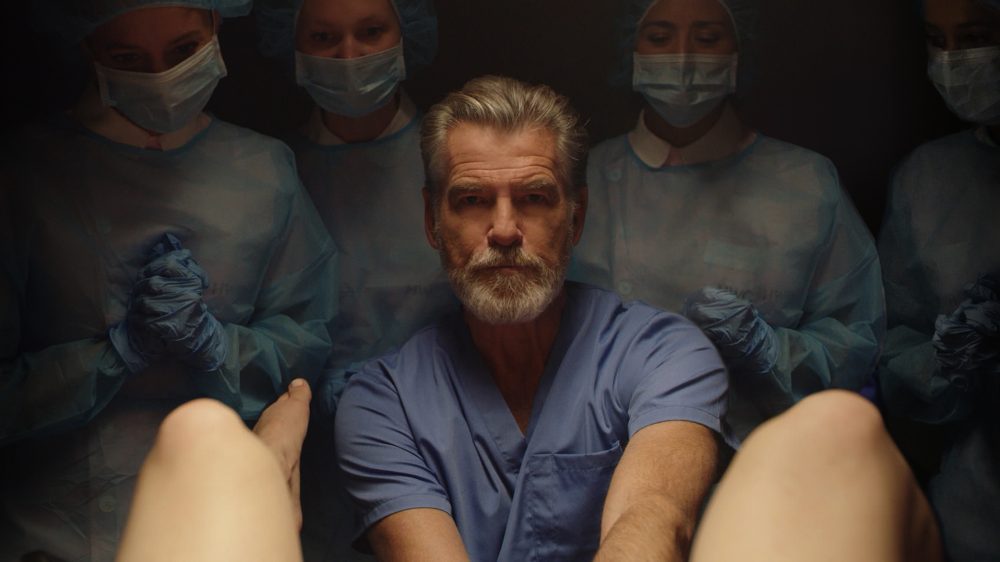
You’ll find real horror in False Positive. There’s the plot, sure—a woman desperate to conceive, in the hands of a nefarious physician with a God complex—and all the body horror and helplessness that go along with it. But that’s not the scary part.
Indeed, co-writer/director John Lee levels a more comedic
tone to the by-the-numbers premise. Where he and co-writer/star Ilana Glazer
mine unnerving dread is in their observational honesty.
Glazer is Lucy, and she and her husband Adrian (Justin Theroux, slyly wonderful) have been trying to get pregnant for two years. As much as she wants to do this naturally, she finally caves in to Adrian’s suggestion that they visit his med school mentor, Dr. Hindle (Pierce Brosnan – perfection).
Lee’s intention is not to make you wonder whether something sinister is afoot. The Stepford-esque nursing staff and eerily meticulous clinic proclaim it. The sheer number and variety of phallic instruments to be inserted, and the volume of lubricant so very lovingly applied, plays like SNL by way of Cronenberg.
If you’ve ever seen Broad City, Glazer’s groundbreaking Comedy Central sit-com, you may not recognize the performer’s dramatic skills, but you will recognize the writer’s keen eye for everyday absurdities.
Here’s where False Positive’s horror kicks in. It’s the
authenticity, the banal realism of Lucy’s daily condescending, dismissive,
patronizing, smothering, gaslighting humiliations that really eat at you. The low-key
accuracy of it all—from the male colleagues who swear you are glowing as they
leave their lunch orders next to your laptop, to your nurse’s reassuring caresses
and terms of endearment, to your husband’s reminder whenever you’re feeling
down that we’ve been through a lot with this pregnancy.
Tensions escalate as the storyline itself dictates, although
the film is far more surefooted in its observational horror than it is in its
plot. Lucy’s pre-pregnancy character is ill-defined, which makes her descent less
satisfying. The climax is played for comedic value and the final act’s weirdness,
though welcome, holds no real meaning.
Worse of all is the under-developed character of a midwife played imposingly by Zainab Jah. Lee clearly hoped to use this character as a statement on the genre itself but the whole affair feels wrong-headed.
Those are some serious misgivings, I grant you, but there really is something subversive, honest, and horrifying worth witnessing in this movie.
I have seen a lot of horror movies. A lot. You have no idea.
Do you know what I have never seen before? A horror movie that opens with a
quote from Fred Rogers.
Well done, Werewolves Within.
Mr. Rogers is a hero of sorts for Finn (Sam Richardson), new
park ranger for a very small, isolated, snowy mountain town. The townsfolk are
divided on a deal to run a pipeline through their little hamlet. But they will
have to work together despite their differences when it appears that a werewolf
has begun to prey on their town.
Because if left and right cannot work together in the face
of a common oppressor, the oppressor will win. It doesn’t matter what that is:
fascists, greedy capitalists, werewolves. Still, it can be tough to get the two
sides to come together, even for their own good, so Finn channels his hero and
does what he can to inspire the townspeople to look out for each other. He just
wants them to become good neighbors.
It is adorable.
Horror has its share of nice guys, but these are almost
invariably tragic victims, either the first to go because they don’t have the
inner meanness to overcome villainy, or eventual victims because the movie is
so much more emotionally relevant if they sacrifice themselves. The nice guy is
almost never a horror film’s hero, and this is where Werewolves Within
really does depart from standard fare.
Director Josh Ruben—fresh off Scare Me, a clever horror-comedy he wrote, directed and starred in—delivers a forgiving, even sweet tone. There’s cynicism here, and characters are not drawn with a lot of dimension, but the performances are fun and the comedy is good-natured.
Richardson makes an ideal Rogers-esque central figure, his new hometown populated by a talented comedy ensemble: Michaela Watkins, Michael Chernus, Wayne Duvall, Harvey Guillen (TV’s What We Do In the Shadows), and fan-favorite, Milana Vayntrub. (You know, Lily from the AT&T ads.)
Werewolves Within is loosely based on the video game of the same name, which may be why the plot feels so very slight. Still, writer Mishna Wolff displays a flair for whodunnit fun that elevates the film high above 90% of the video game movies that have been made.
A lot of that success lies in Wolff and Ruben’s investment
in the nice guy.
Fred Rogers once said: “When I was a boy and I would see a scary thing in the news, my mother would say to me, ‘Look for the helpers.’”
Stern, driven Enid (Niamh Algar) takes her responsibilities
seriously. Unfortunately for her, they come at a high price. Enid is a film
censor in the most punishing time and place for such an endeavor: Thatcher’s
England. It’s 1985, an era when controversial films hoping to make their way to
screens big and small found themselves more butchered than their characters.
Co-writer/director Prano Bailey-Bond takes inspiration from this notion in her feature debut, Censor—an immersive era-specific horror. It is especially immersive for Enid.
She spends long hours deliberating on exactly where the line is between danger and acceptability: rewinding, examining frame by frame, if necessary, regardless of the nonchalance and casual derision of her co-workers. Enid is convinced it is her duty to protect people from these images.
As she herself drowns in repeated viewings of the most violent
and depraved material, you have to wonder whether she might be better off
protecting herself.
Bailey-Bond has other questions in mind, like why is it that
Enid is so preoccupied with this job, how might it feed her own darkness, and
what happens when her worlds blend together?
Censor is a descent into madness film—nothing new in the genre. And moments of Censor can’t help but call to mind fellow Brit Peter Stickland’s 2012 treasure Berberian Sound Studio. But Bailey-Bond and co-writer Anthony Fletcher evoke such a timestamp with this film, not just in the look and style, but with the social preoccupation.
As coincidences pile up – a definitive family decision, a horror movie-style murder spree, a film that hits too close to home — Enid seems to suspect that her real motive has been to censor her own thinking.
When she stops doing that, look out.
Algar’s prim and sympathetic, deliberate and brittle. It’s clear from the opening frame that Enid will break. But between Algar’s skill and Bailey-Bond’s cinematic vision, the journey toward that break is a wild ride.
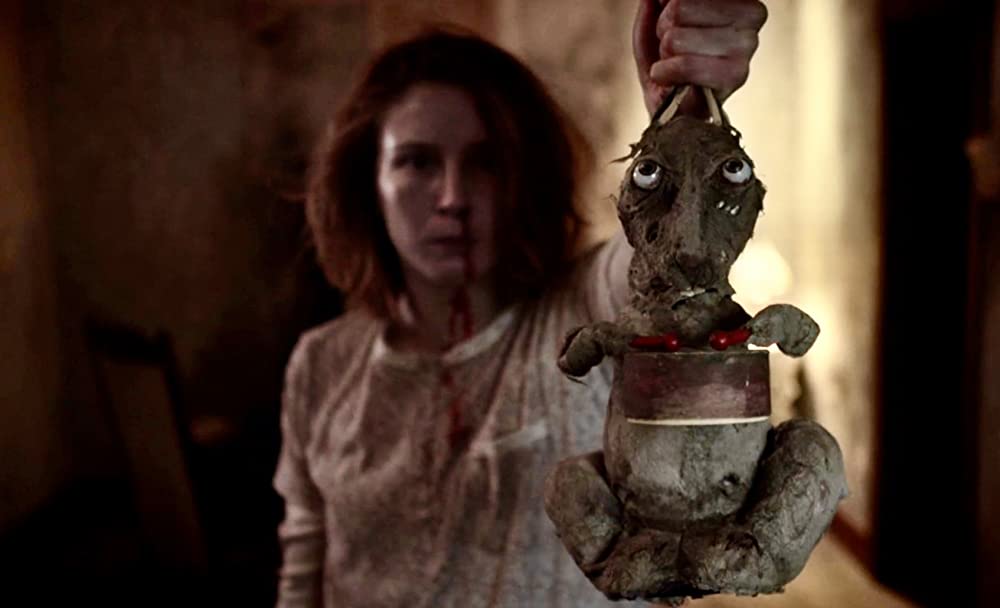
The room is dark, decrepit. A wild-eyed woman with a bloody
nose holds a toy out in front of her like a demon slayer holds a crucifix. The toy
– what is it, a rabbit? A jackalope? – beats a creepy little drum. Faster. Slower.
Hotter. Colder.
This is how writer/director Damian Mc Carthy opens Caveat
and I am in.
The woman is Olga (Leila Sykes), and we’ll get back to her in a bit, but first, we’re part of a conversation between the hush-voiced Barrett (Ben Caplan) and the foggy Isaac (Jonathan French). What can we tell from the conversation? They seem to know each other, Isaac’s had some kind of an accident, Barrett needs a favor.
The favor involves Olga, that house, and a long stretch of tightly fastened, heavyweight chain.
Dude, how good is Mc Carthy at this?
An expertly woven tapestry of ambiguity, lies and
misunderstanding sink the story into a fog of mystery that never lets up. Isaac’s
memory can’t be trusted, but he seems like a good guy. He looks like a good
guy. Surely, he is a good guy! He’s just not making good decisions right now.
French shoulders the tale, and you hate to compare anything to Guy Pearce in Memento because who can stand up to that? No one, but still, Mc Carthy and French draw on that same type of damaged innocence and unreliable narration to stretch out the mystery.
Meanwhile, the filmmaker unveils a real knack for nightmarish
visuals, images that effortlessly conjure primal fears and subconscious
revulsion.
Caveat is not without flaws. Once or twice (when
possibly channeling Mario Bava) Mc Carthy dips into camp unintentionally. OK,
twice. These moments feel out of place in the unnerving atmosphere he’s created,
which makes them stand out all the more. But it’s hardly enough to sink the
film.
Mc Carthy does a lot with very little, as there are very few locations and a total of three cast members—all stellar. You won’t miss the budget. Mc Carthy casts a spook house spell, rattling chains and all, and tells a pithy little survival story while he’s at it.
Practical effects, hallucinatory sequences and a throwback
exploitation vibe keep Skull: The Mask interesting enough to watch.
The film’s opening is its strongest segment, a grainy video
portrayal of a 1944 political bloodbath with the goal of enacting an ancient pre-Columbian
ritual. Directors Armando Fonseca and Kapel Furman bring a retro violence to
the effort that makes the most of limited resources.
Flash forward 60 years or so and we move from the Amazon to
Sao Paulo and a convoluted police procedural led by a one-note performance from
Natallia Rodrigues as Det. Beatriz Obdias. She’s bad news! Damaged goods!
She also has no idea how to treat a crime scene, but there’s
a lot of questionable policework going around, with no real leads to connect
these corpses strewn from one end of town to the other. All of their hearts are
missing. Sometimes their guts. Once in a while their faces.
The best thing about Skull: The Mask is Furmam’s
extensive background in gore effects. You’ll find plenty of it here, some of it
inspired, all of it bloody. The goregasm is in support of a story of a marauder
in a stone skull mask, the same cursed mask from the 1944 massacre.
Brought to Sao Paolo by nefarious men with nefarious
intentions, it falls into the wrong Goth girl’s hands early on and soon there’s
a housecleaner ripping the hearts and guts out of club kids, drug dealers and
priests all over town.
Does it make sense? Not really. Does it have to? Probably
not. The film is a callback to a style and brand of movie that didn’t need an
airtight plot or convincing performances as long as it did very nasty things in
novel ways to the human body.
Skull: The Mask is a pretty dumb movie. Hell, even the title is dumb. But it knows where to invest its energy and money, and you cannot say it skimps on the goods.
There is something inescapably silly about toy horror.
Whether it’s a marionette or a ventriloquist doll, a china doll (with those
creepy eyelashes) or a friend til the end, the toy itself can only generate so
much authentic terror. After that, it’s just goofiness.
Karl Holt embraces that combination for his vengeful toy
story, Benny Loves You.
We open on a spoiled child, her new Barbie, and the now-discarded
stuffed dog, Todd. But soon we’re entrenched in the subpar life of Jack (Holt,
who also writes and directs). It’s his 35th birthday. He still lives
with his parents, still sleeps in his childhood bedroom that is still decorated
as it was when he was seven.
Jack is a toy designer, but co-worker Richard (a colossal
tit) makes him look like a peon. They’re both up for the same promotion. Things
go from bad to worse, then worse, then worse still. Finally, Jack decides to
grow up and put away all his childish things, including his beloved stuffed
bear (Bear? With those ears?), Benny.
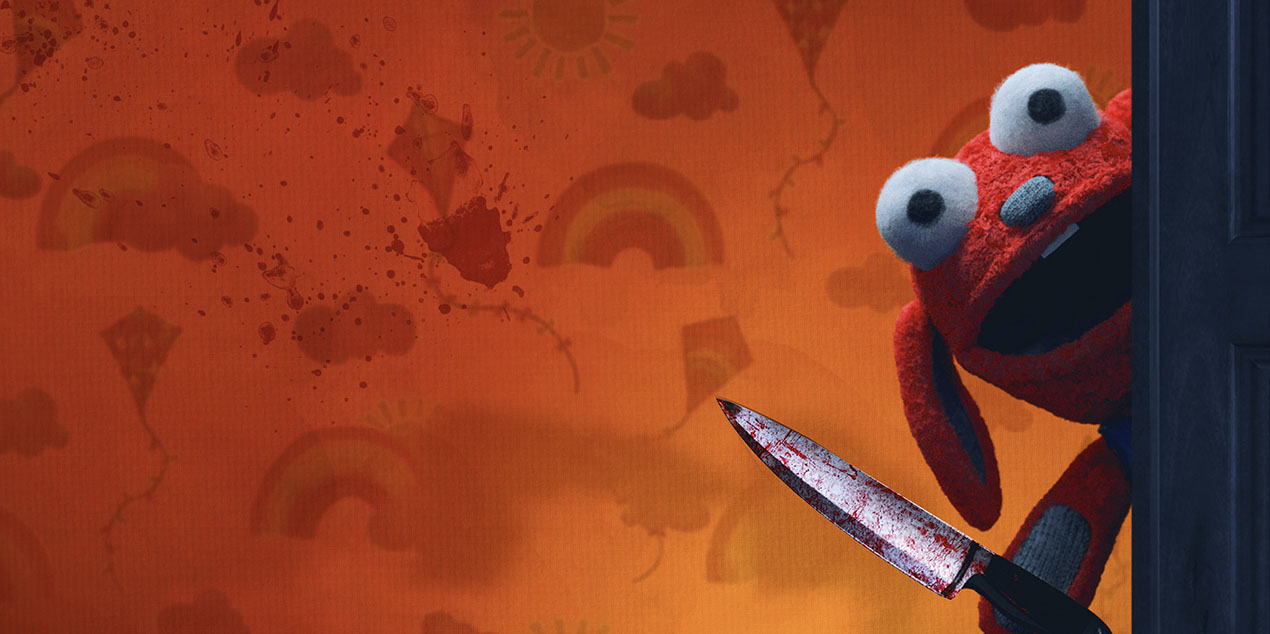
It goes less than well, the unruly toy responding like a bloodthirsty
if very cheery jilted lover.
Holt turns in a solid performance as the stunted man-child living a nightmare of adulthood, and there are times when his writing suggests something deeper. He almost develops themes about arrested development, the entertainment/gaming/toy industry, maybe even masculine entitlement. Almost.
Instead of digging in, he settles for a superficial but
generally charming and very violent comedy. (Dog lovers may want to skip this
one.)
Low-rent FX heighten the film’s silliness and general wrong-headed glee. All the support work is on target, from George Collie as the noxious Richard to the love interest (Claire Cartwright), dog-loving boss (James Parsons), and incompetent cops (Anthony Styles and Darren Benedict). Each understands the tone here and nails it.
It’s just that it doesn’t amount to much. A mean spirit punctuates the romplike atmosphere a couple of times and feels wildly out of step with the balance of the film, but other than that, Benny Loves You offers forgettable, bloody fun.
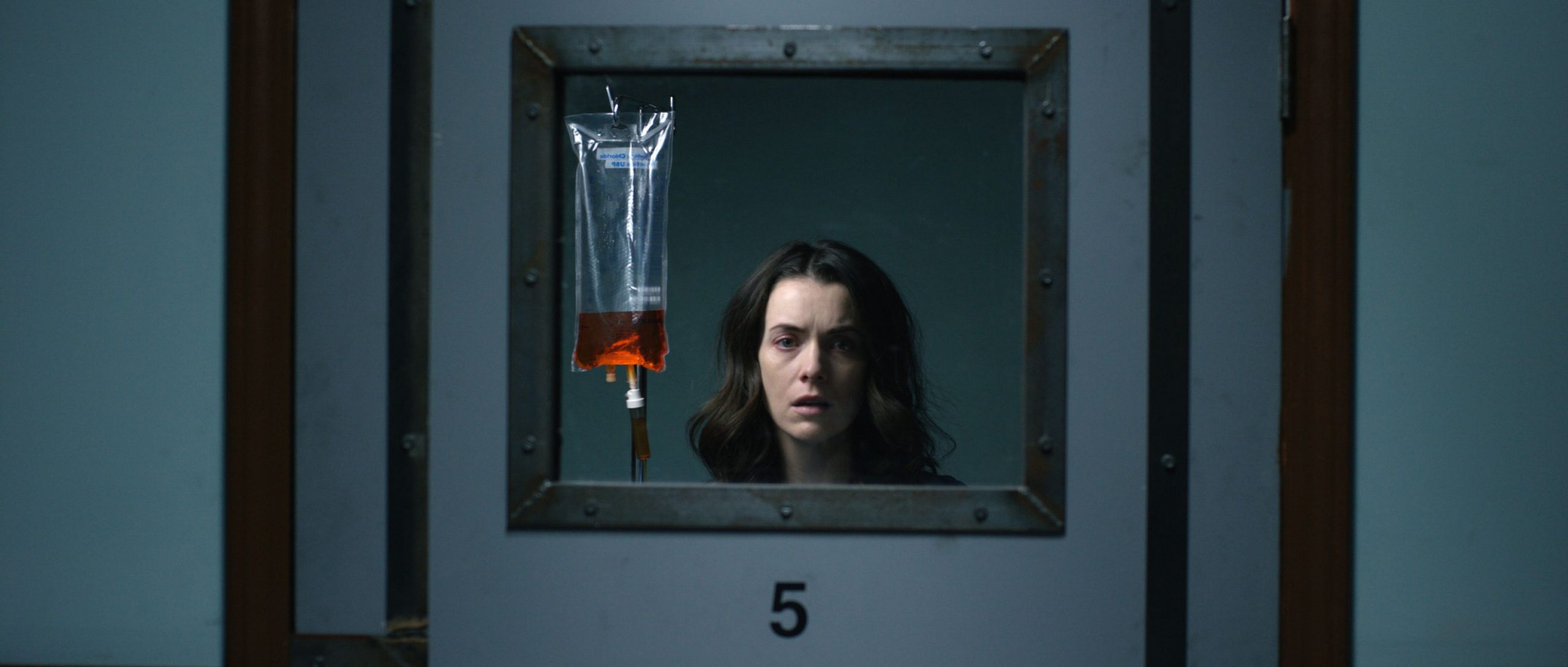
Imagine going to the hospital for a routine appendectomy and waking up in a hospital that’s a little too Hostel. That’s what happens to Sharyn (Ashlynn Yennie) in director Peter Daskaloff’s film, Antidote.
From the mysterious and gruesome opening, we’re quickly plunged into this warehouse-style hospital where patients are chained to their beds and answers to the question ‘why am I here?’ are in short supply.
We’re not given much information as Sharyn awakens to this nightmarish situation. A mysteriously polite doctor (Louis Mandylor) appears to offer her medicine for her anxiety, leading us down one alley of possible explanations. Glimpses into Sharyn’s past as she struggles to cope with her new world offer another possibility.
However, Daskaloff wants to keep us guessing with each new
bit of information. As Sharyn meets her fellow patients, we learn new facets of
the horrific experimentation that happens at the facility. A mysterious serum
promises healing from every possible injury: amputation, burning, hanging,
tongue removal. The antidote is really quite magnificent stuff.
While I was initially reminded of films like Hostel and
Saw, Antidote doesn’t relish the gore quite as much. Most of the
brutality happens off-screen, and the film is more interested in the tension
created by the unknown. The suggestion of violence often does more to put the
audience on edge than the ultra-realistic rendition.
But to work, the film must keep the audience hooked. We need to feel Sharyn’s anxiety and desperation, and this is where the film struggles. Watching Sharyn wander around the hospital (why is she allowed to do this?) is repetitive and boring. It’s easy to grow disinterested as we wait for the big reveal.
Yennie does bring an everywoman quality to her character. Sharyn’s dubious past unfolds throughout the film and is the most interesting aspect. It’s a problem when the film’s backstory is more engaging than the present action. Maybe if we’d seen a little more of that suggested violence, I’d have sat up straighter in my seat.
Playing against our everywoman, Mandylor makes Dr. Aaron Hellenbach a cool, sophisticated, sadistic madman – a bit like Hannibal Lecter only not so terrifying. He never feels like a villain, even though he appears to be the main engineer of the ‘experiments’ done on the patients.
Antidote has the elements to be intriguing, but doesn’t effectively deliver them.
This episode is years in the making. We’ve talked about doing this, jotted down ideas and characters, debated — and now it’s finally here. Well, half of it, anyway. There’s just no way to reasonably fit the best side characters—those fully deserving a film of their own—in just one podcast. So here is our list, in alphabetical order (no need to rank them!). This one’s for the ladies.
Smartly dressed, thoughtful, loving, misguided, and as if a creature from an entirely different film. She made a decision and, sure, Angela probably should have been a part of that decision-making process. But it wasn’t Aunt Martha’s fault that Paul was a no-good cheater. Or that Judy was such an asshole. I mean, yes, that surprise at the end was due in large part to Aunt Martha, but as for the campers—they had it coming.
Mademoiselle (Catherine Begin), Martyrs (2008)
What a presence. Commanding, calm, wizened and weary, Catherine Begin’s Madamoiselle has such resigned decisiveness that it’s almost impossible to argue with her. She turns something that could have easily become torture porn into a mesmerizing glimpse at zealotry.
Ruth Gordon earned an Oscar as Rosemary and Guy Woodhouse’s busybody neighbor Minnie Castavet, wife of Roman and nonplussed chief operations officer of the coven. Yes, Roman made a good figurehead, but somebody has to just keep things moving. And as long as she ate the mouse, everything’s fine.
Mother (Fons Rademakers), Daughters of Darkness (1971)
One of the many glorious things about Harry Kumel’s decadent 1971 vampire fable is the way it feels like two or three different films colliding into one elegant bloodletting. Mother casts a looming shadow over one of those storylines, that of a young, beautiful couple recently married, Stefan and Valerie. Even before they’re ensnared in Countess Bathory’s love web, Stefan (an irredeemable asshole if ever there was one) needs to figure out how to break the news of his nuptials to Mother.
Whenever a new character makes you simply need to hear an entirely other story, one focused on whatever they’re not telling you about that character, you know you have a winner. The way Fons Rademakers pets his butler’s head, holds court in the greenhouse, and wields unspecified but somehow sinister power over Stefan begs for its own movie.
Mrs. Baylock (Billie Whitelaw), The Omen (1976)
From the moment she takes the screen, Mrs. Baylock is the new sheriff in town. She quietly yet immediately takes control of the Thorn household. If you didn’t know who was alpha, you only need to see who the dog listens to. Yep, Richard Thorn is in trouble. To say nothing of his poor, useless wife Catherine.
Tangina (Zelda Rubenstein), Poltergeist (1982)
Walks in the house, owns the place. Tangina is a force of nature with a soft little lilt and a no-nonsense approach to cleaning the Freeling house. Her confidence gives the character more than a huckster vibe, although there is a sense of showmanship to everything she does. But when she is addressing the living, it’s best not to give trick answers.
Zelda (Andrew Hubatsek), Pet Sematary (1989)
Scary as hell. Sure, the cat, little Gage, that guy with the brain on the outside of his skull—all of it has its horror charm. But the real nightmare in Mary Lamber’s adaptation of the Stephen King tale is Rachel Creed’s guilty memory of the sister who terrified and horrified her, the sister she believes died—at least in part—due to her own negligence and hatred. Thanks to the angular, monstrous vision of Andrew Hubastek in a nightdress, all contorting ribcage and spine, Zelda became easily the scariest thing in the film.