Perhaps the most terrifying horror born of neighborly manners is Michael Haneke’s unnerving Funny Games (either his 1997 German-language original or his 2007 English-language remake). Writer/director Duncan Birmingham doesn’t go that far. What he does is walk a tightrope that’s a little goofier, a little less horrifying, but effective nonetheless.
Margo (Melissa Tang) and Adam (Ryan Hansen) throw a housewarming party. Well, Adam throws it. Margo endures it. She doesn’t honestly know what was wrong with their old neighborhood. It doesn’t help that their 5-year-old has had nightmares every night since they arrived.
Adam invites all his colleagues and bosses, hoping to impress without coming off as douchey. He’s upwardly mobile, although the house —which he got at a steal because of that nasty double homicide—might make them look a little higher up than they really are.
Not that Margo and Adam are the only partiers who aren’t what they seem. That really good-looking couple—the two who look like they just came from a really hip funeral—does anyone know who they are?
Maybe Sasha (Perry Mattfeld) and Tom (Timothy Granaderos) are the neighbors, as they say.
But probably not.
What we can say for sure is that they do not want to leave.
What transpires after all the other guests have gone would be a comedy of manners except that it feels pretty clear that something awful lurks underneath the handsome couple’s evasion and gaslighting.
Birmingham’s film is a mystery of sorts, although you’ll have most of that intrigue figured out pretty early. There is also a subplot about Margo’s friends who are babysitting. This goes essentially nowhere. Worse still, Birmingham rushes Act 3 and leaves you feeling short-changed.
However, that 30 minutes or so that Margo and Adam and Sasha and Tom have on their own gets pretty uncomfortable.
Hansen unveils surprising warmth within the needy, insecure Adam. He and Tang take the married couple in surprising and welcome directions. Mattfeld and Granaderos are drolly perfect as the home invaders masquerading as partygoers who just can’t tell it’s time to go.
A tight script wastes little time and manages to surprise even if you figure out the main mysteries early. Who Invited Them isn’t flawless, but it is an anxious bit of fun.
Exciting all MaddWolf Pack episode! Daniel Baldwin, aka The Schlocketeer, and Brandon Thomas join us to talk about a topic we stole from their Twitter conversation: which directors not known for horror made the best horror movies?
Be sure to listen because Daniel and Brandon both bring much knowledge (plus extra movie titles!) to the conversation. But here’s our Top 5:
5. Nosferatu, the Vampire (1979, Werner Herzog)
Sure, it’s another Dracula, but because it’s another Dracula by way of Murnau’s masterpiece Nosferatu, and it’s written and directed by the great Werner Herzog, it’s weird and wonderful.
Herzog uses the imagery Murnau created – in particular, the naked mole rat of a vampire – to turn vampirism into a pestilence to evoke the Black Plague of Europe. Klaus Kinski is that naked mole rat, and he is glorious.
Isabelle Adjani is the pure of heart maiden who is his undoing, but the way Herzog reimagines Jonathan Harker gives the film a cynical twist that feels like a surprise within this dreamlike adaptation. Gorgeous location shooting and an astonishing score help Herzog create a suffocating but captivating atmosphere.
4. The Haunting (1963, Robert Wise)
Coming off the big epics of The Sound of Music and West Side Story, no one would have expected the intimate psychological horror of Robert Wise’s The Haunting.
Shirley Jackson fans have to appreciate the way the film remains true to her vision of horror. Fans of horror have to appreciate Wise’s unbelievable knack for generating terror with sound design and imagination.
Yes, the performances are magnificent – especially Julie Harris, whose bitter Eleanor is picture perfect. But Wise’s mastery of form is what makes this G-rated film a lasting terror.
3. Hour of the Wolf (1968, Ingmar Bergman)
Like all Bergman films, this hypnotic, surreal effort straddles lines of reality and unreality and aches with existential dread. But Bergman and his star, Max von Sydow, cross over into territory of the hallucinatory and grotesque, calling to mind ideas of vampires, insanity and bloodlust as one man confronts repressed desires as he awaits the birth of his child.
As wonderful as von Sydow is as the central figure, a man spiraling toward insanity, it’s the heartbreaking Liv Ullman who owns this movie. Heartbreaking, solid, and the most unusual combination of strength and weakness, her Alma grounds the surreal elements of the movie.
The result is gorgeous, spooky, and so very sad. It’s one of the most underappreciated films of Bergman’s career.
2. The Shining (1980, Stanley Kubrick)
You know who you probably shouldn’t hire to look after your hotel? Jack Nicholson.
A study in atmospheric tension, Kubrick’s vision of the Torrance family collapse at the Overlook Hotel is both visually and aurally meticulous. It opens with that stunning helicopter shot, following Jack Torrance’s little yellow Beetle up the mountainside, the ominous score announcing a foreboding that the film never shakes.
The hypnotic, innocent sound of Danny Torrance’s Big Wheel against the weirdly phallic patterns of the hotel carpet tells so much – about the size of the place, about the monotony of the existence, about hidden perversity. The sound is so lulling that its abrupt ceasing becomes a signal of spookiness afoot.
Nicholson outdoes himself. His early, veiled contempt blossoms into pure homicidal mania, and there’s something so wonderful about watching Nicholson slowly lose his mind. Between writer’s block, isolation, ghosts, alcohol withdrawal, midlife crisis, and “a momentary loss of muscular coordination,” the playfully sadistic creature lurking inside this husband and father emerges.
He’s not the caretaker management expected, but really, was Grady? Like Grady and Lloyd the bartender, Jack Torrance is a fixture here at the Overlook.
1. Silence of the lambs (1991, Jonathan Demme)
It’s to director Jonathan Demme’s credit that Silence made that leap from lurid exploitation to art. His masterful composition of muted colors and tense but understated score, his visual focus on the characters rather than their actions, and his subtle but powerful use of camera elevate this story above its exploitative trappings. Of course, the performances didn’t hurt.
Hannibal Lecter ranks as one of cinema’s scariest villains, and that accomplishment owes everything to Anthony Hopkins’s performance. It’s his eerie calm, his measured speaking, his superior grin that give Lecter power. Everything about his performance reminds the viewer that this man is smarter than you and he’ll use that for dangerous ends.
Demme makes sure it’s Lecter that gets under our skin in the way he creates a parallel between Lecter and FBI investigator Clarice Starling (Jodie Foster). It’s Clarice we’re all meant to identify with, and yet Demme suggests that she and Lecter share some similarities, which means that maybe we share some, too.
That was the excellent tag line for Jaume Collet-Serra’s fun 2009 surprise Orphan. Then 12-year-old Isabelle Fuhrman delivered an inspired performance buoyed by the nuanced work of two veteran talents (Vera Farmiga and Peter Sarsgaard), but it was the climactic shocker that guaranteed the film’s place in horror history.
The bigger surprise might be to make a prequel 13 years later with the same lead. Furhman, now in her twenties, reprises her role as the orphan you do not want to adopt.
In director William Brent Bell’s episode, we go back in time to meet up with our wee villain in an Estonian facility. It’s a fun, bloody start to Esther’s adventure and an early reminder (it has been 13 years) that if you wonder whether Esther’s evil, F around and find out.
That, of course, is one of the obstacles writer David Coggeshall needs to overcome. We already know Esther’s big secret and we already know what she’s capable of. What surprises are left?
Plenty!
Orphan: First Kill goes in unexpected places, many of them an absolute hoot. Bell’s film walks an impressive line between tension, horror and laughs. It works because of a tight script, but mostly because of rock-solid performances from Fuhrman and Julia Stiles.
Stiles is Esther’s new mommy, a wealthy helicopter parent with an artist husband and a teenage son. She’s magnificent.
Able support work surrounds the pair, and Coggeshall’s screenplay meshes the expected with the unexpected.
I had no idea Bell—whose previous work includes the unintentionally funny The Boy andBrahms: The Boy II—had this in him. Yes, Orphan: First Kill may have benefitted from low expectations: a heretofore weak director, a 25-year-old trying to convince the audience she’s 12, a franchise none of us thought needed a sequel. Still, there’s no denying it entertains.
The film is no masterpiece and Fuhrman’s age does take you out of the fantasy now and again. But it is sly fun.
Just when you think you know where director Vincent Grashaw’s Southern Gothic What Josiah Saw is going, you meet Eli.
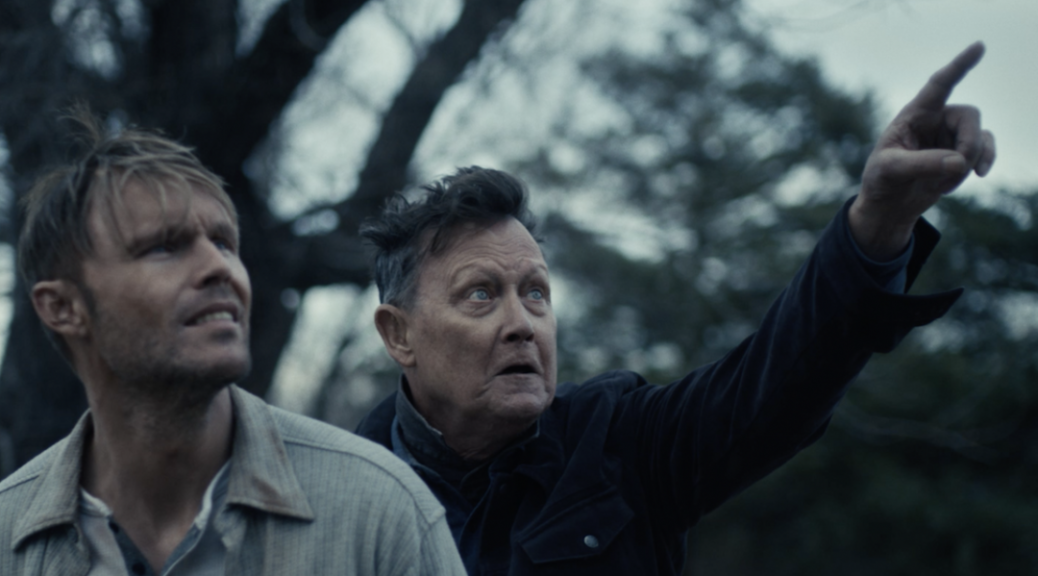
One at a time, Grashaw introduces us to the Graham children. At first, it’s poor Tommy (Scott Haze), a simple fella living at home with Graham patriarch, Josiah (Robert Patrick). Josiah doesn’t think much of Tommy. He doesn’t think much of God, either, but he’s having a change of heart.
Then Grashaw switches gears and introduces us to Tommy’s brother Eli (Nick Stahl), who lives hard. He’s run afoul of some bad people (including Jake Weber in a welcome cameo) and is in some pretty desperate straits. Finally, we meet sister Mary (Kelli Garner), whose trauma sits far nearer the surface and strengthens our unease about the inevitable family reunion.
The Grahams reunite, drawn by the lure of oil money: the Devlin corporation hopes to drill on their land. The money could mean a fresh start for everyone. But some details need to be handled first.
Moving from story to story, What Josiah Saw keeps you on your toes. Grashaw glides easily from one style to the next, although Eli’s gritty thriller storyline is the most intriguing. It feels more complete, less bait and switch, and benefits from Stahl’s naturalistic, resigned performance.
Not every episode works as well. The stones left unturned and strings left untied from one tale to the next, though, give the film a rich, dark present-day. From the outset it’s clear there’s a traumatic backstory waiting to be revealed, so it’s to Grashaw and writer Robert Alan Dilts’s credit that the messy present keeps pulling our interest.
Patrick delivers a strong turn, mean-spirited and commanding. He’s at the center of the mystery, the center of everybody’s trauma in a film mainly concerned with how you live with the marks left by your childhood.
Ambiguity in the third act is becoming a theme in horror this year. Alex Garland’s Men, the recent stalker horror Resurrection, and now, What Josiah Saw. Sometimes it’s brave to let the audience own the experience and make the call. More often, it feels indecisive or muddy. I’m not sure all the clues are here to help make the determination for What Josiah Saw, but even without proper closure, Grashaw paints a creepy picture.
In today’s episode, we celebrate Hope’s novel ROOST, plus the brand spanking new audiobook, recorded by George himself. ROOST is the story of twins in a small Midwestern town during the satanic panic of the 1980s.
To properly put us in the mood, we will run through the best smalltown horror. There is a lot! Partly because small towns come equipped with small police forces. So, in addition to this fuzzy math list, we recommend: The Mist, Children of the Corn, Tremors, Dead and Buried, The Fog, The Birds, The Blob, We Are Still Here, Something Wicked This Way Comes,The Wolf of Snow Hollow, and Brotherhood of Satan (which always makes Hope think of her hometown).
6. I Am Not a Serial Killer (2016)
Billy O’Brien (Isolation) finds a new vision for the tired serial killer formula with his wry, understated indie horror I Am Not a Serial Killer.
An outsider in a small Minnesota town, John (Max Records) works in his mom’s morgue, writes all his school papers on serial killers, and generally creeps out the whole of his high school. But when townsfolk start turning up in gory pieces, John turns his keen insights on the case.
Records, who melted me as young Max in Spike Jonze’s 2009 masterpiece Where the Wild Things Are, serves up an extraordinarily confident, restrained performance. His onscreen chemistry with the nice old man across the street – Back to the Future’s Christopher Lloyd – generates thrills enough to offset the movie’s slow pace.
For his part, Lloyd is in turns tender, heartbreaking and terrifying.
Bursts of driest humor keep the film engaging as the story cleverly inverts the age-old “catch a killer” cliché and toys with your expectations as it does.
5. 30 Days of Night (2007)
If vampires can only come out at night, wouldn’t it make sense for them to head to the parts of the globe that remain under cover of darkness for weeks on end? Like the Arctic circle?
The first potential downfall here is that Josh Hartnett plays our lead, the small town sheriff whose ‘burg goes haywire just after the last flight for a month leaves town. A drifter blows into town. Dogs die viciously. Vehicles are disabled. Power is disrupted. You know what that means…the hunt’s begun.
Much of the film’s success is due to the always spectacular Danny Huston as the leader of the bloodsuckers. His whole gang takes a novel, unwholesome approach to the idea of vampires, and it works marvelously.
4. It (2017)
The Derry, Maine “losers club” finds itself in 1988 in this adaptation, an era that not only brings the possibility of Part 2 much closer to present day, but it gives the pre-teen adventures a nostalgic and familiar quality.
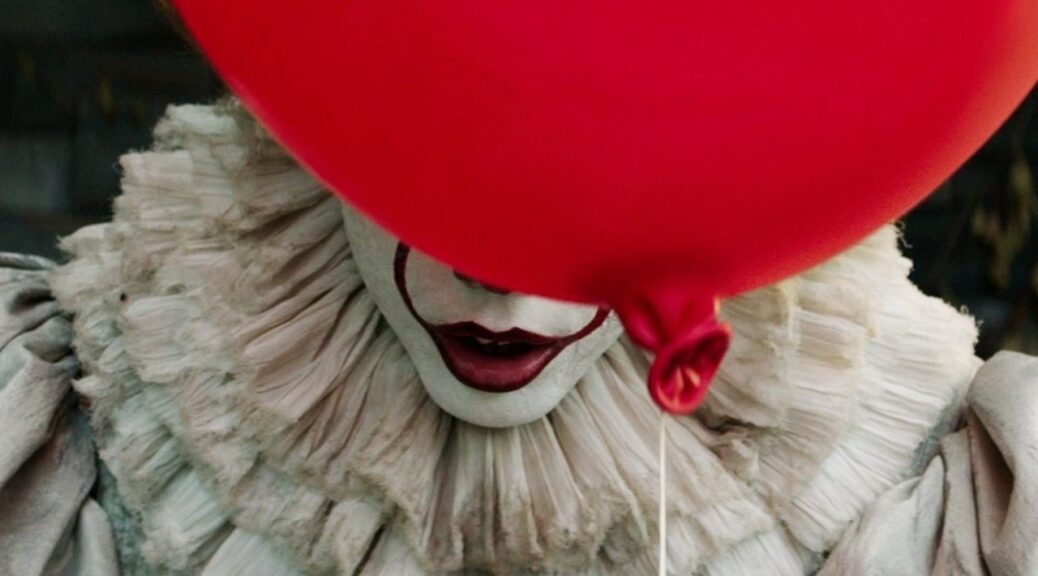
Bill Skarsgård has the unenviable task of following a letter-perfect Tim Curry in the role of Pennywise. Those are some big clown shoes to fill, but Skarsgård is up to the challenge. His Pennywise is more theatrical, more of an exploitation of all that’s inherently macabre and grotesque about clowns.
Director Andy Muschietti shows great instinct for taking advantage of foreground, background and sound. Yes, It relies heavily on jump scares, but Muschietti’s approach to plumbing your fear has more depth than that and he manages your rising terror expertly.
3. The Wailing (2016)
“Why are you troubled?” Jesus asked, “And why do doubts arise in your hearts? Look at my hands and my feet. It is I myself. Touch me and see — for a spirit does not have flesh and bones, as you see I have.”
Though the true meaning of this quote won’t take hold until the final act, it presents many questions. Is this film supernatural? Demonic? Or, given the corporeal nature of the quote, is it rooted in the human flesh?
Yes.
That’s what makes the quote so perfect. Writer/director Hong-jin Na meshes everything together in this small town horror where superstition and religion blend. The film echoes with misery, as the title suggests. The filmmaker throws every grisly thing at you – zombies, pustules, demonic possession, police procedural, multiple homicides – and yet keeps it all slippery with overt comedy.
2. Halloween (1978)
No film is more responsible for the explosion of teen slashers than John Carpenter’s babysitter butchering classic.
From the creepy opening piano notes to the disappearing body ending, this low budget surprise changed everything. Carpenter develops anxiety like nobody else, and plants it right in a wholesome Midwestern neighborhood. You don’t have to go camping or take a road trip or do anything at all – the boogeyman is right there at home.
Michael Myers – that hulking, unstoppable, blank menace – is scary. Pair that with the down-to-earth charm of lead Jamie Lee Curtis, who brought a little class and talent to the genre, and add the bellowing melodrama of horror veteran Donald Pleasance, and you’ve hit all the important notes. Just add John Carpenter’s spare score to ratchet up the anxiety. Perfect.
1. Jaws (1975)
A big city cop moves to tiny Amity, where one man can make a difference. Unfortunately, that one man is Mayor Vaughn.
Steven Spielberg cemented his legacy with this blockbuster masterpiece. The interplay among the grizzled and possibly insane sea captain Quint (Robert Shaw), the wealthy young upstart marine biologist Hooper (Richard Dreyfuss) and the decent lawman/endearing everyman Brody (Roy Scheider) helps the film transcend horror to become simply a great movie.
Spielberg achieved one of those rare cinematic feats: he bettered the source material. Though Peter Benchley’s nautical novel attracted droves of fans, Spielberg streamlined the text and surpassed its climax to craft a sleek terror tale.
It’s John Williams’s iconic score; it’s Bill Butler’s camera, capturing all the majesty and the terror, but never too much of the shark; it’s Spielberg’s cinematic eye. The film’s second pivotal threesome works, together with very fine performances, to mine for a primal terror of the unknown, of the natural order of predator and prey.
There are some truly frightening moments in Nope. Some revolve around things you may think you know based on the trailer. Others feature a bloody monkey in a party hat.
All these and more are tucked inside the kind of patient and expansive brand of storytelling you might not expect from writer/director/producer Jordan Peele. Where the filmmaker’s first two exceptional features explored wildly different styles of horror, his third effort, though scary, taps much more into Sci-Fi.
And Nope has plenty to say about Black cowboys, the arrogance of spectacle, and getting that elusive perfect shot.
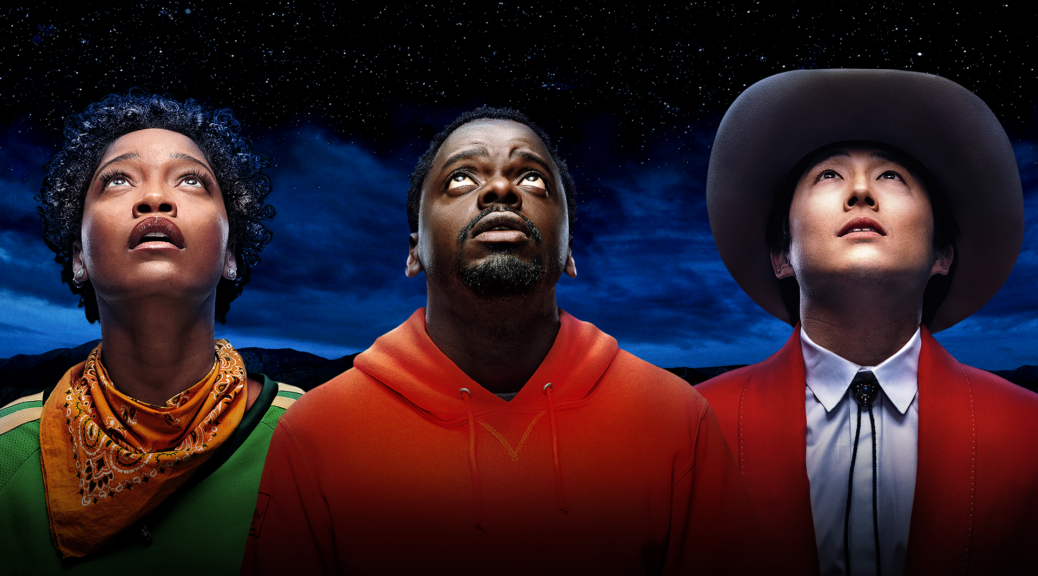
OJ Haywood (Daniel Kaluuya) and his sister Emerald (Keke Palmer) work under their father Otis, Sr. (Keith David) at the only Black-owned horse training business in Hollywood. The Haywood lineage dates back to the very first “assembly of photographs to create a motion picture,” and Haywood’s Hollywood Horses serves various TV and film productions out of a remote California ranch.
But recently, OJ has also been doing business with Ricky “Jupe” Park (Steven Yeun), a former child star who runs a nearby tourist attraction. Some amazing things have been happening there, and Ricky seems to need more and more horses to keep the people amazed.
Toss in Brandon Perea as a dangerously curious tech store worker and the inimitable Michael Wincott as an esteemed and disenchanted cinematographer and you have a remarkable set of oddball characters, each brought to life with peculiar but sympathetic performances.
Peele’s direction and writing effortlessly mine comedic moments, but Nope is no comedy. He unravels a mystery before your eyes, and his shot-making has never been so on point. The way he splashes color and motion across this arid landscape is stunning. His visual cues—often executed with macabre humor and panache—amplify the film’s themes while inducing anxiety.
Palmer and Kaluuya are a fantastic pair, sharing an uneasy, lived-in familial tension. Their battling energy—OJ is slow-moving and soft-spoken to Em’s live wire—contributes to the film’s discombobulating feel. Yeun delivers a surprise turn as a man still trading on past glories at a theme park. But everyone here has a relationship to the dangerous, life-altering, perhaps idiotic act of filming, of entertainment, of spectacle.
It feels a bit like Peele is saying that making a movie will kill you, if you’re lucky. But opening a film with a Biblical passage is no accident, and on a grander scale, Peele has crafted a genre-loving ode to a comeuppance tempted by grandiose delusions.
Nope is a tense, gorgeous, funny, insightful and ambitious thrill ride, which updates the filmmaker’s scorecard to three for three. And while Peele may still feel like he’s chasing perfection, here’s hoping he just keeps chasing.
A bog is a nice spot for horror, eh? You think you’re walking along a lovely field when suddenly, you’re sucked in. Like quicksand, only mossier.
Betriek (Sallie Harmsen) and her daughter Hanna (Noor van der Velden) live with Hanna’s grandparents on the edge of one such Dutch mire in Nico van den Brink’s Moloch. A body just turned up out there, perfectly preserved for maybe hundreds of years.
And then another appears. And another. And another—each a female from a different era. The discoveries trigger other unusual behaviors, all of it corresponding with the town’s celebration of an unsavory history.
It sounds a little contrived, a little familiar, but van den Brink’s naturalistic approach to the story offsets any hokeyness. Harmsen’s spooked but reasonable lead makes for a clear-eyed hero, one who rails against her lot in life quietly but surely. Her choices sometimes feel erratic but never unnatural, and the cast around her shares a lovely and reasonably strained chemistry.
All performances are more raw than polished, which amplifies an authenticity struggling to anchor the supernatural elements.
Because scary stories are scarier if you believe them.
Not that the film ignores its spectral side. Ringing bells, musical interludes, moments in an aquarium and other highlights of the film’s sound design lend Moloch a supernatural eeriness that deepens its dread.
Van der Velden shows keen instincts for allowing his tale to unravel in its own time. Close attention to detail allows a rich understanding of the story Moloch tells. Whether you devote that kind of attention to the film or not, Moloch gets its point across.
A tale as old as time: boy meets girl, girl convinces boy to accompany her on a couple’s retreat, couples retreat turns satanic. If we see this setup anymore, we’ll have to consider the trope its own genre.
Director Mark Meir’s The Summoned follows average mechanic and hopeful musician Elijiah (J. Quinton Johnson), as he accompanies his pop star girlfriend Joplyn (Emma Fitzpatrick) on a secluded (and exclusive) self-help retreat. Joined by a millionaire author (Salvador Chacon) and prissy movie star (Angela Gulner), the vacation quickly goes from life-changing to life-threatening.
Unfortunately, when drawing up appropriate criticisms or praises for The Summoned, the metaphorical canvas remains blank. That is to say: this film drives at a safe speed and steadily down the dead-center of the road. Never veering into terrible road bumps like uneven performances, loose script, or uninspired narrative. This also means it never hits the high speeds of stellar performances, transformative writing, or intriguing ideas.
The Summoned is competently made in almost every aspect. It looks pleasant, the cast is strong and is obvious in their chemistry, and the direction is solid. But you keep waiting for the twist of the knife, the moment where this film becomes a breathing piece. Unfortunately, that final push never comes, and the result is ultimately adept but magicless.
Perhaps the most enjoyable element of this film was the willingness to lean into camp. The performances offered by Gulner and Frederick Stuart as the flamboyant Dr. Frost gave even the most grisly moments appropriate levity. This levity is the ultimate grace the film needs to distance itself from gloom-obsessed horrors of the past (think Insidious, The Conjuring, etc.). It hits more closely to Jordan Peele’s Get Out, often pulling surprisingly snappy dialogue.
If you’re looking for an easy fright, check this film out. You won’t be disappointed. If you’re looking for a thought-provoking scare, you may wish you hadn’t been summoned.
We’re thrilled to welcome filmmaker George Popov back to Fright Club. His Sideworld docuseries explores different supernatural whatnot the world over, beginning with the Haunted Forests of England. So, we thought we’d comb through our favorite haunted forests together. Here’s what we came up with!
5. The Hallow (2015)
Visual showman Corin Hardy has a bit of trickery up his sleeve. His directorial debut The Hallow, for all its superficiality and its recycled horror tropes, offers a tightly wound bit of terror in the ancient Irish wood.
Adam (Joseph Mawle) and Clare Hitchens (Bojana Novakovic) move, infant Finn in tow, from London to the isolated woods of Ireland so Adam can study a tract of forest the government hopes to sell off to privatization. But the woods don’t take kindly to the encroachment and the interloper Hitchens will pay dearly.
Hardy has a real knack for visual storytelling. His inky forests are both suffocating and isolating, with a darkness that seeps into every space. He’s created an atmosphere of malevolence, but the film does not rely on atmosphere alone.
Though all the cliché elements are there – a young couple relocates to an isolated wood to be warned off by angry locals with tales of boogeymen – the curve balls Hardy throws will keep you unnerved and guessing.
4. Without Name (2016)
Haunting and hallucinatory, this Irish gem develops a menacing presence you cannot shake. Director Lorcan Finnegan (Vivarium) leads surveyor Eric (AlanMcKenna) into the Irish woods with no real hope of finding his way back.
Like The Hallow, this film braids ecological horror with the supernatural, all of it rooted in Irish folklore. The’s an understanding that not everything was pushed out once Catholicism took over, the two sides just kept their distance. But now that it’s big companies making the decisions, a lack of reverence in the presence of the past is more than one man can survive.
3. Antichrist (2009)
A meditation on grief and sexual politics, it’s not until Antichrist moves into its second act that you know the kind of film Lars von Trier has actually made. It’s a cabin in the woods horror show, and one of the very best.
Grief becomes something supernatural, a hellish nightmare perfectly suited to the type of woods Shakespeare wrote of. The forest is a lurking, magical place where danger and enchantment frolic.
In this case, they frolic perhaps too close to the tool shed.
2. The Blair Witch Project (1999)
Blair Witch may not date especially well, but it scared the hell out of a lot of people back in the day. This is the kind of forest adventure that I assume happens all the time: you go in, but no matter how you try to get out – follow a stream, use a map, follow the stars – you just keep crossing the same goddamn log.
One of several truly genius ideas behind Blair Witch is that filmmakers Daniel Myrick and Eduardo Sanchez made the audience believe that the film they were watching was nothing more than the unearthed footage left behind by three disappeared young people. Between that and the wise use of online marketing (then in its infancy) buoyed this minimalistic, naturalistic home movie about three bickering buddies who venture into the Maryland woods to document the urban legend of The Blair Witch. Twig dolls, late night noises, jumpy cameras, unknown actors and not much else blended into an honestly frightening flick that played upon primal fears.
1. The Witch (2015)
Ideas of gender inequality, sexual awakening, slavish devotion to dogma, and isolationism roil beneath the surface of the film, yet the tale itself is deceptively simple. One family, fresh off the boat from England in 1630 and expelled from their puritanical village, sets up house and farm in a clearing near a wood.
Every opportunity writer/director Roger Eggers has to make an obvious choice he discards, though not a single move feels inauthentic. Rather, every detail – whether lurid or mundane – feels peculiarly at home here. Even the most supernatural elements in the film feel appallingly true because of the reality of this world, much of which is owed to journals and documents of the time, from which Eggers pulled complete sections of dialog.
You are trapped as they are trapped in this inescapable mess, where man’s overanxious attempt to purge himself absolutely of his capacity for sin only opens him up to the true evil lurking, as it always is, in the woods.
The apocalypse really brings out the best and the worst in people, doesn’t it?
Take Sally (Shaina Schrooten), for example. She’s been waiting for the end of days for as long as she can remember, but now that it’s here, is she really happy?
And what about Angie (Caito Aase)? She was pretty angry to start with, working a peep show booth in a 1980s Chicago strip mall, dealing with leering customers, a cheap boss, and that judgy bitch Sally. You think she might embrace the end times.
Filmmaker Luke Boyce traps the two in the peep booth while trumpets of doom sound outside and they have to work through their nonsense, make sense of the situation and try to survive.
Tiny cast, minimal sets, distractingly fun set—the film has all the earmarks of smartly made low-budget horror. Solid creature effects help Revealer transcend financial limitations and a sassy turn from Aase elevates an often threadbare script.
Boyce co-writes, along with Michael Moreci and Tim Seeley, but they run out of things to say or ways to say them. A lot of time is spent with illogical action contrived to extend conversations. Those conversations unveil all backstory, context, character growth—and with few places for his characters to go, Boyce seems hard-pressed to invent ways to show us rather than tell us what’s happening.
What is happening is that two people rethink who’s really a saint and who’s really a sinner and whether it really matters while Chicago burns. There’s not a lot of subtlety.
Boyce shows instincts for making the most of the frame. His visual ideas pay off comedically, amplifying the frenemy vibe while creating a fun atmosphere. The time period seems an odd choice, given the actual apocalypse, but it’s executed well enough.
In fact, a lot of Revealer is done just well enough. It could have been a really fun short. But at feature length, Boyce’s film feels like a lot of filler.