Tag Archives: horror movie reviews

Evil (Corporate) Empire

Behemoth

by Brandon Thomas

The intersection of corporate greed and evil incarnate feels like a match made in cinematic heaven (I know, I know). While the idea itself is teeming with possibilities, the execution in director Peter Szewcyck’s Behemoth leaves a lot to be desired.

Joshua Riverton (Josh Eisenberg) was once a top sales rep for a massive chemical company. When his daughter became mysteriously ill, Joshua believed his employer to be responsible and became an outspoken whistleblower. As his daughter gets sicker, Joshua’s need for answers intensifies into obsession. After a chaotic altercation with his former employer, Dr. Luis Woeland (Paul Statman), an injured Joshua is forced to hide out in a seedy motel with two friends and a captive Woeland. As the night progresses, Joshua begins to lose his grip on reality and question whether his horrific visions are in his head or caused by the malevolent Woeland.

First thing’s first: Behemoth is a mess. Szewcyck and co-writer Derrick Ligas’s script erratically bounces back and forth between corporate thriller and demonic sfx extravaganza at a moment’s notice. The problem is that the movie doesn’t do either sub-genre very well. The thriller side is preachy in a “college freshman discovering politics for the first time” kind of way, but lacks subtext surrounding corporate America. 

The horror elements aren’t any stronger. There’s a notable attempt to create interesting creatures throughout the film, but the dodgy effects work does more harm than good. The creatures have interesting designs and might have worked if made practically, but as they are, these digital counterparts look silly and don’t fit within the film’s more serious tone. 

As flimsy as the material itself is, the acting isn’t any better. The majority of the cast delivers the script’s clumsy dialogue with a mix of histrionics and forced exasperation. Chemistry is wholly absent between the main trio. Only Statman knows how to handle the material he’s working with. He walks an impressive line between corporate sleaze and evil minion with grace. 

Behemoth makes a noble attempt at infusing a standard-ish creature feature with timely real-world issues. However, the weak script and subpar acting never allow the film to live up to its aspirations. 

Bzzz

Mosquito State

by Hope Madden

Right from its scientifically precise and profoundly unsettling opening, Filip Jan Rymsza’s Mosquito State is almost unwatchable. The film, about Wall Street analyst Richard Boca (Beau Knapp) and the 2008 financial collapse, takes on an upsetting metaphor.

Richard, brilliant and socially awkward in equal measure, brings two bodies home with him one evening: the poised and lovely Lena (Charlotte Vega) and a thirsty mosquito. Thanks to Richard’s intimacy ineptitude, things don’t go well with Charlotte, but that mosquito gets all she came for.

Though the buzzing of the bloodsuckers that soon breed in Richard’s apartment may suggest those Wall Street parasites whose appetites will soon collapse the market, Rymsza has something less obvious on his mind.

Any underlying themes about benevolence versus predation serve the filmmaker’s somewhat confounding allegory, but his aesthetic is as pointedly horrific as they come. My god, that whining buzz! The sound threatens to overwhelm you as certainly as the insects themselves overwhelm Richard, who becomes utterly submissive, offering his naked body to the unholy swarm.

Rymsza orchestrates a certain ghastly beauty, but first he has to immerse you in sounds and sights that trigger an automatic, primal revulsion and need to swat and flee.

Knapp’s performance suggests a bloodless Nicolas Cage as Elephant Man — bloodless not just because he’s made Richard the mosquitos’ feast, but because Knapp drains his character of charisma and flamboyance. Richard’s as unpredictable and difficult to enjoy as the film itself, but that makes him —and Mosquito State — no less distressingly intriguing.

Rymsza’s anticlimactic finale will leave many unsatisfied with his film. But for a wild combination of revulsion and beauty, Mosquito State is worth a look.

Unchained Melody

Caveat

by Hope Madden

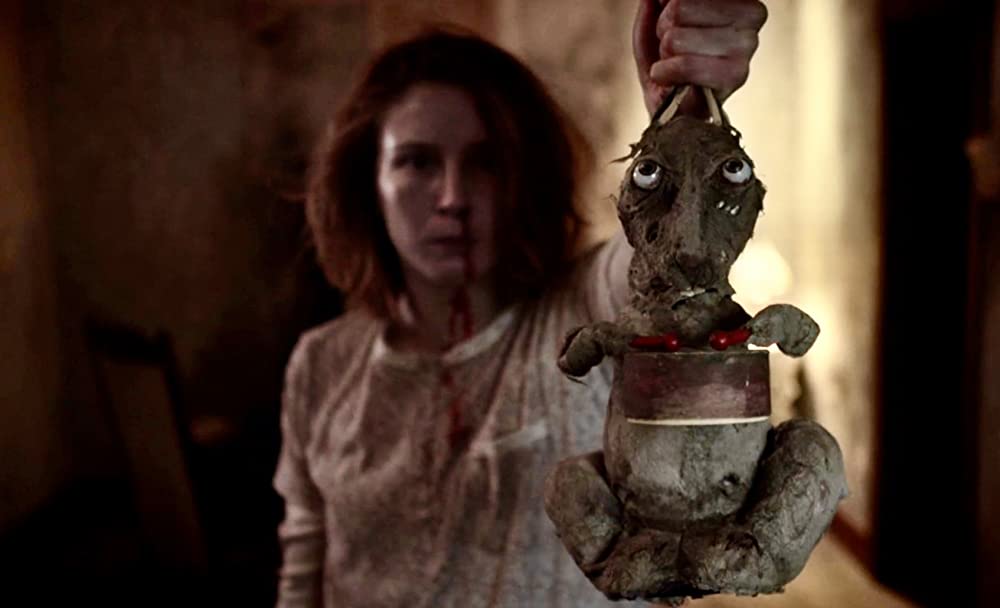
The room is dark, decrepit. A wild-eyed woman with a bloody nose holds a toy out in front of her like a demon slayer holds a crucifix. The toy – what is it, a rabbit? A jackalope? – beats a creepy little drum. Faster. Slower. Hotter. Colder.

This is how writer/director Damian Mc Carthy opens Caveat and I am in.

The woman is Olga (Leila Sykes), and we’ll get back to her in a bit, but first, we’re part of a conversation between the hush-voiced Barrett (Ben Caplan) and the foggy Isaac (Jonathan French). What can we tell from the conversation? They seem to know each other, Isaac’s had some kind of an accident, Barrett needs a favor.

The favor involves Olga, that house, and a long stretch of tightly fastened, heavyweight chain.

Dude, how good is Mc Carthy at this?

An expertly woven tapestry of ambiguity, lies and misunderstanding sink the story into a fog of mystery that never lets up. Isaac’s memory can’t be trusted, but he seems like a good guy. He looks like a good guy. Surely, he is a good guy! He’s just not making good decisions right now.

French shoulders the tale, and you hate to compare anything to Guy Pearce in Memento because who can stand up to that? No one, but still, Mc Carthy and French draw on that same type of damaged innocence and unreliable narration to stretch out the mystery.

Meanwhile, the filmmaker unveils a real knack for nightmarish visuals, images that effortlessly conjure primal fears and subconscious revulsion.

Caveat is not without flaws. Once or twice (when possibly channeling Mario Bava) Mc Carthy dips into camp unintentionally. OK, twice. These moments feel out of place in the unnerving atmosphere he’s created, which makes them stand out all the more. But it’s hardly enough to sink the film.

Mc Carthy does a lot with very little, as there are very few locations and a total of three cast members—all stellar. You won’t miss the budget. Mc Carthy casts a spook house spell, rattling chains and all, and tells a pithy little survival story while he’s at it.  

South African Mayhem

Fried Barry

by Hope Madden

So, Fried Barry then.

Four years ago, South African writer/director Ryan Kruger made the 28th short film of his young career, a quick and experimental one-man meth attack starring Gary Green called Fried Barry. On the merits of Kruger’s vision for harrowing realism underlying a scifi vibe, as well as the startling central figure (Green is quite something to gaze upon), the short film made a big impact.

It’s also a single scene of a profound reaction to a drug. Not a lot to build on, and yet that’s just what Kruger does in his feature of the same name, streaming this week on Shudder.

Green returns as a Cape Town low life whose latest high is complicated due to an alien abduction.

Or is he just really, really, really high?

Kruger maintains an experimental feel, although his feature takes on more of a traditional cinematic structure. This primarily consists of Green—looking as disheveled, lean and imposing as ever—wandering wide-eyed and silent through Cape Town. Oh, the adventures he finds!

Most of them involve different women who are curiously interested in having sex with this obvious junkie. He must just smell so rank! Suspend disbelief. The movie is nuts.

It’s not entirely unique, though, as it continuously calls to mind Rolf de Heer’s notorious 1993 film Bad Boy Bubby—another Huck Finn style adventure about a man-child and the curiosities he stumbles into.

And to be honest, de Veer’s film is far more of a mind f*ck.

Fried Barry also conjures Terry Gilliam and Panos Cosmatos (top-notch purveyors of drug-fueled mayhem), and maybe even an especially high-octane Lynch. Which is to say, the film offers insanity to spare. Kruger’s episodic fever dream blends frenetic editing and a charged soundtrack into something harsher and harder than a psychedelic trip, but the film lives and dies with Green.

It isn’t as if the actor performs alone. He stumbles into and upon a slew of wild, weird and sometimes insane (literally) characters. But it’s Green you cannot take your eyes off of.

Dude is fried.

This Old House

The Banishing

by Hope Madden

Filmmaker Christopher Smith has repeatedly proven a knack for horror.

Whether he locks us up in the tunnels beneath London with Franka Potente (2004’s Creep), transports us to the Dark Ages with Sean Bean and Eddie Redmayne (2010’s Black Death), or forces us on a weekend corporate team building of death (the sublime 2006 horror comedy Severance), Smith takes an audience somewhere we probably shouldn’t go.

The Banishing drops us in rural England, just days before WWII. Marianne (Jessica Brown Findlay, Downton Abbey) and her young daughter arrive at a beautiful-if-creepy estate where Marianne’s husband Linus (John Heffernan) has just been appointed Vicar.

Naturally, the house is haunted. The Church says one thing, but this odd redhead from town (Sean Harris, the picture of subdued weirdness) whispers another.

The Banishing is really the first Smith film to walk such familiar ground. His screenplay, co-written with David Beton and Ray Bogdanovich, takes inspiration from England’s infamous Borley Rectory—allegedly the nation’s most haunted house.

The direction that inspiration leads is rarely in question. Smith trots out a lot of familiar ideas, though he does package them well. Some incredibly creepy images accompany Marianne’s deepest fears, and Smith puts horror’s beloved old mirror prop to exceedingly spooky use.

Performances are solid as well. Findlay, in particular, finds depth and genuineness in the frequently portrayed role of the woman to be deemed insane in lieu of dealing with the supernatural.

Smith sometimes crosses over effectively into the inner working of the mind, and these scenes feel freshest and most engaging. They are overwhelmed, unfortunately, with stale plot devices.

The result feels very un-Christopher Smith-like (if there is such a thing). He’s been a tough filmmaker to pinpoint because each of his movies varies so wildly from the last. The Banishing looks and feels unlike anything else he’s done. Too bad it feels so much like what everyone else has.

Undead Again

Train to Busan: Peninsula

by Hope Madden

Back in 2016, filmmaker Sang-ho Yeon made the most thrilling zombie film since 28 Days Later. Sometimes funny, sometimes shocking, always exciting and at least once a heartbreaker, Train to Busan succeeded on every front.

You can’t chalk it up to newness, either. Busan was actually a sequel to Yeon’s fascinating animated take on Korea’s zombie infestation, Seoul Station. So the guy was 2 for 2 in gripping zombie thrills.

Can he make it a hat trick?

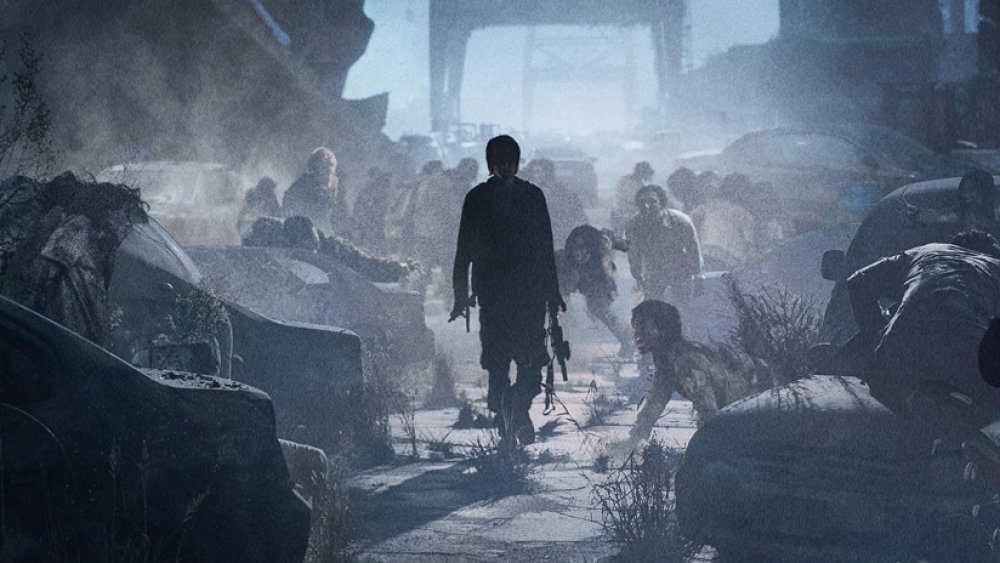
Train to Busan: Peninsula begins on that same fateful day that South Korea falls to the zombipocalypse. Those fleeing Korea by ship are turned around for fear of global contamination, so all survivors descend upon Hong Kong. Four years later, the city’s overrun, survivors are living in poverty, and a rag tag bunch is so desperate, they’re willing to go back to the Korean peninsula to pull a job that will make them rich.

But if Hong Kong looks bad, wait til they see what’s happened since they left the peninsula.

Things feel much more borrowed this time around. Peninsula plays like a mash up of Friedkin’s 1977 adventure Sorcerer (or Clouzot’s 1953 Wages of Fear) and the 4th in George Romero’s line of zombie adventures, 2005’s Land of the Dead. There’s also a little Dawn of the Dead, plus one scene lifted wholesale from 28 Days Later. And you cannot miss a great deal of a great number of Mad Max flicks.

Both the claustrophobia and the relentless forward momentum of the 2016 film are gone, replaced with tactical maneuvering around a fairly stagey looking city scape and military compound. And while you have to believe Yeon had a bigger budget to work with based on the success of his previous effort, Peninsula’s zombie effects are weaker here.

That’s not to say the film is bad, just a letdown. Dong-Won Gang makes for a serviceable quietly haunted hero. Scrappy Re Lee and adorable Ye-Won Lee infuse the film with vibrance and fun, and both Gyo-hwan Koo and Min-Jae Kim create respectably reprehensible villains. (Although the high water mark in zombie villainy was reached with Train to Busan.)

The story is tight, if highly borrowed, and the action scenes are plentiful. Compare it with nearly every other zombie film to come out in the last two decades and it’s a creepy way to spend a couple of hours. Compare it to Yeon’s last two movies, though, and it comes up lacking.  

Enter at Your Own Risk

Wrong Turn

by Hope Madden

Writer/director Mark P. Nelson is kind of fixated on the social rifts in America.

His 2018 film Domestics followed the aftermath of an apocalypse intentionally deployed by a ruling class looking to thin the herd. The smaller herds only fracture into groups of radicalized, violent maniacs, though, and even your white bread nuclear family types are threatened.

Which is to say, this filmmaker brings a different perspective to the inbred cannibal franchise, Wrong Turn.

Yes, big city liberals on a hiking trip run afoul of Virginia rednecks. But where Nelson varies from the script of the 2003 original is in reimagining the antagonists.

We know there’s trouble afoot from the opening scene when Matthew Modine drives into the quaint Virginia town looking for his character Scott’s missing daughter (Charlotte Vega). The lovely blonde was last seen here, along with her African American boyfriend, another heterosexual couple, and a gay couple, one of whom is Muslim.

Because apparently not one of these people has ever seen a horror movie.

The film gets into trouble early by conjuring moments from Tucker and Dale vs Evil, which is a great movie. It’s an insightful lampooning of movies just like the one Nelson is trying to make, though.

Nelson’s more successful when he borrows a bit from the likes of Green Room and The Ritual, although he plants Wrong Turn’s folkloric barbarism firmly on American soil. This is a film about America.

If you’re looking for a movie about cannibal families, you will most definitely be disappointed.

The horror is less unseemly, all of it in support of Nelson’s image of a divided America. There are some startling moments of gore, and other more harrowing ideas that suit the picture well.

Nelson takes too long getting to the point, unfortunately. The film runs just under two hours, which is at least 20 minutes too long. A trimmer runtime might have helped the film leave more of a mark. Instead, Wrong Turn is a decent if unremarkable backwoods thriller.

https://www.youtube.com/watch?v=fkoCo1bpNRs

Fjords of Forgettable

Sacrifice

by Brandon Thomas

If we’ve learned anything from horror cinema over the decades, it’s that Europe is a scary place and to avoid it at all costs. Werewolves on the moors, rage zombies, predatory hostels – just go to Myrtle Beach again and try your luck with the drunk rednecks. And now, with Sacrifice, co-writers/co-directors Andy Collier and Toor Mian give us a taste of the unsavory side of Norway.

Isaac (Ludovic Hughes) and Emma (Sophie Stevens) return to Isaac’s birthplace on a remote Norwegian island to claim his inheritance. Unknown family truths bubble to the surface as Isaac confronts a dark legacy and Emma fears not only for her husband’s sanity but for the life of her unborn child. 

Sacrifice is a frustrating film from the start. The basic “fish out of water” premise is one we’ve seen time and time again, and Sacrifice offers nothing new to this subgenre. The opening credits promise a story built around the works of H.P. Lovecraft, but the closest we get to Lovecraft is unsubtle nods to Cthulhu.

Subtlety in horror certainly has its place. There are countless horror movies that take a more methodical approach to dole out the scares. These movies eventually pay off, though. Sacrifice is a film that tries to build tension and atmosphere, but whiffs at every opportunity. Semi-odd behavior from backwoods Norwegian folk isn’t exactly edge-of-your-seat material. And I would be ashamed of myself if I didn’t mention how the film uses the tried and true “character wakes up from a nightmare that seemed real” device a grand total of four times. 

At this point, I was hoping the movie was a dream.

So much of the films’s tension is built around the unraveling of Isaac and Emma’s relationship. The problem with this is that the characters toggle between unlikable and uninteresting from the get-go. Isaac’s descent into madness never once borders on tragedy. Instead, this turn feels like the filmmaker’s checking off a box on their genre bingo card. 

Even the illustrious Barbara Crampton (Re-Animator, From Beyond) doesn’t come out unscathed. It’s a role that asks her to do little more than be a suspicious local and deliver an uneven Norwegian accent. 

The film does get a lot out of the location shooting in Norway. The lush green fjords with their raging waterfalls inject a strong sense of place. These scenic establishing shots help set an “otherness” to the island, even if the remainder of the film does a poor job of maintaining the eerie mood. 

Sacrifice tries to set itself alongside Europe-centric horror movies like The Wicker Man and Midsommar, but instead comes off as a watered-down, and quite lazy, copy of better movies. 

Beneath Was Taken

What Lies Below

by George Wolf

Eeewww – no 16 year-old girl wants to hear about her Mom’s sexcapades with the new boyfriend!

John (Trey Tucker) is kinda hot, though, and young Liberty (Ema Horvath) has caught herself staring when he traipses around the Adirondacks lake house with his shirt off – which is often.

Mom Michelle (Mena Suvari) is 42 but has told John she’s 35 – and she’s desperate for “Libs” to keep her secret so he doesn’t run off. But John seems like he’s strangely attached to Michelle – or at least to the lake. In fact, as Libs looks closer, there’s plenty about John that’s strange.

He says he’s an “aquatic geneticist” working to preserve fresh water supplies. But man, he’s really interested in parasites, especially ones that can adapt to any host available.

Writer/director Braden R. Duemmler’s feature debut unfolds like a minor league Under the Skin. There’s simmering sexual tension here – some of it metaphorical – amid dreamlike atmospherics and a few glimpses of a creature on the hunt.

Horvath (The Mortuary Collection) is great. Her mix of teenage disgust, confusion and curiosity hits just the right pitch, as does her panicked courage when Lib has to fight for her life (and her Mom’s).

Not every logical building block is water tight, and the sci-fi/horror combo sometimes feels desperately earnest. But the creep factor in What Lies Below holds steady, with Duemmler earning some water-logged points for not copping out at the finish.

Memory Motel

Black Box

by George Wolf

Nolan (Mamoudou Athie) needs Post-It Notes to get through the day. A car crash took his wife and his memory, and the colorful little squares give Nolan useful info while his young daughter Ava (Amanda Christine) is often forced to assume a parental role.

But there is some hope…of the experimental kind.

Dr. Lillian Brooks (Phylicia Rashad) thinks she can help Nolan regain his memory and reclaim his life through her “black box” therapy. Worn like a high-tech VR headset, it allows the patient to wander through their own subconscious, re-living past experiences until they manifest in the conscious world.

Wow, that’s amazing! What could go wrong?

Director and co-writer Emmanuel Osei-Kuffour anchors his feature debut with some recognizable inspirations, crafting another sci-fi ode to identity that flirts with horror tropes while struggling to find a unique voice.

Athie (The Get Down, Underwater) carries the load here with admirable range. The Nolan we come to know early on is not one found in his own subconscious. And as Nolan comes to fear that he is not the man he thought he was, Athie deftly balances the dual roles fighting for control.

And memories aren’t the only area full of mystery. Nolan’s friend Gary (Tosin Morohunfola), a Dr. himself, follows some suspicions to uncover disturbing information about the night of his buddy’s tragic car accident.

The note-posting and body-writing may totally recall Memento, but Black Box also swims in waters populated by iconic J-horror visuals and a touch of Get Out‘s “sunken place.”

The wonders of technology can hide a dark, malevolent side, and we can lose ourselves believing we are always in control.

It’s not a new idea, and Black Box doesn’t blaze any new trails revisiting it. But it is committed to the viability of the journey, and finds its greatest success in engagement rather than surprise.